

In this week’s gardening update, I’m mainly going to focus on a plant that was supposed to be a melon but is looking more like a pumpkin with each passing day. Additionally, I’ll go over some of the harvesting that we’ve done as well as what we’re seeing in the garden. Let’s dive in.
Is It a Melon or a Pumpkin?
One look at this picture, and it’s obviously a pumpkin, right? That’s what we’re thinking now too. The skin is giving off serious pumpkin vibes, and the stem is thick and curved much like a pumpkin. Heck, even the leaves look like pumpkin leaves. And I expect that by early September it should begin to turn orange. So why did we think it was a melon? The answer is simple: we didn’t plant any pumpkins in this bed this year. In this section of the bed, we planted three varieties of melons, and for most of the plant’s life, I thought it was a melon plant. I obviously wasn’t paying attention to the leaf shape, which looks nothing like a melon leaf. This begs the question of how do we have a pumpkin when we didn’t plant pumpkin seeds?
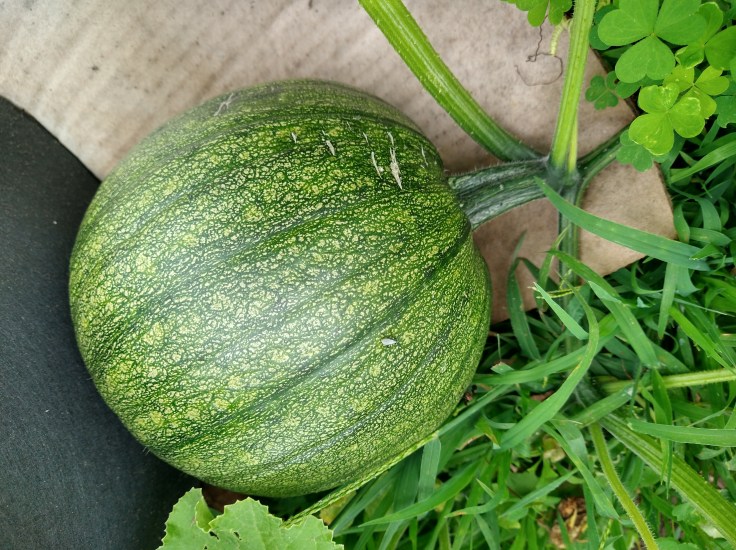
I think there are only two possibilities. One is that the envelope of Cream of Saskatchewan melon seeds we received actually had pumpkin seeds in it. I don’t think this is the case because I believe I would have noticed if the seeds looked like pumpkin seeds rather than watermelon seeds. Also, in this same row, we have several melon plants growing, so I’m confident we received and planted the proper seeds.
The other possibility is that this seed was left on the ground from last year and grew this spring. I’m confident this is what happened. We grew pumpkins in this bed last year, including a New England Sugar Pie variety, which is what this pumpkin looks like. There were a couple of pumpkins that deer started to eat, allowing seeds to fall on the ground. Then, this spring, I likely tilled them into the soil when I was turning it over, allowing this seed to germinate and grow. It’s similar to the rogue tomato plants we have in this same bed. Those are also growing well. I’m getting a kick out of how this happens, and we’re pretty happy with this pumpkin plant since the plants we’re intentionally growing aren’t doing all that well.
Squash, Beans, and First Tomato
We’re continuing to harvest summer squash, with the yellow crooknecks being ready to pick. We’ve also been picking more Costata Romanesca and Lebanese White Bush and have learned the importance of consistent watering and waiting until the vegetables are fully ripe before picking. One of our Costata Romanescas was firm for about 75 percent of its length before tapering to a soft section in the last 2 inches. We picked two Lebanese White Bushes. One was white and the other was a pale green. We learned that they need to be white before picking because it indicates full ripeness. We’re also starting to see the first patty pan squashes growing on the plants. Last year, these were our favorite summer squash to eat, so we’re really excited to be able to eat them again soon.
One thing I can’t figure out is why our winter squash have done nothing. We planted a couple varieties with multiple plants of each variety. Some of the plants have completely died off, while others haven’t taken off, and we haven’t seen any fruit development. It’s a similar story with our intentionally planted pumpkins. I’m unsure if this is the result of the intense heat wave we had in June or something else, but last year, our winter squash grew very well.
We continue to have an excellent year for beans. We’re picking a batch of them every couple of days and have been enjoying eating our fresh snap and wax beans. We’re also seeing pods on our shelling beans, which is really exciting.

Finally, we harvested our first tomato last night. It was a cherry tomato was delicious. Our tomatoes have been kind of weird this year. The plants took off after being transplanted into the garden, but inconsistent watering, weed issues, and uneven temperatures led to some issues. At one point, it looked like most plants were going to die, but that’s no longer the case. There are a lot of tomatoes growing and starting to turn red, but the leaves are still brown and don’t look healthy. I’m choosing to focus on the positives in that we’re going to be able to harvest tomatoes from plants that don’t look great while thinking about ways to improve next year.
Cucumber Bitterness
One of the most disappointing vegetables this year has been our cucumbers. Like our tomatoes, the plants took off after being transplanted, but a combination of not remembering how far the Bushy variety spreads and not being able to see the vegetables below the leaves has made it difficult to pick the cucumbers at the ideal size. And the flavor of these cucumbers has been hit and miss. Some have been amazing and similar to the freshest-tasting cucumbers I’ve ever eaten. Others, though, have been bitter and not pleasant to eat. This was due to the heat wave we had in June since cucumbers are apparently very heat-sensitive and respond to it by developing thicker skins, which causes bitterness. We may take a year off from growing cucumbers next year because they’re a bit finicky and annoying to grow. But when we do grow them again, I want to find a variety that is less heat-sensitive because we tend to get one weeklong heatwave each summer.
Up Next
Do you have any experience with cucumbers being bitter? If so, do you have any tips for addressing the issue at this point in the summer?
 One Rabbit Riot
Leave a comment