Weekly Garden Update #7 – Melon or Pumpkin?

In this week’s gardening update, I’m mainly going to focus on a plant that was supposed to be a melon but is looking more like a pumpkin with each passing day. Additionally, I’ll go over some of the harvesting that we’ve done as well as what we’re seeing in the garden. Let’s dive in.

Is It a Melon or a Pumpkin?

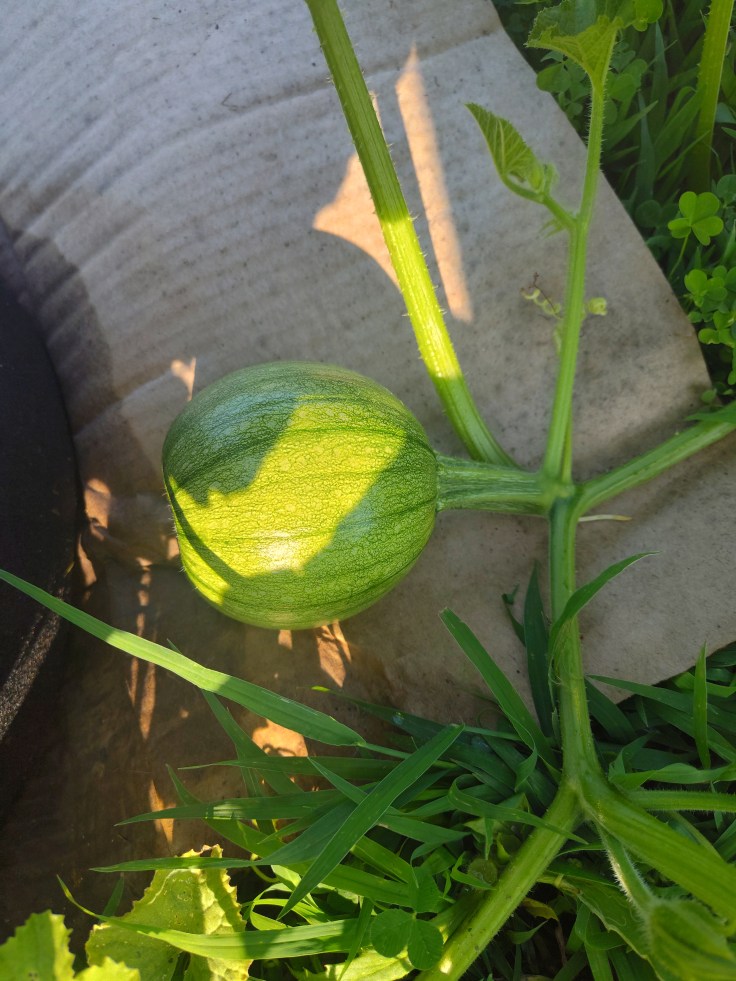
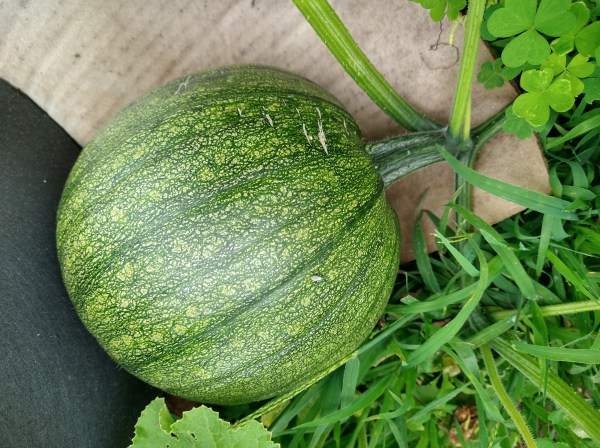
One look at this picture, and it’s obviously a pumpkin, right? That’s what we’re thinking now too. The skin is giving off serious pumpkin vibes, and the stem is thick and curved much like a pumpkin. Heck, even the leaves look like pumpkin leaves. And I expect that by early September it should begin to turn orange. So why did we think it was a melon? The answer is simple: we didn’t plant any pumpkins in this bed this year. In this section of the bed, we planted three varieties of melons, and for most of the plant’s life, I thought it was a melon plant. I obviously wasn’t paying attention to the leaf shape, which looks nothing like a melon leaf. This begs the question of how do we have a pumpkin when we didn’t plant pumpkin seeds?
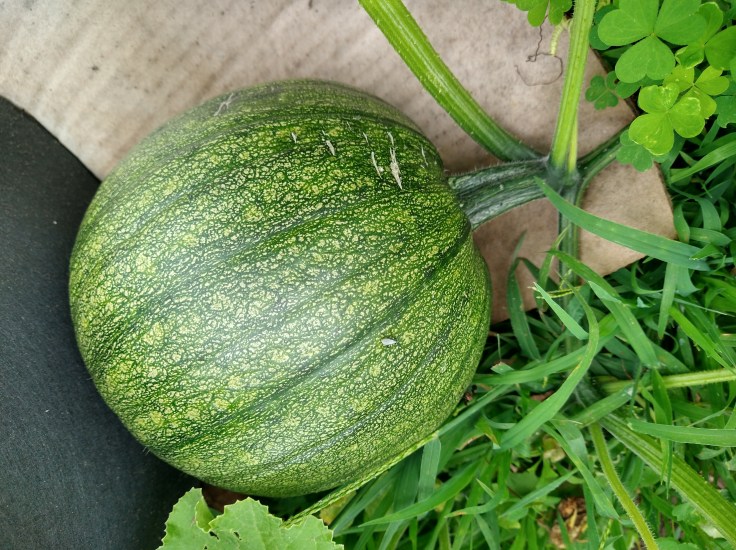
Pumpkin
This pumpkin started out as a melon, or so we thought.

I think there are only two possibilities. One is that the envelope of Cream of Saskatchewan melon seeds we received actually had pumpkin seeds in it. I don’t think this is the case because I believe I would have noticed if the seeds looked like pumpkin seeds rather than watermelon seeds. Also, in this same row, we have several melon plants growing, so I’m confident we received and planted the proper seeds.

The other possibility is that this seed was left on the ground from last year and grew this spring. I’m confident this is what happened. We grew pumpkins in this bed last year, including a New England Sugar Pie variety, which is what this pumpkin looks like. There were a couple of pumpkins that deer started to eat, allowing seeds to fall on the ground. Then, this spring, I likely tilled them into the soil when I was turning it over, allowing this seed to germinate and grow. It’s similar to the rogue tomato plants we have in this same bed. Those are also growing well. I’m getting a kick out of how this happens, and we’re pretty happy with this pumpkin plant since the plants we’re intentionally growing aren’t doing all that well.

Squash, Beans, and First Tomato

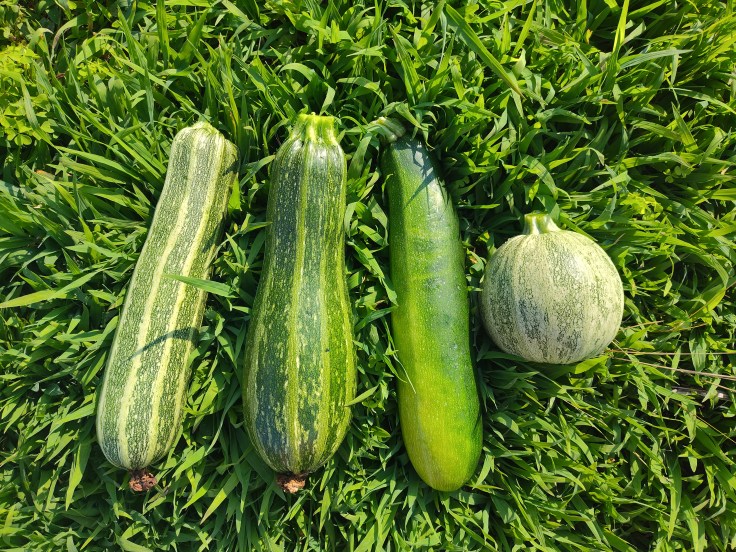
We’re continuing to harvest summer squash, with the yellow crooknecks being ready to pick. We’ve also been picking more Costata Romanesca and Lebanese White Bush and have learned the importance of consistent watering and waiting until the vegetables are fully ripe before picking. One of our Costata Romanescas was firm for about 75 percent of its length before tapering to a soft section in the last 2 inches. We picked two Lebanese White Bushes. One was white and the other was a pale green. We learned that they need to be white before picking because it indicates full ripeness. We’re also starting to see the first patty pan squashes growing on the plants. Last year, these were our favorite summer squash to eat, so we’re really excited to be able to eat them again soon.

One thing I can’t figure out is why our winter squash have done nothing. We planted a couple varieties with multiple plants of each variety. Some of the plants have completely died off, while others haven’t taken off, and we haven’t seen any fruit development. It’s a similar story with our intentionally planted pumpkins. I’m unsure if this is the result of the intense heat wave we had in June or something else, but last year, our winter squash grew very well.

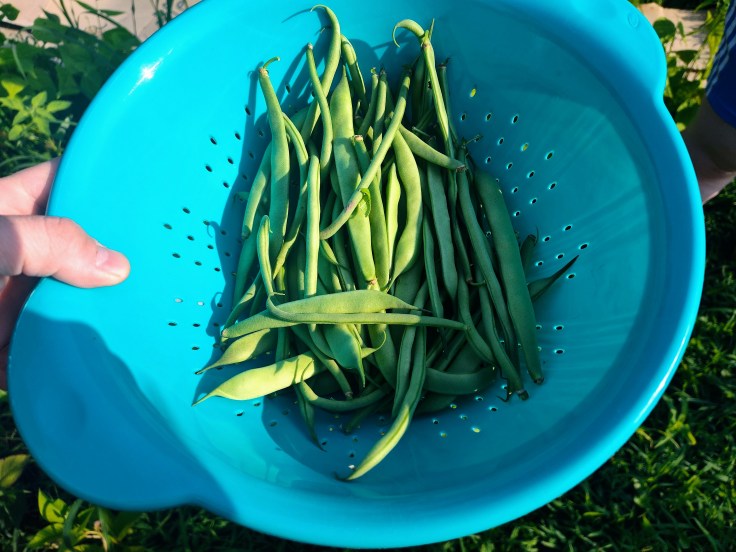
We continue to have an excellent year for beans. We’re picking a batch of them every couple of days and have been enjoying eating our fresh snap and wax beans. We’re also seeing pods on our shelling beans, which is really exciting.

Cherokee Wax, Blue Lake Bush, Iroquois Skunk Pole
Cherokee Wax, Blue Lake Bush, Iroquois Skunk Pole Beans

Finally, we harvested our first tomato last night. It was a cherry tomato was delicious. Our tomatoes have been kind of weird this year. The plants took off after being transplanted into the garden, but inconsistent watering, weed issues, and uneven temperatures led to some issues. At one point, it looked like most plants were going to die, but that’s no longer the case. There are a lot of tomatoes growing and starting to turn red, but the leaves are still brown and don’t look healthy. I’m choosing to focus on the positives in that we’re going to be able to harvest tomatoes from plants that don’t look great while thinking about ways to improve next year.

Cucumber Bitterness

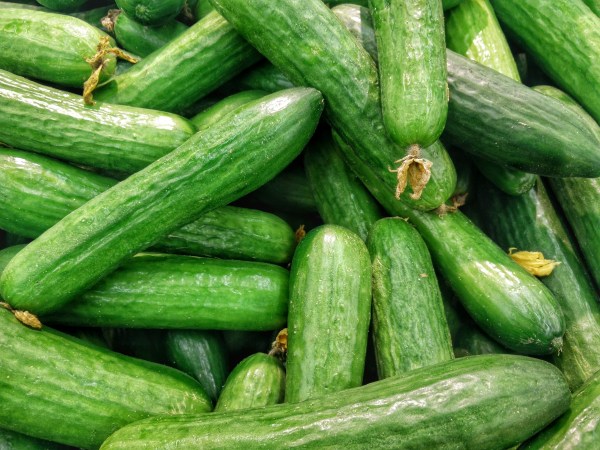
One of the most disappointing vegetables this year has been our cucumbers. Like our tomatoes, the plants took off after being transplanted, but a combination of not remembering how far the Bushy variety spreads and not being able to see the vegetables below the leaves has made it difficult to pick the cucumbers at the ideal size. And the flavor of these cucumbers has been hit and miss. Some have been amazing and similar to the freshest-tasting cucumbers I’ve ever eaten. Others, though, have been bitter and not pleasant to eat. This was due to the heat wave we had in June since cucumbers are apparently very heat-sensitive and respond to it by developing thicker skins, which causes bitterness. We may take a year off from growing cucumbers next year because they’re a bit finicky and annoying to grow. But when we do grow them again, I want to find a variety that is less heat-sensitive because we tend to get one weeklong heatwave each summer.

Up Next

Do you have any experience with cucumbers being bitter? If so, do you have any tips for addressing the issue at this point in the summer?
Weekly Garden Update #6 – Cucumbers, Zucchini, Corn Growth & More

In this week’s update, we finally harvested our first cucumbers from this year’s garden. We also picked more zucchini, our corn is producing ears, our melons are showing major growth, we harvested a bunch of beans, and more. Let’s dive in!

First Cucumber Harvest

Until last week, our cucumber plants were perplexing. As a refresher, we’re growing a variety called Bushy, which originally came from Russia and does well in cool climates. I started them from seeds and transplanted 4 plants into the garden, with 3 of them surviving. What has confused me about this cucumber is that the name Bushy implies a contained plant that doesn’t sprawl out. That hasn’t been the case, as the plants have vined out feet from the roots. Yesterday, I revisited the seed listing, and this variety still produces 5-foot vines, so they’re growing as expected.

Bushy Cucumbers, cucumbers
Cucumber Harvest

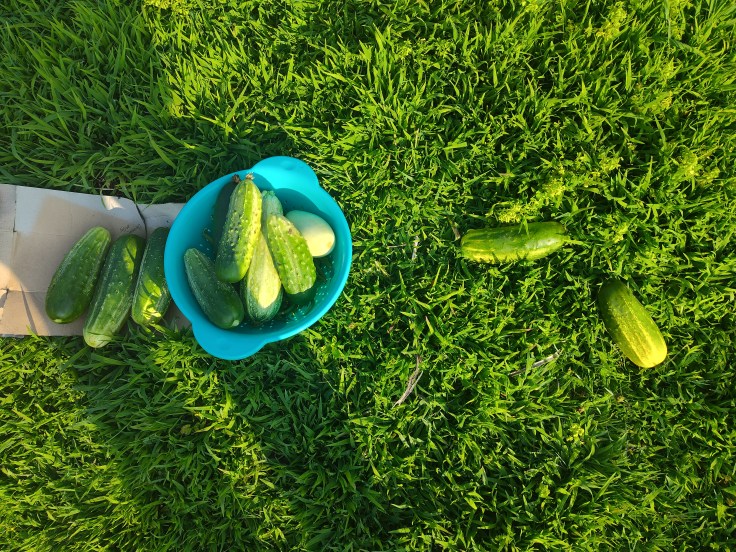
The other thing that’s perplexed me about them is how long they’re taking to grow. It felt like this year’s cucumbers (and other vegetables) were taking longer to mature than last year’s garden; however, looking at my weekly blog entries from last year, I learned that we didn’t pick our first cucumbers until the second week of July. So, at most, we’re a week late, which is almost entirely the result of the weather. The craziest part is that on Wednesday of last week, our cucumbers were only 3 or 4 inches long, but by Sunday evening, we picked 6 that were 7 to 8 inches long, with 2 of them being overripe. Magz cut 2 of the cucumbers into chunks, and we ate them raw with dinner. The Bushy cucumber is a very tasty variety that is firm enough to hold up to brining for pickles but still tender enough to be eaten fresh.

Experiencing New Summer Squash Varieties

In last week’s update, I wrote about our first zucchini harvest for the year, which was a Costata Romanesca. Since then, we’ve picked 4 or 5 more of them as well as 3 or 4 Lebanese White Bush, 2 Ronde de Nice, and 1 Black Beauty. The Lebanese White Bush is an heirloom variety that produces 4-to-5-inch squashes that are light green in color. The Ronde de Nice is a French heirloom that has an acorn shape but is a summer squash. It can be dark or light green and is typically picked at 4 inches in diameter. The Black Beauty is the dark green zucchini that comes to mind for most people when they think of a zucchini. It has a smooth skin with an even color, and we pick ours when they’re 8 to 10 inches in length.

Costata Romanesca, Black Beauty, Ronde de Nice, zucchini
Costata Romanesca, Black Beauty, and Ronde de Nice summer squash

We’ve eaten at least one of each variety except for the Black Beauty, and all are delicious. My dad and stepmom visited us this past weekend, and we were able to send them home with some Costata Romanesca, Ronde de Nice, and Lebanese White Bush. My dad messaged me yesterday and said that they fried the Ronde de Nice and loved it. In a future blog post, I’ll review each variety and detail the flavors.

Corn Tassels and Ears

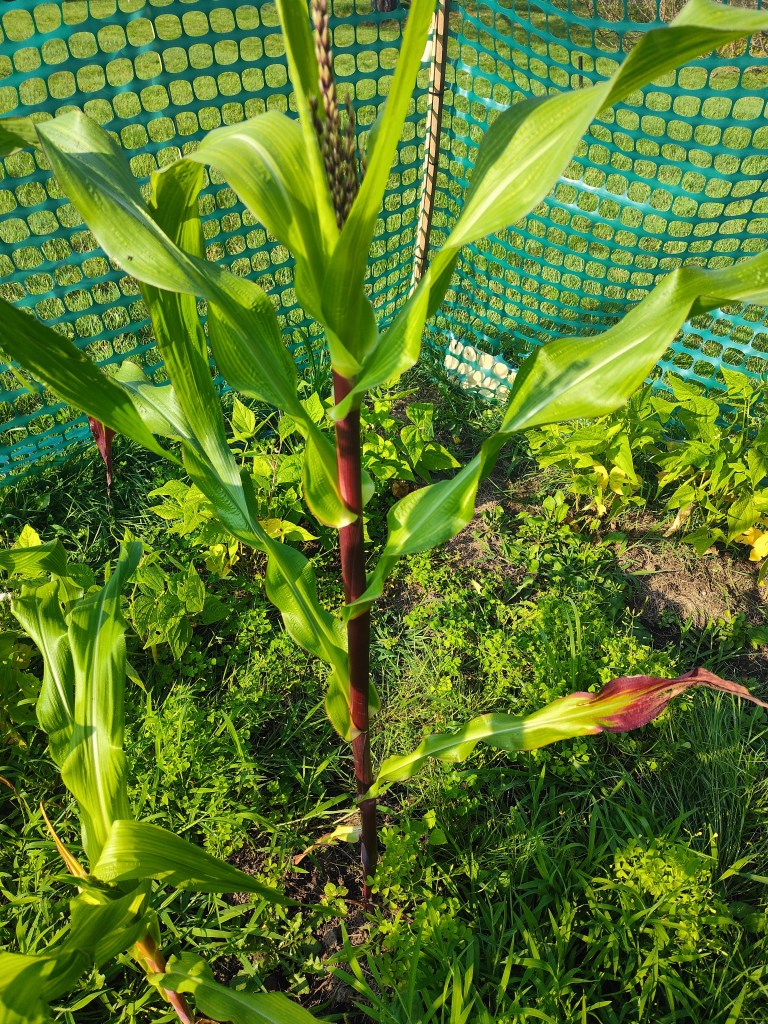
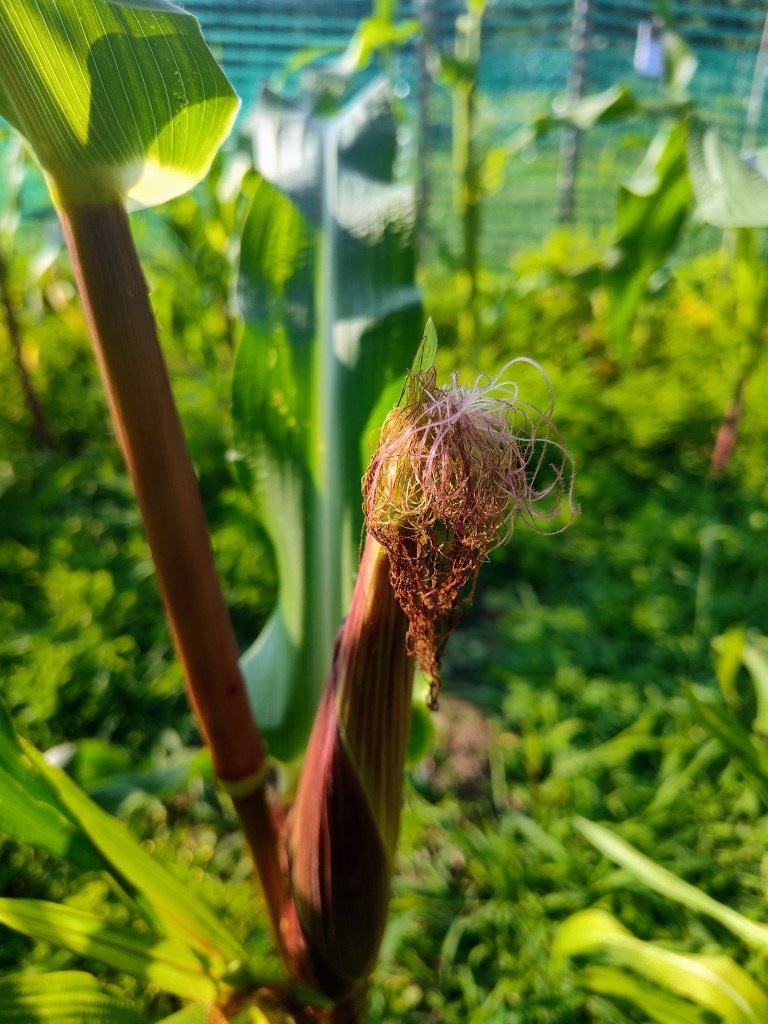
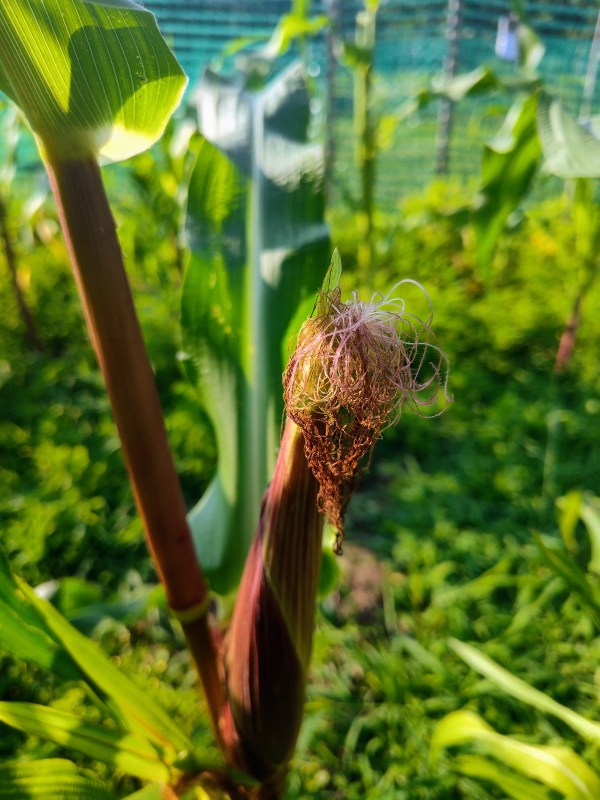
Our corn has really taken off over the past week. Our Painted Mountain corn has the most beautiful reddish-purple stalk, and even the tassels and silk have a purple tinge to them. They’re almost 6 feet tall and have ears developing. Meanwhile, our Sweet Mexican corn is approaching 7 feet tall, and the tassels are starting to appear. Nearly every day, we go out to the garden to tap the stalks to help germinate the ears.

A Bean Harvest

On Sunday, we had the joy of being able to harvest a full dinner’s worth of beans. We grew beans last year and were able to eat some, but they didn’t grow well, and we never had enough ripen at once to have as a meal. This year, conditions seem to be perfect for growing them, because we’re having a ton of success. We picked Beurre De Rocquencourt and Maxibel Haricot Vert, yielding a quart in total. Magz steamed them, melted butter over them, and added a pinch of Kosher salt and black pepper.

Beans, Maxibel Haricot Vert bean, Beurre de Rocquen bean
First bean harvest of 2026.

Even though we ate the two varieties together, you could taste a difference between the two beans, which I love. Yesterday, that harvest was followed up with another quart of beans, with Cherokee Wax beans comprising the bulk of the haul.

A Grab Bag of Topics – Potatoes, Peppers, Flax & More

Our potatoes continue to do well with the exception of one bag of Adirondack Blues. For some reason, that bag never took off, and on Saturday, I noticed that the plant that had been growing in it died. It’s not a big deal since we have 19 other bags that are doing well, and we’re going to use that bag to transplant a couple of the Gochugaru pepper plants I started late. In other pepper news, one of our habanero plants is producing fruit. It currently has 3 or 4 small peppers on it, each about 2 inches long.

Our flax and sunflowers are looking great. The flax plants are about 2 feet tall and have a lovely light purple flower on top. Not knowing how they grow or what to expect from them has made the process of growing them all the more fun. What we didn’t realize is how much flax you need to grow in order to turn it into a sizable amount of yarn/thread. We thought that growing a few rows of it would yield a decent amount, but it looks like we’ll need to grow an entire bed of it in the future. Meanwhile, our sunflowers are 4 feet tall (Mammoth variety) and 12 inches tall (Teddy Bear). The plants are looking healthy, and we’re hopeful that we’ll get heads to form on them this year and that we can prevent the squirrels from attacking them.

Lastly, we’re beginning to see progress from our melons. All 3 varieties are vining nicely and producing flowers, but the Montreal Market and Pride of Wisconsin are stealing the show. Both have fruit growing. The Montreal Market is nearly the size of a softball, while the Pride of Wisconsin is close to tennis ball size. Happy Gardening!

Montreal Market Melon, Melon
Montreal Market melon growing

A Brief History of the Cucumber

In early December, I started a series on the history of vegetables with a post on the history of the tomato. My plan was to make that a weekly or bi-weekly post; however, it’s now been more than a month since I wrote it. Holiday busyness along with the arrival of seed catalogs pushed this idea to the back burner for a bit, but I finally have some time to research and write the next installment: The history of the cucumber. Cucumbers are a very popular vegetable all around the world and play a key role in many cuisines. I knew that the cucumber was a global vegetable given the diversity of variety names that pay homage to where they originated. Boston Pickling, Armenian, and Shintokiwa are three popular varieties and point to three different parts of the globe. So, where did the cucumber originate, and how did it spread? I was shocked to learn its history and how it was transported to become a popular food item all across the world.

Foothills of the Himalayas

The modern cucumber dates back more than 3,000 years to India where it grew wild in the foothills of the Himalayan Mountains. This early predecessor to the modern cucumber was likely very bitter, which can still be found in today’s cucumbers. This bitterness works as a natural repellent against insects and pests. It started to be domesticated around 1,000 B.C., and soon, three varieties emerged: slicing (Eurasian), pickling (East Asian), and burpless.

The cucumber spread from there, moving east and west. While we don’t know exactly when the cucumber arrived in China and Japan, records show that they were present by the 10th century. We have better records for how it was transported west. Via trade routes, it made its way to Egypt, and the Old Testament book of Numbers, Moses wrote about cucumbers: “We remember the fish we ate in Egypt that cost nothing, the cucumbers, the melons, the leeks, the onions, and the garlic.” (Numbers 11:5) In Egypt, it was cultivated, as both the Greeks and Romans took a liking to it.

Greeks & Romans Brought Cultivation

We likely have the Greeks and Romans to thank for introducing the cucumber to Europe. Roman naturalist and author Pliny the Elder wrote that Emperor Tiberius ate cucumbers daily as part of his diet. The Romans also developed an artificial growing method similar to the modern greenhouse. They used sheet mica to cover the frames of the wall and roof. This allowed cucumbers to be grown and eaten all year long. At this point, cucumbers were eaten for both culinary and medicinal purposes, as it was believed that they could treat fevers, inflammation, and indigestion. Even in modern culture, cucumbers are often viewed as a dieting food due to its high water content.

In Europe

As mentioned above, the cucumber was likely introduced to Europe by the Greeks and Romans. Records show that emperor Charlemagne grew them in Italy in the 8th and 9th centuries, and we know that they were grown in France in the 9th century. The English word “cucumber” actually derives from the Latin “cucumerem,” which became “cocumbre” in Old French. Because of Charlemagne, who helps to unify Europe, the cucumber spread throughout Western Europe, and under King Henry VIII, it was first introduced to England in the 15th and 16th centuries.

Introduction to The New World

In elementary school, we learned the simple rhyme: In 1492, Columbus shared the ocean blue. It was an easy device to remember when he set sail for the New World. On that voyage, he and his sailors brought cucumbers with them, first arriving on Hispaniola in 1494. From there, it spread like many other vegetables: across the Caribbean and into North America. By 1539, Spanish explorer/conquistador Hernando de Soto identified cucumbers growing in modern-day Florida and judged them to be better than what was grown in Spain.

During the 16th century, trappers and fur traders transported them westward and used them as a bartering tool in trade with the Native Americans. This resulted in them quickly being grown throughout the Great Plains and Midwest United States. The growing popularity of cucumbers wasn’t consistent, though, and during the late-17th century, their popularity began to decline when people thought that raw vegetables were poisonous and only should be fed to farm animals. Thankfully, that erroneous opinion didn’t persist.

By 1806, eight distinct cucumber varieties existed in the United States. And later, in 1876, Henry J. Heinz, founder of the H.J. Heinz Company began making pickles commercially, and the cucumber’s popularity continued to grow. Today, cucumbers are grown commercially on every continent except Antarctica, and new varieties continue to be developed and released.

Types of Cucumbers

There are generally three types of cucumbers:

Slicing

Slicing cucumbers are ones that are typically sliced and eaten fresh. They’re crunchy with a juicy texture. Their skins are thicker, smooth, and stay uniform in color. They also tend to be longer cucumbers. Some popular varieties of slicers include Straight 8, Marketmore, Muncher, Suyo Long, and Armenian.

Pickling

Pickling cucumbers are often shorter varieties that have less uniformity in color. Their flesh is drier, which makes them perfect for pickling because it efficiently absorbs the pickling liquid. They can be cut into spears or coins, and some of the smaller varieties can even be pickled whole. Many pickling cucumbers also have a more compact growing habit than slicing varieties. Popular varieties include Boston Pickling, Homemade Pickles, National Pickling, Arkansas Little Leaf, and Bushy.

Burpless

Burpless cucumbers have been bred throughout the centuries to cause less burping than a standard cucumber. Cucumbers contain cucurbitacin, which can cause digestive issues, including burping, in humans. Burpless varieties have less cucurbitacin in them, which means fewer digestive issues. Many slicing cucumbers are burpless, but not all of them. Popular varieties include Armenian, Suyo Long, and Summer Dance.

I hope this brief history of the cucumber was informative and that you were able to learn something new. I know that I did.


Sources

Create a website or blog at WordPress.com

Up ↑