Upcycling an Ikea Chair Into a Garden Trellis

In 2021, we bought a pair of Ikea Poang chairs. They’re pretty iconic and are what many people envision when they think about Ikea chairs. We used to sit in them every time we would shop at Ikea and dream of buying them when it made sense. That time came in 2021, and at first, we loved them. However, over time, they lost their luster. They were really low to the ground, making them hard to get out of, and they were narrow, so it was difficult to work on a computer or do anything with your hands, like cross-stitch or knit.

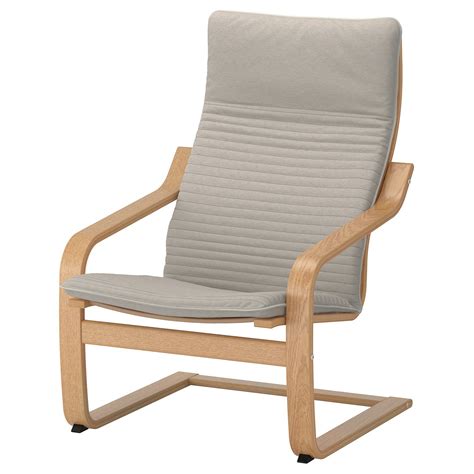
Ikea Poang chair
Ikea Poang chair

After moving in 2024, we decided that these would become outdoor chairs on our porch. Although the chairs weren’t designed to be outdoors, the wood can be treated to resist the weather, and the cushions were brought inside at night. They worked decently well on the porch; however, the same design flaws persisted: too narrow and low. When we built our table and stools, we no longer had a need for the Ikea chairs since the stools are primarily where we sit. And when we want something more “loungey” or have people visiting, we have folding chairs that recline flat. When not in use, they can be folded and stored away, taking up less space than the Ikea chairs. That left us with a decision to be made about the Ikea chairs.

We aren’t people to throw things away unnecessarily, and we didn’t want to donate these chairs because they sat outside for nearly a year. Throughout the entire process, Magz had the idea of trying to use these chairs in our garden. We talked about simply setting a planter where the seat would be and letting nature take over them, as well as cutting out the seat support and growing a plant up from the ground through the chair. Eventually, I had the idea of using the back of the chair as a trellis system. You can’t see it in the above picture, but behind the cushion are two vertical pieces with several horizontal pieces between them, creating a ladder system. That’s essentially what a trellis is anyway. So, with that in mind, I set out to make it all happen.

Disassembly, Design, and Construction

If you’ve ever put together a piece of Ikea furniture, you know that they are all pretty similar. All of the individual wooden (or wood-adjacent) pieces are connected with screws, bolts, or barrel nuts (I had to look up what they’re called). Although assembly can be overly complicated, once you’ve put one piece of Ikea furniture together, you have an idea of how everything goes together. And while durability and longevity aren’t Ikea’s strong points, thankfully, it was a bonus in this case, because as easily as the chairs went together, they came apart.

With the pieces separated, we were left with two cross pieces, the back section that will be used for the trellis, two seat support pieces, and the two large side pieces that comprise the arms and bottoms for each chair. There was a seat section for each chair that was incredibly difficult to pull the staples from. We ended up getting rid of that piece. The back of each chair was the original inspiration for this project, but as I took the chairs apart, I could see ways to use the remaining pieces. The sides can either be cut down for individual lengths of wood or can be transformed into a planter stand. Meanwhile, the cross pieces will be used to build additional planters or in another woodworking project in the future. I typically don’t throw anything away if there’s a possibility that it can be used again.

Ikea Poang, Upcycling, Garden Planter
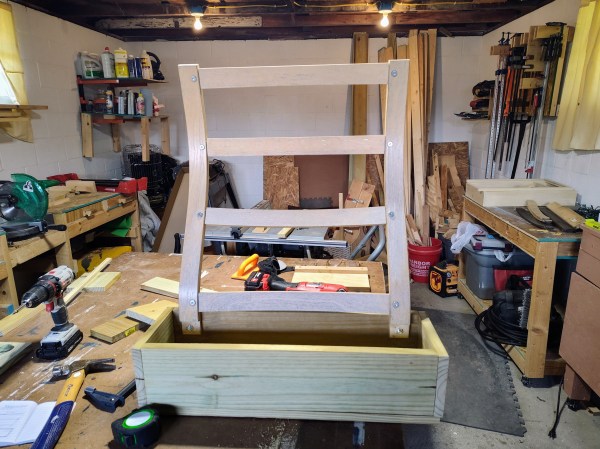
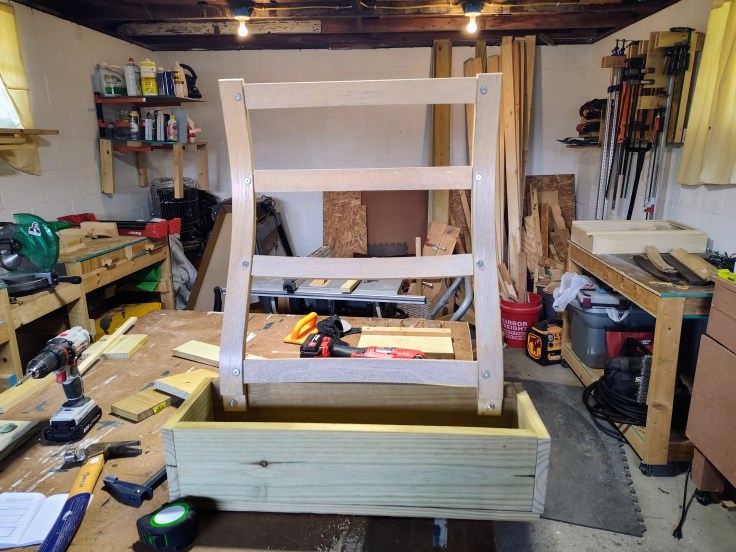
The first upcycle Ikea Poang chair into a garden planter.

Designing the planters for the back pieces was straightforward. I measured the width of them, added two inches, and that was the interior width of the planters. I had a bunch of leftover pressure-treated 1x6s from last year’s porch project. I kept them their full width and cut pieces to length to make the four sides of the planters. Initially, I thought I would need to have two rows of these boards so that each planter was roughly 11 inches tall. However, after attaching the sides for each planter and feeling confident that one row would provide enough dirt and be sturdy enough to not tip over, I kept the planters separate. This was great, because it meant I had two planters mostly finished when I thought I only had one planter halfway done.

With that decision made, I had to figure out the bottom. I did this by using scrap pieces and ripping full-width pieces on the table saw to cover the opening. I also added support pieces for extra attachment points. Also, a note on the connectors I used. For the most part, I used coated exterior 1 1/4-inch screws that went into pre-drilled holes to reduce the likelihood of the wood splitting. This mostly worked; however, there were times when I used exterior brad nails for efficiency and simplicity. I also used outdoor-rated wood glue to hold everything together. I’m confident that these planters are built well and should stay together for the foreseeable future.

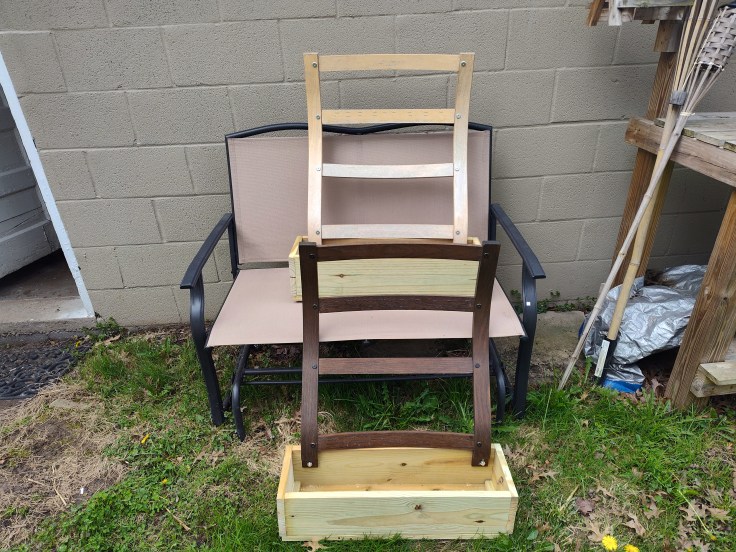
Next up was the most complicated part: attaching the back piece to the planter. On the chair, this piece connected to a cross member with a short bolt that screwed into an enclosed nut that was pressed into the back side of the piece. There was no way to reuse this setup with the planter since the bolt was too short. Instead, I determined that a 3/8-inch bolt would go through the existing hole. I managed to clamp the back piece to the planter in order to drill a small pilot hole through the plant. I then drilled that hole out with a bigger bit and ran a zinc-coated bolt through everything and tightened it down with a nut. With both sides connected, I added a screw through both pieces on each side to make sure everything is secure. And with that, it was all done.

Ikea Poang, Upcycling, Garden Planter
Both upcycled Ikea Poang chair trellis planters.

In total, I think each planter took about two hours, and it was pretty easy to bring this idea to fruition. I’m also very proud of our ability to reuse and upcycle something that a lot of people would have thrown away. I’m really excited to plant in these this year and see how beans or cucumbers will climb the trellis system. I’ll definitely follow up with other posts about how we reuse the other pieces (if they’re used in a garden-related project) as well as how successful these planters are. If you’re interested in doing something like this, don’t be afraid to take a chance and upcycle something into a planter for your garden. It’s a lot of fun and gives your garden extra character.

Building a Patio Table & Stools From Wood

Last year, Magz and I screened in our back porch. It’s an elevated concrete slab that had railings on all three sides except for where the steps are located. We removed the railings, strengthened the posts that hold up the roof, and screened in the three sides. We closed in the two ends so that the screen goes from waist height to the roof for privacy, while the back has floor-to-ceiling screens with French doors where the steps are located. The project was a success in the sense that we had more privacy with plenty of airflow and some protection from the elements, including rain. It also reduced the number of bugs, bees, and flies that we have to deal with, but we still didn’t use the porch as much as we thought we would.

That was largely due to the outdoor furniture that we had. The only option we had that was designed to be outdoors was a narrow glider we bought from Aldi a few years ago. And although it’s comfortable for one person, it’s quite narrow and isn’t comfortable for two people to share. We also repurposed two Ikea Poang chairs that we had previously used inside but no longer had a need for. Although they weren’t intended to be used outdoors, they held up since they weren’t directly exposed to the elements. While these chairs worked, they aren’t the most comfortable, especially if you want to do anything with your hands while sitting in them, like typing, cross-stitching, or knitting. This led to us deciding that we wanted something different, and since I really enjoy building things and hate spending money unnecessarily, we designed and built our alternatives.

The Design

Building outdoor furniture is something I’ve wanted to do for a long time. Outdoor tables, benches, chairs, and swings are projects that call to me, but I didn’t have anything designed or planned. So, on a lovely Saturday in February, Magz mentioned that she’d like to figure out our outdoor furniture before the weather was really nice and we wanted to be on the porch. Quickly, we came up with a design.

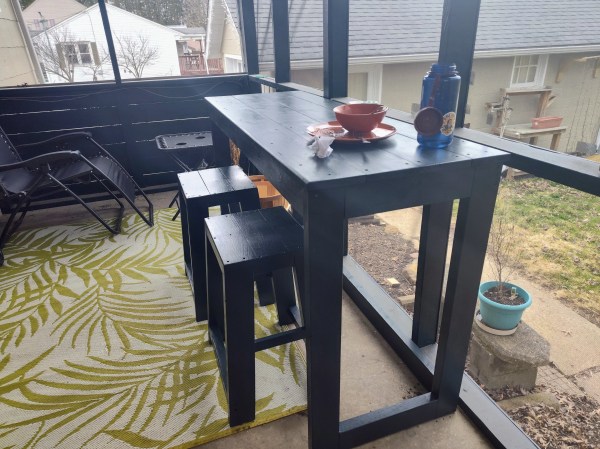
For the table, we wanted something wide enough for us both to sit at it and deep enough that we could play board games or work at it. We also wanted something higher than a coffee table. For the seats, we discussed one long bench versus two individual stools, ultimately choosing the two stools. The freedom for each of us to choose how close or far we sit to the table was important, and having sat at the table multiple times now, it was the right decision.

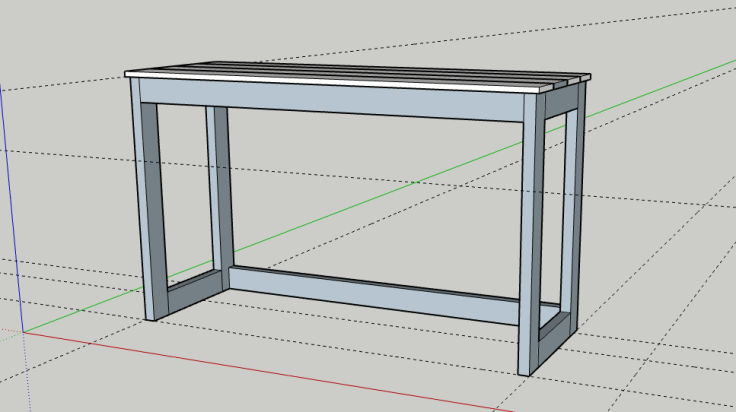
We were going for something simple and durable. We were fine with it being made of dimensional lumber to make the building process as straightforward as possible. As much as I love building fine woodworking projects, when it comes to outdoor furniture, using dimensional lumber that is designed for strength is often the right move. Here is the design I came up with:

Outdoor table, woodworking
Outdoor table design

When it came to materials, my initial thought was to buy pressure-treated lumber. It would be great to buy cedar, teak, or composite to build this type of furniture, but those are all very expensive. Plus, cedar and teak will eventually break down over time and need maintenance, and composite lumber requires specific saw blades designed to cut it. All three types are also really difficult to find where we live. I love watching old New Yankee Workshop episodes and think that Norm Abram is an excellent woodworker and craftsman, but one of the least relatable elements of the show is his ability to get exotic wood species or high-end cabinet-grade plywood locally. Finding those in store would require at least an hour’s drive, which isn’t worth it most of the time.

Meanwhile, pressure-treated lumber is readily available; however, it isn’t cheap in our town. We don’t have a local Home Depot or Lowe’s, so we rely on regional franchises for lumber and building supplies if we don’t want to leave town. One of the local stores, 84 Lumber, (the same store we bought our materials to screen in the porch) was charging $2 more per 2×4 than Home Depot and $1 more than the other local store, Busy Beaver. 84 Lumber also stores most of their lumber outside, so running it through a saw isn’t a pleasant experience. Even at Busy Beaver, the pressure-treated 2x4s were more than $1 more than kiln-dried pine 2x4s, which led me to begin considering pine as an alternative.

Pressure-treated lumber has its advantages, with the biggest being that it’s designed to withstand the elements. However, it also has its disadvantages. It can be quite expensive, is heavy and often damp, and it will destroy saw blades. Meanwhile, pine can be a great alternative. It’s cheaper, for one. It’s also pretty light since it should be kiln-dried, so it’s easier to maneuver, and it’s easy to cut. And while it doesn’t have the weather protection of pressure-treated lumber, it can be coated with finish or exterior paint and will do well outside. It will need recoated, and it’s best to not let it directly touch the ground, but it can last a long time. Combining all of those together, we decided on buying regular pine. In total, I think we bought 16 8-foot 2x4s and 5 8-foot 1x6s. We also have a bunch of paint left over from the screened-in porch project, so we didn’t need to buy any. After acquiring the lumber, it was time to start cutting and assembling.

Assembly

Building the table was really easy. In 2020, I built a similarly designed table that we currently have in our kitchen. It’s quite straightforward. Working together, we measured and cut all pieces of the same length for the frame. We then pre-drilled the holes, using a pocket hole jig where normal 2 1/2-inch screws wouldn’t work. Along with the screws, we used exterior-rated wood glue to secure the joints. With the frame assembled, we moved on to the top, where once again, we measured and cut all the slats to length at the same time, ensuring consistency. Three of the slats were full 5 1/2-inch wide boards, while the fourth had to be ripped to be narrower. We allowed for a 1/2-inch overhang on the front for aesthetic purposes and roughly an 1/8-inch gap between the slats. They also weren’t glued to the frame and were only attached with screws to allow for expansion due to humidity. After cutting a round over on the front edge with my router and a quick sand, it was ready for paint.

The stools were a bit more difficult to figure out. There’s generally a standard distance between the top of a stool and the underside of a table, but we adjusted it a bit to be more comfortable for us. With that measurement, I had to work down to calculate the length of the legs. With that number, I could move to cutting, using full-width 2x4s for the legs. Quick note: I didn’t think about this, but stools are most comfortable, stable, and strong when the legs are cut on an angle. Initially, I was going to have them be perfectly straight but learned from a plan on Ana White’s website that they should be cut on a five-degree angle and bevel. Then, the rest of the pieces, including the apron and footrest, are only cut at a five-angle without the bevel.

Once the legs were cut, I cut the apron pieces that connect the legs and the seat slats. These were easy cuts, but the next step was pivotal. Because the angle and bevel of the legs are so minimal, it’s hard to tell which orientation the legs need to be in. On the first stool, I flipped the legs around a bunch of times until it was right, but with the second stool, I held the four legs up against each other and marked the inside corner on all. That made assembly more efficient down the road. The footrests and the remaining two supports (on sides perpendicular to the footrests) were cut individually and attached. Like the table, once the frames were together, the slats were easy. It was as simple as cutting all the pieces to length, allowing for a small gap between the slats and attaching with screws.

The Wrap-Up

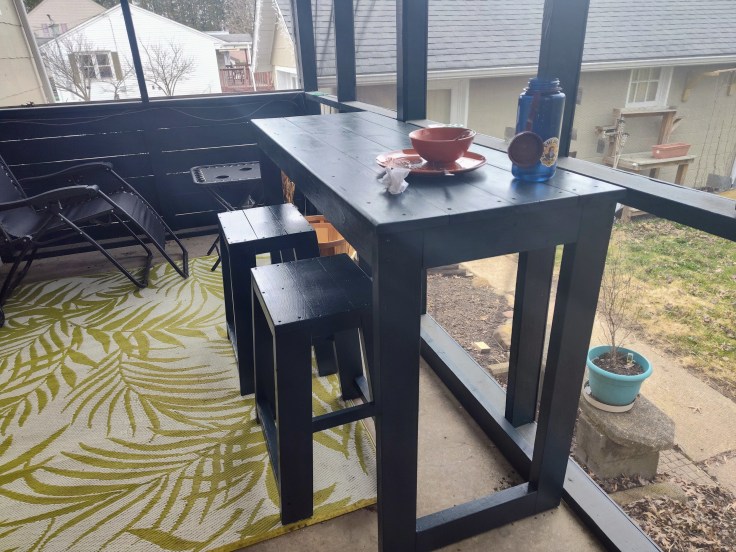
The project flew by and was a lot of fun. On day one, we decided we were going to build these, came up with a design, bought the materials, and had the table’s frame assembled. The stools certainly took more time, but the entire project was done within two weeks, and we’ve been able to sit at the table several times already. It was also very affordable. I think we spent $140 on materials, including the screws, which is much cheaper than anything we could have bought of the same quality. It also could have been built with only minimal power tools, so I would recommend this project for anyone who doesn’t want to overspend on outdoor furniture. And if you find the wooden seats to be uncomfortable, you can always add an outdoor cushion.

The finished product.

Also, we didn’t get rid of our previous furniture. Our glider is going to be placed in front of our back porch in an area where we’re going to grow potatoes in bags. Meanwhile, the Ikea chairs are going to be disassembled, with the backs being used as trellises for climbing plants, and we’re going to build planters for them to connect to.

A Study in Coffee Tables

There are a few woodworking projects that are on my bucket list to complete in my life. My list includes a Morris chair, a dresser, a lamp, a bed frame, and a coffee table. For the past couple of months, I worked on crossing one of those off my list: the coffee table.

Why We Needed a Coffee Table

Before going into the details of the coffee table I designed and built, let’s first cover why we needed a new coffee table in the first place. Prior to the new one, we were using a gate leg dining room table that I had previously shortened the legs on to make it a more comfortable height for our couch. That had been our setup since May 2021, and it had worked for the most part. We were able to eat at our couch, and we could always put up both ends of the table if we needed the extra space. However, there were also some flaws that had always been present but were getting more annoying the longer we used it.

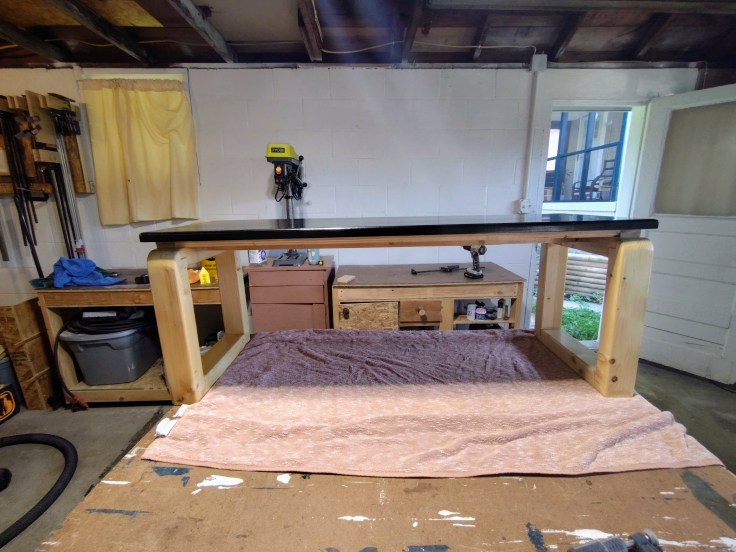
Finished coffee table

The first is that the table is really old and wasn’t maintained by the previous owners, who also happened to be the people Magz’s mom bought their house from. The table had also been stored in the basement for years, and the result was that the joints were loose, the top had scratches and scrapes in it, and the ends sag if the gate leg isn’t at a perfect 90-degree angle.

The second is that the table’s shape made it difficult to move around. We had to walk all the way around to access the other side of the couch rather than walking between the table and the couch. The gate leg also meant that we would bump into it on a daily basis, which caused anything on top of the table to spill due to the loose joints.

I had considered fixing and refinishing the table, but I think it would have been more hassle than it was worth. It quickly became evident that replacing it was the best option, and when there’s a choice of building vs. buying something, I will always build it.

Picking a Style & Designing the Table

Unless I know exactly what we want before I start designing a piece of woodworking piece, I turn to various books and online resources to determine the style. This usually means starting with craftsman or mission-style furniture. I love everything about these styles, including the warm tone of the wood, clean lines, and function over style. Think Frank Lloyd Wright or the famous Morris chair. I found many examples, the bulk of which had some form of storage, either immediately below the table-top or near the legs. There was a lot to like about a coffee table with built-in storage because we knew that we would be losing a drawer of storage in the gate leg table. However, we also wanted the option to sit at the coffee table with our legs underneath it, which made it difficult to also accommodate built-in storage. So, my search continued.

And here is where my study became interesting. I also have a book on Shaker furniture. Shaker furniture is named for the United Society of Believers in Christ, also known as Shakers, which was started in England in the 1720s and became organized in the United States later in the century. Shaker furniture is known for its durability and simplicity. You can still see well-preserved examples of this furniture at various Shaker museums in the New England region of the United States. Also, Shaker furniture was put on the radar of modern Americans thanks to Norm Abram’s New Yankee Workshop, where he visited several of the Shaker villages and replicated pieces of furniture. What surprised me, though, is that there were no coffee tables in the book I have, nor did Norm Abram recreate one on his TV program. And the reason for that is that coffee tables didn’t actually become a “thing” until the early 20th century. There were examples of low tables placed in the middle of sitting rooms that dated back to the late 18th century and the Victorian Era, but they weren’t called coffee tables until the 20th century.

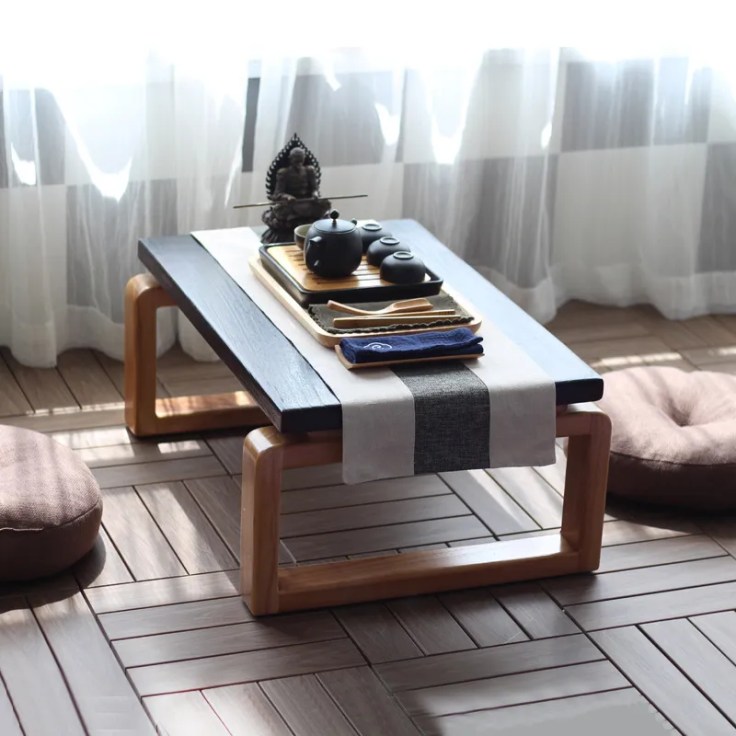
Striking out here led me to begin looking at Japanese furniture. We love Japanese culture and design, and the floor tables they use would perfectly fit our needs for a coffee table. They’re close in height to what’s considered standard for coffee tables and are meant to be sat at with a person’s legs underneath. But what was still proving difficult to pinpoint was the exact style we wanted the table to have. Japanese woodworking is quite different from what is common in Western cultures. They use a lot of hand tools and feature carvings and intricate joinery in their projects. The design is exquisite and is tough to replicate. I’m certainly not at a place where I can confidently replicate something like that. That led me to finding this table and using it as my inspiration:

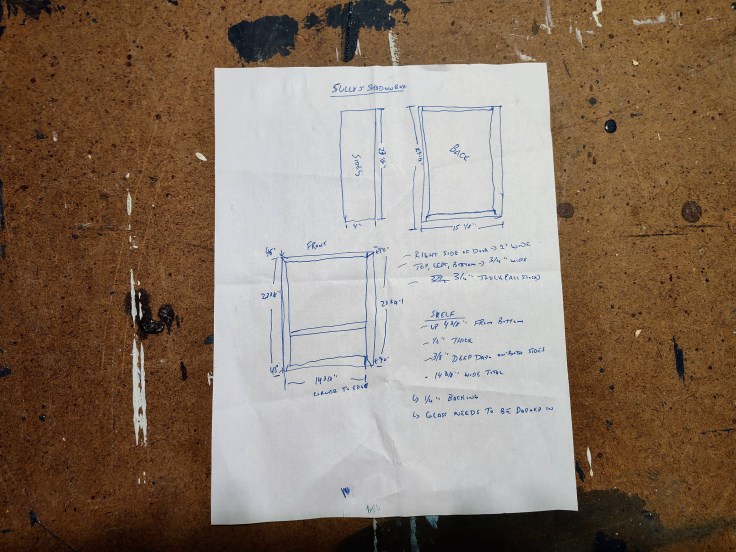
After determining the style of a project, I turn to SketchUp and create a 3D rendering of the item. If you don’t know what SketchUp is, it’s a web-based program that allows you to design 3D models. Once it’s designed, you can label the dimensions and print everything, which makes it really easy to use in the shop. There is a free and paid version of SketchUp. I use the free version, and it always fits my needs. From there, I like to transfer everything over to a piece of paper and draw specific portions of the project with a pencil. It helps me to see a specific joint or something that is hidden from view and would be difficult to see in a printout of the rendering. I’ll also use these sheets of paper as an opportunity to take any notes that I want to make sure I remember. It could be the size of a dado slot or the type of joint I’m using. The final thing I’ll jot down is a cut list. It includes the quantity I’ll need for each cut. This helps me to make all the same cuts at once, reducing the chance of unequal cuts.

The Materials

Going into this project, I knew that I wanted to incorporate two heavy planks into the table. They were originally used to move and store heavy pieces of equipment in an aircraft hangar, and we’ve had them for seven years since they were gifted to us. We originally had six of them, and four of them are currently being used: one acts as a shelf for us, and I made three of them into a mantle that is in our living room. The remaining two were originally used as the “hearth” for the mantle I built, but we haven’t used that piece since we bought our house and the mantle has been anchored to the wall. I disassembled the hearth piece, ran the planks through the planer, and was left with two pieces that were roughly 3 inches thick, 40 inches long, and 5 inches wide. Only having two pieces means that I couldn’t use them for the tabletop, so I was always planning to use them as the legs in some capacity.

Rough planks

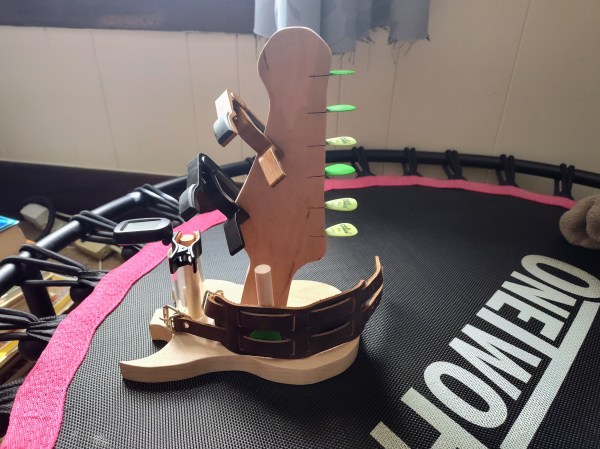
For the top, I turned to my stash of red oak and pulled two 4/4 x 6-inch boards. In 2022, I bought a bunch of lumber that was earmarked for a few projects. I’ve since completed those projects (bookcase, guitar stand, and kitchen cabinet) and still have a few full-length pieces left. The last thing I needed was fasteners to attach the top to the frame. I was unsure how to do this, but eventually found figure-8 clips, which are brackets that attach to the frame and underside of the top, but no screws run through the two pieces, preserving the integrity of the wood.

Building the Table

At its root, this was a simple table build. It has legs and a hidden stretcher under the top, but there were two aspects that were initially confusing and had the potential to trip me up. The first was the shape of the legs. When you first look at the inspiration picture above, the tops of the legs look as though they are bent, which is a skill that I don’t currently possess. However, when you look more closely at it, you can see that only the vertical pieces of the leg frame are curved, where the joint with the horizontal pieces is. This creates the illusion of bent wood, but it’s much simpler. I decided to cut half-lap joints for this and then round over the outside pieces to give it a seamless look. I can’t tell what joint the inspiration piece uses, but I’m guessing it’s a mortise and tenon joint. I didn’t want to do that on such an important joint, and it needed more strength than what a standard butt joint delivers. A half-lap joint allows the weight and force of the tabletop to be shared across the vertical leg pieces rather than all being focused on the joint.

The second aspect that was a bit confusing was how much framework to have under the tabletop. My original design only had a stretcher piece that connected the legs with spacers placed on top of it, which the top would connect to. As the piece came together, though, I wasn’t confident in it being strong enough, especially as we put our feet up on the table (it’s a coffee table, after all), ate at it, and played board games on it. I saw a scenario where the sides would sag in the future without support below. I addressed this by building a ladder-shaped support system that is placed on top of the stretcher and gave me roughly a dozen attachment points for the figure-8 clips.

With those design decisions made, building the table went smoothly. I limited the number of nails I used by only adding them to the leg joints, but even then, only on the top joints. Elsewhere, I drilled holes and used dowels to strengthen joints. I’m a big fan of how this looks. I also used biscuit joints to connect the four pieces used to create the tabletop. Biscuit joints are great because they’re much stronger than a basic butt joint, and biscuit jointers are easy to use once you get the hang of them.

Finishing the Table

Deciding how to finish this project wasn’t easy. In the inspiration picture, you can see that the top is very dark, while the legs appear to be finished naturally. At first, I thought that the top was a dark blue, but I now think it’s black. Either way, I had no intention of painting the top. I have a pretty rigid rule that prohibits me from painting woodworking projects built from hardwood that has beautiful grain patterns. My opinion is that if you want to paint a woodworking project, you should use a cheaper wood, like pine or poplar. The problem that arose was figuring out how to reach the level of saturation needed to get that dark color without turning to paint.

Milk paint was a possibility because you can thin it to still see the grain, but with Magz’s food allergies, we didn’t want to take a chance. You can also thin latex paint, but it’s difficult to create a consistent product and have an even finish. They also make solid stains, which sounds great in theory, but the product has very questionable reviews, citing a short working time, difficulty removing excess stain, and an uneven final product. Eventually, I’d like to give this a try, but I wasn’t going to use this project as a tester. Wood dyes were also a possibility, but like the solid stain, I don’t have experience dying wood and didn’t want to risk ruining this project. Plus, it was going to be expensive. That led me back to traditional wood stain, since they have several really dark tints, including ebony and true black. This stain isn’t perfect because it’s technically transparent, but I have experience layering coats of it to create a more saturated final product, so I was confident. With a half-pint of stain, a quart of oil-based polyurethane, a can of mineral spirits, and a fresh oil-based brush, I was ready to start.

Staining the table proved to be easy. With the surface sanded with 220-grit paper and tacked off, I applied a thick coat of stain before wiping off the excess. The wood absorbed the stain nicely, but it wasn’t dark enough. With the second coat, I let the stain sit for 10 minutes before lightly wiping the excess, which gave us the dark color we wanted. I then let the stain sit for 24 hours before applying the first coat of poly. In total, I applied four coats to the tabletop and three to the frame, lightly sanding between coats, and got a beautiful, glossy, hard finish. After letting the project sit for 48 hours, I attached the figure-8 clips and secured the top to the frame, and finally, it was done.

Reflecting on the Project

In general, I am very happy with this project’s outcome. I started on it in August and had it finished by mid-September. That’s very fast for me. There are several reasons for it, but I’m not the fastest woodworker, so I was thrilled by how quickly this one came together. The most time-consuming part of the project was finishing, as there’s always a lot of downtime while the stain or finish dries.

I’m extremely happy with how strong the table is and how beautiful the table is, especially the legs. It accomplished my goal of resembling Japanese woodworking, but I made it unique. I love how simple everything looks, while still being incredibly strong. That said, it’s not perfect. Some of the joints aren’t as tight as I’d like, and the curves on the legs aren’t perfect. With a bandsaw or scroll saw, this would be easier to achieve. It’s also not perfectly square, but then again, what is?

Ultimately, we love this table, and it perfectly fits our needs and our living room. We’re able to sit at it and eat dinner or do work, which is very comfortable. If we don’t feel like sitting on the floor, we can pull it closer to the couch or sit on a footstool. The table’s height allows us to prop our feet on it, which was a goal. Unintentionally, the table’s height also allows us to stow stools below it, which was a wonderful surprise. Finally, the table is easy to move and clean under. While it’s very strong, it’s pretty light and slides on the carpet. For the first coffee table I’ve made, I couldn’t be prouder.

I hope you enjoyed reading about my journey of building a coffee table. Even more, though, is that I hope it inspired you to build something if you’re considering it. It can be daunting, but it’s okay to make mistakes and take risks.

Create a website or blog at WordPress.com

Up ↑