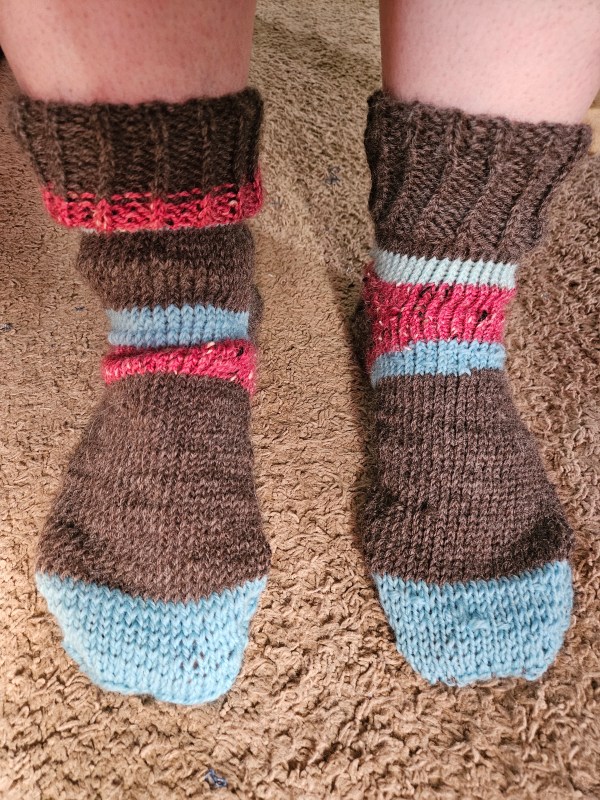
After Thought Heel Socks

A special thanks to the pattern writing of Weichien Chan from Saskie & Co and Jamie Lomax from Pacific Knit Co, for explaining this process with such clarity, that I leveled up from a sock knitting dreamer to a sock knitter. Check out their patterns! I’m glad I did. 😃

The Sock Saga

How? And, why? Those were the questions burning at the back of mind as the sock process eluded me, again and again. For years, I couldn’t wrap my mind around the heel of the sock patterns I acquired. I tried a toe up approach. I tried to mess around with short rows. I even bought a sock pattern book from a used book store, for a bit of sock heritage. Heel flap, confused me. The mechanics of double pointed needles, challenged my hand eye coordination. Magic Loop tested my patience and exposed my tight tension, from my cluttered mind. But the Addi Sockenwunder 9″ cable in 3.5mm became the key to unlock knitting mechanics I was lacking.

If you’re familiar with this blog, you know my frustrations with knitting in the round. This came to a head in February, during the Melt the ICE hat knit along. I seriously messed up my tension, and initial attempt by twisting my work. My joined stitches became a helix, coiling around the cable. I frogged my work, and started again, this time waiting a few rows before joining. (I found this wisdom thanks to the advice of Reddit, I think? To the past comment thread that helped me, know that I am eternally grateful.) This time around, I was determined to keep my hands loose and my mind relaxed, and it worked. I did not feel the hand fatigue, I normally experience when knitting in the round. The short cable length of the Sockenwunder needles was the key, the stitches slid easily around in the exact space of a sock circumference. This is why Magic Loop and I, did not form a lasting relationship, the shifting of stitches was a hurdle I disliked. Same with DPNs, I don’t want to keep track of stitches on needles, I want to be in a flow state of stitching. That is the best part of knitting in the round, in my opinion, you just go and knit. It is incredibly relaxing, like crocheting a simple stitch across a project, you and the stitching implement become one with the yarn, looping and creating a fabric with a relaxed mind.
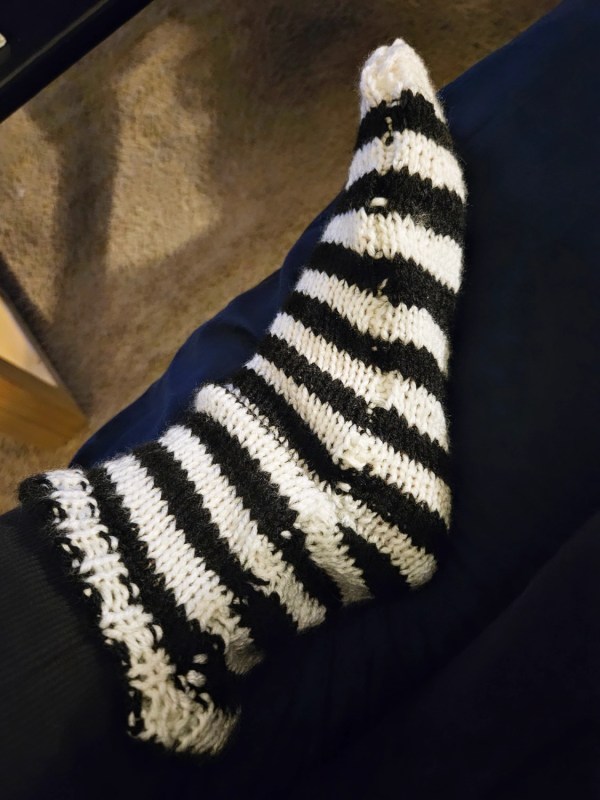
For this reason, the Sockenwunder socks came together quickly, despite the new techniques I was employing in this project. My first sock, I began at the end of the day on a Thursday, knit the body of the sock on Friday, and finished the toe and heel on Saturday. My second sock was began on Sunday, knit Monday, and wrapped up on Tuesday. Quick and easy, compared to a sweater! It’s what I want out of this knitting practice, something quick and relaxing, that is a pleasure to replicate over and over again. In the short term for my own feet for this coming winter, and in the long term for loved ones and beyond, hopefully charity knitting socks and possibly selling them at a market or online marketplace.

Sock Pattern

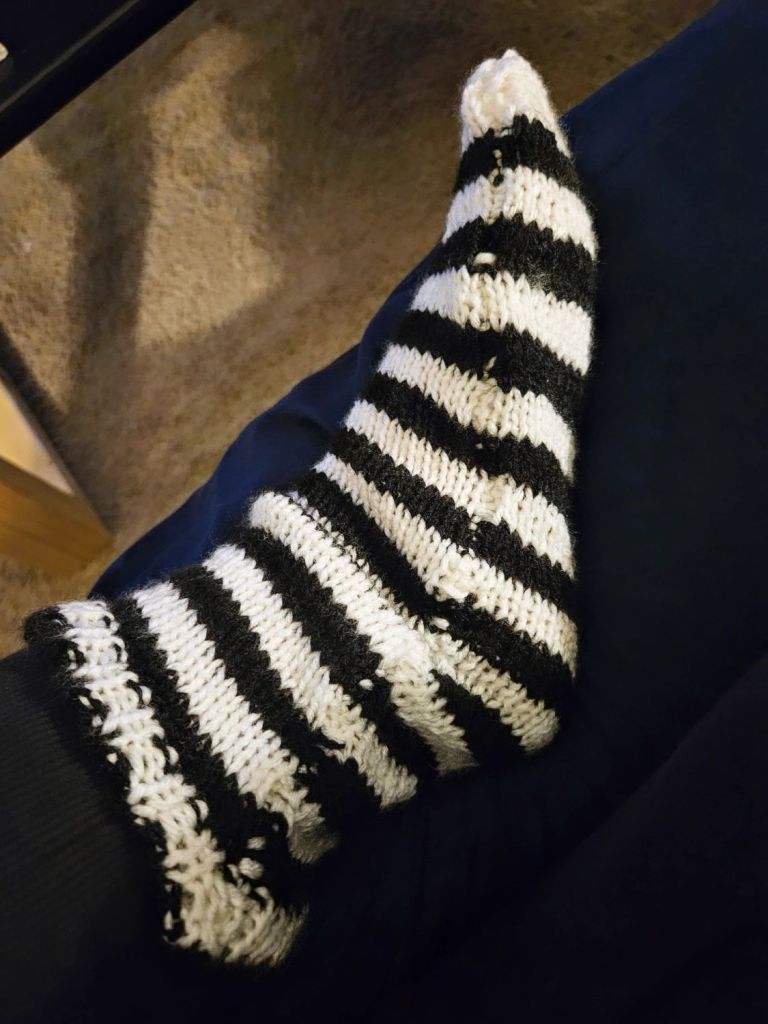
My sock pattern was loosely based on the patterns featured in the Arctic Knits book, which I will not go into detail for copyright reasons, but one thing I will talk about is my sizing mistake. I cast on an extra ten stitches from the Saskie & Co pattern, because of my usual tight tension knitting in the round. They fit a bit loose, and that’s okay. These first socks are a toile, for future socks, as I develop my preferences for socks. They are still usable, with a relaxed cabin socks fit for lounging around the house. I may layer other cotton socks underneath on cold days to pad the fit.

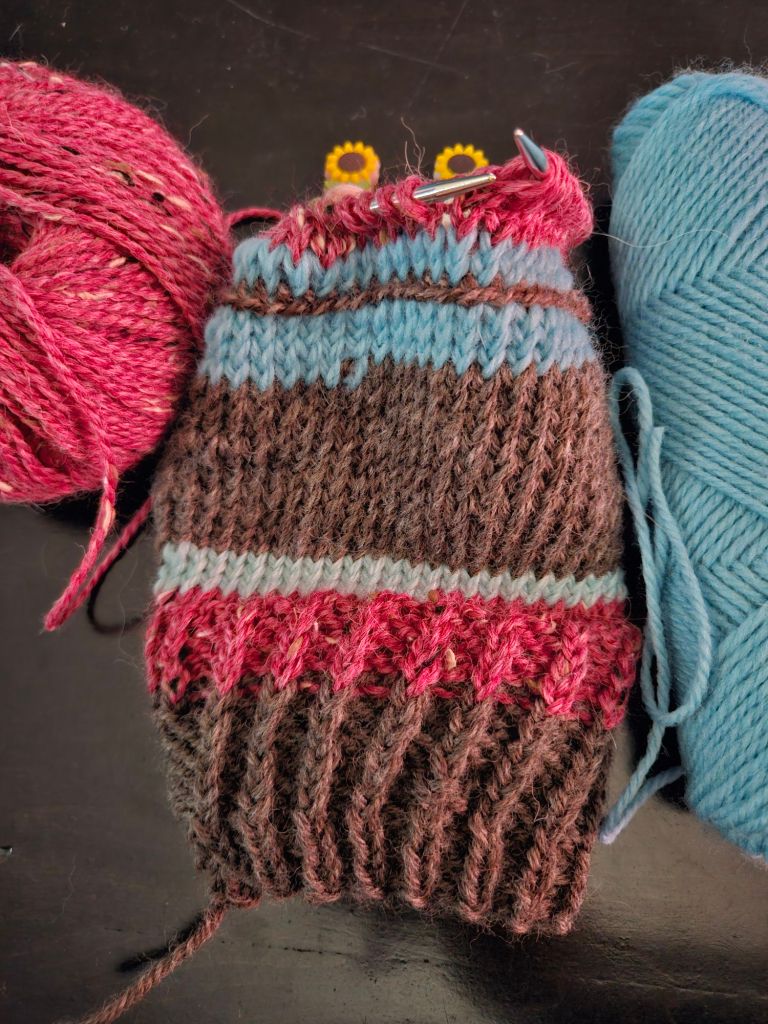
Another deviation from the sock patterns in the Arctic Knits book, was my choice to knit stripes, with scrap yarn from my Saskie Cardigan (another Saskie & Co project I will share soon). I didn’t know if these socks would turn out or be another failed attempt, so I used up my extras, in random stripes. This freed up my mind to concentrate on the mechanics of knitting the sock, and not the knitting charts. In the future, I plan to make the socks as written by Weichien Chan, they are stunning color work socks.
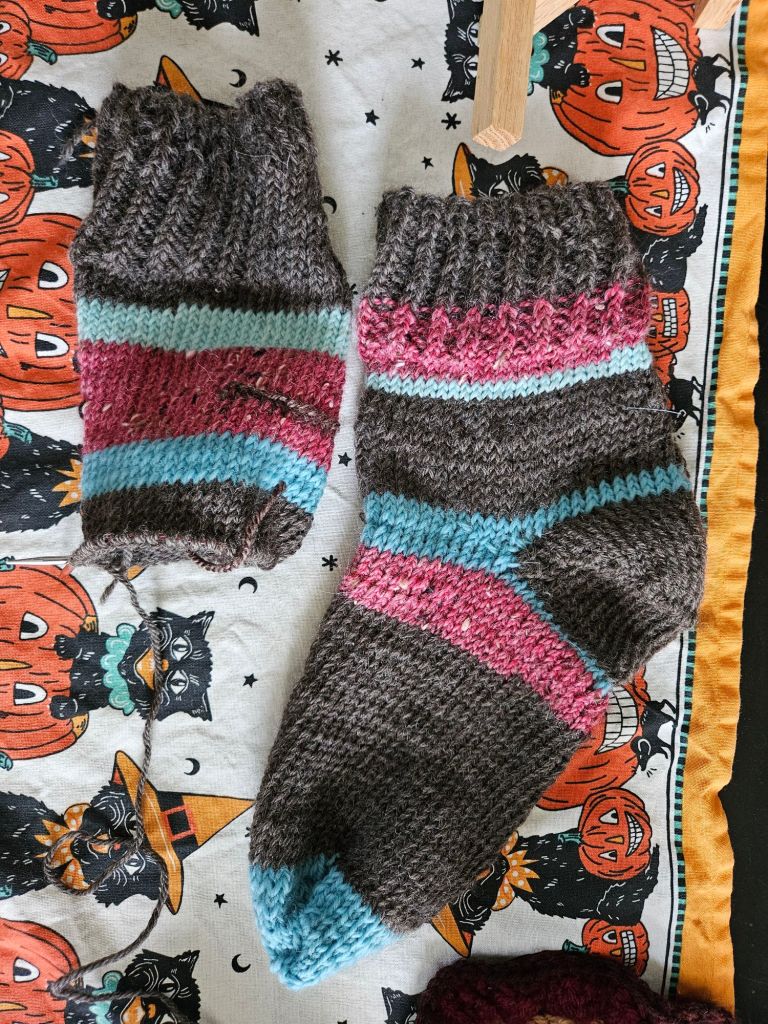
I used a combination of Knit Picks Wool of the Andes, Knit Picks Stroll, and Kelbourne Woolens Germantown.

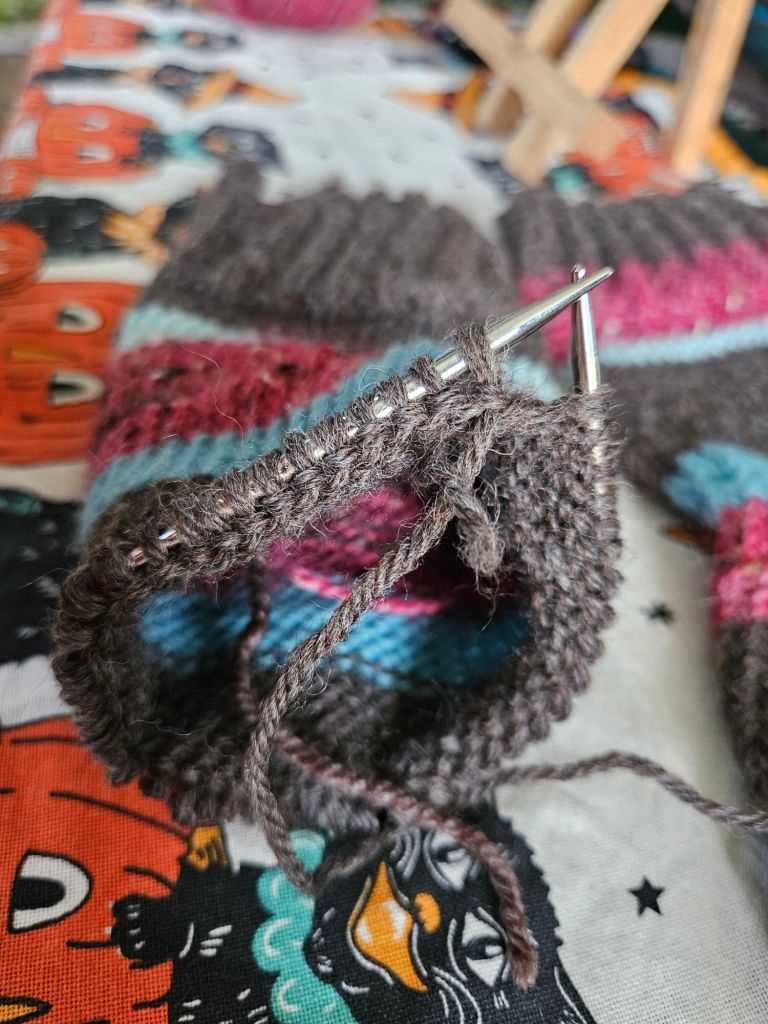
Now, what about that random raised row of brown yarn? That is the magic of the after thought sock! You make temporary arrangements for your heel and pick it up again after the sock body and toe are complete. This is where Pacific Knit Co’s tutorial had my back. Sometimes I need things rephrased, and many detailed pictures to make a new skill click. I’m a visual learner. Sometimes those patterns, although well written jumble in my mind. By using the combination of both pattern designers I successfully picked up the stitches above and below. I did this with a second set of circulars from Clover that were a bit longer, 16″ but the same gauge of 3.5 mm. The length difference was helpful during the knitting process, as the long needles hung down out of the way of my hands knitting on the Sockenwunder, and alleviated the stress of stitches falling off when unattended to.

Both Weichien and Jamie helped finally see the how and why of the heel shaping. With the heel flap techniques, I lost sight of the point. With the patterns that had me turn the heel while knitting the body, the complexity of this, overwhelmed me. But the after thought heel, eliminated both of these hiccups. I could see the sock body and the heel taking shape, it was intuitive. If you have experienced overwhelm by socks, I high recommend mixing up your tools and techniques. That is why we have so many to choose from, you must experiment to find the right fit like selecting a bowling ball.

Experimentation and repetition are my biggest takeaways from this multi-year sock saga. It’s not the finished project, as much as the process that defines the success. Knitting requires a patience and tenacity to frog and cast on again that has been hard for me, as a perfectionist with squirrel brain to stay the course with. Mistakes anger me. Frogging feels like a waste of time, but its not. Committing the skills to memory by practice is no different to volleyball practice drills or math homework. To be a skilled maker, you must put the time in, no short cuts. In this age of information and short cuts, it’s counter-cultural to slow down and fixate one skill until it is acquired, but it is the only way as humans we learn.
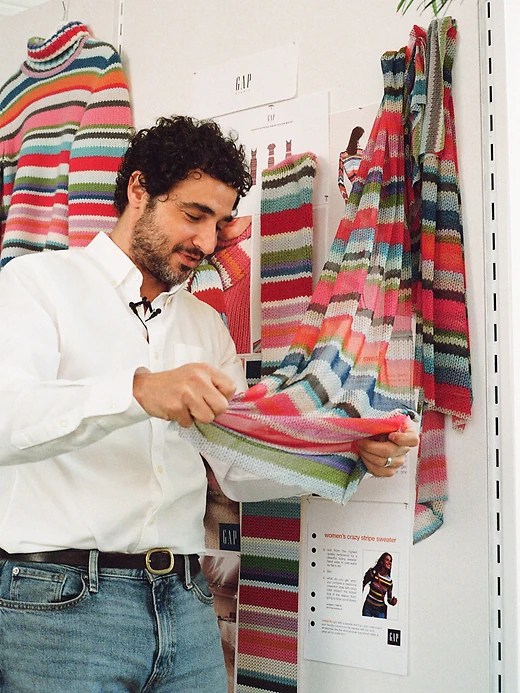
Tyra Banks, Gap Happy Stripe, and Project Runway 22

This post is a little bit of a mash up, I guess the connecting thread is Zac Posen, or maturity? I’m not sure. I’ve been mulling over two topics that have been in my head this week. The first is the premiere of Project Runway Season 22, the second, being a knitting “controversy” that I believe is not a controversy at all. So, maybe, the connection is drama fatigue?

The Television Evolution from the 1990’s to the 2020’s

Social media is bad for us, we can agree on that. It compresses nuance, and that is exactly what is happening here. But, in the case of television and the fashion industry, it seems to be brain chemistry altering, to borrow an internet term, and the effects are getting strange. This is far from a comprehensive history, just a quick snippet for context.

Television has gone through several iterations in my lifetime – from the rise of cable, to the golden age of reality TV in the 2000’s, to streaming. In 2005, YouTube transformed who could occupy our attention, shortly following in 2007, the Iphone brought a new screen to our lives. In 2020, Tik Tok became the supreme ruler of culture, with the short-form content revolution. Now, in 2026, streaming platforms of shows and film, are self aware that they are the second or third screen vying for our goldfish-like attention spans. This is bad for business. What are networks supposed to do? I’d say they are letting this short form content culture lead.

Enter Project Runway Season 21 and its new, Tik Tok and YouTube editing style with quick cuts and comedy edits, that are self-aware to a level, that was a bit jarring to me. It was like internet culture was uploaded to an established show of 21 years, in order to modernize it. It did just that, it laid its cards on the table of what producers think a successful television show must have in the mid-2020’s – drama and internet-personas instead of contestants, in my opinion. It’s only gotten worse with the announcement of Season 22.

Why is it so loud here?

It’s noisy. I feel like everything about the show is shouting at me. I tried watching the first episode, and quit after the intro. Instead of letting the viewer sit back and engage with the show, the show demands shock, shade, and a level of seriousness that is simply undermined by how the contestants, presenters, and judges act. They are caricatures of humans. Like Zoolander or The Devil Wears Prada, it’s not an accurate representation of human behavior. The drama has been dialed up to a point of puppetry and theater, which would be fun if it was for say, in the pursuit of comedy like RuPaul’s Drag Race, which I am a fan of. This version of Project Runway is not about the clothing or the craft of sewing. It is for the purpose of creating internet buzz and translating that into streaming numbers. It feels so trite to say that. Project Runway is a business, what I miss is the illusion of the storytelling.

Tim Gunn, Zac Posen, Michael Kors, and Nina Garcia brought an industry seriousness to the show that provided context. With the elimination of all but Nina Garcia, and the death knell of losing the spot to show at NYFW, the legitimacy of the show is in shredded. What is all for? Internet fame. Even the challenges were different last year, with sponsorship themes shoe horned into a semblance of “design criteria” and it felt off. For example, the PNC “brilliantly boring” challenge to use boring fabric. There was the Eczema awareness challenge, that should have gone deeper, but instead gave us a concept and then quickly shooed it off screen.

In contrast, I have gained greater appreciation for Drag Race and its the commitment to staying on topic.The causes presented on the show seem genuine and it is refreshing! Like it is all in alignment with worldview.

Lack of Integrity in the Fashion Industry

I think this is because to have a clear worldview in the fashion industry right now, it has to be political, and they don’t want to do that at Disney, and so the political stances are muddled for the sake of saying nothing. Which is a political stance, indifference is infuriating with the amount of clout the show claims to have. This show is fashion “influencing” but make it a reality show.

The worst part of this muddled stance is the inclusion of Tyra Banks. The Netflix documentary from this winter makes sense now, it was a PR project to rebuild Tyra’s image. I grew up with America’s Next Top Model, created by Tyra Banks. I watched ANTM long before Project Runway, and it was a sh*tshow.

She let the cameras roll in Season 2, when a dangerously inebriated contestant, Shandy, experienced SA, and then Tyra had the gall to keep her from the hospital and police, to keep filming. She framed Shandy as an example of cheating, and publicly shamed her for a decade. She pressured contestants, Joanie and Danielle to undergo dangerous dental procedures. Tyra created photoshoots promoting blackface.

She fat shamed and encouraged ED on the show, ignoring the dangers of ED, all while shaming contestants who couldn’t “hide it” well enough. This is just a short list of the problematic behaviors on the ANTM show, a show that preyed on young women of color, and then made a mockery of them, reinforcing racism again and again for profit. I have no interest in watching a show that Tyra Banks is a part of, when she danced around an apologize in her documentary and, in my opinion, did not take any responsibility. Just have integrity, it’s all I ask for. Apologize. Truly make amends and rebuild your reputation through real change. This path is not fooling anyone.

Connecting the Two

Okay, so how are my two topics connected? Well first off, I wish they had brought a quality judge back like Zac Posen, but secondly, I think as much as people are not up in arms enough about Tyra coming back to television, I think the internet is always trying to drum up knitting controversies, that are not that serious.

I was definitely dragged into caring about The Game of Wool, by my corner of the internet, and proceeded to make a bingo card, as my farewell, once I realized I didn’t give a hoot even if this show was a let down. The most recent “controversy” I’ve seen is the Gap Happy Stripe collection for Summer 2026, promoted by the CCO, Zac Posen. The collection is not a knitwear focused throwback, instead it utilizes technology to make something “knitwear” centered. The image of the original knit has been printed on a mesh collection, that I believe has a decently high polyester content, because mesh.

As a fiber artist, if I want a happy stripe inspired piece, I’m just going to recreate it. Done. I don’t need to feel slighted by Gap, or be frustrated that they are not centering knitters with “fake knitwear” as I have seen touted on the internet. Gap is a fast fashion company, the knitwear would be machine knit, and the workers are not being compensated fairly. It’s the fashion industry, its problematic. They make poor choices and they create a ton of pollution. They also favor tech “innovations” so this is not radical, it seems inline with Project Runway to be honest.

I don’t think Zac Posen should “canceled” for this or for us to spam Gap, with anger that knitters have been slighted again. I don’t buy store bought knit anymore. I certainly don’t buy store bought crochet, because its either fake or created with slave labor. I try to buy thoughtfully, make what I can, mend, up cycle, and treat clothing as a permanent object. I think that is the best we can do right now. The problems with the fashion industry are not contained to Gap. It’s world wide. I have no reason to buy a mesh printed garment, so its a moot point for me. Protect your peace, the world is incredibly messy right now, this is a drop in the bucket.

Do you remember the Gap Happy Stripe collection? I don’t. I remember colorful knitwear from the early 2000’s and wearing one from Old Navy or Aeropostale. I’m getting tired of the internet shouting. I’m getting tired of endless knitting drama. I’m quite tired of dumb reboots of shows I liked. Whew, I think it I did it! Thank you, reader, hanging in with me on this random post. I hope you have a wonderful weekend. ❤

Night Sky Sweater

I’ve mentioned this before, but as a maker, I revisit a single project many times before it is done. Sometimes I will live with a finished object for a month, a few months, or even a year, and suddenly pick it back up again to adjust something that feels off. Honestly, taking a season or two away from that garment – such as, putting away a dress for the winter, or a sweater while you sweat it out for the summer, can give your mind the space to forget and re-acquaint yourself to the garment like you picked it up from the store. It is a whole new piece again, which can lead to me be less than thrilled with past me and her design choices.

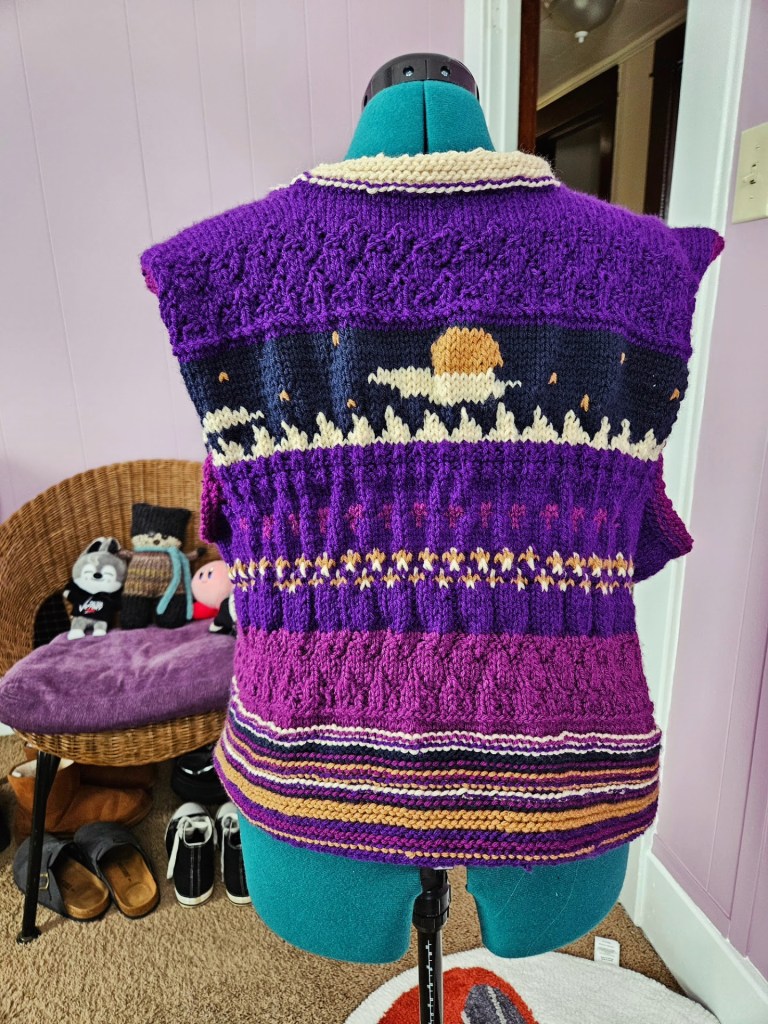
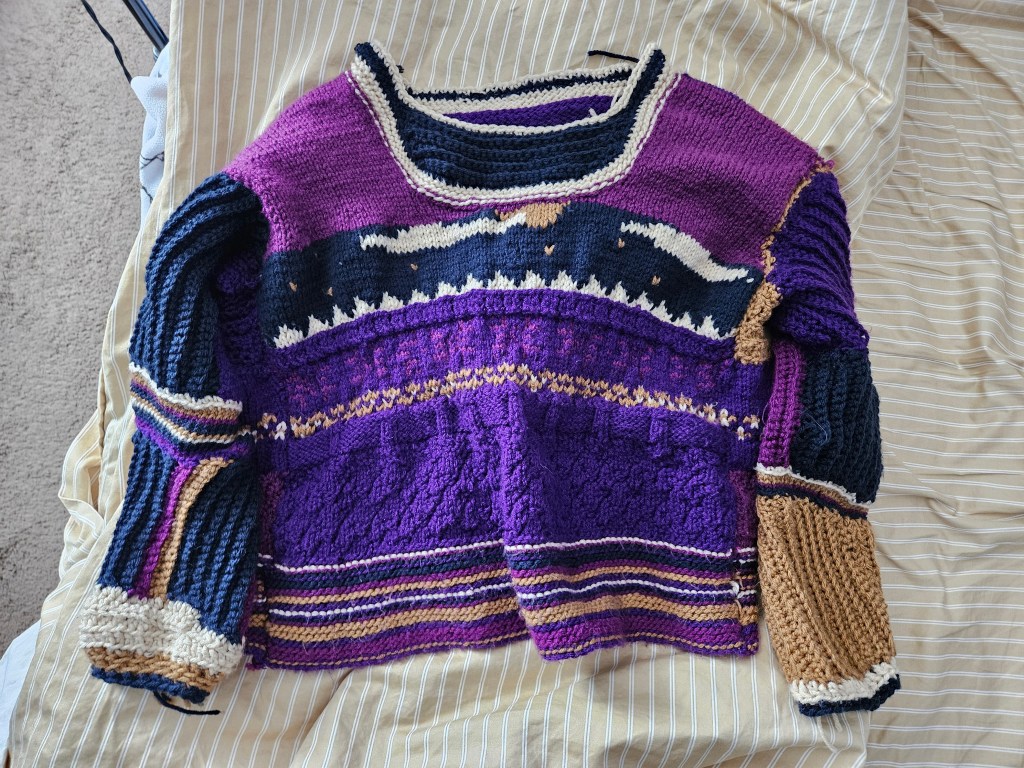
Take this vest for example, I began this project in December 2024, wrapping it in February 2025. I wore it a few times, as it stands as a vest that winter and spring, then it was put away for the warm weather. When cool air returned in the fall, I pulled it out of its drawer and set it on my dress form. This vest did not feel complete, it had more to say, even though my hands were weary back in the winter, so I stopped and called this piece done. But its not done, it would be a gorgeous colorful sweater, and it was time to go back to this garment to make it whole.

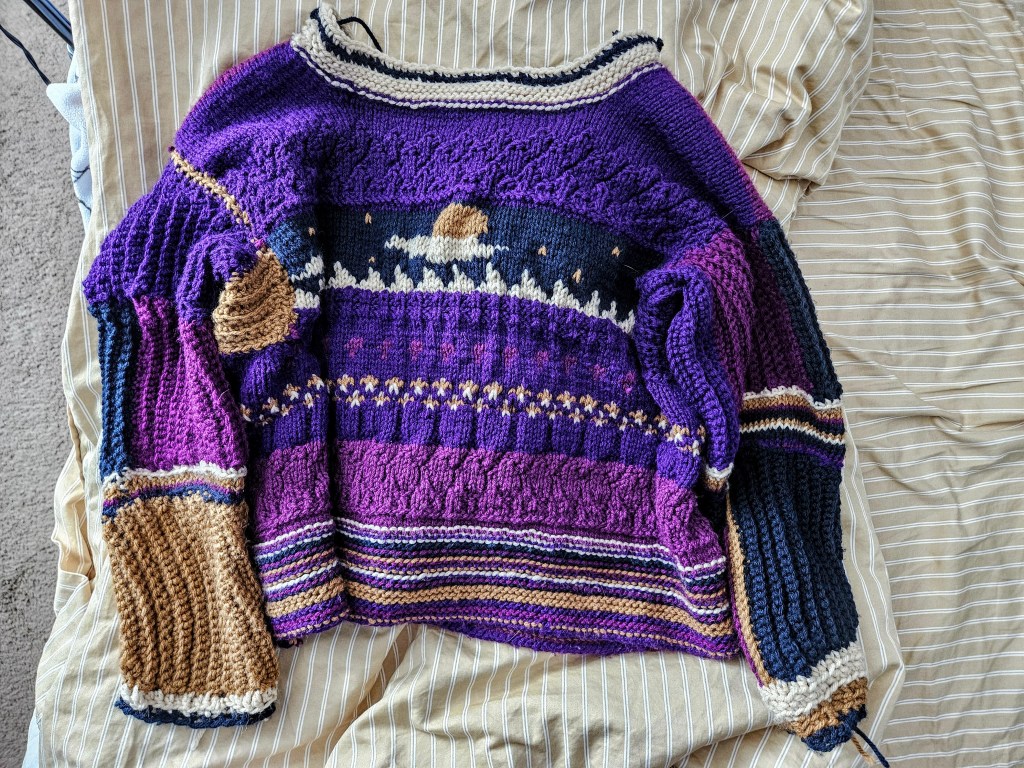
Now, this was a self drafted piece. A complicated self drafted piece that helped me cut my color work chops in a garment. This was the first sweater I made with such a large color palette and the first time I decided to make a knitted piece with the motivation of telling a story. I wanted to evoke a winter sky, with a moon that was visible on the front and back. A moon with stars, and clouds, floating above a forest. This sweater would not only feature colorful forms across the fabric, it would have texture. I chose to use the ‘seersucker stitch’ as it was labeled from a Pinterest chart, to weave a diamond texture into the fabric for a 3-D plush effect. I chose large and miniature color work sections to create ebb and flow in the color story.

For the bind off, I had grown tired of the classic 1×1 rib, so I tried something a little different! I chose to create tight stripes, knit stitched together. Instead of stockinette which used knit (right side) and purl (wrong side) for it’s classic construction, I decided knit stitch, knitting the right side and wrong side, would stabilize the stitches for a lack of curling in the finished fabric. And it worked! The technique and color changes ground the color palette for a cohesive garment.

Keeping these previous choices in mind, when it came time to add sleeves and a new collar, I chose to employee a new to me technique, crochet. I wanted the sleeves to be made in the round, and be completed quickly so I could wear this piece for most of the winter. Crochet is much easier to do in the round, and to make progress quickly. The crochet stitches allowed me to work in new directions too, so the sweater had vertical texture to contrast with the horizontal lines of the original vest. With sleeves complete, this is one of my favorite pieces to date. It tells a story. The color palette reminds me of Stardew Valley. The cloud on the back reminds me of an episode of Avatar: The Last Airbender when Appa is missing, and Aang thinks a cloud flying above is Appa floating above. I love the variety of colors – gold, navy, magenta, violet, and cream.

This was a labor of love, but I would highly recommend trying a complex project such as this if you are interested in making your own garments. Not only does this piece express my identity, it taught me how to be a better fiber artist. I feel proud each time I wear it. Get inspired and start stitching something from your own imagination!

If I Love Fashion History, Do I Have to Like the Met Gala?

The more popular and well-covered the Met Gala is online, the more controversial it becomes. This once New York Society event has transformed into an international spectacle that feels more like the Oscars or the Olympics than a fundraiser for a museum’s costume archive. That is the origin of the Met Gala, a dinner to raise money for the Costume Institute, to pay for the day-to-day operations and expansion of the collection displayed at the Metropolitan Museum of Art in New York City. The spectacle and theme, red carpet coverage, constant intertwining with rich, questionable people, and the baked-in elitism of making Anna Wintour’s guest list have become the bigger story of this so-called “fundraiser.”

Now, I am being a bit dramatic in questioning its fundraising; it is successful at its core function. For a deeper dive, I suggest checking out Abby Cox’s video about the history of the Met Gala. I believe they have raised enough to create an entire wing for the museum. The hefty price tag per plate or per table is usually not the attendees’ responsibility to cover, as the attendees are usually there to represent a brand or company. What I have seen as the biggest defense for the Met Gala is this system of big brands, donating money to the arts, that they would otherwise pocket or invest in questionable things, such as political donations to Trump or AI technology. But is that enough to make this event palatable? The Met Gala was sponsored by Lauren and Jeff Bezos, which alone made this year’s gala controversial. The justification once again is that his money is better spent on the arts than on something else, like another Melania movie. Such as comparing this sponsorship to the investments by Carnegie, Frick, and Morgan in the arts during the Gilded Age to improve their public opinion.

I have mixed thoughts on this, as a believer in the preservation of the arts, but also a kid who grew up in the Pittsburgh area and was surrounded by Carnegie libraries, museums, etc. Are these nice to have? Yes. Does it make up for the pollution, labor practices, and wealth hoarding by these industrialists that were so greedy they did not care if they were evil, but instead chose to buy their way into good public standing? No. My Grandma died of COPD, from the level of pollution she was exposed to as a kid in the 1940s. The Atlantic Monthly, in 1868, called the city of Pittsburgh, “hell with the lid taken off.” Soot from the Steel factories coated everything. The number of heart conditions in my family, and later autoimmune conditions, has been shocking, until you consider the effect of pollution. Similarly, the number of people from my home region with Cancer has been downright terrifying. You still can’t eat the fish from the rivers or ponds.

But forget that, right? Let’s have a ball, and display our wealth to all the people around the world who will never experience this kind of luxury. We have to preserve the arts and fashion history! Yeah…honestly, when you consider how much human suffering is essential to this kind of wealth, that these systems depend on most people going without human rights and dignity so that they can wear their custom haute couture to donate millions to a single museum, it’s disgusting to me. And I love fashion.

History is great, sometimes, but more often than not, it is a tragic collection of stories of inequality, suffering, war, destruction, and a few that benefit greatly from the oppression of others. You don’t have to dig far into the history of my country to see how true this is. I mean, each day this Iran War drags on, add another footnote to the list of wrongs. I would rather preserve cultures than general historical collections that focus on white, Eurocentric clothing on white Eurocentric mannequins. The bulk of the vast Costume Institute’s collection, the biggest in the world, is mostly Western clothing with a few token exceptions, displayed on mostly small, white mannequins. The Met has enough resources and clout to do better. The fashion industry is not interested in doing better, though. They are one of the biggest polluting industries in the world, and have knit together their brand empires with sweatshops in the global south. I guess my point is, I think we all know enough about Western fashion and luxury fashion. More than I think we need to know. Who is preserving the fashion history of the places and people who make the clothes, and whose lives are being wasted away sewing day in and day out to feed their family a meager portion, while these brands spend hundreds of thousands of dollars at the Met Gala? If they have enough to blow money on this event, it is despicable that they choose to not pay their workers properly, and give them vacation time, health care, maternity/paternity leave, etc.

The most difficult part of this conversation, for most of us, is the Amazon of it all. I shop on Amazon, most of us do. Sometimes it literally is the only option, and I know it is not a good company, and I am not proud of supporting it. It makes me feel like a big hypocrite. Because with Amazon, you don’t have to leave the US to see how bad they treat their employees. It’s out in the open, and hyper-consumerism and lack of other options make the bad behavior of Amazon seem beyond reproach due to how entrenched the company is in our world. I do think the Met Gala is an offensive flaunting of wealth that we, normal people, should stop worshipping because it’s pretty and is “art.” I do think the “Eat the Rich” protests are valid, and I think a lot of us feel stuck because we feel like hypocrites. After all, the system seems rigged right now for billionaire domination, and sometimes the only or cheaper option is supporting these businesses, like Amazon.

I like fashion history, but I don’t like the Met Gala. I don’t like Bezos or how he does business, and I do have an Amazon package arriving today. Just as much of life is complex, this subject is so layered, and I hope I made sense in this post.

What If Game of Wool Celebrated Design and Craftsmanship?

If you missed it, I made a Game of Wool Bingo card for episodes 1-3, because in my opinion, this show should not be taken seriously. I’ve given up watching, interacting with recaps, etc. I’m not going to watch beyond episode 3, and that is because hate-watching is validation in the attention economy of 2025. That got me thinking, what do I wish Game of Wool was instead of what it is? Game of Wool, just like Project Runway, I have notes!

No Kits or Internet Dressing Projects

I don’t want any themed-making kits sold per episode. They have been doing this for the episodes I have watched, each week partnering with a big yarn company, honestly making kits that serve no purpose other than a cash grab. I also don’t want to watch weekly episodes with challenges that create useless items. Useless from a practical and technical standpoint.

  • Crochet and knit swimwear is dumb. You can’t wear it other than for a photo shoot, which places it in the “internet dressing” category. It’s for a photo. It’s not even practical for a music festival. But it does resemble a “Coachella” look.
  • A crochet deck chair had potential, but it was not used within the materials provided or the time frame.
  • A dog sweater with a required hat is not kind or practical for dogs. The sweater is comfortable, but the hat is not comfortable for the dog. Again, it is for a photo. Washability was not discussed either.
  • The mohair sweater was the only challenge that was the closest to being a useful challenge, for design teamwork and wearability, but they ruined it with the ridiculous time frame.
  • A couch cover is useless, because I have thought about constructing one for my own couch to stash bust, but it’s just not practical for anything other than a showpiece. Which is how they judged it, so a lot of wool was wasted to make a big, useless swath of fabric.
  • The fair isle vest misrepresented a heritage craft of the region they were filming in. Why not just film a historical film set in the Renaissance, and put the actresses in Victorian corsets without a chemise, tight-laced? Same level of idiocy to be flashy!

This Game of Wool presents everything that late-stage capitalism is in relation to crafting and hobbies, thanks to greed, social media, and the attention economy. The British farmers could use the income; how about sourcing locally? What about sustainability and slow fashion? Yeah, 12-hour challenges do not represent anything but hustle culture. Girl boss, slay!

How Would I Fix It?

  • Real experts, not these two ladies.
  • Either all amateurs or all expert contestants. Pick a lane. Either be the Bake-Off or be Project Runway and offer a CFDA mentorship kind of prize.
  • Bring in a real mentor to help in the wool barn.
  • Take them on field trips to see wool being processed, dyed, and spun. Same with flax for linen.
  • Tell the story of why textiles matter and why fair trade for the animals, farmers, and ethical standards matter.
  • Explain why local matters for the economy and the ecology of the region.
  • Teach the history of cottage industries.
  • Teach the history of how knitting has changed the world, such as the development of textile machinery and the creation of the binary code. Essentially, fill in the gap of what Sci Show failed to do.
  • Set real challenges that teach, showcase the skill of the fiber artists, and show innovation.
  • Do a challenge that involves unravelling sweaters for yarn and teach the world about this amazing, sustainable possibility.
  • Task the fiber artists to design patterns, and explore what goes into design and proper pattern writing, because it is a technical skill.
  • Make things that will be auctioned off for charity.
  • Bring in people as guest judges who will bring professional connections and opportunities for the fiber artists.
  • Set realistic deadlines, and slow down the pace of the show. Follow a timeline like Mind of a Chef that explores moments of cooking over an entire season.
  • Let the makers make, unencumbered by the pace of the internet. Take note from Bernadette Banner and other makers out there that celebrate true craftsmanship and sustainability in the heyday of microplastics.

I’m tired of this show discounting a skill that has been tossed aside as a Grandma hobby since the Industrial Revolution. In these weird and wacky times, slow fashion and an appreciation of craftsmanship are in short supply in the media. This show had such potential! But they are truly chasing the money over integrity.

Socks Are Madness

This is a story of a winding road. It is not just passion that makes us try new and difficult things, but also the desire to fit in. Sometimes the road is bumpy, and bumpier still than we expected.

Last winter, I began a journey; at the time, I did not realize how technical this would be, and oh, how I miss the naive wonder of that time. I started my quest to make socks. The sock does not appear technical from the outside. It is a tube of knit fabric which we slip on our feet, most every day. Due to the Industrial Revolution, socks can be knit by machine with ease and speed. This has suspended our connection to the technology that first developed the sock—hand knitting.

In our modern day, socks are affordable and accessible. They are for sale everywhere in a myriad of textures, weights, and styles. We have socks for athleticism, socks for leisure, socks for style. They are boring, mundane Christmas gifts of childhood, and puppets with googly eyes. But what does it take to make a sock by hand?

I gave this a shot last year, and it challenged me! I cataloged my experience in Socks, A Journey, and Socks: An Update, where I began knitting socks flat on straight needles and three months later gave circular knitting a try. My first flat knit socks were made top down, in a tube style that negates the heel flap and requires sewing the sock into a tube. They are loose in fit but warm and great socks to wear around the house. My advanced tries, knitting in the round and turning the heel, were more of an adventure. My tension was tight, and my heel flap a nightmare, unable to be duplicated into a second sock, for how off script my technique became. I didn’t grasp the why of what I was doing and therefore messed up the pattern.

This summer, I went to a local yarn shop where I began my journey to sock more traditionally. I picked up a pair of small-gauge double-pointed needles and sock sock-making kit with proper sock yarn of wool and nylon, to do it “properly” and oh my, did this bomb. The toe-up pattern, new to me from my previous projects that were cuff down, pushed me far out of my depth. I sank instead of swimming. The four double-pointed needles and my uncoordinated hands created tension and laddering in the knit, which looks exactly as it sounds. I tried three times to knit a few centimeters before the stitches fell off the needles, the sock falling off with the stitches. In desperation, as the needles were 29 USD and the sock kit 29 USD, I was feeling very silly and wasteful purchasing new needles and new yarn that I couldn’t do anything with.

So I pivoted to my trusty straight needles until I saw my mom later that weekend, and she lent me a pair of small-gauge, small-circumference needles to finish the sock. Still baffled by the heel flap and the vague instructions on the pattern, I tried German short rows for shaping the heel. In a fortnight, I completed the first of the two socks. I cast off and handed it to Kyle to try on, and the size was all wrong. I tried to frog it back into a skein of yarn, but the splitty yarn tangled, ripped, and became a ball of knots. It was over, and I was furious with myself for wasting time, money, resources, and, honestly, hurting my eyes squinting to see my tiny stitches for almost two weeks to accomplish nothing.

Socks are madness. And maybe I should stop beating myself up about my failure when socks are one of the hardest things to make by hand. I am an overachiever and a perfectionist, so this type of failure cuts me deep. I obsess, I rage, and I fall apart in the madness of learning something that may take years to execute once, not even perfectly. But you know what? I have made good socks before! Comfortable, almost perfect for what I was looking to achieve, socks. But I rejected them as being good because I was embarrassed at how I made them. I didn’t follow the right techniques, I used the “wrong” yarn, and I didn’t turn the heel.

Sometimes I have major imposter syndrome as a knitter. I feel like a fraud because I don’t use the exact same patterns, same tools, same yarn as everyone else on the internet. But why is that a bad thing? I’ve listened to other knitters in podcasts discuss how the sameness of knitting is making it boring. Apparently, at Rhinebeck or other knitting events, it is easy to see the same sweater throughout the sea of people, and that is a new thing. Listening to knitters, who have been knitting long before 2020, when I really started knitting consistently, knitters used to do their own thing. Yarn suggestions in patterns were exactly that – a suggestion.

People were designing more and experimenting instead of knitting in the homogenized way we see today, which is one of the ways I feel like an outsider. I don’t want to knit the same things as everyone else, but I also want to be good at the craft, and it leaves me in this push-and-pull tension. It became clear to me, though, that my search to “fit in” with the proper sock kit and the expensive needles didn’t make me a better maker. It was honestly a bit of a handicap. So I guess my takeaway is to be yourself?

I don’t want to stagnate in my skills, but if I can find my own technique to make socks and other garments with the “non-standard” tools and yarn, then is it really stagnation or just getting creative with where my skill level is at? I’ve been pondering this a lot and have more thoughts on this from both the point of view of a knitter and a sewist. But that will have to wait for next time.

It’s Okay to Admit You Don’t Like It

A place I didn’t expect to reach this year, was the mental head space of dislike for a dream I’ve had for most of my life. Now could it be burnout and I just need a break? Probably. But I also think it might a healthy thing to acknowledge something you thought you would love, may not actually bring you joy as you wished.

What am I talking about? Sewing. I don’t like sewing as much as I want to. It is tedious, extremely complicated, and requires a level of patience I lack. I’ve been a sewist for 5 years now. I devoted a large amount of my time over the past five years to the study of garment construction, and I realized that it is not my medium, yarn is, and its not a failure to admit I don’t like sewing as much as knitting and crochet.

I think I have known this for about a year, yet refused to verbalize my feeling because it felt like I failed the one thing I always wanted to do. But why is that a failure?

Just because it’s not my passion, doesn’t mean I am going to stop sewing. I think having this space to put less pressure on it to be “my thing” could make me enjoy it more!

Because then I am free to create, to fail, to be a slow learner, to take breaks from sewing when I am ready to cry. I don’t have to feel pressured to get my skills up to par for selling my work. I don’t have to feel pressure to design my own patterns or build a business on sewing. I can go back to basics of what has always been at my core – art. I am an artist, I don’t set out to be, but I know its there inside me too afraid to commit to the bit.

I love what sewing brings me. It’s a fantastic skill to have. I can design my own clothing made to measure and that is luxurious even if my sewing skills are mid.

I can experiement with my style through upcycling. I love how I can recycle and repurpose fabric instead of donating. That is a important part of comsumption. We buy and buy but don’t think about the life cycle of the garment, but with needle and thread you can leave the buy and declutter cycle.

Sewing has taught me to be a wiser comsumer as well. I buy garments that I can’t sew. Complex garments. I also price compare fabric against pieces in store to figure out what is more cost effective to sew. Such as buying a 6.99/yard, one yard cut of cotton jersey to make one long sleeve basic tee. You can buy these from retailers for 35 USD compared to sewing one for 7 USD.

It’s not always cheaper, but sometimes it is and that is a huge win!

Finally, by allowing myself to feel these feelings, my hope is that I will be free to explore and create unencombered by goals of monetizing my hobby, instead that I enjoy the creative process again.

Have you ever tried sewing? Did you find it challenging?

I Am My Own Crafting Worst Enemy

This is an unplanned part three of my “Drafting Shortalls From Scratch” because I did not succeed in making my overalls for winter. Although I have made shortalls twice this summer, a few silly, but very human mistakes, led to the project going awry. This is what I think went wrong:

  • Flew too close to the sun when tailoring
  • Planning < No Plan
  • Lack of Focus
  • Measure Once, Cuss Twice
  • I kinda hate sewing when it feels this hard
  • Putting too much pressure on myself
  • Not Buying Enough Fabric
  • Not Mocking Up
  • Not using my Patterns when I’m stuck
  • Research the Basics

It’s so easy to think we’ve got this and be too confident when going into a project. With knitting, this approach of fearlessness had led to some great projects, but with sewing, this artistic type of approach crashes and burns. Sewing is fabrication, as weird as that sounds. I think I was prepared to sew such complex tailoring projects, such as my shortalls, this summer, because I spent the spring building a screened-in porch with Kyle. Woodworking is very similar to sewing, I learned! It is about measuring, planning, creating things in a specific order, and constructing something that is built to last. When we started working on the porch, I never imagined how much it would teach me about garment construction. But it gave me a template to focus on. Who knew that woodworking would be such an inspirational experience for me?

So why am I sharing this? I am really struggling to accept that sewing is not coming easily to me; no matter how much I practice, it continues to challenge me. I’d like to invite you to join me in not giving up on those things in our lives that are hard.

Designing Clothing That Fluctuates With You

This is inspired by a discussion from Maybe Bre, which made me reflect on something I hadn’t discussed before. As well as my own experience wearing clothing, as a garden-variety human who loves fashion but doesn’t always enjoy how our clothing is made.

By this, I mean the patterns and fastening of our modern times. The zipper is a wonderful thing, and so is the structured waistband. I love them in jeans because denim that isn’t compromised by stretch is a rugged and sturdy garment that isn’t a piece that conforms to you; your body is housed within the trousers. I feel the same way about a structured coat. In doing so, I buy these pieces oversized for comfort, which leaves me with a garment that most of the time doesn’t technically fit me. If I did buy it to fit me right now, there is no guarantee that over many decades it would continue to fit me – I’ve been burned before by this problem. Hence, all my “staple, investment pieces” from college no longer live in my closet because they are no longer my size. If I had planned ahead and bought them a bit oversized, they might still be with me, but they wouldn’t have “fit” me at the time.

My problem with clothing is becoming clear, isn’t it? I desire longevity and wearability from clothing, in a way that is not offered off the rack. I desire my clothes to grow and shrink with me, depending on how my body changes over time. This has been my design focus in the last few years as I have placed myself in the driver’s seat of my wardrobe through the process of sewing and knitting.

My idea is not innovative; it is historical. Clothing, because it was so expensive and hard to make, was more adaptable in the past. Fastenings such as tie waist, lacing, and buttons with multiple sizes of tightness were common because clothing was not as easy or cheap, and they were not seen as disposable or replaceable. Changing fashions came with garment reworks, ye olde upcycling as it were. This is what I desire: the ability to change the fit of my garment.

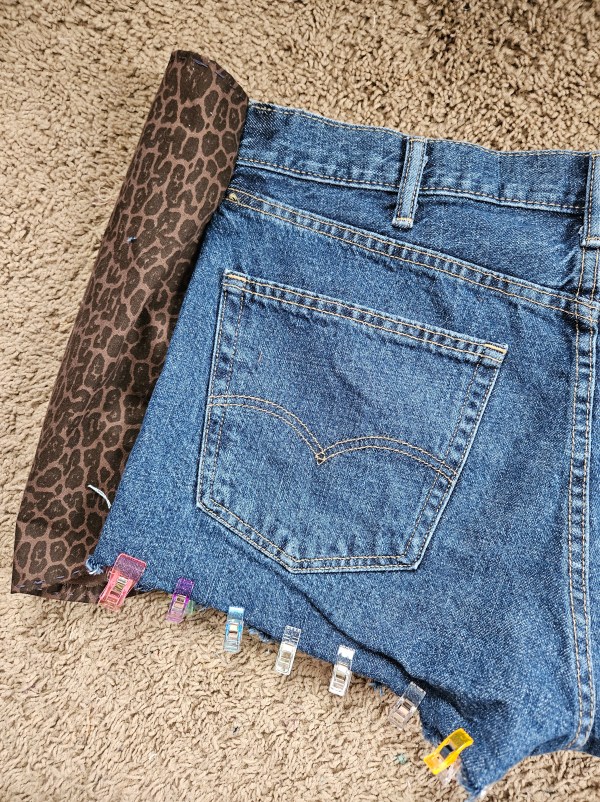
I recently figured out how to sew with elastic, which is a game-changer for shorts and gathered sleeve hems! Before this, though, I was making most of my bottomweight garments with tie waists or several options of buttons to let the garment adjust to the needs of the day, I’ve also sewed with intentional relaxed fit, initially due to a lack of tailoring skill but over time it has been to allow wiggle room in pieces I have spent days or weeks of my life crafting.

Being present in the making process has taught me to treat my clothing with more respect, even when it is time to discard the current version of it for something more useful. I’ve stopped donating as much, decluttering, and rebuying, to be honest, to be more intentional with the garment and its life cycle. I am the one who brought it to life, I can’t simply consume and discard it like it is nothing. I am deprogramming my brain from decades of fast fashion insanity.

I believe if clothing were made with this design philosophy, that clothing would fluctuate with you over time, I believe we would enjoy wearing our clothing more because instead of buying stretch fabric everything, we could still wear good natural fibers, maybe a bit bulkier than spandex and less figure hugging and lurex denim, but would be better for the humans and the planet. Style and substance, as they say on the Great British Baking Show!

Will I Wear a Knit T-Shirt?

I asked myself this question last summer with genuine uncertainty. Knitting is such a cold-weather medium that a knit made to be breathable and light for warm weather seemed, well, a bit like an impractical fashion piece. I think this is an important question to ask of ourselves before we jump on a trend. Whether it is to buy a knit t-shirt or to handknit (which means you are dedicating weeks of work to a project), having the right expectation matters. Trying on a knit t-shirt beforehand helped me visualize what I was in for. Knitwear for all seasons is currently having a moment even in ready-to-wear, which makes this a great time to go try on a piece before committing to a big project.

Wearing my Grandma’s cotton knit t-shirts, although they were two sizes too small, helped me visualize knit as a process to make a fabric instead of a woolly winter garment. That’s what makes knitting and crochet extraordinary skills; they are versatile. The fiber maketh the project. The stitch maketh the airflow. Lacey, open weave? Fantastic for hot and humid days. Not so much for a pair of mittens. 

To remedy this, I think fiber acquaintance is a fantastic way to learn whether a knit t-shirt is right for you. When I began knitting in 2012, I knew there was wool yarn and acrylic yarn. That was it. However, there is actually a rainbow of fiber waiting to be discovered, and the lineup sure has expanded in the last 13 years!

Cotton

Linen

Bamboo

Hemp

Pineapple

Lyocell

Rayon

Yak

Alpaca

Camel

Mohair

Cashmere

Silk

Did you know that wool has two unique properties? It helps you regulate temperature and is naturally antibacterial/antimicrobial; therefore, it inhibits bacterial growth naturally on the fiber and prevents odors, which is why it is such a great sock material! Although I wouldn’t recommend wool for summer tops, it is a remarkable fiber. There are two fibers, though, that are breathable and naturally don’t let bacteria and microbes hang around – it’s linen and silk! For fiber education and the chance to feel these materials, I recommend finding a friendly local yarn shop and talking to the experts.

Finally, I do have one possible hiccup with my current selection of hand-knit t-shirts. I can’t wear them in 85 degrees Fahrenheit weather and above with humidity, but I do believe a knit tank would fix this problem, and a lacey stitch technique in future projects will solve this. I don’t like sweating a lot in my handknits, and because I was learning with my first few tees, the knitted cotton fabric is a bit bulky. That’s my error. You know what is so cool about knitting, though? You can unravel the finished garments and try again, so I can rework these finished garments in the future. Anyway, I hope you will consider the knit t-shirt as a warm weather staple in your wardrobe, it’s a lovely way to use crochet and knitting all year round!

Create a website or blog at WordPress.com

Up ↑