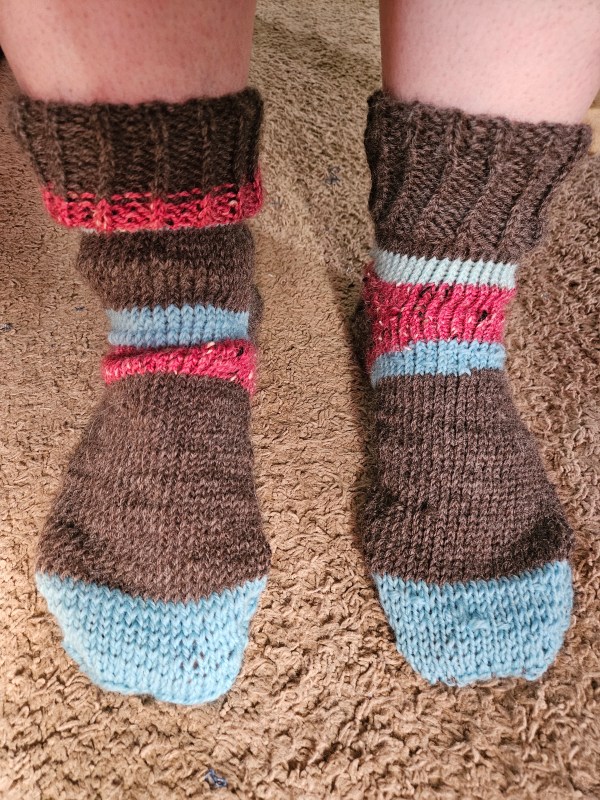
After Thought Heel Socks

A special thanks to the pattern writing of Weichien Chan from Saskie & Co and Jamie Lomax from Pacific Knit Co, for explaining this process with such clarity, that I leveled up from a sock knitting dreamer to a sock knitter. Check out their patterns! I’m glad I did. 😃

The Sock Saga

How? And, why? Those were the questions burning at the back of mind as the sock process eluded me, again and again. For years, I couldn’t wrap my mind around the heel of the sock patterns I acquired. I tried a toe up approach. I tried to mess around with short rows. I even bought a sock pattern book from a used book store, for a bit of sock heritage. Heel flap, confused me. The mechanics of double pointed needles, challenged my hand eye coordination. Magic Loop tested my patience and exposed my tight tension, from my cluttered mind. But the Addi Sockenwunder 9″ cable in 3.5mm became the key to unlock knitting mechanics I was lacking.

If you’re familiar with this blog, you know my frustrations with knitting in the round. This came to a head in February, during the Melt the ICE hat knit along. I seriously messed up my tension, and initial attempt by twisting my work. My joined stitches became a helix, coiling around the cable. I frogged my work, and started again, this time waiting a few rows before joining. (I found this wisdom thanks to the advice of Reddit, I think? To the past comment thread that helped me, know that I am eternally grateful.) This time around, I was determined to keep my hands loose and my mind relaxed, and it worked. I did not feel the hand fatigue, I normally experience when knitting in the round. The short cable length of the Sockenwunder needles was the key, the stitches slid easily around in the exact space of a sock circumference. This is why Magic Loop and I, did not form a lasting relationship, the shifting of stitches was a hurdle I disliked. Same with DPNs, I don’t want to keep track of stitches on needles, I want to be in a flow state of stitching. That is the best part of knitting in the round, in my opinion, you just go and knit. It is incredibly relaxing, like crocheting a simple stitch across a project, you and the stitching implement become one with the yarn, looping and creating a fabric with a relaxed mind.
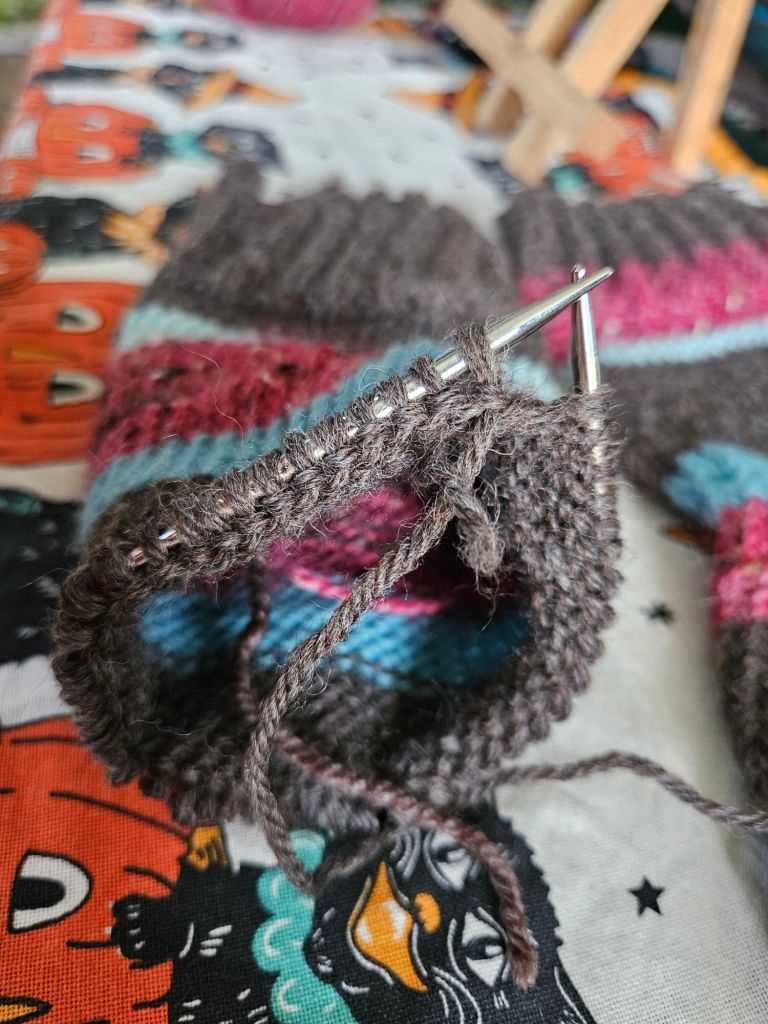
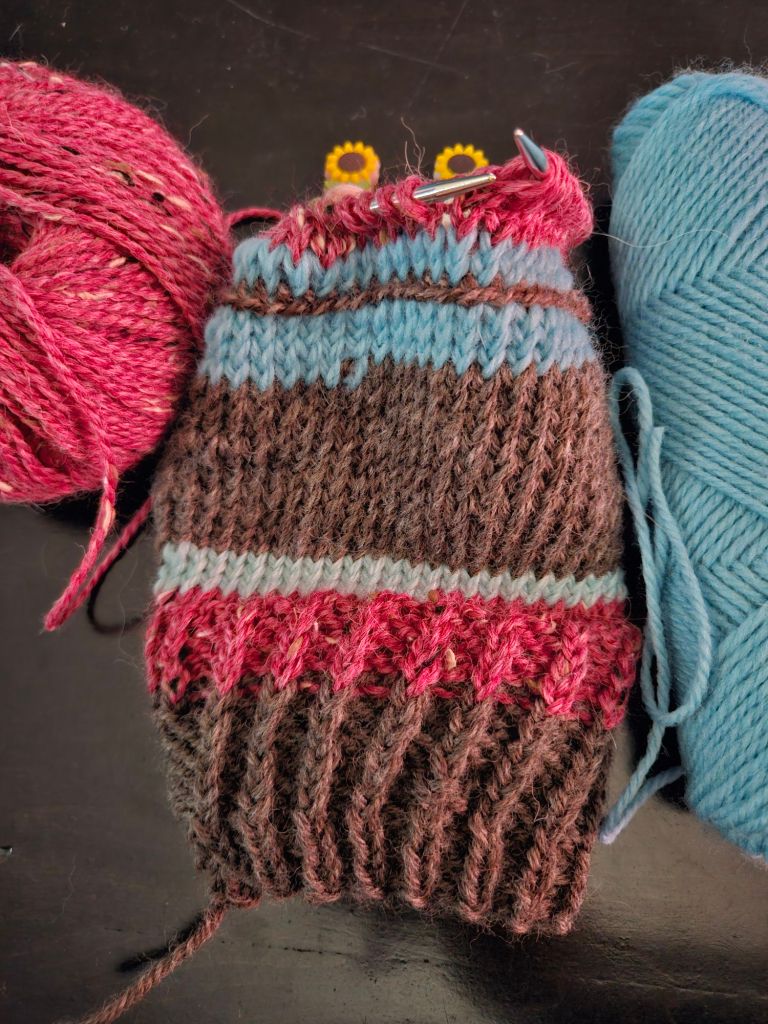
For this reason, the Sockenwunder socks came together quickly, despite the new techniques I was employing in this project. My first sock, I began at the end of the day on a Thursday, knit the body of the sock on Friday, and finished the toe and heel on Saturday. My second sock was began on Sunday, knit Monday, and wrapped up on Tuesday. Quick and easy, compared to a sweater! It’s what I want out of this knitting practice, something quick and relaxing, that is a pleasure to replicate over and over again. In the short term for my own feet for this coming winter, and in the long term for loved ones and beyond, hopefully charity knitting socks and possibly selling them at a market or online marketplace.

Sock Pattern

My sock pattern was loosely based on the patterns featured in the Arctic Knits book, which I will not go into detail for copyright reasons, but one thing I will talk about is my sizing mistake. I cast on an extra ten stitches from the Saskie & Co pattern, because of my usual tight tension knitting in the round. They fit a bit loose, and that’s okay. These first socks are a toile, for future socks, as I develop my preferences for socks. They are still usable, with a relaxed cabin socks fit for lounging around the house. I may layer other cotton socks underneath on cold days to pad the fit.

Another deviation from the sock patterns in the Arctic Knits book, was my choice to knit stripes, with scrap yarn from my Saskie Cardigan (another Saskie & Co project I will share soon). I didn’t know if these socks would turn out or be another failed attempt, so I used up my extras, in random stripes. This freed up my mind to concentrate on the mechanics of knitting the sock, and not the knitting charts. In the future, I plan to make the socks as written by Weichien Chan, they are stunning color work socks.
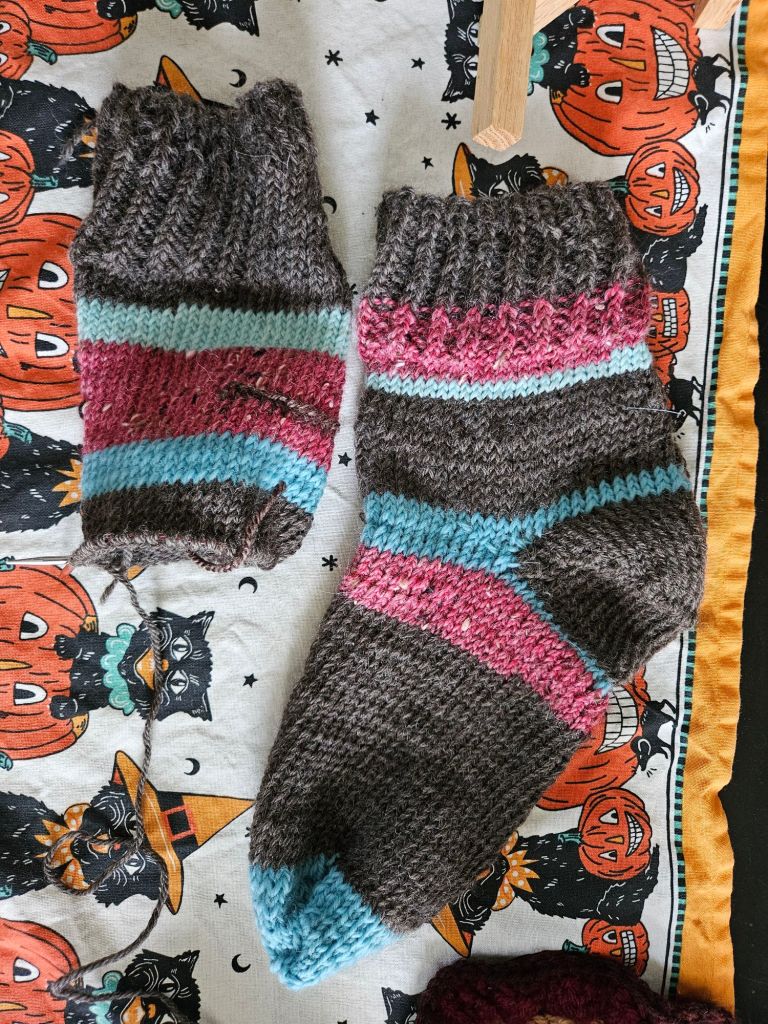
I used a combination of Knit Picks Wool of the Andes, Knit Picks Stroll, and Kelbourne Woolens Germantown.

Now, what about that random raised row of brown yarn? That is the magic of the after thought sock! You make temporary arrangements for your heel and pick it up again after the sock body and toe are complete. This is where Pacific Knit Co’s tutorial had my back. Sometimes I need things rephrased, and many detailed pictures to make a new skill click. I’m a visual learner. Sometimes those patterns, although well written jumble in my mind. By using the combination of both pattern designers I successfully picked up the stitches above and below. I did this with a second set of circulars from Clover that were a bit longer, 16″ but the same gauge of 3.5 mm. The length difference was helpful during the knitting process, as the long needles hung down out of the way of my hands knitting on the Sockenwunder, and alleviated the stress of stitches falling off when unattended to.

Both Weichien and Jamie helped finally see the how and why of the heel shaping. With the heel flap techniques, I lost sight of the point. With the patterns that had me turn the heel while knitting the body, the complexity of this, overwhelmed me. But the after thought heel, eliminated both of these hiccups. I could see the sock body and the heel taking shape, it was intuitive. If you have experienced overwhelm by socks, I high recommend mixing up your tools and techniques. That is why we have so many to choose from, you must experiment to find the right fit like selecting a bowling ball.

Experimentation and repetition are my biggest takeaways from this multi-year sock saga. It’s not the finished project, as much as the process that defines the success. Knitting requires a patience and tenacity to frog and cast on again that has been hard for me, as a perfectionist with squirrel brain to stay the course with. Mistakes anger me. Frogging feels like a waste of time, but its not. Committing the skills to memory by practice is no different to volleyball practice drills or math homework. To be a skilled maker, you must put the time in, no short cuts. In this age of information and short cuts, it’s counter-cultural to slow down and fixate one skill until it is acquired, but it is the only way as humans we learn.
A Sea Of Shifting Sand

The more I feel like I should suppress my feelings about something, the more I feel it pressing upon my heart to be bold and talk about it. Can you relate?

I feel like my world has been swirling around me since 2024. Change. Good or bad, I never feel prepared. Leveling up in life, it is rewarding yet sometimes it is more akin to biking up hill and shifting gears downward for the tough pedaling ahead. And I wonder if there are more people feeling this way?

My early thirties have been incredibly rewarding – buying a house, adopting a rabbit, building a garden, successfully sewing pants, etc. But they have also been a sea of shifting sand globally, professionally, and personally.

We all know the public, political bad – the orange fool that has put us all on blast for 2 years. The price of everything, including yarn & fabric has challenged my professional goals because it is so expensive. It zapped my creativity and threw me off my game. I mean, how can I feel inspired to create when neighbors are being kidnapped and put into concentration camps, and our tax dollars are going to fund a war and a genocide. It’s dark. Like where is the joy when that is happening and your “representatives” are trying to silence your right to vote?

I basically took a year off from sewing to regroup, picking up my thimble again this August. I threw my focus into yarn crafts – knitting and crochet, pondering what my plan is going to be to fight for what is right. It’s been humbling to understand that I can help and also this whole situation is systemic, and will be far more difficult to get to the bottom of then I realized. But game on.

AI and the poor economy has been discouraging to my professional goals of becoming a pattern designer. I would like to be a full time, fiber artist, that is bringing in money. But AI has been a one two punch of stealing work and stealing engagement of artists everywhere. It has made creativity feel hopeless, and sharing work online, like I am contributing to a malevolent overlord.

AI and data centers are like a curse dropped into our lives, disrupting what worked and what gave us joy. Now, we have to fight for our water, environment, and creative expression. I know we humans will win this one. I fully believe AI is a fad that will cause a bunch of damage and then collapse – like mining and steel, it is just going to be messy in the present and future. 

What I wasn’t prepared for was the personal complexities of marriage, healing from childhood trauma together, and the doom spiral of parents having health issues and also toxic parents dropping in to rock your world. I have felt some days like nothing feels familiar. Some days, this healing journey that Kyle and I are together has feel like a canyon, spreading between us, and we’ll never rejoin on the same road again. It has been so weird.

Why doesn’t anyone prepare you for how hard marriage is? Or how outside forces and generational cycles can seriously fight the strong bond you have with your spouse. I feel like he and I have been in the trenches on one of these outside problems for a decade now, and I just want us to be able to climb out of this together and walk home hand in hand, but people are complicated and so for now, we keep holding on together and waiting for the hard work to be over.

I have never tried so hard across so many different relationships, and tasks (gardening, house responsibilities, social media marketing) to grow and succeed just for things to unravel over and over again. I have felt like I am on a boat that cartoonishly keeps springing leaks, and I am out of limbs and props, to stop the leaks. Some days I wish the cartoon rapids would just appear already so I can sail over the waterfall and smash the boat to bits, because my best efforts feel so futile. I get burnt out and want a change. Because perseverance is exhausting. Choosing to be hopeful and keep going can feel like a cruel joke.

What has shaken me to the core though, and I’m nervous to talk about, is the way the church doesn’t feel like the church to me. My churching friends have become far too comfortable with Christian Nationalism and it is freaking me out. The blind eye to suffering, and the hyper fixation on “sins” that are not sins. I have always found it baffling that the concept of a person in the church getting a divorce, or seeing Catholic believers as “real” Christians is controversial to some people. It’s those kind of opinions that get canonized by the group, that are so destructive.

That’s not even dipping our toes into the sexism, purity culture, and racism that has been alive for centuries. Seeing how normal this is, has been infuriating to me. It has made me feel like I don’t know where I belong anymore. And to be honest, has awoken real life pain of never feeling good enough to be a “good Christian” to some because my parents divorced.

To be clear, I 100% believe in God and that God is good, and that it is the church, the humans, that are taking things to a bad place. I’d like to elaborate more on these reflections in another post, because I don’t think I’m alone in feeling like I am at risk of being sucked into the corruption in these normally “safe” spaces.

It’s not what I thought the church and my christian friends would become. The corruption is running rampant here, and I hate it. But this is not the first, and won’t be the last, because constant sanctification is needed to continually keep our focus on what is important – loving others as God loves us.

I have a ton of stuff to work through, and I am so far from perfect. I just want to open up about things I have been too afraid to open up about because of the highly controlling religious school settings I have found myself in as a kid, and no I did not go to Catholic school, I went to very Calvinist leaning private schools.

So we’ll see if I am brave enough to keep unpacking. I think we all just need to air this stuff out to move forward as the body of Christ in a healthier place, that is not wrapped in a fake cloak of hidden sin and cyclical shame of those who want to talk about the sin being tolerated, because the church in America is fine with teaming up with the political machine and money chasing.

This was a rambling one, but if you stuck through, I appreciate you.

Using Doodle Decks for the First Time

The Doodle Decks from Pacific Knit Co had this aura, pulling me in from the first instance I saw online. Maybe it’s because of my 90s and 2000s childhood? It reminded me of the crafts we do as kids – the mini weaving looms, tie dye shirts, friendship bracelets, bedazzling etc. There was something about this deck cards.

If you are not familiar with the doodle decks, they are curated colorwork charts that are combined into a small deck of cards, with a design per card, and additional cards to teach you how to make the most from the themed deck of your choice. I love the approachable nature of this pattern! Instead of a paper pattern, with line by line instructions, you get miniature charts contained per card, that is far easier to keep track of when you are knitting.

I found this format incredibly easy to use! I could quickly flip through my options, and choose my pattern cards. You can compare options or brainstorm sections of your project by easily laying out the cards on a table. The small card, the size of a playing card, was easy to manage in my project bag. To pause my work, all I needed to do was slip my card on top of the deck, and slide the deck back into the box. No graph paper to fold or book to mark, easy peasy!

As a self-drafter, I am not the best at following patterns. I think some of this stems from neurodivergence, and some from the fierce individuality instilled from girlhood in the 90s-2000s. I remember, not wanting to be accused of “copying” someone’s style, or locker layout, or room decor. It was a major social faux pas. Even though knitting patterns are literally sold for this purpose, to share your design with the world, I can feel myself resisting. But with these doodle decks, even though I was not the one to draw these charts, I feel like it is a choose your adventure kind of pattern.

There are ideas for sure suggested in the deck, but you can follow your own heart. I like the customization of Pacific Knit Co’s format. I have learned a lot from them through this experience of using their color work doodle decks, including new perspective in regard to my own self-drafted color work charts. I always go big, with these large graphics, that span the front of a piece, when big is not the only way. Small designs, with repetition, in the fair isle tradition, are just as effective and a new way to tell the same story.

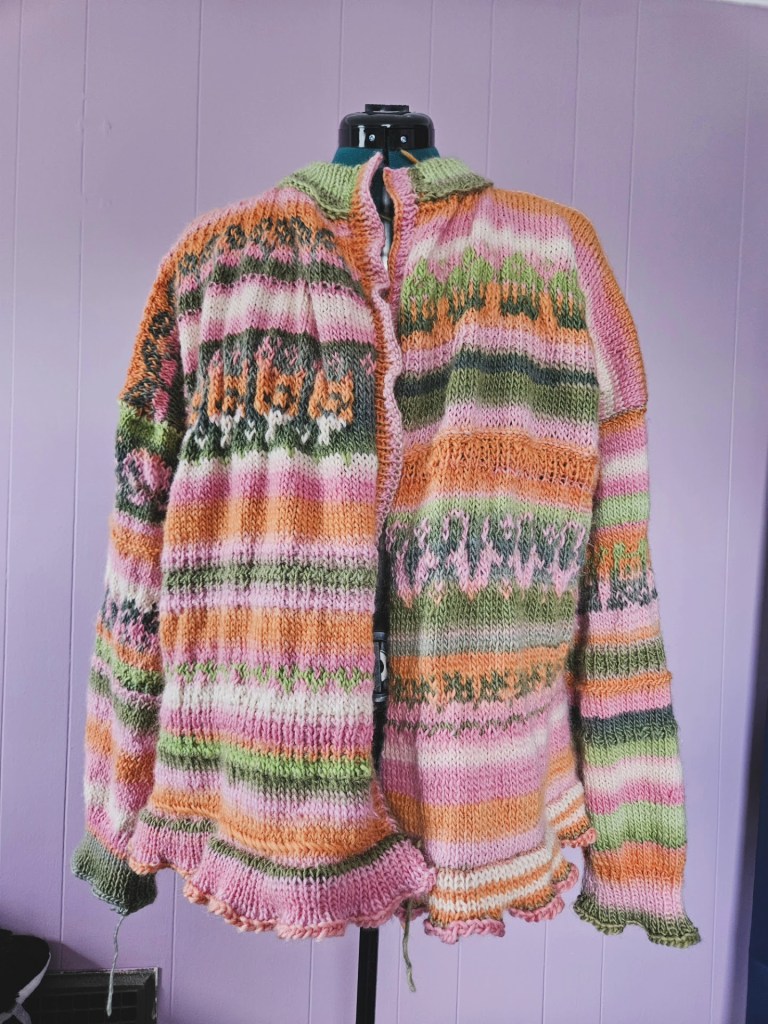
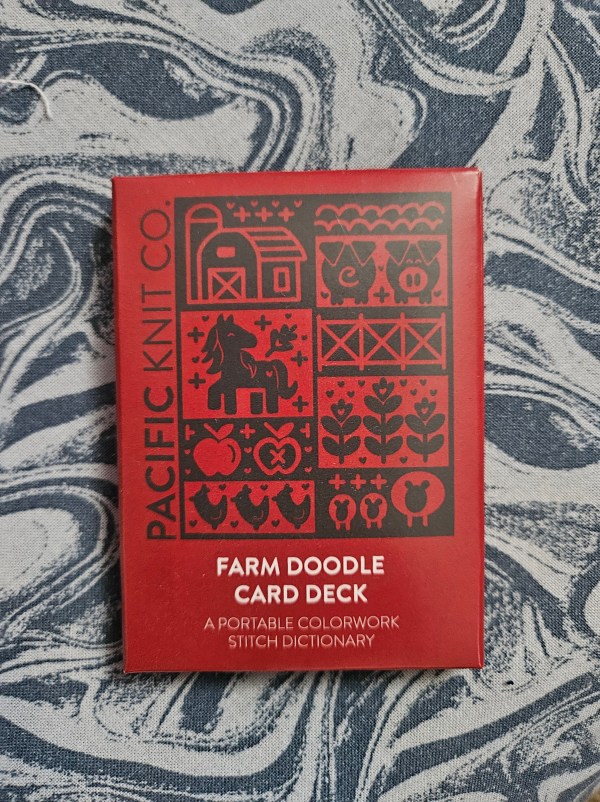
I would highly recommend giving these decks a try. I purchased the Farm Doodle Deck from my local yarn store, Moon and Yarn Craft Room to make the Town Farm Cardigan. For copyright reasons, I did not show the cards, aside from the front of the deck, but as you can see from these photos of my finished object, they contain lovely variety that will spark your imagination.

Maple Leaf Sweater

I love fall, and I wanted a sweater to celebrate that. But what makes this project even more personal to my taste, is the maple leaf motif at the neckline. Through my dad, I am half Canadian. They are from all over Canada from Saskatchewan to Alberta, and a lot from Ontario. Growing up, because of the nature of divorce and my dad’s messy relationships, I didn’t get to know this side until my twenties, and although it continues to be complicated, I wanted to knit a piece that spoke to my own heritage. Maple leaves seemed like a perfect motif to jump into. With the addition of the tonal yarn, this piece has a lovely fall gradient, that evokes the season, but doesn’t pigeon hole the garment into one season. I wear this in the winter and spring, without feeling out of place.

You may recognize the base of this sweater from my post, ‘Will I Wear a Knit T-shirt?’ and the answer for this project was yes, but, I’d love this even more as a full length sleeve! So as it goes, this project was cast back on to needles to make some sleeves, except, this time I tried a new to me technique – crochet – to create sleeves in the round. I wanted this piece to have a lot of texture, so I experimented with knit and crochet stitches to make this piece, which has a simple design, compared to my other projects feel a bit unique. In the end, I think I ended up with a lovely love letter to a part of me that I don’t always understand but are connected to even when they feel far away.

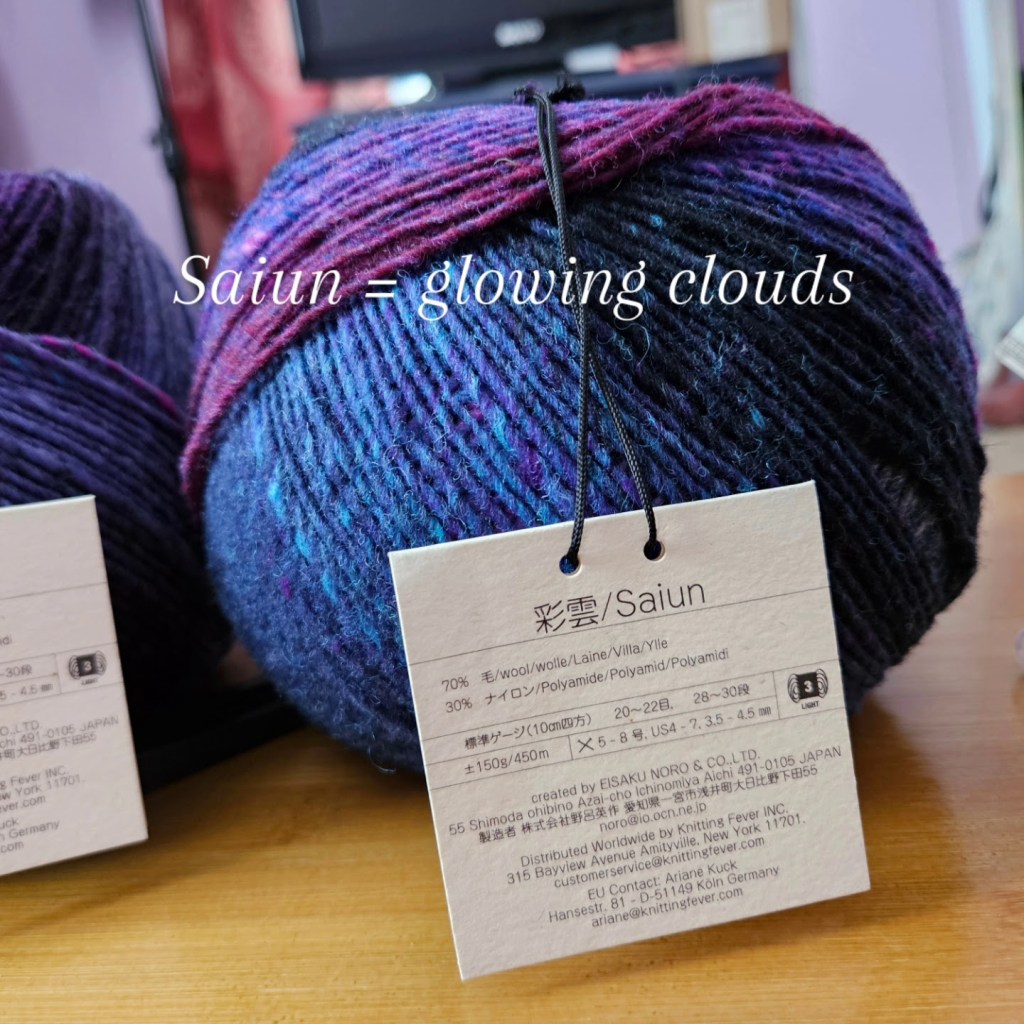
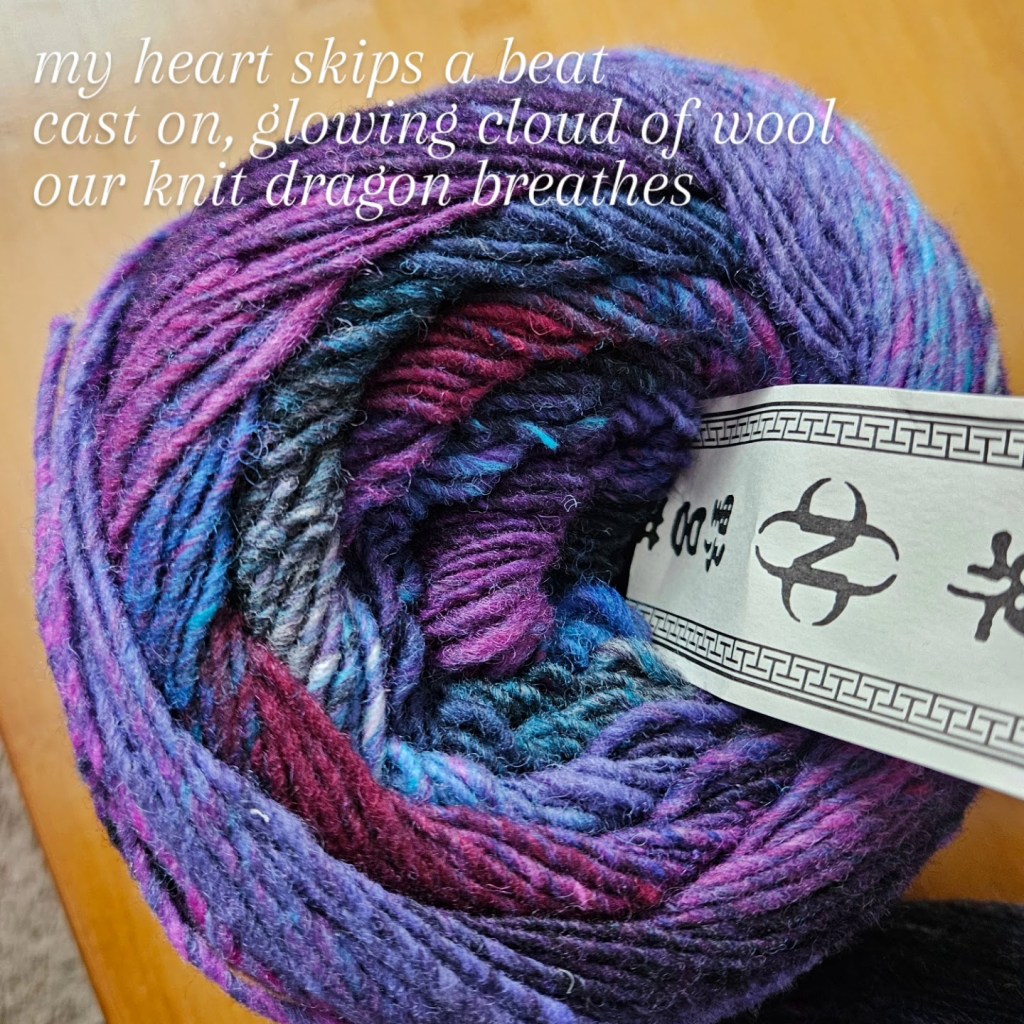
Glowing Clouds Sweater ft. Noro Yarn

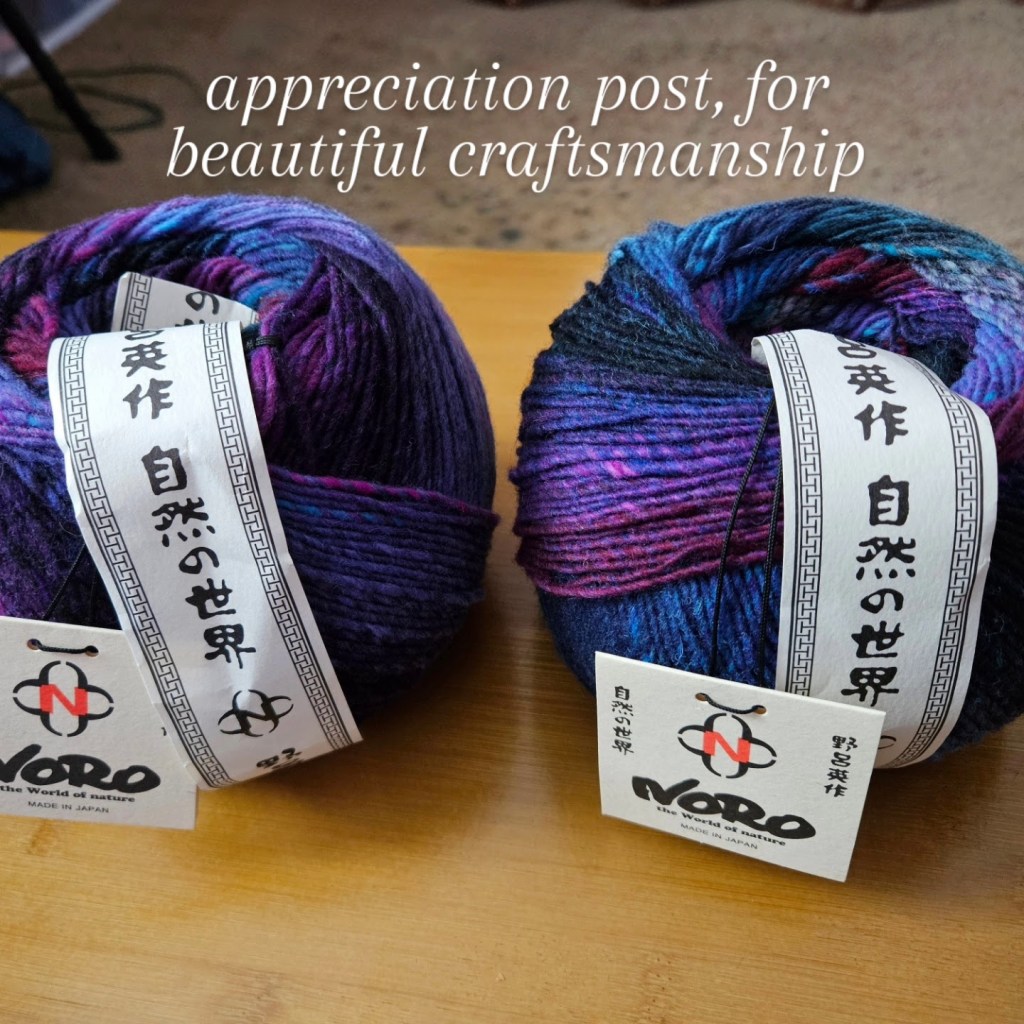
When I first saw these dragon egg skeins, it was right in the wake of Joann’s closure, I felt a sense of wonder. Like, maybe there was more to see outside the cave, to paraphrase Plato. I began to look at niche and new to me yarn brands, and Noro stole my heart.

The yarn is effervescent, floating on the loveliness of its craftsmanship. The yarn looks hand spun, although it is made on a hybrid machine. It called to me, as a knitter who had stuck to the budget yarn and avoided wool for years because the scratchiness was all I could remember. I didn’t know that wool, in spite of the scratchiness, has unique properties that enhance your stitches and make caring for your sweaters easy. Wool is antimicrobial naturally, meaning you don’t have to wash them consistently like other garments in your closet. They can be spot cleaned and refreshed between wears. The other important thing I was missing out on was the way the wool grips onto itself, it has memory, and a squish that is unlike what I had experienced with my acrylic and cotton based fibers.

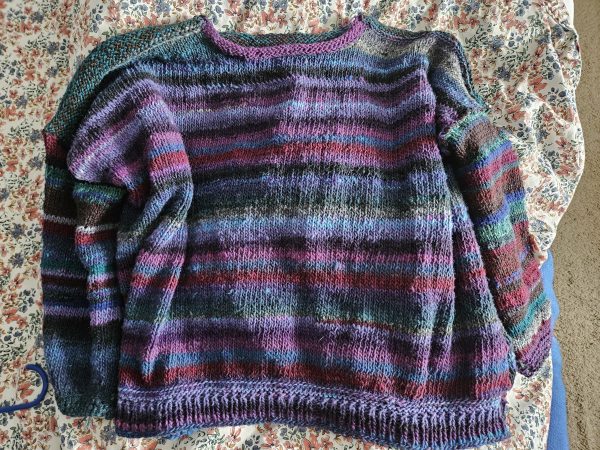
Now, the Noro had me from first sight, but how was this self striping yarn to work with? Great actually! I chose the colorway Kori, a cool toned blend of blues and purples, with occasional hints of green, red, and gray.

The pooling was well behaved and the transitions were gradual. The hand spun feel of the yarn did pose some issues for me, when it came to gauge. There were sections that were quite thick and disconcertingly thin. I did cut some of thread like sections out of my yarn, because one snapped on me as I was working with it. This led to some yarn chicken, unfortunately.

My lack of yardage was also my own fault. When I first ordered this yarn, from my local yarn shop, I had planned to make a vest. But once I felt the fabric the yarn created, I wanted a whole sweater. This was not going to be possible with 900 meters of yarn. I had to get crafty, and sourced some yarn from my stash that was a similar color and weight, and most importantly, was a non-super wash wool like the Noro. To mimic the color story of the Sauin, I was careful to splice in the other yarn where the colors made sense and I think it is hard to tell what is the Noro yarn and what is Knit Picks Palette.

So what is it like to wear? A dream honestly. It feels like a vintage sweater, like a wool sweater from the 80s or 90s, a find that would make you do a happy dance if you picked this up at a thrift store. It is minimally scratchy, warm, yet breathable. It’s made me a wool convert and a Noro stan. I want to make this over and over again. What will keep me in check is the price point and availability. Each skein of the Sauin was 35 USD. That is why I chose to add in yarn from my stash to keep this project at 70 USD, instead of 105 or 140 USD, since I am bad at guessing yardage. This yarn brand is incredibly popular, which has made it tricky to get my hands on, but I am seeing that is 2026 the yarn is becoming more common in the US. That makes me happy to see – every knitter and crocheter should give this fiber a try!

Tyra Banks, Gap Happy Stripe, and Project Runway 22

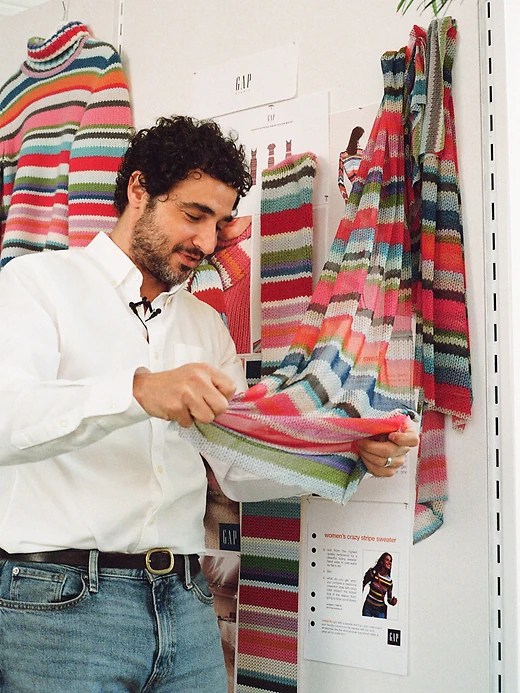
This post is a little bit of a mash up, I guess the connecting thread is Zac Posen, or maturity? I’m not sure. I’ve been mulling over two topics that have been in my head this week. The first is the premiere of Project Runway Season 22, the second, being a knitting “controversy” that I believe is not a controversy at all. So, maybe, the connection is drama fatigue?

The Television Evolution from the 1990’s to the 2020’s

Social media is bad for us, we can agree on that. It compresses nuance, and that is exactly what is happening here. But, in the case of television and the fashion industry, it seems to be brain chemistry altering, to borrow an internet term, and the effects are getting strange. This is far from a comprehensive history, just a quick snippet for context.

Television has gone through several iterations in my lifetime – from the rise of cable, to the golden age of reality TV in the 2000’s, to streaming. In 2005, YouTube transformed who could occupy our attention, shortly following in 2007, the Iphone brought a new screen to our lives. In 2020, Tik Tok became the supreme ruler of culture, with the short-form content revolution. Now, in 2026, streaming platforms of shows and film, are self aware that they are the second or third screen vying for our goldfish-like attention spans. This is bad for business. What are networks supposed to do? I’d say they are letting this short form content culture lead.

Enter Project Runway Season 21 and its new, Tik Tok and YouTube editing style with quick cuts and comedy edits, that are self-aware to a level, that was a bit jarring to me. It was like internet culture was uploaded to an established show of 21 years, in order to modernize it. It did just that, it laid its cards on the table of what producers think a successful television show must have in the mid-2020’s – drama and internet-personas instead of contestants, in my opinion. It’s only gotten worse with the announcement of Season 22.

Why is it so loud here?

It’s noisy. I feel like everything about the show is shouting at me. I tried watching the first episode, and quit after the intro. Instead of letting the viewer sit back and engage with the show, the show demands shock, shade, and a level of seriousness that is simply undermined by how the contestants, presenters, and judges act. They are caricatures of humans. Like Zoolander or The Devil Wears Prada, it’s not an accurate representation of human behavior. The drama has been dialed up to a point of puppetry and theater, which would be fun if it was for say, in the pursuit of comedy like RuPaul’s Drag Race, which I am a fan of. This version of Project Runway is not about the clothing or the craft of sewing. It is for the purpose of creating internet buzz and translating that into streaming numbers. It feels so trite to say that. Project Runway is a business, what I miss is the illusion of the storytelling.

Tim Gunn, Zac Posen, Michael Kors, and Nina Garcia brought an industry seriousness to the show that provided context. With the elimination of all but Nina Garcia, and the death knell of losing the spot to show at NYFW, the legitimacy of the show is in shredded. What is all for? Internet fame. Even the challenges were different last year, with sponsorship themes shoe horned into a semblance of “design criteria” and it felt off. For example, the PNC “brilliantly boring” challenge to use boring fabric. There was the Eczema awareness challenge, that should have gone deeper, but instead gave us a concept and then quickly shooed it off screen.

In contrast, I have gained greater appreciation for Drag Race and its the commitment to staying on topic.The causes presented on the show seem genuine and it is refreshing! Like it is all in alignment with worldview.

Lack of Integrity in the Fashion Industry

I think this is because to have a clear worldview in the fashion industry right now, it has to be political, and they don’t want to do that at Disney, and so the political stances are muddled for the sake of saying nothing. Which is a political stance, indifference is infuriating with the amount of clout the show claims to have. This show is fashion “influencing” but make it a reality show.

The worst part of this muddled stance is the inclusion of Tyra Banks. The Netflix documentary from this winter makes sense now, it was a PR project to rebuild Tyra’s image. I grew up with America’s Next Top Model, created by Tyra Banks. I watched ANTM long before Project Runway, and it was a sh*tshow.

She let the cameras roll in Season 2, when a dangerously inebriated contestant, Shandy, experienced SA, and then Tyra had the gall to keep her from the hospital and police, to keep filming. She framed Shandy as an example of cheating, and publicly shamed her for a decade. She pressured contestants, Joanie and Danielle to undergo dangerous dental procedures. Tyra created photoshoots promoting blackface.

She fat shamed and encouraged ED on the show, ignoring the dangers of ED, all while shaming contestants who couldn’t “hide it” well enough. This is just a short list of the problematic behaviors on the ANTM show, a show that preyed on young women of color, and then made a mockery of them, reinforcing racism again and again for profit. I have no interest in watching a show that Tyra Banks is a part of, when she danced around an apologize in her documentary and, in my opinion, did not take any responsibility. Just have integrity, it’s all I ask for. Apologize. Truly make amends and rebuild your reputation through real change. This path is not fooling anyone.

Connecting the Two

Okay, so how are my two topics connected? Well first off, I wish they had brought a quality judge back like Zac Posen, but secondly, I think as much as people are not up in arms enough about Tyra coming back to television, I think the internet is always trying to drum up knitting controversies, that are not that serious.

I was definitely dragged into caring about The Game of Wool, by my corner of the internet, and proceeded to make a bingo card, as my farewell, once I realized I didn’t give a hoot even if this show was a let down. The most recent “controversy” I’ve seen is the Gap Happy Stripe collection for Summer 2026, promoted by the CCO, Zac Posen. The collection is not a knitwear focused throwback, instead it utilizes technology to make something “knitwear” centered. The image of the original knit has been printed on a mesh collection, that I believe has a decently high polyester content, because mesh.

As a fiber artist, if I want a happy stripe inspired piece, I’m just going to recreate it. Done. I don’t need to feel slighted by Gap, or be frustrated that they are not centering knitters with “fake knitwear” as I have seen touted on the internet. Gap is a fast fashion company, the knitwear would be machine knit, and the workers are not being compensated fairly. It’s the fashion industry, its problematic. They make poor choices and they create a ton of pollution. They also favor tech “innovations” so this is not radical, it seems inline with Project Runway to be honest.

I don’t think Zac Posen should “canceled” for this or for us to spam Gap, with anger that knitters have been slighted again. I don’t buy store bought knit anymore. I certainly don’t buy store bought crochet, because its either fake or created with slave labor. I try to buy thoughtfully, make what I can, mend, up cycle, and treat clothing as a permanent object. I think that is the best we can do right now. The problems with the fashion industry are not contained to Gap. It’s world wide. I have no reason to buy a mesh printed garment, so its a moot point for me. Protect your peace, the world is incredibly messy right now, this is a drop in the bucket.

Do you remember the Gap Happy Stripe collection? I don’t. I remember colorful knitwear from the early 2000’s and wearing one from Old Navy or Aeropostale. I’m getting tired of the internet shouting. I’m getting tired of endless knitting drama. I’m quite tired of dumb reboots of shows I liked. Whew, I think it I did it! Thank you, reader, hanging in with me on this random post. I hope you have a wonderful weekend. ❤

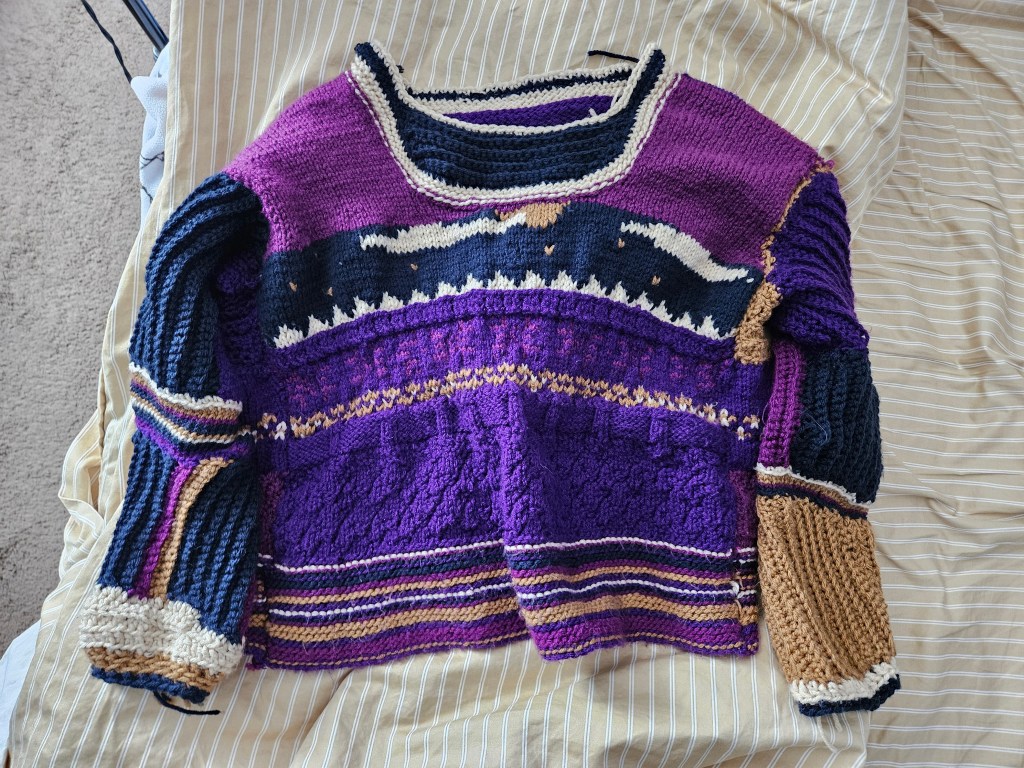
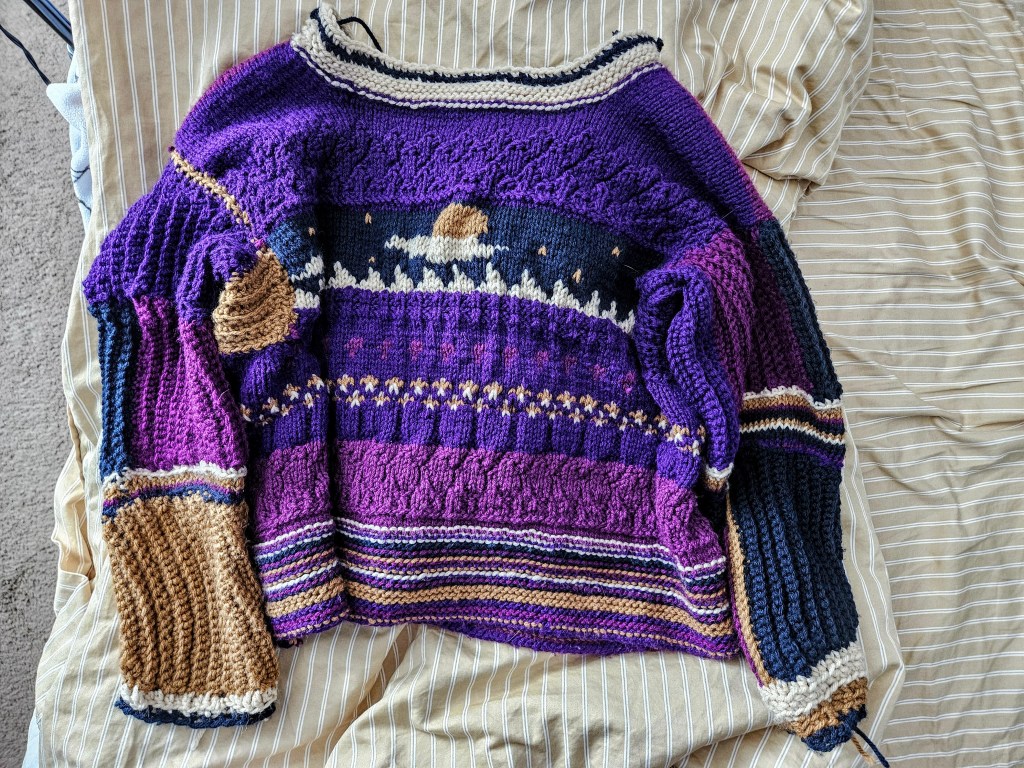
Night Sky Sweater

I’ve mentioned this before, but as a maker, I revisit a single project many times before it is done. Sometimes I will live with a finished object for a month, a few months, or even a year, and suddenly pick it back up again to adjust something that feels off. Honestly, taking a season or two away from that garment – such as, putting away a dress for the winter, or a sweater while you sweat it out for the summer, can give your mind the space to forget and re-acquaint yourself to the garment like you picked it up from the store. It is a whole new piece again, which can lead to me be less than thrilled with past me and her design choices.

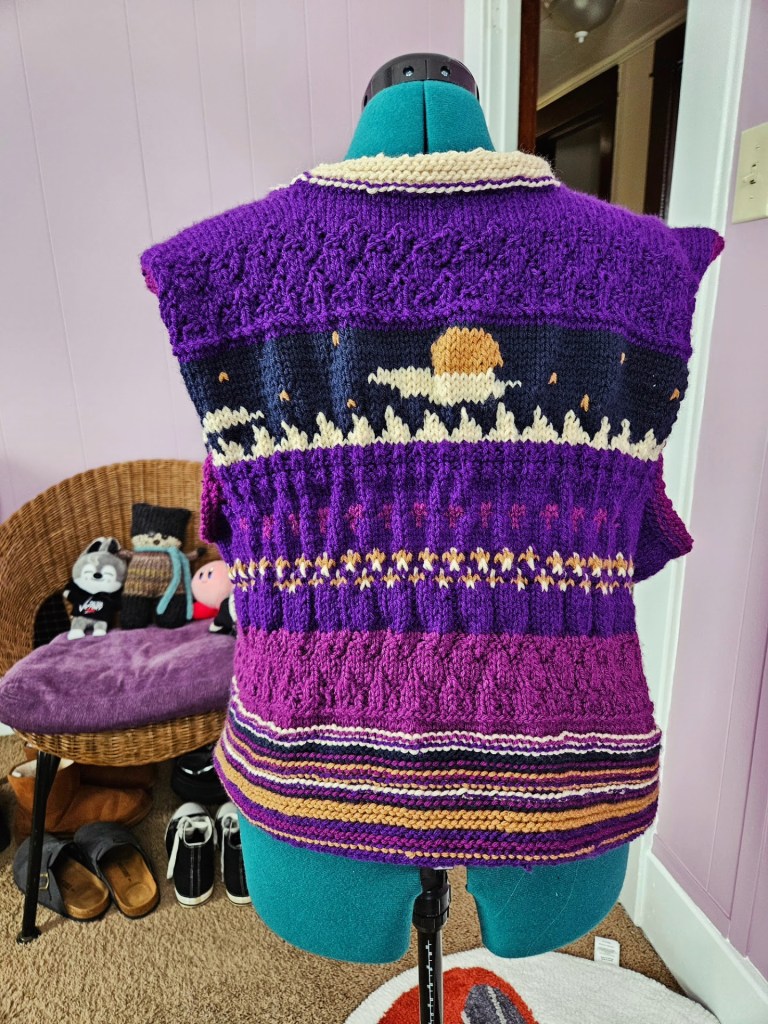
Take this vest for example, I began this project in December 2024, wrapping it in February 2025. I wore it a few times, as it stands as a vest that winter and spring, then it was put away for the warm weather. When cool air returned in the fall, I pulled it out of its drawer and set it on my dress form. This vest did not feel complete, it had more to say, even though my hands were weary back in the winter, so I stopped and called this piece done. But its not done, it would be a gorgeous colorful sweater, and it was time to go back to this garment to make it whole.

Now, this was a self drafted piece. A complicated self drafted piece that helped me cut my color work chops in a garment. This was the first sweater I made with such a large color palette and the first time I decided to make a knitted piece with the motivation of telling a story. I wanted to evoke a winter sky, with a moon that was visible on the front and back. A moon with stars, and clouds, floating above a forest. This sweater would not only feature colorful forms across the fabric, it would have texture. I chose to use the ‘seersucker stitch’ as it was labeled from a Pinterest chart, to weave a diamond texture into the fabric for a 3-D plush effect. I chose large and miniature color work sections to create ebb and flow in the color story.

For the bind off, I had grown tired of the classic 1×1 rib, so I tried something a little different! I chose to create tight stripes, knit stitched together. Instead of stockinette which used knit (right side) and purl (wrong side) for it’s classic construction, I decided knit stitch, knitting the right side and wrong side, would stabilize the stitches for a lack of curling in the finished fabric. And it worked! The technique and color changes ground the color palette for a cohesive garment.

Keeping these previous choices in mind, when it came time to add sleeves and a new collar, I chose to employee a new to me technique, crochet. I wanted the sleeves to be made in the round, and be completed quickly so I could wear this piece for most of the winter. Crochet is much easier to do in the round, and to make progress quickly. The crochet stitches allowed me to work in new directions too, so the sweater had vertical texture to contrast with the horizontal lines of the original vest. With sleeves complete, this is one of my favorite pieces to date. It tells a story. The color palette reminds me of Stardew Valley. The cloud on the back reminds me of an episode of Avatar: The Last Airbender when Appa is missing, and Aang thinks a cloud flying above is Appa floating above. I love the variety of colors – gold, navy, magenta, violet, and cream.

This was a labor of love, but I would highly recommend trying a complex project such as this if you are interested in making your own garments. Not only does this piece express my identity, it taught me how to be a better fiber artist. I feel proud each time I wear it. Get inspired and start stitching something from your own imagination!

Town Farm Cardigan

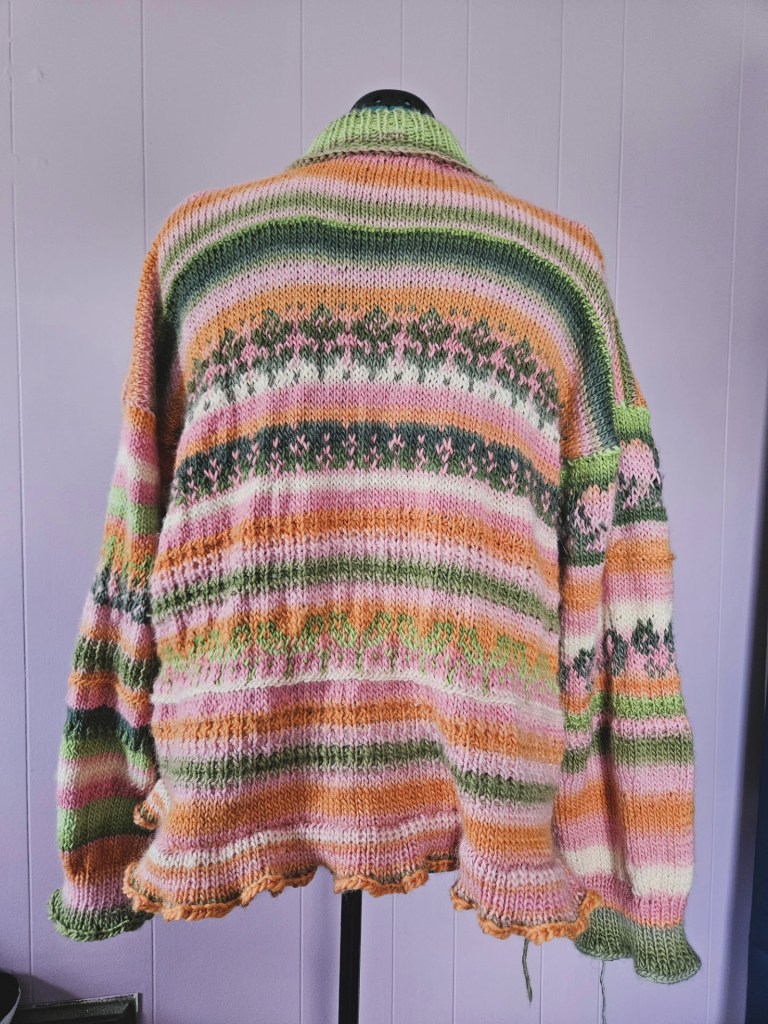
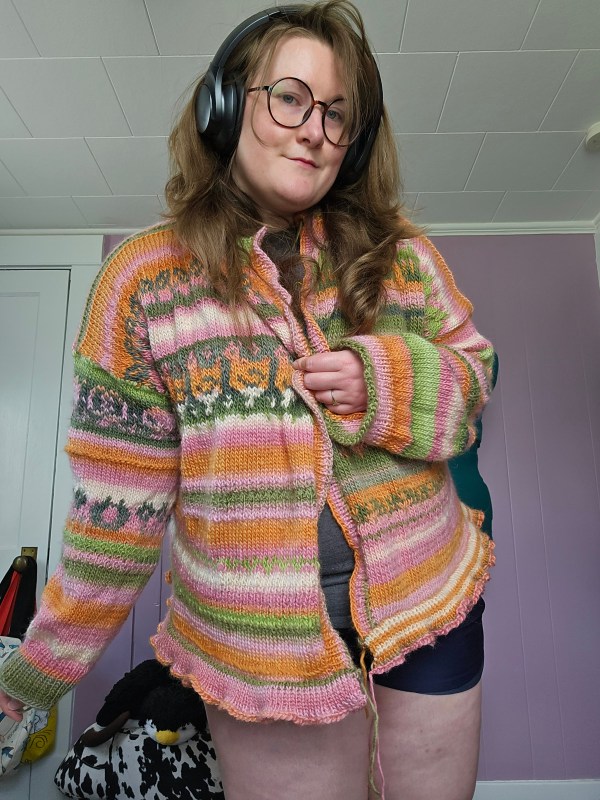
I wanted to make a cardigan that celebrated our garden, with a yarn inspired by Beatrix Potter, that was made from wool, and featured a fair isle design. To do this I used Pacific Knit Co’s farm doodle deck and Knit Picks’ Chroma Worsted Weight yarn in the colors Beatrix and New Leaf. The Chroma yarn has become a fast favorite of mine for its durability and delicious halo. The yarn is comprised of 70% super wash wool and 30% nylon. This was a bit of a stash busting project, and a splurge. I wished to use up three skeins of deadstock New Leaf, finding the pink-orange-white of Beatrix was the perfect spring-inspired color palette upon which to build. Using a gift card from Christmas, I purchased 6 skeins of Beatrix, although I had to repurchase more with this project using thirteen skeins in total. Not cheap! But worth the splurge to create a piece I plan to wear for the rest of my life that celebrates the garden we have created here at our new house. It’s our in-town farm, as our friend calls it.

The bulk of this project was done on US 8 straight needles, and seamed together using a 5.5 mm crochet hook. The bottom ribbing was created using a US 4 circular needle. The size reduction of 1.5 mm, changed the gauge to create this floral ruffle along the bottom edge. At complete accident! But I like it. In addition, I used mostly stockinette stitches, with 1×1 ribbing at the cuffs, collar, button band, and bottom hem, and the seersucker stitch for added texture, in between color work sections. Will I add buttons? I am uncertain. The original plan was to use buttons, and have purchased buttons, yet I like to wear my garments first beforehand, to see if I want to wear the garment closed. Since yesterday was the Summer Solstice, I have a while to wait!

This garment took approximately 4 months to complete, along side other sewing, crochet, and knitting projects.

Catch of the Day Sweater

In 2025, sardines and other tinned fish became more than just food; they appeared on beaded bags, shirts, and prints. They also made their way to the fiber arts community, which inspired me to make a fish print sweater for Kyle, who enjoys fishing IRL and in video games. I just like the video game version.

The Design Concept

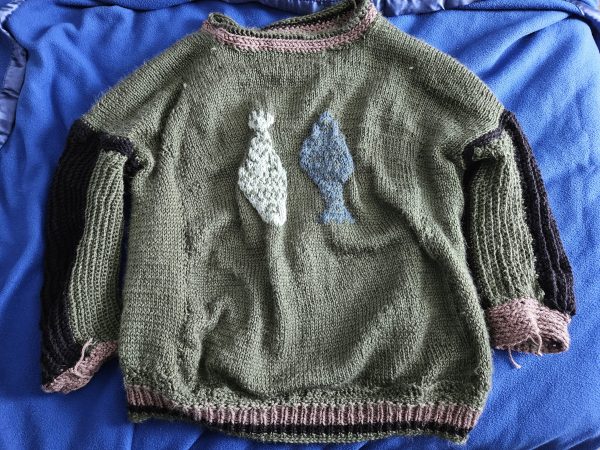
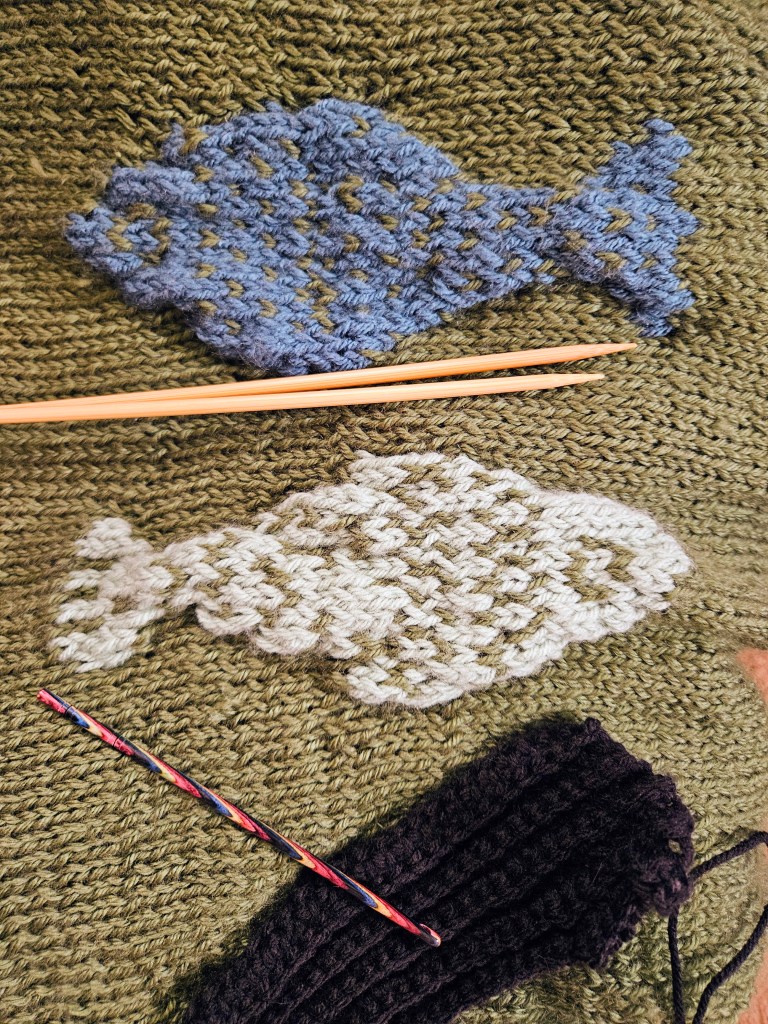
When planning a garment with a colorwork motif, I always consider scale, placement, and repetition. To do this, I use what I learned in art class many years ago – the seven fundamentals of art. So I consider line, shape, color, value, form, texture, and scale. In the catch-of-the-day sweater, it was important to make the fish wearable and to ensure good form and function. How do I make the fish on this sweater make sense? I decided to hang freshly caught fish on the sweater to help with the scale of the art. I placed them in the center, on the front, only to keep the perspective of this in focus. I thought placing more fish would become overwhelming to the eye and become unwearable.

Adding more fish would have required adjusting the scale and the color, meaning I would have simplified the sweater down to two yarn colors only, with sections of fair isle colorwork, which is a smaller, more concentrated technique. But I like the color contrast of using two colors, representing two types of fish with slightly different scale patterns. How big is too big? How do you represent a fish, with their scales and texture? For this, I went to Pinterest to find cross-stitch or knitting colorwork charts for inspiration. I believe I settled on a cross-stitch pattern because it had the detailed lines and scale I was looking for. I wanted the fish to look realistic, although it could be in an imagined world like Animal Crossing New Horizons or Stardew Valley. Whimsical? I think that is the best way to sum it up.

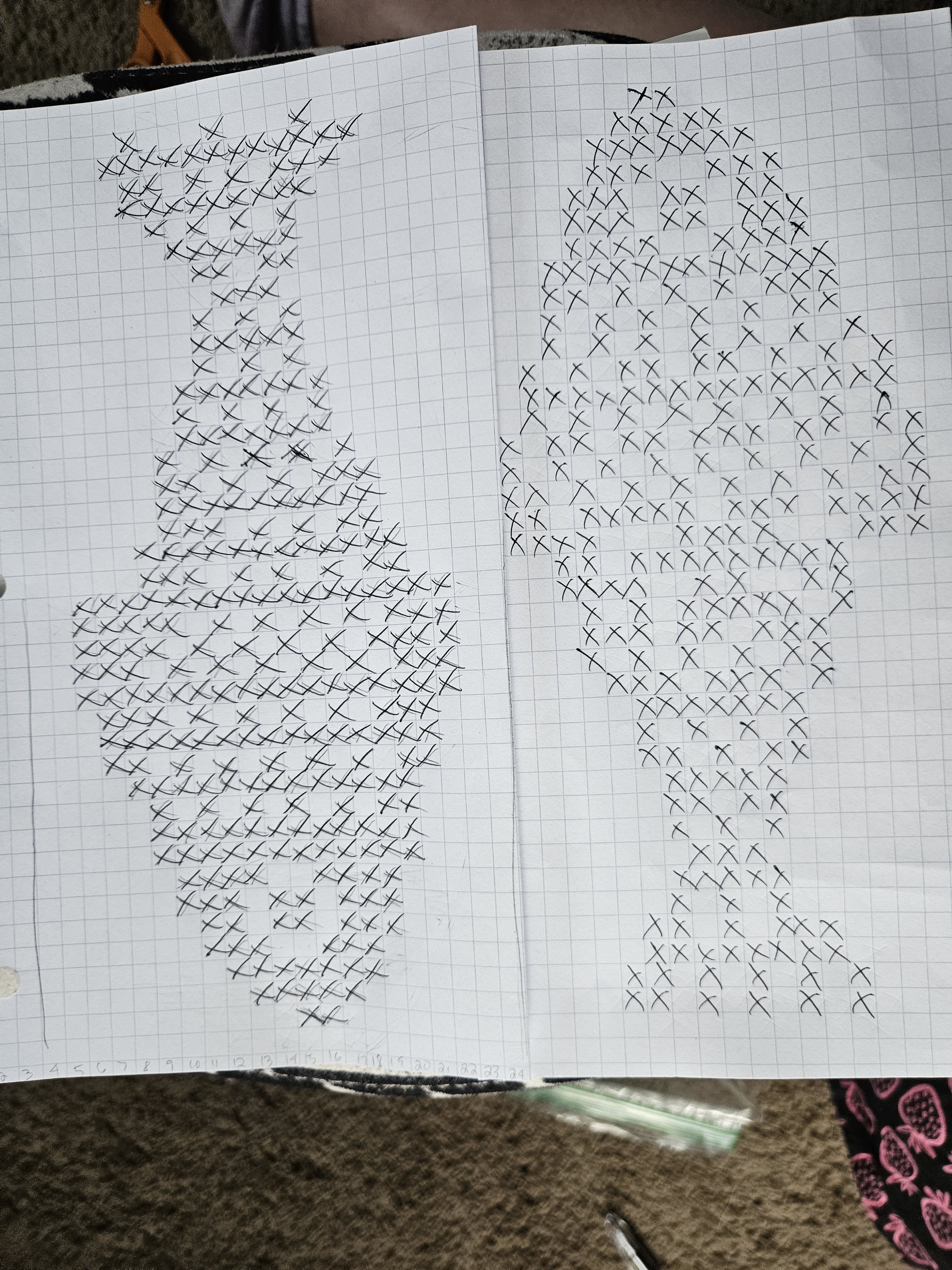
To make my pattern, I used the cross stitch reference and transferred it to graph paper by hand, tweaking some areas to make the inspiration my own. I did this in the same application for my Red Velvet Cosmic Knit Tank project. Next, I needed to determine the scale of the fish within the sweater pattern. It’s important to plan out how many stitches you need to complete the colorwork section across your rows and keep it centered. To do this, subtract the number of stitches in your colorwork pattern from the number of stitches in your row. Divide the sum by two and adjust to keep the stitches on either side equal, to keep the pattern centered. It is also important to note how tall the color work pattern is compared to the garment you are knitting, to allow enough room above and below that the graphic motif makes sense and doesn’t look misplaced on the garment. I think I literally held my pattern up to Kyle’s chest to figure it out.

Fiber Content

For this sweater, I went in a different yarn direction to try something new. I chose a wool and acrylic blend from Knit Picks called Mighty Stitch. It was underwhelming. The yarn, while soft, pills something fierce. It is also a slim worsted weight, which was exaggerated by the large needle size I used – US 10 or 6 mm. This created a breathable, airy sweater, but dang, did it throw off my pattern and design. Eventually, I had to face my fate – I was running out of yarn, and my panel was too narrow. Not exactly the outcome you want after spending a week on the front panel with the intricate fish design. I would rather start over than frog the color work, always.

I had some decisions to make. I originally purchased the Mighty Stitch on sale, but when I ran out of yarn, it was not on sale, and I wasn’t interested in doubling the price of this already too expensive project that was in the process of failing. So like Miss Frizzle recommends, I got ready to “Take chances, make mistakes, get messy!” I went to my closet of yarn and fabric and began to dig through the stash for something else I could introduce into the design. I found a warm-toned gray and neutral black yarn from Big Twist that was also worsted weight. Because the Mighty Stitch is a washable yarn, I felt comfortable combining the two yarns. I had already introduced acrylic yarn to the project through the mint and teal fish, using scrap Big Twist for those sections. Always check your fiber content, though, to avoid incompatible fibers that will make the project hard to care for over time.

Making a Change

The original design was changing from color palette to overall concept. This sweater would need to have color blocking sections now, to stretch the main green color. I decided to not only change up the design, but to change up my technique, opting for crochet on the sleeves to make the sleeves go faster. Knitting is a slow craft, and for some reason, knitted garments for Kyle have this curse of going horribly wrong and also knitting up slowly because of the hiccups. I wanted him to be able to wear this sweater for the bulk of the winter season of 2025-2026, and I was knitting this in August-October, so I took a shortcut. But in my defense, the texture of the sleeves, ironically, looks like fish scales to me. Especially with the gray and black colors!

The second change I made was adding width to the sides of the front panel to make the sweater a drop shoulder. I then knit the back panel wider from the start, and added a section of gray on the middle to upper back panel. It adds a nice contrast to the overall composition of the sweater, while making the sleeves feel cohesive.

Men vs Women Shoulder Shaping

The shoulders gave me such grief in this project! I’m used to making sweaters for myself and my female form. The bust makes the shoulders rest differently than I realized, and this came back to bite me. For a man’s sweater, the back needs to be longer. Especially the shoulder section on the back of the sweater is going to ride up the back, and be too long in the front. This happened, and I was bamboozled on how to fix it. Enter short row shaping and the principles of perspective and scale.

I learned that I needed to add short rows, meaning only working a section across a row to add length to a specific portion of the back panel, the back middle. To do this, you work back and forth on the section, evenually go back to working across the entire row. In addition, I made the back collar and back ribbing longer to compensate. These simple changes made the sweater appear the same length back and front, draping across the shoulders pleasantly, even if one side was technically longer. It doesn’t matter because of the role of perspective. Magic!

Final Thoughts

I learned a tremendous amount of knowledge from the Catch of the Day sweater, and I am grateful it all came together in the end to make a sweater that Kyle enjoys wearing. I have saved my patterns to attempt this again in the future with better yarn and proper dimensions to make the pattern fit well from the start, instead of scrambling to adjust at the end.

How I am Preparing to Leave Pinterest, if OpenAI Buys Them

I want to start off by pleading with Pinterest, please don’t work with OpenAI. (I know this is purely a rumor, but even so, I think using the internet to voice opinions is important.) I have been using your platform since 2012, and it is so useful! It has become less useful over time, with the “purely financial” decisions of peppering in a multitude of advertising pins and allowing AI-generated art to invade the platform. Even so, it is still a platform I use and love to escape into for inspiration.

Without Pinterest, creative writing projects like Udal Cuain, knitting colorwork projects, sewing projects, and home decor ideas would have been more difficult to source and may not have been on my radar – ever. I’ve even learned simplified versions of songs to play on the piano before I bought proper books, for free through Pinterest. Now what about fandoms? On really difficult days, my Stray Kids board is filled with memes, SKZ Code, captured moments from lives, silly edits, and STAY inside jokes that would not exist in one place to make me smile.

I don’t want to leave Pinterest at all, but there comes a time when we must make a stand for what is right – if you integrate with OpenAI, as rumors have thrown around, many other like-minded individuals, and I will leave because, as artists, we will not stand for the theft being carried out by generative AI of our work. Art is human. Generative AI is regurgitation. Art is for an audience of many; AI-generated art is for an audience of one. Human-made art has emotion; AI-generated art is the result of algorithmic decisions. AI-generated things are not new; they are not groundbreaking. They are human effort and human creativity scraped by these computers and served up as “new” all while consuming vast amounts of electricity and clean water, for nothing but perceived “innovation” that makes these tech bros wealthier. It gives nothing to humanity; it feeds the greed of the few. Alright, that’s enough of looking into the abyss for me.

How do I plan to make this change if Pinterest is bought by OpenAI?

  • Crafting Books
  • Used Books, Magazines, and Catalogs
  • Respectful Fan Accounts on Instagram
  • Physical Notebooks
  • Migrating to Milanote
  • Blogs and Research
  • Building a Creative 3rd Place Elsewhere
  • Creating Your Own Charts
  • Physical Moodboards
  • Acknowledging Frustration
  • Diving into History
  • Utilizing Libraries

Yes, we’ll be going back to analog inspirations, like going back to the 1990s and 2000s. I’ll be crafting even slower, researching longer, and spending more time digging to learn how to do new techniques like fillet crochet or how to paint using gouache paints, but that’s okay. At least it will be honest inspiration. In time, we will all come back together through a new creative community platform, and it will be a bit of a waste of time. So, Pinterest, put these rumors to bed, please, because when it comes to AI, we artists mean business, and you will be left behind.

Thanks for coming to my TED Talk ❤

Create a website or blog at WordPress.com

Up ↑