
I probably should have written this post before mid-June, but I wanted to gain enough experience with this fencing before giving my thoughts on it. And after using it for a couple of months, I think the time is right. Before introducing this year’s fencing, I want to give a brief overview of what we used last year.
Using Deer Fencing in 2025
Last year was the first garden at our house, so we had to buy a lot of stuff to get it ready. As a result, we looked for the most affordable fencing option we could find. After considering a few options, we went with rolls of mesh fencing that is designed to prevent deer from getting into orchards. Each roll was 100 feet long and 7 feet tall. We used bamboo poles as the fence posts, and apart from tangling, it was pretty easy to install. And for the first few months, it worked perfectly. It kept most animals out and did its job. However, around mid-to-late August, we started having issues with it. Larger mammals like deer and raccoons were able to break through the fence and get to our corn and melons, which they treated like a buffet. We attempted to fix the holes by patching them with sections of fencing, but that didn’t work. Eventually, we gave up on fixing it and let the animals have their way.
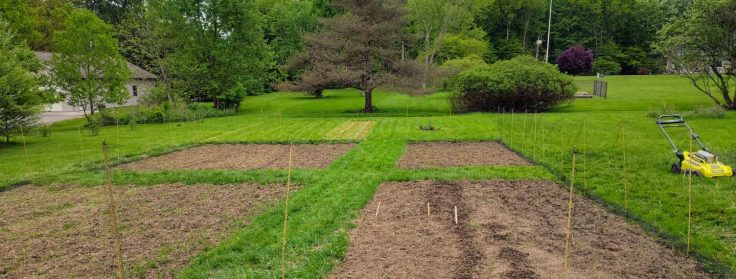
So, even though we bought the fence to be a short-term option, it didn’t last as long as we were hoping it would. It tore easily and got entangled with the grass growing along the bottom, which made pulling it out at the end of the year a nightmare. So, we knew that we’d need something better this year.
What Is Snow Fencing?
We again knew that we weren’t looking for a long-term fencing solution this year. Putting in a permanent fence is quite an investment. We also aren’t sure what we want a fence to look like or if our garden is the size it’s going to be long-term, and we want to upgrade to a permanent fence in sections so that the cost is spread out. So, we needed something that was more durable than the mesh fencing from 2025 but was strong enough to be used multiple years without being permanent. There weren’t a lot of options that fit these needs, so we circled back to something we considered last year: snow fencing.
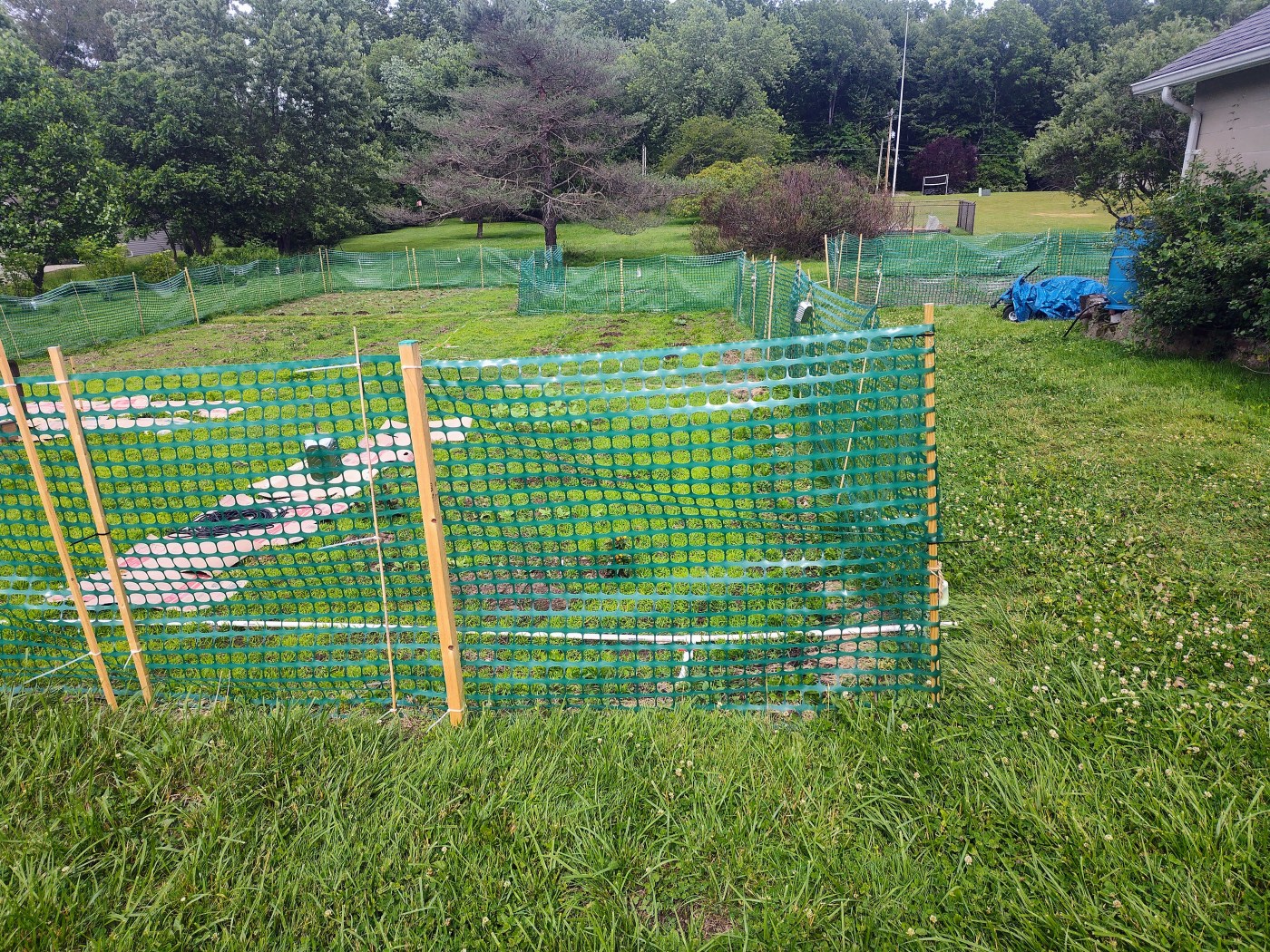
Snow fencing is also known as construction fencing. It’s often used to prevent snow from drifting across open fields and to block off construction sites. It comes in a variety of colors, including black, orange, and green (ours is green). It’s made of a thick plastic and has roughly 1-inch holes in it to allow air to pass through it.
This fencing interested us because it is 4 feet tall, comes in 100-foot rolls, and is light. It’s also pretty cheap. We bought ours from Lowe’s, where it was cheaper than Amazon, and they were able to ship it faster. For 4 rolls of fencing and a 100-pack of zip ties, it was just over $150. Ironically, this wasn’t much more than we paid for the rolls of deer fencing last year.
How Hard Is It to Install?
Compared to the deer fencing, the snow fencing was very easy to install, although it does require two people. We chose our starting point, started to unroll it, and laid it on the ground around the garden, giving ourselves some extra room. For the posts, we thought we could get away with using lightweight stakes at the corners and “gates” and bamboo poles in between since this is what we used last year. That wasn’t enough to keep the fence upright, so I cut more fence posts out of pressure-treated 2x4s, getting 6 posts out of each board. With each post 5 feet long, they were sunk a foot into the ground. We attached the fence to the posts and bamboo poles with 3 zip ties on each, and I used a staple on the top zip tie to anchor it to the pole/post.
We followed this process around the garden until we finished out a roll or reached the place where we wanted a gate. We wanted the end of one fence roll and the start of another to overlap on one of the bigger posts so that there is plenty of strength. For gates, we used one post for the start of it. This served as a “pivot point” for the fence. A second post was used to establish the end of the gate. At this point, we cut the fencing and installed a third post that acted as the frame for the gate. This is the post that we latch the gate to with a twist tie.
It’s a simple design, and because we had experience installing last year’s fence, we installed this year’s in an hour and a half. There’s no need to be intimidated by this type of fence, and if you buy fence posts, you don’t have to use any saws. It doesn’t tangle when installing, it’s easy to cut with a pair of scissors or a utility knife, and with two people, one person can hold it up while the other zip ties it to the post.
Our Experience With Snow Fencing
In general, we’ve been very happy using snow fencing for our garden. It was much easier to install than we anticipated. Each roll went further than I expected, so we only used 3 full rolls and a portion of the 4th one even though we expanded our garden this year.
It’s proven to be durable so far. We had a pretty significant thunderstorm last weekend, and the fence withstood it without any damage. That doesn’t mean it’s impermeable, though. There are a couple of places where a rabbit has chewed through the plastic, creating a hole for it to get into the garden. Luckily, it can be fixed, but it is a nuisance.
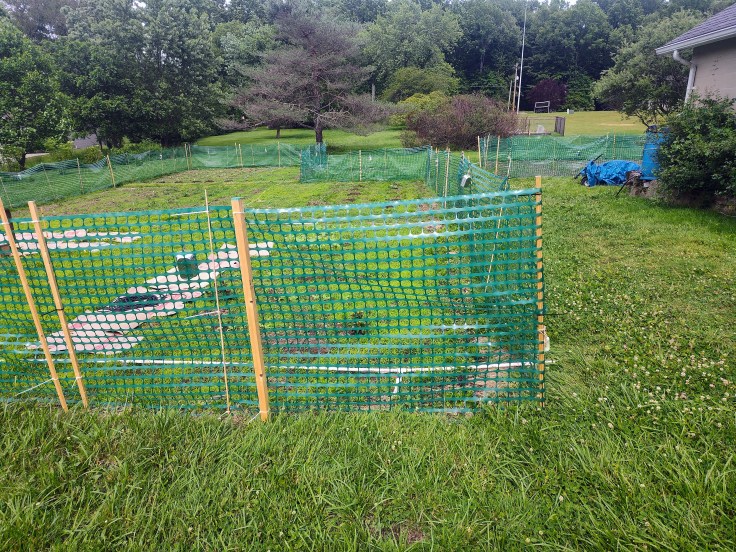
We love how the fence looks. There were some concerns with how it would look in our yard and whether or not it would stick out like a sore thumb. This was a key reason we didn’t go with snow fencing last year. We only thought it came in black and orange, and neither was going to look good. However, prior to buying the fencing this year, we saw the green color in store and were confident that it would blend in with the grass and plants and not be an eyesore. The fence looks like it belongs around our garden. It’s opaque enough that you can see it from inside our house and notice if there are any issues with it while still being transparent enough to see the plants inside.
This brings me to my last takeaway. While still being light, it is much heavier than the deer fencing. Duh, right? We knew it would be heavier, but what we didn’t consider is how this would work with our fence posts. I thought the bamboo poles and lightweight fence posts would be sufficient. That proved to be an error. When we installed the fencing, the ground was soft after we received a lot of rain in April. This made it easy to install the fence posts, but it also meant that the posts and poles worked themselves loose as wind came across our yard. We continued to add more posts, but eventually, we had to upgrade the posts with something much stronger than the small 3/4-inch square posts that I had been creating.
One Saturday afternoon, we came back from eating lunch with Magz’s parents and saw that heavy wind gusts had blown portions of the fence over. I cut a 2×4 in half to make two 1 3/4″ x 1 1/2″ posts that were 5 feet long. Each post was cut to a point, and my father-in-law and I hammered them a foot into the ground before attaching the fence to them. This proved to be the necessary upgrade, as the fence stayed upright through the rest of the gusts we received. I’ve since had to add a couple more of these heavy-duty stakes throughout the garden, but I’m confident that the fence is strong enough to withstand thunderstorms this summer.
We are pleased with our decision to use snow fencing for our garden. It has surpassed all expectations to this point, and I think it was the correct choice for our needs. Only time will tell if it’ll deter deer in late summer and early fall, but for now, it’s been everything we could have hoped for.
 One Rabbit Riot