I’m modifying this prompt slightly to focus on one aspect of my life – sewing. These are the three tools I can’t imagine working without. After four to five years of sewing clothes and trying out various tools and techniques, these are the cream of the crop for me. This is my just opinion. Depending on your sewing style and personality, this list would probably change. I’m sure if I was a sewist who went to design school, I would also have a different list.
Fabric Clips –
When I started sewing, I had no idea fabric clips were an option. I bought a Dritz tin of straight pins and a pin cushion. This is where things began to get uncomfortable. No matter how careful I am when I use pins, I stick myself. When I use pins for a fitting, the pins slip out of the fabric and scratch my skin. I find the pin tins spill easily which is terrifying if you don’t notice it because you are then surrounded by pins in a spill around your feet. When I found fabric clips, my sewing experience improved 180 degrees. I don’t get stuck and the clips stay in place. I can try things on my body and the dress form, without the discomfort of pins sticking or the annoyance of the pins slipping out of place.
Sashiko Adjustable Ring Thimble –
I’ve tried two kinds of thimbles. The first was the cylindrical metal thimble, which I found hard to use. It fell off my finger or I simply struggled to find the correct finger to place it on for my sewing. I tried another metal thimble that looks like a fencing mask, with an adjustable back. It stayed on my finger just fine. I could make it tighter or looser or move it to a different finger but it still felt odd. I noticed the thimble wasn’t providing the support I needed to push the needle through the tough fabric and in turn, was putting stress on my finger joints.
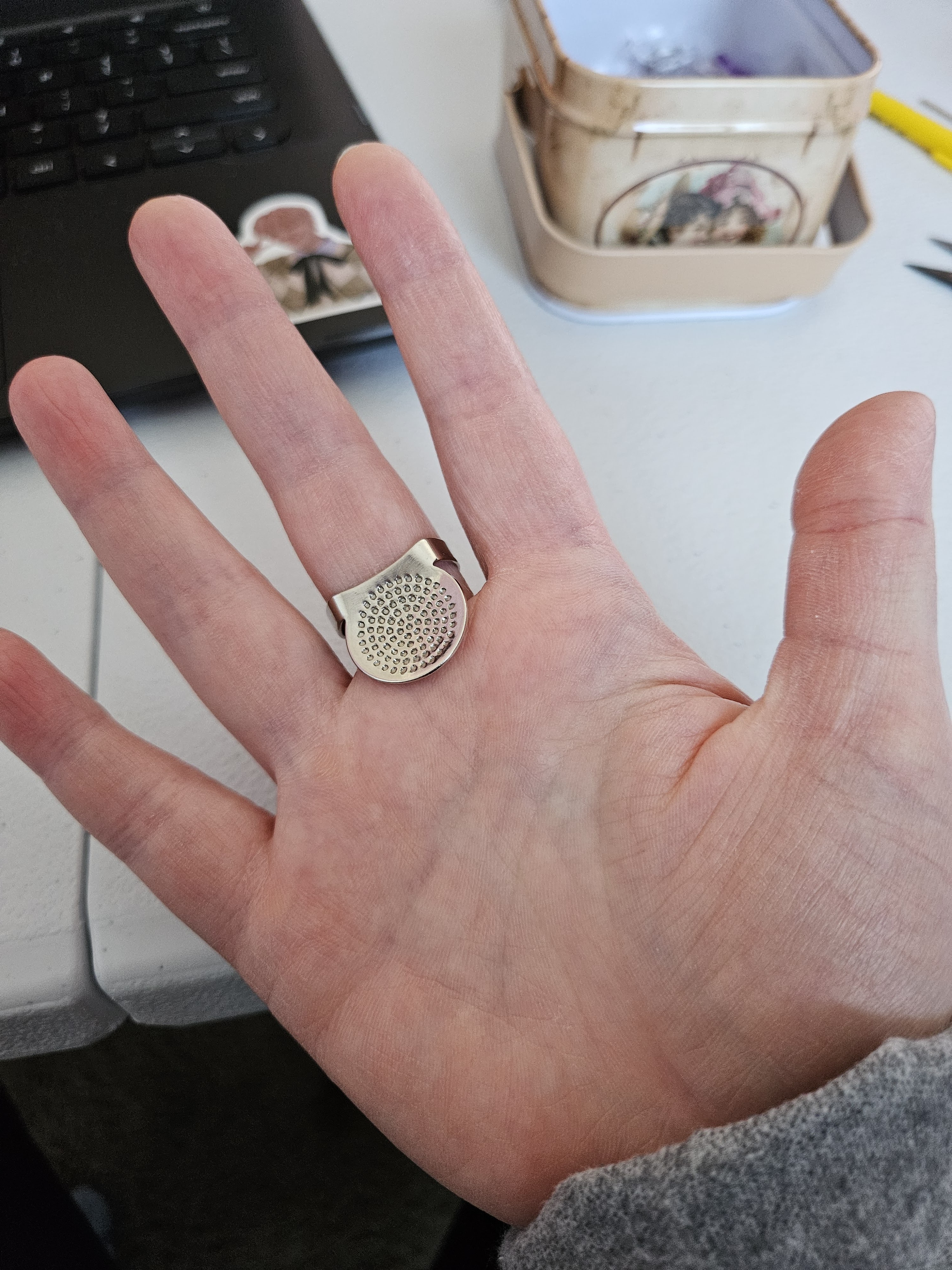
I was introduced to the Sashiko-style ring plate thimble through the account Geri In Stitches and was hooked. The idea of pushing the needle through dense layers by the palm of your hand instead of your fingertip made more logical sense. This has transformed my hand-sewing experience! I can sew longer without hand fatigue. The ring is comfortable. I hardly notice I’m wearing it until I’ve walked into another room with the thimble still in my hand. This is a Japanese thimble, for the sashiko technique, I am using it for general sewing, but the thimble and sashiko have a rich history of their own that you should check out.
Hand Sewing Needles –
I started my sewing journey by hand sewing before I purchased a Singer Heavy Duty Sewing Machine in 2022. It was my preferred method until my hands started showing stress and my mind was fed with how long garments were taking on a deadline. The switch to a machine was fantastic! I quality garments quickly. The only wrinkle was sewing machine maintenance and gremlins in the machine. Sometimes machines have attitudes. Sometimes you can’t get in sync without your equipment. Sometimes you drop the small screws into the machine and you are in a panic. It’s a wonderful asset but also a source of great frustration for me. For that reason, hand-sewing needles will always be by my side because they are easier to manage, and sometimes you and your machine need some therapy. Also, some projects call for the delicacy of hand sewing. It’s an art form that cannot be fully eclipsed by the machine. For example, how can you attach a button or hook and eye closure without a hand-sewing needle? It’s best to keep them handy.
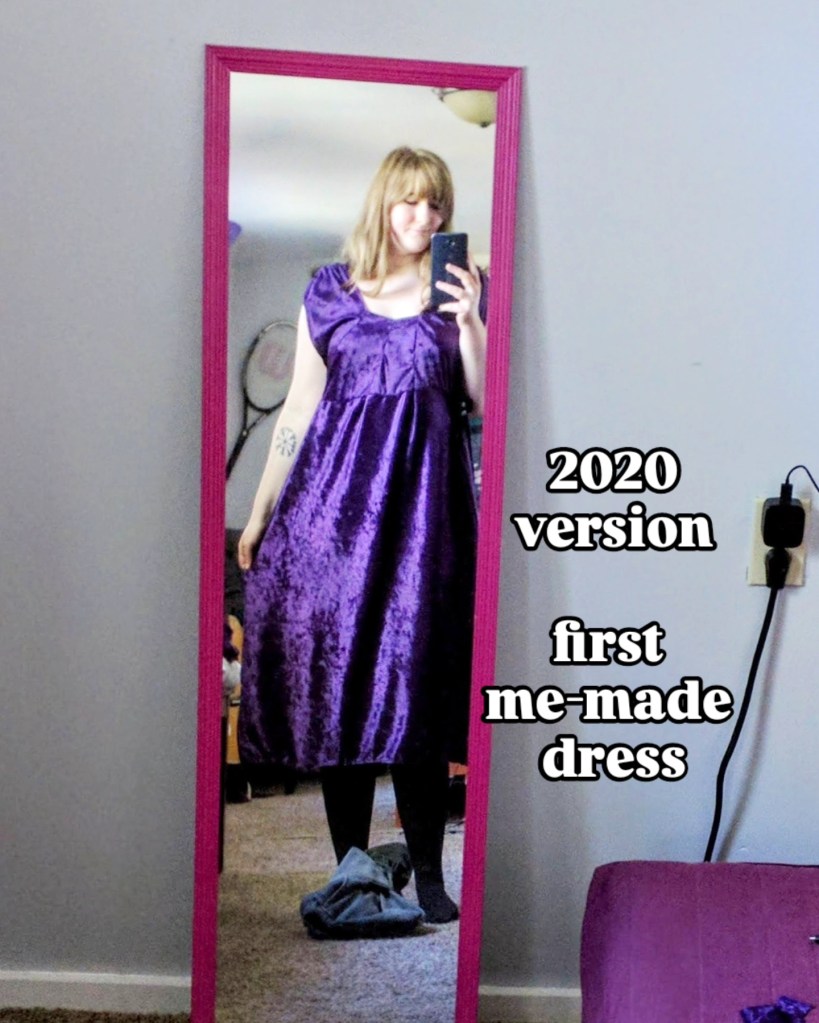
Last September, I felt this aching in my creative heart to make what I didn’t make well the first go around. A project that some would say was insane to attempt as a beginner because of the difficult nature of velvet and the frustration that is sewing with stretch fabric. The dress pictured below was my first wearable garment. I saw the same purple stretch fabric on sale for Halloween at my local Joann’s and my heart skipped a beat. It still exists – I could try again!
You see the first dress I made was constructed so poorly that I ended up cutting it down into a skirt because I was embarrassed to continue wearing it out. After all, the bodice was bunching up and gathered strangely in the back. I lacked the confidence to keep going and try to alter the dress for success. I see now that it would have been an easy make to take out the gathers and bunches of fabric for clean seams, but that kind of thought came with trial and error. I needed a bit more experience and patience to make it right, and at the time in 2020, my younger self was not willing to wait.
But what if I am living in the past? My mind thought, maybe I should let it be and let the dress be a learning experience. I put the purple velvet down and left it, it was not on sale, it would be a sizeable impulse purchase at 15.99 a yard for 4 yards. I can’t justify 60 USD for a passing whim, that would be a poor use of money. So I left the daydream and moved on. Still thinking about that fabric. Another few weeks passed, finding myself in my local Joann’s again. It was my favorite place to explore. I went to the shopping plaza over the weekend where Joann’s remains live boarded up with the lights still on. It was eerie. I found myself thinking about what was blocked off inside? Was the fabric slumbering in the bolts, waiting to be made into something new? Would the yarn ever find a home in a fiber artist’s hands? It felt like a mistake, a bad dream, but it was not. It is over and now it is just a memory.
Anyway, on the second trip to Joann’s during the Halloween sales, I found my purple beloved. The bolt was still full, now marked down to 7 USD a yard. But this time I couldn’t get the project out of my mind. I’m glad I did give in to the creative urge or this project would be left without an ending. At the time, I had no idea Joann’s was going to go under. I thought I had plenty of time to remake this when in reality the window was closing. As I worked on this dress in 2025, I followed Joann’s story with frustration and weight of expectation. This remake is the final try, for this fabric I will never find again.
I made a different dress from the original and that surprised me. I believed going into the remake project that I would duplicate the same dress but with better technique. Instead, it was a project of feel. This time, I had a dress form I could drape the garment on. I had fabric clips with securely held the the slippery fabric together while on the dress form or for a quick test of fit on my own form. This time I understood proportion and where this dress would fit into my wardrobe instead of making a dress that only went with my moto jacket. I reinforced the shoulders and was thoughtful about my stitching, to make the garment strong. I added darts to pull the dress in where it was fitting baggy instead of leaving it like a velvet sack.
It became something new and I am okay with that. None of us are the same as we were years ago, we grow and evolve with every passing year. Making a dress for now, with the spirit and the fabric of my first garment, but with a new neckline and a new fit I think is an inevitability of learning and growth. I had the patience this time to try on the dress, mark what was not fitting right, and go back to work until it was correct. That was not something I was willing to do when I started, because it was all so new and confusing, but with time and practice, those new concepts became a familiar old friend. Like this tan carpet. It wasn’t until I looked at the 2020 mirror photo and the 2025 mirror photo that I saw it. The carpet in the house we bought looks just like the carpet in our apartment in Meadville. How random is that?
I have one more section of the purple velvet left over that I plan to make something with, possibly a mini dress, a blouse, or maybe a jacket. I think knowing this fabric is a relic now, makes me feel unwilling to finish this scrap project, because once it is done. I’m going to feel like my time experimenting with fabric from my first craft store is done. A chapter of my sewing life is over, and I hate saying goodbye. I’m a sentimental person. When things end, I take it hard. I dwell on the loss and muse on it. It might be unhealthy. It certainly makes life harder as a person who wants to keep things alive that are gone, it’s why I think I was drawn to study history in college.
As I keep making things, some of these projects become an archive of crafting past. What are some things in your own life that have moved from the present to part of your past? Does it surprise you to consider these things as your history instead of your current story? Thank you, reader, for joining me again down this sewing memory lane. I hope you have a wonderful day!
We are in a clickbait world, with insane thumbnails and exaggerated headlines. Over time I’ve learned to stop clicking, stop believing, to wait and see if there is an ounce of truth to the “news” on the screen. That was my strategy for the ongoing Joann’s bankruptcy story. They filed for Chapter 11 bankruptcy in March 2024, which raised many red flags in my mind, but I wasn’t allowing myself to worry. Bankruptcy happens, it should be fine. I decided to wait and see with a cool and calm demeanor. In the meantime, I would craft and mind my business.
In the fall of 2024, a news headline caught my attention – Joann’s was closing a few stores nationwide, one of them being my local Joann Fabrics. What a weird coincidence! But only a few stores nationwide, my mind pondered, that must signify this is okay, right? They’ll close my small store and a few more, not a big deal. No need to be concerned. I have other Joann Fabric locations within driving distance, I’ll go to those!
As the news cycle went, I continued to see thumbnails of a concerning nature as we entered the new year, questions of Joann’s future, and whether they were closing their doors for good. What an odd way to get traffic, I thought. They filed almost a year ago and the consequence was a few stores that would shut down, are these creators making a mountain from a small pile of dirt? I ignored them and carried on my way, thinking of the projects I’d like to make and the yarns I’d plan to use from the ever-growing list of inspirations I have saved.
I love Joann’s Big Twist line along with their collaboration with Eddie Bauer. They have been my two most used yarns aside from Knit Picks in 2024. I use the Eddie Bauer for sock and accessory projects, while the Big Twist has been my go-to yarn for wearables like sweaters due to its soft not scratchy acrylic structure, which gets softer with wear and washing, it is such an affordable yarn that has helped me create in lean times.
I have the same affection for Joann’s fabric department! The amount of inspiration I have found from Joann’s clearance section has been a huge blessing to my sewing journey. It has provided an affordable way to try new fabrics and hone my fabric knowledge without the pressure of learning by sewing expensive fabric for these experimental projects. Some of my favorite makes have been possible because of the clearance section. I also adore their lightweight quilting cotton fabric for summer. It makes a great sundress and no, people don’t automatically see that it is quilting cotton like some sewists fear. The ribbons, the notions, buttons, zippers, thread, interfacing, patterns, embroidery thread, not to mention Halloween decor!
Over the weekend, my alarm bells rang out while watching a new TLYarnCrafts video, because Toni is not a clickbait creator. She and her mom, Gwen, went to their local Joann’s for one last trip just in case of closure. That’s when it sunk in, Joann Fabrics filed Chapter 11 bankruptcy again in January 2025, calling for its sale and possible liquidation by said buyer until Joann’s is gone. I began tracking the updates on Reddit this week and the news was grim with each passing day. My fellow sewists and yarn enthusiasts seem just as heartbroken and confused as I feel by this ominous development. I truly thought Joann Fabrics was turning the financial woes around by closing just a few stores, but I was wrong.
It’s a staple for me to shop there. My local yarn shop and local fabric shop where there isn’t a small local business to support in my area. Joann’s filled that void. It was my first fabric store experience and will always hold a special place in my heart for supplying access to items that gave me purpose through crafting when my life needed a new direction.
On Wednesday, the updates became utterly ridiculous. An official document from Joann Fabrics named 500 of their 800 locations across the United States marked for shutdown. Including all the ones in my area. After I sat with the news I began to feel despair, not for me, but for all the workers who were getting the rug pulled out from under them. I’ve been laid off in the past and it is such a bizarre feeling. You’re not losing your job for a better opportunity or because you screwed up, nothing about the reason which led to your layoff was connected to you. Yet it directly affects your life and it leaves you feeling empty, in my opinion.
There has been a lot of bad news here in the last two months – fires, plane crashes, Tulsi Gabbard being confirmed, etc. The air is ripe with change and I hope that every employee who is being affected by this can transition to their next step with as little stress as possible. You guys did nothing to deserve this, the leaders of your company are taking away a great resource for the crafting community due to their mismanagement, not yours. What a weird year this is and it’s only February.
So this is my little reflection on what Joann Fabrics has meant to me and I hope this is not the end. Even with the sale looming, I hope they will not get rid of the company entirely, it serves a good purpose that cannot be filled by Michaels or Hobby Lobby. This will be a new adventure for me to find other yarn and fabric stores, not local to me but a local small business for someone. Thankfully the internet does exist so who knows where this will find me.
What will never be the same though is the ability to go look at fabric and yarn in person in a store that had it all in the same place, only catering to creative endeavors at an affordable price. It was a third place to be around others who liked the same crafts as me. I’m going to miss the connection to others and the lovely fabric-cutting humans who more often than not had more sewing experience than I had years lived that helped me numerous times formulate my sewing plans. Even if I didn’t agree with them, they were usually right when I went rogue and used fabric not meant for that project. I’m going to miss that.
In 2024, I was inspired to start making pants. I had attempted making pants before and they were successful but I struggled to make them feel like more than just a pair of lounge pants. Part of this was caused by not choosing a good bottom-weight fabric, and instead opting for a lightweight summer cotton that draped beautifully but didn’t give me that tailored look. I also tried an ill-fated scuba fabric in 2023 that crashed and burned because my thread tension was off. Enter this checkerboard denim print I purchased at Hobby Lobby. It was denim but lighter, not too heavy to be a problem for my sewing machine. But how would I find the right pattern?
I had a pants pattern in my stash for menswear trousers, that I considered using on this project. It’s a solid pattern and would make a straight-fit pair of jeans, maybe not the style I was going for though. I considered buying a new pattern, but then I fretted that the pattern would fit me weirdly or might not fit at all. The current style in 2024 still featured that tapered-in waist on pants that favor an hourglass figure, not my rectangle athletic build, so should I risk it? A big reason I chose to make pants in the first place was that I was sick of shopping and trying on pants that made me feel weird about my body. The men’s section was my go-to for their up-and-down pattern cutting, compared to the extreme tapering and high waist silhouette of women’s pants. Even low rise was stuck in mid-rise inseam, not the true low waist inseam I was accustomed to in the 2000s and early 2010s that helped me find good-fitting jeans because they favored my shape not the post-bbl world of fashion. I digress, my point is that buying a pattern someone else drafted felt like a risk because the fit is such a personalized thing.
My solution was to take a pair of pants in my wardrobe that I liked the fit of and to trace that pair of pants to gauge the shape. I did this with a pair of jeans that were high waist but had a nice loose fit through the hip and leg for the K-pop-inspired baggy jeans style I was interested in making with this 1990s Vans checker board print. This worked swimmingly! So much so that I traced the jeans onto a piece of brown craft paper for a quick pattern to reach for on future projects.
I chose to record this project, start to finish in video from instead of video to have a memory of how I did this to learn for myself and remember what I did but to also inspire others to try this. Pants are intimidating, especially from a paper or PDF pattern. The written instructions and diagrams have puzzled me in past projects but truly, pants are simple once you see how its done. I wanted to help others feel that freedom to create because at least in my American fashion market, fast fashion has destroyed the craftsmanship of pants and standardized sizing. I referenced this in a previous post, Shaping Up where I had to confront the dressing room terror of things not fitting and seeking to not be defined by my jeans size, when trends and pattern cutting shape shift sizes, but to take control of it on my end and get healthier in 2023.
This pants project was one of the most challenging and rewarding projects of 2024. I faced my fear of sewing denim, inserting pockets, and fastenings. I chose to not attempt a fly into I had more pants sewing experience, instead I planned to make what I knew I could achieve under my skill set. I opted for a side closer with a drawstring to have an adjustable fit since the denim had zero stretch. The denim containing no stretch was a feature I sought because I believed it would be easier to work with as it was my first project of this kind, and I wanted a crisp tailoring from the woven fabric. A key thing to note is that the jeans I used for my template also are non-stretch denim. For an accurate this is paramount or else the project will not work. Either you will cut your project too large or too small. It is also essential to leave a seam allowance on your pattern pieces. When self-drafting it is your responsibility to take charge of the seam allowances and plan ahead.
I messed this up with the crotch line and had to make a quick fix. My fix was a diamond gusset. Popular in women’s leggings, this diamond gusset shape piece allows for greater mobility while maintaining the strength of the seams.
The second challenge I faced was the problem of a narrow bolt and an all-over pattern. This fabric was quite narrow and because I was cautious with my seam allowance, I cut my pieces large. This meant that I was not cutting from the longest side, but the most wide. The pattern pieces were cut out missing length on the leg. My solution was to add on to the bottom and pattern match. It’s easier to match than people say, it just takes patience and intentional sewing. I’m pleased with how seamlessly I got my pieces to match up.
The pockets were a challenge. How do you place them? How do you insert them with strength so the pockets can be used without pulling the pants down or ripping? I chose to place them angled on the sides, aligned with my hips so that they would be practical and not create weird bunching at the front of the pants. No wonky crotch fit here!
Would you make your own pants? I hope I inspired you to get creative and go for it if you are sewing-inclined. Thanks, reader, for joining me once again on this quest to grow my fashion design skills. Have a wonderful day!
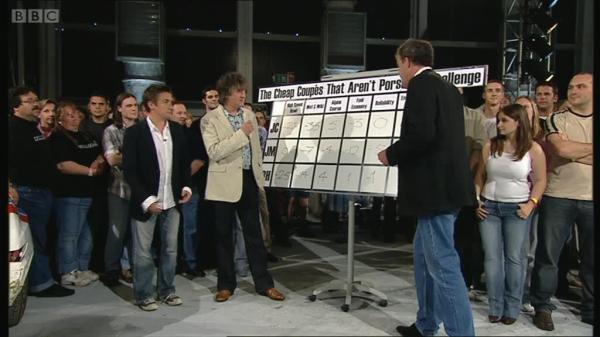
Have you ever watched one of the Top Gear UK challenges, from the good old days of Clarkson, May, and Hammond?
The amphibious cars, DIY caravans, lorry drivers, hot-hatchbacks, cheap Porsches, etc. There is one thing in common. There is a scoreboard, the points make no sense, it’s all a big laugh, and on that terrible disappointment, it’s time to end.
This is what I equate growing an Instagram was like in 2024.
I did the things. I’ve made many pieces of content across stories, reels, and posts. I’ve sewn and knit a varied amount of things. I’ve done silly trends, serious reviews, inspirational posts, filmed tutorials, recorded thoughtful voice overs, and participated in the “add yours” cards on stories.
I turned on metrics. I carefully analyzed posting times, consistently shared things to keep engagement up, took breaks to avoid spamming, carefully thought of 3-second hooks, transcribed subtitles, filmed artistic shots, and agonized over lighting. I networked, supported other creators, and tried to make genuine connections. Got burned a few times by people who only interacted with me for the follow and stopped talking to me and following me after months of supporting them. It’s tricky making friends on that platform. Connections are either amazing, lovely people, or not at all. I met several lovely people too, it wasn’t all bad.
I ended the year with higher engagement, more friends, and negative or neutral growth depending on the refresh. The metrics contradict themselves constantly. I’ve lost as many followers as I’ve gained. I’ve learned I had ghost followers who were keeping my engagement low. I also had accounts following me that left the platform through Meta’s deactivation due to idleness. It’s one of the worst algorithms, showing your followers your posts days after you share them. Zuckerberg, do better.
I ended 2024 feeling like I was on a Top Gear challenge. Meta added and subtracted points to my metrics total willy nilly, like Richard Hammond getting minus “exactly the points he had” so that he ends with naught. It was nonsensical and mind-boggling. This platform provides no satisfaction in what you accomplish. I got one point here, minus a thousand there, 20 points for this task – yada, yada, yada.
So 2025, what am I doing with my time? What am I working towards? I am going to write more and move on from growing an Instagram account to open a shop. Not interested anymore. It’s not happening and I think it’s a blessing. Fiber art creation is going back to being a hobby. I’m not going to be a fashion designer, or a pattern designer, or a sewing educator, or a part of fixing fashion. I am going to make things I like and have fun, and share what I want where I choose for the fun of it. I have a backlog of projects that I haven’t shared here because of the distraction of Instagram. I am looking forward to writing more, new things, and celebrating the victory of finishing the Udal Cuain manuscript. Available to peruse here. I’m going to do art, I’m going to garden, to bake, learn things, and work hard. I’m excited about it. The key intention is to focus on fulfillment over productivity, and when my to-do list is crossed off to feel fulfilled, not productive.
Recently, I shared a Knit Star Plush Keychain Pattern, but that wasn’t the only keychain I’ve been working on. Behold, a knit bunny keychain made from repurposed fabric! This keychain was inspired by my Skzoo Quokka plush keychain which I have styled on my purse and belt loop. I was tempted to buy more as this trend has been all over my feed this year, but that’s unrealistic. So I thought, in Jeremy Clarkson fashion, how hard could it be?
This key chain was made by repurposing a pair of underwear, that was weirdly made without any stretch. They had no purpose but to be trashed, which I didn’t want to do because they were brand new and I liked the pattern and color story. So I wondered, could I translate this to a plushie and I could make this plushie into a keychain without buying any materials beyond the keychain hardware? The answer is yes!
I used a pen to draw pattern pieces onto the underwear by designating the fabric into four ear-pieces, two head-pieces, and a rectangle piece that would be used to connect the keychain hardware. The rest of the fabric was cut into small cut pieces that would be used as the stuffing. This worked like a dream!
I chose to sew this item by hand because of the small nature of the project. The pieces were too small and delicate to sew by machine with any semblance of control or care. It was a quick make and took one day to complete. I sewed 90% of the ears, turned them right side out, stuffed them, and then set the ears aside. Next, I repeated this process with the circle for the head and stuffed it. When I was certain that all the stuffing was divided between the three pieces adequately, I sewed closed the ears and head. Next, I attached the ears to the head. Finally, I sewed the rectangle and threaded it through the loop of the keychain before attaching it to the bunny plushie. I opted for an abstract look so I did not decorate the bunny plush with a face, therefore if it spins around it doesn’t matter what side is facing out.
Overall, this was a quick and thrifty project with the hardware coming in a pack of two for $2.99. I used the other clip on the knit star plush project. This type of plushie could be made with any scrap fabric you have and could be adapted into other animals. It would be an easy DIY gift too!
Plaid. Tartan. The Ancient Celts. Punks. Lumberjacks. Kilts. Pumpkin Patch. A Christmas wrapping paper. A simple pattern of perpendicular stripes, woven together to create a fabric that has stood the test of time. Unsurprisingly, plaid comes around again in the trend cycle each fall and winter. It’s an iconic textile that makes various garments that connect us across cultures. I was delighted to see the plaid trousers as one of these tartan offerings this year. But there is one thing about this trend that I think we should talk about more. Pattern placement. Specifically pattern matching and how this changes depending on garment quality and silhouette. I believe there may be a wrong way to make a plaid trouser even though it should be straightforward. This classic has gone down a bad path this season.
But How Does it Look On a Human Body?
Something that has struck me this year about plaid trousers – how do these pants look worn on a human form, viewed from all angles? I’ve seen many ads from various retailers have been advertised to me, with increasing tempo as we inch closer to Black Friday, and there is one common thread about retail and the fashion industry in 2024. Low quality. Clothing across the board from fast fashion to luxury items are at the lowest quality they have been as brands look to cut costs every step of the way. The fabrics chosen are cheap and not cheerful, and the items themselves are being sewn under inhumane labor conditions in the global south and China. To learn more about this I’d check out the documentary The True Cost of Fashion and check out Fashion Roadman’s commentary also on YouTube. He has a book club discussing How Luxury Lost Its Luster by Dana Thomas.
My opinion is not hyperbole or subjective conjecture, of the three examples I took screenshots of two of the three brands that are known to work with factories in Bangladesh, where the Rana Plaza tragedy happened 9 years ago. Old Navy and American Eagle are these brands, fast fashion brands, that work with factories in Bangladesh, India, Vietnam, and Indonesia. Old Navy, part of the Gap brand that also produces Gap, Athleta, and Banana Republic, which is an odd name for a brand, works with factories in Bangladesh, Cambodia, Sri Lanka, China, El Salvador, Guatemala, China, Nicaragua, and the Philippines. It’s not great.
The third example is from Ralph Lauren, which I am under no guise that because it’s a designer brand the factories are more humane or that the fabric is always better because that’s not the case anymore. Look at Chanel and their gold-plated hardware, or Dior and Armani’s labor controversy in Italy. Ralph Lauren works with factories in China, Italy, the United States, Hong Kong, Pakistan, Sri Lanka, Turkey, Mexico, Cambodia, Vietnam, and India.
They are a little better I’d say but just barely. Their attention to detail in the design of their clothing though, it’s night and day to Old Navy and American Eagle who have gone the way of H&M, Zara, and Shein.
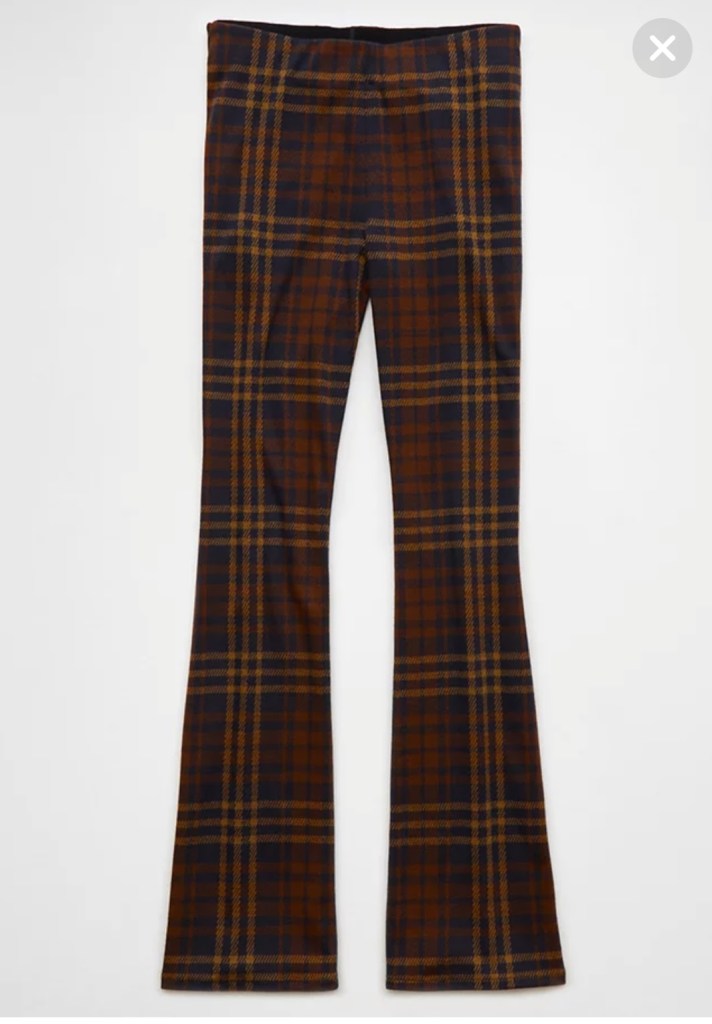
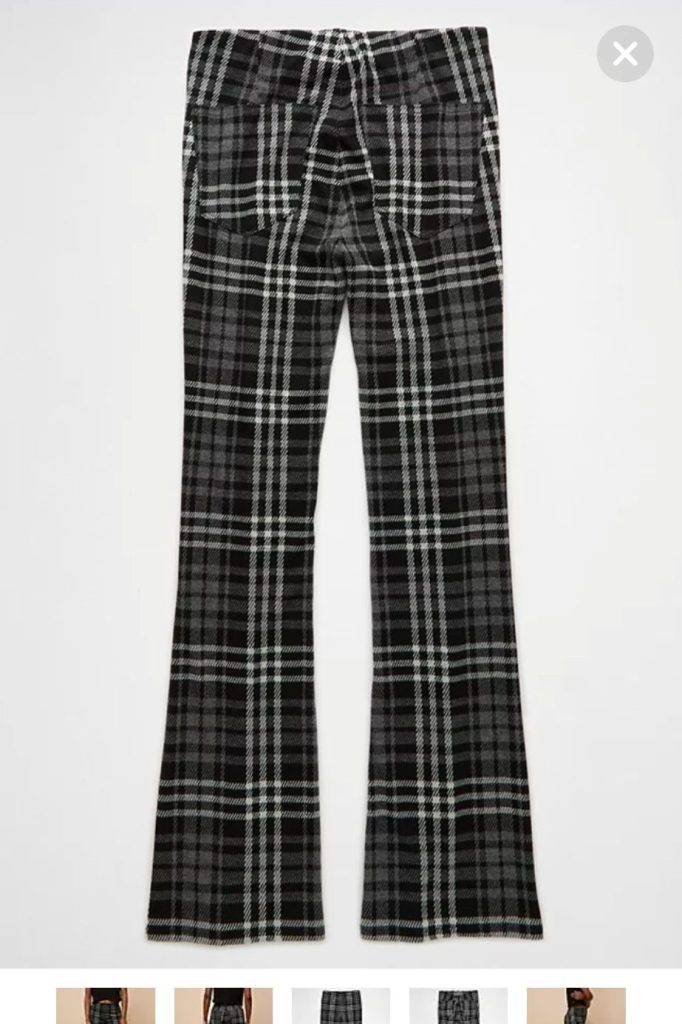
American Eagle: Pattern Alignment and Patch Pockets
These are a pair of pants that I like in theory. I think a plaid trouser with a closer fitting hip that flares out gently at the bottom is a great idea and would be a versatile item. The plaid print is also matched up quite well in the front view. Something wild happens when you turn the garment around. Those pockets are a bad idea. That’s impossible to match and it detracts from the line of the pants. It emphasizes the way the plaid pattern has to bend with the line of the pants because they chose to change the orientation of the pattern on the butt of the pants only. I think it could be done better and this garment suffers from TikTok lens. It photographs okay and they would be cute from the front, which you can keep as the only view if they are being shown online, but once they enter the real world I don’t think they are going to look as cute. That’s a lot of attention being drawn to one area.
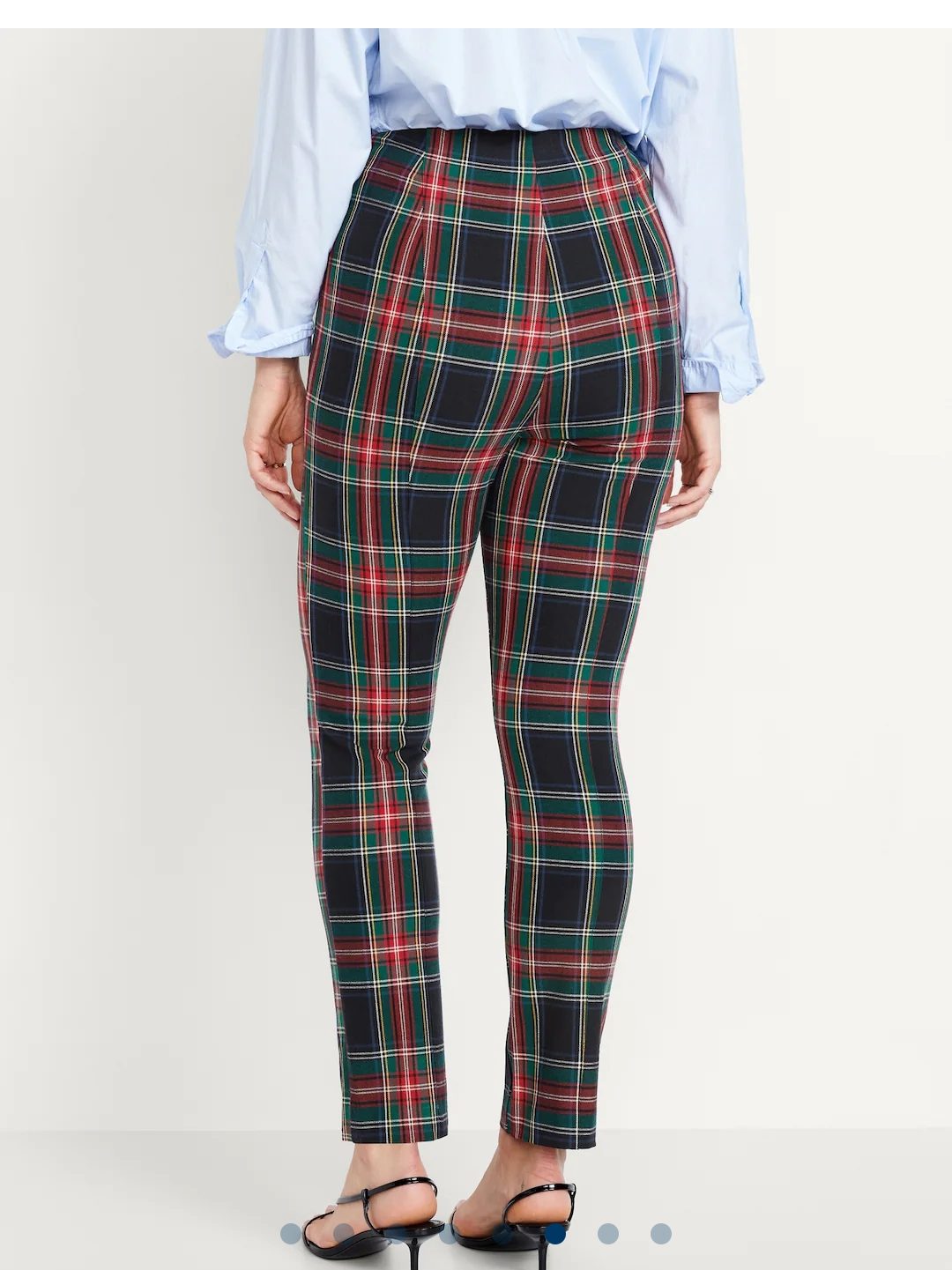
Old Navy: The Lines in the Seat Are Crazy, But Good Pockets
I do think this pattern looks like Audrey Hepburn time traveled through the 1970s punk scene and ended up with Christmas wrapping paper cigarette pants that are cut like leggings. These look really stretchy. Remember in the 2010s when we were wearing patterned leggings? These remind me of them. But they aren’t leggings, they are tailored pants with insert rear pockets and darts at the hip line. I think that is where the problem lies with this garment, the fabric and the fabric needed to make this silhouette.
The product description states the fabric is 55% cotton, 40% viscose-rayon, and 5% spandex. This is not a structured bottomweight fabric. This is a stretchy fabric that is going to have softness and contour your body which is fine in a solid but in a pattern that leads to complications with the pattern. I think the pattern looks odd on the back, particularly along the seat of the pants and the front seam. I think these high-contrast patterns are not a good choice for this application and another type of plaid is better for pants where the distortion of the lines and the seams themselves will not be spotlighted. It’s not where you want the focus of your outfit to be, at the seat line of the garment, that’s uncomfortable. They offered a black watch tartan with lower contrast which was a much better option.
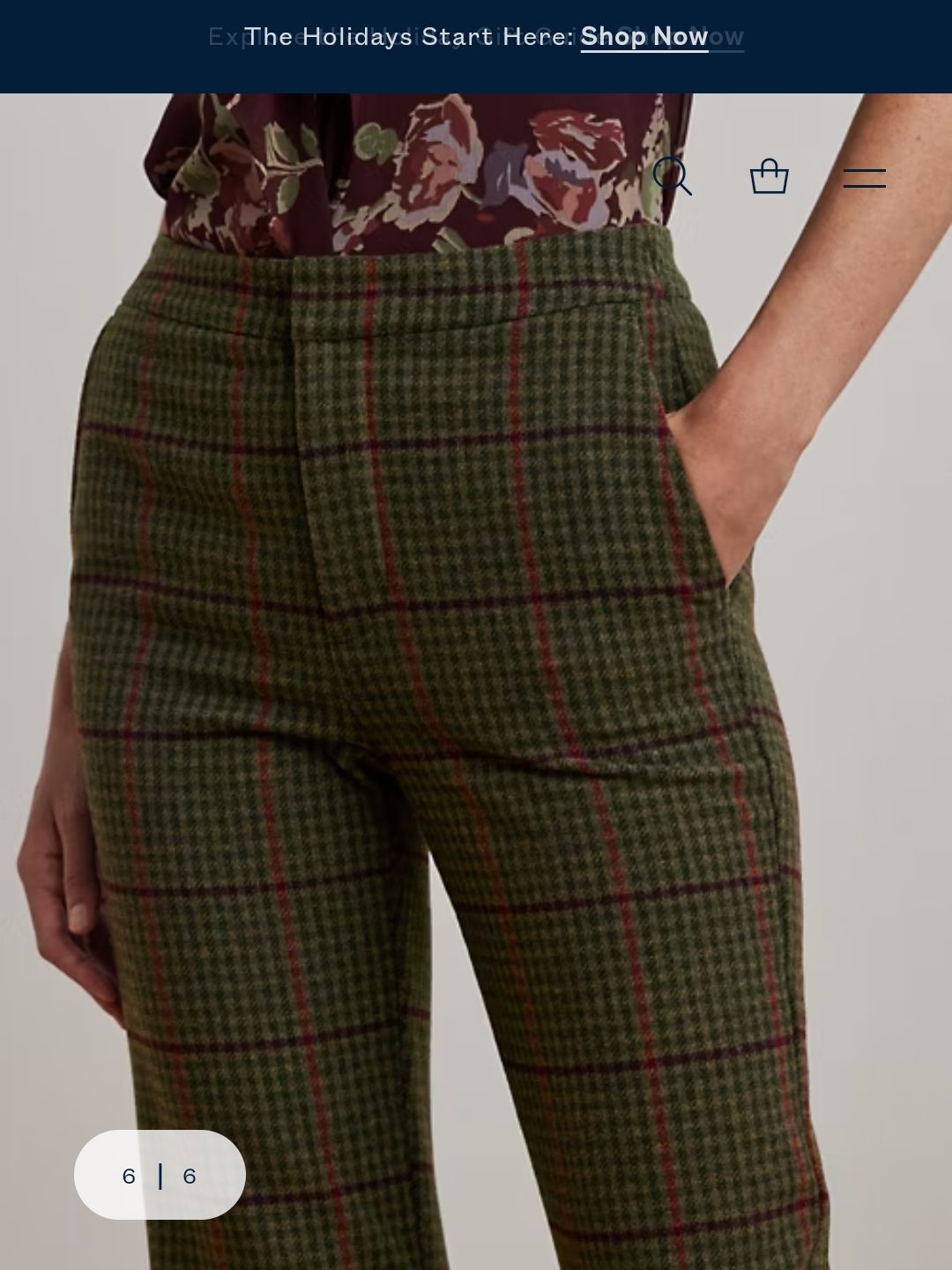
Ralph Lauren: Fabric Choice and Silhouette, but it’s Pricey
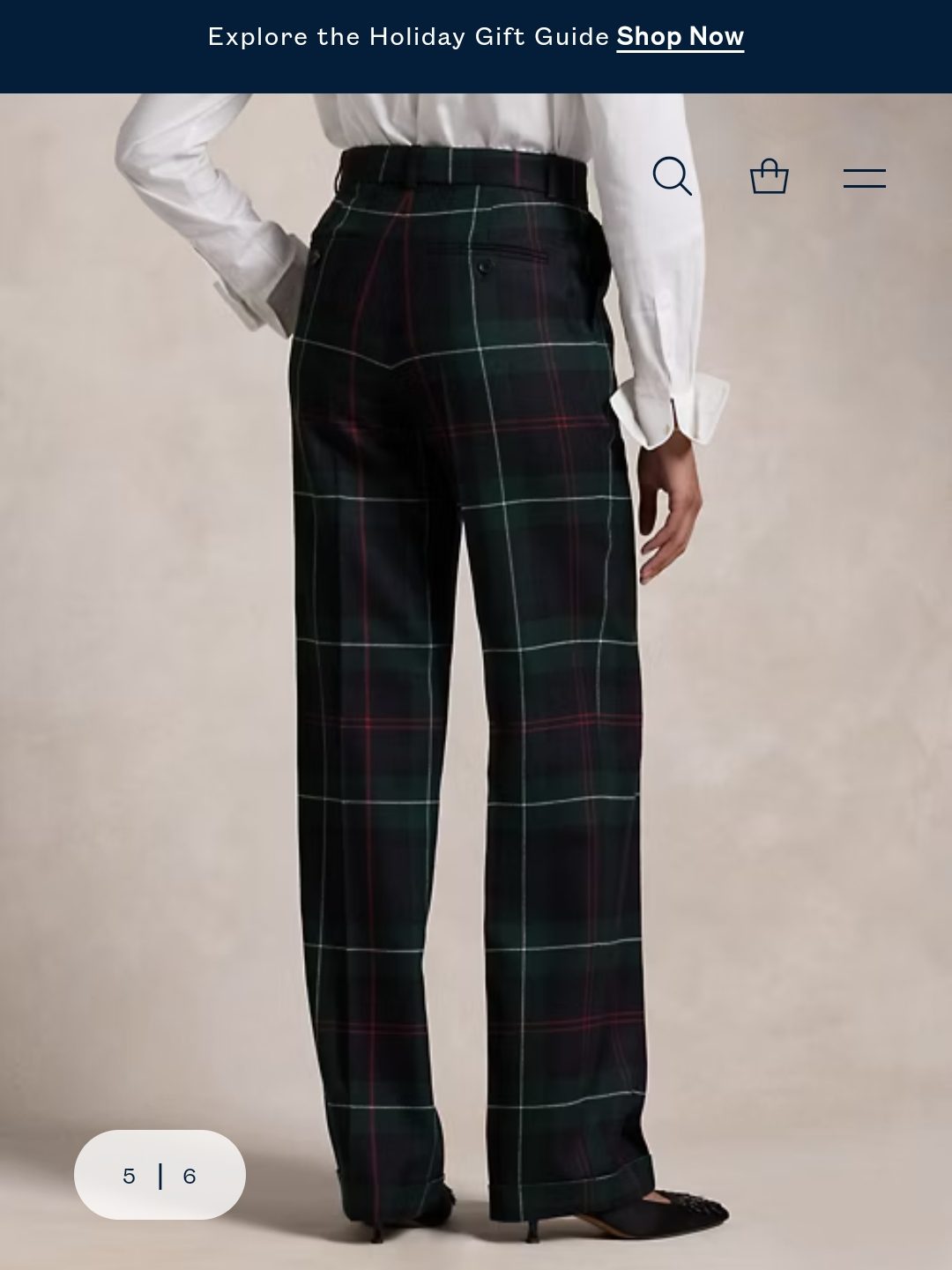
These trousers are comparable to both the Old Navy and American Eagle options for style and silhouette. They have the slight flare of the American Eagle pants and the slim trouser style with insert rear pockets of the Old Navy option. What is different, and in my opinion is a better design choice for these Ralph Lauren pants is the lower contrast plaid style of the fabric and the weight of the fabric which adds structure, eliminating the need for stretch to create the shape. These pants are cut in a way that emphasizes the shape of the wearer in strategic places while also draping away from the body. The pattern cutting of this garment is doing the heavy lifting, not your physique being asked to have the ideal shape to give the pants life.
The plaid is a lower contrast allowing for those tricky seams to fade into the background instead of drawing attention to the problems. On the back seam, the designer chose to use sections of the plaid that were darker, cutting off the pink vertical stripe on both sides before the seam so that the pink appears to flank the seat and therefore draws attention away from the pattern matching of this seam. In the front they follow a similar format, seamlessly integrating the fly into the pattern. The side pockets are tapered again so that the pink vertical begins lower at the hip, drawing the eye to the hip and the waist in a way that enhances the form of the trousers. Again this does not rely on stretch to accomplish this. It takes longer to do, and because of this it has been relegated as a “luxury” feature when actually if you take a bit longer to design to initial pattern after that process it will be easy to grade and use over and over. It’s not a luxury, it’s thoughtful and what design is about.
You can see this attention to detail repeated again in these plaid wool trousers. The back seam was mitigated again by thoughtful lines and fabric structure. Because the wool is a heavier fabric and has structure, it can float across the body instead of stretching across it so the diagonal lines of the plaid do not detract from the design of the garment. It also keeps the vertical line of the trousers even though the lines change direction and the pattern is altered here from the standard perpendicular plaid fashion. This shouldn’t be considered a luxury feature either. Wool is a sustainable textile that is durable and creates much less water pollution than stretch fabrics that shed microplastics or denim which requires a vast amount of water to dye.
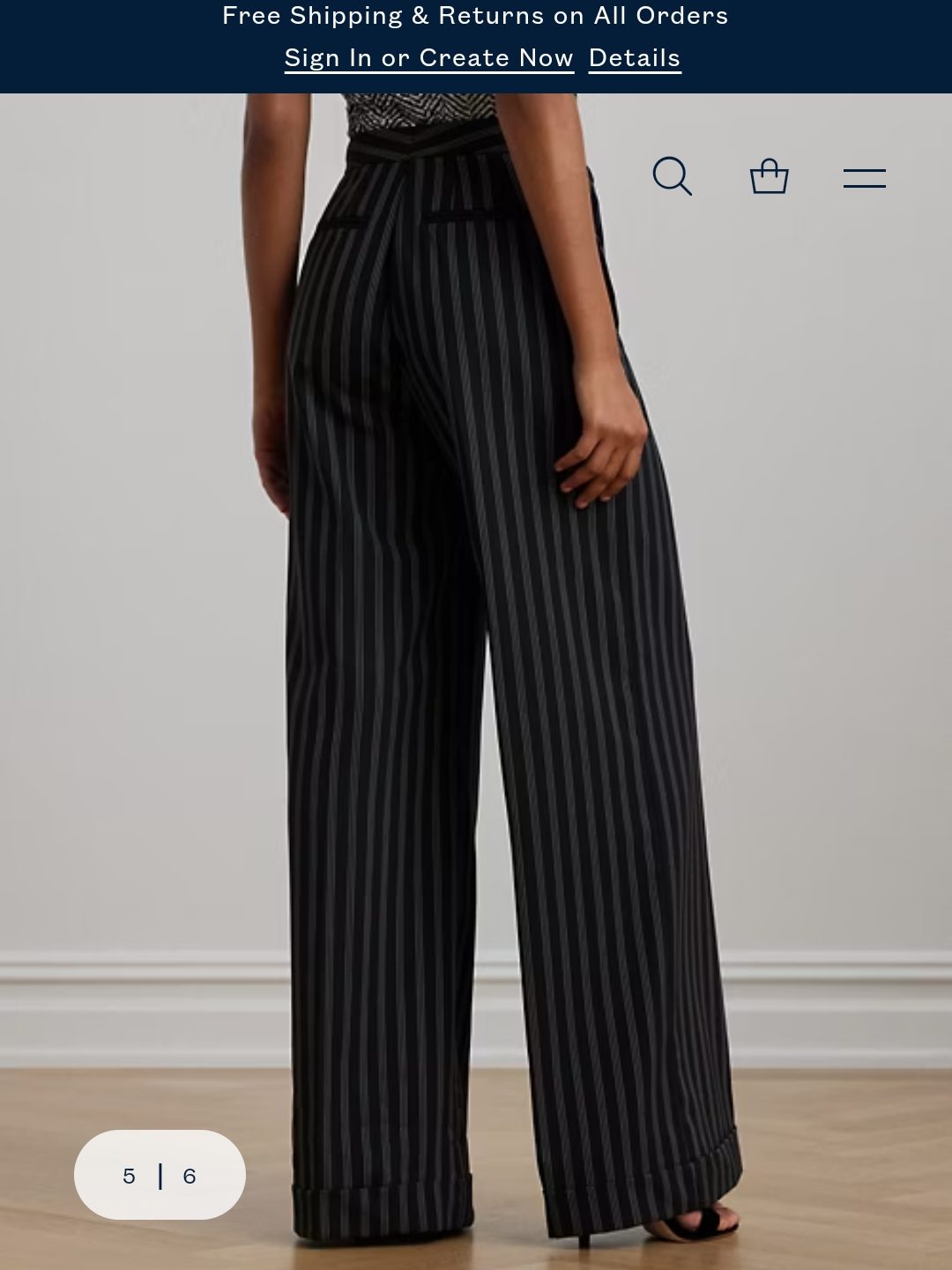
This last example is not plaid but striped, yet the lines of the garment I think still apply. This is another smart design that works with the pattern to create a garment that looks good from all angles. Part of that comes from the wider leg silhouette and the fact that the pant celebrates drape. If this was made from a stretch fabric and was a skinny leg design, a legging basically disguised as a pant, this would be an awkward-looking garment. But affordable should not mean crap design and as consumers we are letting companies determine this as a fact.
Let’s be more discerning in our consumption and look for good design, learn to sew, or support sewing people who can make a good trouser. These Ralph Lauren pants are almost 300 USD and they are not worth that price tag. The Old Navy and American Eagle pants are 50 USD and they aren’t worth that price either. Which leaves the customer with no good option while the brands cash in. We need better clothes made in ethical labor conditions and clothes with good designs that are made to last so that we don’t need to consume so much.
Do you ever spend time learning a skill just to forget it when you need to use it? That’s me. That’s how I sew stretch fabric on my machine. I just jump in and completely forget that I need to first properly adjust the tension and stitch type or else mayhem ensues. Mayhem like my machine having a nice little snack on my fabric.
Sometimes the machine gets extra bold and drags the hem under into the bobbin’s domain, jamming the machine. This is what I am talking about:
In the moment of panic, when I realize the fabric is stuck down in the machine a few thoughts dance through my mind.
Why didn’t you sew this by hand?!
You did it, you finally broke the machine you maniac!!
It’s ripped to shreds, isn’t it? The whole project might be gone in a moment.
This machine hates me. How do other people sew so effortlessly??
But it’s not the machine’s fault and it’s not the fabric that caused this, and it’s not even my fault. It’s morally neutral, it’s an accident and a learning experience to grow from!
As I was writing this, I caught myself crafting sentences to describe the situation with very negative and demeaning language towards myself for making a simple mistake. (A mistake that once I freed the fabric from the machine, I corrected and carried on to make the finished garment. The tight thread tension actually made a happy accident, a lettuce edge hem.)
It is not something that I should hold with such severity against myself that I internally tell myself I am an idiot, a lousy sewist, or useless.
Because how would I respond to hearing someone say that to another person? I would be disappointed in the speaker and make them stop.
How would I respond if I spoke with such aggression to another person? I would be ashamed.
I am learning through these sewing setbacks to temper the internal monologue and be a more gentle and loving person towards myself, to maintain better mental health, and establish the practice in my mind so that I can be a source of gentleness and kindness to others.
How do you speak towards yourself and others when they make a mistake?
While I was on vacation up to Erie I received exciting news! I saw this blog has reached 100 subscribers! It made my day. I am so grateful to everyone who has subscribed. You guys are amazing! I appreciate every view, every visitor, every like. It’s given me purpose in a season of transition, helped me get back into writing, and drawing, and feel more comfortable sharing Potato Technology designs online. It has also been a rewarding way to connect with people worldwide which I find exciting.
I’m hoping in time to connect more, and maybe keep comments on my posts to get to know you more. I’m just shy and scared of getting hate comments when I want this to be a safe space. Maybe in 2025? I’ll keep trying to be brave.
I’m looking forward to sharing bits about my trip and some more sewing and knitting projects I’ve completed in September. September was a busy month! I think heading into October, I’ve needed a break. It was good to get away and refresh. I’ve been feeling a bit of writer’s block the past week so I took a small break from the blog too, hoping to have renewed my creativity!
Thank you, dear reader, for such an amazing milestone! I hope you have a wonderful day and that I see you around the blog again. There are many exciting things I have planned that I would love to share with you. I hope you know that you are loved and worthy just as you are.























 One Rabbit Riot