Recently, I shared a Knit Star Plush Keychain Pattern, but that wasn’t the only keychain I’ve been working on. Behold, a knit bunny keychain made from repurposed fabric! This keychain was inspired by my Skzoo Quokka plush keychain which I have styled on my purse and belt loop. I was tempted to buy more as this trend has been all over my feed this year, but that’s unrealistic. So I thought, in Jeremy Clarkson fashion, how hard could it be?
This key chain was made by repurposing a pair of underwear, that was weirdly made without any stretch. They had no purpose but to be trashed, which I didn’t want to do because they were brand new and I liked the pattern and color story. So I wondered, could I translate this to a plushie and I could make this plushie into a keychain without buying any materials beyond the keychain hardware? The answer is yes!
I used a pen to draw pattern pieces onto the underwear by designating the fabric into four ear-pieces, two head-pieces, and a rectangle piece that would be used to connect the keychain hardware. The rest of the fabric was cut into small cut pieces that would be used as the stuffing. This worked like a dream!
I chose to sew this item by hand because of the small nature of the project. The pieces were too small and delicate to sew by machine with any semblance of control or care. It was a quick make and took one day to complete. I sewed 90% of the ears, turned them right side out, stuffed them, and then set the ears aside. Next, I repeated this process with the circle for the head and stuffed it. When I was certain that all the stuffing was divided between the three pieces adequately, I sewed closed the ears and head. Next, I attached the ears to the head. Finally, I sewed the rectangle and threaded it through the loop of the keychain before attaching it to the bunny plushie. I opted for an abstract look so I did not decorate the bunny plush with a face, therefore if it spins around it doesn’t matter what side is facing out.
Overall, this was a quick and thrifty project with the hardware coming in a pack of two for $2.99. I used the other clip on the knit star plush project. This type of plushie could be made with any scrap fabric you have and could be adapted into other animals. It would be an easy DIY gift too!
Plaid. Tartan. The Ancient Celts. Punks. Lumberjacks. Kilts. Pumpkin Patch. A Christmas wrapping paper. A simple pattern of perpendicular stripes, woven together to create a fabric that has stood the test of time. Unsurprisingly, plaid comes around again in the trend cycle each fall and winter. It’s an iconic textile that makes various garments that connect us across cultures. I was delighted to see the plaid trousers as one of these tartan offerings this year. But there is one thing about this trend that I think we should talk about more. Pattern placement. Specifically pattern matching and how this changes depending on garment quality and silhouette. I believe there may be a wrong way to make a plaid trouser even though it should be straightforward. This classic has gone down a bad path this season.
But How Does it Look On a Human Body?
Something that has struck me this year about plaid trousers – how do these pants look worn on a human form, viewed from all angles? I’ve seen many ads from various retailers have been advertised to me, with increasing tempo as we inch closer to Black Friday, and there is one common thread about retail and the fashion industry in 2024. Low quality. Clothing across the board from fast fashion to luxury items are at the lowest quality they have been as brands look to cut costs every step of the way. The fabrics chosen are cheap and not cheerful, and the items themselves are being sewn under inhumane labor conditions in the global south and China. To learn more about this I’d check out the documentary The True Cost of Fashion and check out Fashion Roadman’s commentary also on YouTube. He has a book club discussing How Luxury Lost Its Luster by Dana Thomas.
My opinion is not hyperbole or subjective conjecture, of the three examples I took screenshots of two of the three brands that are known to work with factories in Bangladesh, where the Rana Plaza tragedy happened 9 years ago. Old Navy and American Eagle are these brands, fast fashion brands, that work with factories in Bangladesh, India, Vietnam, and Indonesia. Old Navy, part of the Gap brand that also produces Gap, Athleta, and Banana Republic, which is an odd name for a brand, works with factories in Bangladesh, Cambodia, Sri Lanka, China, El Salvador, Guatemala, China, Nicaragua, and the Philippines. It’s not great.
The third example is from Ralph Lauren, which I am under no guise that because it’s a designer brand the factories are more humane or that the fabric is always better because that’s not the case anymore. Look at Chanel and their gold-plated hardware, or Dior and Armani’s labor controversy in Italy. Ralph Lauren works with factories in China, Italy, the United States, Hong Kong, Pakistan, Sri Lanka, Turkey, Mexico, Cambodia, Vietnam, and India.
They are a little better I’d say but just barely. Their attention to detail in the design of their clothing though, it’s night and day to Old Navy and American Eagle who have gone the way of H&M, Zara, and Shein.
American Eagle: Pattern Alignment and Patch Pockets
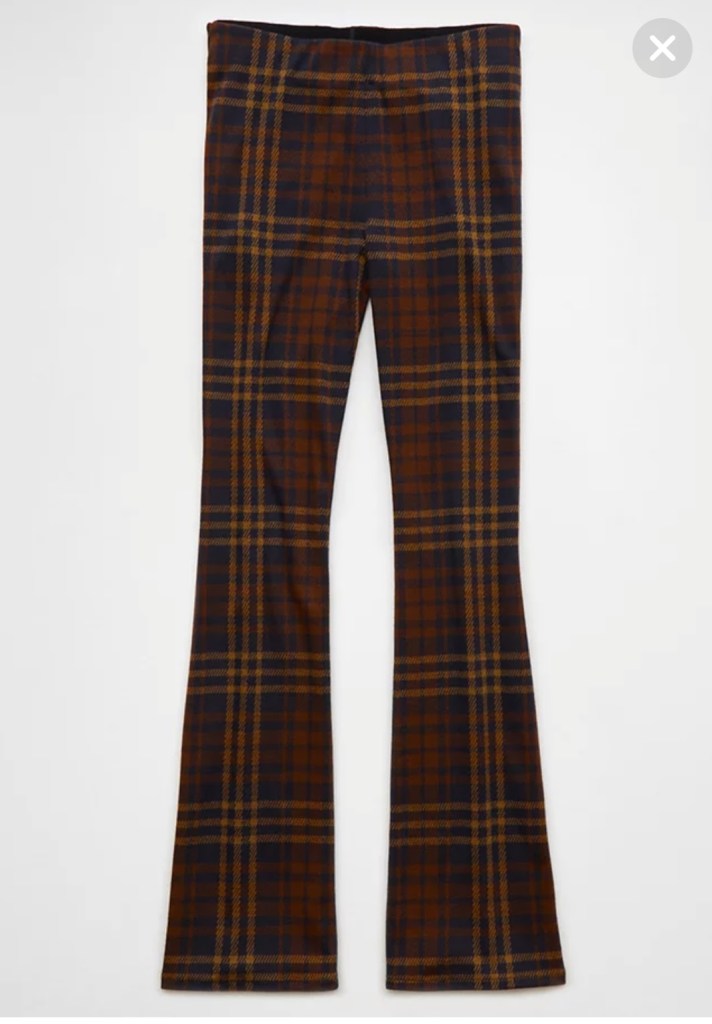
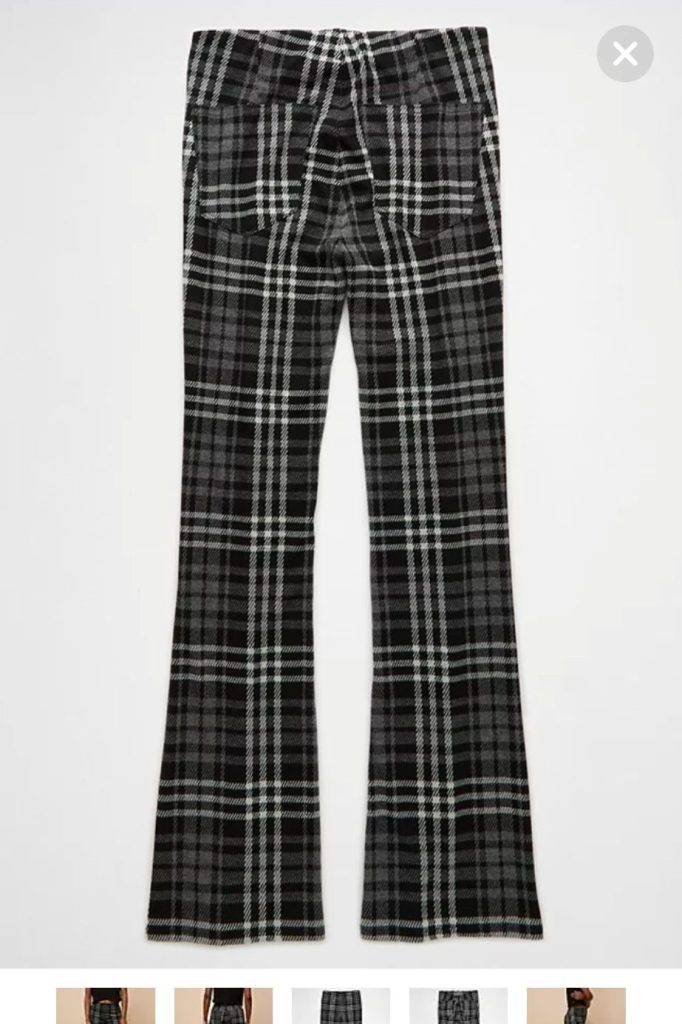
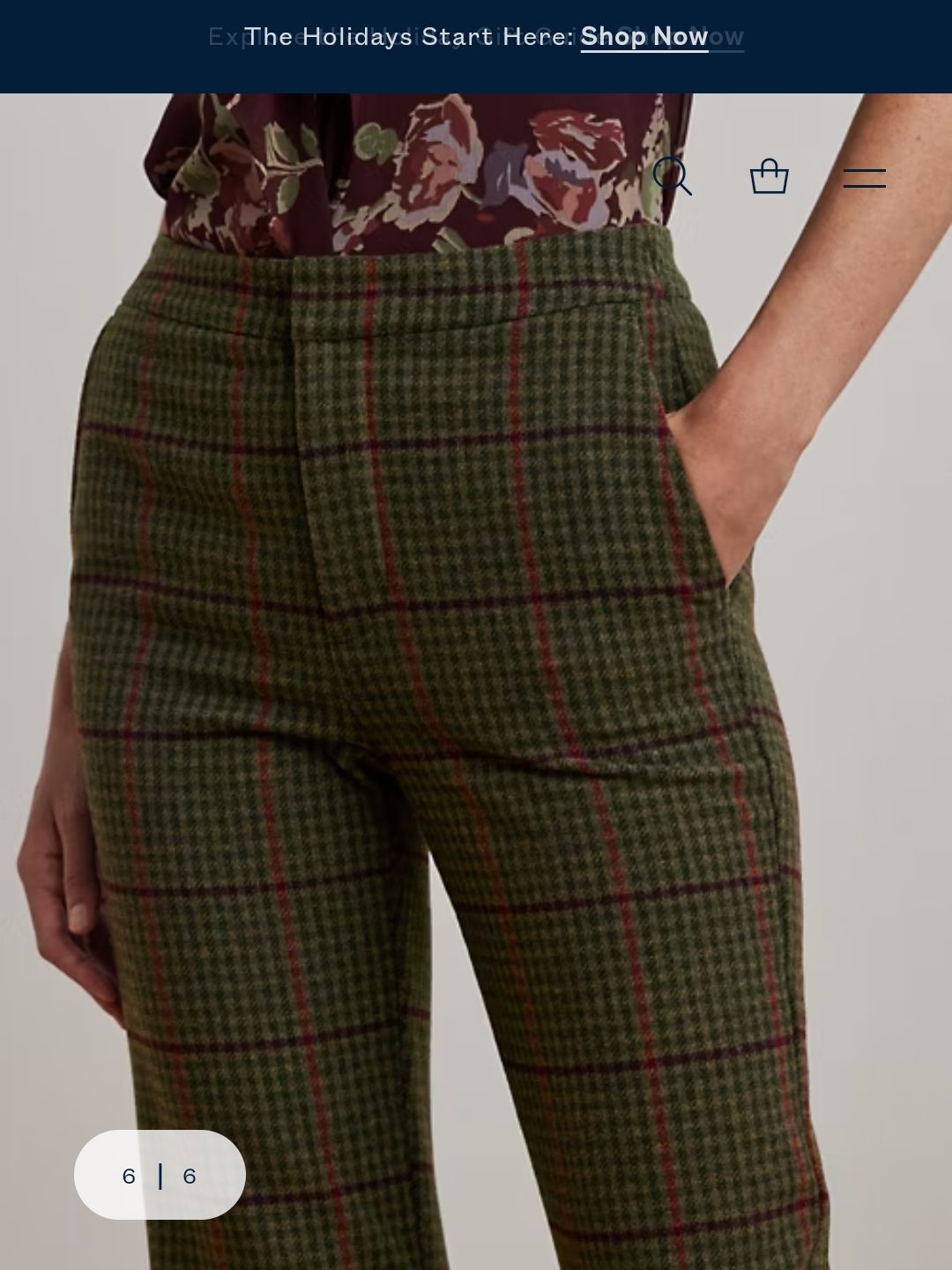
These are a pair of pants that I like in theory. I think a plaid trouser with a closer fitting hip that flares out gently at the bottom is a great idea and would be a versatile item. The plaid print is also matched up quite well in the front view. Something wild happens when you turn the garment around. Those pockets are a bad idea. That’s impossible to match and it detracts from the line of the pants. It emphasizes the way the plaid pattern has to bend with the line of the pants because they chose to change the orientation of the pattern on the butt of the pants only. I think it could be done better and this garment suffers from TikTok lens. It photographs okay and they would be cute from the front, which you can keep as the only view if they are being shown online, but once they enter the real world I don’t think they are going to look as cute. That’s a lot of attention being drawn to one area.
Old Navy: The Lines in the Seat Are Crazy, But Good Pockets
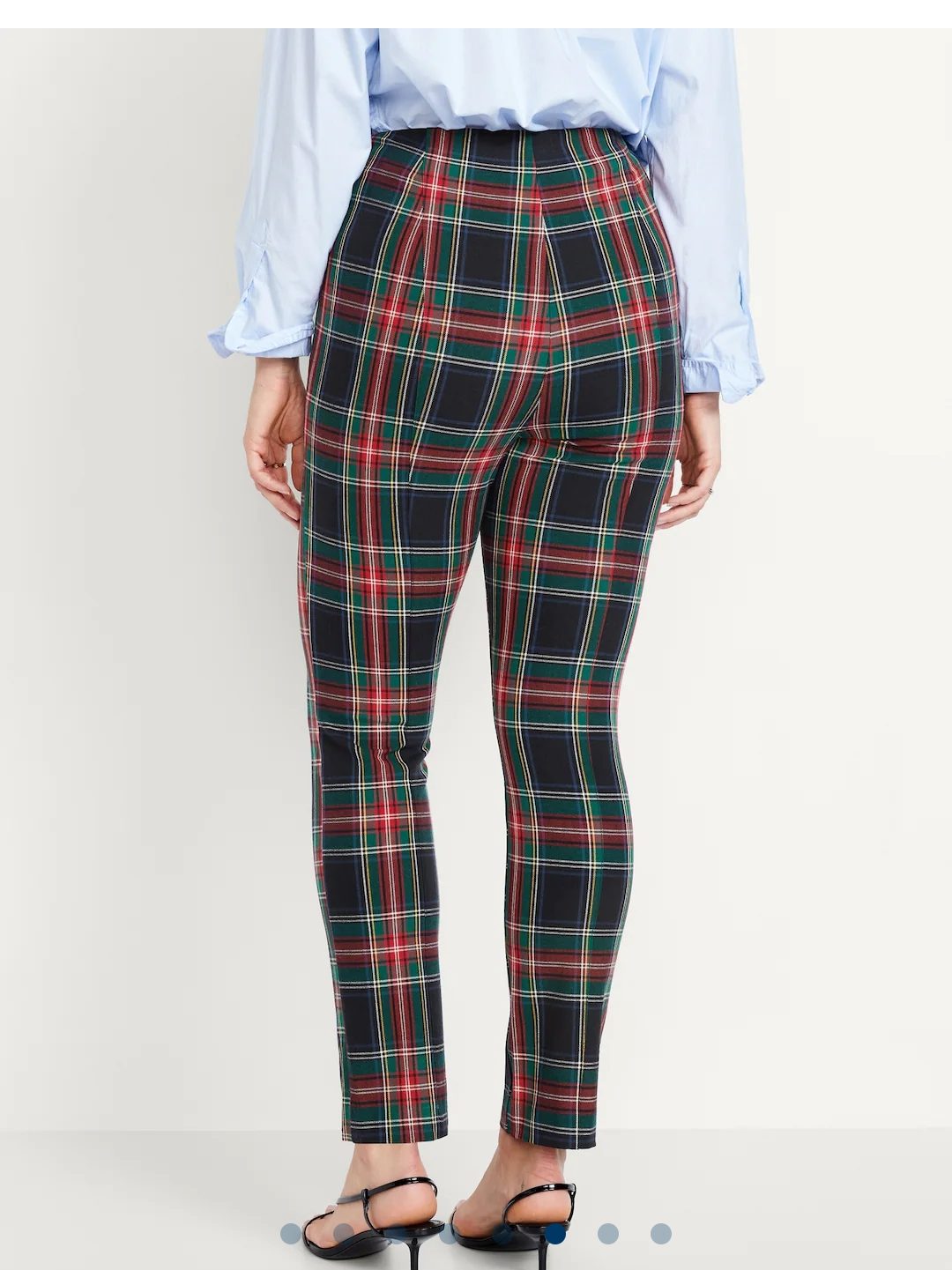
I do think this pattern looks like Audrey Hepburn time traveled through the 1970s punk scene and ended up with Christmas wrapping paper cigarette pants that are cut like leggings. These look really stretchy. Remember in the 2010s when we were wearing patterned leggings? These remind me of them. But they aren’t leggings, they are tailored pants with insert rear pockets and darts at the hip line. I think that is where the problem lies with this garment, the fabric and the fabric needed to make this silhouette.
The product description states the fabric is 55% cotton, 40% viscose-rayon, and 5% spandex. This is not a structured bottomweight fabric. This is a stretchy fabric that is going to have softness and contour your body which is fine in a solid but in a pattern that leads to complications with the pattern. I think the pattern looks odd on the back, particularly along the seat of the pants and the front seam. I think these high-contrast patterns are not a good choice for this application and another type of plaid is better for pants where the distortion of the lines and the seams themselves will not be spotlighted. It’s not where you want the focus of your outfit to be, at the seat line of the garment, that’s uncomfortable. They offered a black watch tartan with lower contrast which was a much better option.
Ralph Lauren: Fabric Choice and Silhouette, but it’s Pricey
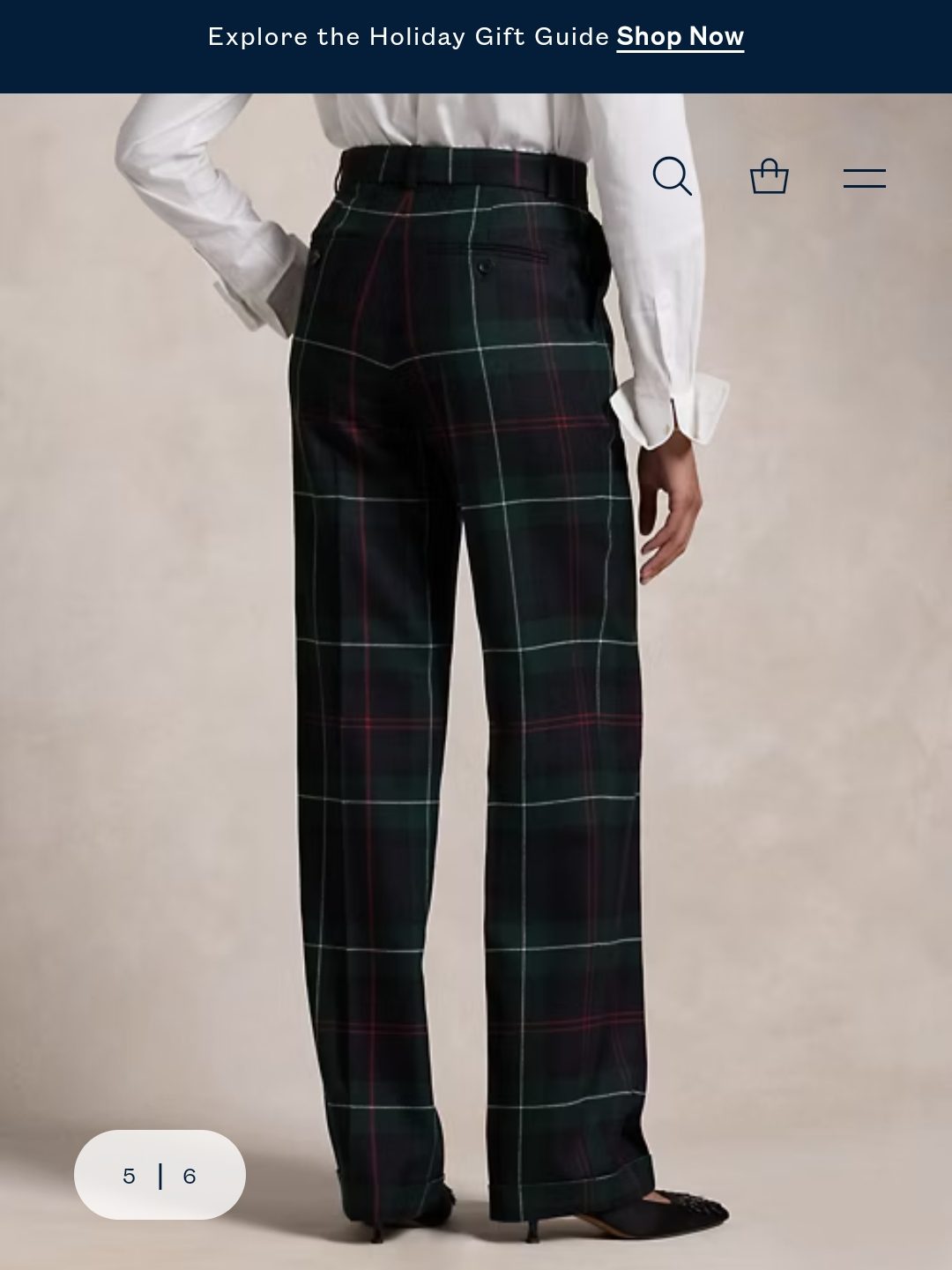
These trousers are comparable to both the Old Navy and American Eagle options for style and silhouette. They have the slight flare of the American Eagle pants and the slim trouser style with insert rear pockets of the Old Navy option. What is different, and in my opinion is a better design choice for these Ralph Lauren pants is the lower contrast plaid style of the fabric and the weight of the fabric which adds structure, eliminating the need for stretch to create the shape. These pants are cut in a way that emphasizes the shape of the wearer in strategic places while also draping away from the body. The pattern cutting of this garment is doing the heavy lifting, not your physique being asked to have the ideal shape to give the pants life.
The plaid is a lower contrast allowing for those tricky seams to fade into the background instead of drawing attention to the problems. On the back seam, the designer chose to use sections of the plaid that were darker, cutting off the pink vertical stripe on both sides before the seam so that the pink appears to flank the seat and therefore draws attention away from the pattern matching of this seam. In the front they follow a similar format, seamlessly integrating the fly into the pattern. The side pockets are tapered again so that the pink vertical begins lower at the hip, drawing the eye to the hip and the waist in a way that enhances the form of the trousers. Again this does not rely on stretch to accomplish this. It takes longer to do, and because of this it has been relegated as a “luxury” feature when actually if you take a bit longer to design to initial pattern after that process it will be easy to grade and use over and over. It’s not a luxury, it’s thoughtful and what design is about.
You can see this attention to detail repeated again in these plaid wool trousers. The back seam was mitigated again by thoughtful lines and fabric structure. Because the wool is a heavier fabric and has structure, it can float across the body instead of stretching across it so the diagonal lines of the plaid do not detract from the design of the garment. It also keeps the vertical line of the trousers even though the lines change direction and the pattern is altered here from the standard perpendicular plaid fashion. This shouldn’t be considered a luxury feature either. Wool is a sustainable textile that is durable and creates much less water pollution than stretch fabrics that shed microplastics or denim which requires a vast amount of water to dye.
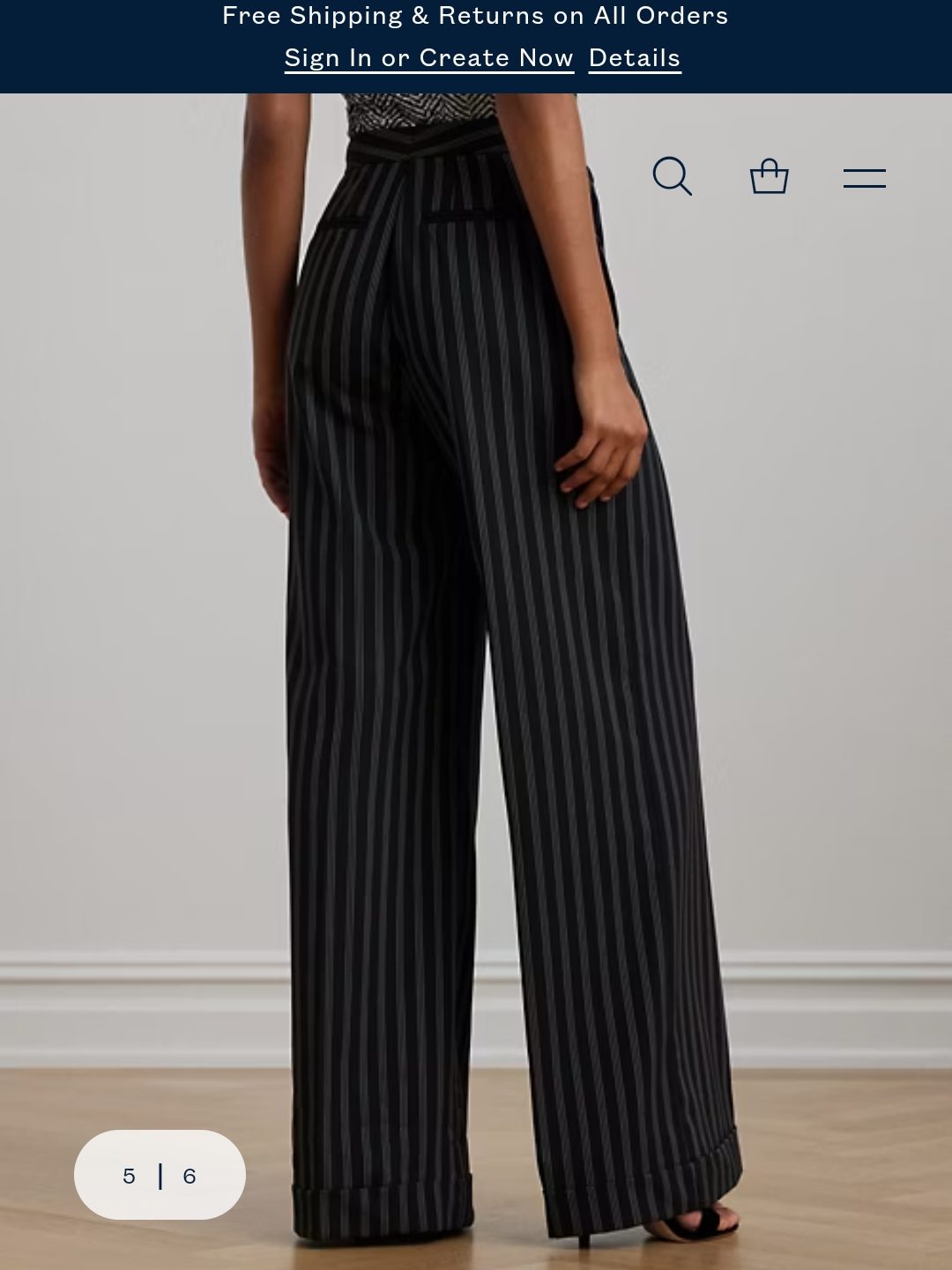
This last example is not plaid but striped, yet the lines of the garment I think still apply. This is another smart design that works with the pattern to create a garment that looks good from all angles. Part of that comes from the wider leg silhouette and the fact that the pant celebrates drape. If this was made from a stretch fabric and was a skinny leg design, a legging basically disguised as a pant, this would be an awkward-looking garment. But affordable should not mean crap design and as consumers we are letting companies determine this as a fact.
Let’s be more discerning in our consumption and look for good design, learn to sew, or support sewing people who can make a good trouser. These Ralph Lauren pants are almost 300 USD and they are not worth that price tag. The Old Navy and American Eagle pants are 50 USD and they aren’t worth that price either. Which leaves the customer with no good option while the brands cash in. We need better clothes made in ethical labor conditions and clothes with good designs that are made to last so that we don’t need to consume so much.
Do you ever spend time learning a skill just to forget it when you need to use it? That’s me. That’s how I sew stretch fabric on my machine. I just jump in and completely forget that I need to first properly adjust the tension and stitch type or else mayhem ensues. Mayhem like my machine having a nice little snack on my fabric.
Sometimes the machine gets extra bold and drags the hem under into the bobbin’s domain, jamming the machine. This is what I am talking about:
In the moment of panic, when I realize the fabric is stuck down in the machine a few thoughts dance through my mind.
Why didn’t you sew this by hand?!
You did it, you finally broke the machine you maniac!!
It’s ripped to shreds, isn’t it? The whole project might be gone in a moment.
This machine hates me. How do other people sew so effortlessly??
But it’s not the machine’s fault and it’s not the fabric that caused this, and it’s not even my fault. It’s morally neutral, it’s an accident and a learning experience to grow from!
As I was writing this, I caught myself crafting sentences to describe the situation with very negative and demeaning language towards myself for making a simple mistake. (A mistake that once I freed the fabric from the machine, I corrected and carried on to make the finished garment. The tight thread tension actually made a happy accident, a lettuce edge hem.)
It is not something that I should hold with such severity against myself that I internally tell myself I am an idiot, a lousy sewist, or useless.
Because how would I respond to hearing someone say that to another person? I would be disappointed in the speaker and make them stop.
How would I respond if I spoke with such aggression to another person? I would be ashamed.
I am learning through these sewing setbacks to temper the internal monologue and be a more gentle and loving person towards myself, to maintain better mental health, and establish the practice in my mind so that I can be a source of gentleness and kindness to others.
How do you speak towards yourself and others when they make a mistake?
While I was on vacation up to Erie I received exciting news! I saw this blog has reached 100 subscribers! It made my day. I am so grateful to everyone who has subscribed. You guys are amazing! I appreciate every view, every visitor, every like. It’s given me purpose in a season of transition, helped me get back into writing, and drawing, and feel more comfortable sharing Potato Technology designs online. It has also been a rewarding way to connect with people worldwide which I find exciting.
I’m hoping in time to connect more, and maybe keep comments on my posts to get to know you more. I’m just shy and scared of getting hate comments when I want this to be a safe space. Maybe in 2025? I’ll keep trying to be brave.
I’m looking forward to sharing bits about my trip and some more sewing and knitting projects I’ve completed in September. September was a busy month! I think heading into October, I’ve needed a break. It was good to get away and refresh. I’ve been feeling a bit of writer’s block the past week so I took a small break from the blog too, hoping to have renewed my creativity!
Thank you, dear reader, for such an amazing milestone! I hope you have a wonderful day and that I see you around the blog again. There are many exciting things I have planned that I would love to share with you. I hope you know that you are loved and worthy just as you are.
Fast fashion is a problem for many reasons. The overconsumption. The exploitation of workers. The lack of quality in construction and fabric. Polluting water sources and landfills. Ruining thrift stores with Shein products. But one I hadn’t considered was how these fast fashion brands are watering down design to the point that they are misrepresenting fashion terms like corset, choosing the wrong fabrics for construction, and not even trying to pattern match. It’s becoming nonsensical!
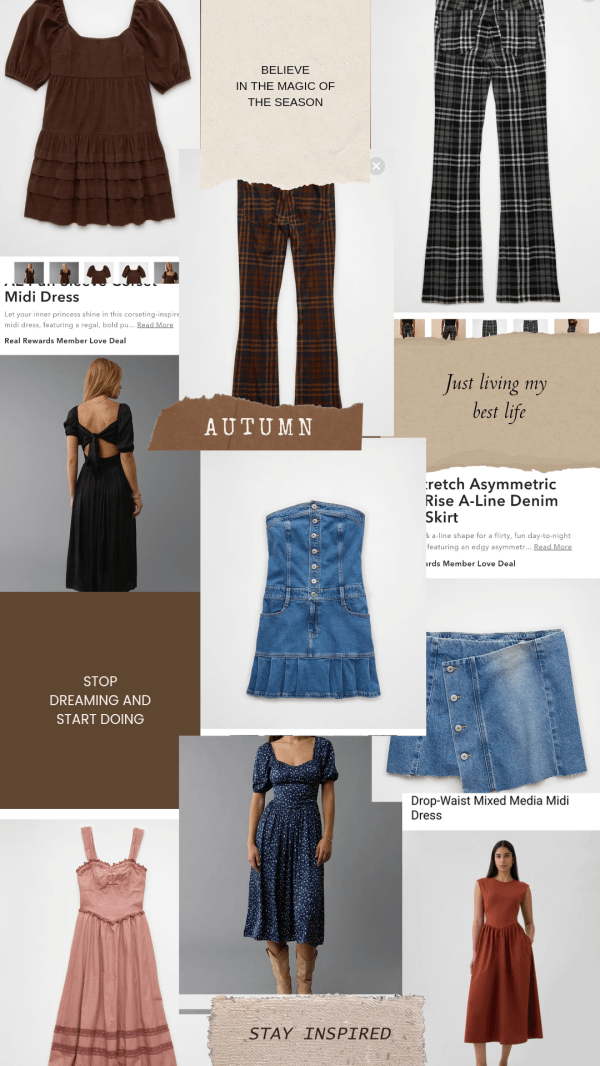
Fall fashion trends and fall sales are in full swing here in the US. I’m seeing ads everywhere, in between Instagram stories, in my email inbox, on YouTube, on television advertisements, etc. It’s bonkers! You would think that we had empty closets and had never owned cold-weather clothing before! Each season you need to completely restock your wardrobe! Buy, buy, buy!
So I caved and I started to look at these websites. Looked, not purchased. That is the key here because I found some wacky things masquerading as vintage and historical-inspired pieces of fashion. These fashion brands are two that are quite popular in my neck of the woods.
The Gap does Medieval Plate Armor
A brand I get a lot of ads from, which amuses me because I don’t like this brand, is the Gap. I probably see ads because I do buy occasionally from Old Navy and they are owned by the same company. If only the Gap knew how I feel about them, they would realize it is a lost cause. I think that the Gap cuts its patterns weirdly, is expensive for the quality, and is dry toast in terms of its aesthetic. So I wasn’t surprised to see a rather vanilla dress. What surprised me were the style lines of this dress and the fabric they chose.
This dress looks inspired by 16th-century plate armor, a breastplate specifically, but it is made out of what I would guess is a stretch jersey because there is no structure or fastenings in the photos. So a rigid garment, being made out of a stretch shapeless fabric, just isn’t right. There is something off about the shape of the bodice and how it hangs on the body. This is a missed opportunity. I think they could have added boning channels or made this out of a stiff woven fabric. Maybe a coordinating vest? Vests have come back in popularity. It’s a misrepresentation of the historical garment they were inspired by and as a dress historian, it bugs me. This dress is already an attempt at thinking outside the box, so why not do it properly and celebrate the design? 🙂
There is an exhibit at the Met, linked above showing a historical example of what I am talking about, featuring an exhibit of 16th-century armor with beautifully sculpted lines.
A Corset That is Not a Corset
This dress is not a corset. Maybe it is a Victoria’s Secret definition of a corset with the stretch smocking on the back, but this is not in form or function, what a corset is or was. The corset was a supportive undergarment, a foundation garment as they were called that shaped the body and supported the bust according to the specific standard of beauty at the time. The first iteration of the corset appeared in the 16th century, called a pair of bodies. This was followed by stays in the 17th and 18th centuries and the transition to the corset in the 19th century which held popularity until the 1920s when the corset began to fall out of fashion for other types of garments. This is a very quick overview and I probably oversimplified this so I would recommend checking out historical costuming YouTube for a better reference, also the V&A has an online exhibit featuring Victorian corsetry.
Because of the lack of familiarity, we have with the corset in our 21st-century mind, we tend to slap the word corset on any shape that looks like a formed bodice, which is what this is a bodice cut to accentuate the waist but will fall flat because it is not made with any structure to give the garment a shape. There is no lacing, cording, fake baleen, or steel to give this any shape beyond the body that will wear it. It is all smoke and mirrors. But that bugs me, because American Eagle, the maker of this dress, is a popular teenage and young adult brand that can shape the minds of the future by their experience with clothing!
So why not ride this wave of aesthetic TikTok dressing and go full-on corsetry? Tight lacing is not required, nor was it popular for most women historically, except for the Kim Kardashians of antiquity who did it for the spectacle, people of the past needed to move and breathe just like us so it could be a corseted bodice, and not be controversial! It’s just a thought. I do appreciate the trim on the skirt, it is very 1890s, and I like it.
This dress has the same problem, this is not a corset and this is barely a puff sleeve. This is bad marketing and bad fashion education. You could never corset an open-back dress and to puff a sleeve you need quite a lot of volume and possibly some Tarleton to help keep the sleeves voluminous. The Fashion Institute of Technology has an online exhibit featuring the Gigot sleeve, a beautifully puffed historical design.
When it comes to historical dress there are so many cool designs from the past, and with the amount of research that exists and abilities to connect through technology, there are endless ways to be inspired from the past but not screw it up. I think we should embrace the gift we have of historical dress knowledge and technology like sewing machines, the internet, etc to make something beautiful. These companies have so many resources at their disposal, that I wish they would try a bit harder to make good clothing. But alas, they are fast fashion, and this is one of the worst fast fashion blunders I have seen from these two brands, the Gap and American Eagle until I found this one pair of plaid pants, but that is another story!
Thank you, reader, for going on this adventure into historical dress with me. If you are as tired as I am of the current state of fashion, I encourage you to learn how to sew! It’s the best hack I’ve found.
I think the only thing bouncy here is me feeling like I’m bouncing off the walls of my creative box after setting a goal in 2024. This goal was to get serious about my sewing and knitting Instagram account, use the creator metric tools, and learn how to use my digital marketing background to create engagement.
The Focus
I wanted a lifestyle change, an actual commitment to taking this seriously and it has worked. Follower count is a garbage stat on Instagram as mine hops around like a binkying rabbit, but engagement, interactions, and reach have been insightful tools to see how this can grow and what I should be working towards.
Now that it is Q4, um, I am creatively burnt out. So many reels, so much video recording, so many moments having to stare at my own face and body because I am the model, and try not to get body dysmorphia or feel self-absorbed. Yikes it messes with the head. The way some pieces of content have huge runs of traffic and some fall flat must be what it feels like to find the crab and miss the crab on the same string of pots. It’s wild.
My Internal Monologue
I spend time tracking and comparing one piece of content against another one that performed better on a different day or was posted at the same hour, so why did it perform differently? Did I use the right tags? How do I capture the same magic in a new piece of content? Should I use a formula for my pictures or videos? Oh no! Am I one note? How do I mix it up? Was that the right song? Should I create more content with trendy sounds? Was it my hair? Is it because I haven’t painted my sewing room yet? If I paint it a color I like will it perform better or worse? Should I paint it a sad beige? No that’s insane.
I miss the days of making content that didn’t feature my face, or my designs, and was not solely based on my own deadlines. But I hated that job?! Why do I miss the days of launching that Employee App or writing for an internal corporate magazine that was employee propaganda? I think its the artistic blues mixed with the echo chamber of the algorithim. When I get stuck in the metrics and the trends, I’ve noticed I have blinders to the things that are going well. Instead of appreciating any person who takes the time to watch my reels or like my posts, I refuse to let myself feel happiness.
It’s really unhealthy. It’s killing my mindset and keeping me from feeling inspired to create or to write. I’m just bottling it all up because I’m embarrassed of how this is getting to me. I feel silly. And because I am building something, and don’t feel like I have something to show for it, even though I do because it is on the internet. But how else in 2024 can you reach people in our world of technological disruption to our sense of community? So its not silly. It is work and can lead to something.
Wake Up
It’s time I creatively refresh and slow down. I’ve accomplished my goal of making it a habit and learning how to grow engagement. It’s time to shift gears. It’s October and I’ve barely written a piece of fiction or poetry. My artistic practice has slowed, my sketchbook gathering dust. What about Japanese, Korean, and the language of the piano? So dusty.
How about my goal to knit socks? It’d be nice to try at least one before 2025.
So as October, November, and December stretch out to the horizon, I’m looking forward to finishing this year strong and with renewed purpose. This blog is for all my hobbies; unfortunately, sewing is my coping mechanism. And when that landlord said we had to buy or get out, I went into a full-on sewing spiral.
It’s been a fun time. I’ve sewn so much more than I’ve even had the time to share on Instagram or the blog. It’s starting to get lost, all those moments, with haste instead of being shared with patience and proper love.
So I’m going to start. This afternoon I sat down and learned how to play the beginning of Für Elise. Tomorrow I hope to write and to feel free to create slowly. To be intentional with my time and pull my mind back into writing and the things I want to write about in my heart. Maybe some yoga thrown in there too.
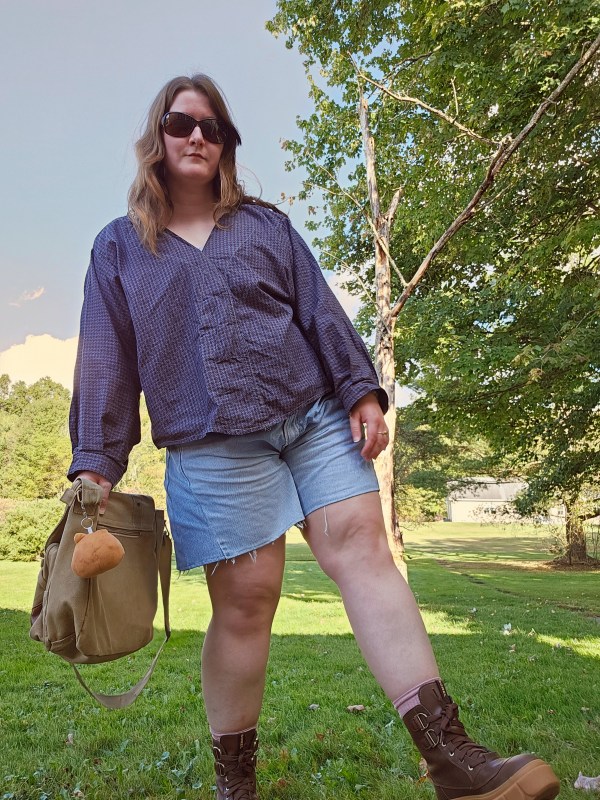
It’s that time of year when I am ready to wear long sleeves but the weather isn’t so convinced. This blouse is a project I made at the end of March 2024-early April 2024, that I completed and put into my closet to wear later. I was excited as soon as it began to cool off for the chance to style this piece! All summer long I’ve worn its sister piece, my denim houndstooth skirt that can also be worn as a dress that was absolutely lovely material to wear. It’s so breathable and has a bit more visual interest than the usual chambray, something I look for. This fabric is from Mood Fabrics, it looks like they no longer carry it which is a shame because I have two pieces from this cut of fabric, and I want to make more.
This piece is special to me because I did something a little different with the collar, I stitched in white the lines of a blazer lapel and lines of a jacket crossing over, for a bit of a formal feel. I originally wanted to make this fabric into a jacket but ran out of material, and I think it worked out for the best. I want to play with this stitching a bit more. It resembles a tailor’s chalk marking to me and I like that.
As the fall progresses and the temperatures continue to drop I’m looking forward to styling this piece with pants, vests, dresses, skirts, boots, scarves, etc. Styling this piece with new color combos excites me. I’ve only paired it with this brown and blue combo so far, which sparks my interest the most. I’d like to try this stitching application on trousers and dresses too with a solid fabric or maybe another pattern.
Do you like contrast stitching? Do you like clothing with a bit of whimsy like this faux blazer collar? Are you a fan of patterns? I like how different we all are and how tastes and preferences make this fashion thing, full of endless creativity. Thank you, dear reader, for stopping by. I hope we meet again soon. ❤
The start of September feels like the start of the Gilmore Girls season. Probably because it used to start airing around this time of the year, but also the show follows a seasonal structure. Usually beginning before or during the school year as Rory embarks on her next academic chapter. A key aspect of Lorelai and Rory’s life is the Friday Night Dinners at Richard and Emily’s house, every week. Emily and Richard, being rather formal people, expect a dress code for their family dinners being formal. It reminds me a bit of dressing up for church as a kid.
There is also a silhouette to the outfits each of the Gilmore Girls wear. They wear a lot of dresses with small cardigans over top, but they also pair fitted blouses with a knee length skirt, usually flared for Rory or a pencil skirt for Lorelai. Rory dresses with a more demure style, that reflects her academic personality where as Lorelai is a bit bold with her patterns, textiles, and colors. It matches her personality of being independent and need to separate her life from her parents’ world.
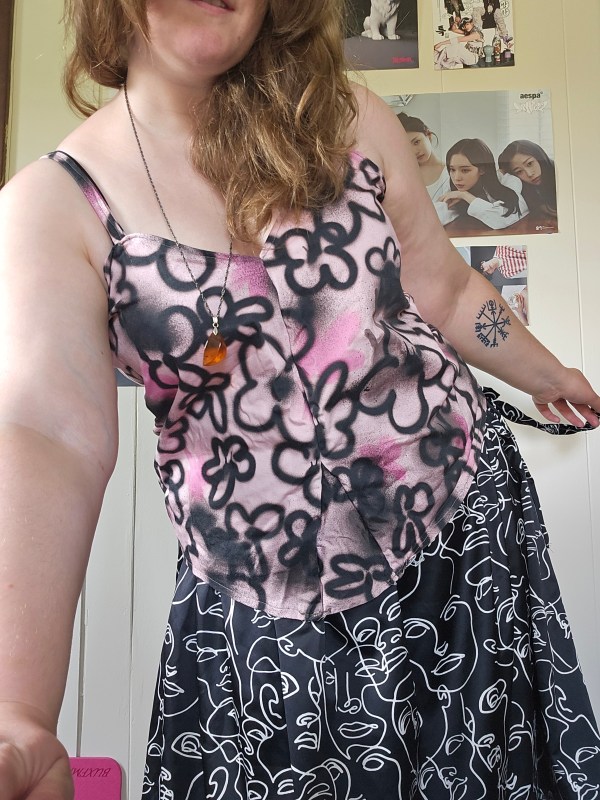
I thought this combination married both the silhouette of Rory’s style with the bold and playful textiles of Lorelai’s personal style. The blazer is not a Potato Technology piece, I ordered it from YesStyle, but the bustier top and skirt are my own designs. The Floral Print Grafitti Bustier Tank, I designed in 2023 from 1/2 a yard of fabric. This piece was draped and cut on the form. I wish I had known about making craft paper patterns at the time because it’s going to be a challenge to reproduce. The Expressions and Lines Skirt is a new design from this summer. It is a satin graphic print that for the first time, I was able to cut out the pattern directionally without any mishaps! I’m so pleased. 😀
I think the combination of pieces look a bit 2000s, mid 2000s for sure, and capture the essence of the time period. The blend of Lorelai and Rory’s style is a reflection of how I consume the show now. Which character I relate to is a blend as I get closer to Lorelai’s age when the show begins instead of Rory’s age, which is so weird to realize. I’ve truly grown up with this story, being just 12 when I first watched it. Lorelai’s story finds me more each time I watch it.
In honor of National Sewing Month and the 160 years of their existence the big four – Simplicity, McCall’s, Butterick, and Vogue Patterns are taking a look back at their patterns. The Simplicity Creators group turned this little moment of fashion history into a challenge, Sew Your Decade. I first learned about this through a video from Stephanie Canada where she took a look at the patterns Simplicity was highlighting on their ‘Stitch in Time’ historical presentation of patterns and fashions made by these four companies over the years. A lot of them were reproduction patterns and had dubious choices, including some 1950s patterns in the 1960s. But that’s more of an editing problem.
Because I have a lot of other projects in progress but I love historical fashion, I thought I would take a look through the historical pattern wiki and choose a pattern from each decade of what I would want to make if I had the time to make a garment from each era. I’m using the vintage patterns wikia and historical sources instead of the patterns on Simplicity’s site because the originals are just more appropriate and imaginative than the ones selected on the timeline and the reproductions they sell currently.
1800s Era (1860s-1890s)
Butterick 9111; ca. 1897; Ladies’ and Girls’ French Bathing Costume. Pictured in September 1897 Butterick catalog.
I choose this bathing costume because it is such a unique relic from the past but also because we’ve seen some new designs for swimwear come out recently that reimagine the typical 20th century-21st century swim suit, that look less like bikinis and more like a crop top and a skirt.
1900-1910s Era
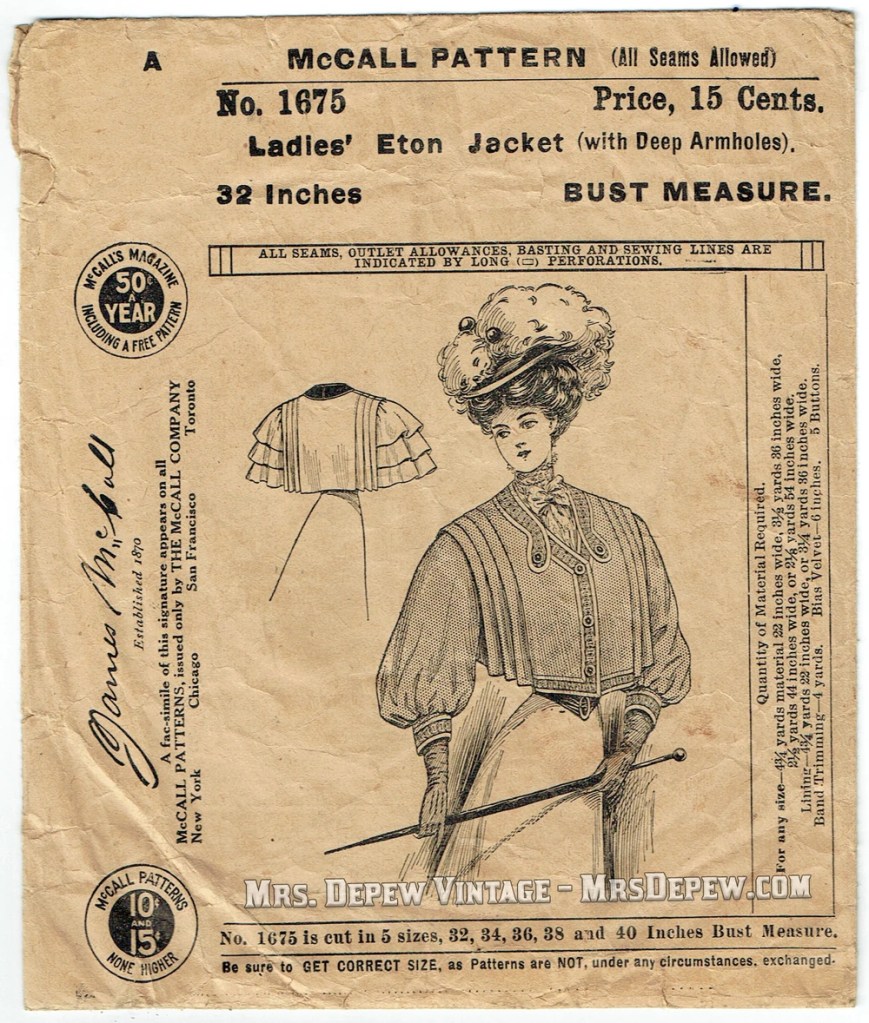
McCall 1675; ca. 1907; Ladies’ Eton Jacket (with deep armholes). Featured in McCall’s Magazine September 1907.
What a fabulous jacket! That’s why I would choose this Eton jacket from 1907 because not only would it create a great historical silhouette, I’d love to try styling it with other items from my modern wardrobe.
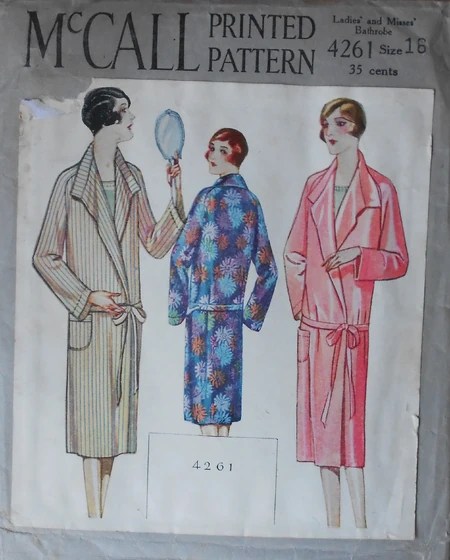
The flapper dress patterns you see in the store are so played out and inaccurate. My choice was influenced by the wonderfully boxy lines of this robe. It encapsulates the straight up and down silhouette of the time while looking like a piece that could be dressed up or down, for around the house or used for wearable garment in the right fabric.
1930s Era
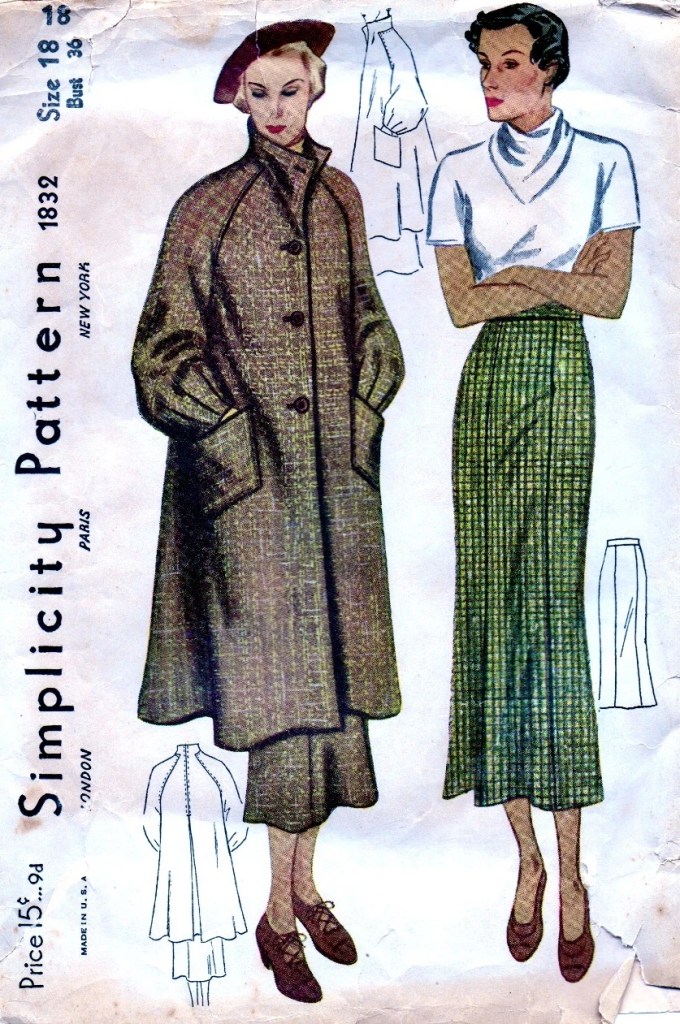
Simplicity 1832; ca. 1935; Ladies Swagger Coat and Six Gore Skirt. Coat has full raglan sleeve tucked at the wrist, patch pockets, stand-up collar and inverted back pleat.
Oh my goodness, this coat is fabulous. I may try to track this down in the future just to try my hand at it because I love these style lines. I love the raglan sleeves with the contrast of the narrow 1930s skirt. It’s so chic.
I like the academic style of view A and the elegant style lines of view B. I think I would get a lot of wear out of a dress in this style. The 1940s are one of my favorite eras for vintage fashion, I love the style lines of this time period and the 1920s-1930s.
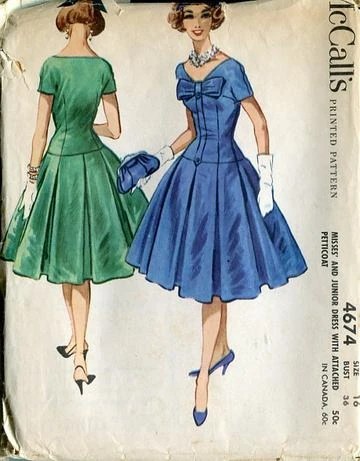
The 1950s is not my favorite era of fashion, mainly because this silhouette looks horrible on me and it’s really over done when people think of “vintage” so for inspiration I went to 1958, the year my grandparents got married to find something interesting. I like the bow on the front of this and flounce of the skirt. The shape reminds me a bit of a bridesmaids dress I tried on that my grandma wore for her friends’ wedding in the 1950s.
1960s Era
Vogue Paris Original 1434; ca. 1965; Pierre Cardin – Suit. Side-buttoned jacket with standing, bias ring collar and cuffs. Tie belt at front, welt pocket and three-quarter length sleeves. Slim skirt.
I chose this one, first because I had yet to choose a Vogue pattern and secondly, because this suit is sharp and screams 1960s glamour. I love the over sized buttons. The classic shape and the slightly mod-artsy feel of the over all look.
This is a unique pattern. I like how many styling options we get in the line drawings. It’s an interesting jumpsuit I could see made up in several types of fabric for casual or fancy styling. I should see the blazer made in a contrast fabric or the same. Jumpsuits were a staple of the 1960s and 1970s so I think this is a great option to represent the decade.
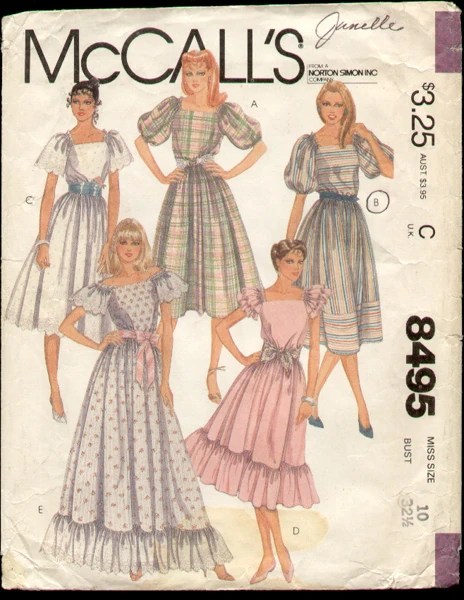
This pattern is so extra. I didn’t realize how much the cottagecore aesthetic pulled from this time period – wow! I thought the 1980s was just inspired by the 1940s, but there is a lot more there to see. I think this would be a great upcycling project with bedsheets.
I originally wanted to pull from 1993, but this pattern is too perfect for me. I honestly want to make all three of these. I have fabric that would work for view B. I wonder how difficult it would be to track down?
Closing Thoughts
A special thanks to Vintage Pattern Wikia for making it possible to browse vintage patterns and for keeping these moments of fashion history alive. Thanks also to Stephanie Canada for putting this on my radar and for sewists like her who are keeping vintage patterns accessible to us to sew with. This was a fun challenge posed by the Simplicity Creators group and Simplicity itself for putting this on all of our radar. Although I’m not going to sew anything from what I found because I seriously have to many projects to add another right now. It’s a great way to appreciate vintage paper patterns and the effect they have had fashion and clothing in the last 160 years. Sewing your own clothes is such a great way to make things that fit you, and have your own flair, they also combat the unhinged mayhem that is fast fashion. It’s a win win 🙂







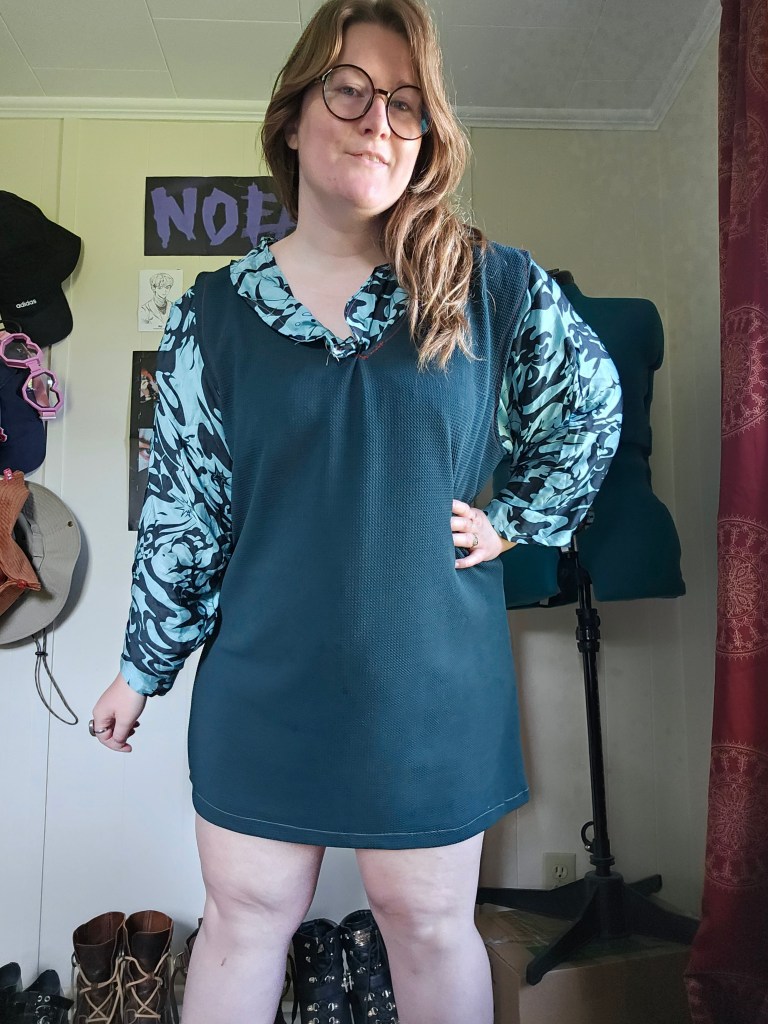
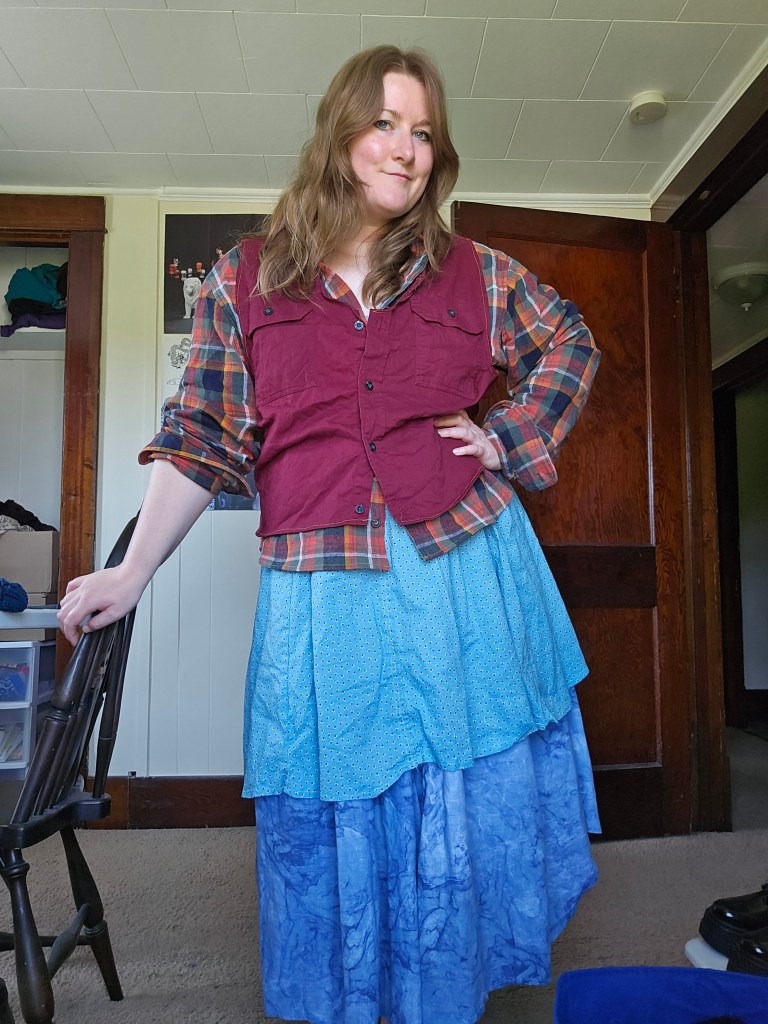

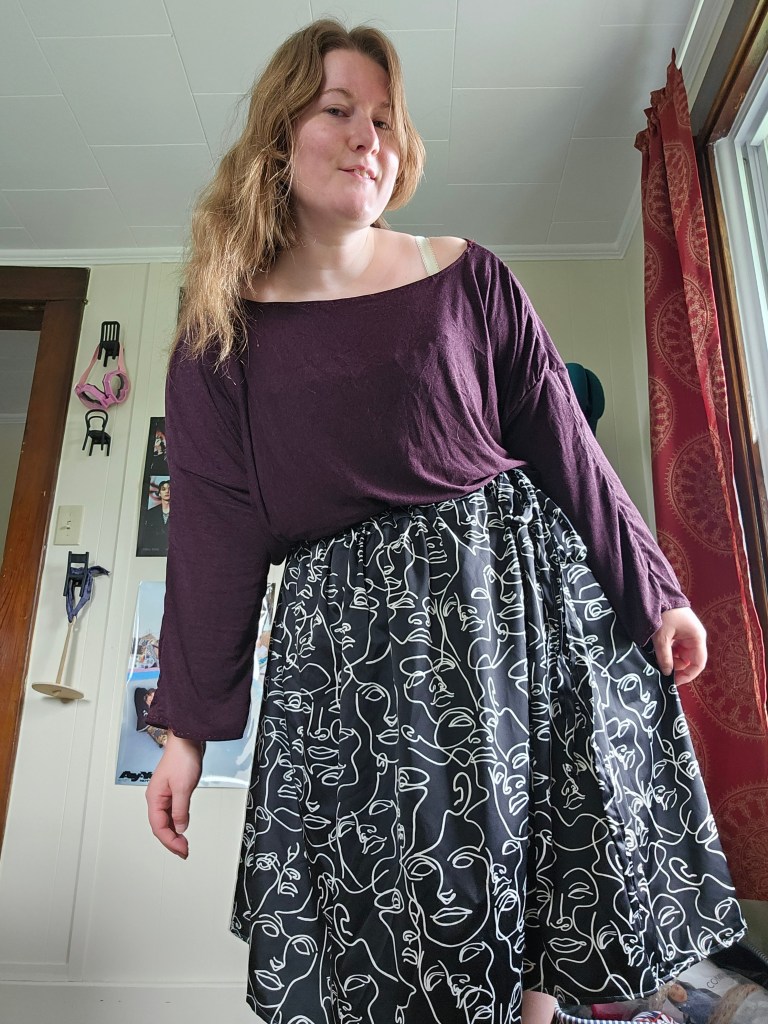
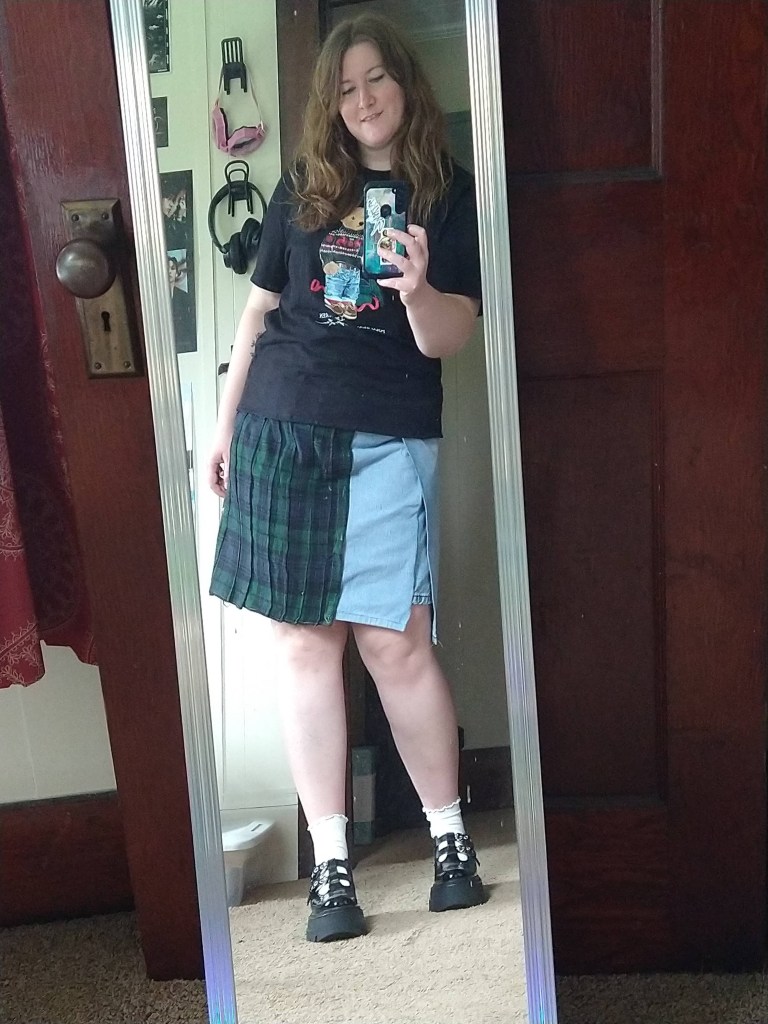




















 One Rabbit Riot