What’s Wrong With This Tomato Plant?

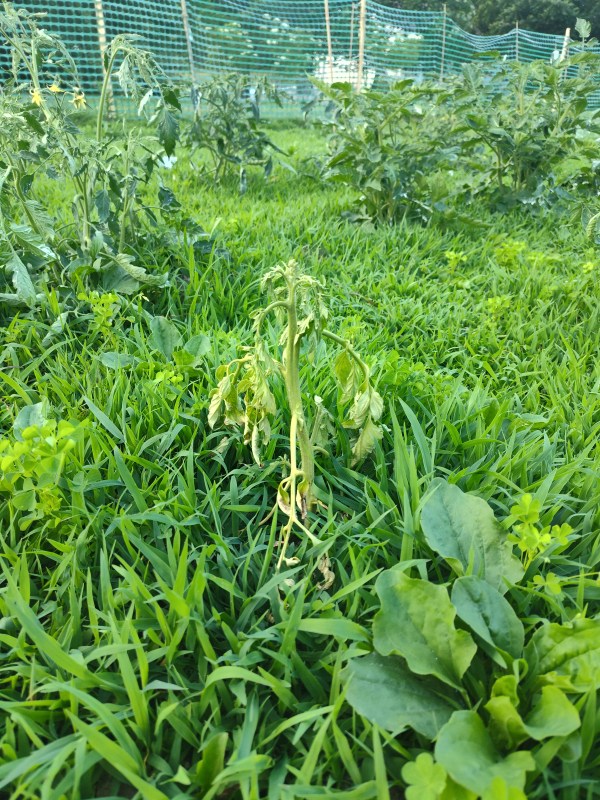
Our garden is doing very well this year. Our squash plants are thriving and putting on finger-length fruit, our tomatoes have a lot of blossoms, and our corn is up to my waist. In general, we are ecstatic with how much success we’re having. But this is a garden, so let’s be realistic: we’re not achieving perfection. And one example of where something is failing is this single tomato plant.
tomato plant, gardening
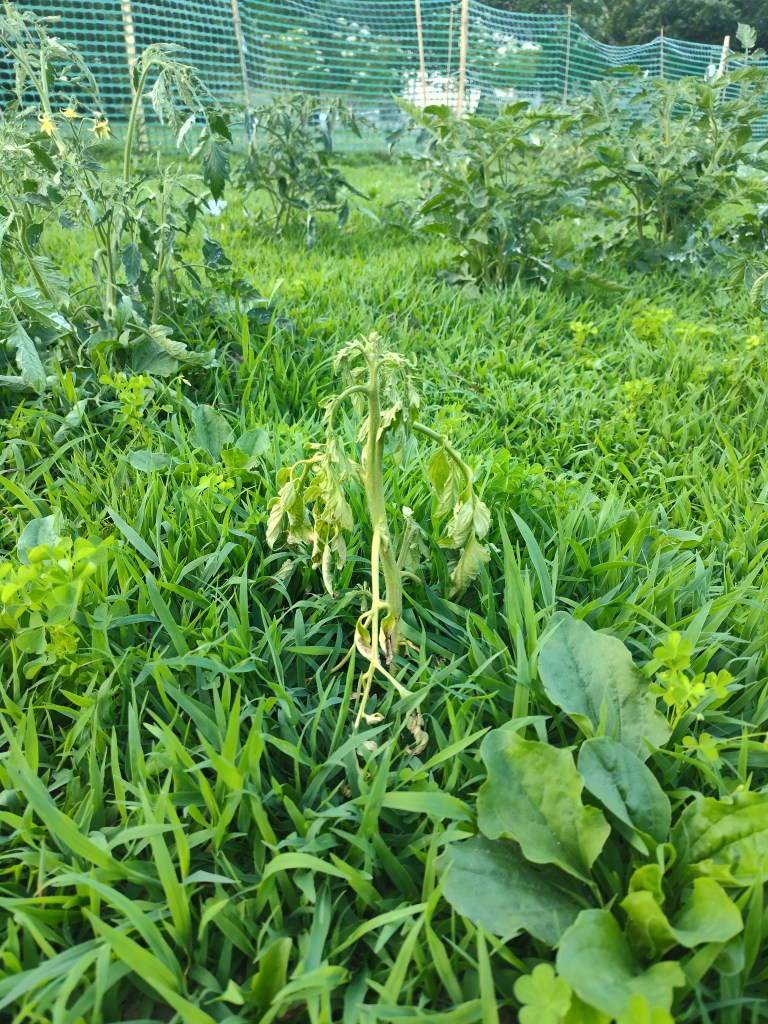
A dying tomato plant.

I took this picture last evening, and it’s pretty clear that the plant is going to die, but the thing I can’t figure out is why. I know that there is a lot of grass and other weeds growing around it. We’re in the process of remedying that with cardboard, but the grass is present around our other plants, and they’re thriving. It’s not the soil, moisture levels, nutrients, or amount of sun. This bed is full of tomato plants, and this is the only one that looks like this. For comparison’s sake, here’s the tomato plant that’s right beside it.
tomato plant, gardening
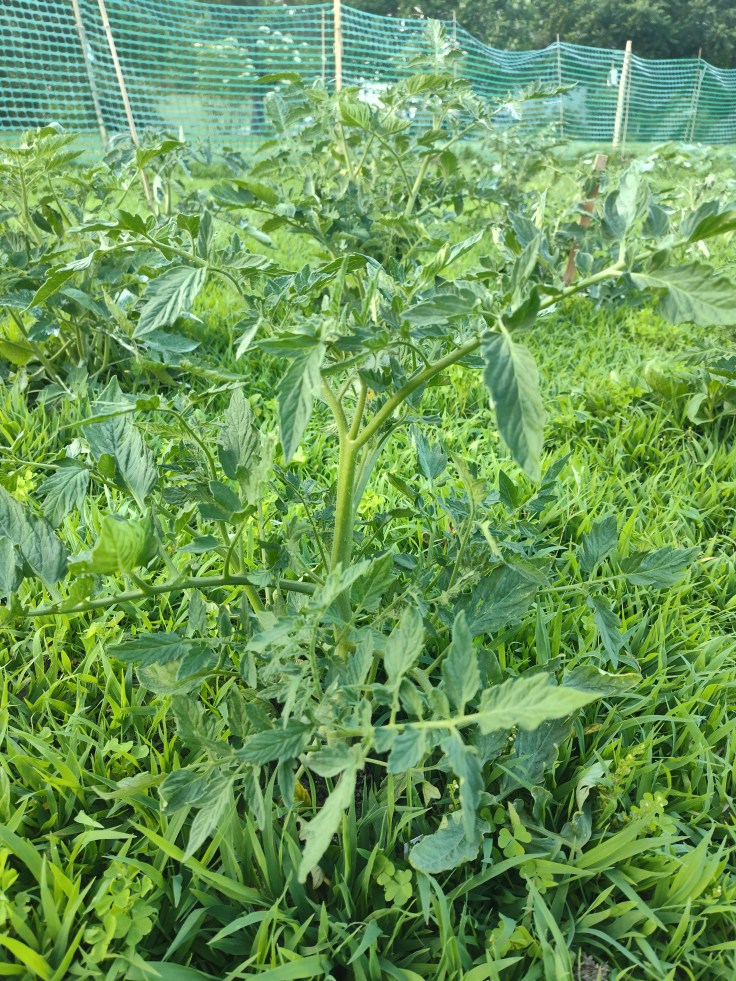
An example of a thriving tomato plant.

This tomato plant is the same variety and only planted about 18 inches from the dying one. It has healthy leaves, it’s standing upright without support, and it has blossoms on it. By all counts, it’s doing very well and will produce fruit. The majority of our tomato plants look just like this one. Side note: we’re going through a week-long heat wave, so the plants show signs of stress from the heat before the sun goes down. Besides that, though, they’re incredibly healthy with a lot of flowers. So, if everything is the same between the dying plant and this one that is thriving, what is the cause? I honestly don’t know, but if you have any theories, I would love to hear them, because I’m perplexed.

Actually, although I wish I knew the answer to what’s causing the plant to die, there is something so refreshing about gardening, with how you don’t always have solutions. Gardening is quite analog when almost everything in our world is digital. And even though there is a lot of science behind a successful garden, you also need to rely on your senses. Is a tomato plant’s leaves curled? Do they feel brittle? How firm is the zucchini? Does the soil feel moist when you place a finger in it? These are all things that research can’t give you straightforward answers to. Sure, books, blogs, and videos can describe how something should feel, look, or smell, but you have to experience it for yourself.

We were watching something on YouTube last night about the lack of silence in the world today, which is something I’ve expressed frustration over in recent years. The video included a clip of Fred Rogers from Mr. Rogers’ Neighborhood. In it, he said:

Our society is much more interested in information than wonder, in noise rather than silence…And I feel that we need a lot more wonder and a lot more silence in our lives.

With the explosion of data, social media, and the internet’s intrusion into our lives, the quote could easily be from 2026. But if you’re familiar with Fred Rogers, you’ll know that he passed away in 2003. That quote was actually from 1994 or 1997. Charlie Rose interviewed him twice, and I’m having some difficulty determining which interview this quote is from, but I believe it’s 1994. Either way, though, it was at least a couple of years before the Internet became a household norm and at least a decade before the first iPhone. He was concerned about the wave of information long before it reached its current level.

Gardening is great because you can escape the oppressive nature of technology and information. When you look up the cause of tomato leaf curl, you’ll get a lot of different answers. It could be too much water. It could be too little water. It could be too much sun. It could be not enough sun. A lack of nutrients could be the problem. It could be root rot. And then there are the endless number of pests it could be. Because gardening is an extension of nature, it feels like it’s beyond the realm of technology, and I think that’s what draws many of us to it. My job requires me to be on a computer on a daily basis, which I’ve accepted because it’s allowed us to buy a house and have a garden. But beyond that, I generally hate technology even though I’m guilty of doom scrolling on Reddit or picking up my phone because I’m bored. But nature and gardening allow us to escape that, if we choose to. It’s like John Muir said: “Into the woods I go, to lose my mind and find my soul.” I’ve seen woods replaced with forest, but I also think garden or nature work here. As a society, it seems that we’ve grown afraid of not knowing the answer to something, but that mindset causes us to lose all wonder and creativity. It leads to an absence of being motivated to discover the answer on our own.

To circle back to our dying tomato plant, I have no idea what caused it to die, but I’m sad about it. I’m also comfortable with not knowing the answer at this time. Plants are living creatures, just like humans and animals. Unfortunately, they get sick like we do, and sometimes we just don’t know the reason. But I’ll continue to hone my gardening skills so that this happens less over time, and if you have any ideas as to why it died, I’d love to hear them. I’m not interested in researching the answer and becoming overwhelmed by information, but I’m always up for a good conversation. And in the meantime, happy gardening!
I Was A PBS Kids Girl

What TV shows did you watch as a kid?

Wishbone

A Jack Russell Terrier that is one part family dog and one part incredible thespian. Wishbone is the most versatile performer jumping through classic literature as the hero of many classics like Robin Hood, Dr. Jekyll and Mr. Hyde, Romeo Montague, Mr. Fitzwilliam Darcy, Sherlock Holmes, Don Quixote, etc. It was my first introduction to these stories as a child and it made reading exciting. It also brought a smile to my face when in high school these stories came alive once again in class from my memories of these episodes.

Zoom

Zoom sparked my imagination for science, especially the online games from the Zoom section of PBS Kids. They did interesting experiments, and it was an educational variety show featuring skits, arts, letters, language lessons, and more. My favorite part of the website games was the ones that featured chemistry. They had a sandbox-style game with baking soda and vinegar ratios that propelled a rocket based on the ratio you mixed. Another one I enjoyed was the pH level game where you could tweak the acidity or base pH of a solution. This is how I remember why my Mom’s hydrangeas are blue, the soil has a higher base pH.

Mr. Rodgers’ Neighborhood

I’ve mentioned my love for Mr. Rodgers’ Neighborhood before in Fred Rodgers: The Call to Create and this show gives me all the feels. It was just so cozy and created a safe space for kids to exist where Fred ministered to kids through the TV screen. He helped me feel less scared of my big emotions and I will forever be grateful to him for wanting to bless kids through the show.

Zoboomafu

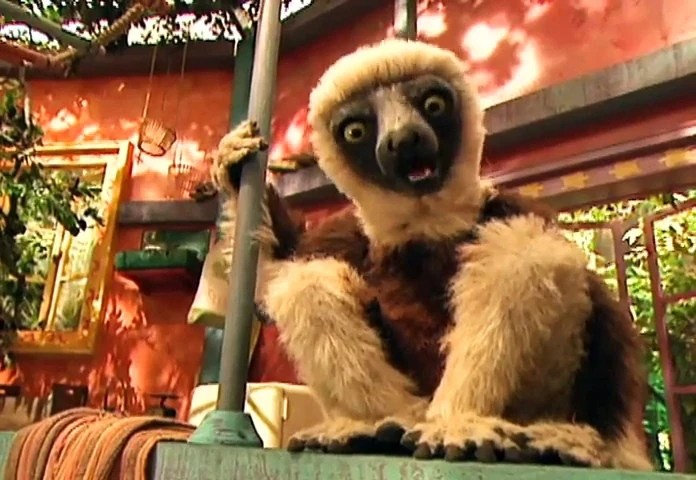
This show was my first encounter with lemurs, before Madagascar was made, there was Zoboomafu of Animal Junction and his zoologist friends the Kratt Brothers. As a child, I was fascinated by animals and this show was a wonderland of animals that were more than what you would learn about in a normal class or zoo trip. Such as the lemur, the binturong, the capybara, and the coati or coatimundi. Whenever I visit Keystone Safari or Living Treasures I feel like I’m transported back to those moments after school watching an episode of Zoboomafu.

Liberty’s Kids

This show may have helped me decide my major in college? It definitely sparked a love of history at an early age and helped me engage in American history class because, for the most part, I hated learning about American history in school except when we talked about the American Revolution and Early America.

I realize now it was because this was when there was most the opportunity to learn about Native nations that lived on the East Coast which I wanted to learn more about as I grew up in Pennsylvania and there were a lot of references to the Iroquois or Five Nations, and places like Aliquippa and Beaver and Mohawk were references to a culture we didn’t learn much about in school. I understand now that this was due to a genocide that is part of America’s formation and that’s why, culture and history were not allowed to be preserved.

What I liked most about Liberty’s Kids was the pacing and story style of the kids being reporters for Ben Franklin’s newspaper. I also liked that Moses, a freed former slave, ran the print shop and was a key character in the show. Moses and Henri were my favorite characters in the show. This show did not shy away from highlighting the hypocrisy of the founding fathers in their treatment of black and indigenous people and I think that is why the show is so good. It tells the story, the good and the bad.

Cyberchase

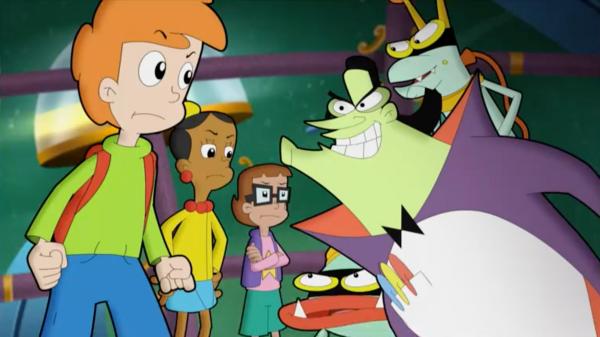
Christopher Lloyd as Hacker, the villain against Motherboard, and three kids who defeat him with math. It’s brilliant and Lloyd’s voice acting is spectacular. The world is imaginative and adventure-filled and sometimes there is even time travel back to the time of the pyramids or Archimedes. I have actually watched this again as an adult and while the subject matter is a bit elementary now, the show holds up and that’s not easy to do when you are making an educational kids cartoon about defeating a bad guy with math. It’s clever. Terms like motherboard and hacker were concepts in this show before computers became the backbone of modern life where the plot makes so much sense, why a hacker is a bad guy and motherboard would need to be protected and math is integral in code and binary language. Tis peak, my lord.

Sagwa: The Chinese Siamese Cat

Amy Tan’s children’s book ‘Sagwa: The Chinese Siamese’ cat was adapted to television and quickly became one of my favorite shows. It was my first introduction to Asian culture, Chinese culture particularly, and has been a lifelong love for me to want to know more about China and beyond like my K-pop and K-drama obsession and my current Korean and Japanese language learning quest. This show was such a delight. Sagwa and her family are calligraphers to the foolish magistrate, their paws, faces and tails are stained by ink from their calligraphy – how cute is that? This show along with Mulan has to be why I’ve had a dream, even pursued studying abroad in China although it fell through, my whole life to see China, and now Korea and Japan. It’s interesting how the stories we are introduced to as children can spark lifelong interests.

Create a website or blog at WordPress.com

Up ↑