I’m going to start reviewing some of the interesting beers that we try. Or if it goes well and I enjoy writing them, I may review every new beer we try. Beer is fascinating because of the nuances that are developed by the brewmaster. Two breweries can brew the same type of beer but can have vastly different results. Breweries have varying inspirations that impact how they approach brewing beer. Take my favorite brewery, Dogfish Head, for example. Since their founding, they’ve been driven to brew culinary-inspired beers, and it often results in complex flavors that are common along the East Coast. Beers are fun to drink and fun to write about. This will be my way of remembering what a beer tastes like down the road.
First up on my series of beer reviews is one that I didn’t know existed until last weekend. It’s Great Lakes’ Cran Orange Wheat, the brewery’s September release, even though we didn’t find it until October. Before diving into the beer, a little bit about the brewery. Great Lakes is from Cleveland, Ohio, and was started by two brothers in 1988. Since then, they’ve expanded to sell beers in nearly one-third of the states. Their most famous beers are their Edmund Fitzgerald Porter, Commodore Perry IPA, and Eliot Ness Amber Lager, which are their flagships and available year-round. They do an incredible job of taking inspiration from the region, with many of their beer names honoring Lake Erie and Northeast Ohio.
Cran Orange Wheat
And now we move to the beer itself. It’s a fruited wheat ale with a 5.5% ABV and 17 IBUs. We paid around $12 for a six pack of cans.
Visual
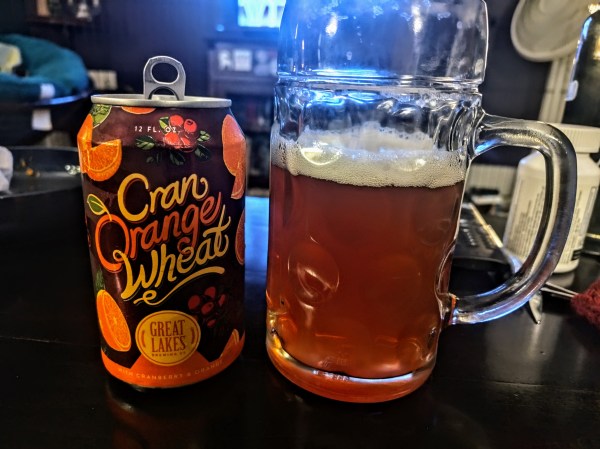
Cran Orange Wheat is a gorgeous reddish-orange color that reminds me of a Cara Cara orange. It has a medium head on it, which helps to release the aromatics, but more on that in a second.
I’m a sucker for beer can and bottle design/artwork. Regardless if it’s a well-designed graphic or just a striking color palette, the design is the first thing that draws you in when you’re exploring new beers. A well-designed product shows that the brewery dedicates time and attention to providing the consumer with an all-encompassing experience. Great Lakes really understands this, and their beers almost always include an eye-catching design, especially their flagship beers, which include some of the most recognizable labels you’ll find on a distributor’s shelf.
They continue this trend with Cran Orange Wheat. The artwork that gives me Christmas-themed wallpaper vibes. The base layer of the design is maroon with oranges and cranberries placed on top of it. The beer’s name is written in a lovely script that stands out from the can while staying within the overall design theme. The design works for me and does a great job of setting the consumer up for a delightful drinking experience.
Scent
A deep inhale of the beer after it’s poured immediately transports you to Christmas time. It could be a pot of water with cranberries, oranges, and spices on the stove or a Christmas-themed candle, but it’s invigorating and full of natural scent notes. The cranberries are the first to hit your nose, and they’re followed by a bright citrus note from the oranges. Specifically, it reminds me of the fresh cranberry relish we make at Thanksgiving and Christmas.
Taste
The initial flavor hit you get when you first take a sip of Cran Orange Wheat is a punch of cranberry. With it comes a slight bitterness and astringency that the cranberries bring. Alone, it would leave your mouth feeling dry. But immediately after that are the warming citrus notes of the orange, and it’s not an artificial orange flavor, either. It tastes like someone squeezed an orange into your glass. It results in a well-balanced, easy-to-drink beer that is tart but stops short of being a sour. This works perfectly for me because I love sours and the “pucker” effect they deliver.
Overall Review
I would describe Orange Cran Wheat with a simple phrase: Thanksgiving in a glass. Of course, I don’t mean turkey and mashed potatoes, but more so the scent and vibe of the holiday. I think this is what Great Lakes was going for too. Their page for the beer mentions pairing it with turkey and pecan pie, both common elements of an excellent holiday meal. As soon as I took my first sip of this beer, I found myself wanting more of it. It’s incredibly easy to drink, and you’ll find yourself going back for more. Perhaps the worst part of it is that it’s only released for one month. I give this beer a score of 8/10 and recommend seeking it out if you can buy Great Lakes beer in your area.
What’s the best brewery? It’s a question that I’m sure has thousands of answers. Location and access to beers, a person’s style preferences, and pricepoint can all lead to different answers. Plus, there’s the question of what it means to be the best brewery.
Is the best brewery the one that produces the best single beer or the one that produces the most high-quality beers? Because there is certainly a difference. I want to take a shot at answering this question.
My Beer Preferences
I turned 21 during one of the peak craft beer time periods: the 2010s. I was in college from 2010 to 2014, when the number of craft breweries and the amount of craft beer drank exploded. Some numbers to back it up, all from the Brewers Association:
Some quick definitions to help with the above numbers:
Microbrewery – Produces less than 15,000 barrels of beer per year and sells at least 75% of its beer off-site.
Brewpub – Restaurant/brewery that sells at least 25% of its beer on-site and operates a significant food service.
Regional Brewery – Annual beer production between 15,000 and 6,000,000 barrels.
These stats help convey the environment that existed when I started drinking beer. Whereas most college students typically drink low-cost domestics in kegs or cases, my friends and I usually went to a great local bar that had a massive list of craft beers. Granted, this decision was probably aided by the fact that our college was a dry campus, so buying cases or kegs of beer would have been pointless. And sure, I would still split a pitcher of Yuengling if we went to another bar, but my preference quickly became craft beers that were full of flavor and complexity.
Another aspect of the time period was the rise of India Pale Ales (IPAs). Although IPAs have been around for more than 150 years, they didn’t start to really take off in the United States until the latter half of the 20th century, and by the 2010s, American IPAs were everywhere. Essentially, every craft brewery was producing at least one IPA, with some of the most popular ones being Russian River’s Pliney the Elder, Sierra Nevada’s Pale Ale, and Dogfish Head’s 60-Minute and 90-Minute IPAs.
In fact, I was such a fan of Dogfish Head and its founder, Sam Calagione, that my first beer was a 60-Minute IPA. It’s a weird first beer to purchase, but I was so enamored with Dogfish’s approach to brewing that I wanted to participate in it. I loved it, and it kicked off my love of craft beer and trying as many different beers as possible.
The bar I first mentioned used to allow its patrons to keep beer lists, which I participated in. I think the list had 100 or so craft beers on it, and you would keep track of what beers you drank. I don’t remember if you got something for completing the list, but I do remember some of the beers on the list. Some notables included Magic Hat #9, Wells Banana Bread, Founders Breakfast Stout, and Dogfish Head’s Midas Touch. There were so many beers on that list that I still think about (RIP #9).
I have a pretty broad and eclectic beer taste as a result of trying all these beers. I love fruit beers like Ellicotville’s Blueberry Wheat, high-ABV IPAs like 90-Minute, dark imperial stouts like Sierra Nevada’s Narwhal, pumpkin beers, and Belgian and German imports. Like I said, it’s all over the place. These preferences will certainly influence my decisions as I attempt to find the best brewery.
What Do I Mean by ‘Best Brewery?’
Back to the question I reference at the beginning: what does it mean to be the best brewery? I’m going to take a page from Top Gear’s playbook when they attempted to find the carmaker that has produced the greatest number of excellent cars. So for me in this context, it means the brewery that has produced (and hopefully still produces) the greatest number of excellent beers. A brewery can produce the best beer in the world, but if the rest of the beers it brews are mediocre, I think it lowers the overall quality of the brewery. Similarly, a brewery can produce a single excellent beer and nothing else. To me, that still doesn’t compare to a brewery that produces a dozen elite beers even if no single one is the very best.
So, I am looking for a brewery that has a very high average instead of sharp peaks and valleys. Although I don’t know all of the breweries I’m going to consider, I can safely say that some of the ones I will consider include Dogfish Head, Ellicotville Brewing Company, Erie Brewing Company, New Belgium, Southern Tier, Troegs, and Sierra Nevada. My goal is to try as many beers from as many different breweries as I can, so this is certainly going to be a long-term project. I think as we buy beer at our local distributors, I’ll look for ones from the above breweries to ensure I get a solid understanding of their portfolios. If you have any breweries or brews that you think I have to try, please let me know in the comments. I will try my best to find it. One limitation I know I’ll run into is location and how far breweries ship their beers. For example, I’ve never tried Pliny the Elder because Russian River isn’t sold anywhere within 100 miles of our town. I also never tried it when I had a chance in the past. Beyond that, though, I’ll look for just about anything.
I think fall is the best season of the year. There’s something magical about the crispness in the air, the magical colors of the leaves changing, and the incredible flavors that come with it. Pumpkin is one of my favorite things to enjoy throughout fall, and I’ll eat it in pie, cookies, rolls, coffee drinks, and even soups, but one of my favorite ways to enjoy it is in beer.
Wikipedia says that the first mention of pumpkin beer being brewed in the United States was in 1771, but it wasn’t until the 1980s that it was commercially brewed when Buffalo Bill’s Brewery in California did so. Since then, pumpkin beer has skyrocketed in popularity, and Magz and I were in college during the 2010s when it felt like every independent brewery was releasing a pumpkin beer at a time when craft breweries were all the rage. Correct me if I’m wrong, but it felt like the popularity of pumpkin beers lessened toward the end of the 2010s and the start of the 2020s, but it appears to be back now. Go into any reputable distributor in early September when I’m writing this, and you can find more than a dozen different pumpkin beers to try. Here are the 10 best pumpkins beers for 2026 that I’ve drunk this year.
Top 10 Pumpkin Beers for 2026
10.) Pumpkinville Latte
Brewery: Ellicottville Brewing Company – Ellicottville, NY
ABV: 6.5%
IBU: 17
Ellicottville is located in the Southern Tier of New York about 30 miles east of Jamestown and directly north of Bradford, Pennsylvania. When you picture a beautiful fall day, the Southern Tier is the kind of place that comes to mind. Close to Ellicottville is the tiny hamlet (that’s what they’re called in NY) of Great Valley, where each fall the spectacle that is Pumpkinville comes alive and everything that is fall is celebrated. It’s this Pumpkinville attraction that the beer gets its name. Pumpkinville Latte is a smooth beer that builds upon its regular Pumpkinville beer by combining it with elements reminiscent of a pumpkin-spiced latte. I’m not sure how accurate this is, but it tastes like the regular Pumpkinville beer was mixed with a milk stout to give it a creamy mouth feel that is often associated with lactose being present. It’s certainly a unique beer, and I recommend it to anyone who likes quality beer, pumpkin, and lattes, but I don’t think it’s an improvement over the original Pumpkinville. It can also be a bit pricey at upwards of $12 for a four-pack of 16-ounce cans.
Score: 5.5/10
9.) Jack-O
Brewery: Samuel Adams, Boston Beer Company – Boston, MA
ABV: 4.4%
IBU: 8
Prior to about two weeks ago, neither of us knew this beer existed. In the past, I haven’t been the biggest fan of Sam Adams beer apart from the Boston Beer Company’s partnership with Dogfish Head, so I wasn’t researching their fall beer offerings. We saw a six-pack of this in the grocery store; the description was intriguing and the price was right at less than $10, so we picked it up. I think it’s safe to say that it’s the most unique pumpkin beer I’ve ever had because it’s heavy on the nutmeg. Most spiced pumpkin beers are heavy on the cinnamon to replicate a pumpkin pie, but nutmeg gives it a different flavor profile. I really enjoyed it and think it’s worth trying or even buying a six-pack, but it isn’t a flavor I could have all the time.
Score: 6/10
8.) Pumpkin Ale
Brewery: Block House Brewing, Pittsburgh Brewing Company – Pittsburgh, PA
ABV: 7%
IBU: N/A
Magz and I differ a bit on our opinions of Block House’s Pumpkin Ale. She likes it a bit more than I do, but I still think it’s a quality beer. It’s definitely on the sweeter end of things, but you get all the notes of pumpkin pie, which is clearly what Block House is trying to offer given the artwork. Even the beer’s phrase “spice & everything nice” indicates what you’re in for with this beer. I personally think it’s a bit too sweet, but the spice blend works really well. My biggest complaint with the beer is its price. At $21 for an 18-pack of cans or $11.99 for a six-pack of bottles, it’s not too expensive until you learn that Block House is the “craft” division of Pittsburgh Brewing Company, the same brewery that makes Iron City. That price point is on par with some higher-end imports, and I’m not convinced this belongs there. Regardless, it’s worth trying if you live near Pittsburgh.
Score: 6.25/10
7.) Double Zombies
Brewery: New Trail Brewing Company – Williamsport, PA
ABV: 8.5%
IBU: 4
I think this may have been the first pumpkin beer we had this year, as our local distributor had some leftover four-packs from last year. I think it was also our introduction to New Trail Brewing Company. This beer hits hard at 8.5%, plus it’s only sold in 16-ounce cans, so it’s not what you would call sessionable. Still, in spite of the fairly high ABV, it’s easy to drink and is smooth. In addition to the standard pumpkin flavors, Double Zombies also has maple syrup in it, adding an extra bit of sweetness and another flavor. Like other New Trail beers that are only available in four-packs, it’s a bit pricey. I’m not sure of the exact cost, but I would guess anywhere between $12 and $16 for the four-pack. But if you can find it in singles or have someone to split it with, it’s still worth trying.
Score: 6.5/10
6.) Pumpkinhead
Brewery: Shipyard Brewing Company – Portland, ME
ABV: 4.5%
IBU: 17
This beer has some of the coolest artwork of any pumpkin beer, depicting the headless horseman from Washington Irving’s The Legend of Sleepy Hollow; however, this horseman does have a head, but it’s a pumpkin. I first saw the artwork when a distributor we like shared pictures of it on social media. I read about it and had to find it. Interestingly enough, our local distributor (the same place we bought Double Zombies) had a case of last year’s Pumpkinhead and sold it to us for $15. This is one of my favorite things about trying new beers. Sometimes, it’s the artwork or design that entices you, just like the cover of a book. Pumpkinhead lives up to its design with a flavorful beer that is light and refreshing. It actually tastes like beer, which isn’t always a given with pumpkin beers that are often full of spices. Pumpkinhead isn’t too sweet with a subtle pumpkin flavor, making it easy to drink, and at 4.5% ABV, it’s very sessionable. And even though we got our case really cheap, it’s still an affordable beer full price, at around $9 or $10 for a six-pack of bottles.
Score: 7/10
5.) Pumpkin Ale
Brewery: Smuttynose Brewing Company – Hampton, NH
ABV: 5%
IBU: 25
We became big fans of Smuttynose beers earlier in the summer when we found a discounted fall variety pack that was outdated. The pack had four great beers, including their Pumpkin Ale. It’s been a couple of months since I’ve had their Pumpkin Ale, but how smooth and easy to drink it is stood out. It’s a beer that reflects the earliest versions of pumpkin beer, so its flavor has more pumpkin than spice notes. It put Smuttynose on the map for us, and now we know that we’re likely to enjoy any of their beers. It’s also an affordable brewery to buy from, so it’s possible to find a six-pack of it for around $10.
Score: 7.5/10
4.) Pumpkin Ale
Brewery: Saranac Brewery – Utica, NY
ABV: 5.3%
IBU: 15
Let me start by saying that Saranac makes some unbelievably good and affordable beers. Their Pumpkin Ale was our introduction to them, but we’ve since had the rest of their fall beers and their 12 Beers of Summer variety pack. It’s all delicious. Their pumpkin is darker in color than many of the others on this list, but it’s lighter in flavor, making it really easy to drink even at 5.3%. You get a nice pumpkin flavor with hints of the typical spices – cinnamon, allspice, ginger, and clove. It’s simply great and is comparable in quality and flavor to the three above it. For around $10 for a six-pack of bottles or $15 for their summer variety pack, you can’t go wrong.
Score: 8/10
3.) Punkin Ale
Brewery: Dogfish Head Craft Brewery – Milton, DE
ABV: 7%
IBU: 28
Punkin Ale was one of the first pumpkin beers I tried in college, and it’s because I love all things Dogfish Head. It’s been brewed since 1994 before the brewery started, and the story behind it is great. Dogfish Head founder Sam Calagione brewed the first batch of Punkin Ale to enter it in the annual Punkin Chunkin contest in Delaware, putting it up against pumpkin baked goods and other homemade items. He won the contest, and it’s been brewed every year for a fall release since. Using all natural ingredients, you can taste authentic pumpkin, brown sugar, and pie spices. At 7%, it’s a bit heavy, but it drinks lighter than the ABV suggests. It’s a staple in our rotation of pumpkin beers. However, beware, because, like other Dogfish beers, it’s not cheap at nearly $14 for a six-pack of cans.
Score: 8.5/10
2.) Johnny Rails
Brewery: Erie Brewing Company – Erie, PA
ABV: 6.5%
IBU: 12
We looked for Johnny Rails for weeks before eventually finding it in our grocery store. I think Erie Brewing Company may release it later than other breweries release their pumpkin beers, and despite living just an hour away from Erie, we couldn’t find it at any of the distributors. We first had it years ago, but it had been since at least 2019 that we drank it, so the first sip this year felt like the first one. As a blonde ale, it’s really crisp and refreshing, and with an ABV of 6.5%, I think it’s the perfect balance of refreshing and heavy. It’s flavorful but not overpowering, establishing a great balance. It was worth waiting for, and I also think it’s worth the high price tag of $15 for a six-pack of bottles.
Score: 9/10
1.) Pumpkinville
Brewery: Ellicottville Brewing Company – Ellicottville, NY
ABV: 6.5%
IBU: 17
I referenced Ellicottville’s original Pumpkinville earlier, and here it is. I think it’s the best pumpkin beer I’ve ever had, and I don’t think it’s that much of a debate. At 6.5%, it’s right in the sweet spot of being heavy enough to notice the alcohol without being overpowering. You get plenty of pumpkin flavor, and the spice adds a nice touch to complete the tasting notes. It’s one of several reasons that Ellicottville has become my favorite brewery. Pumpkinville is also pretty affordable at $12 or $13 for a six-pack of 12-ounce cans. If you can find this in your area, you should give it a try. I don’t think you’ll be disappointed.
Score: 9.5/10
Pumpkin Beers Left Off the List
If you’re an experienced pumpkin beer drinker, you’ll likely notice that some popular ones are missing. I’ll address those here. I’ve had Southern Tier’s Pumking and Maple Warlock, but I think both are too heavy at 8.6%. I like pumpkin beer to be smooth and easy to drink, and anytime a beer gets above 8%, it gets into a range that I don’t find enjoyable. Both are also crazy expensive at nearly $4 a bottle. I also had a pumpkin cider from Penn Brewery that was a collaboration with a local orchard and didn’t enjoy it at all. I didn’t think the pumpkin flavor worked well with the cider and will avoid those moving forward.
There are also plenty of pumpkin beers that I want to try but have yet to find. I’d really like to try the pumpkin beers from Elysian, especially the Night Owl and Punkoccino, but I’ve yet to find them in singles to try. I’ve seen them in six-packs and variety packs, but at their price point, I’d really like to try one before committing to multiple of them. Good Gourd from Cigar City is another popular pumpkin beer that I have yet to see in stores.
Do you enjoy pumpkin beers? If so, what do you think of my list, and are there any that I need to try? I’m always interested in trying new beers and like to expand my horizons each fall.