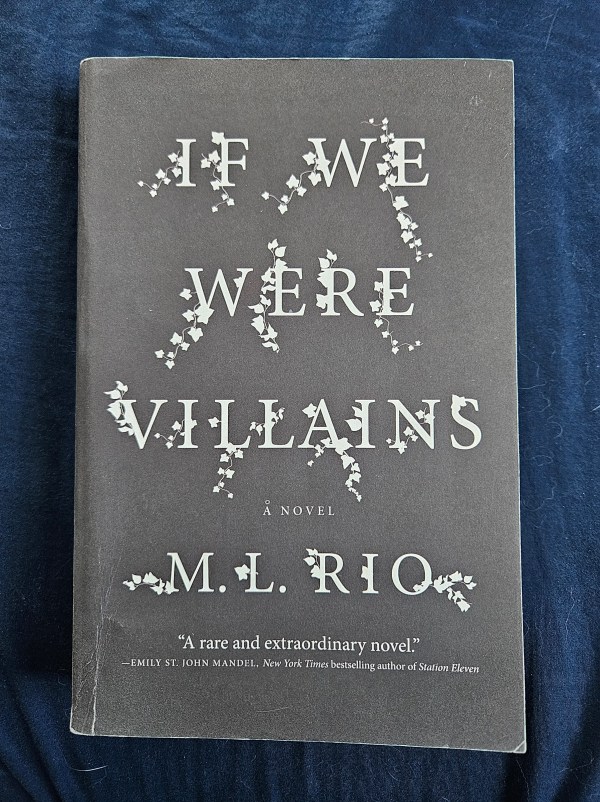
I read a book, that woke me up from a dream. At least that is what it felt like. That book was by M.L. Rio, entitled “If We Were Villains” a dark academia book compared to the “Secret History” by Donna Tartt. But honestly, I found this book to be far more about literature and what happens to your brain when you lose yourself in Shakespeare, than just a “dark academia” book.
It reminded me of the time we spent in high school studying Shakespeare’s plays and sonnets under the intense direction of my English/Speech teacher.
In English class, we would not simply read and discuss, we would perform. To my chagrin, we were tasked with memorizing scenes and performing them in front of the class, either solo or in pairs. I vividly remember performing the balcony scene from Romeo and Juliet, and reciting Mark Antony’s speech from Julius Caesar in a bed sheet toga over my clothes. Probably red faced, and heart pounding by the need to make eye contact as part of the assignment.
Later, when we dove deeper into the plays, I remember reading many parts for Hamlet, Macbeth, Romeo and Juliet, Julius Caesar, King Lear. Performed with fake swords and random props with our desks pushed in a corner to make a stage floor in the front of the room.
For senior year, we went to see two plays in Stratford, Canada at their globe theater. We saw Taming the Shrew, and later on As You Like It which I preferred. Although I struggled to follow at points, I loved how the play felt like it swallowed up the actors in a world all their own, in verse and story that has endured for centuries.
That is what I felt once again, reading “If We Were Villains” like I was back in Stratford, in the audience. The way Rio pairs plays to the plot, shows a deep intelligence for theater in a way, I don’t think many authors could do.
Some claim the plot was predictable, but I’d say, too mamy twists would have spoiled the point of this book. Which I believe is a love letter to the stage, and the pressures, and the bizarre obsessive love that comes with passion for you craft. I could have done with less of the f-word, it was a bit grating, so was the amount of drinking and drug use. I’d compare it to Skins UK, but I understand everyone’s college experience is different. I appreciate that all the main characters were in the early twenties, with the source material being so dark.
Anyways, I came away from this book feeling inspired. Inspired to read and study Shakespeare once again, not for a grade this time, but to remember how to tell a story. I’ve felt the desire to write another work of fiction, but loose all momentum once I begin writing. Because no matter what your opinion is of Shakespeare, there is no denying that he could write a good story, stories that continue to remain popular for the stage and film. If I want to remember how to write, this is a good place start, along with reading other books. Like I’ve reflected on before, to write you must read.
Now, before I end my reflection, I’d like to talk about something that is weighing on me. The shooting and killing of Renee Good by ICE agents, who shot her inside her car in broad daylight, in Minnesota.
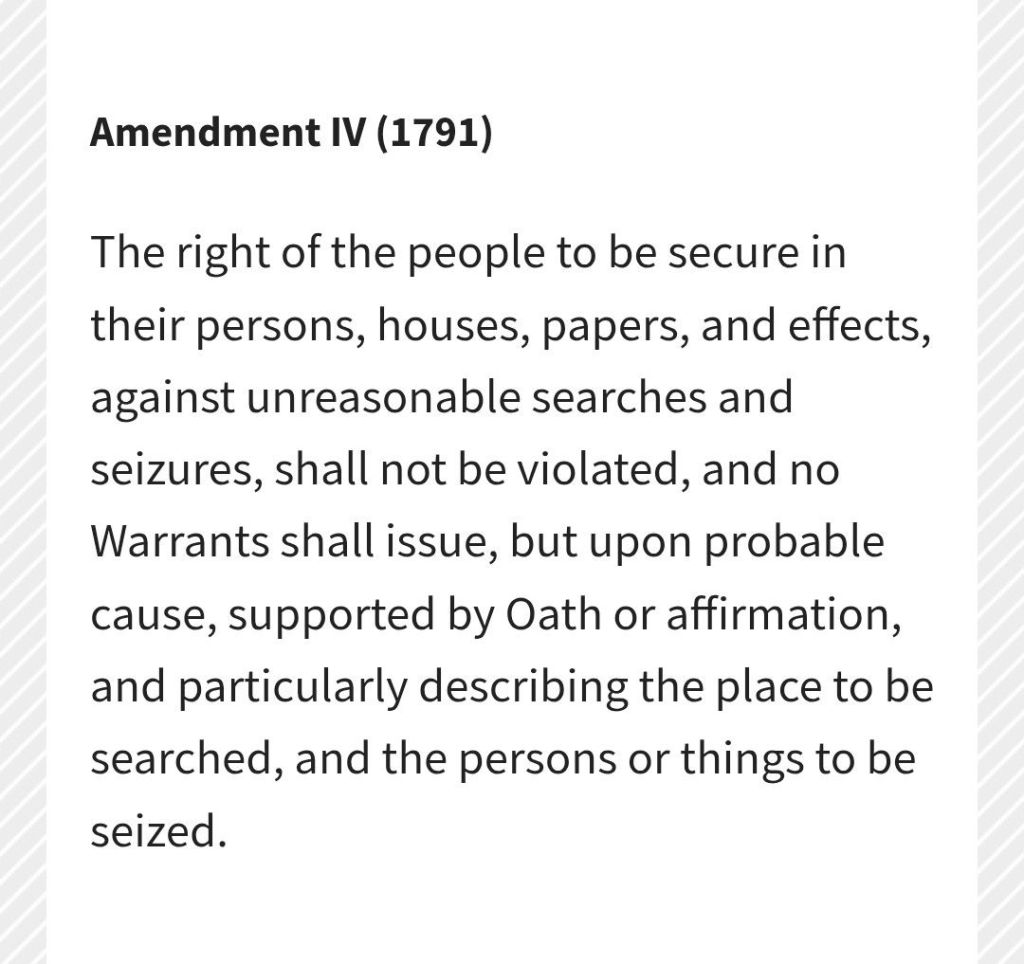
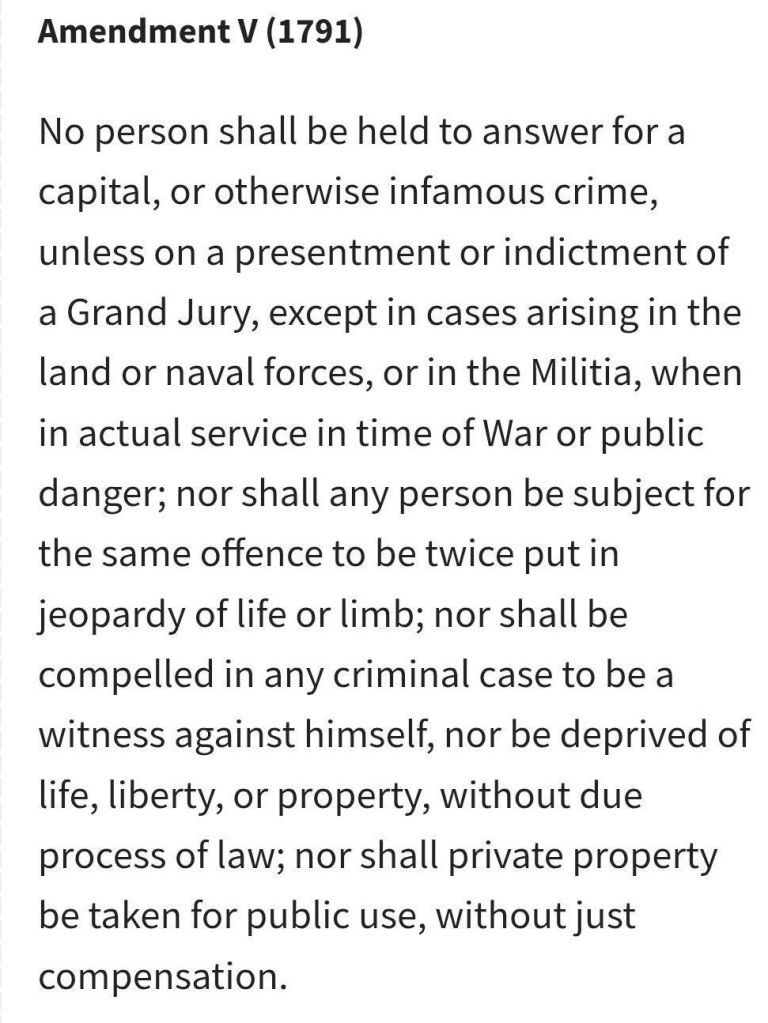
This was an illegal and evil act, but it is just one of many evil acts carried out by organizations violating my country’s constitutional ammendments.
In addition to that the people who are being kidnapped, and persecuted by racism and hate, we must stand with them. They are suffering. We cannot ignore their pain. As a believer it is clear what we are called to do.
“Carry each other’s burdens, and in this way you will fulfill the law of Christ.”
Galatians 6:2 NIV
So my fellow Americans, if you are under the spell of political manipulation, and believe the acts of ICE are necessary – wake up and speak up against evil. If you are believers – wake up, repent, and speak up against evil.
When my go-to yarn, Big Twist, was temporarily discontinued in 2025, I felt adrift in a sea of unfamiliar yarns with unfamiliar prices. Which raised an interesting question: what will be my new tried and yarn? I thought I would share this journey with short reviews of the yarn I explored in search of a new favorite.
Yarn Criteria:
What am I looking for in a yarn? Big Twist was my favorite for a few key reasons – affordability, quality, color range, and ease of accessibility. Big Twist had a large selection of colors in a worsted weight that did not split easily or snag in knotted tangles. The skeins contained 380 yards, selling for 4.49 USD, which made sweater projects affordable. It was easy to source in person. Now I am not looking for in-person yarn purchases like I used to. It’s just not possible at this time.
Wool of the Andes
Wool, worsted weight, has a large color range, and can also be purchased in a superwash variety. This yarn is a Knit Picks, made from Peruvian Highland Wool is sold for 4.99 USD per 110-yard skein. I like how sticky this yarn is. When it is stitched up, it stays in place and has great stitch definition. It’s not too itchy. I am sensitive to wool, and I find this yarn to be fine. I also used the superwash for a hat, so that could be where the extra scratchy feeling came from. I think this is a great yarn for budget wool, and for beginners, the best part is that it arrives in a skein, not a hank that you have to unwind. Yes, I would buy this again. I just purchased this for an upcoming rabbit-related project.
Mighty Stitch
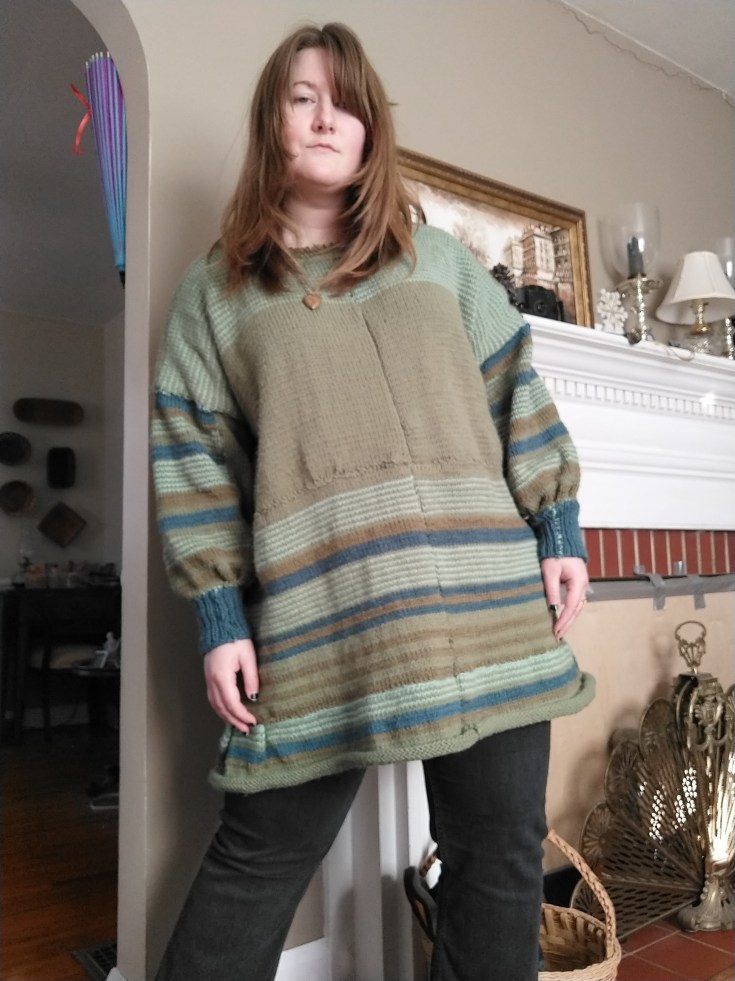
Silky and soft. This yarn had great sheen for an 80% acrylic, 20% wool fiber. It was labeled as worsted, but I found it to be too thin compared to my other worsted yarns, which created some issues in my project. This Knit Picks yarn is 7.99 USD for 208 yards. When I purchased this yarn, it was on sale, but still more than I am used to paying for acrylic. Due to the thinness of the yarn, I failed to meet the gauge. I found myself using a lot more than I thought I would. The most disappointing thing was the way it slides out of knots, which was a problem for the colorwork and color blocking sections. The yarn also doesn’t respond well to my husband’s beard. I found this out because I knit him a sweater, and the top was falling apart where it caught on his beard. Would I buy again? No. I don’t trust it not to pull out of the weave, and I felt let down by the price for the experience.
Lion Brand Pound of Love
I found these oversized yarn skeins at Michael’s, and I was thrilled. Lion Brand is a fantastic budget yarn that I used before on a previous sweater project. At 1020 yards for 11.99 USD, this yarn has been a game-changer for experimentation. I can try new projects, have room to mess up, or be able to make gifts, blankets, etc, on a budget. It does not split. I can knit or crochet easily, and it meets the gauge. My only negative critiques are the color range and the composition of the fiber. I wish there were more colors; the range is small compared to Knit Picks or Big Twist. I also wish acrylic were not made from plastic. I wish this were wool, and was kinder to the environment. Yes, I will buy this again. It is the best budget acrylic yarn I have found that is easy to purchase and would be a great beginner yarn to learn with.
Loops and Threads Soft Classic
Before Big Twist fully came back in Fall 2025, I thought Loops and Threads may be Michael’s brand expression of Big Twist, after they acquired Joann’s IP and the yarn vendor contracts, so I gave it a shot, and I have some mixed feelings. The color range is large, which I like. Some of the shades are lovely, and some are a bit garish. Some of the yarn dyeing is odd. Some of the texture of the acrylic fiber is also odd. It can be a bit limp, almost too soft. I love the mushroom and curry color ways. The black yarn I purchased, however, smelled like a cheap pleather purse- a bit fishy and a bit like burnt hair. I still can’t get the smell out of the yarn with airing out, Febreeze, and laundering. Maybe it was the chemical dye? For this reason, I have some pause. But you can’t beat the 3.99 USD price and 354 yards per skein. Let the creativity reign! Yes, I will buy again.
Palette
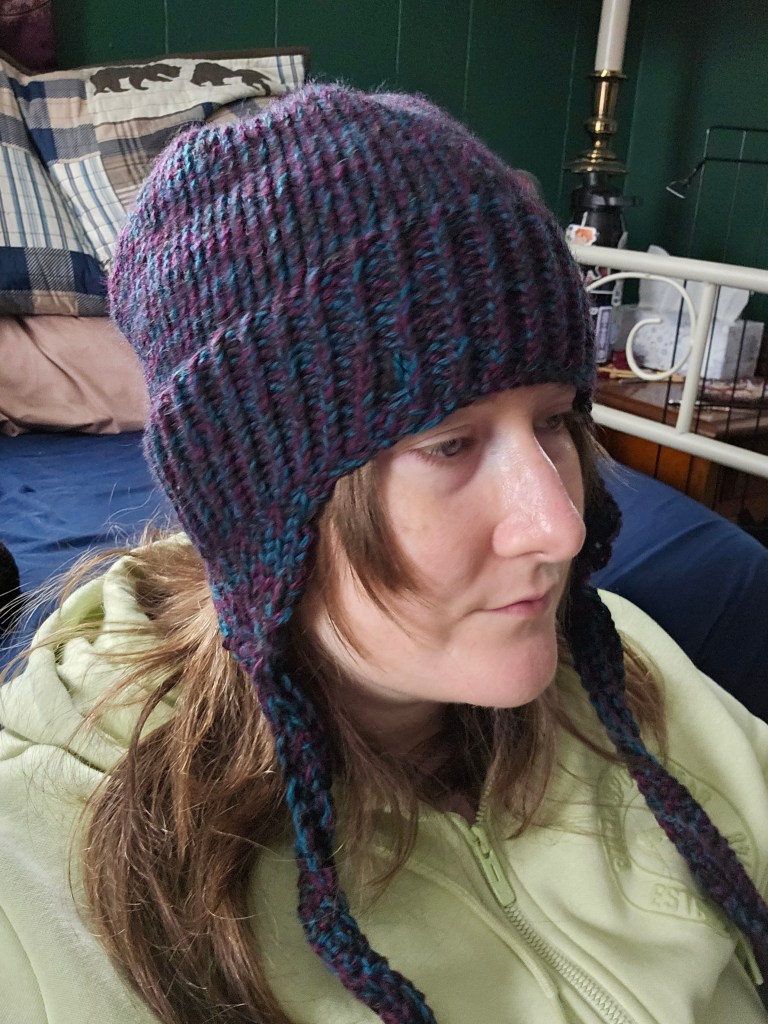
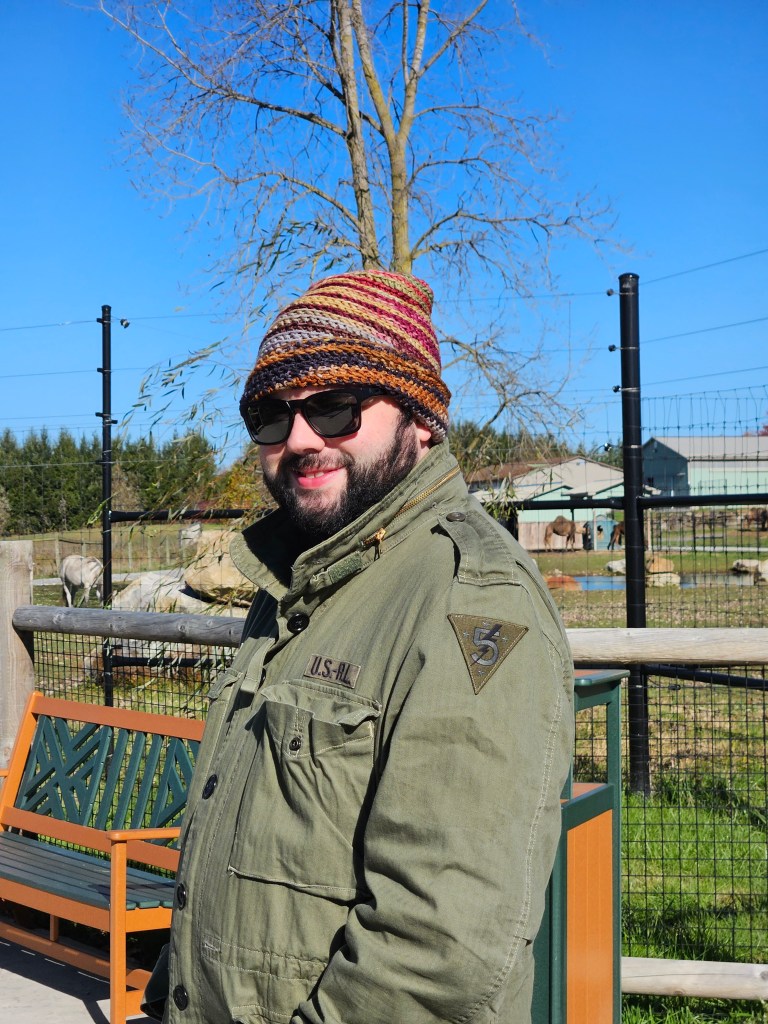
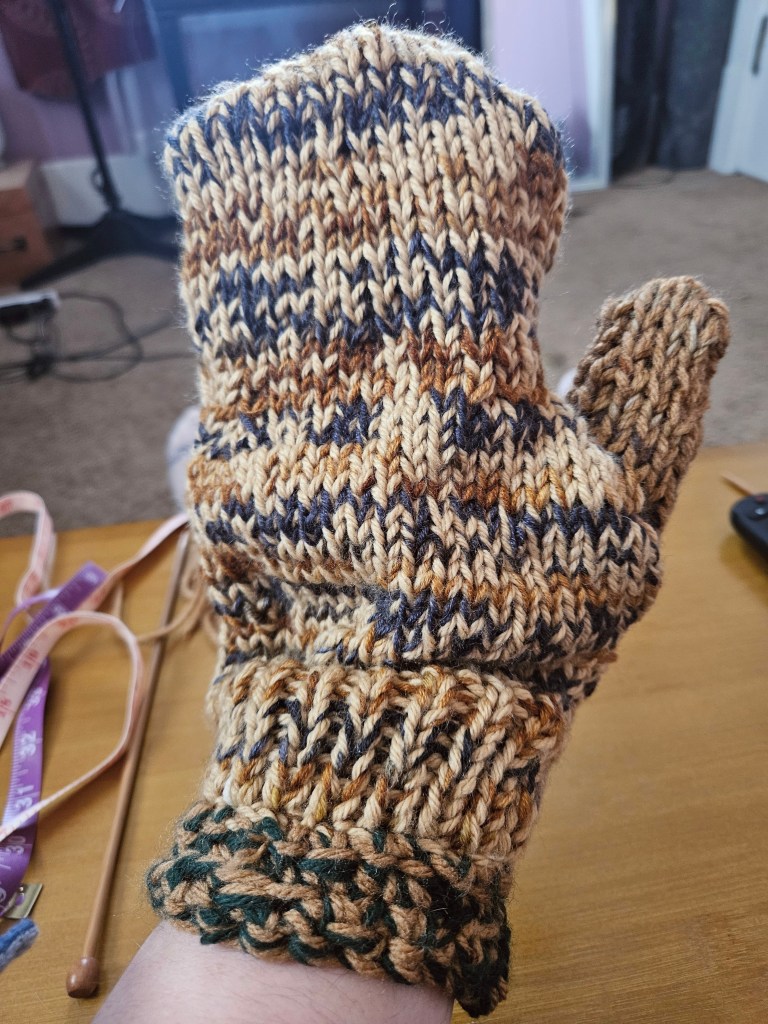
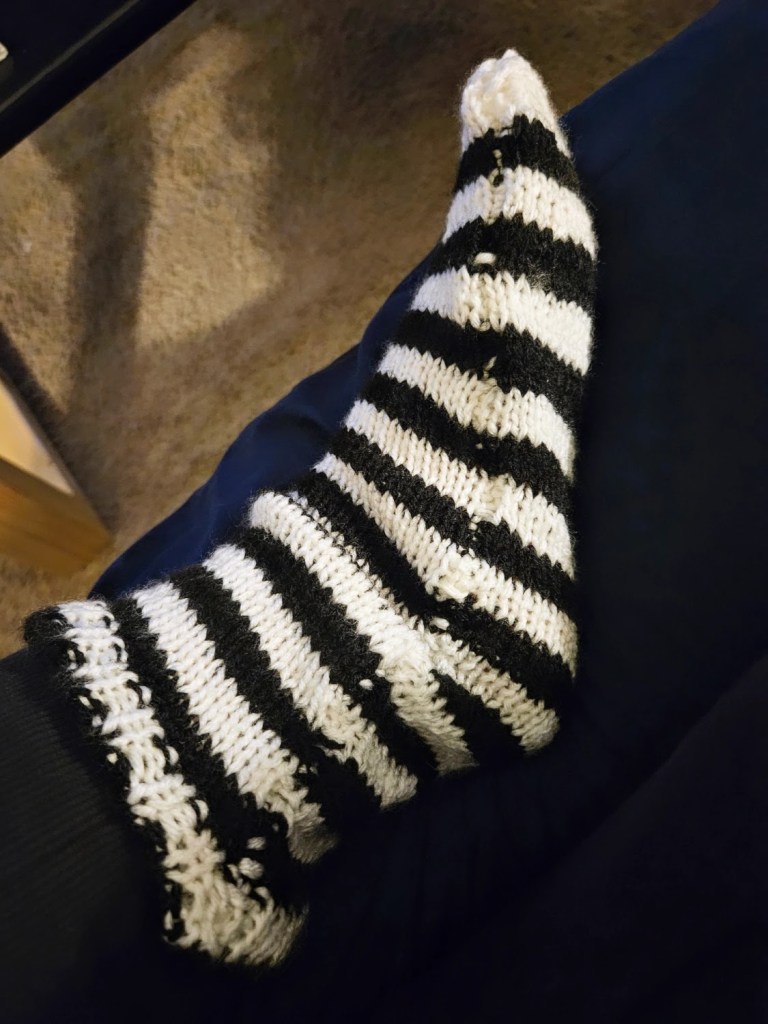
Palette Fingering Weight yarn from Knit Picks is a 100% Peruvian Highland wool yarn that has become my go-to winter accessory yarn. With its lightweight ply, I combine it with other yarns to create marled and warm hats, mittens, and socks. The hat to the left is three strands of Palette held together on US 7 needles. The hat to the right is made with two strands of worsted-weight acrylic (Big Twist) and one strand of Palette. It’s a non-superwash and has a lovely squish to the skeins. This yarn is already skeined up, no Hanks to unravel, and contains 231 yards for 5.49 USD per ball of yarn. I will rebuy. I actually panicked on New Year’s Eve, that I had drained my whole stash, to find they were at the bottom of a tote bag.
Caron Cakes
I have worked with two Caron Cake varieties in 2025 – Blossom Cakes and Big Cakes. The Blossom Cakes are a blend of 61% cotton and 31% acrylic fibers. They are variegated, worsted-weight cakes of 481 yards that sell for 14.99 USD per cake. They tend to do a BOGO sale at Michael’s, so I get them on sale, or else I would be less enthused about this item. The Big Cakes are also worsted-weight acrylic yarn, which is self-striping. I love the quality of the yarn, but the striping is a bit tricky. I am currently using them for blankets, but I did consider separating the sections of color to make something different. The Big Cakes contain 603 yards, which are sold for 14.99 USD. On a sale, you can make a blanket for a great price. For this reason, I will try the cakes again, with the proper project. They are complicated, and without a plan, they feel like a waste of money. With a good plan, they are a great resource.
Final Thoughts:
I found more options than I expected last year, and this led me to actually be happy that I had to find a new option for my tried-and-true yarn. Moving forward, I don’t have a sole favorite; instead, I feel like a nuanced palette of tastes is the better way to describe it. If you are a new knitter or curious about trying some of these yarns, I hope my thoughts helped. These are all my opinions, and all the yarn was purchased with my own money.
What do you do when you need a break, but you can’t? I’ve been wrestling with this for months. It’s been a tricky thing to discuss on here, and without feeling ready to write without revealing too much, I have been spinning on it, to quote NMIXX.
Any time I feel overwhelmed, I take that space. But what if you can’t? Like what if the thing that is weighing on you is as interwoven in your life as a single thread in the warp and weft of your jeans? It’s a tricky one that I don’t think anyone has taught me; it’s just kinda hanging there. We struggle alone, because we are human.
Relationship University
I’ve been thinking alone, pondering my frustrations, my overwhelm, my weariness for a break because I am a neurodivergent, deep-feeling, overthinker. It does not come easy to me to pause, to force my mind to stop and breathe. It’s something I wish we had learned in school. Any of the schooling – elementary, high school, or college? How wonderful would it be to learn about emotional intelligence and algebra? Traumatic stress coping mechanisms and world history? What about grammar and proper communication tools to de-escalate a tense argument? Literally would be life-changing. Meditation with a side of physical education? We mostly played soccer(football) because it was cheap, and it was monotonous. Both Kyle and I would feel less we are drowning in the complications of personal struggles if we had an education in relationships.
We did the brief marriage counseling, sure, which I guess prepares you for marriage? I think getting through the first year is truly what teaches you the most. (We are a few months away from celebrating ten, so we do have some experience.) We also had the years of friendship experiences, some previous dating experiences, and the lifelong knowledge of being part of families – but they don’t prepare you for the stress that comes with multiple, personal struggles that you and your spouse sometimes have to tackle all at the same time, meanwhile life keeps moving forward, and you feel like a hamster in a wheel.
Burnt Out, Like Toast In Obsidian Crumbs
What I felt the most since these stressful situations began to weigh on Kyle and me was the desire to hit pause and process what I was feeling while the world held still. You know? Just a moment, where you could feel without the expectation to be who you are and do the things others depend on you for. Even the little things, you depend on yourself to do. Of course, that feeling grows to a desire to stop the world for days, and escape to a zone where the stressful things can’t bother you. A yearning for the before and a hunger for the after, this is all resolved and back to normal. It’s so easy to get wrapped up in the big emotions of personal things that you forget to have fun together. You forget to just be yourself. It’s a bizarre version of your life that doesn’t feel familiar, and I think after months of feeling like this, 2025 ended with me feeling chewed up and angry.
So why do we pretend like this is a normal state of being a responsible adult? Like if I hadn’t decided to stop drinking alcohol in 2021, this season would have been months of riding out a buzz, ignoring my problems, and choosing unhealthy coping mechanisms. Subbing in a source of temporary joy, depending on a thing or a feeling to get you through, is avoiding the inevitable mess that upset you in the first place. But I think this is the box we put ourselves in as adults, to stop from appearing weak or vulnerable. Substitute a drink for a shopping haul, sports betting, s*x, doom scrolling – what I’m talking about is far more common than we admit. So why do I feel so alone in this feeling?
It is still my present burden to bear, Kyle’s present burden to bear. Contrary to the calendar, your problems on Dec 31 are still there when you wake up on Jan 1. Doesn’t that suck? I felt myself wishing more than ever at the end of 2025 that the “fresh start” effect was real. Because life requires emotional endurance with no cap. That is quite difficult for us humans to do. It requires patience, hope, faith, self-control, gentleness, and love. We grow weary, we hide our struggles like they are something to be ashamed of, instead of a common part of life. We are odd creatures. That’s why I decided to share this, because I don’t think we discuss this enough, and I plan to talk about it more.
Marriage is hard, in more ways than I could even comprehend, but that doesn’t mean it is impossible. As we are both kids of divorce, we stubbornly refuse to address the stress that is negatively affecting our relationship because to do so feels like we are already failing, but that’s not true. So I’m writing this for you, the one who feels the weight of their parents’ divorce on all of their relationships, like a curse you are inevitably going to repeat. It’s not true. Keep going and stop bracing for the bottom to drop out, like I waste time waiting for. We are survivors, and we are going to make it through the mess.
First off, Happy New Year! Thank you to anyone and everyone who took the time to check out our work in 2025. You are a blessing to us!
It’s been a much better end to the year, from where we wandered in 2025. I swear this year was mentally, more taxing than others. I never knew marriage could be this difficult. Or being a daughter. There were some big moments, behind the scenes where I felt like my life as I know was as stable as an earthquake and I couldn’t tell anyone.
I’ve gotten better at sitting with my problems by myself. That is one thing, I am finding comfort in again. Being by myself, without a bunch of screens to make me feel like I am being “social” when I am not.
Habit #1
Since Thanksgiving Day, I have been limiting my time on social media. I have a timer set to a few minutes for Instagram, most days. I have done this successfully now for 5 weeks. At first it was a but tought to keep it at zero, so I cushioned myself to 15 mins. By Christmas week, I didn’t feel any pull to open the app. The only connection I do feel to my account is a few online friends I have met, who without Instagram, are disconnected from my life. Therefore I am keeping my account, but I am detoxing my addiction. With a record of two weeks without posting.
Habit #2
In December I started challenging myself to do pushups again. They started with knee pushups and have risen to a record of 20 real pushups in a set. My goal moving into 2026, is to do these consistently throughout the week and be more fit, along with the other exercises I do – rebounding, wall pilates, and yoga. More consistency.
Habit #3
Books. I am watching less Youtube when I knit and reading more. I listen to audiobooks through Libby and read while working on other days. So far I have completed four books, which sounds pathetic, but I had not been reading at all for years. I would read a book or two per year since we moved to our current town. I missed the previous city’s library and the mental wellness to focus. But this summer, we joined a local to us library and restoked my desire to be bookish again.
Final Thoughts
Unintentionally, I already started my “resolutions” and it feels great. It shows me that maybe finishing a year on a good note is about setting yourself up with good habits before the “fresh start” and if you are feeling a bit off going into 2026, maybe get off of socials too? Except for wordpress, truly a great group of people on here. 💖
I had plans originally to write about Ralph Lauren Christmas on its own, but then I saw two advertisements, one from local brand Steel City and another from Banana Republic, so bizarre that I knew I would be here. Hopefully not ranting too much, for the goal of this discussion for me is to think more deeply about the subtle oddities in my culture, I see weaving themselves in, like they are normal. Overconsumption, cultural appropriation, and the cosplay of wealth.
Banana Republic’s Holiday Edit
So what does fippery have to do with it? Fippery is another word for ostentatious; it’s showy. Frivility in dress or style. I also find the attitudes of these two brands, and I do want to write about exactly that. Banana Republic has always been in my mind, a bit ridiculous. But with every re-watch of Seinfeld, I see J. Peterman in Banana Republic’s threads, but their recent holiday commercial pushed me over the edge. They are that nonsense.
The holiday commercial is set in Ireland, County Cork, and I know I haven’t been to Ireland in 20 years, but dang, nothing about this commercial felt authentic. They play a cover of “Linger” from the Cranberries over the holiday scene in a pub, wandering around the town, finding a telephone booth with Irish Gaelic on the sign. They are all wearing vaguely Irish clothing, but really it looks like cast walked through a Premium Outlets on their way to Castletownshend, Cork. There are lovely Irish Christmas songs and many other songs by Irish bands that would have captured the spirit of the season better than a breakup song. No shade to the Cranberries, I love them. There were better Cranberries songs to pick. Personally, I would have looked at Dreams, Ode to My Family, and I Can’t Be With You to capture the nostalgia of the season with a non-traditional song.
Moving beyond the music, there was nothing really Irish about this ad. We barely see the town, we barely see the people, or the ancient beauty of Ireland. Think about movies such a Waking Ned Devine or Banshees of Inisherin – the landscape is a character, so is the music, and community. Ireland felt warm, not in temperature, but in the warmth of the people. The land feels like there is magic just under the surface, an imagination unbreakable, and a spirit that carries the culmination of all those who came before in an essence that makes you want to know more. The sweaters are intricate, made with the intention of preserving heritage crafts. Just take a look at Banana Republic’s holiday page compared to Blarney Woolen Mills, which is based in County Cork! The source material was right there. I guess what I am trying to say is obvious: Banana Republic’s collection is the fast fashion version of Irish style, don’t fall for it, no matter how they try to sell you on the “luxury” of it all. Now, what really bugged me about this ad was, in my opinion, the cultural appropriation of it all.
There is a fairisle sweater in this Irish collection, which is actually a Scottish heritage craft from the Shetlands. This sweater contains wool from Italy, being sold as an Irish-inspired sweater. You couldn’t even use Irish wool? Or include iconic Aran sweaters? Fisherman sweaters like the iconic one from When Harry Met Sally? The Donegal Wool sweater and sweater vest, straight up annoy me because these are again Italian wool. There is a wonderful mill in Donegal called McNutt that could have supplied true, authentic craftsmanship. We still have our clothing pieces from this store and Blarney Woolen Mills, 20 years later. I don’t like Ireland, which has been used for centuries, been the butt of the joke for centuries, being used again to peddle some lackluster clothes.
Gap, Inc. is a huge brand; they should have invested in sustainable Irish materials and supported the local Irish economy by using Irish craftspeople to create this collection. But just like J. Peterman, they come and see, then they steal other cultures’ designs to make a quick buck from subpar clothing. Look at the prices! The Banana Republic sweaters, made in Italy with Italian wool, versus the Blarney Woolen Mills sweaters made in Ireland from Irish wool, both made from merino wool, too. Local is better. Also, look at the craftsmanship of the Blarney sweaters; those cables are stunning and also affordable. Shame on you, Gap!
Steel City, What Are You Doing?
Actually, to quote the Big Fat Quiz Show, “You slag!” Steel City is a brand no one outside of the Pittsburgh area will know about, and that’s okay. Small businesses are great, and when this brand first started, they were cool. Their claim to fame was hyper-local graphic tees of beloved cultural things such as Turners Tea, the Stillers (aka the Steelers), Kennywood, Mr. Rogers, the Pens (Pittsburgh Penguins), and nostalgia. Over time, though they have expanded, which is great, creeping out to the suburbs of Cranberry and Ross Park Mall, and that is where things have taken a bizarre turn. In 2022, I went to their location in Cranberry Township and was appalled by how tissue-paper-thin the new items were. We had bought pierogi and Potato Patch shirts, which were of great quality, but the new stuff was off. The prices, quite higher than before, and I was no longer interested in their stuff.
But as targeted ads go, I keep seeing their stuff everywhere, and it has gone in some random places. There was a motorcycle and a desert aesthetic to their pieces now? Okay, odd. Neither of these things has anything to do with Pittsburgh. I guess the name is the only connection? Next, I got ads for quiet luxury workwear pieces, the local graphic tees, now behind a t-shirt club paywall. It felt soulless, and I was incredibly disappointed. I thought in the beginning maybe they were going to make the items in Pittsburgh, but they are made overseas. This morning, though, I got an ad that straight up felt out of touch.
Seriously? In this economy? With the amount of destruction the fashion industry creates on our planet? Honestly, Steel City, what the flipping heck are you doing? This brand is neither relatable nor cool anymore. Wasteful consumption is not in style, no matter what the internet says.
Ralph Lauren Christmas
Now, Ralph Lauren isn’t promoting this; this is just a TikTok trend, and I just wanted to drop my two cents. I’ve spent the last five years chasing the nostalgia of old Christmas, Christmas before everything hurt. Before people died. When I was a kid, things were simple. No matter how much you spend, decorate, chase – this aesthetic is not going to fix what is broken in your heart. I encourage you to seek out authenticity this Christmas. Volunteer time at shelters, donate supplies, check on neighbors. Call those friends or those family members you haven’t seen in so long and connect once again. The Home Alone house is stunning, but remember, what brings the true Christmas spirit is the relationships reconciled for the Old Man and Kevin on Christmas morning. People over things, always.
For two years, I’ve been mulling over how to dive into Stray Kids and their music, the way I’ve done with other K-pop artists, like aespa, Ateez, and i-dle. I sipped my toes in with My Tagline and Skz Hop Hip Tape, but I have not shared anything deeper, because dang, this band can be controversial, fan wars suck, and I also deeply love their music. It’s got me through rough patches and high highs; it is probably my neurodivergent special interest. It’s a spiderweb of music, funny moments, and an overall safe place to land, thanks to elements like Chan’s Room. Borrowing the Song-A-Day challenge format and filling out my own card seemed like the perfect way to get back into K-pop deep dives. (Then I hope – I can finally get myself to write about Kpop Demon Hunters!)
DAY 1 – My first experience with the eight-member Korean boy band, Stray Kids, was their song Maniac (2022). Shortly after Maniac and its album, Oddinary, were released in March 2022, the algorithm served me the Maniac music video, and my taste in music has been transformed. For good, I’d say!
DAY 2 – Case 143, released in October 2022, was my first official comeback experience. With the release of Maxident, I discovered Skz Code, compilations of funny moments, memes, etc. I dipped my toes into the world of Stay and haven’t looked back. Case 143 is one of their songs that challenges song structure, the whole way through. It’s complex.
DAY 3 – Creed. I think this because Karma was released at a time (August 2025) when I felt lost, pissed off, and in need of a song that captured how fed up I was feeling about the world. But I needed a song that was not one of my old standbys of Breaking Benjamin, Evanescence, System of a Down, or Nightwish. Stray Kids, no matter what emotion they explore, always have light in the darkness. I listened to this song like an emotional release through August, September, and in the culmination of stress in October. It just scratched that part of my brain that needed a song to echo all my big feelings.
DAY 4 – Novel is a fantastic, underrated song with a great high note. It’s from The Sound (February 2023), a Japanese release, so it flies under the radar until you dig into their discography. I found it this year while listening to the full The Sound album while tilling the garden.
DAY 5 – My favorite SKZ record is Want so Bad by Minsung, also known as Lee Know and Han. I love this song for its music, the happy feeling it brings me when I listen to it, and the thrill of these two pals getting to write a song just the two of them. This is not because I am shipping them. I’d also argue this song would be lovely in a K-drama similar to The Potato Lab or Business Proposal. It is instant dopamine, give it a listen! My final thought is, listening to this song again, Lee Know’s song Youth from the SKZ Hop album feels like a sequel to this song in their discography, which is varied and, to be honest, vast for only being a band for 8 years.
DAY 6 – Haven is a song about identity and courage, being yourself, and it is so comforting. All I want is the space to be myself. This song was released in 2020, but it didn’t hit my radar until 2024, when they performed it at Lollapalooza in Chicago, and it was like it hit me in my core. I felt like I had found a little virtual home in their music. A haven, literally. I’ve always felt like an outsider – a stray.
DAY 7 – My Pace is a no-skip; it is a song that, when it plays, I must listen and soak up all the vibes of this anthem. I love Changbin’s barking, aggressive rap lines. I want to jump around. It was another stunner from Lollapalooza that I hadn’t appreciated in its true form until I watched them perform it on a big stage. My Pace is an original, from their early days back in 2018, when Stray Kids were still rookies. They have always been good and always deeper than the “noise music” or “braggy” accusations.
DAY 8 – Divine, you have bewitched me body and soul, and I love you most ardently. There is not a boring song on ‘Do It’ (November 2025), to be clear, but this new song, Divine, has eclipsed Do It for me. Divine’s music video is such a fun ride if you like vintage Asian cinema or stories like Smallville, Lord of the Rings, etc. They face down a dark force and defeat it, turning their enemies into the scales of a sweeping dragon in a painting. The song showcases a Korean legend, with the lesson being not to escape away from reality too far and neglect your responsibilities. There is an old school hip-hop feel, random noises, and the electric energy of God’s Menu and Thunderous.
DAY 9 – Just one favorite B-side? That’s cruel. The b-sides are where Stray Kids really shine. I guess if I can only choose one, Leave (November 2023). It’s such a bop. It’s one of their softer, melodic songs that, in my opinion, marked the new era of Stray Kids. By 2023, they were fine-tuning their sound, and I could see where the possibilities could be long-term. The way they share the lyrics across the song, they truly are one band. One sound. Also, that chorus, “Lalalala la Lalalala x3, I’m missing you.” It’s haunting and beautiful. I could see how this band would be one I would keep listening to, as long as they want to put out music.
DAY 10 – LALALALA from the November 2023 album, Rockstar, is magnetic. LALALALA is language play. The original Chinese character Rak, pronounced slightly between la and ra (To the best of my understanding, I am not an expert.) and represents emotions – fear, sadness, anger, and happiness. The song’s journey gets rid of the rest until only happiness remains. Using the repetition of “Feel the rock” and “Let it rock” to bridge the gap between east and west, delicately weaving together this metaphor. The dance, oh, how I wish I could do it. The beat is so catchy. Such a good hype song!
DAY 11 – I’m a sucker for a Seungmin soundtrack. If I had a clear bias in the group (I’m an OT8 bias for reference), Seungmin would most likely be my bias wrecker for how I have grown to appreciate his vocal range since 2022. For all eight members, my favorite OST would be ‘Why?’ from January 2024, but overall, I am enamoured by My Destiny by Seungmin and the growth of his voice over the years. There is nowhere to hide in My Destiny; it is all vocals. So again to the haters, if you think Stray Kids are phonies, they are most certainly not! My Destiny is a romantic song with a subtle melody, perfect for the K-drama, The Potato Lab (March 2025).
DAY 12 – Ceremony (August 2025) is the best workout song, full stop. Try listening to it while doing cardio. The song doesn’t have a chorus until the end; it just keeps building and circling. It will push you, but it will feel like an exhilarating party.
DAY 13 – Parade is a Japanese release from the Hollow album (June 2025), which I’d love to see them circle back to with a music video. A full-scale production with a real parade, a band, confetti, floats, and excitement. Something like Ceremony would be fun.
DAY 14 – When Hollow (June 2025) came out, it changed me. It melted me, and I cried listening to the lyrics. Like ‘Golden’ and ‘This Is What It Sounds Like’, it broke me. One of my loved ones and I were fighting, and I was worried about their health. A former friend was really piling on their problems, and I was drained and feeling lonely. This song got it.
DAY 15 – I love singing along to Surfin’ even though I can only sing half the words, but dang, what a masterpiece from Lee Know, Changbin, and Felix back in 2021 from the No Easy album. It’s summertime. It’s upbeat. It’s got a rhythm that echoes the cadence of the waves and sea breezes. It’s one of a kind.
DAY 16 – I’d love to see them perform ‘Slash’ from Deadpool and Wolverine (August 2024) live on tour, or maybe a festival performance. I don’t think they have ever performed it. It was released quietly with the Deadpool and Wolverine theater release. To the best of what I’ve gathered from people who saw it, Disney didn’t even put it in the movie…because they suck. But like, what about a tiger, dual sword-wielding, superhero? Yes.
DAY 17 – I’d be interested in them re-releasing Hellevator (2017) with the music production and style they have now. It’s a fantastic song, but it does feel a bit 2010s and Chainsmoker-y in the production, as was popular at the time. No shade to the original.
DAY 18 – I’ve been trying to save God’s Menu (June 2020) and have no duplicates, but the opening sequence of God’s Menu goes
어서 오십시오 eoseo osibsio
이 가게는 참 메뉴가 고르기도 쉽죠 i gageneun cham menyuga goleugido swibjyo
and sounds like Changbin is saying “shit show.” I’ve shared this song with a loved one, and they literally have remarked, “Ah, it’s the shit show song” upon hearing it. Still the funniest misheard lyric for me.
DAY 19 – S-Class (June 2023) from the 5-Star Album was not my jam the first time around. It took multiple tries, and feeling a bit lost, until this song won me over. It was so different in structure. But that whistle, the chorus, and the music video eventually got me excited. Now this is one of my favorite title tracks for its signature Stray Kids randomness.
DAY 20 – Tortoise and the Hare (September 2020) for me is the most meme-worthy song because of one simple chorus swap – I know, you know, we know, Lee Know. This was reprised in the song Jjam in July 2024 from the album ATE. It is one of my favorite little easter eggs, especially when Lee Know encourages it with random Tortoise and the Hare references.
DAY 21 – Okay, this might be a weird pick to play for grandparents, but they were both into music. I’m choosing my maternal grandparents for this. Papa was in a quartet, and Grandma was a pianist who also taught. If I could catch their interest with good vocals, solid music, and the romance of the song, I could have opened the door to showing them more. My choice, if they were still here, is Waiting for Us from the album Oddinary (March 2023).
DAY 22 – Cheese is a go-to sing for me when I have chores to do around the house and zero motivation. This song is from No Easy (2021) and has so much attitude. I love it. This song has a misheard lyric for me – “Hook ya? Cheese!” It’s also a song that makes me think of my dog Sully, who loved cheese.
DAY 23 – Since I already used God’s Menu, and I refuse to duplicate with this many songs to choose from, I say Thunderous from No Easy (2021). This song has swagger. I listened to this song second, after Maniac, with maybe God’s Menu or Venom afterwards. Upon watching the Thunderous music video, I thought, “How freaking cool is this band?!” I’d never heard a band blend modern and traditional with such skill before.
DAY 24 – DLMLU or Don’t Let Me Love You (2023) is one of their great, slightly problematic love songs. They do a fantastic job of capturing the dysfunction of relationships, and this song is just that, a song fighting the undeniable pull the narrator feels. It’s got a great beat, and doesn’t get the attention of other Stray Kids songs, such as I Like It or Collision. Honorable mention: Venom (2022), which gets sidelined for Maniac but is complex, satisfying, and has a fun music video.
DAY 25 – In 2023, the University of Illinois Urbana-Champaign covered All In by Stray Kids at a halftime show, and it was so flipping satisfying. I have been waiting for their music to show up like this, and when it did, I was over the moon. All In is a high-energy Japanese release from October 2020.
DAY 26 – Cover Me from 2023’s Rockstar album stood out for many reasons, one of them being the harmonizing, the slow pace, and the one-take high note from Seungmin that is phenomenal. But the lyrics got me; they captured the feelings I’ve felt for so long. Being the kid on the fringe. All my friends had two parents, didn’t live with their grandparents, had siblings with the same mom and dad, didn’t have childhood trauma, and now I understand the outside thing I felt was also because of neurodivergence. I’ve never quite fit anywhere, only in passing, and this song gets all of those feelings. Thank you, Hyunjin, for this gem.
DAY 27 – Rama Giant! That’s how Han’s recording sounds, and I love it. It’s supposed to be “I’m a giant.” I also love this music video, as the meaning is deeper than it seems. Han’s sneeze. The clever line of “do re me fa King giant!” This title track, Giant came out in October 2024, on an album of the same name. I’m not over this song. It was one of my most listened to albums of 2025. It’s a Japanese release, so it gets less notoriety, but that’s okay. I hope one day they add it to the regular set.
DAY 28 – Domino is iconic. It’s also a great car jam because there is no weird stuff in the background, as Kyle says. He doesn’t like how much chaos, sirens, etc, they add to the back track for driving, and I get it. It does create mental chaos. Domino, from No Easy (2021), has been a favorite since my first listen. The cadence, the creativity. I just love listening to it, but especially in the car on a zippy and winding road.
DAY 29 – Chan’s solo, Railway (2024), would be my choice for a superhero theme, maybe an odd choice, but I could see it working for a complex, maybe misunderstood superhero? Watching Smallville has shown me the levels, and somewhere underneath, Clark Kent is here in this song, in the moments when he feels like an outsider. Maybe a show where both Railway and Escape were the title credits and ending credits? That could be satisfying.
DAY 30 – Night (2024) is an original soundtrack, but dang, this song is so good. It’s like a rock opera. The guitar, the piano, the range of the vocals, and the orchestral swell of it all into a final crescendo. This song could easily be just a song for an album. I really want them to keep exploring J-rock and these big opus-type songs. It brings everything I love about classical music into the mix. I crave more.
DAY 31 – Chk Chk Boom has currently dethroned Miroh for me as the Stray Kids anthem, please Stay, don’t hate me. It’s just been the song that has had such massive reach for the past year with awards, the Dominate tour, and even the satisfying feature of Ryan Reynolds in the music video. It shows how much they have accomplished, and it is also a fantastic song.
Phew! I did it. That was a lot of decisions, and I could probably keep revising and revising. I truly love their discography; it’s self-produced, written by them, and choreographed by them. They recently won the Daesang (album of the year) at MAMA 2025. They broke the Billboard 200 record for No. 1 album debuts with Karma, and extended the record to 8 with Do It. It’s truly impressive. In this world of increasing convenience, AI slop, and conformity, you can still excel and be yourself. That’s what they have done.
Should I have posted this before Halloween? Yes, most definitely! But I forgot, so here we are, and I think that getting this posted before Thanksgiving is still fair. Fall is still here, even though Black Friday is coming at you like asteroids headed for Smallville.
We made a haunted house from recycled cereal boxes and other sources of repurposed cardboard to transform what could have been trash into a piece of Halloween decor from what we already had! The only materials we had to purchase for this project were acrylic paint and felt. We used Apple Barrel brand paint, which is less than 1 USD at Walmart or less than 3 USD on Amazon for big bottles. We also purchased sheets of felt that were 25 cents a sheet. For the adhesive, we used Tacky Glue for construction and Mod Podge to smooth out seams.
Our inspiration was the Addams Family mansion from the 1992 movie version. We wanted an old, mansard-roofed, Second Empire-style, Victorian-era house to play the role of haunted house. I wish our actual house was a bit more historical. It was built probably in the 1930s, but I question if it is a bit older, from the 1910s, from the style of woodwork. So a nice, old spooky build was just the ticket. We gathered inspiration from Pinterest and set forth to construct the house. We used two Honeycomb cereal boxes glued together, which are a bit taller than the average box. For the roof, we chose cardboard from a 12-pack of Wild Cherry Pepsi cans and some mac n cheese boxes for the roof line. The porch was constructed with a Wegman’s 12-pack of sparkling water. Miscellaneous cardboard scraps supplied the porch beams, door, and shutters.
To paint this, I bought an array of colors to mix custom shades. For realism, weathering and highlights, it is important to mix depth into the shades. If you have ever watched Bob Ross paint, you will know that he is always adding depth to his paintings with colors that exist in the natural scenes, but that your eyes may not recall what the colors on their own actually look like. If you want to paint a sky, you need more than just sky blue. If you are going to paint a tree, you need more than just brown and green.
I put two layers of paint on the pieces, which I painted after they were glued and fully dried. The first layer was necessary to block out the cardboard and the branding, which I could see shining through the matte paint. This was an excellent time to try mixing shades. I was able to try several colors underneath the final layer, which helped me determine the color scheme of moody charcoal, black, and burgundy for the roof and trim. The paint not only adds character but also preserves the pieces under a layer of acrylic. The final touch was a cutout silhouette of Gomez and Morticia in the window.
This project took a lot of drying time, and therefore was a month-long project that was finished a few days before Halloween. Because of this, I did not accomplish all I wanted to do, including moss, more weathering, ghosts, etc. Next year, I plan to add on. In the meantime, I am sharing this to inspire you to craft with trash for the upcoming holiday season. Let’s celebrate sustainability and underconsumption and make those decorations with repurposed materials! It truly is a blast. Happy Crafting!
I was inspired to get crafty by these YouTube creators:








































 One Rabbit Riot