Socks Are Madness

This is a story of a winding road. It is not just passion that makes us try new and difficult things, but also the desire to fit in. Sometimes the road is bumpy, and bumpier still than we expected.

Last winter, I began a journey; at the time, I did not realize how technical this would be, and oh, how I miss the naive wonder of that time. I started my quest to make socks. The sock does not appear technical from the outside. It is a tube of knit fabric which we slip on our feet, most every day. Due to the Industrial Revolution, socks can be knit by machine with ease and speed. This has suspended our connection to the technology that first developed the sock—hand knitting.

In our modern day, socks are affordable and accessible. They are for sale everywhere in a myriad of textures, weights, and styles. We have socks for athleticism, socks for leisure, socks for style. They are boring, mundane Christmas gifts of childhood, and puppets with googly eyes. But what does it take to make a sock by hand?

I gave this a shot last year, and it challenged me! I cataloged my experience in Socks, A Journey, and Socks: An Update, where I began knitting socks flat on straight needles and three months later gave circular knitting a try. My first flat knit socks were made top down, in a tube style that negates the heel flap and requires sewing the sock into a tube. They are loose in fit but warm and great socks to wear around the house. My advanced tries, knitting in the round and turning the heel, were more of an adventure. My tension was tight, and my heel flap a nightmare, unable to be duplicated into a second sock, for how off script my technique became. I didn’t grasp the why of what I was doing and therefore messed up the pattern.

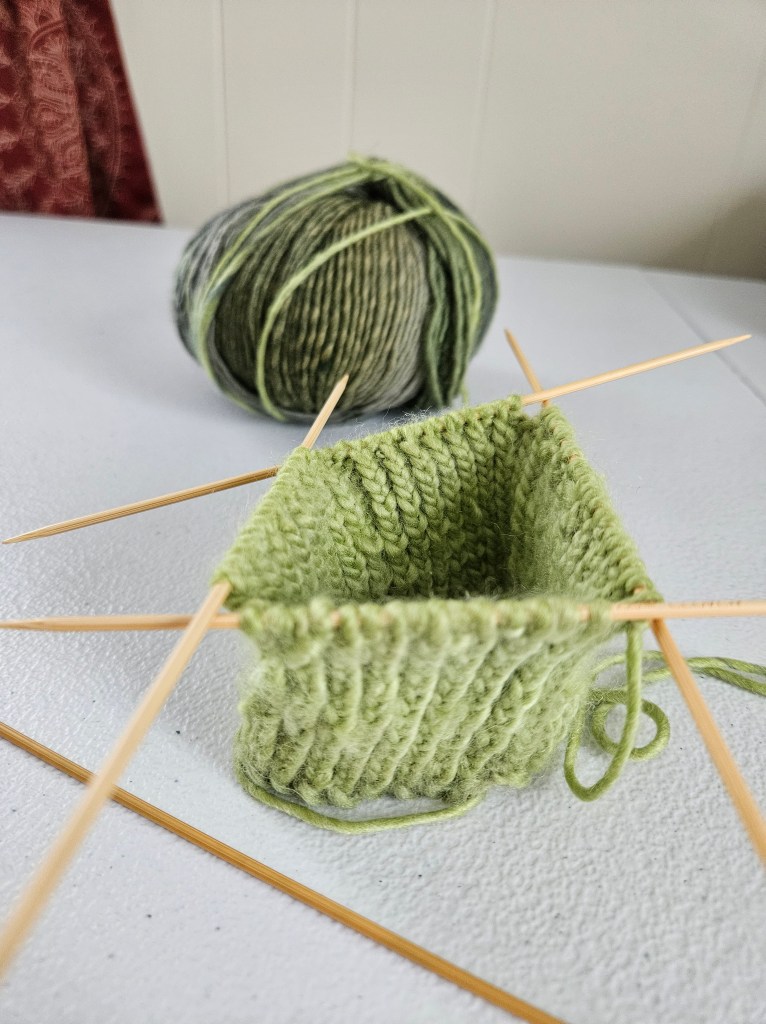
This summer, I went to a local yarn shop where I began my journey to sock more traditionally. I picked up a pair of small-gauge double-pointed needles and sock sock-making kit with proper sock yarn of wool and nylon, to do it “properly” and oh my, did this bomb. The toe-up pattern, new to me from my previous projects that were cuff down, pushed me far out of my depth. I sank instead of swimming. The four double-pointed needles and my uncoordinated hands created tension and laddering in the knit, which looks exactly as it sounds. I tried three times to knit a few centimeters before the stitches fell off the needles, the sock falling off with the stitches. In desperation, as the needles were 29 USD and the sock kit 29 USD, I was feeling very silly and wasteful purchasing new needles and new yarn that I couldn’t do anything with.

So I pivoted to my trusty straight needles until I saw my mom later that weekend, and she lent me a pair of small-gauge, small-circumference needles to finish the sock. Still baffled by the heel flap and the vague instructions on the pattern, I tried German short rows for shaping the heel. In a fortnight, I completed the first of the two socks. I cast off and handed it to Kyle to try on, and the size was all wrong. I tried to frog it back into a skein of yarn, but the splitty yarn tangled, ripped, and became a ball of knots. It was over, and I was furious with myself for wasting time, money, resources, and, honestly, hurting my eyes squinting to see my tiny stitches for almost two weeks to accomplish nothing.

Socks are madness. And maybe I should stop beating myself up about my failure when socks are one of the hardest things to make by hand. I am an overachiever and a perfectionist, so this type of failure cuts me deep. I obsess, I rage, and I fall apart in the madness of learning something that may take years to execute once, not even perfectly. But you know what? I have made good socks before! Comfortable, almost perfect for what I was looking to achieve, socks. But I rejected them as being good because I was embarrassed at how I made them. I didn’t follow the right techniques, I used the “wrong” yarn, and I didn’t turn the heel.

Sometimes I have major imposter syndrome as a knitter. I feel like a fraud because I don’t use the exact same patterns, same tools, same yarn as everyone else on the internet. But why is that a bad thing? I’ve listened to other knitters in podcasts discuss how the sameness of knitting is making it boring. Apparently, at Rhinebeck or other knitting events, it is easy to see the same sweater throughout the sea of people, and that is a new thing. Listening to knitters, who have been knitting long before 2020, when I really started knitting consistently, knitters used to do their own thing. Yarn suggestions in patterns were exactly that – a suggestion.

People were designing more and experimenting instead of knitting in the homogenized way we see today, which is one of the ways I feel like an outsider. I don’t want to knit the same things as everyone else, but I also want to be good at the craft, and it leaves me in this push-and-pull tension. It became clear to me, though, that my search to “fit in” with the proper sock kit and the expensive needles didn’t make me a better maker. It was honestly a bit of a handicap. So I guess my takeaway is to be yourself?

I don’t want to stagnate in my skills, but if I can find my own technique to make socks and other garments with the “non-standard” tools and yarn, then is it really stagnation or just getting creative with where my skill level is at? I’ve been pondering this a lot and have more thoughts on this from both the point of view of a knitter and a sewist. But that will have to wait for next time.
I Found A Local Yarn Store!

If you have been following my blog this year, you will know that I was feeling a bit frustrated, that I didn’t have a local yarn store to turn to after Joann closed – but that’s no longer the case! I found a local shop thanks to the Yarn Discovery Tour of North Eastern Ohio. How wonderful is that!

As a Western Pennsylvania resident, it was a little bit of a drive, but not too far to visit the lovely Three Sheep Gallery and Workshop of Boardman, Ohio. This yarn shop had so much for me and my mom to check out – spinning wheels, weaving looms, yarn brands galore, project kits, needles, hooks, etc. I picked up a sock kit with a superwash merino and nylon blend fingering weight yarn that is self-striping. I was excited to try this sock kit because it came with a free pattern from Urth Yarns. This sock pattern has been full of surprises, some good and some challenging. It is a toe-up sock pattern, based on traditional Turkish sock design.

I’ve never made a toe-up sock before, I’m excited to learn new techniques, but here is where I am struggling. I bought double-pointed needles, on recommendation for sock knitting, and they are wonderful needles, but dang, the combo of a new sock technique and new tools has been frustrating. I’m getting laddering on the sock every time I start over, and I feel a bit on the edge of tears because these needles were expensive – 21 USD! On top of the sock kit for 29 USD for 100 grams of yarn and a PDF pattern. I feel a lot of pressure, from my own mind, because I was not paying attention to the price and feel like I made a mistake, but I need to remember that new skills take time. With patience and practice, the skill will come in time.

The second project I purchased was a scarf kit with two yarn hanks of worsted weight wool and a pattern from Urth Yarns, that my mom also purchased so we will have matching scarves! I’m so excited. The biggest blessing of this day was the opportunity to share what I love with my mom, my Scott, and my Kyle. I am truly grateful for all that these guys did to make this a great day of bonding for my mom and I, and for the four of us. It’s been a heavy few weeks after losing our beloved Sully, and getting a day to explore a new yarn store, learn about weaving, and getting to meet the lovely owner of Three Sheep was a bright spot after days of gray.

Socks: An Update

Several months ago, I started a new side quest in knitting – making socks. It’s a windy and treacherous climb, fraught with new equipment and an entirely new approach from a garment like a sweater. At the beginning it’s like casting on a mitten or a small hat, yet as time goes on you realize you are somewhere between a knitter and a sculptor, looking for the heel shape in your amphorous block of yarn. It is the most challenging garment I’ve made, culminating in going over the waterfall, at least that’s what turning the heel felt like at times.

What makes this ubiquitous garment so hard to learn? It’s a project of multi-tasking, like dribbling a basketball and moving at the same time. You are not only knitting a pattern – a sock, but you are also learning it on a new court – double pointed needles or with a magic loop configuration on circular knitting needles. There is also the third option, the one I leaned on when I was baffled by hitting gauge on my project and fed up with ripping out my progress over and over, knit flat tube socks that are sewn together to form the tubular shape.

My first two completed sets of socks were made this way, with straight needles to help me process all I was learning from these new techniques. It was the confidence boost I needed to keep going and finish the sock. I get overwhelmed in new projects when nothing is familiar but taking one part, flat knitting, and keeping that as the control part of the experiment let me knit and see how it should look and feel when the socks are completed. To better understand what I was working towards on double pointed needles or circular needles. Flat knitting also gave me the chance to try something I’ve never done before as a knitter, I cast on two socks at a time on my needles. It was incredibly satisfying to finish each sock at the same time!

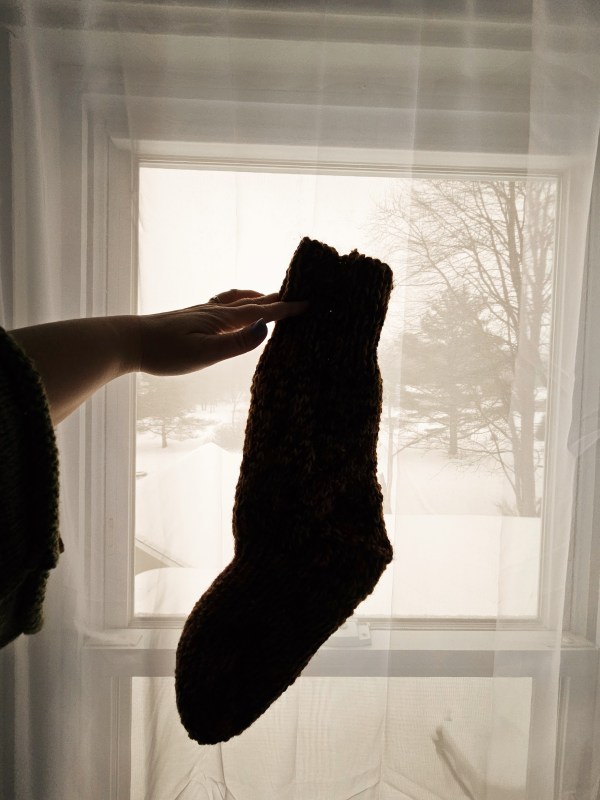
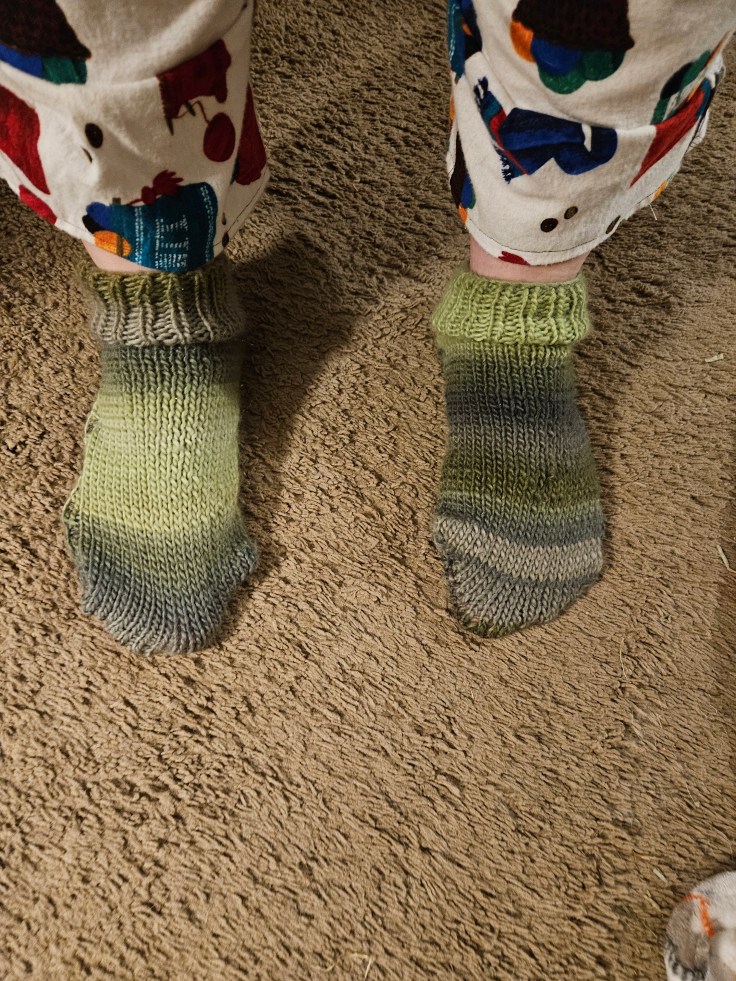
With this new found confidence I carried on and cast back onto the straight needles, making a brown pair of socks from recycled acrylic that wash and wear well. These green socks above are a blend that is mostly wool with a hint of acrylic in the yarn and they are hand wash or steam only for me. I wash them gently with either shampoo or conditioner in the sink, carefully to prevent felting. For my next project I wanted to explore fiber content, so I cast on a sock with three strands – two fingering weight wool and one acrylic. I chose this composition to test wear and washability, to make these a sock I could worry less about washing yet would insulate my foot, this was during a month long stretch of cold weather, dipping into the negatives fahrenheit so my mind was on cold weather. I decided to make these chunky socks into a sock I would use to insulate my L.L.Bean duck boots which are waterproof but are canvas, not insulated at all. They are a boot I want to wear for cold weather and snow, but they make my feet cold even with two pairs of socks.

As I got to the heel portion, I knit these socks cuff down, I made a last second decision and transfered my project to my round needles, joining the row into a round a stitches. With my heel turning reference book in hand I began turning that heel! It wasn’t as bad as I thought it would be! I don’t think I executed it perfectly, but I conquered a fear. Now, the tough part of the process is that my handwork for circular knitting is subpar. I hold my stitches too tight and the tension hurts my fingers the longer I knit on a project. The only way to improve this is to keep practicing, yet I don’t want to practice. The second sock is cast on but I have yet to make progress on project because I am dreading the circular process and those tight stitches that come from inexperience.

Is this sock the best fitting sock I’ve ever made? Yes! Is it better than store bought ones? A 1000% yes, and I’m a novice so they are going to get better with practice. It’s an art form we wear everyday without thought, but it is truly a sculpture of yarn. Next time you put on a sock, have a moment of appreciation for the geometry, the symmetry, and the sculpture adorning your foot.

Socks, A Journey

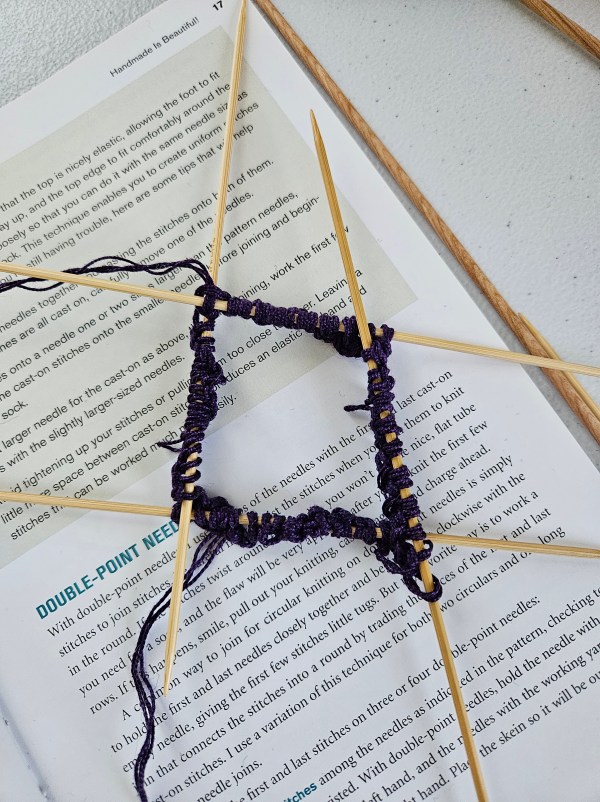
Today I completed the most stressful cast on of my knitting life, casting on a sock. This was with three strands of lace weight yarn and four double pointed needles, size US 1. Why double pointed needles? Why not! It got me out of my comfort zone and pushed me to be a focused, careful knitter with dexterity and cultivated patience for myself, the materials, and the technique.

Once the first round was joined, I felt the tension coursing through my body settle, like a war had been won in needles and yarn.

How will my first sock turn out? Who knows, but I’m optimistic. I have a sock knitting book, a step-by-step pattern, and properly gauged materials. I’d like to have cute socks to wear, the ruffly kind so here goes nothing! 😃

Create a website or blog at WordPress.com

Up ↑