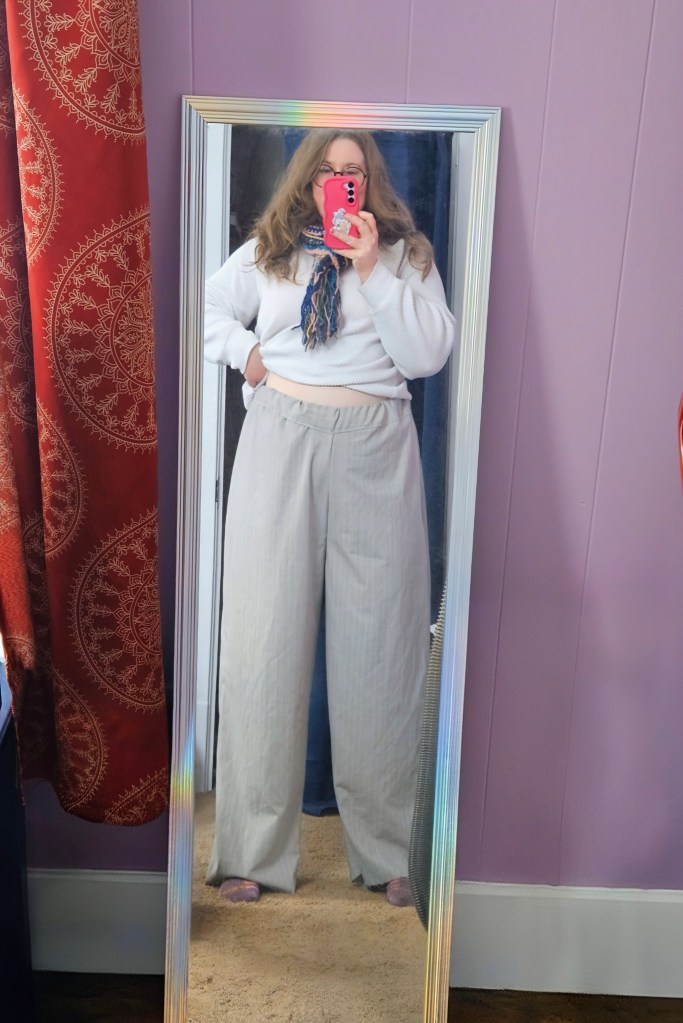
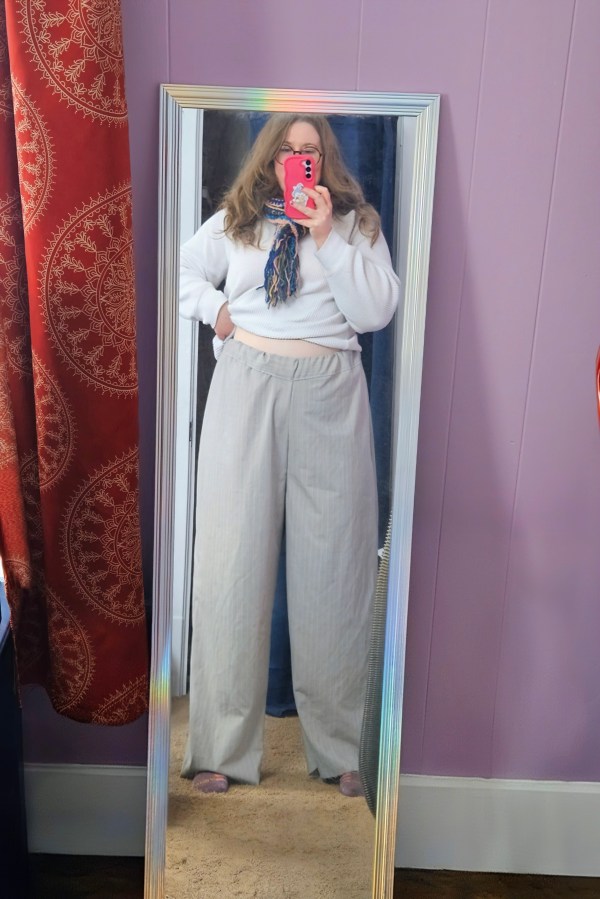
How I Duplicated My Favorite Pair of Pants

Have you noticed I am not sewing as much as I used to? As Marie Kondo instructs, if it doesn’t bring you joy, let it go. That’s been my relationship with sewing, honestly, since 2024. Sewing and I had hit a rough patch in our relationship. No longer in the euphoric beginning, nor going deeper and bonding through the big sewing wins. We were burned out in the grind of sewing, striving to be better but lacking the proper knowledge to do so. Therefore, we’ve been on a break – off and on since 2025, and it’s been good.

It’s given me time to reflect on what I want to pursue, sewing, specializing, and what I feel like I should make because of the internet. It’s given me time to ponder what drives me to make my own clothes. When I began sewing, I was intrigued by historical styles, and then I drifted into more feminine items like dresses, blouses, and skirts. Shorts and pants were made and quickly cut up for scrap because they were such enigmas for my mind to understand. On this break, I’ve given myself room to figure out what I like to wear, which is key to sewing your own clothes. You can chase all the trendy patterns and styles, but if you don’t want to wear them, then you have a very expensive wardrobe of your own sweat equity that is useless to you. My desire was to break this cycle.

Going into 2023, I wasn’t sure what to make anymore or what I wanted to sew, but I felt this compulsion to keep going because I was so committed to this new hobby. A hobby I wanted to become my future career. It’s been in the midst of the slowdown that my artistic point of view has recalibrated. I like pants (trousers), overalls (dungarees), denim (dungarees), comfortable silhouettes like that of Lucy & Yak, and that is what I want to make.

This has only intensified since the Trad Wife trend co-opted the flouncy dresses, giving me the ick at the thought of associating with something I have always strived to avoid. Growing up in communities dominated by the Reformed Presbyterian church (a denomination I do not belong to and never shall) and Christian Nationalism spreading its snakey tendrils throughout the Christian bubble – I want nothing to do with the Trad Wife and all it represents.

That brings us to the present day, March 2026. After 2 years of sitting in my fabric stash, I finally started to cut the trouser fabric I bought to make my own pants in 2024. Too intimidated by my own past failure, I let it hide in my crafting closet, all of 2025, for fear of failing again. I did fail at pants in September 2025 with another fabric, so it was not unfounded fear. But what is the point of living in fear, especially for something so small? Would I learn that I am not very good at sewing? Sure, and who cares?! Is crafting a competition? No. It’s about making incremental steps towards success through practice.

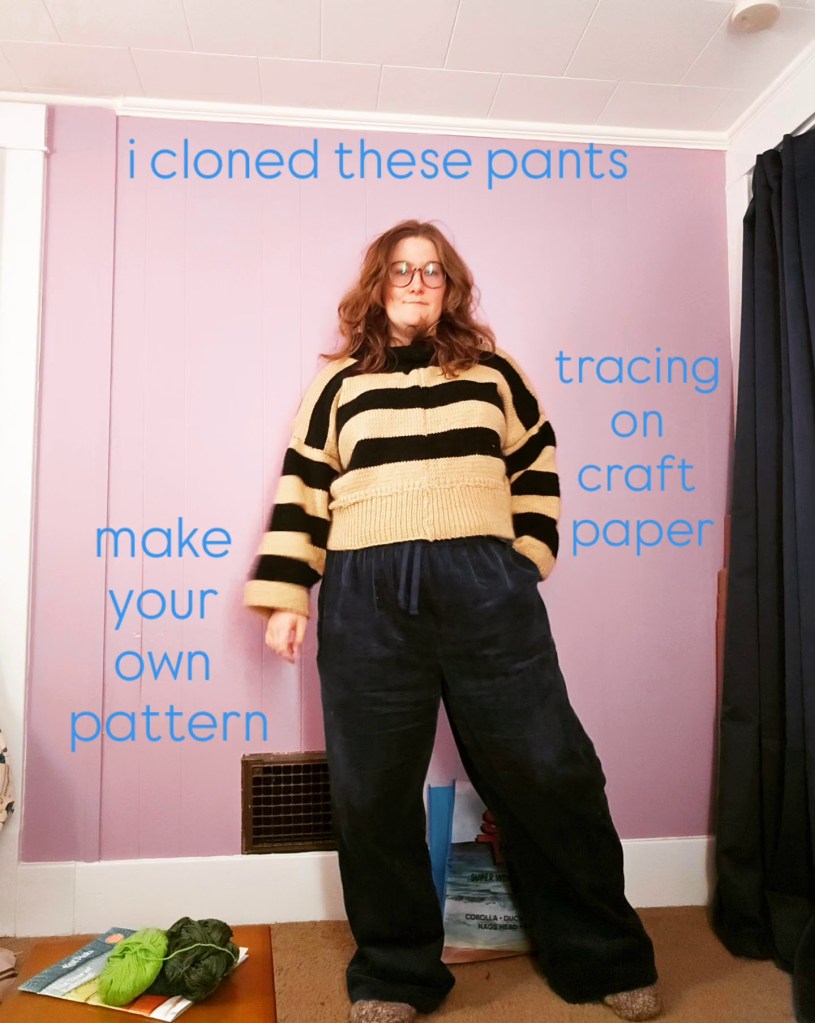
For my birthday, Kyle gave me two garments from Lucy & Yak, something I had dreamed of since 2019. A pair of denim dungarees and a pair of corduroy pants. And you know what I thought of looking at them folded? What a lovely thing to take a pattern from. Use brown craft paper or wrapping paper, and feel free. I traced methodically, marking the seam allowance, and back from the front pattern piece. I carefully laid out my pattern, mirroring the right and left pieces for the front and back. Then, over two weeks, I slowly sewed these pants together by hand with a fresh sewing needle, which makes all the difference. Don’t be cheap like I used to be; buy new needles regularly to save your hands. Sew with courage, because this might be the time it all clicks. What if you never let yourself succeed? That would be more terrible than failing again at doing the hard thing.

I wish you happy sewing and good-fitting pants that make you smile every time you wear them.
Checker Board Pants: Making Pants From Your Favorite Jeans

In 2024, I was inspired to start making pants. I had attempted making pants before and they were successful but I struggled to make them feel like more than just a pair of lounge pants. Part of this was caused by not choosing a good bottom-weight fabric, and instead opting for a lightweight summer cotton that draped beautifully but didn’t give me that tailored look. I also tried an ill-fated scuba fabric in 2023 that crashed and burned because my thread tension was off. Enter this checkerboard denim print I purchased at Hobby Lobby. It was denim but lighter, not too heavy to be a problem for my sewing machine. But how would I find the right pattern?

I had a pants pattern in my stash for menswear trousers, that I considered using on this project. It’s a solid pattern and would make a straight-fit pair of jeans, maybe not the style I was going for though. I considered buying a new pattern, but then I fretted that the pattern would fit me weirdly or might not fit at all. The current style in 2024 still featured that tapered-in waist on pants that favor an hourglass figure, not my rectangle athletic build, so should I risk it? A big reason I chose to make pants in the first place was that I was sick of shopping and trying on pants that made me feel weird about my body. The men’s section was my go-to for their up-and-down pattern cutting, compared to the extreme tapering and high waist silhouette of women’s pants. Even low rise was stuck in mid-rise inseam, not the true low waist inseam I was accustomed to in the 2000s and early 2010s that helped me find good-fitting jeans because they favored my shape not the post-bbl world of fashion. I digress, my point is that buying a pattern someone else drafted felt like a risk because the fit is such a personalized thing.

My solution was to take a pair of pants in my wardrobe that I liked the fit of and to trace that pair of pants to gauge the shape. I did this with a pair of jeans that were high waist but had a nice loose fit through the hip and leg for the K-pop-inspired baggy jeans style I was interested in making with this 1990s Vans checker board print. This worked swimmingly! So much so that I traced the jeans onto a piece of brown craft paper for a quick pattern to reach for on future projects.

I chose to record this project, start to finish in video from instead of video to have a memory of how I did this to learn for myself and remember what I did but to also inspire others to try this. Pants are intimidating, especially from a paper or PDF pattern. The written instructions and diagrams have puzzled me in past projects but truly, pants are simple once you see how its done. I wanted to help others feel that freedom to create because at least in my American fashion market, fast fashion has destroyed the craftsmanship of pants and standardized sizing. I referenced this in a previous post, Shaping Up where I had to confront the dressing room terror of things not fitting and seeking to not be defined by my jeans size, when trends and pattern cutting shape shift sizes, but to take control of it on my end and get healthier in 2023.

This pants project was one of the most challenging and rewarding projects of 2024. I faced my fear of sewing denim, inserting pockets, and fastenings. I chose to not attempt a fly into I had more pants sewing experience, instead I planned to make what I knew I could achieve under my skill set. I opted for a side closer with a drawstring to have an adjustable fit since the denim had zero stretch. The denim containing no stretch was a feature I sought because I believed it would be easier to work with as it was my first project of this kind, and I wanted a crisp tailoring from the woven fabric. A key thing to note is that the jeans I used for my template also are non-stretch denim. For an accurate this is paramount or else the project will not work. Either you will cut your project too large or too small. It is also essential to leave a seam allowance on your pattern pieces. When self-drafting it is your responsibility to take charge of the seam allowances and plan ahead.

I messed this up with the crotch line and had to make a quick fix. My fix was a diamond gusset. Popular in women’s leggings, this diamond gusset shape piece allows for greater mobility while maintaining the strength of the seams.

The second challenge I faced was the problem of a narrow bolt and an all-over pattern. This fabric was quite narrow and because I was cautious with my seam allowance, I cut my pieces large. This meant that I was not cutting from the longest side, but the most wide. The pattern pieces were cut out missing length on the leg. My solution was to add on to the bottom and pattern match. It’s easier to match than people say, it just takes patience and intentional sewing. I’m pleased with how seamlessly I got my pieces to match up.

The pockets were a challenge. How do you place them? How do you insert them with strength so the pockets can be used without pulling the pants down or ripping? I chose to place them angled on the sides, aligned with my hips so that they would be practical and not create weird bunching at the front of the pants. No wonky crotch fit here!

Would you make your own pants? I hope I inspired you to get creative and go for it if you are sewing-inclined. Thanks, reader, for joining me once again on this quest to grow my fashion design skills. Have a wonderful day!

Create a website or blog at WordPress.com

Up ↑