Easter: A Confrontation of Oppression?

Something I have pondered through this Easter season, thanks to the Bible Project Exodus Way series, is Jesus’ motivation for His mission and how His ministry confronted oppression in the 1st century. Oppression from sin, society, and the corruption of the Jewish leaders, all under foreign occupation. It was a tense atmosphere. That is something I tend to forget. I think that the Pharisees were petty, and Rome was a casual player; instead of Jesus existed in the context of people who wanted to be free.

The Romans were incredibly brutal. If you have watched Gladiator or Gladiator II, there is a temptation to get caught up in the splendors of Rome, but they were a society sustained by oppression. Gladiators were slaves; any immigrants or conquered nations were slaves, there was a strict class divide, and women were not valued. With newborn baby girls and disabled babies being thrown away to animals, off of cliffs, or sold to human traffickers. It was a common practice.

Doesn’t this sound like eugenics and the practices we saw in the extermination plans of genocides? Yep. It’s a cycle of evil and sin that we fall into over and over again. Same ship, different day.

Under Roman occupation, the cross and crucifixion were a common and calculated practice of execution. Men, women, and children could be crucified, usually by the roadside. It was designed to instill fear and was engineered to be a horrific death, and yet Jesus willingly allowed himself to be crucified for us. All of us, His mockers, those scheming against Him, even those Romans.

He came to challenge our understanding of love through the radical expression of it, taking the sin of the entire world – past, present, and future – on His fully human, yet fully God, shoulders – to pay a price we cannot pay for freedom from oppression.

Jesus ministered to everyone in His path, but He sought out those who were abandoned by the society they lived. Jesus healed the sick, the lepers who were kicked out of society and left to live as outcasts, when they needed compassion and care. Those who were disabled were ignored, but Jesus saw them and healed them. He confronted the demons who took up residence inside people and cast the demons out, ending the oppression of their host and restoring peace.

He gave second chances. There were many times throughout His ministry when the disciples and His followers let Him down, yet Jesus forgave them. Even when they denied and abandoned Him, Jesus forgave. Forgiveness confronts the oppression of grudges, vengeance, malice, and bitterness.

Our society is embroiled in grudges, vengeance, and the oppression that comes with unwillingness to forgive. Justice with an iron fist, eye for an eye. That is not what the Bible calls for, even in those Old Testament passages that are brought up to challenge this – the Egyptians were free to join the Passover and be spared from the plague that killed the firstborn, the kingdoms that were in Canaan when the Israelites did it God’s way were conquerered not by violence. God is a just God, a righteous God, and even in the Day of the Lord is not a God of oppression. We are called to forgive, to be reborn in salvation as new creations in Christ, and to give second chances with generosity and love.

The Passover of the Jews was at hand, and Jesus went up to Jerusalem.  In the temple he found those who were selling oxen and sheep and pigeons, and the money-changers sitting there. And making a whip of cords, he drove them all out of the temple, with the sheep and oxen.

And he poured out the coins of the money-changers and overturned their tables.
And he told those who sold the pigeons, “Take these things away; do not make my Father’s house a house of trade.”

His disciples remembered that it was written, “Zeal for your house will consume me.” So the Jews said to him, “What sign do you show us for doing these things?”

Jesus answered them, “Destroy this temple, and in three days I will raise it up.”
The Jews then said, “It has taken forty-six years to build this temple, and will you raise it up in three days?”

But he was speaking about the temple of his body. When therefore he was raised from the dead, his disciples remembered that he had said this, and they believed the Scripture and the word that Jesus had spoken.

John 2:13-22 ESV

It’s been a daily struggle for me and the rest of us who have eyes open to the oppression occurring in our midst. I am angry. I want to fight against the pervasive corruption. This Holy Week has been a week of me learning about the El Salvadorian CECOT prison, where there are no second chances ever, hearing that Autism is an “epidemic”, Putin launching missiles during Ukrainian Easter celebrations, and my state’s governor being the target of arson because of his faith.

The ceasefire, which I knew was broken, just fills me with frustration at the ongoing suffering and senseless death. Like the Pharisees, Sadducees, and Romans, the apathy for suffering people and the greed for power and money is the “tale as old as time” plot playing on today. I wish the world would wake up. It’s also the tax deadline here in the United States, and I have to say, I am the least confident I’ve been in my adult life that my taxes are doing anything good for my community.

Especially when social services and disaster relief funding are cut. I want these leaders in my midst, and my fellow citizens who are lukewarm like the church of Laodicea, to stop perpetuating “Christianity” as a form tied up with politics and confront the ways that they are participating in the oppression of others and repent, because this week is about freedom. We are all invited to become a new creation.

True freedom. From who we are, have been, come from, or what we feel we can’t be. It is a transformative second chance of mercy and justice that we have not earned, but is freely given. No corruption or cronyism can take it away, nor can violence or tyranny.

If you are reading this and haven’t experienced this kind of freedom, may I recommend the Chosen, the Bible Project, and the gospel of John first? John is so thematic, and it’s a story that will pull you in. The world is a vampire, but there is hope. Stay strong, friends, and know that you are loved.

Blacksmithing – Micah 4:3

At the beginning of this blog I was reading through sections of the Bible that I did not know as well as passages that are taught quite frequently and I was letting God lead me in the process. This was my goal in 2023, and in 2024 I’m still doing that albeit a bit more chaotically than last year. I blame the move, but honestly, my focus has been all over the place except on my devotions since we moved which I am not proud of. Because of this I have been hopping around the Bible I was in Proverbs and then I was in Mark and now I’m sporadically reading through the minor prophets. I read through Jonah and now I’m back in Micah.

There was something that stuck out to me again as I read Micah chapter four yesterday but for a different reason than my reading in 2023. In 2023, verse three stood out to me because of the promise of peace, this time it was the historical process that caused me to stop and ponder.

He shall judge between many peoples,
    and shall decide disputes for strong nations far away;
and they shall beat their swords into plowshares,
    and their spears into pruning hooks;
nation shall not lift up sword against nation,
    neither shall they learn war anymore;

Micah 4:3 ESV

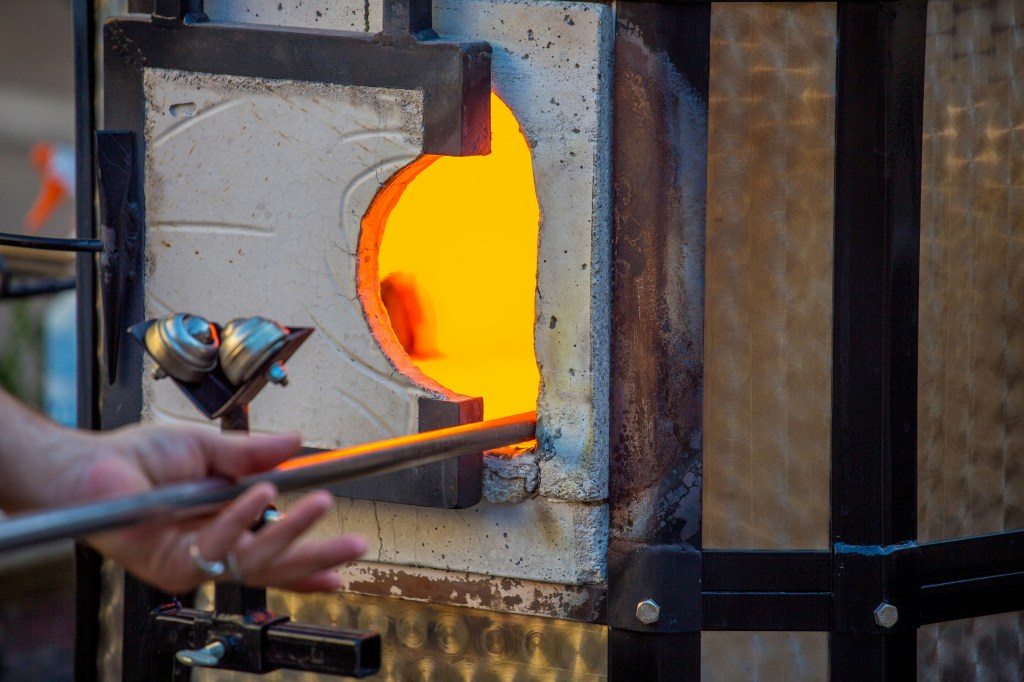
I was watching an I Like to Make Stuff video recently where Bob constructed a forge, followed by another video where he forges his own machete from a piece of steel. The process was fascinating! It is such a different medium from the fiber crafts I do because the material requires more persuading than scissors, stitches, or thread to be transformed. It requires heat to allow the material to be pliable, but you can’t form it unless you have a hammer to beat the metal into the form you desire. It can take many attempts of heating and hammering to get a crude shape. This doesn’t take into account the angle grinder or sanding to adjust the shape, plus the tempering of the metal through heating and dipping the blade to make it stronger. It’s a complicated process to make something.

This verse about ‘beating swords into plowshares’ and ‘spears into pruning hooks’ well depending on how expertly these weapons were made this is a lot of craftsmanship to be destroyed, and not reformed in one beat of the hammer. This would be a process. These would be precious resources that would need to be heated in the forge, hammered into shape, and reinforced with tempering. It would be a full transformation and would require work and commitment, so full submission to God’s will and full trust that you’re not going to need that carefully crafted weaponry or I think you would hold on to it. Because there was no Amazon 2-day to get more materials or a replacement sword or spear if you changed your mind. This was it.

Because we’ve lost this technology in our modern culture to other means, this picture of blacksmithing seems like an insignificant detail but I think it has a lot of weight to the meaning of the larger message in Micah 4 and the book in general. This was a full 180-degree shift from war to planting, something you only do if you have hope for the future and stability because you have to be there to tend to the crops and harvest at a later time. You are committed to the process.

I think it is also important that the weapons are not just laid down and cast away, instead, they are reshaped and forged by fire to reveal their new life as necessary tools in the kingdom. They had a past of different goals, but are shaped by a refining fire to become a new thing and serve a new purpose. For being an Old Testament book this surely has New Testament significance, as this is what being a new creation in Christ through repentance and salvation looks like. You are not cast away for a new thing, you are transformed for a new form and a new function.

Like a blacksmith with a forge and a hammer, the Christian life transforms us from one thing to another for a new purpose. Even if our former life was filled with contradictions to the one we are living now, that forge of refining fire changes everything.

Mark 14 – Dipping that Bread

Today was a good day because I remembered to do my Bible Study, a bonus for coordinating my Bible Reading by lying on my yoga mat. It is incredibly peaceful. I’m reading through the book of Mark which I can’t study without thinking of a sermon series at my childhood church in Mark, which if you don’t know is the shortest gospel and is written with the intention of conciseness and fast-paced structure. Ironically this series took years, literal years with a lot of repetition and I just find it amusing. But focusing on what is important here – I was struck by something new while I was reading Chapter 14, a couple new things actually.

This is not my first time through Mark or the Gospels or the whole Bible actually, I read through the entire book from 2020-2021. Today when I was reading through Chapter 14 which is all about Mary Magdalene anointing Jesus for burial, the Last Supper, the plot to kill Jesus, Jesus’ arrest, and Peter’s denial, I noticed something that I had added to the story by paraphrasing in my previous study. Like clearly was not listening or comprehending what I was reading, which I get distracted easily so no surprise there! Thankfully I have started praying before I study and asking God to help me focus only on Him and guide me to what He wants to teach me.

“And when it was evening, he came with the twelve.  And as they were reclining at table and eating, Jesus said, “Truly, I say to you, one of you will betray me, one who is eating with me.” They began to be sorrowful and to say to him one after another, “Is it I?” He said to them, “It is one of the twelve, one who is dipping bread into the dish with me.  For the Son of Man goes as it is written of him, but woe to that man by whom the Son of Man is betrayed! It would have been better for that man if he had not been born.”

Mark 14:17-21 ESV

This is where I was adding something! I was reading it as this sign that Jesus would offer the bread and the cup around and each disciple was going to have the chance to dip and only Judas does in this ultimate sign of his transformation. Revealing his true identity in a bold betrayal like a movie or a strategy reality TV show. This was his mic drop of shadiness!

It doesn’t say that or imply that at all, it says one of the twelve who is eating with Jesus. I totally read into that and added a whole bunch of cinematic drama that isn’t what God intended here. I was struck by how convinced I was that this was in the Bible when it’s not at all. Judas betrays Jesus in the Garden of Gethsemane a few verses later.

I was shook by how I could be so familiar with a story and not know the actual details of the events! It shows why you read the Bible more than once, and you continue to study it because there is a lot in here and it is hard to remember everything as I should. That doesn’t mean I shouldn’t try though!

Let’s Run This Race With Perseverance

Q: What gives you direction in life?

A: “Therefore, since we are surrounded by such a great cloud of witnesses, let us throw off everything that hinders and the sin that so easily entangles. And let us run with perseverance the race marked out for us, fixing our eyes on Jesus, the pioneer and perfecter of faith. For the joy set before him he endured the cross, scorning its shame, and sat down at the right hand of the throne of God.” 

Hebrews 12:1-2 NIV

I remember in 2009, this was my school’s theme verse for the year. It was on the bulletin board you saw as you entered the high school building. Being our theme verse it was incorporated into devotionals throughout the school year, lessons, and referenced by my fellow students, but I thought about it more in the context of our annual jog-a-thon. The day the whole school K-12, held a fundraiser at our local college’s track to raise money through lap sponsorship. More miles clocked, more money raised for the next year. Every May, this day was the only day I ever jogged around a track. It was a big push to keep the school going, and I endured for one day. Afterward, I would put set down my perseverance and keep going through life until the next jog-a-thon. It’s funny how I didn’t think it would apply to life.

Because I heard this verse so often in high school, it was an easy one to memorize. I carried it with me into my life without giving it much thought. Suddenly, it came back into view when my Grandma had to live by herself for the first time. My Papa was sick and living full-time at a nursing home. She was alone and was feeling like life had leveled up quick. I remember talking with her and she would quote the verse from high school, Hebrews 12:1-2. “Therefore, since we are surrounded by such a great cloud of witnesses, let us throw off everything that hinders and the sin that so easily entangles. And let us run with perseverance the race marked out for us,  fixing our eyes on Jesus, the pioneer, and perfecter of faith. For the joy set before him, he endured the cross, scorning its shame, and sat down at the right hand of the throne of God.” She changed my perspective on this verse from being a coffee mug kind of quote to understanding the deeper meaning written in these words from Hebrews.

The Book of Hebrews was a letter written to a Jewish Christian community that was facing persecution and imprisonment because of their association with Jesus and the 12 apostles. They are facing hard times, with no end in sight. They are not simply running a race, it is a metaphor. The audience was feeling discouraged, unsure if they could carry on when the future looked grim and full of suffering. What I learned through my conversations with my Grandma was that she was feeling incredibly overwhelmed by how her life had changed by Papa not being there. We didn’t know if he would recover, or if he would be healthy enough to come home. Everything about her world looked unfamiliar, she was now a sojourner in unknown lands. Her best friend was no longer by her side and this new reality had no end. Like people for whom Hebrews was written, she didn’t know what the future held and she knew the likely options were dark, filled with separation and death.

It was tough to find the words to comfort a friend who is suffering. From this experience, I learned that even Christians don’t always know what to say or how to comfort those who are walking through a season of pain. To my Grandma, the Book of Hebrews became a beacon of hope. A reminder that the desert road is winding towards a destination that is better than where she currently stood. Although she didn’t want to be there, the words of encouragement in Hebrews 12:1-2 reminded her that she wasn’t the first person to experience this kind of pain. As the Messiah, Jesus experienced what it was like to be fully human and fully God. He experienced persecution, loneliness, and separation from His Father on the cross. He knew what it was like to be staring down a timeline moving toward death. Because of that, we can look to His example and dig deep knowing that He will be with us every step of the way.

After both my grandparents passed away, I realized there is even more to this verse. I ignored the section, “surrounded by a great cloud of witnesses” and failed to consider what a great cloud of witnesses meant. At the jog-a-thon, it was a group effort. Parents, older siblings, younger siblings, teachers, etc. They were all around us on the track during the race. Some were waiting in the stands, and some were cheering us on from the water station – we weren’t alone on that track. Alongside myself, my friends were running too. We would motivate each other to keep going. In life, God brings people into our lives to encourage us. Maybe they aren’t the people you long for, like loved ones who have passed on, but they are people who know how to love you. They cheer you on through the ups and downs of life.

With a deeper understanding, Hebrews 12:1-2 has gone from being a school theme verse to a reminder to keep going when life feels impossible. It gives me the hope that life will get better, on those days I have to dig deep because I am not alone. This verse has helped me time and time again re-frame my overwhelming emotions to transform them from obstacles into motivation to keep running the race.

Matthew 27 & Isaiah 25

This post is a little late, Resurrection Sunday was over two weeks ago, but hey, at least I made it before Pentecost so that’s a win right? Anyways, this year as we went into the week of remembrance of Maundy Thursday, Good Friday, Silent Saturday, and Resurrection Sunday my Bible reading coincided with a study of Isaiah.

If you’re unfamiliar with the book of Isaiah, it is a book from the Old Testament that contains prophecies about the coming Messiah, Jesus. During Jesus’ life and ministry, Isaiah is quoted 21 times, and referenced throughout the New Testament a total of 85 times. It is an important text! This is my second proper study of Isaiah, my first being when I read through the entire Bible, this time around I have been taking it slow, and meditating on the text. Letting the significance of the words steep in my mind.

Since watching The Chosen, the gospels have come alive. Dallas Jenkins and Angel Studios’ intentionality to portray scripture, adhering to the text and historical details bring the story to life. The Chosen has challenged me to approach my Bible studies not as just a familiar thing I do. With the text being known well so I tend to go into auto-pilot mode, which is a blessing to know scripture but as we know it can be a barrier to learning.

If you are wondering why I am not calling it Easter, Easter originates from a pagan fertility festival that was co-opted by the Catholic Church to celebrate the death and resurrection of Jesus by the Council of Nicea in 325 AD. In North America, I find it to be a weird holiday. I’ve celebrated Easter Sunday before with family that staunchly refuses to acknowledge Jesus and that gave me a different perspective on Easter. Now I do recognize the connection to Passover, and would much rather celebrate Passover leading into Resurrection Sunday, than a bunch of Spring symbols and bunnies, although I do love bunnies. But they are a distraction and this year, I desired as little distractions as possible.

The Chosen has challenged me to remember this is a real story, to understand that Jesus my redeemer and friend, sacrificed himself not just for me but for the whole world. It is the most incredible event in human history and for too long I have not recognized that. I have been distracted by North American culture downplaying it whether that is in the church or the spectacle that is the bombardment of advertising campaigns to make me dwell on Reese’s Eggs instead of death being defeated.

First and foremost the Bible is an account of real people and the work of the Almighty God who is still working now, so when it happened to be that I was reading Isaiah 25 on Good Friday, the same day I planned to re-read Matthew 27 to remember Jesus’ sacrifice on the cross, there was this incredible sense of purpose between this pairing that excited me because I knew it wasn’t fate, it was an opportunity for God to teach me more. And He did indeed. If you look at the text below in Isaiah 25: 7-9 you can see a key moment prophecies that would come to be in Matthew 27:45-54.

And he will swallow up on this mountain the covering that is cast over all peoples,
    the veil that is spread over all nations.  He will swallow up death forever;
and the Lord God will wipe away tears from all faces,
    and the reproach of his people he will take away from all the earth,
    for the Lord has spoken. It will be said on that day,
    Behold, this is our God; we have waited for him, that he might save us.
    This is the Lord; we have waited for him;
    let us be glad and rejoice in his salvation.

Isaiah 25:7-9

Now from the sixth hour there was darkness over all the land  until the ninth hour. And about the ninth hour Jesus cried out with a loud voice, saying, “Eli, Eli, lema sabachthani?” that is, “My God, my God, why have you forsaken me?” And some of the bystanders, hearing it, said, “This man is calling Elijah.” And one of them at once ran and took a sponge, filled it with sour wine, and put it on a reed and gave it to him to drink.  But the others said, “Wait, let us see whether Elijah will come to save him.”

 And Jesus cried out again with a loud voice and yielded up his spirit.

And behold, the curtain of the temple was torn in two, from top to bottom. And the earth shook, and the rocks were split. The tombs also were opened. And many bodies of the saints who had fallen asleep were raised, and coming out of the tombs after his resurrection they went into the holy city and appeared to many. When the centurion and those who were with him, keeping watch over Jesus, saw the earthquake and what took place, they were filled with awe and said, “Truly this was the Son of God!”

Matthew 27: 45-54

The hope of death being swallowed up so the veil, or symbolic barrier in the Holy of Holies (in the Temple and Tabernacle) would no longer be needed. The veil or curtain marking the entrance to the Holy of Holies kept God’s presence separate from the people because of sin. God is righteous and just, because of this our sin separates us from the intimacy Adam and Eve had in the garden when they walked with God. But God desired this intimacy with us again, and we desire it too, and so through Jesus’ sacrifice for the sins of the world (past, present, and future) on the cross provided the ultimate sin offering to move us from the Old Covenant of the Law of Moses to the New Covenant in Christ Jesus where the curtain is no longer needed.

How cool is that?! And God planned this from the beginning. Isaiah spoke of this coming redemption before the exile even happened. From the beginning of the story in Genesis 3, God was already referencing the coming redemption:

I will put enmity between you and the woman,
    and between your offspring and her offspring;
he shall bruise your head,
    and you shall bruise his heel.

Genesis 3:15 ESV

This Good Friday, I felt a deeper sense of sorrow than ever before reading the account of Jesus’ death. In the past year, I have desired to know Him, and have Him be my confidant, my friend. Because of The Chosen, as I have mentioned before, I can’t wait to see Jesus in person. I can’t wait to hug Him. With this great sorrow, there has been an even greater joy in knowing that even the idea of spending time with Jesus in Heaven is because of the sorrow. His death was necessary to swallow up death forever and resurrection was necessary to be able to rejoice in the salvation of our Redeemer. All in all, I have found more excitement in this season than I have before because I know how much it means. Thank you, Jesus!

Create a website or blog at WordPress.com

Up ↑