
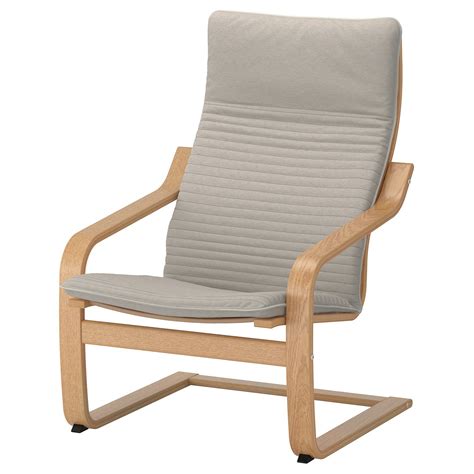
In 2021, we bought a pair of Ikea Poang chairs. They’re pretty iconic and are what many people envision when they think about Ikea chairs. We used to sit in them every time we would shop at Ikea and dream of buying them when it made sense. That time came in 2021, and at first, we loved them. However, over time, they lost their luster. They were really low to the ground, making them hard to get out of, and they were narrow, so it was difficult to work on a computer or do anything with your hands, like cross-stitch or knit.
After moving in 2024, we decided that these would become outdoor chairs on our porch. Although the chairs weren’t designed to be outdoors, the wood can be treated to resist the weather, and the cushions were brought inside at night. They worked decently well on the porch; however, the same design flaws persisted: too narrow and low. When we built our table and stools, we no longer had a need for the Ikea chairs since the stools are primarily where we sit. And when we want something more “loungey” or have people visiting, we have folding chairs that recline flat. When not in use, they can be folded and stored away, taking up less space than the Ikea chairs. That left us with a decision to be made about the Ikea chairs.
We aren’t people to throw things away unnecessarily, and we didn’t want to donate these chairs because they sat outside for nearly a year. Throughout the entire process, Magz had the idea of trying to use these chairs in our garden. We talked about simply setting a planter where the seat would be and letting nature take over them, as well as cutting out the seat support and growing a plant up from the ground through the chair. Eventually, I had the idea of using the back of the chair as a trellis system. You can’t see it in the above picture, but behind the cushion are two vertical pieces with several horizontal pieces between them, creating a ladder system. That’s essentially what a trellis is anyway. So, with that in mind, I set out to make it all happen.
Disassembly, Design, and Construction
If you’ve ever put together a piece of Ikea furniture, you know that they are all pretty similar. All of the individual wooden (or wood-adjacent) pieces are connected with screws, bolts, or barrel nuts (I had to look up what they’re called). Although assembly can be overly complicated, once you’ve put one piece of Ikea furniture together, you have an idea of how everything goes together. And while durability and longevity aren’t Ikea’s strong points, thankfully, it was a bonus in this case, because as easily as the chairs went together, they came apart.
With the pieces separated, we were left with two cross pieces, the back section that will be used for the trellis, two seat support pieces, and the two large side pieces that comprise the arms and bottoms for each chair. There was a seat section for each chair that was incredibly difficult to pull the staples from. We ended up getting rid of that piece. The back of each chair was the original inspiration for this project, but as I took the chairs apart, I could see ways to use the remaining pieces. The sides can either be cut down for individual lengths of wood or can be transformed into a planter stand. Meanwhile, the cross pieces will be used to build additional planters or in another woodworking project in the future. I typically don’t throw anything away if there’s a possibility that it can be used again.
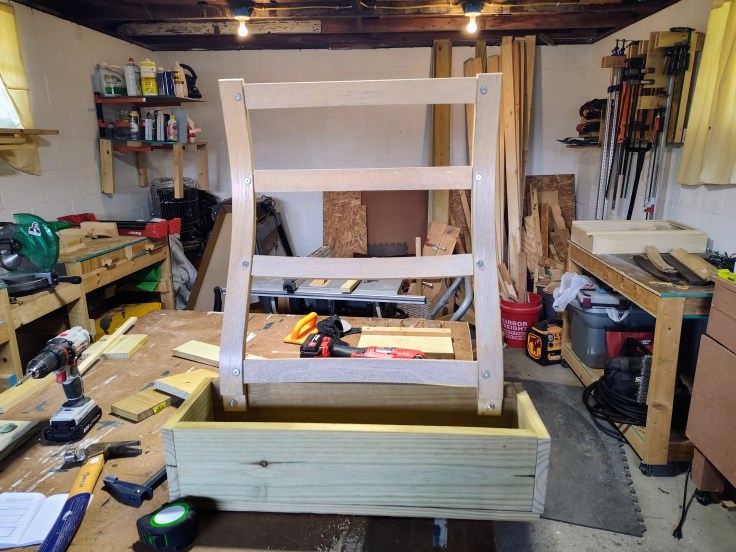
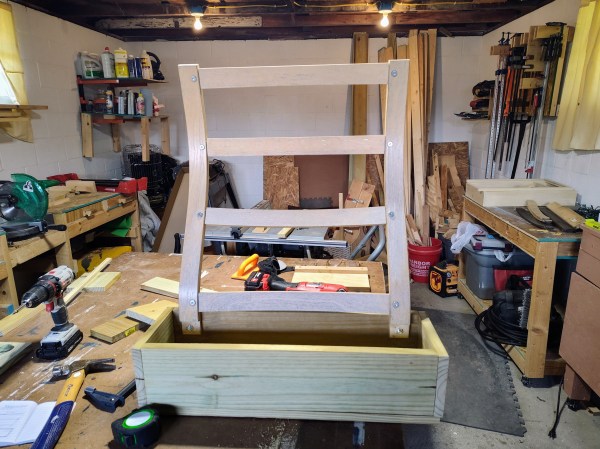
Designing the planters for the back pieces was straightforward. I measured the width of them, added two inches, and that was the interior width of the planters. I had a bunch of leftover pressure-treated 1x6s from last year’s porch project. I kept them their full width and cut pieces to length to make the four sides of the planters. Initially, I thought I would need to have two rows of these boards so that each planter was roughly 11 inches tall. However, after attaching the sides for each planter and feeling confident that one row would provide enough dirt and be sturdy enough to not tip over, I kept the planters separate. This was great, because it meant I had two planters mostly finished when I thought I only had one planter halfway done.
With that decision made, I had to figure out the bottom. I did this by using scrap pieces and ripping full-width pieces on the table saw to cover the opening. I also added support pieces for extra attachment points. Also, a note on the connectors I used. For the most part, I used coated exterior 1 1/4-inch screws that went into pre-drilled holes to reduce the likelihood of the wood splitting. This mostly worked; however, there were times when I used exterior brad nails for efficiency and simplicity. I also used outdoor-rated wood glue to hold everything together. I’m confident that these planters are built well and should stay together for the foreseeable future.
Next up was the most complicated part: attaching the back piece to the planter. On the chair, this piece connected to a cross member with a short bolt that screwed into an enclosed nut that was pressed into the back side of the piece. There was no way to reuse this setup with the planter since the bolt was too short. Instead, I determined that a 3/8-inch bolt would go through the existing hole. I managed to clamp the back piece to the planter in order to drill a small pilot hole through the plant. I then drilled that hole out with a bigger bit and ran a zinc-coated bolt through everything and tightened it down with a nut. With both sides connected, I added a screw through both pieces on each side to make sure everything is secure. And with that, it was all done.
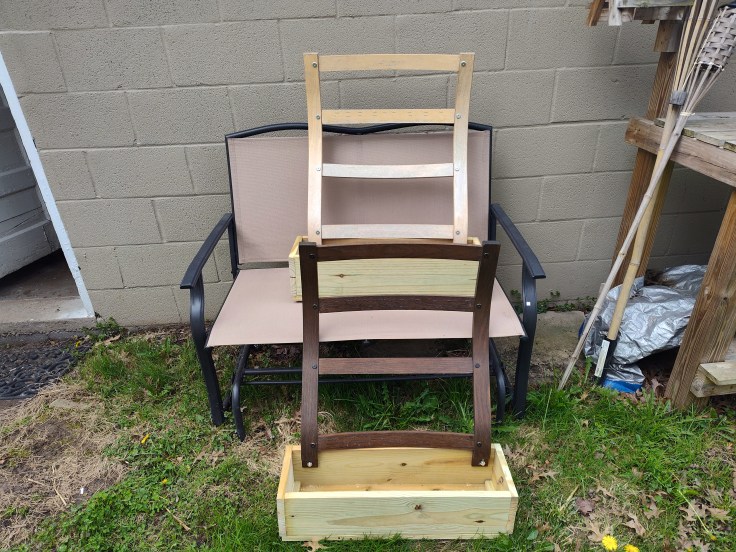
In total, I think each planter took about two hours, and it was pretty easy to bring this idea to fruition. I’m also very proud of our ability to reuse and upcycle something that a lot of people would have thrown away. I’m really excited to plant in these this year and see how beans or cucumbers will climb the trellis system. I’ll definitely follow up with other posts about how we reuse the other pieces (if they’re used in a garden-related project) as well as how successful these planters are. If you’re interested in doing something like this, don’t be afraid to take a chance and upcycle something into a planter for your garden. It’s a lot of fun and gives your garden extra character.

