When planning an upcycle, one thing that I consider with care is how to use the entire garment in the most innovative way possible. Maybe it’s all those episodes of Project Runway guiding me?
When I began my flannel upcycling project, and planned to transform them into vests, they needed a real purpose.
I began this project last year, as the summer was winding down, with fall whispering in the trees. Fall is an unmistakable inspiration for me. I love the color palette, traditional fabrics, and the academic style that returns to fashion every autumn season.
Sleeves Find New Life
Knowing how much yardage there is hidden in those sleeves, I had an idea – a plaid skirt with alternating colored plaid skirt panels connected by a waistband.
To do this, I cut the sleeves carefully from the shoulder seam to retain as much width and length as possible. This would become the bottom of the skirt. Next, I cut the cuffs from the sleeve; this tapered end was perfectly shaped for the waistline of the skirt for a flared effect.
For the waistband, I had yet to understand elastic, and was growing tired of waist ties, so I got a bit creative! I decided to use buttons, four of them to start, and created an adjustable button closure skirt, like the hook and eye of a bra band. The buttons were actually repurposed from the buttons of the shirt. For ease of getting dressed, I sewed the skirt on all the side seams, leaving a 2.5-3 inch opening to adjust the waistband, in a way that the fabric would cross over for security.
If you are looking for an easy and cute fall upcycle for the new season, I would highly recommend this project! You can even pair the vest and skirt together for a complete outfit!
Plaid. Tartan. The Ancient Celts. Punks. Lumberjacks. Kilts. Pumpkin Patch. A Christmas wrapping paper. A simple pattern of perpendicular stripes, woven together to create a fabric that has stood the test of time. Unsurprisingly, plaid comes around again in the trend cycle each fall and winter. It’s an iconic textile that makes various garments that connect us across cultures. I was delighted to see the plaid trousers as one of these tartan offerings this year. But there is one thing about this trend that I think we should talk about more. Pattern placement. Specifically pattern matching and how this changes depending on garment quality and silhouette. I believe there may be a wrong way to make a plaid trouser even though it should be straightforward. This classic has gone down a bad path this season.
But How Does it Look On a Human Body?
Something that has struck me this year about plaid trousers – how do these pants look worn on a human form, viewed from all angles? I’ve seen many ads from various retailers have been advertised to me, with increasing tempo as we inch closer to Black Friday, and there is one common thread about retail and the fashion industry in 2024. Low quality. Clothing across the board from fast fashion to luxury items are at the lowest quality they have been as brands look to cut costs every step of the way. The fabrics chosen are cheap and not cheerful, and the items themselves are being sewn under inhumane labor conditions in the global south and China. To learn more about this I’d check out the documentary The True Cost of Fashion and check out Fashion Roadman’s commentary also on YouTube. He has a book club discussing How Luxury Lost Its Luster by Dana Thomas.
My opinion is not hyperbole or subjective conjecture, of the three examples I took screenshots of two of the three brands that are known to work with factories in Bangladesh, where the Rana Plaza tragedy happened 9 years ago. Old Navy and American Eagle are these brands, fast fashion brands, that work with factories in Bangladesh, India, Vietnam, and Indonesia. Old Navy, part of the Gap brand that also produces Gap, Athleta, and Banana Republic, which is an odd name for a brand, works with factories in Bangladesh, Cambodia, Sri Lanka, China, El Salvador, Guatemala, China, Nicaragua, and the Philippines. It’s not great.
The third example is from Ralph Lauren, which I am under no guise that because it’s a designer brand the factories are more humane or that the fabric is always better because that’s not the case anymore. Look at Chanel and their gold-plated hardware, or Dior and Armani’s labor controversy in Italy. Ralph Lauren works with factories in China, Italy, the United States, Hong Kong, Pakistan, Sri Lanka, Turkey, Mexico, Cambodia, Vietnam, and India.
They are a little better I’d say but just barely. Their attention to detail in the design of their clothing though, it’s night and day to Old Navy and American Eagle who have gone the way of H&M, Zara, and Shein.
American Eagle: Pattern Alignment and Patch Pockets
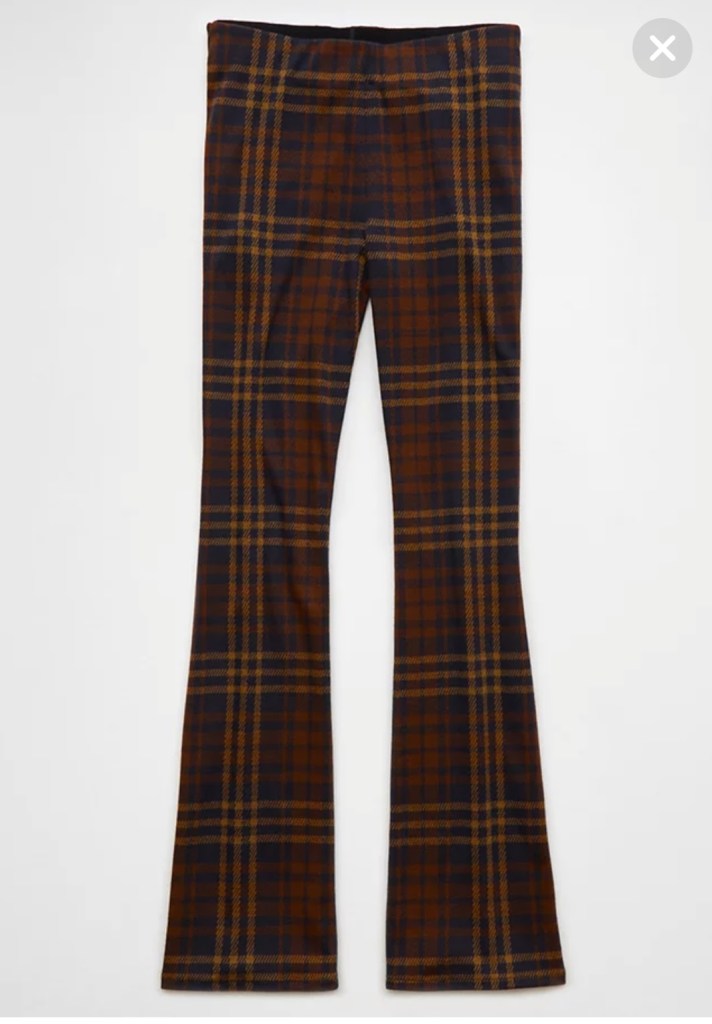
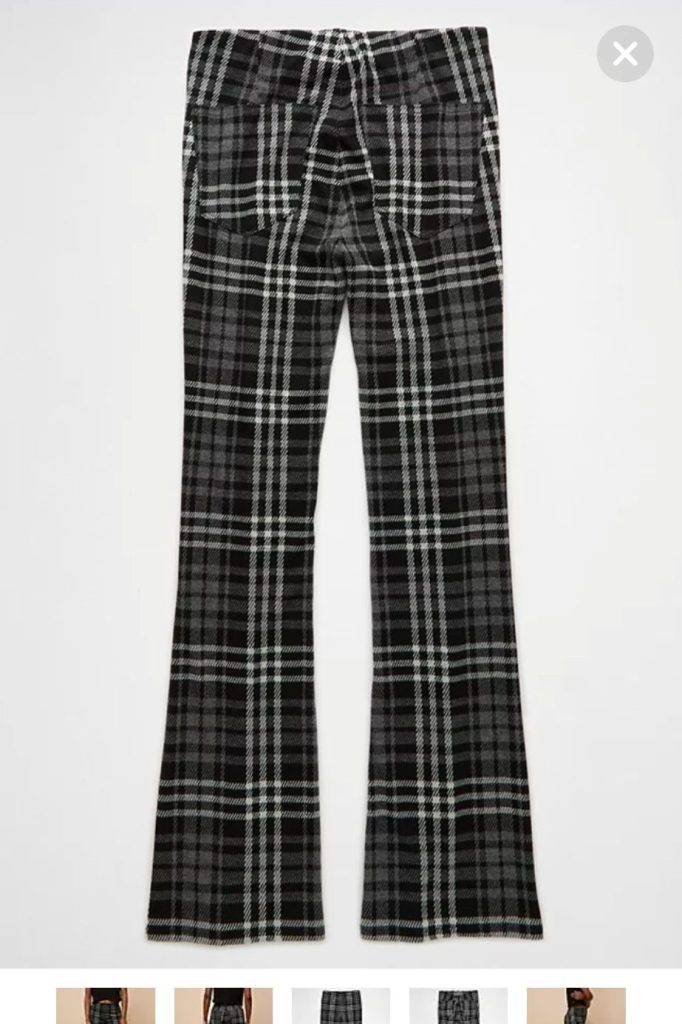
These are a pair of pants that I like in theory. I think a plaid trouser with a closer fitting hip that flares out gently at the bottom is a great idea and would be a versatile item. The plaid print is also matched up quite well in the front view. Something wild happens when you turn the garment around. Those pockets are a bad idea. That’s impossible to match and it detracts from the line of the pants. It emphasizes the way the plaid pattern has to bend with the line of the pants because they chose to change the orientation of the pattern on the butt of the pants only. I think it could be done better and this garment suffers from TikTok lens. It photographs okay and they would be cute from the front, which you can keep as the only view if they are being shown online, but once they enter the real world I don’t think they are going to look as cute. That’s a lot of attention being drawn to one area.
Old Navy: The Lines in the Seat Are Crazy, But Good Pockets
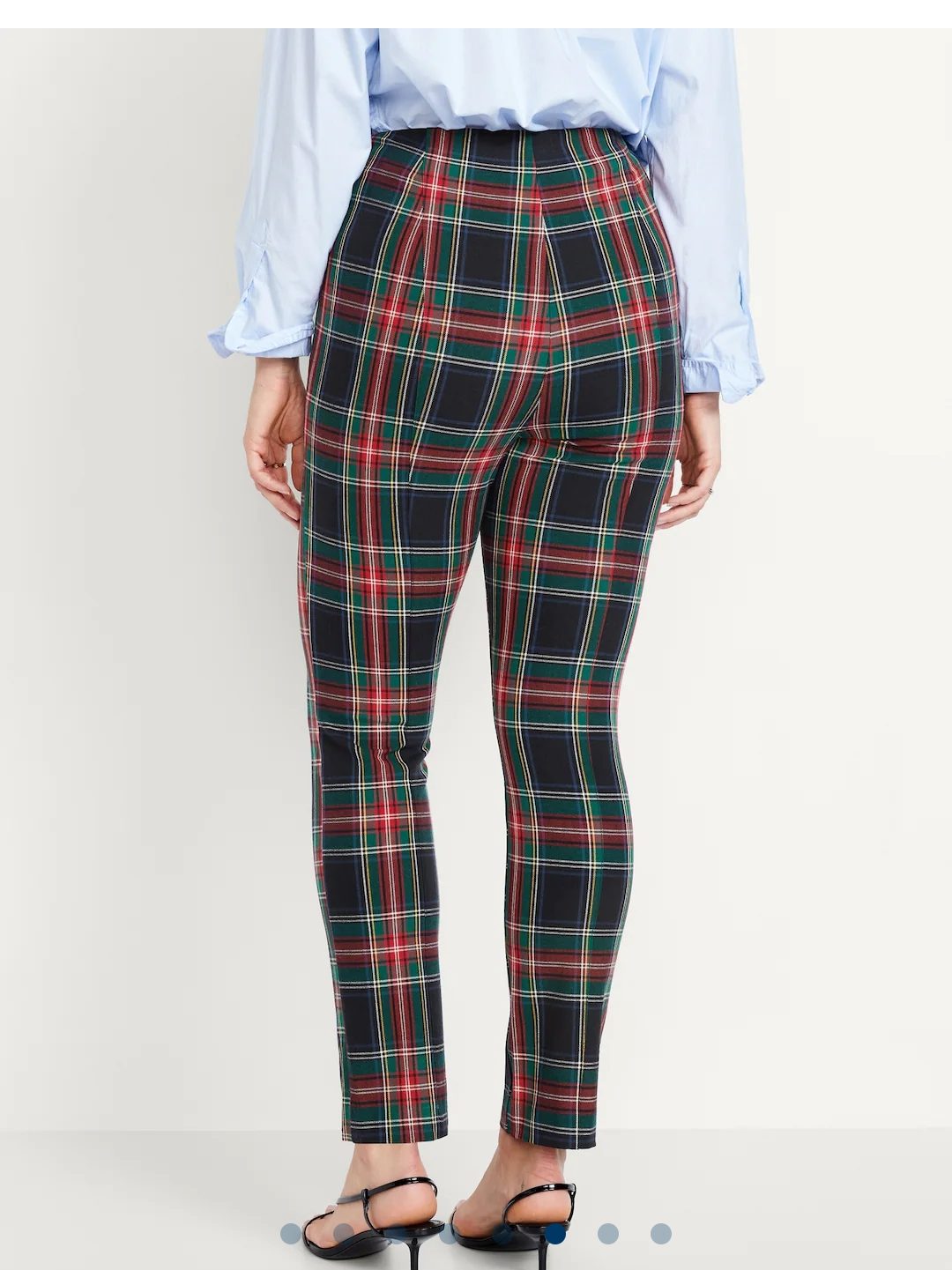
I do think this pattern looks like Audrey Hepburn time traveled through the 1970s punk scene and ended up with Christmas wrapping paper cigarette pants that are cut like leggings. These look really stretchy. Remember in the 2010s when we were wearing patterned leggings? These remind me of them. But they aren’t leggings, they are tailored pants with insert rear pockets and darts at the hip line. I think that is where the problem lies with this garment, the fabric and the fabric needed to make this silhouette.
The product description states the fabric is 55% cotton, 40% viscose-rayon, and 5% spandex. This is not a structured bottomweight fabric. This is a stretchy fabric that is going to have softness and contour your body which is fine in a solid but in a pattern that leads to complications with the pattern. I think the pattern looks odd on the back, particularly along the seat of the pants and the front seam. I think these high-contrast patterns are not a good choice for this application and another type of plaid is better for pants where the distortion of the lines and the seams themselves will not be spotlighted. It’s not where you want the focus of your outfit to be, at the seat line of the garment, that’s uncomfortable. They offered a black watch tartan with lower contrast which was a much better option.
Ralph Lauren: Fabric Choice and Silhouette, but it’s Pricey
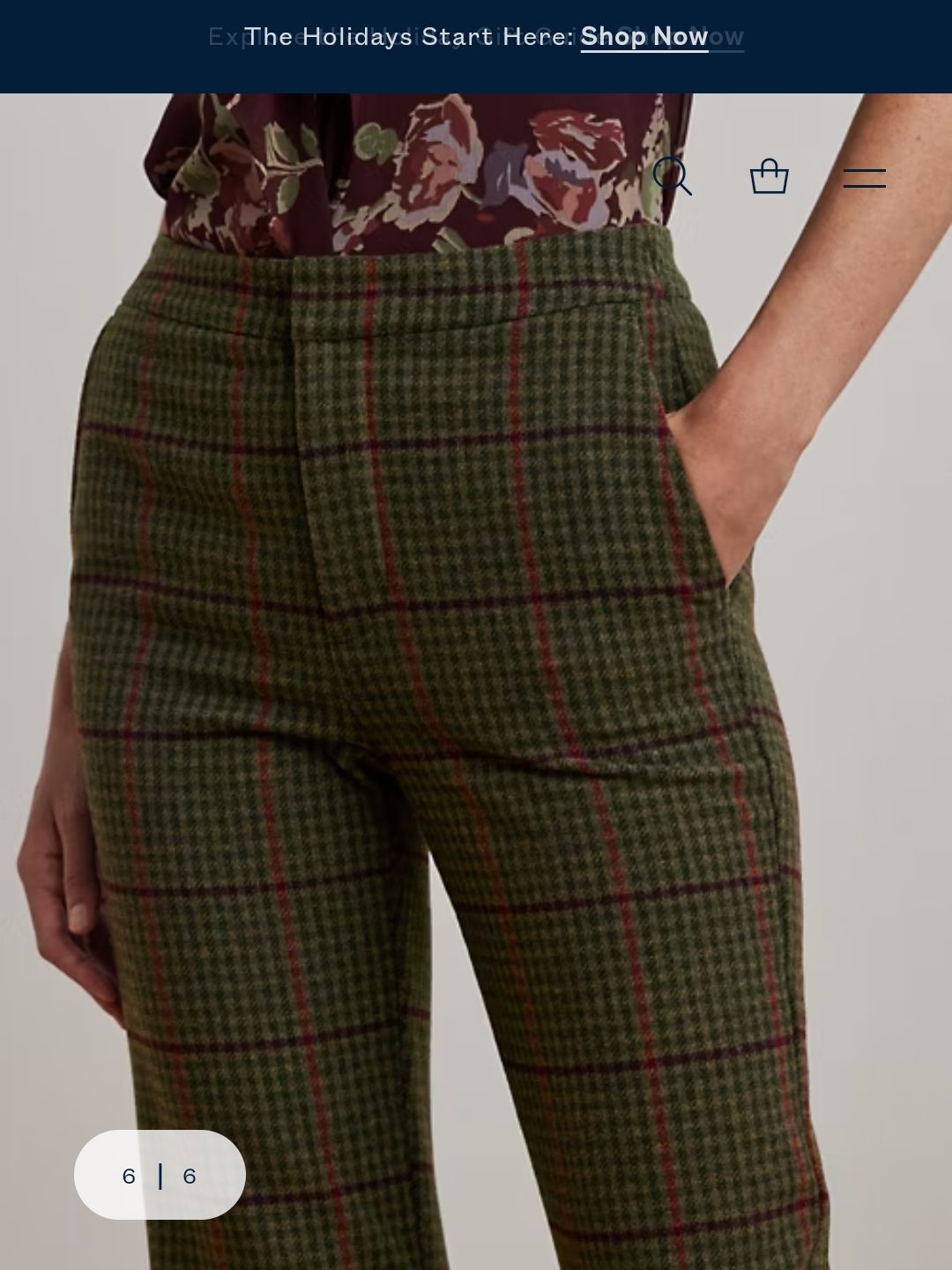
These trousers are comparable to both the Old Navy and American Eagle options for style and silhouette. They have the slight flare of the American Eagle pants and the slim trouser style with insert rear pockets of the Old Navy option. What is different, and in my opinion is a better design choice for these Ralph Lauren pants is the lower contrast plaid style of the fabric and the weight of the fabric which adds structure, eliminating the need for stretch to create the shape. These pants are cut in a way that emphasizes the shape of the wearer in strategic places while also draping away from the body. The pattern cutting of this garment is doing the heavy lifting, not your physique being asked to have the ideal shape to give the pants life.
The plaid is a lower contrast allowing for those tricky seams to fade into the background instead of drawing attention to the problems. On the back seam, the designer chose to use sections of the plaid that were darker, cutting off the pink vertical stripe on both sides before the seam so that the pink appears to flank the seat and therefore draws attention away from the pattern matching of this seam. In the front they follow a similar format, seamlessly integrating the fly into the pattern. The side pockets are tapered again so that the pink vertical begins lower at the hip, drawing the eye to the hip and the waist in a way that enhances the form of the trousers. Again this does not rely on stretch to accomplish this. It takes longer to do, and because of this it has been relegated as a “luxury” feature when actually if you take a bit longer to design to initial pattern after that process it will be easy to grade and use over and over. It’s not a luxury, it’s thoughtful and what design is about.
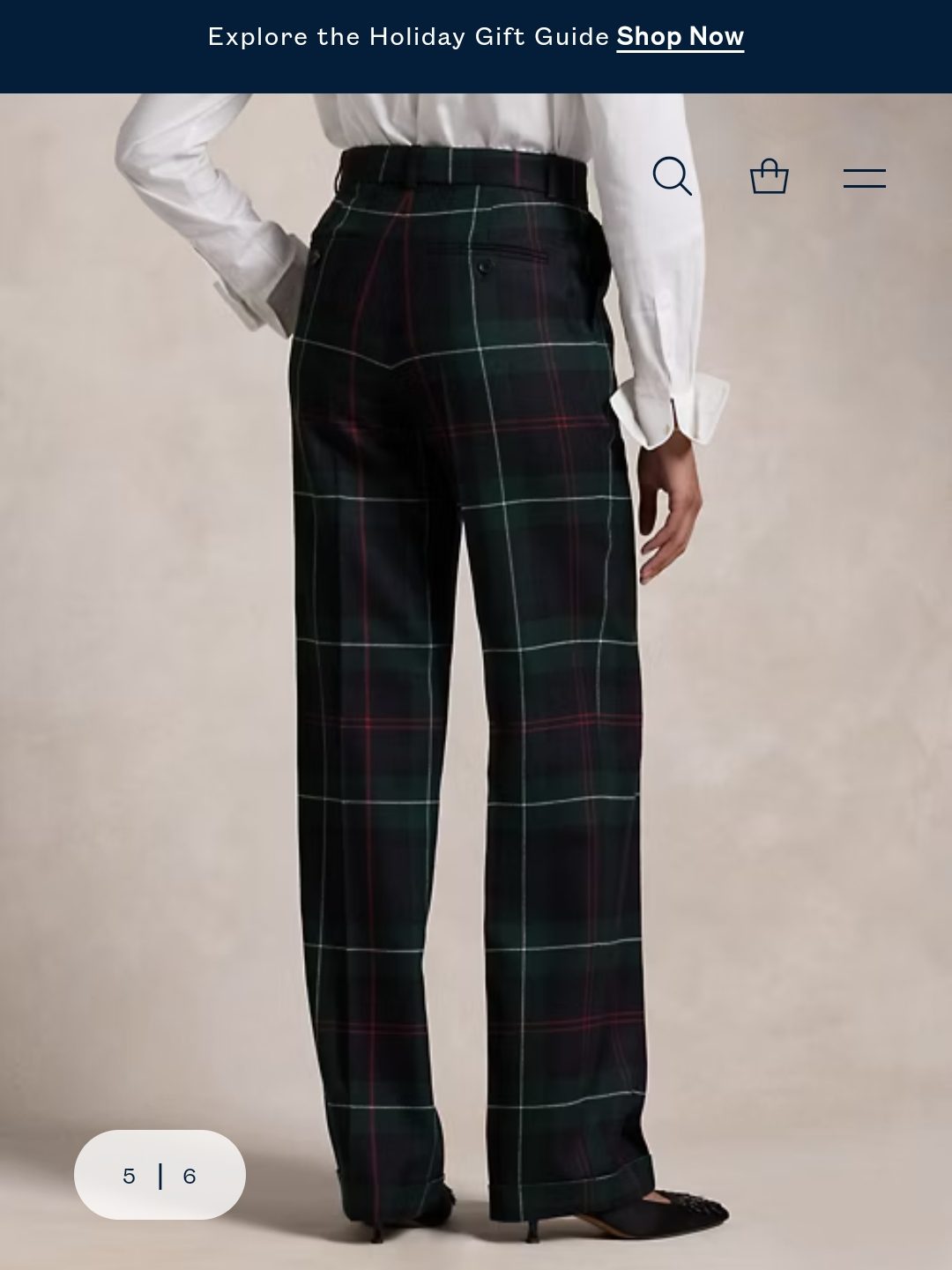
You can see this attention to detail repeated again in these plaid wool trousers. The back seam was mitigated again by thoughtful lines and fabric structure. Because the wool is a heavier fabric and has structure, it can float across the body instead of stretching across it so the diagonal lines of the plaid do not detract from the design of the garment. It also keeps the vertical line of the trousers even though the lines change direction and the pattern is altered here from the standard perpendicular plaid fashion. This shouldn’t be considered a luxury feature either. Wool is a sustainable textile that is durable and creates much less water pollution than stretch fabrics that shed microplastics or denim which requires a vast amount of water to dye.
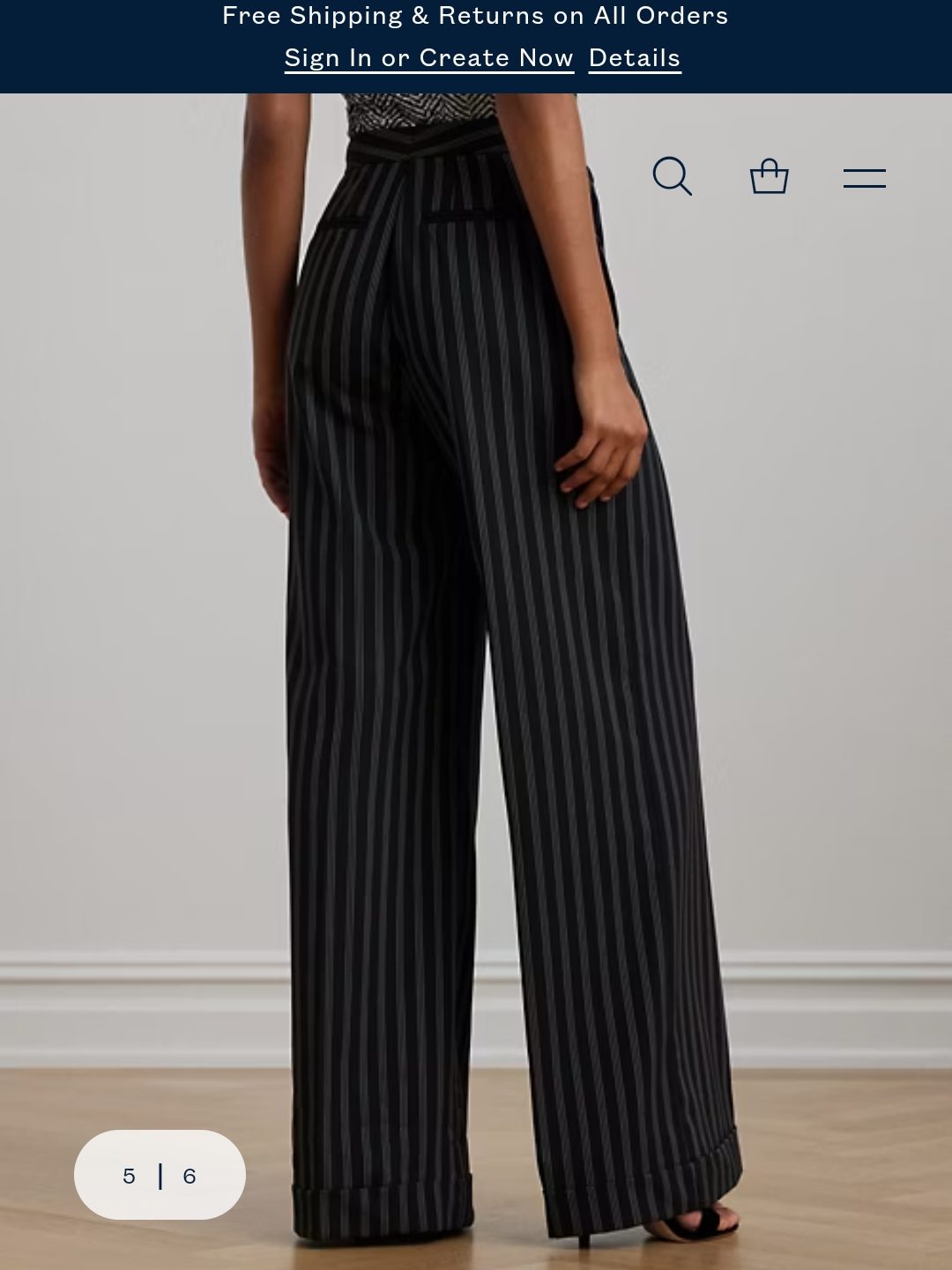
This last example is not plaid but striped, yet the lines of the garment I think still apply. This is another smart design that works with the pattern to create a garment that looks good from all angles. Part of that comes from the wider leg silhouette and the fact that the pant celebrates drape. If this was made from a stretch fabric and was a skinny leg design, a legging basically disguised as a pant, this would be an awkward-looking garment. But affordable should not mean crap design and as consumers we are letting companies determine this as a fact.
Let’s be more discerning in our consumption and look for good design, learn to sew, or support sewing people who can make a good trouser. These Ralph Lauren pants are almost 300 USD and they are not worth that price tag. The Old Navy and American Eagle pants are 50 USD and they aren’t worth that price either. Which leaves the customer with no good option while the brands cash in. We need better clothes made in ethical labor conditions and clothes with good designs that are made to last so that we don’t need to consume so much.








 One Rabbit Riot