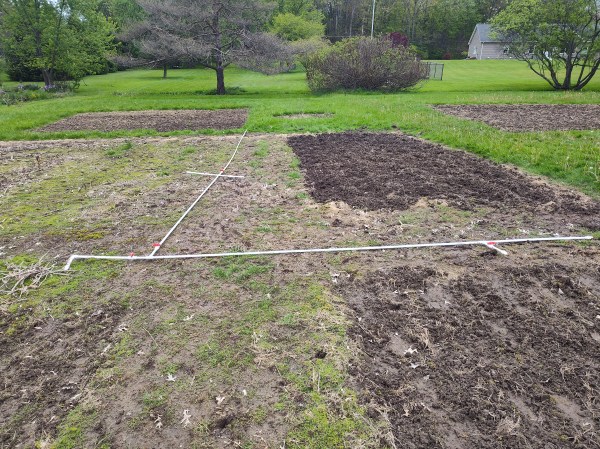
Our irrigation system didn’t work. When I wrote my previous posts on our irrigation system, I hadn’t had the chance to fully test it. All of the PVC components were together, and, I thought, the tubing was ready to be connected once all the holes were drilled. Unfortunately, when we were ready to give it a trial run, there were multiple failure points that I hadn’t planned for. What went wrong, how are we watering our garden this year, and what’s the plan for the irrigation system moving forward? I’m going to answer all those questions.
What Went Wrong?
I wish I could say that only one element of the irrigation system went wrong, but that isn’t the case. There were several things that contributed to it not working.
Not Drilling the Drip Holes Correctly
The tubing we bought for our system didn’t have holes already drilled in it. I wanted to be able to determine how close the holes would be. That alone wouldn’t have been a big deal. But the other issue is that I drilled the holes too big. When we were buying supplies for the system, I grabbed the smallest drill bit at our local Ace Hardware store, which was 1/16″. That is very small when you’re used to drilling holes in wood or metal. The smallest bit I tend to use is 1/8″, which is double the size of the bit from Ace, so I thought it’d work fine.
However, when you’re drilling holes for irrigation, a sixteenth of an inch might as well be a mile. I also drilled through the tubing so that there is a hole on both sides. The goal was to have the tube lay flat and water plants on both sides. The plan and reality were completely different things.
When we hooked the hose to the system, the holes let so much water out that it looked like a fountain, which wasn’t what we were going for. Combined with how close the holes were and that I drilled some before the tubing reached the plants, there was so much pressure loss that the water couldn’t reach the plants at the end of the tube. I attempted to fix this by filling some of the holes with Flex Seal caulking and Gorilla Glue tape, but it hasn’t worked.
Remedy: There are a couple of easy ways to fix this in the future. One is to buy tubing that already has the holes drilled in it. Tubing that is designed for irrigation purposes will have the right-sized holes, and they’ll be correctly spaced. If we don’t want to go that route, I would buy the same tubing I got this year, but I’d use a much smaller drill bit. I think a 1/64″ would probably work. I also wouldn’t drill through both walls of the tubing. Finally, I would lay the tubing out in each garden bed to figure out how much was needed and mark where the plants will start. That way, there aren’t unnecessary holes, which cause a loss of pressure.
Inadequate Water Pressure
I was sort of prepared for this problem, but I didn’t think it would be as large of a problem. I even wrote about water pressure and the role of gravity in my tips post. It quickly became evident that our rain barrel was unable to provide enough pressure to push the water through the irrigation system. Our rain barrel is only a couple of feet higher than our garden beds, so it was only generating a few PSI of pressure, which isn’t enough. Perhaps if the holes in the tubing were smaller and there were fewer of them, it would work for some of the closer beds, but that’s not a guarantee. I thought that the hose bib connected to our hose would provide enough pressure to operate the system, but even that failed thanks to the holes I drilled. Are you sensing a theme?
Remedy: Without fixing or replacing the tubing, there isn’t a remedy that can be applied in the near future. We could build a platform for the rain barrel to get it higher off the ground and generate more pressure, but building a platform to get it high enough would be expensive and potentially dangerous. That isn’t an option we’re interested in pursuing. Another option is to buy an RV pump that could generate pressure for the system. This type of pump typically runs off a 12-volt battery, which would allow us to use solar energy to charge it, but I also think it could be modified to run off AC power via an extension cord.
Measurements Unclear/Inaccurate
This problem applies to a few aspects of the irrigation system, and not all of them were the result of an error we made. All of the tubing we bought was supposed to be 1/4″. The first 200 feet that we bought didn’t specify if this was the interior or exterior diameter. I was planning on it being the interior diameter. It turned out to be the exterior diameter. This caused a big problem because the connection I got to go between the PVC pipe and the tubing was based on the tubing having a 1/4″ interior diameter. Now, had I learned this in that first 200-foot section of tubing, it wouldn’t have been a big deal. Unfortunately, though, I didn’t check it until we ordered 600 more feet and drilled holes in all of it.
The worst part of things not being measured correctly or not having their measurements clearly listed is that the last section of tubing we bought had a slightly larger interior diameter than the first two sections. I went back and checked the Amazon listing for it, and it was supposed to be identical to the other sections. I’m unsure what happened, but the clamps we bought didn’t fit this larger interior diameter.
Remedy: I learned that there are reducers for this type of a project that allow you to transition from one size of tubing to another. I just had to find the right one because there are a lot of versions available, all with different measurements. First, I needed to convert all of the measurements into the same system and format. In my situation, I went with standard and decimal points. This made it easy to compare sizes and guarantee that the reducer I bought would fit both sizes of tubing. Eventually, I determined that I needed a 5/32″ x 1/4″ reducer. The 5/32″ side fit the interior diameter of the tubing, and I would need a small section of tubing with a 1/4-inch interior diameter. The goal was to go from the 1/4-inch barbed fitting that was connected to the PVC pipe to the new 1/4-inch interior diameter tubing to the reducer to the tubing we already had. We also needed new hose clamps to fit the 1/4-inch side of the reducer and barbed fitting.
How Are We Going to Water Our Garden This Year?
Even though I listed a remedy for each problem in the previous section, you may have guessed that we haven’t fixed our irrigation system so that it can be used this year. That is true. Even after buying the reducer and ensuring that all the components fit, the holes I drilled were too much to overcome for this year’s garden. The tubing won’t go to waste, though. Magz is going to craft something with it. She mentioned a basket that can be used outside, which would be really cool and useful. Meanwhile, the PVC pipe, the connectors, and valves are all able to still be used this year.
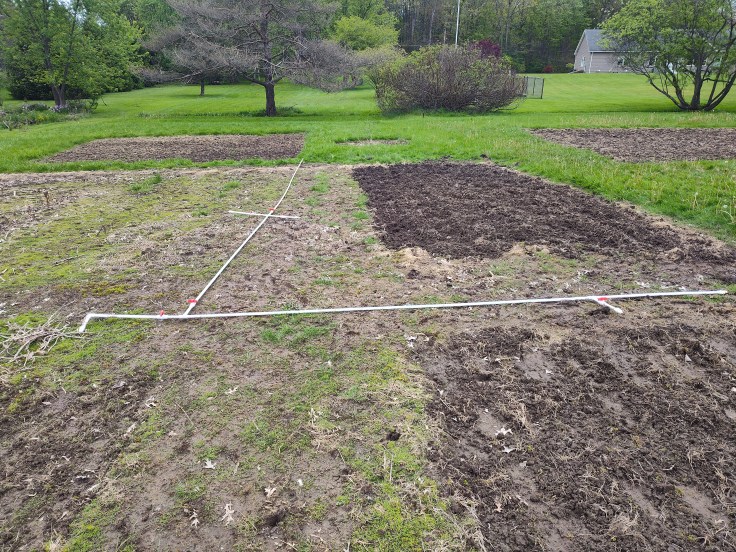
We forgot until about midway through the irrigation project that we have a sprinkler that we previously used to water our container garden in 2022. When we realized that the irrigation system wasn’t going to work, Magz mentioned the possibility of using the sprinkler again. We gave it a go, and it works perfectly. The sprinkler connects to a small section of hose that attaches to one of the PVC fittings we were using for the irrigation system. We’re still able to use the PVC portion of the system, which is great. We connect our garden hose to one of the three hookups we have in our garden beds. We then attach the small hose section and sprinkler closest to the bed(s) we want to water. Once that section is watered, we move the sprinkler by relocating the hose or connecting to a new PVC section. We have to move things around a bit, but it’s still much better than using watering cans for everything, and we can use a lot of the valves to divert water as needed.
It’s not the outcome I had hoped for when I began planning and designing this system, but it is still an efficient way to water everything. And because we weren’t able to use the rain barrel with the irrigation system, we’re using the same water source with the sprinkler. We’re also still going to use the rain barrel by filling cans to water plants in bags or planters.
Will We Revisit the Irrigation System in the Future?
Absolutely. The failure of the irrigation system for this year’s garden is only going to be a one-year setback. We have the bulk of the materials needed for the system and only need to buy replacement tubing to make it work. I also still believe in the effectiveness of an irrigation system relative to other watering methods. The plan is to either buy pre-drilled irrigation tubing that fits our fittings or buy the same tubing that we did this year but be more intentional with drilling the holes and use a smaller bit. Doing that, along with addressing the water pressure problem, can still see this become a successful and useful system in 2027.
Last evening, we did a walkthrough of our garden, and I was disappointed in myself for not thinking of the sprinkler before I went down the rabbit hole of an irrigation system. Because we were already buying a new fence this year, we could have avoided wasting money on an irrigation system that failed. I voiced that, and Magz is always so good at pulling me out of that mindset and helping me see things more clearly. The truth is that if I didn’t try the irrigation system this year, I probably would have wanted to try it next year. I also think that I would have made the same mistakes next year that I did this year because you can’t learn what doesn’t work until it fails. It would have taken me one round of buying the wrong size of tube to learn what works. And because we did try the irrigation system this year, we have the PVC portion in place, which is how we’re able to connect our hose and sprinkler. Not all is lost just because it didn’t work this time. Happy gardening!