A lot has changed in the 2 years since this blog was launched, and I thought, it might be time to update my introduction.
In 2023, my plan was to finding a new landing place for me to explore writing again, after Muirin Project, my blog from 2016-2019. I wanted to showcase my novel, catalog my knitting and sewing journey, journal my bible study, and share my love for creative expression in many artistic mediums.
Now I have added some new things to the mix – Japanese learning, Kpop, garment workers/conscious consumption, and most excitingly: gardening! Which welcomed my husband to the site to share his experiences with gardening and bring awareness to why natural ecosystems, seed saving, and eating local matter. He is also preparing to share his other favorite hobby – woodworking.
Now, for something I question – should I change the site name? I am uncertain for SEO purposes and the likelihood of broken links. I don’t think it is wise. But this site is so much more than just my work, it is the harmonizing voices of myself and Kyle which is how I think the world becomes a better place – working together. Let’s keep the honmoon sealed. ❤
If you’ve been reading my gardening articles for a bit now, you know I’ve written about using my woodshop to create things for the garden. Some examples are the planter box and trellis for our beans, the trellis system for our snow peas, and the fence posts I’ve been cutting. Lately, I’ve been looking forward to getting back into the woodshop and doing serious woodworking again. The garden and our screened-in porch projects took precedent over woodworking projects this spring and summer, and I’m now ready to get back at it.
As I’m thinking about and planning my next projects, I wanted to write about blending two of my favorite hobbies: gardening and woodworking. I mentioned the ways I’ve used my woodshop to build things for the garden this year, but only the planter box was somewhat serious woodworking. It was the only thing that required glue, but not even that project needed me to use my table saw. In this post, I’ll go over some future project ideas I’d like to pursue and a previous piece that I built and we still use. And if I have fun writing about this, and it seems interesting, I may write more woodworking articles.
A Planting Table
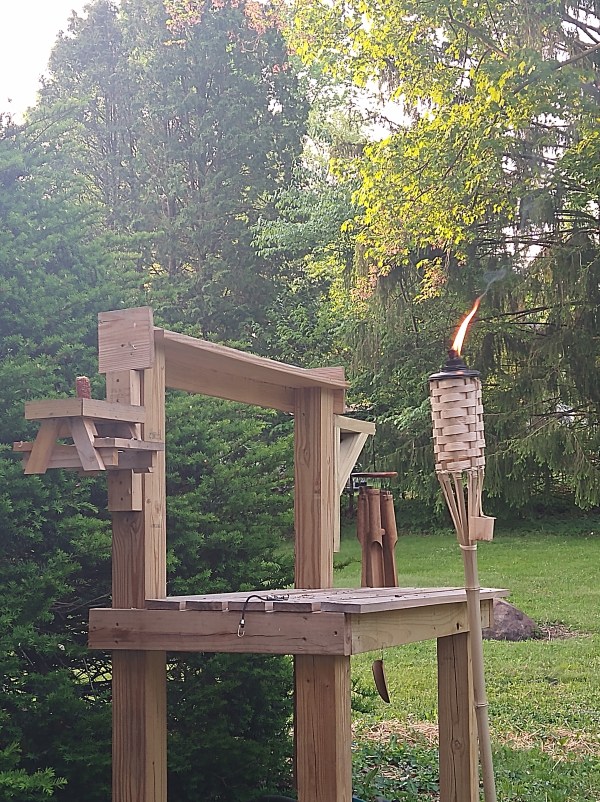
In 2022, I wanted a planting table that would aid in the process of transplanting starts, starting seeds, mixing the soil, and filling the containers of our container garden. I’ve always been a fan of the classic planting table that includes multiple areas for storage, a place to hang tools, and a flat surface to work on. There are a lot of videos of woodworkers and makers building these, including Bob Clagett (I Like to Make Stuff), Norm Abram (The New Yankee Workshop), and Steve Ramsey (Woodworking for Mere Mortals). These three makers represent three versions of a planting bench. Bob Clagett’s was made of dimensional cedar, Norm Abram’s was based on an antique found in Savannah, Georgia, and built from recycled pine, and Steve Ramsey’s was built with scrap wood, largely reclaimed pallets. A planting table can be made as cheaply or expensively as you’d like. I went somewhere in the middle of these three.
I didn’t have any recycled or reclaimed wood to use for the project, so we bought pressure-treated lumber for it. This included two 4x4x8s and numerous 2x4x8s and 1x6x8s. The 4x4s served as the main strength of the table, with one at each corner. The 2x4s were used as the main framework to connect the 4x4s to each other, while the 1x4s became the slats for the tabletop and shelves. Here are two pictures of how it turned out:
Planting table with our containers on it.Planting Table
This table was a blast to work on. Dimensional lumber, which you can find in the big box stores (Home Depot or Lowes), is really easy to use, and I would encourage everyone to try building one for your gardening needs. I used my table saw to rip the 1x6s down to narrower pieces, but I could have bought 1x4s instead and not needed a table saw. If I didn’t need to rip those pieces down, the entire thing could have been built with a circular saw and a drill. It’s a perfect project to dip your toes into woodworking if you’re curious.
Tips if You Want to Build One
Bulk cut all the pieces that are the same length. Because all but one of the slats for the top were the same length, I set up a stop block on my miter saw and cut all the pieces in quick succession. This made it so I didn’t have to measure each piece and potentially have small differences in the lengths. This was also the case with the bottom shelf pieces.
Clamps are your best friend. Clamps weren’t required to build this table, but they were really helpful. It can be difficult to hold pieces together with one hand while you’re using a drill with the other. Clamps hold it all together so that both hands can be used for drilling. They also work to prevent the pieces from moving off your mark.
Use a level. This applies when you are attaching the 2x4s to the 4x4s. You’ll measure up from the bottom or down from the top to mark where the 2×4 will go on the 4×4, but it’s wise to use a level to ensure the slats will sit flat and the entire table will be level when assembled.
What I Would Do Different
In general, I’ve been pleased with how the planting table turned out and continues to serve us. However, there are some areas that I’d like to improve and address in the future. The first is trimming the table slat closest to the front. It sticks out over the 2×4 framing piece by an inch or so, which has resulted in that piece cupping and needing to be attached with extra screws. I would like to remove this piece and trim it down so it sits flush on top of the 2×4.
I’d also like to add hooks to the bottom of the top shelf and chicken wire to the back to hold tools. The last improvement I’d make is having a water source and a place to rinse veggies when they’re pulled from the garden. This would be a bit more complicated than the other improvements, but I want to cut a hole in the table slats where a plastic bowl or dish washing basin would sit. That basin would have a hole in it with a small piece of PVC attached for the water to drain into a bucket below. I will also need to have a water source. For that, I want to attach a simple outdoor spigot or faucet that a hose can connect to and mount it close to the basin. Because the planting table is close to where we’re going to add another rain barrel, we’ll have a water source without needing to run a long hose. These are minor improvements, but once they’re done, I think the planting table will be even more useful.
Future Woodworking Projects for the Garden
Planters – These include all the types of planters, including planter boxes that sit on the ground, ones that are attached to porch railings, and window boxes.
Garden Bench – Magz and I want to eventually have our garden be a place where we can sit and enjoy nature. It won’t just be a place to work in, but also a place to relax. Having a bench in our garden would also provide us with a place to rest while working.
Whirligigs – Whirligigs are an area of woodworking that I’m interested in. If you’re unfamiliar with them, they are a nifty decoration that spins when the wind blows. They can be bought or made, and there are endless possibilities for design, style, color, etc. Norm Abram built one on The New Yankee Workshop, and the YouTube video below features the Whirligig Festival. I have a lot of ideas floating around in my head of how to build different versions.
Garden Gate – We’re eventually going to upgrade our fence, likely to something that we build out of wood. When that happens, I want to design and build an aesthetically pleasing garden gate similar to what you see in English gardens. They are incorporated into the fence and can be as ornate or as simple as you want.
Greenhouse – We have talked about wanting to have a greenhouse for some time. We want to be able to start plants outside sooner than we currently can. You can buy greenhouses, but they can be expensive. Instead, we’ll probably build one that perfectly fits our needs and is cost-effective.
Swing – I want to build multiple swings. One is a porch swing or bed that hangs from the ceiling. The other is a covered swing in the garden. Similar to the garden bench, a swing would help in our pursuit of creating a relaxing garden.
Arbor – I have a lovely vision of an arbor in our garden that you can either walk under or sit under. The arbor will be placed so that vining plants, such as cucumbers, squash, or flowers, can climb the arbor, leaving you totally immersed in nature.
To me, woodworking and gardening perfectly go together. They’re both creative, can be hard work, and result in the satisfaction that you built or grew something from scratch. Building something with one hobby that can be used in another hobby is a cool experience. I also try to build something instead of buying something whenever I can. Is woodworking one of your hobbies? If not, what are your favorite hobbies? I hope you enjoyed reading about my experiences with woodworking and gardening. Have a great day.
In several of my weekly gardening updates, I have mentioned that we installed a rain barrel. I have known several people with them and have been excited to have one of my own for quite a few years. The opportunity to save some money on water? Sign me up!
Before buying our house last summer, we had been renters, so this was our first opportunity to have a rain barrel. As we were planning our garden, the idea of having one for this year came to mind as a potential reality rather than a long-term thought. We knew that we’d need a large amount of water for the garden, and we were looking to reduce our dependency on city water.
Our Barrel
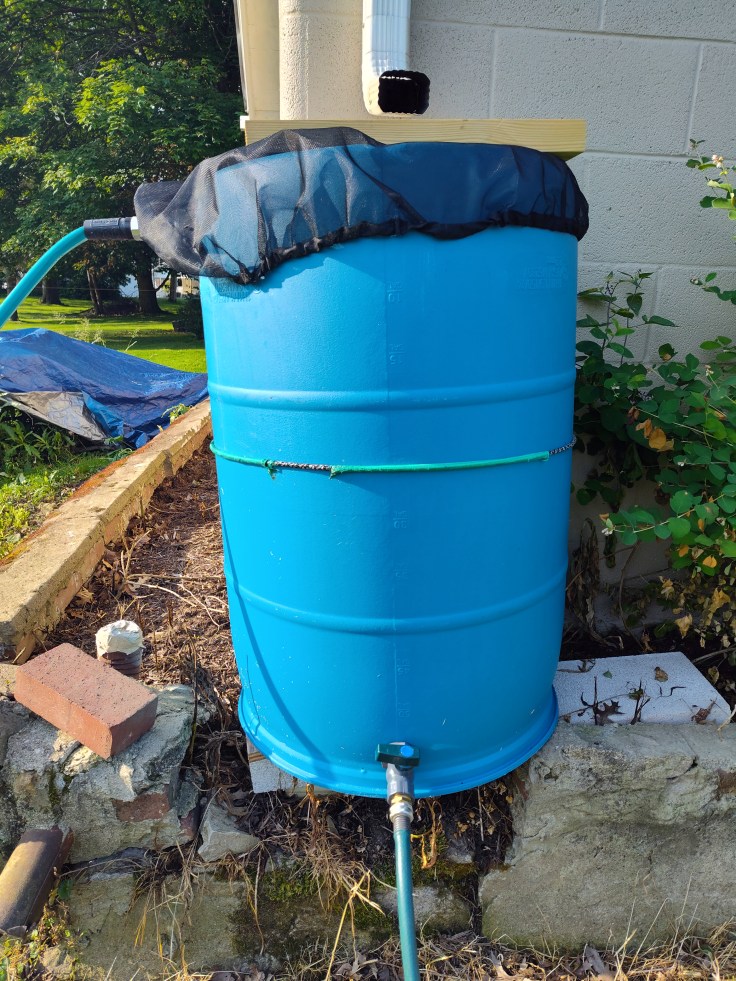
We picked up a 55-gallon food-safe blue barrel from Rural King. It was previously used for transporting drink concentrate. It was $30, so it would quickly pay for itself. We also needed to buy the spigots and a filter for keeping leaves and other debris out of the barrel. Those items came from Amazon.
Rain barrel
When adding a rain barrel, you can either buy one that is completely put together or repurpose something else. We went the latter route and saved money ($50), but it is a good deal of work. Instructions can also be vague, and YouTube videos may not apply to your setup. It’s also helpful to have power tools for cutting and drilling and have confidence in your ability to operate them. We were able to keep costs down because we have the power tools and only needed to buy a drill bit for the holes that the spigots go through. In total, I think it took an hour to get everything set up. Future ones will take less time now that we know what we’re doing.
If someone isn’t interested in converting a regular barrel into a rain barrel, they can easily buy one. A quick Google search shows many options with prices ranging from $50 to above $100. Some of the lower-priced options are collapsible, which sounds a bit precarious, and the more expensive options hold more than 55 gallons. These rain barrels typically include everything you need to get started.
What Makes a Rain Barrel a Game-Changer?
Simply put: Being able to convert rainwater into water for the garden is a difference-maker. Instead of paying for water (like we do) or using water from a well or spring, you get to use water that would normally run off the roof and be drained somewhere else. In our case, this was the yard, and it was running off into our garden beds. Converting something free into a usable resource has given us a sense of freedom that I didn’t expect.
Having the rain barrel has made us more aware of how much water we use when watering the garden and our flowers. It’s a 55-gallon barrel, but because there is an overflow spigot near the top, it probably holds around 52 or 53 gallons. We water with cans that hold a combined 4.5 gallons, so we get around 11 or 12 trips when using both cans, which is enough to water the entire garden. As a result, we are aware of the importance of not overwatering because the excess runs off, and it’s wasting the water we collected.
Using a rain barrel has also helped to contribute to the slow and quiet nature of gardening that I love. Because the rain barrel is gravity-fed without pressure, it doesn’t fill the cans as fast as our garden hose does. And that’s okay. It’s nice to take a break and let the cans fill at a slower pace. It’s also quieter than a typical hose setup due to the lack of pressure.
Naturally, a big reason to use a rain barrel is the money you can save. At the top, I said that we probably spent around $50 on everything. We don’t know what we pay for water on a per-gallon basis, but we will save enough money with the rain barrel this summer to pay for it. Gardening can use a lot of water, especially when you first start seeds, and being able to use free water that doesn’t need to be treated is wonderful.
Since we started using our rain barrel, we’ve found ourselves excited to see rain in the forecast, especially if it’s been dry in recent days or weeks. Every gardener gets excited for rain after a dry spell, since it means the plants are getting water, but with a rain barrel, you also get excited for your barrel to refill. A full rain barrel after a dry spell means your plants are watered AND you have a full supply to pull water from as needed. Speaking of refilling the rain barrel, I’m amazed at how fast it will fill. A half-inch of steady rain will fill it from empty in a few hours.
Get a Rain Barrel if You’re Able To
If you’re a gardener (flower or vegetable) and have the chance to, I recommend buying or creating a rain barrel. The financial, environmental, and plant health benefits vastly outweigh any negatives. It’s a relatively simple process to set one up, and they can be placed almost anywhere with a downspout.
Magz recently told me that some states have some restrictions against collecting rainwater, which I looked into. It appears that most of the restrictions apply to only using the rainwater for non-potable (aka non-drinking) purposes. That is an understandable restriction. Rainwater is not necessarily safe to drink, especially if it’s running off your roof and through a gutter/downspout system. Please don’t drink it. If you live in an area with more severe restrictions, I recommend trying to change those laws. Many university extension offices (here’s Penn State’s as an example) as well as the Environmental Protection Agency argue for the benefits of a rain barrel. Local municipalities and states should recognize those benefits as well.
We currently have one rain barrel but are planning to get at least one more. Collecting twice the amount of rainwater would further reduce our reliance on city water. When we create that rain barrel, I’ll take pictures and create a step-by-step article.
So, that is our experience with rain barrels and the benefits we’ve seen so far. Water conservation is very important, and being able to participate in it, even minimally, can be a difference-maker. Rain barrels also help to reduce run-off and soil degradation thanks to the presence of grass. The benefits vastly outweigh any perceived negatives. If you have the chance to, I recommend getting one. You almost certainly won’t regret it.
Do you have a rain barrel that you use for your garden? If so, what are your experiences with it?
As a kid, one of my favorite pastimes was designing. I loved the fashion styling flash games from Lizzie McGuire and My Scene. I designed my own catalog of clothes for a made-up brand with my friends in 4th grade, illustrating with my school supplies and piecing it together with scrap paper. Mary-Kate and Ashley’s movies captured my imagination through their use of clothes to characterize each sister’s personality.
That’s So Raven enveloped me in imagination, not from her psychic abilities, no, Raven Baxter’s closet pulled me in! Raven’s room was a stunner as well, like Zenon Kar’s space station cabin, and my Fashion Polly’s colorful playsets that folded out like Richard Hammond’s caravan. My friends and I discovered shows like What Not To Wear and Trading Spaces, which launched my sketches from clothing brands to interior design. I had a notebook full of room drawings. There were designs with slides, hammock beds, and intricate themes. I drew a Survivor-themed room with a tribal council area on the lower level, an outer space room with circular windows and futuristic lighting, even a beach room with a lofted bed, sunset paint scheme, and a pool placed in the middle of the floor. I wish I knew what happened to these sketches; it’s been such a long time.
When I discovered Animal Crossing in 2020, I was curious what the fuss was about, and later the next year, we bought a Nintendo Switch, opening a world of design I thought was lost to childhood. I was thrilled! Animal Crossing New Horizons debuted in March 2020, and because of the unique time, it had a huge following for its charming island life. You begin your game landing on a deserted island as part of a Nook Inc. Getaway Package, and assist Tom Nook in developing the island with the help of Timmy, Tommy, Dodo Airlines, Blathers, Isabelle, and the villagers who move to the island with you.
But what about the fashion and the home decor? This game first places you in a tent that you upgrade into a house, with subsequent expansions costing large sums, but with a relaxed payment policy. You also gain the ability to design custom things with Nook Mile redemption upgrades, craft unique recipes from resources on the island, and buy items from Nook’s Cranny and clothing items from Able Sisters. A ridiculous amount of my gameplay, even years later, comes from pairing and collecting new clothing items for my character to wear on her adventures. This game loves coordination!
As a player who is well-versed in the Animal Crossing fashion catalog, I wait and anticipate finding my favorite pieces with each new island. The game has four seasons, with clothing corresponding to the season at play, including specialty garments for holidays. Currently, as I play in June, it’s wedding season and Able Sisters is selling traditional Japanese wedding attire, Nook Shopping is selling Father’s Day items, and International Children’s Day pieces, which include a paper crown that is oh so cute!
How has this impacted my own personal style, though? Well, it has brought me back to the mindset of creating a full look. Working from home or working in professional painting at jobsites for most of my adult life has killed the style I used to have. I no longer felt the need to put together a look, but instead I got used to throwing on pieces and wearing things for function, not fashion. But that’s not who I really am, just what the environment of life drifted me into. I was missing intentionality, Animal Crossing lit that spark once again. My little character doesn’t just get dressed to do life; she wears a head-to-toe look with hats, bags, glasses, specialty socks, clever shoes, cute tools, and interestingly paired garments. This game got me out of jeans and a t-shirt, or a hoodie and leggings, because this game has trousers in many fabrics and shapes, shorts in colorful prints, skirts in a bouquet of fancy, coats, hats a plenty, tops that span the seasons – it’s a blast to explore! There are dresses – modern and traditional. I can where a kimono! I change her outfit at least once, maybe three times a session. You can also curate hairstyles and experiment with colors.
This exercise has shown me that pink hair is something I’d like to try. It’s my most-used fashion color. It has inspired me to introduce cute socks of varying heights and weights to my wardrobe, even making some of them. I’ve started wearing hats anytime I leave the house – it pulls the look together! My taste in bags has changed; no longer an option for a sleek purse that looks designer, instead give me a duck bag with feet. I love colorful knitwear, flowing skirts, and shoes that are beyond my comfort zone of boots and Converse. Taking those moments in the game to pair weird combinations together has positively impacted my design sensibility. When I plan a sewing or knitting project, I take into account what I’ve learned from dressing up my character, seeking to inject the whimsy and delightful wares of Animal Crossing into my real-life closet. I’m not the only one; I’ve seen this across Pinterest, YouTube, and Instagram.
But what about interior design? Well, this game not only presents the opportunity to design your house and the island, but you can also download Happy Home Paradise to design vacation homes for clients. This has really challenged me in a fun sandbox way to care about how a room is put together. I’ve become far more intentional about my furniture layout, what types of pieces I want to bring into my space, and how I want to pair pieces for a style that tells a story.
Buying a house last year was the icing on the cake of this new foray into design, as we have painted rooms and dug the garden beds, I’ve felt like it is Animal Crossing come to life. I have this canvas to put my stamp on. Moving from rented landlord-beige homes to a space where we can be colorful, it has shown me that the little details do make a space more welcoming and conducive for creating. The simple act of moving our dining room table from one side of the room to the center, allowing for walkways on either side, has made the room a place I want to be instead of a place I pass through. By filling the empty gaps of cabinets in our kitchen with tables, shelves, and a microwave stand, we have transformed the empty space into a room that feels complete. The simple change of painting my sewing room lavender created an entire mood, a calming and happy vibe that makes me excited to work within those four walls. The garden beds and the screened-in porch have been works of dimension, the outdoor space has useful and designated spaces for us to use that make it more beautiful and purposeful.
I am filled with a sense of possibility again, like the girl who sketched those rooms in a notebook, instead of a person muddling through life. In this time when we feel burned out by AI and stale creativity, it’s been electric to feel the sparks of imagination. The crafting aspect of the game has inspired me to be more creative in my own house. We repurpose, re-finish, and build things in our house from scratch. Because of life’s twists and turns, I have a lot of second-hand pieces that at first felt like a let down, like I was poor, but now I see them as incredibly meaningful items that I have the pleasure of caring for in my home. The game’s customization tools, such as kits for sale or the custom services of Cyrus, demonstrate how a coat of paint truly pulls a room together without buying something new.
Did I think when I purchased Animal Crossing New Horizons that I would see an impact on my own design sensibility? Not at all, but it has been the gift that keeps on giving. It’s an incredibly cozy game, full of wonder that I have grown fond of, year over year. Four years later, I still look forward to running around the island, hunting for recipes, wishing on shooting stars, and besting those pesky Happy Home Academy judges. I hope that I never lose my zeal for dress up and design because it is such a fun little way to relax in this wild and wacky world.
Gardening is not fast-paced. It’s quite the opposite. It takes many months to go from seed to harvest. Most of the time, you will see little day-to-day progress. Instead, progress is seen across the weeks and months. A plant may not show growth from one day to the next, but from one month to the next, it can grow twice its size, start blossoming, or ripen. Unfortunately, I am not a patient person. Actually, I doubt that many of us are patient. It’s probably the result of living in modern society.
Technology allows us to be perpetually connected with people on the other side of the world, to get instantaneous results when we have a question that needs to be answered, and have items delivered to our house a day after ordering. Those are all great, but if there’s anything that doesn’t meet our expectation of speed, it’s easy to become impatient and frustrated. Someone isn’t going as fast as you think they should when driving? We tailgate and pass as soon as we can. A cashier takes longer than we want in a store? We either bolt to the next register when possible or are short in conversation when it’s our turn. Things that used to be treated with patience are no longer.
Garden Beds
I think that’s why gardening maintains a vital place in our fast-paced society. You really can’t rush gardening. If you try to speed up the process, it won’t work. Roots won’t have the necessary time to establish, plants will wither if it’s still cold in the spring, and the fruit won’t mature if it’s harvested too quickly. So, what am I struggling with in our garden?
Seed Starting & Germination
My struggle with patience in this year’s garden started immediately. I wrote about my process of tracking the start dates for all the seeds we bought. I generally wrote down the earliest date for each seed, counting back the weeks from what is typically our last frost date. I didn’t take into account the possibility of not being able to transplant the starts into the ground because of excess moisture or low temperatures. I also didn’t consider the ramifications of seeds taking off and needing to figure out a plan until we can transplant them outside.
You can probably see where this is going. As soon as that start date arrived, I (generally) was ready to start the seeds. In my head, if I were late by a day or two, that plant was certainly going to fail. My focus was very much on the immediate and not on the long-term. Then, if a seed hadn’t germinated at the beginning of its germination window, I assumed it had failed. In reality, seeds can take the entirety of the germination window (and sometimes even beyond) and still be okay.
Tilling
Oh, the process of tilling. I will likely be writing a standalone post on the repeated tilling we’ve done. We started digging the beds in March, which was plenty of time, and got the first four established quickly. What we didn’t account for was grass regrowing before we could plant. Beds that we thought were in good shape have been overtaken by grass that hadn’t been killed. We’ve had an incredibly rainy spring, which has resulted in an out-of-control yard that didn’t give our garden beds a break. We’ve had to mow the beds on the lowest setting before re-tilling them, which was a bit frustrating. A positive is that we’ve learned the best way to use the cultivator to kill as much of the grass as possible when tilling. This has resulted in healthier soil that looks ready to be planted in.
At the time of this writing, though, we still need to finish the first bed, do another pass on a second, mow down the grass and re-till beds 3 and 4, and establish 3 or 4 others. That’s where the need for patience comes in. It’s tough being patient with this process because we’ve already put in a lot of work and needing to redo that work is a bit frustrating. There’s a lot of the “trust the process” going on here. Yes, it’s been a lot of work, and there’s still more to be done, but each time we till a bed, we make more progress. More grass is killed, and the bed becomes more suitable for planting.
Weather
I think weather may seem like a bit of a copout here because almost every outdoor project requires patience with the weather. Very rarely does the weather cooperate with our plans, and this is absolutely the case in Western PA. If you want it to be sunny, it’ll rain. Looking for rain? It’ll be blazing out. This year’s garden has been one long battle with the weather and it not doing what we need.
Mid-March was mild and allowed us to get an early start on tilling. That was followed by a lot of rain in late March and throughout most of April. That led to grass retaking the garden beds. Finally, in May, we’ve been getting the weather we need to address all the beds. My patience was certainly tested during this time period. When it was raining, all I could think about was how quickly the May 15th (average last frost) date was approaching. I also saw all the work that still needed to be done: beds re-tilled, new beds started, seeds sown, and starts transplanted.
The craziest part is that this impatience has now gone in the other direction. We are actually in a good place with some seeds sown and most of the beds taken care of. We’re also now on the right side of May 15th, where we aren’t late with our planting. I’m now finding myself so excited that I need to be patient and wait to plant the rest of our stuff. Would it be problematic to plant everything else now? Probably not. The nighttime lows aren’t problematic. But there also isn’t a reason to rush at this point. What a difference from a week ago.
Lessons to Learn
As I mentioned in the intro, it’s my belief that everyone struggles with patience. I think it’s part of the human condition and the result of the first sin. The Old Testament provides many examples of the Israelites’ battle with patience and trusting God. I think that same struggle has been passed down through the generations, and the struggle to be patient is perhaps harder than ever when we live in a world that is constantly pushing for better efficiency and quicker responses. There’s very little opportunity to sit, dwell, and ponder over things. I think about how philosophers, theologians, and inventors from centuries past would simply sit and think about their subject, working through problems. As Christians, we would say that it is the Holy Spirit leading us in these moments. We rarely give ourselves the freedom to sit and be still. I’m perhaps more guilty of that than anyone I know. I am always looking for the next thing to do or the next step in the process. In my mind, very rarely is that next step sitting and waiting.
I think that’s why gardening is both incredibly tough but also very rewarding. It’s tough because very little of it is in our hands. We can’t do much to speed up germination or plant growth. Sure, we can give them nutrients to aid in the process, but the plant still takes a certain amount of time to reach maturity. Attempting to expedite that process can actually cause more harm than good. The reward that comes in the end when you’ve picked the perfectly ripe fruit makes everything worth it, though. And while the growing process is taking place, if we can simply learn to find peace and comfort in the quiet and slow, I think we’ll learn to handle our fast-paced environment a bit better.
We’ll never be able to keep up with modern society, and I don’t think that should be the goal. If you’re a believer, you’ll know that our faith journey can be a slow one. Sometimes, it feels like two steps forward and one step back. There are even times when it feels like the opposite: one step forward and two steps back. But being patient on the journey and letting Jesus refine us as we draw closer to Him is incredibly important. Salvation is very quick, but sanctification is a slow grind at times. It’s like gardening: germination can happen in a few days, but the process of getting the plant to full maturity is slow.
I’ll leave you with this. John Muir is one of my favorite people in American history. He was a 19th-century writer and naturalist who helped establish multiple national parks, founded The Sierra Club, and his influence helped to establish the National Park System. He’s important to this conversation about gardening and patience because he lived during a time of rapid growth and industrialization. When he was born in 1838, there were 26 states. When he passed away in 1914, there were 48. During this period of population growth, he wrote about the importance of nature and getting away from society to find peace. One of my favorite Muir quotes is: “And into the forest I go, to lose my mind and find my soul.” It’s pretty easy to see what he was talking about. I think there’s something deep within us that makes us want to connect with nature. For Muir, it was escaping to the mountains. I love doing that too, but I think we can also find a similar reprieve from society in natural places closer to home, like our gardens. If we allow our gardens to become places of peace of tranquility, where we don’t take our phones, but instead be content with talking to our plants and watching them grow, I feel that we can let some of the stressors of modern society wash over us. If we do, all of a sudden, the impatience we feel with gardening may take a backseat to the calm the garden provides us.
Do you struggle with patience when it comes to gardening? If so, how do you combat it? Likewise, what does your garden mean to you? Is it simply something that provides food for you or is it a place or escape?
In this week’s garden update, the weather and schedule finally cooperated, and we were able to get our third and fourth garden beds completely tilled. We were also able to put seeds in the ground. If you’ve been following our journey, you’ll know that our weather this spring has been brutal. After a long and harsh winter, spring started out cold. It then rained a lot and only recently began to dry out and be warm enough at night for sowing to be a possibility. Some of our seeds, such as mustard greens, were supposed to have been in the ground in early April, so we’re more than a month behind. However, on Saturday and Sunday, we were able to (mostly) get caught up.
Garden Beds
We planted (and by we, I mean both of us on Saturday, but it was all Magz on Sunday) onions, carrots, beets, greens, and some flowers. Something I don’t think either of us expected was the difficulty of planning where everything should go in the garden. You have companion planting to think about to ensure that beneficial plants are placed near each other. We also want to succession plant some veggies like greens, beets, and carrots to ensure a harvest all season. That means not planting too much to start but instead reserving enough space to plant more in the coming weeks.
We also want to plant flowers in our garden beds to help control pests while simultaneously attracting pollinators. The plan is to have these flowers intermittently planted with our vegetables to create a garden that is both productive and beautiful.
Not all of our seeds are planted, nor have our seedlings been transplanted. We’re planning to wrap that all up over the next week. May 15th is typically the last frost date in our area, so the plan is to sow the rest of the seeds and transplant our starts in the days around that date.
What Else Has Been Going On?
In addition to directly sowing some seeds, we were quite busy this past week. We began the process of hardening off our transplants by taking them outside and exposing them to fresh air and sunshine. That will make the process of transplanting our starts much easier, as they’ll be less likely to experience root shock.
Seed Starts
We also bought and received the fence that I wrote about in last week’s update. We ended up buying it from Amazon because, once again, none of the stores in our town had it in stock. We could have ordered it and had it shipped, but it would have taken nearly a week to get here. We’ll now need to figure out the style of post or stake we’ll use to attach the fence to the ground. Oh, and between everything else going on, the grass has been growing out of control, and keeping up with the mowing has been a struggle. I love our battery-powered mower, but it definitely has its drawbacks when the grass is really long.
Out of busyness, I skipped last week’s garden update. Rather than mail it in with a very light garden update, I ended up taking a week off and coming back this week with a full update. I apologize for skipping last week’s post. We worked on screening in our back porch last week, and it was time-consuming and tiring. In this week’s update, I learned that I’ve made a mistake when it comes to starting seeds, started a bunch of new seeds, and continued learning the importance of patience with gardening.
Seed Starting Mistake
Each day, I check our seed starting trays to see if the plants need water or can be transplanted to a larger growing cell. Two weeks ago, I noticed that a few were a bit laggy and didn’t look as healthy as they did at the start. Since starting the seeds, I had kept the trays on the heat mats and under the lids. I also turned on the grow lights once germination happened. I did a quick Google search and was reminded that the heat mats should be switched off and the lids removed as soon as germination happens. I immediately unplugged the heat mats and removed the lids, but it was too late for some of the starts, and I needed to restart some of them.
When this happened, I was down on myself. I really hate making mistakes when it comes to gardening, especially when starting seeds. Maggie reminded me to be nicer to myself, which is something I always need to be told. It’s incredibly comforting to know that mistakes are okay. I have to remind myself that it has been three years since we gardened, so it’s natural to forget some of the details. And I suppose that if mistakes are going to be made, it’s best for them to happen at this stage rather than when they’ve been transplanted and are a lot further in their development.
Transplanting, Restarting, and Starting
After learning that I needed to restart some of the seeds, I kept looking for opportunities last week in between the porch project to transplant starts, start new seeds, and restart some of the ones that failed. Sadly, it took until Friday, when the weather wasn’t great and we needed a day to rest, to find that time. That afternoon, I transplanted a bunch of tomato, pepper, and cantaloupe starts. I even transplanted a dahlia start that had outgrown its small starting cell. We didn’t buy any larger planting pots for this year’s garden after finding 10 or so of the peat pots from our previous garden. Beyond those, we’ve been reusing plastic containers that would otherwise be recycled.
Then, on Saturday morning, I took the time to restart the seeds that had failed and start some new ones that I hadn’t been able to get to. The ones that needed to be restarted were some tomatoes, peppers, cantaloupes, and dahlias. We also had to restart all of the eggplants, tomatillos, ground cherries, broccoli, and onions. The new seeds we started were our cucumbers, winter squash, pumpkins, and melons. We were originally going to start our beans at the same time; however, I read that they don’t need to be started indoors since they grow so fast. Instead, we’ll wait to direct sow them in the garden. With the newly remembered knowledge about heat mats, domes, the importance of air circulation for starts, and watering needs, we wait.
Gardening Requires Patience
I am not a patient person. I struggle to give things time and want to rush them. This is the case for gardening. At this time, we have a few plants that could be transplanted into the ground outside and other seeds that can be directly sown into the garden. However, the weather has been uncooperative, with cold temperatures at night that keep the soil temp low and consecutive rainy days, which isn’t ideal when seeds are trying to germinate or young plants are trying to establish roots. The rain has also prevented us from tilling the last two garden beds. I know that we’ll be able to get all of this done, but not rushing the process is difficult for me.
Up Next
This week, we wait for the recently-planted seeds to germinate and to see how the starts do after being transplanted. The healthy ones have done very well in the first few days, while the ones that weren’t looking great in the original cells still don’t look too good. We also need to mow our grass for the first time this year, which will include mowing down the areas for the new beds and handling some of the grass that has regrown in the existing beds. Finally, we have plans to finish our screened-in porch when we can get to it and to work in the garden. We had success with setting up our rain barrel and have noticed its impact on the ground around where the downspout originally deposited water. I’m hoping for a pretty eventful week in the garden. Happy gardening to you.
This week’s garden update will be brief, as we haven’t started any more seeds and are in a holding pattern as we wait for the ground to dry out. All of the snow has melted and has been followed by some rain, so our soil is quite saturated.
In last week’s update, I mentioned that we may be starting eggplant seeds this week, but after consulting the seeding starting spreadsheet, we realized that this weekend was a bit too early. We’ll actually be starting them this week, likely Thursday. Instead, the big thing that happened this week was that we bought our rototiller.
Which Tiller Did We Buy?
Buying a tiller or cultivator is a big decision; much bigger than I thought it would be. In the future, I’ll likely write a standalone article that discusses what went into the decision we made, but for now, we bought this tiller:
It is an Earthquake 40 cc 4-cycle tiller (technically, it’s a mini cultivator) that can till up to a 10-inch wide path at one time. Two of the tines can be removed to till a narrower path, and it has a working depth of 8 inches. We bought ours from Amazon, although it is also available at Tractor Supply, Lowe’s, and Ace Hardware. We wanted to buy locally, but the Tractor Supply in our town didn’t have it in stock, Ace was far more expensive than Amazon, and the closest Lowe’s to us is about 30 minutes away. Meanwhile, Amazon was able to deliver it the next day.
It arrived on Thursday afternoon, and it only took about half an hour to put together. Afterward, I had to give it a go and see how it worked. The engine fired right away, and we did a quick trial run in the mulch bed by our back porch and in our yard. It worked extremely well in the mulch bed, which was expected, and did pretty well in the yard, which has never been tilled. We weren’t expecting it to have much success in the yard since the ground was very wet and we hadn’t set the depth on the tiller yet. We’re very excited to have a tiller and can’t wait to get our garden laid out. The plan is to till the garden later this month, but if it dries out before then, we’ll likely start sooner.
What’s Next?
As mentioned in the intro, we were originally planning to start our eggplant seeds this weekend but realized it was too early. Instead, that will happen this week. Those will be the only other seeds we’ll be starting in March. Everything else will be started in April or May. Happy gardening!
After writing about starting our first seeds for the season, I thought it’d be helpful to discuss our seed-starting setup. Although everyone will have a unique set of equipment, the basic items will generally be the same for everyone. The equipment I discuss below is what Magz and I bought, but you’ll want to determine what best fits your needs. That can be based on how much you want to invest in seed starting at this time, how many seeds you want to start, and how large your seed-starting space is.
Necessary Equipment
Regardless of how big or small of a garden you’re planning, these are the essentials you’ll need.
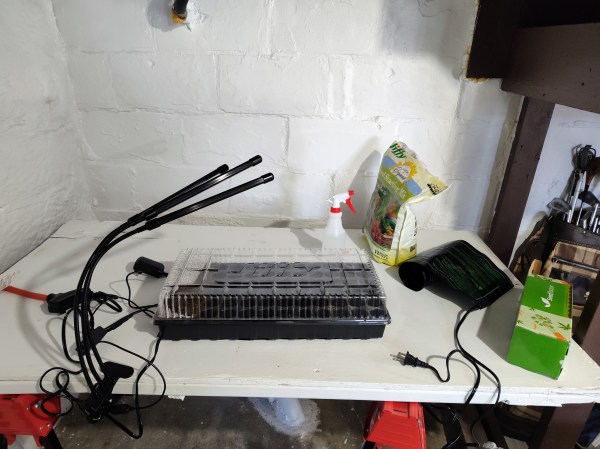
Heat Mat
Although many people will first think of a grow light when buying seed-starting supplies, a heat mat is equally as important. A heat mat warms the soil to the appropriate temperature for seeds to germinate. They are great because they maintain a temperature of about 70-75 degrees Fahrenheit. They are also waterproof and can be wiped clean, so you don’t have to worry about getting wet soil on them.
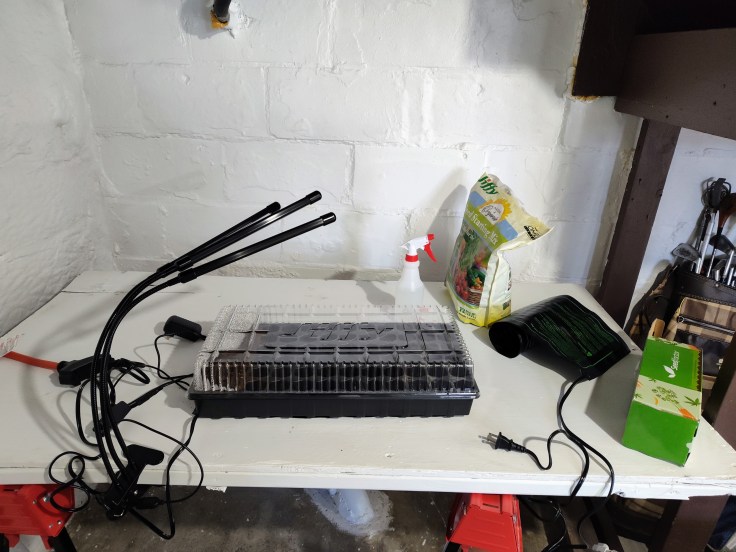
Our seed starting equipment for the 2025 garden.
They’re very easy to operate since the ones we have don’t have a temperature controller. Rather, you simply set them and forget them. Once you plug them in, they stay on 24/7 until you begin seeing your plants poking through the soil. We bought ours on Amazon in Feb. 2022. They are 10 inches by 20 inches, came in a 2-pack, and cost $27.99 at the time. They’re actually cheaper now than they were in 2022 at $23.99. Here is a link to them.
Grow Light
The grow light works hand-in-hand with the heat mat. You don’t need to turn on your grow light when you first start your seeds. That’s because its purpose is to help the plants grow through photosynthesis, and until the seeds germinate and poke through the soil, the grow light has no job. Instead, you wait for germination and see green through the brown soil. At that point, you can begin using the grow light, which you want to mimic the sun by not having it on 24/7. Ours is set to be on 12 hours and off 12 hours. The grow light will be used until you transplant the plants into your garden. Like the heat mats, our grow light also came from Amazon. It was $25.99 when we bought it in Feb. 2022. The exact light we got is no longer sold; however, here is one very similar and is only $23.99. There are different styles of grow lights, but I prefer the ones that clip on tables to the ones that hang. Hanging ones are great because their light is spread across a larger area, but you have to have the right setup to hang them. Meanwhile, the clip-on ones can be attached nearly anywhere and you can angle the lights to fit your needs.
Dome & Tray
You’ll almost always find these sold together as a set. The tray holds your seed-starting cells and will prevent excess water from running onto the table or surface you’re growing them on. The dome, or lid, works like a greenhouse and keeps moisture inside. This is essential during the germination process as the seeds need consistent moisture. The dome can only be used until the plants reach a height where they are pushing up against it. You’ll also want to be careful when using the lid. Keeping the lid on can lead to mildew or mold problems if your soil is too wet. Mini greenhouses are the perfect environment for mold to grow because the soil is warm and wet, and until the grow light is turned on, there are no UV rays to kill said mildew and mold. So, just be sure to monitor your cells each day. The underside of the lid should have condensation on it and the soil should be damp but not soaking wet. If you notice that the soil isn’t drying out within a few days of watering, adjust the lid a bit to allow some airflow. That will dry it out. Seed trays and domes are very easy to find. Your big box stores like Lowe’s and Home Depot will have them, and you can also find them at feed or farm stores, such as Tractor Supply and Agway. They’re very affordable. Here’s one from Tractor Supply for $12.69 that holds 72 cells and includes the compacted soil pellets, so a seed-starting mix isn’t even needed.
Seed-Starting Mix
It’s important to have the right soil mix when starting seeds. It may be tempting to use soil from outside or regular garden soil when starting seeds, but you should resist that temptation. MI Gardener explains it very well in a YouTube video, but the gist is that outside soil and compost will have microorganisms, bacteria, fungus, and bugs in them that can lead to damping off and other diseases in your seedlings. Not to mention, you probably don’t want bugs in your house. Instead, you should use a dedicated seed-starting mix that has things like peat moss, vermiculite, perlite, and coconut coir in it. These give the starting mix a light and airy texture that allows seeds to germinate and grow while also draining well. We look for organic bags of starting mix. Is it necessary? Probably not, but starting mix is so affordable that there isn’t a good reason not to. We bought two bags of Jiffy organic starting mix at Lowe’s. Each was $7.28 for 12 quarts of soil. We’ve used several different starting mixes in our gardens and haven’t found one to be better than the others.
Water Source
This is pretty self-explanatory, but you’ll need a vessel for watering your seeds. In the past, we used small cups to pour the water. This year, we changed to spray bottles and have enjoyed it more. We find the bottles to be better because they don’t spill or flood the seed cells. You don’t want to overwater your seeds, so spraying is a more controlled method. We bought a 2-pack on Amazon that is currently $7.56. Any spray bottle is work, though.
Surface to Set Everything
I’m including this because it can be easy to forget, but you’ll need a good place to set all your supplies. This can be a table, counter, desk, or shelf, but keep in mind that you’ll need to have everything out for several months and there will be UV lights that can be a bit annoying after a while. In the past, we have used a dining table and a collapsible hard plastic table that is nice because it can easily be cleaned. This year, we switched it up and are using a piece of plywood that was left in our basement by the previous owners and a set of sawhorses. It’s working well because the sawhorses keep the seed trays at a nice height and the plywood was free, so it’s not a big deal if it gets dirty. I’d recommend using something you already have. I don’t think you need to buy something new for this purpose.
What Is in Your Seed-Starting Kit?
In addition to everything I discussed in this post, you’ll need to determine the best way to get power to your equipment. That’s going to be unique to your situation. We bought a 50-foot 12-gauge extension cord and a 3-prong adaptor to make sure we had enough length to reach the closest outlet. Keep in mind that the heat mats and grow lights can draw a decent amount of power, so go overboard when using an extension cord just to be safe.
What do you use to start seeds? Is there any overlap with the items we use? We’d love to hear from you and see if we can improve our kit for next year’s garden. Happy gardening.








 One Rabbit Riot