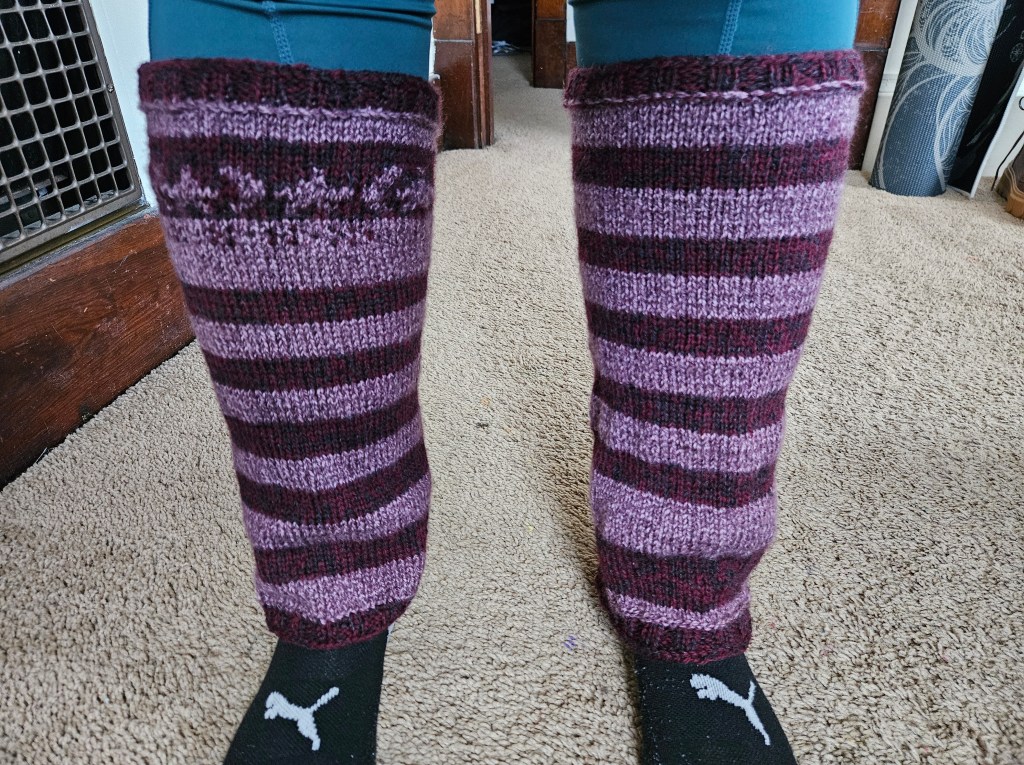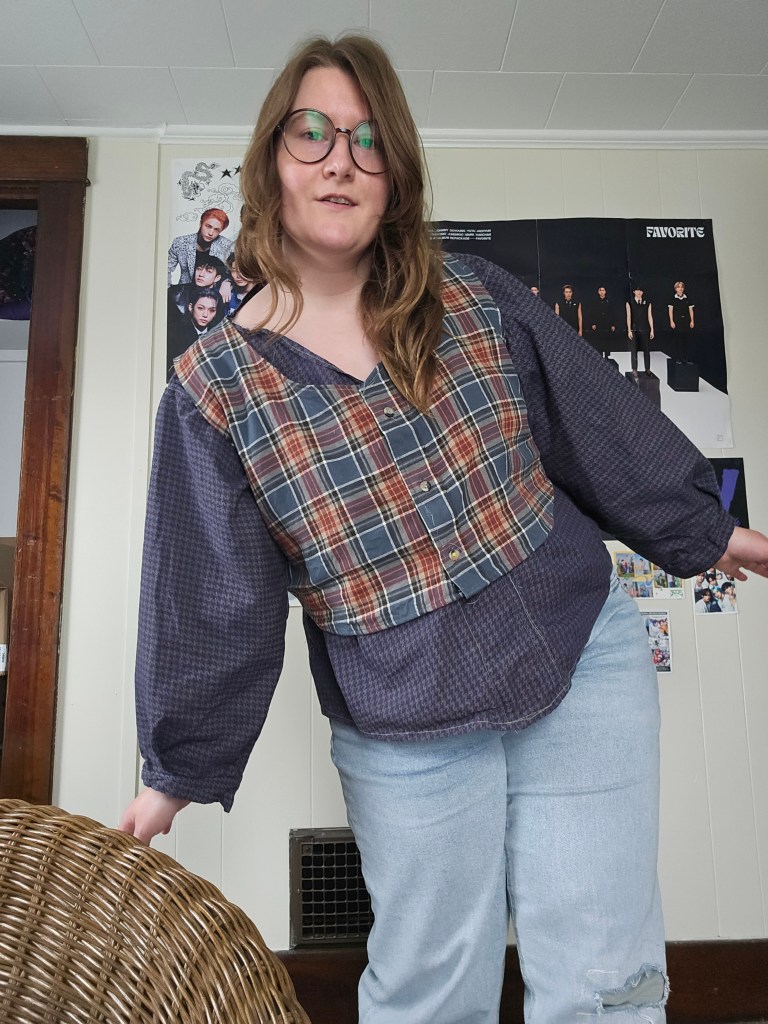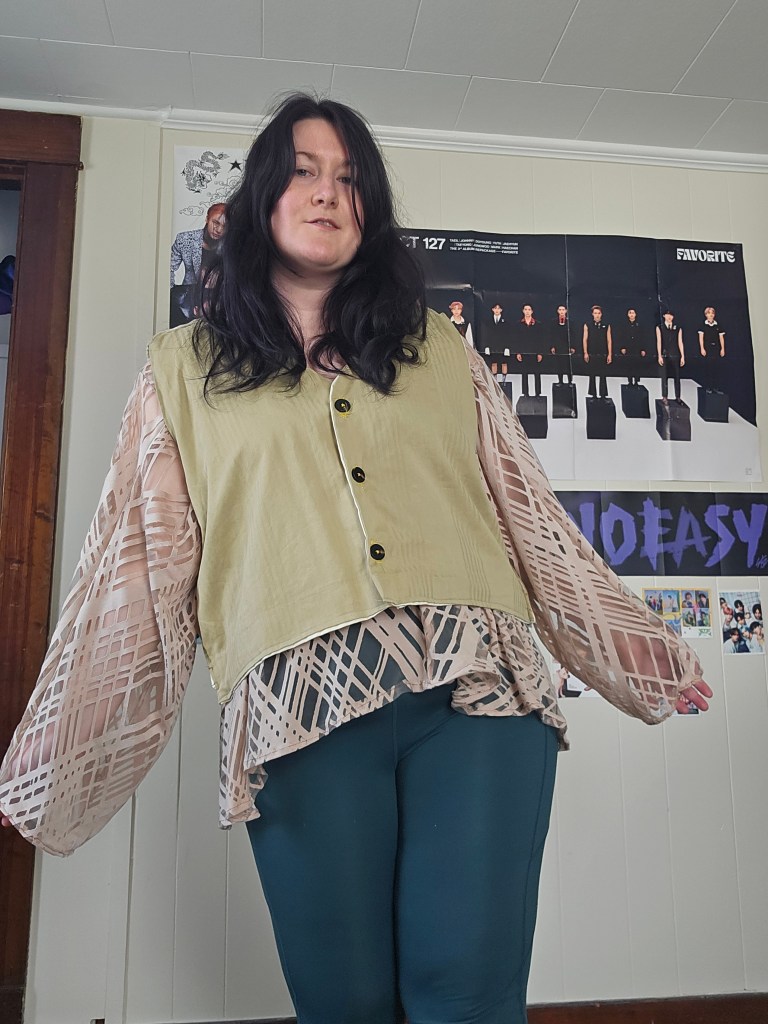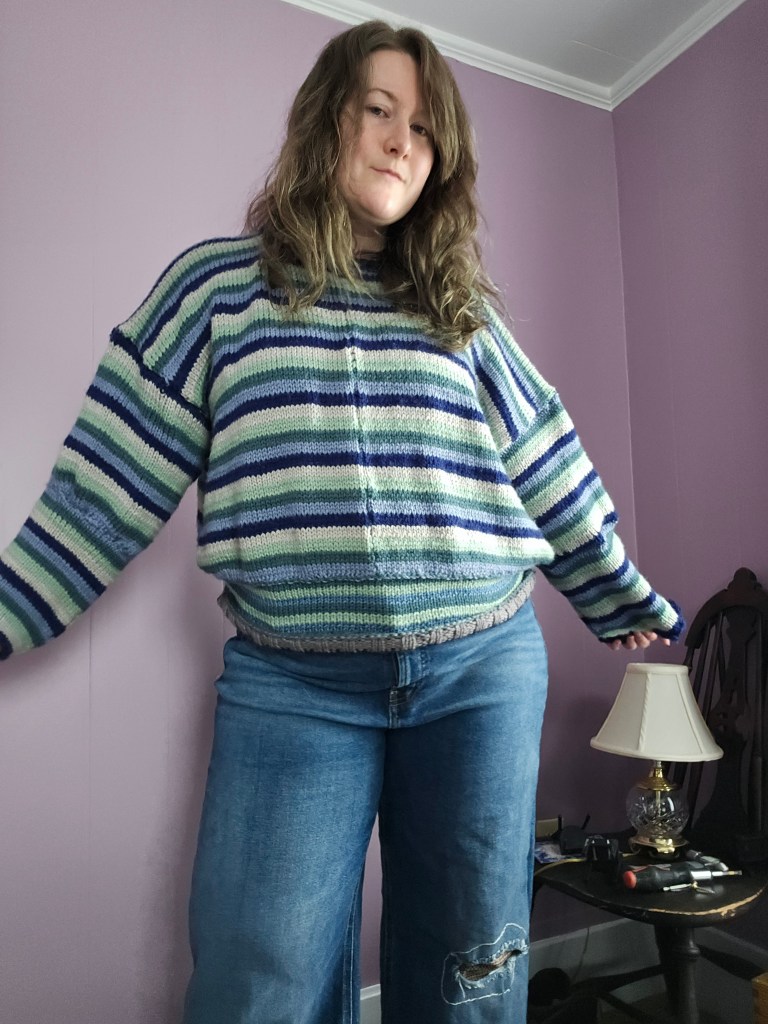
Potato Technology’s 2024 Autumn Winter Collection

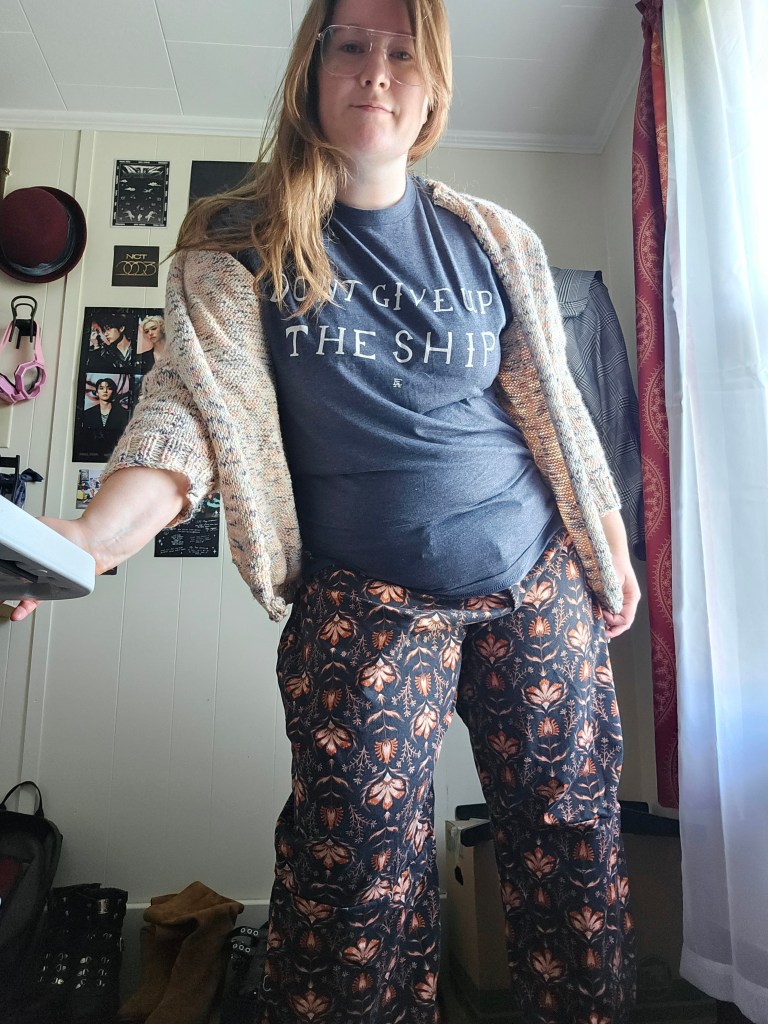
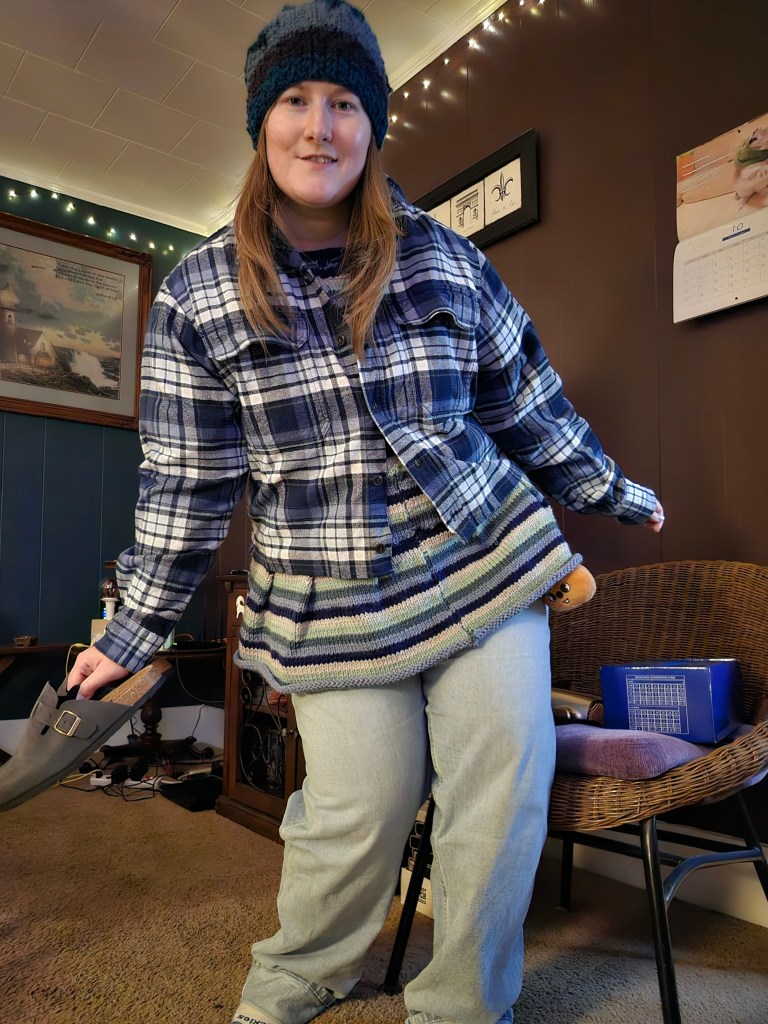
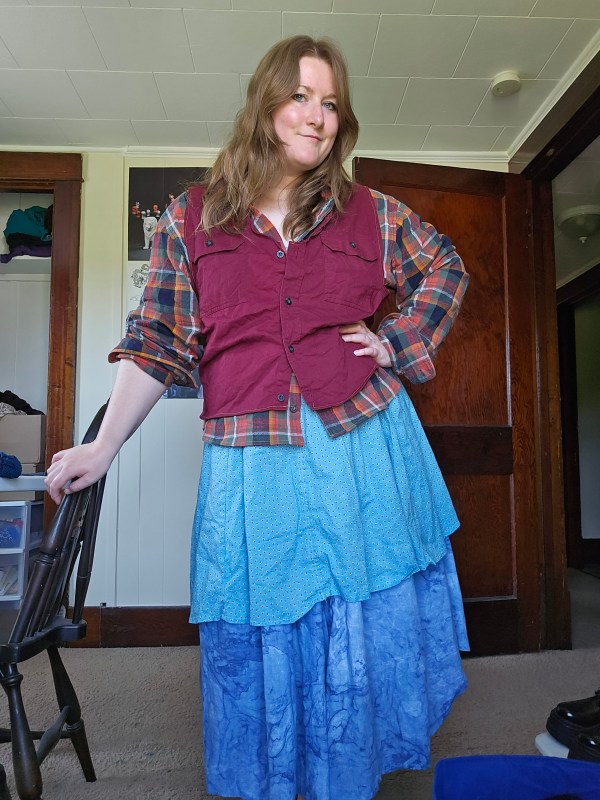
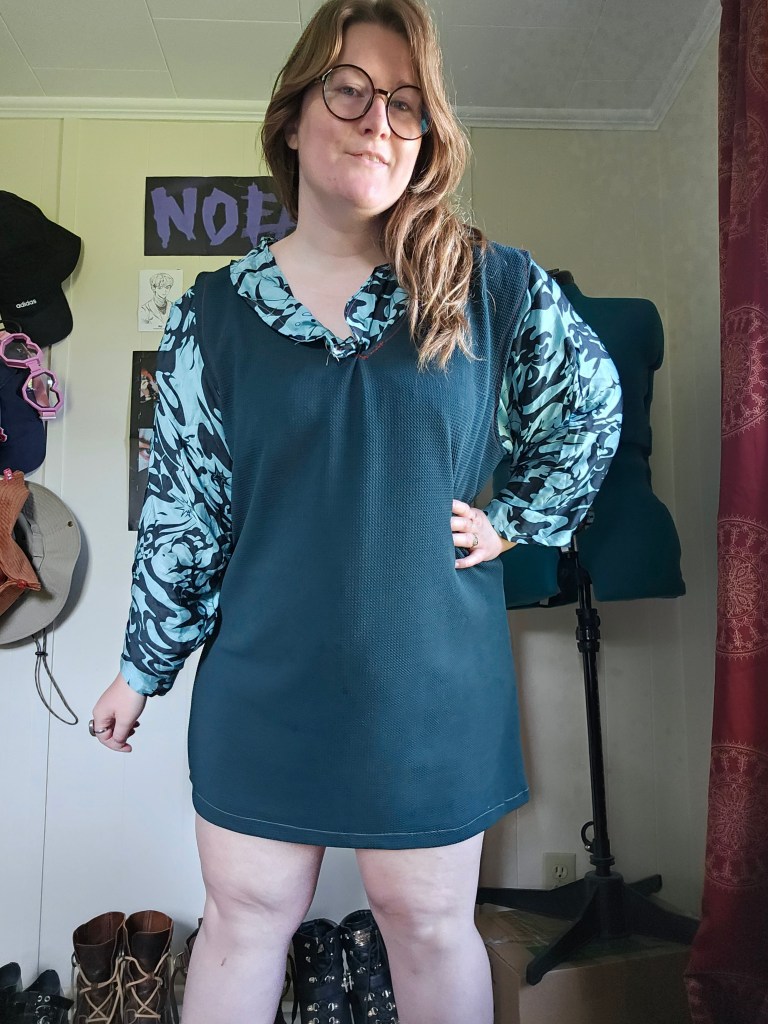
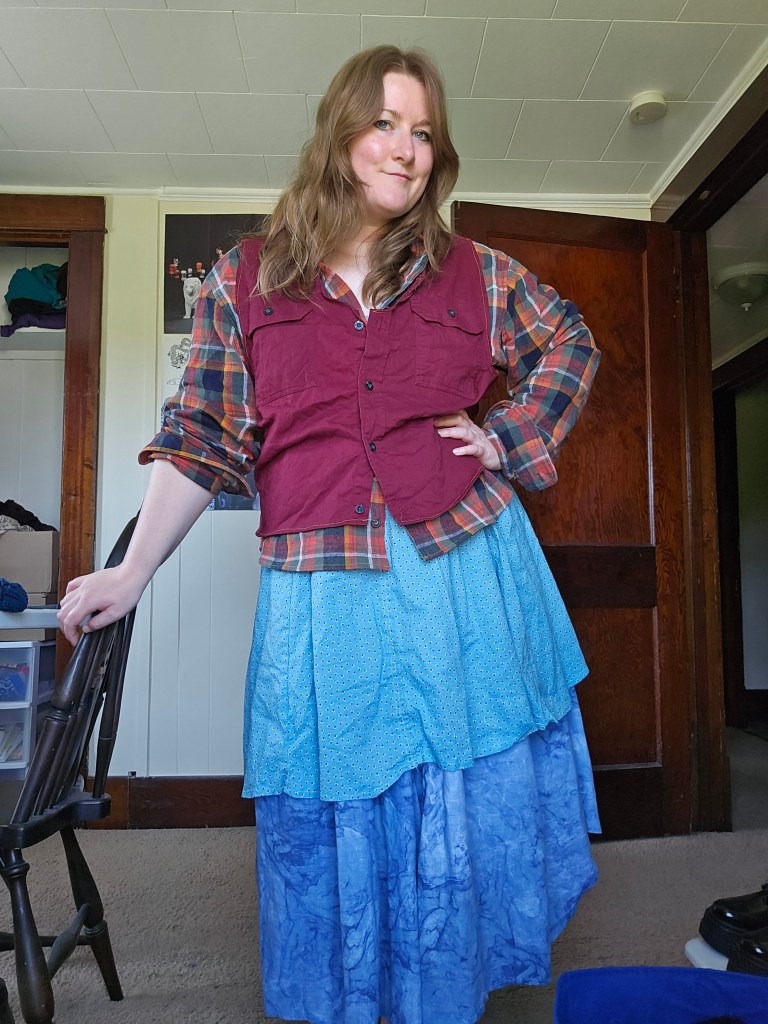
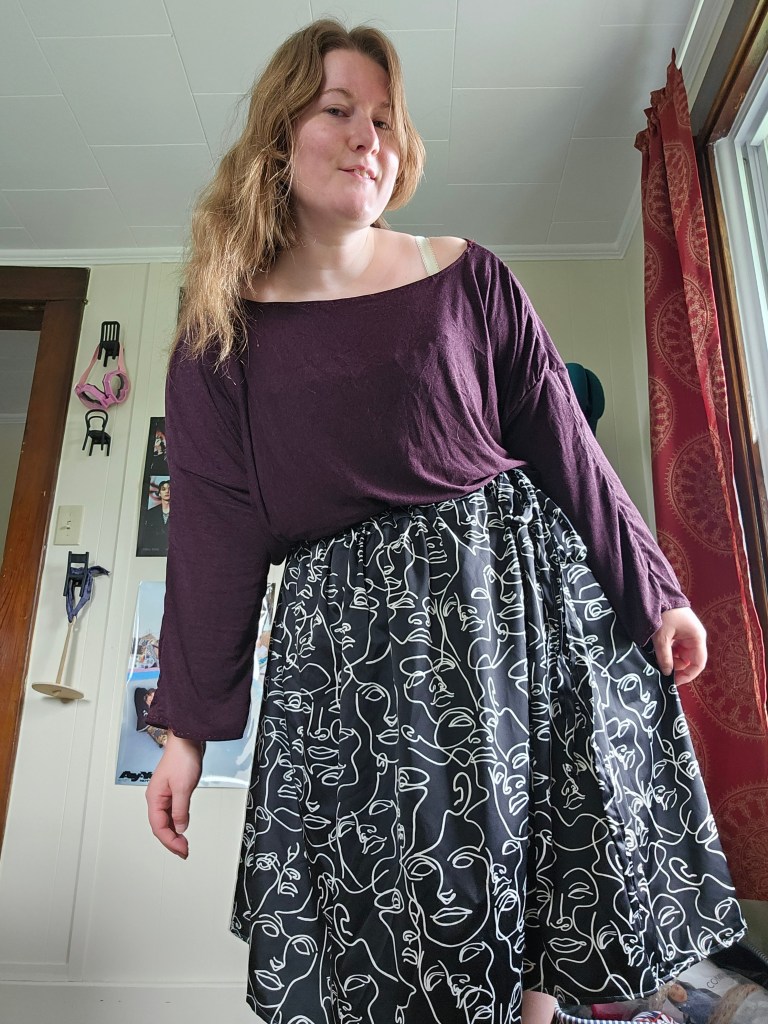
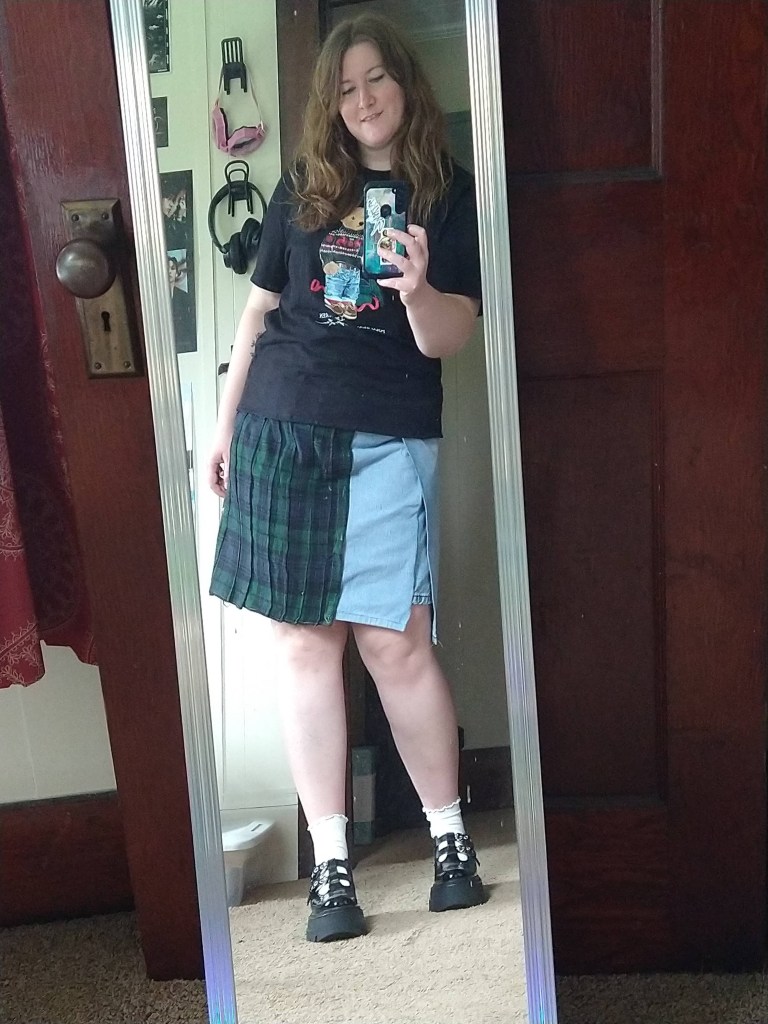
This collection was about upcycling, trying new techniques, and making things that expressed what I like wearing based on previous designs I have made, but with a twist. The items I designed were 75% sourced from existing materials. They were upcycled from items in my closet, hand-me-downs from my mom or grandparents. They were made from destashed yarn I acquired or fabric that had been in my stash for a long time. I focused more on creating with natural materials like wool, linen and as always, I love cotton.

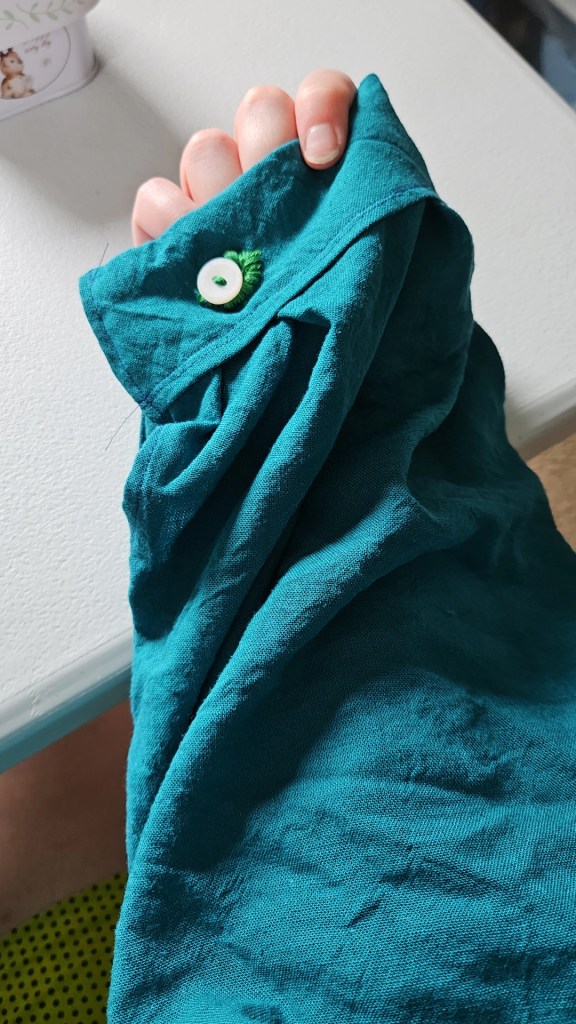
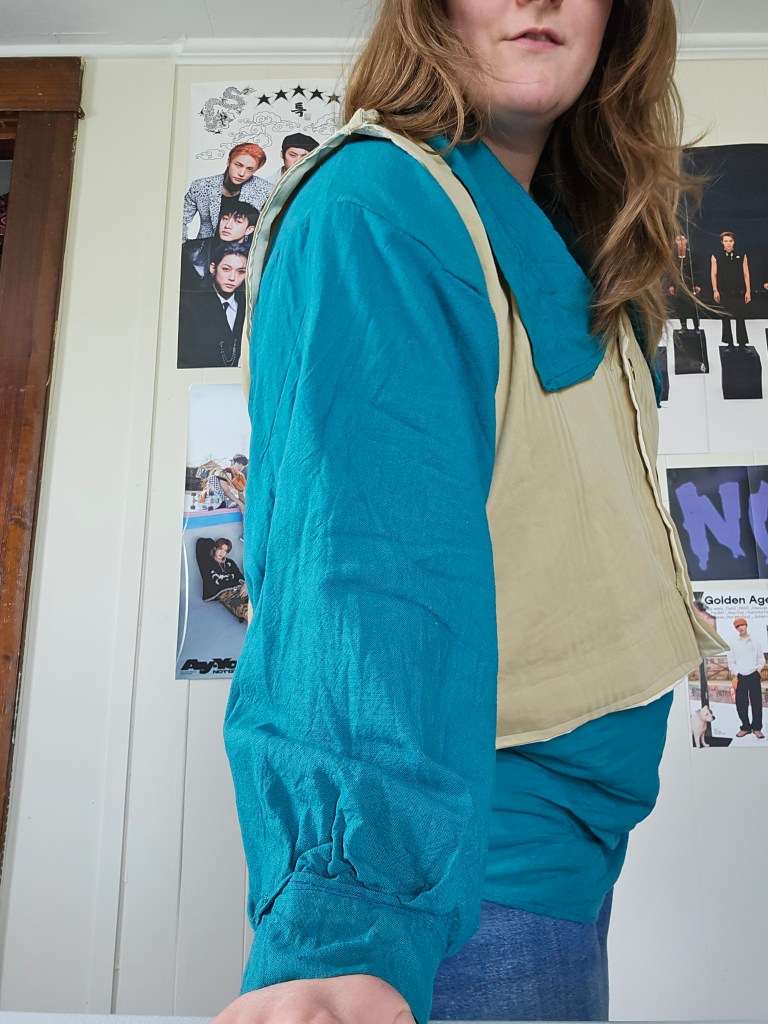
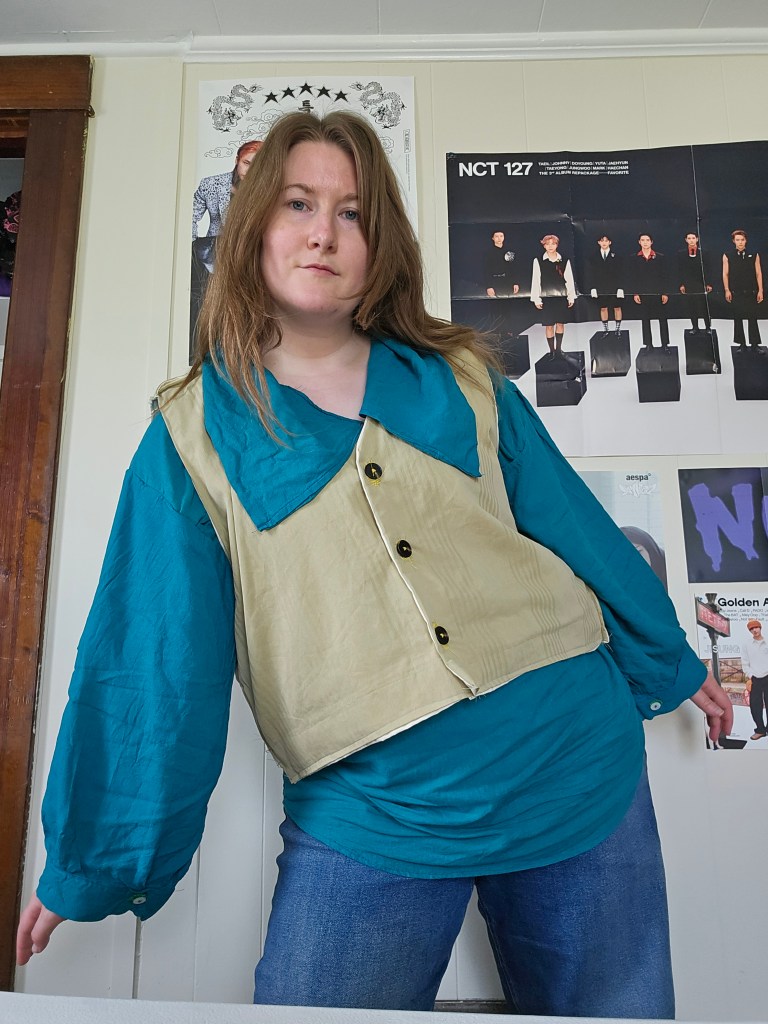
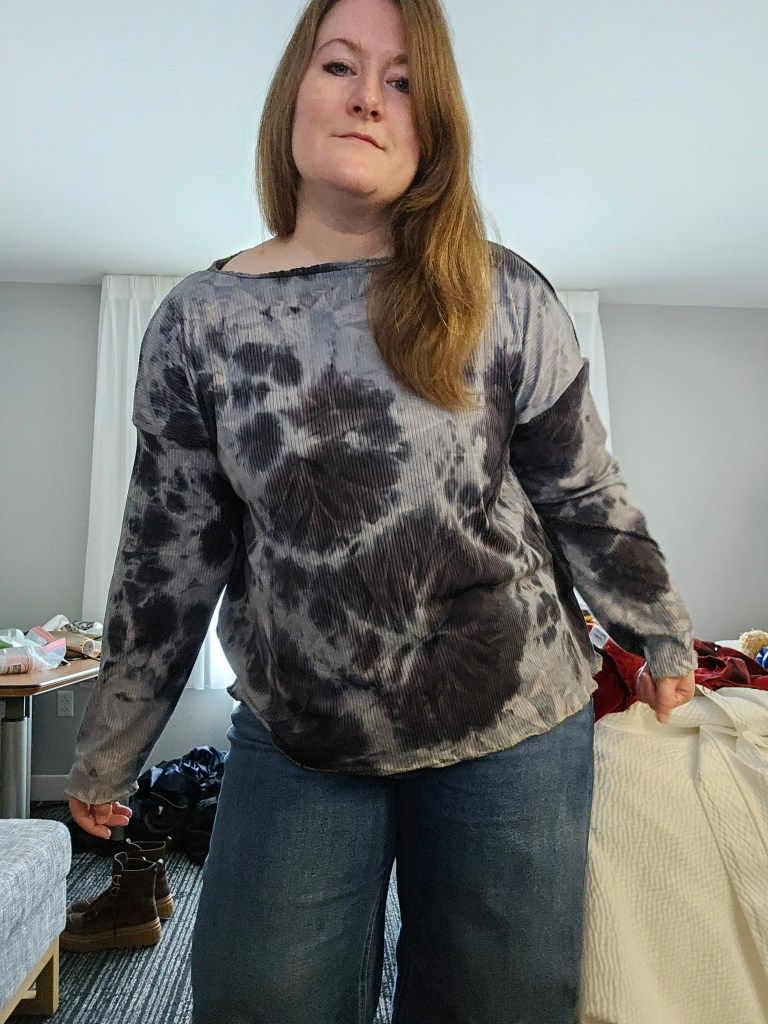
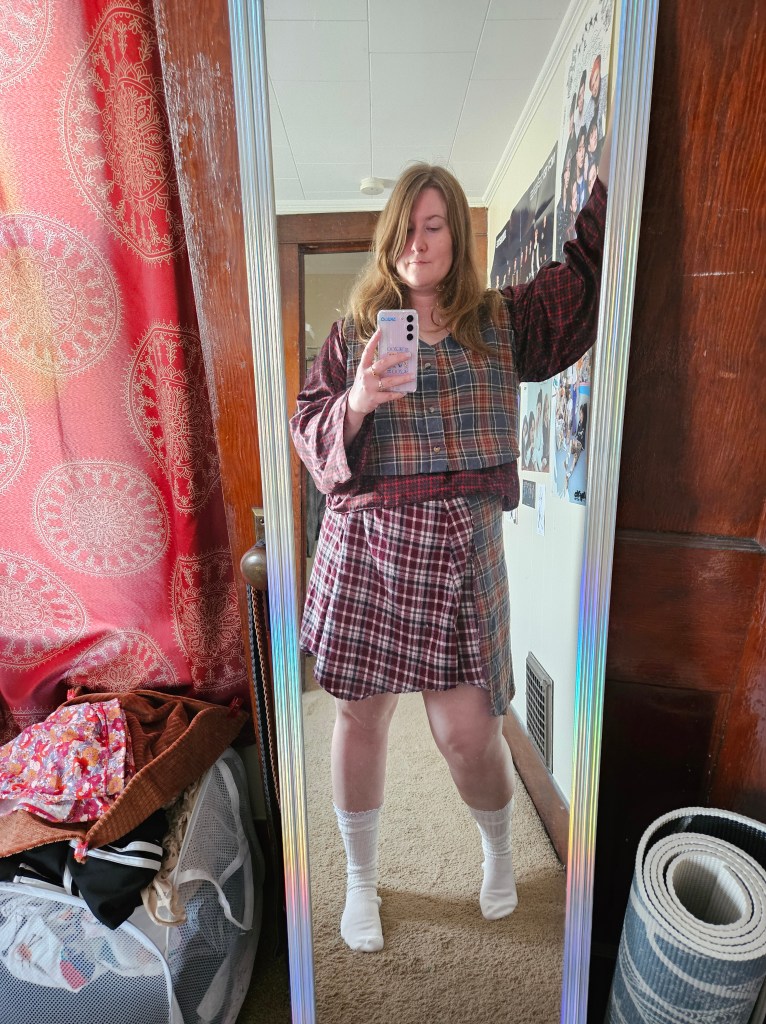
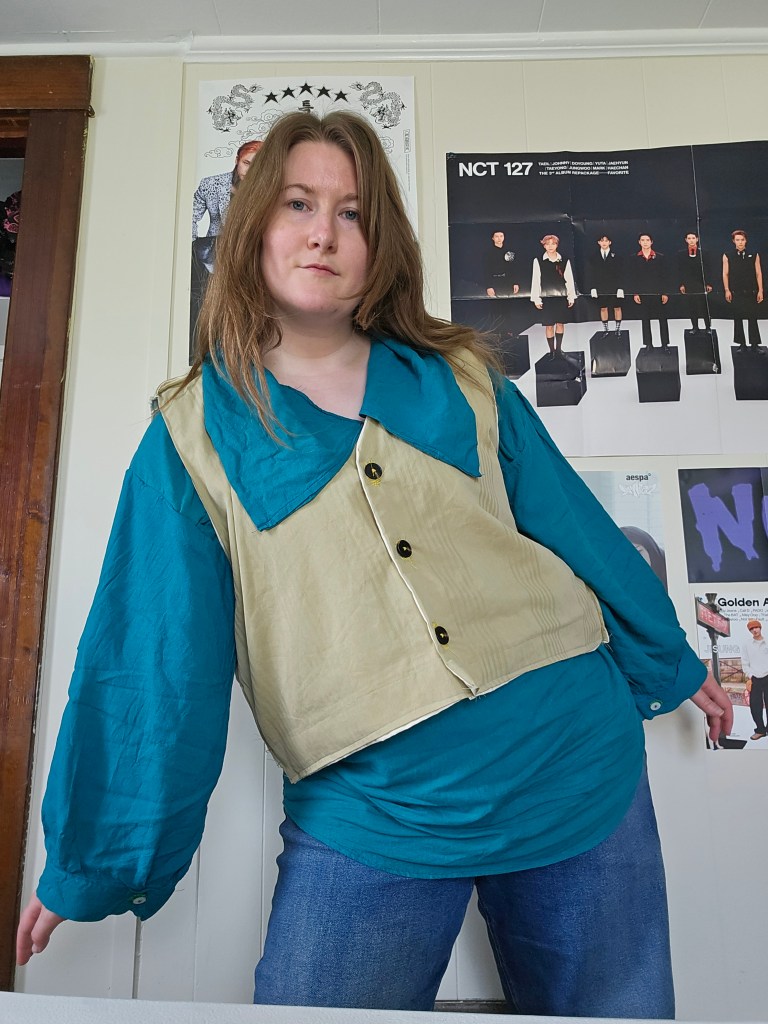
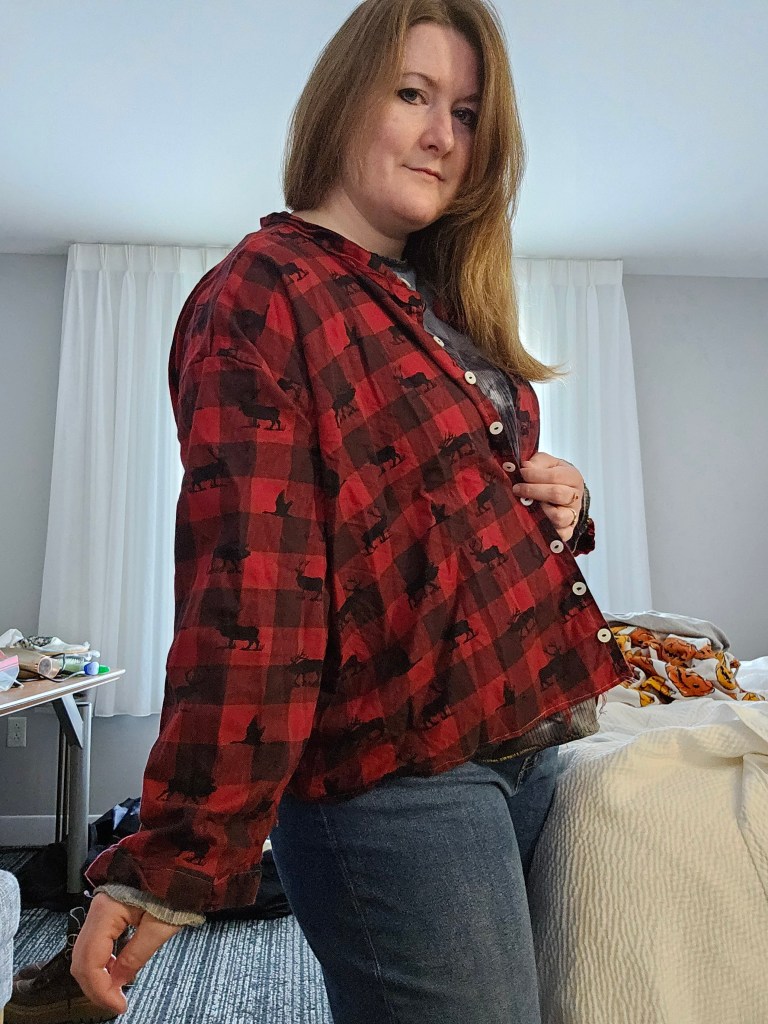
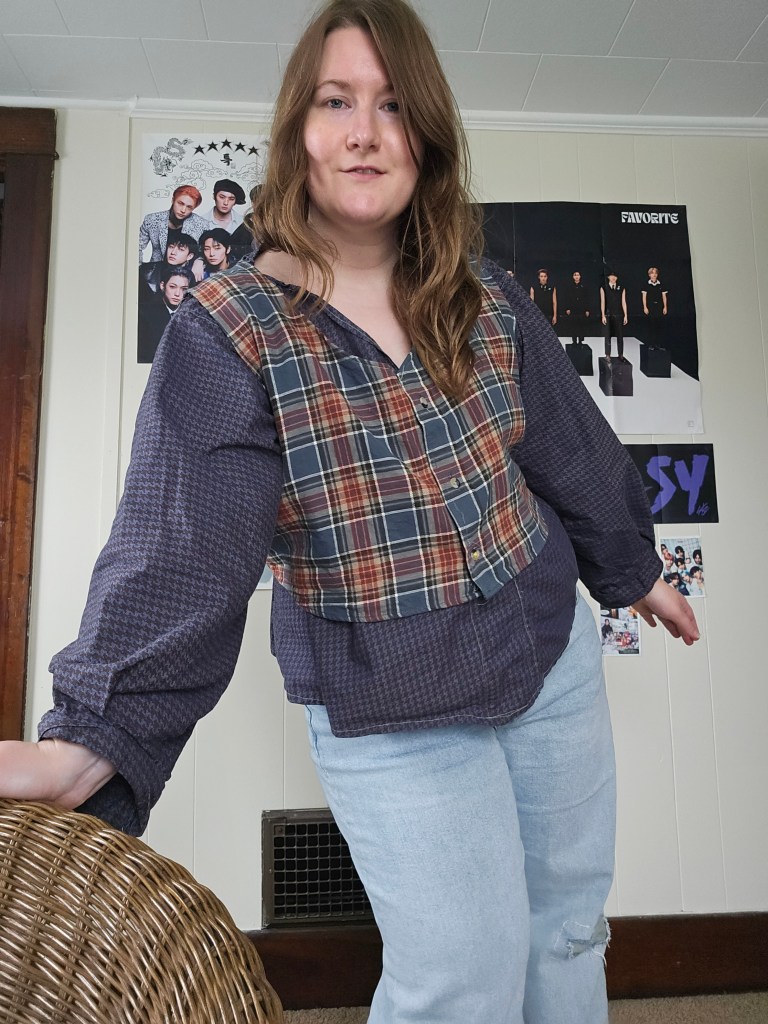
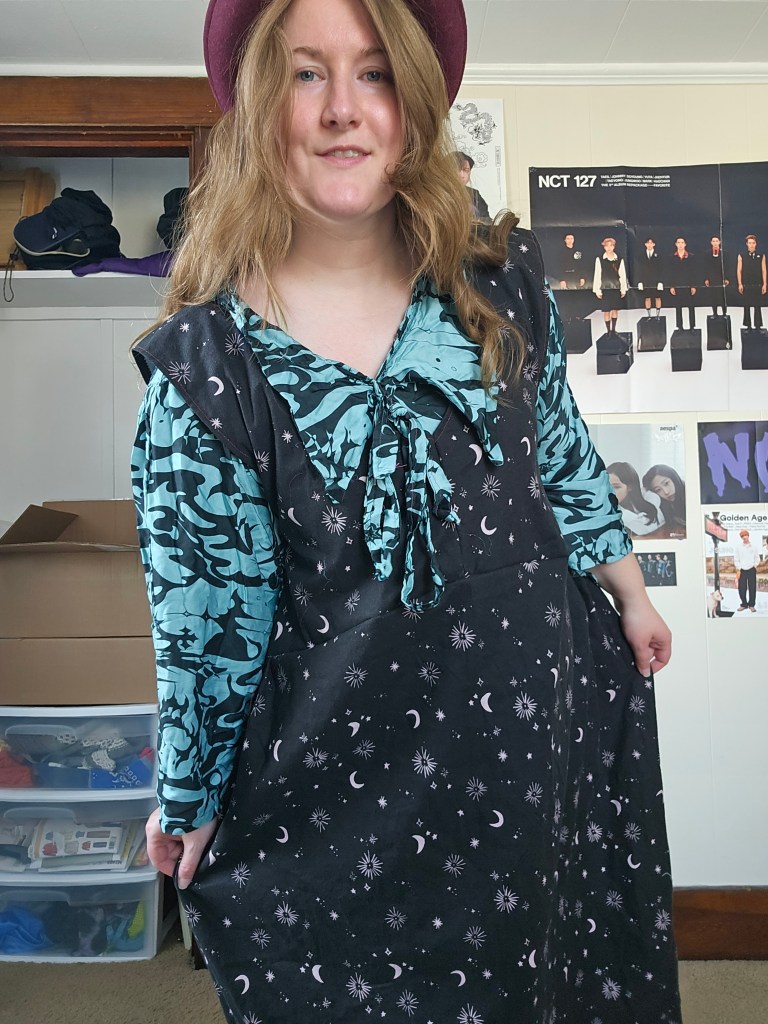
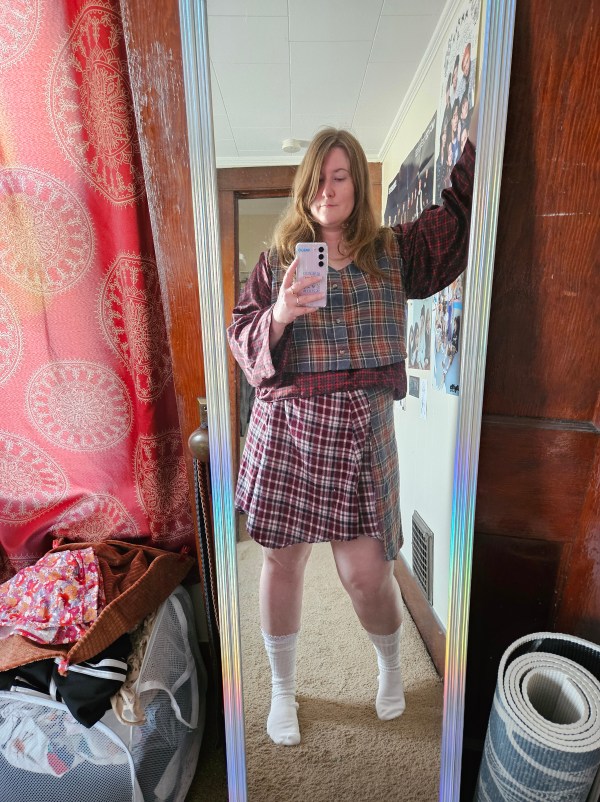
Vests were made from pillow cases and flannels. I re-worked a sweater from the existing sweater and leftover yarn. I dyed denim, deconstructed denim, and made some interesting new shorts and skirts. I combined leftover flannel from Christmas stockings to create a plaid and denim kilt. I used the cut-off sleeves of flannels from my vest projects to create a skirt from four flannel sleeves. I dove deeper into the world of trousers with two new patterns – a floral and railroad stripe. With each pair, I experimented with fastenings and pockets. I constructed my first “Mr. Darcy” shirt from teal linen using Bernadette Banner’s instructions for the body. I put my own spin on the collar, choosing a wider collar similar to a sailor collar that is popular in anime and J-fashion.

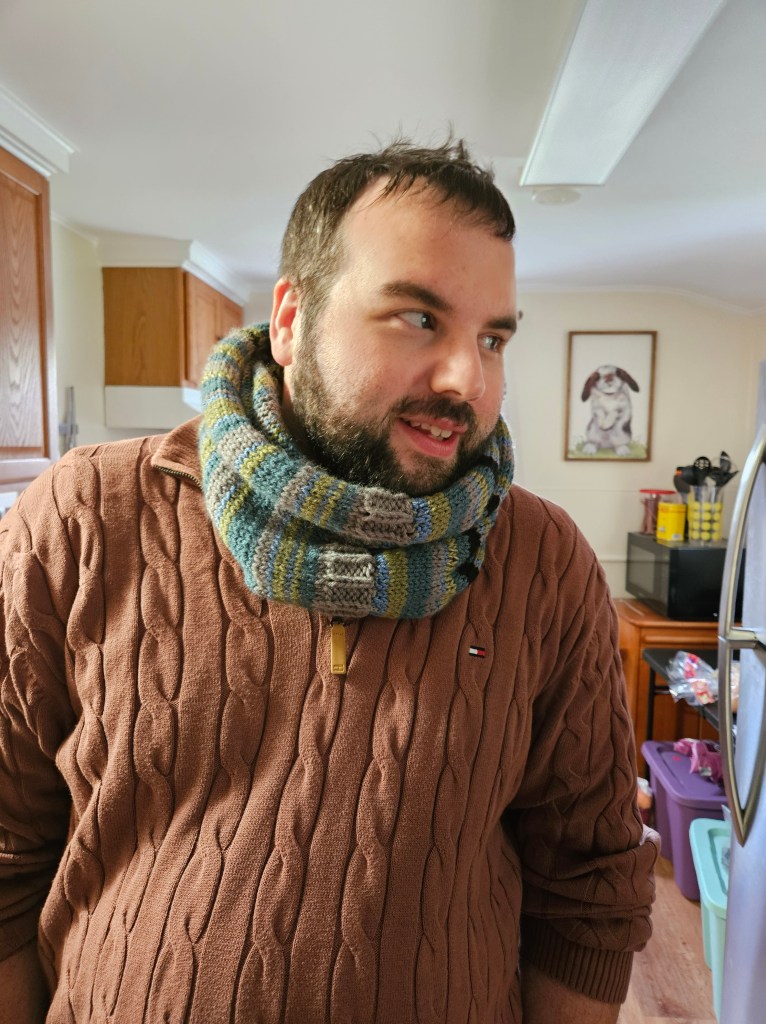
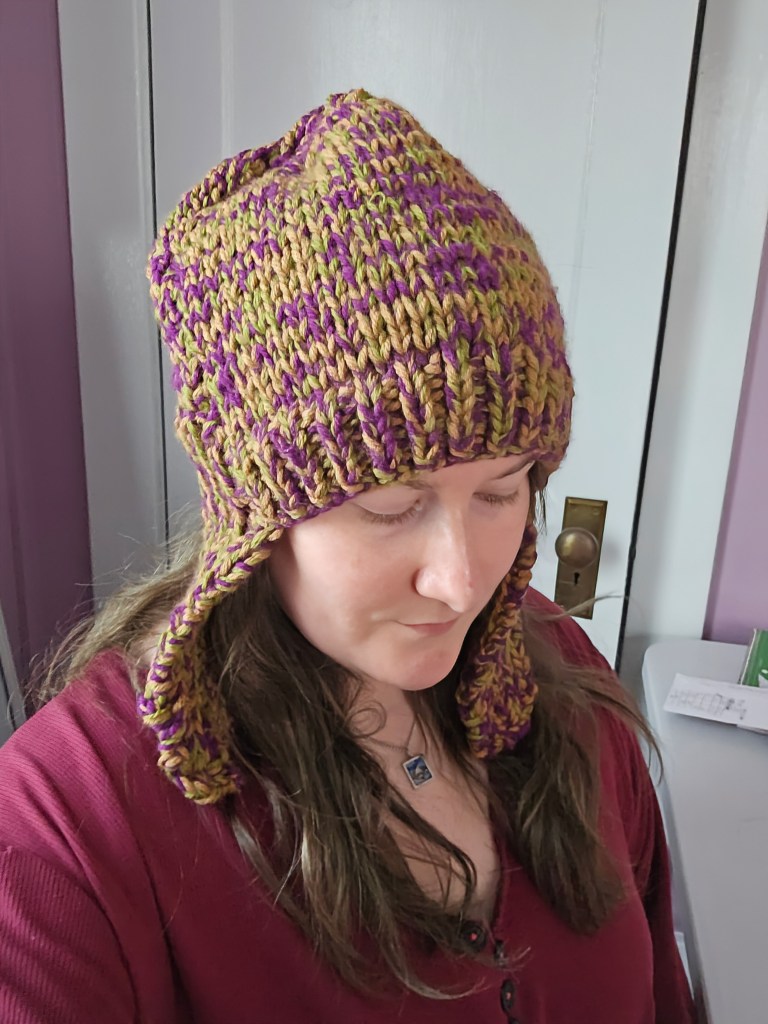
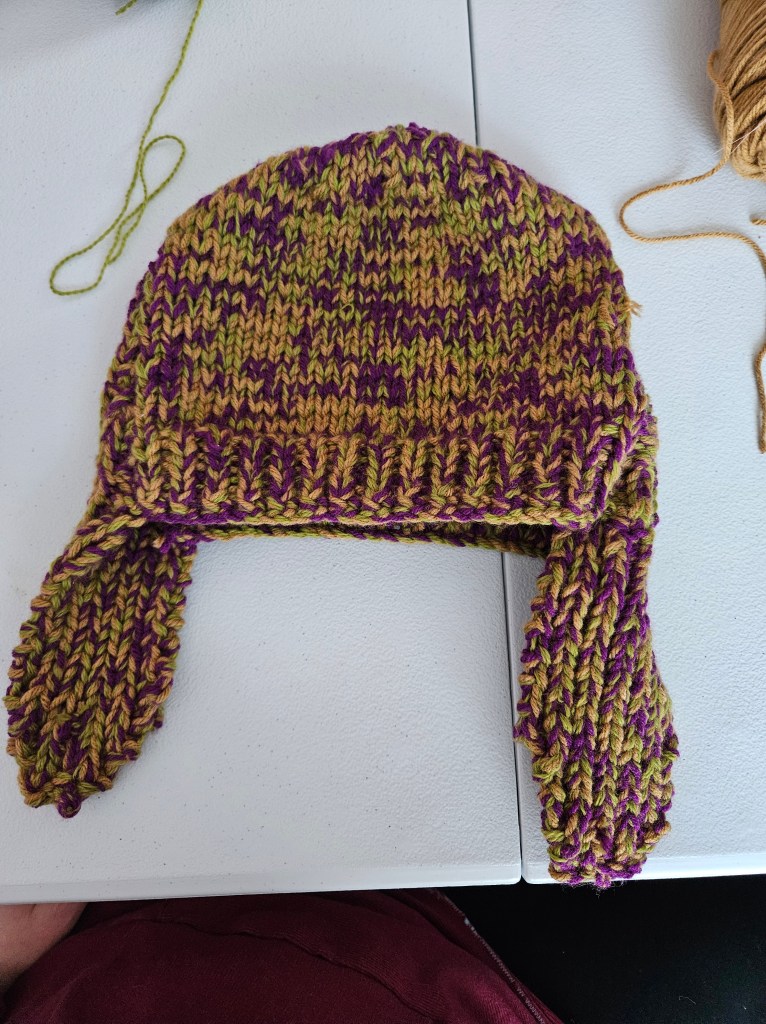
This was the first season I experimented with colorwork in knitting. I made a knit star motif hat from yarn that was leftover from my Magic of Scrap Yarn Cardigan. I made leg warmers, a squirrel motif mitten, and a melange of acrylic and wool to create this ear flap hat that reminds me of medieval European helmets. Although this season of creation was chaotic, I’m not sure if I even included all the projects I worked on, it was a time of great learning. It taught me that fashion design is more than taking raw material and cutting it into a new form.

Great design utilizes new and old. Fashion is about reusing, not wasting, and making things beautiful with careful craftsmanship. It does not mean it needs to be expensive, or need to be made by a great master couturier, it just needs to serve a purpose. We have lost sight of the purpose of fashion, but these projects of upcycling have reminded me that fashion is more than shopping, it is more than consumption, it is about the materials, the vision, the function.
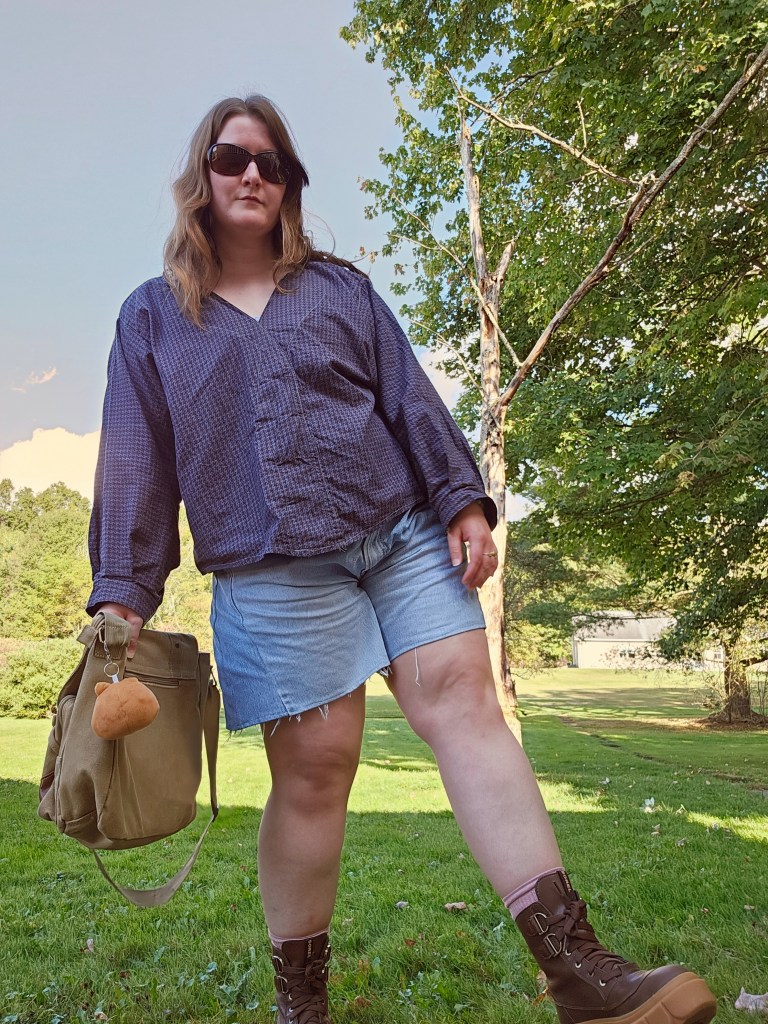
Remaking My First Sewing Project Four Years Later

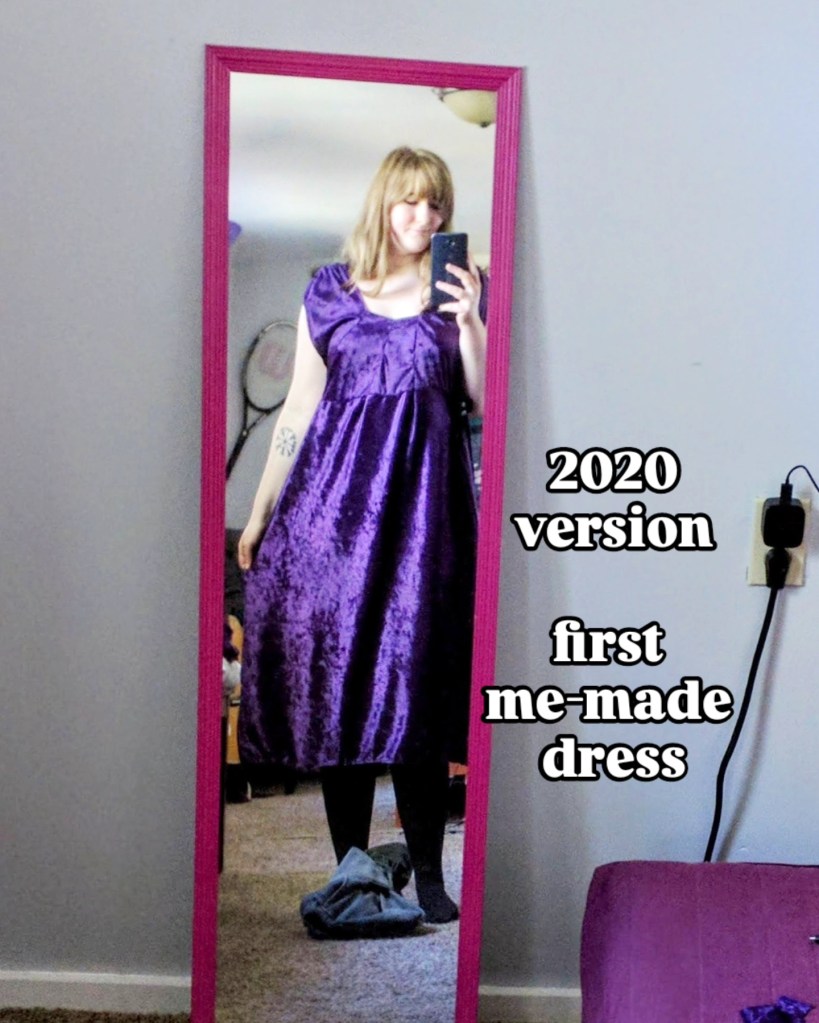
Last September, I felt this aching in my creative heart to make what I didn’t make well the first go around. A project that some would say was insane to attempt as a beginner because of the difficult nature of velvet and the frustration that is sewing with stretch fabric. The dress pictured below was my first wearable garment. I saw the same purple stretch fabric on sale for Halloween at my local Joann’s and my heart skipped a beat. It still exists – I could try again!

You see the first dress I made was constructed so poorly that I ended up cutting it down into a skirt because I was embarrassed to continue wearing it out. After all, the bodice was bunching up and gathered strangely in the back. I lacked the confidence to keep going and try to alter the dress for success. I see now that it would have been an easy make to take out the gathers and bunches of fabric for clean seams, but that kind of thought came with trial and error. I needed a bit more experience and patience to make it right, and at the time in 2020, my younger self was not willing to wait.

But what if I am living in the past? My mind thought, maybe I should let it be and let the dress be a learning experience. I put the purple velvet down and left it, it was not on sale, it would be a sizeable impulse purchase at 15.99 a yard for 4 yards. I can’t justify 60 USD for a passing whim, that would be a poor use of money. So I left the daydream and moved on. Still thinking about that fabric. Another few weeks passed, finding myself in my local Joann’s again. It was my favorite place to explore. I went to the shopping plaza over the weekend where Joann’s remains live boarded up with the lights still on. It was eerie. I found myself thinking about what was blocked off inside? Was the fabric slumbering in the bolts, waiting to be made into something new? Would the yarn ever find a home in a fiber artist’s hands? It felt like a mistake, a bad dream, but it was not. It is over and now it is just a memory.

Anyway, on the second trip to Joann’s during the Halloween sales, I found my purple beloved. The bolt was still full, now marked down to 7 USD a yard. But this time I couldn’t get the project out of my mind. I’m glad I did give in to the creative urge or this project would be left without an ending. At the time, I had no idea Joann’s was going to go under. I thought I had plenty of time to remake this when in reality the window was closing. As I worked on this dress in 2025, I followed Joann’s story with frustration and weight of expectation. This remake is the final try, for this fabric I will never find again.
I made a different dress from the original and that surprised me. I believed going into the remake project that I would duplicate the same dress but with better technique. Instead, it was a project of feel. This time, I had a dress form I could drape the garment on. I had fabric clips with securely held the the slippery fabric together while on the dress form or for a quick test of fit on my own form. This time I understood proportion and where this dress would fit into my wardrobe instead of making a dress that only went with my moto jacket. I reinforced the shoulders and was thoughtful about my stitching, to make the garment strong. I added darts to pull the dress in where it was fitting baggy instead of leaving it like a velvet sack.

It became something new and I am okay with that. None of us are the same as we were years ago, we grow and evolve with every passing year. Making a dress for now, with the spirit and the fabric of my first garment, but with a new neckline and a new fit I think is an inevitability of learning and growth. I had the patience this time to try on the dress, mark what was not fitting right, and go back to work until it was correct. That was not something I was willing to do when I started, because it was all so new and confusing, but with time and practice, those new concepts became a familiar old friend. Like this tan carpet. It wasn’t until I looked at the 2020 mirror photo and the 2025 mirror photo that I saw it. The carpet in the house we bought looks just like the carpet in our apartment in Meadville. How random is that?

I have one more section of the purple velvet left over that I plan to make something with, possibly a mini dress, a blouse, or maybe a jacket. I think knowing this fabric is a relic now, makes me feel unwilling to finish this scrap project, because once it is done. I’m going to feel like my time experimenting with fabric from my first craft store is done. A chapter of my sewing life is over, and I hate saying goodbye. I’m a sentimental person. When things end, I take it hard. I dwell on the loss and muse on it. It might be unhealthy. It certainly makes life harder as a person who wants to keep things alive that are gone, it’s why I think I was drawn to study history in college.

As I keep making things, some of these projects become an archive of crafting past. What are some things in your own life that have moved from the present to part of your past? Does it surprise you to consider these things as your history instead of your current story? Thank you, reader, for joining me again down this sewing memory lane. I hope you have a wonderful day!

Character Design: Mabel Mora and Her Sweaters

Going into the show, Only Murders in the Building, I knew the concept of the show was intriguing. It’s set in New York City, in a classic building, where whodunnit murders take place which the trio solve through their of the time true-crime podcast. The age difference between Selena Gomez and the other two leads Martin Short and Steve Martin gave the story layers from the trailer alone. I was pleasantly surprised by the character design and the costuming which layered depth to each character’s story, like a real person would express through the clothing items they choose.

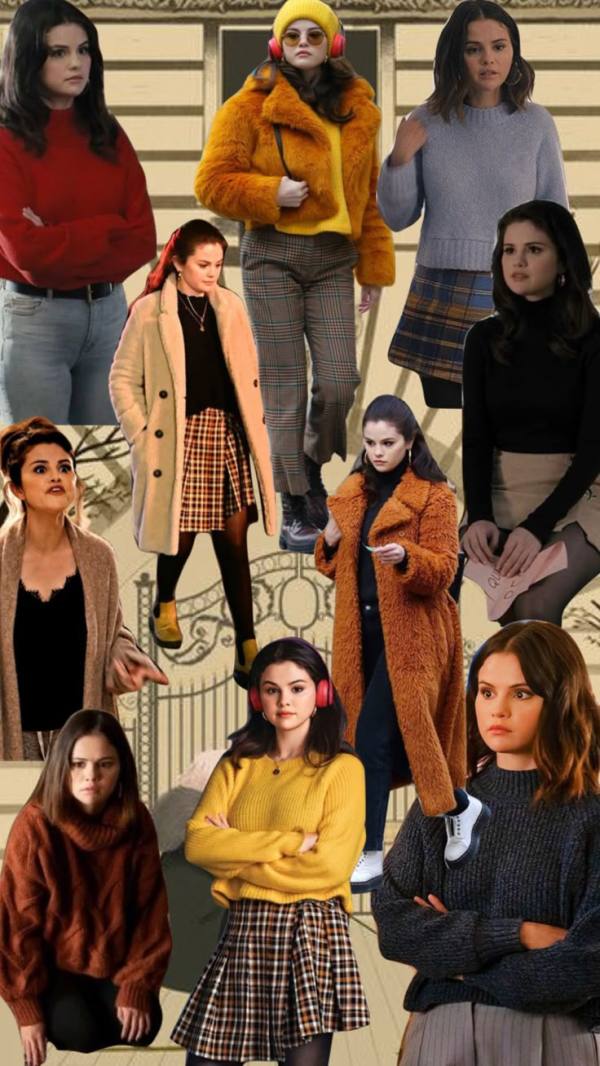
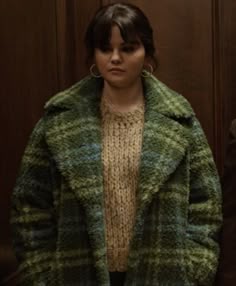
The most relatable to my taste is Mabel Mora because she not only “knits” as a plot device for “Bloody Mabel” but also wears clothing that looks like someone who knits. Her knitwear throughout season one looks like pieces made by someone who enjoys knitting. They are not your typical off-the-rack sweaters and appear to be knit by hand instead of machine. What makes it feel real to me is the weight of the yarn compared to the knitting needles shown in her apartment. The needle she says would be her self-defense weapon of choice is a thicker needle, for bulky weight yarn. My guess would be somewhere between a size 11 and size 13 needle which is appropriate for bulkier projects.

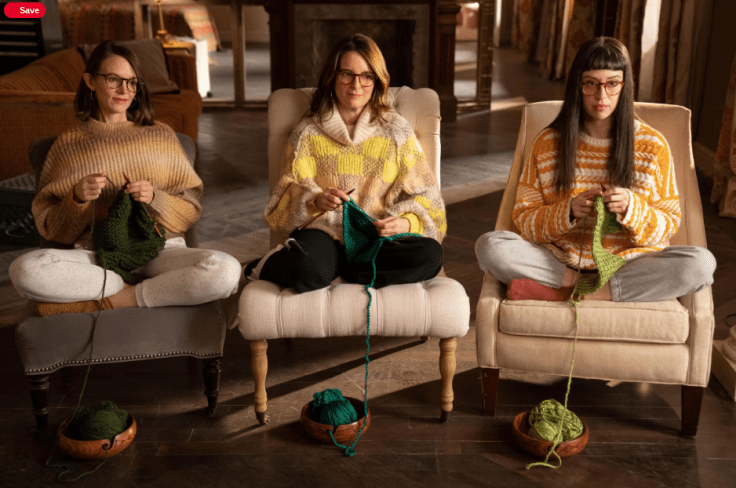
The wooden knitting bowls, the needles, and the unusual designs of the sweaters featured in this scene speak to the craftsmanship of a hand-knit sweater and place Mabel’s knitting needle in her world. They appear to be knitting which is not always the case in TV shows or movies that feature acts of knitting, the best example of this being Gromit from the Wallace and Gromit series.

Although we don’t see this craft as often in Mabel’s scenes as we see her paint or sketch, the evidence of this hobby is peppered throughout the show from her infamous dream, her carrying the needle in her bag when she jumps tie-dye guy or what lands her the moniker “Bloody Mabel” in season two. Movies and TV shows of the last five years have fallen into a telling not showing manner of character development. For example, in the 2022 remake of Persuasion, Anne Elliot breaks the fourth wall to tell views that she and Frederick Wentworth are “exes” instead of developing the story through interactions, long drawn-out glances as we see in Emma (2020), or Pride and Prejudice (2005 & 1995).

Only Murders in the Building did not take the bait, and instead showed what a 20-something knitter would wear in New York City winter – her handmade sweaters made with yarn colors that look like you could buy them from your local yarn shop. It was a clever character hobby to give Mabel as knitting was growing in popularity with people my age and beyond in the last decade, truly exploding in popularity with the rise of crochet in the 2020s. Every sweater she wears in seasons one and two looks like something you could find a pattern for on the site Ravelry.

It was such a great way to add nuance to Mabel’s character, because how many characters in TV shows knit that aren’t older? She’s a girl with a troubled and complex history, you would expect her to be a party girl or have a dark streak, like the characters of Effie Stonem, Serena Van Der Woodsen, or Jenny Humphrey, but instead, she paints, she knits, she is relatable in a plot that can be quite over the top compared to reality. Mabel is a character I can relate to, which pulled me in from the start to a show that doesn’t feel like it is a modern TV show because of how thoughtful the writing is. It never feels like a cash grab and that has given me hope that maybe this time of reboots and CGI reliance will go out of fashion for stories that once again feel handmade, like a good hand-knit sweater.

Have you watched Only Murders in the Building? Did you like it?

Magic of Scrap Yarn Cardigan

I was gifted a set of skeins. This yarn lot was made from peruvian wool, bulky weight in shades of slate gray, purple, and navy. It was some yardage but not enough to know what to use it for. 500-600 yards always trip me up. It’s close enough to be a garment so my mind wanders down that path, but too much to be an accessory, unless its a really extra, truly special accessory. I used to knit big scarves like that. I think maybe I got burnt out? Or maybe the scarf as a project feels like I am staying stagnant, not trying hard enough to make? I’m uncertain why I see it from a view point of melancholy.

Around the same time I was also passed down other bulky weight yarn, a green and red acrylic, a bright blue of wool-acrylic blend, and an olive green much chunkier fiber of many balls of yarn. More than I knew what to with. They were all random, similar im weight, and sort of related in color story. Aside from the red, the red was too bold.

Have you ever seen those absolutely scrappy sweaters? Those ones, usually worn by someone in Copenhagen or another chic city where the handknit garment is exquisitely random? A varied and unplanned web of yarn scraps, carefully made into a uniform pullover or cardigan. I love them. I pin them to boards. I save the posts. They fill the void of completeness of most projects, whether fabric or yarn, because they gobble up the bits left over, like a quilt, to rid the maker of left over yarn without wasting it.

So I made one.

Socks: An Update

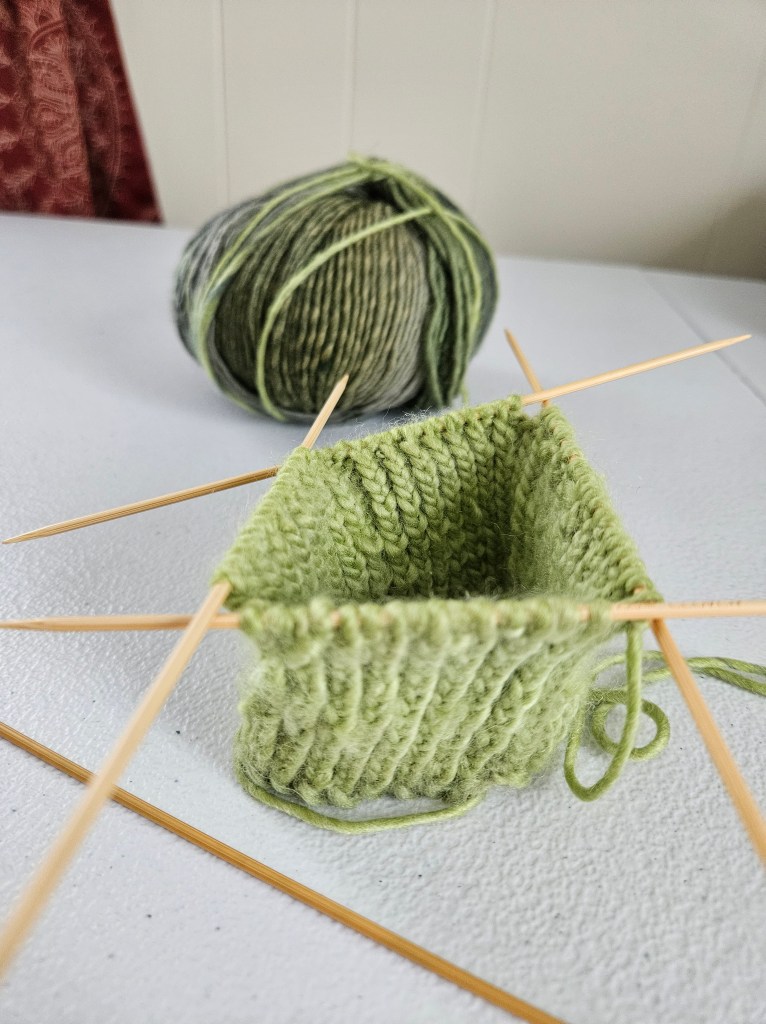
Several months ago, I started a new side quest in knitting – making socks. It’s a windy and treacherous climb, fraught with new equipment and an entirely new approach from a garment like a sweater. At the beginning it’s like casting on a mitten or a small hat, yet as time goes on you realize you are somewhere between a knitter and a sculptor, looking for the heel shape in your amphorous block of yarn. It is the most challenging garment I’ve made, culminating in going over the waterfall, at least that’s what turning the heel felt like at times.

What makes this ubiquitous garment so hard to learn? It’s a project of multi-tasking, like dribbling a basketball and moving at the same time. You are not only knitting a pattern – a sock, but you are also learning it on a new court – double pointed needles or with a magic loop configuration on circular knitting needles. There is also the third option, the one I leaned on when I was baffled by hitting gauge on my project and fed up with ripping out my progress over and over, knit flat tube socks that are sewn together to form the tubular shape.

My first two completed sets of socks were made this way, with straight needles to help me process all I was learning from these new techniques. It was the confidence boost I needed to keep going and finish the sock. I get overwhelmed in new projects when nothing is familiar but taking one part, flat knitting, and keeping that as the control part of the experiment let me knit and see how it should look and feel when the socks are completed. To better understand what I was working towards on double pointed needles or circular needles. Flat knitting also gave me the chance to try something I’ve never done before as a knitter, I cast on two socks at a time on my needles. It was incredibly satisfying to finish each sock at the same time!

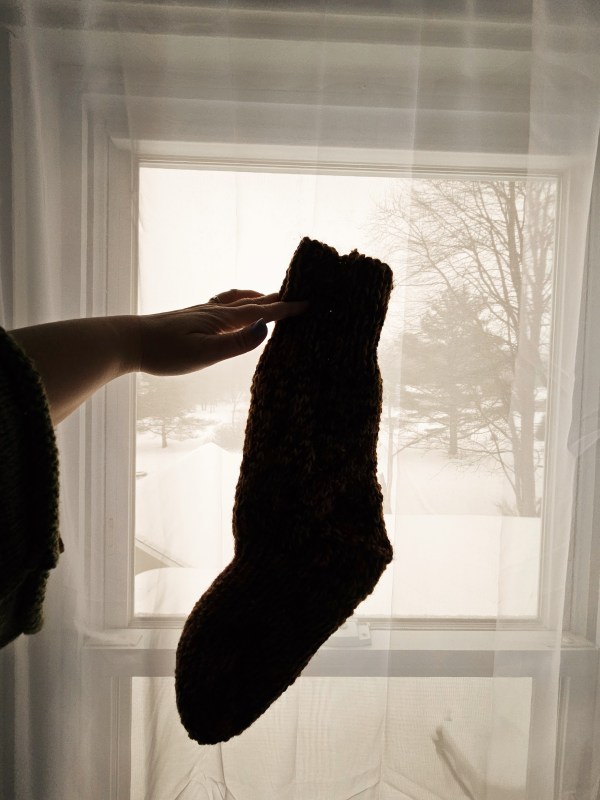
With this new found confidence I carried on and cast back onto the straight needles, making a brown pair of socks from recycled acrylic that wash and wear well. These green socks above are a blend that is mostly wool with a hint of acrylic in the yarn and they are hand wash or steam only for me. I wash them gently with either shampoo or conditioner in the sink, carefully to prevent felting. For my next project I wanted to explore fiber content, so I cast on a sock with three strands – two fingering weight wool and one acrylic. I chose this composition to test wear and washability, to make these a sock I could worry less about washing yet would insulate my foot, this was during a month long stretch of cold weather, dipping into the negatives fahrenheit so my mind was on cold weather. I decided to make these chunky socks into a sock I would use to insulate my L.L.Bean duck boots which are waterproof but are canvas, not insulated at all. They are a boot I want to wear for cold weather and snow, but they make my feet cold even with two pairs of socks.

As I got to the heel portion, I knit these socks cuff down, I made a last second decision and transfered my project to my round needles, joining the row into a round a stitches. With my heel turning reference book in hand I began turning that heel! It wasn’t as bad as I thought it would be! I don’t think I executed it perfectly, but I conquered a fear. Now, the tough part of the process is that my handwork for circular knitting is subpar. I hold my stitches too tight and the tension hurts my fingers the longer I knit on a project. The only way to improve this is to keep practicing, yet I don’t want to practice. The second sock is cast on but I have yet to make progress on project because I am dreading the circular process and those tight stitches that come from inexperience.

Is this sock the best fitting sock I’ve ever made? Yes! Is it better than store bought ones? A 1000% yes, and I’m a novice so they are going to get better with practice. It’s an art form we wear everyday without thought, but it is truly a sculpture of yarn. Next time you put on a sock, have a moment of appreciation for the geometry, the symmetry, and the sculpture adorning your foot.

Checker Board Pants: Making Pants From Your Favorite Jeans

In 2024, I was inspired to start making pants. I had attempted making pants before and they were successful but I struggled to make them feel like more than just a pair of lounge pants. Part of this was caused by not choosing a good bottom-weight fabric, and instead opting for a lightweight summer cotton that draped beautifully but didn’t give me that tailored look. I also tried an ill-fated scuba fabric in 2023 that crashed and burned because my thread tension was off. Enter this checkerboard denim print I purchased at Hobby Lobby. It was denim but lighter, not too heavy to be a problem for my sewing machine. But how would I find the right pattern?

I had a pants pattern in my stash for menswear trousers, that I considered using on this project. It’s a solid pattern and would make a straight-fit pair of jeans, maybe not the style I was going for though. I considered buying a new pattern, but then I fretted that the pattern would fit me weirdly or might not fit at all. The current style in 2024 still featured that tapered-in waist on pants that favor an hourglass figure, not my rectangle athletic build, so should I risk it? A big reason I chose to make pants in the first place was that I was sick of shopping and trying on pants that made me feel weird about my body. The men’s section was my go-to for their up-and-down pattern cutting, compared to the extreme tapering and high waist silhouette of women’s pants. Even low rise was stuck in mid-rise inseam, not the true low waist inseam I was accustomed to in the 2000s and early 2010s that helped me find good-fitting jeans because they favored my shape not the post-bbl world of fashion. I digress, my point is that buying a pattern someone else drafted felt like a risk because the fit is such a personalized thing.

My solution was to take a pair of pants in my wardrobe that I liked the fit of and to trace that pair of pants to gauge the shape. I did this with a pair of jeans that were high waist but had a nice loose fit through the hip and leg for the K-pop-inspired baggy jeans style I was interested in making with this 1990s Vans checker board print. This worked swimmingly! So much so that I traced the jeans onto a piece of brown craft paper for a quick pattern to reach for on future projects.

I chose to record this project, start to finish in video from instead of video to have a memory of how I did this to learn for myself and remember what I did but to also inspire others to try this. Pants are intimidating, especially from a paper or PDF pattern. The written instructions and diagrams have puzzled me in past projects but truly, pants are simple once you see how its done. I wanted to help others feel that freedom to create because at least in my American fashion market, fast fashion has destroyed the craftsmanship of pants and standardized sizing. I referenced this in a previous post, Shaping Up where I had to confront the dressing room terror of things not fitting and seeking to not be defined by my jeans size, when trends and pattern cutting shape shift sizes, but to take control of it on my end and get healthier in 2023.

This pants project was one of the most challenging and rewarding projects of 2024. I faced my fear of sewing denim, inserting pockets, and fastenings. I chose to not attempt a fly into I had more pants sewing experience, instead I planned to make what I knew I could achieve under my skill set. I opted for a side closer with a drawstring to have an adjustable fit since the denim had zero stretch. The denim containing no stretch was a feature I sought because I believed it would be easier to work with as it was my first project of this kind, and I wanted a crisp tailoring from the woven fabric. A key thing to note is that the jeans I used for my template also are non-stretch denim. For an accurate this is paramount or else the project will not work. Either you will cut your project too large or too small. It is also essential to leave a seam allowance on your pattern pieces. When self-drafting it is your responsibility to take charge of the seam allowances and plan ahead.

I messed this up with the crotch line and had to make a quick fix. My fix was a diamond gusset. Popular in women’s leggings, this diamond gusset shape piece allows for greater mobility while maintaining the strength of the seams.

The second challenge I faced was the problem of a narrow bolt and an all-over pattern. This fabric was quite narrow and because I was cautious with my seam allowance, I cut my pieces large. This meant that I was not cutting from the longest side, but the most wide. The pattern pieces were cut out missing length on the leg. My solution was to add on to the bottom and pattern match. It’s easier to match than people say, it just takes patience and intentional sewing. I’m pleased with how seamlessly I got my pieces to match up.

The pockets were a challenge. How do you place them? How do you insert them with strength so the pockets can be used without pulling the pants down or ripping? I chose to place them angled on the sides, aligned with my hips so that they would be practical and not create weird bunching at the front of the pants. No wonky crotch fit here!

Would you make your own pants? I hope I inspired you to get creative and go for it if you are sewing-inclined. Thanks, reader, for joining me once again on this quest to grow my fashion design skills. Have a wonderful day!

2025 Intentions

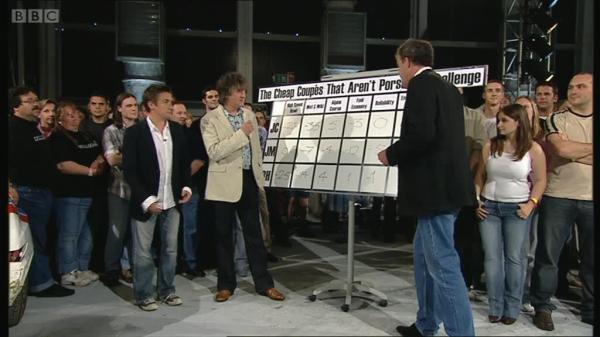
Have you ever watched one of the Top Gear UK challenges, from the good old days of Clarkson, May, and Hammond?

The amphibious cars, DIY caravans, lorry drivers, hot-hatchbacks, cheap Porsches, etc. There is one thing in common. There is a scoreboard, the points make no sense, it’s all a big laugh, and on that terrible disappointment, it’s time to end.
This is what I equate growing an Instagram was like in 2024.

I did the things. I’ve made many pieces of content across stories, reels, and posts. I’ve sewn and knit a varied amount of things. I’ve done silly trends, serious reviews, inspirational posts, filmed tutorials, recorded thoughtful voice overs, and participated in the “add yours” cards on stories.

I turned on metrics. I carefully analyzed posting times, consistently shared things to keep engagement up, took breaks to avoid spamming, carefully thought of 3-second hooks, transcribed subtitles, filmed artistic shots, and agonized over lighting. I networked, supported other creators, and tried to make genuine connections. Got burned a few times by people who only interacted with me for the follow and stopped talking to me and following me after months of supporting them. It’s tricky making friends on that platform. Connections are either amazing, lovely people, or not at all. I met several lovely people too, it wasn’t all bad.

I ended the year with higher engagement, more friends, and negative or neutral growth depending on the refresh. The metrics contradict themselves constantly. I’ve lost as many followers as I’ve gained. I’ve learned I had ghost followers who were keeping my engagement low. I also had accounts following me that left the platform through Meta’s deactivation due to idleness. It’s one of the worst algorithms, showing your followers your posts days after you share them. Zuckerberg, do better.

I ended 2024 feeling like I was on a Top Gear challenge. Meta added and subtracted points to my metrics total willy nilly, like Richard Hammond getting minus “exactly the points he had” so that he ends with naught. It was nonsensical and mind-boggling. This platform provides no satisfaction in what you accomplish.  I got one point here, minus a thousand there, 20 points for this task – yada, yada, yada.

So 2025, what am I doing with my time? What am I working towards? I am going to write more and move on from growing an Instagram account to open a shop. Not interested anymore. It’s not happening and I think it’s a blessing. Fiber art creation is going back to being a hobby. I’m not going to be a fashion designer, or a pattern designer, or a sewing educator, or a part of fixing fashion. I am going to make things I like and have fun, and share what I want where I choose for the fun of it. I have a backlog of projects that I haven’t shared here because of the distraction of Instagram. I am looking forward to writing more, new things, and celebrating the victory of finishing the Udal Cuain manuscript. Available to peruse here. I’m going to do art, I’m going to garden, to bake, learn things, and work hard. I’m excited about it. The key intention is to focus on fulfillment over productivity, and when my to-do list is crossed off to feel fulfilled, not productive.

What are your plans or goals for 2025?

Hot Air Balloon Knit Hat

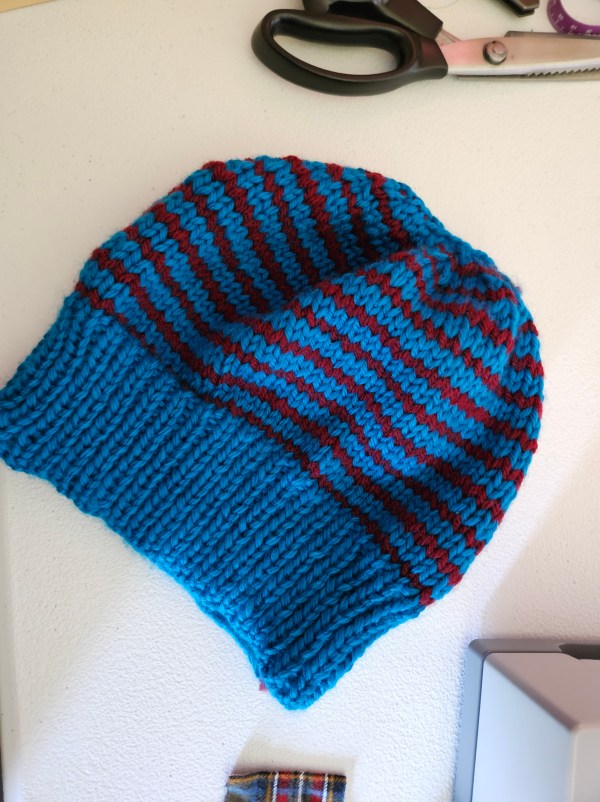
Do you ever pick up a knit object and the fiber feels buttery soft? That’s exactly how this cerulean blue yarn feels to the touch. It is a bulky weight yarn blend of super wash Australian wool and acrylic fibers. It’s a yarn that I believe has been discontinued by Knit Picks but I hope they bring it back because no project has been a joy to knit up like this one. It glided across my needles! It’s one of the reasons I chose to knit this fiber into a hat that would be soft and warm on my head. It’s cozy. Another reason was because this skein of yarn was a destash from my mom, there was only one skein so I decided to make it the focus of one small project.

I’m not very good at using one solid color throughout my projects so I paired this was a Brava bulky in red also from Knit Picks to add visual interest to the hat. I think it looks like a hot air balloon from an illustrated book. An imagination filled tale, like how the heffalumps and woosels turn into hot air balloons during Winnie the Pooh’s trippy dream during the flood. I love how bright the contrast is between the delicate red lines and the vivid water-like blue. It has a bit of the Apres-ski vibe with the vivid color story of the late 80s and early 90s.

I made this knit hat on size 10 bamboo straight needles in two pieces that I seamed together. I made the decision to construct this hat using two pieces because I had not made a hat in over a year and felt a bit rusty. I also wanted control of the taper of the crown, without needing to also refamiliarize myself with circulars or double-pointed needles. I made this hat in August 2024 and I was coming off the big move into the storage unit for two weeks and then into the new house. To be honest, I was feeling a bit creatively stir crazy from the busy summer. I’ve learned a lot since I made this from my dabbling with sock knitting and could confidently make this now with a different construction, but as a quick beginner project or knitting warm up when you’re feeling rusty it’s an easy to make project. I believe I made this over one weekend, potentially one day? I can’t remember how focused I was.

You will need a tape measure or a knit hat that fits you the way you would like your hat to fit for reference. Cast on stitches according to your head size for one half of your head. Knit ribbed stitches for 3 inches and then switch to stockinette for the rest of the hat. Switch yarn at the end of rows and don’t decrease too quickly. I’ve made this mistake before. You will need the width across your crown to join at the top and you can decrease quickly at the end so be filled with care as you taper and don’t hesitate to frog and try again for the right fit. Adding a safety line where you plan to unravel your project to, is a huge life saver! Mirror your second side and stitch the two halves together with a tapestry needle. An easy knitting project that is useful and can help you practice skills like purling, ribbing, yarn over decreases, crown shaping, and yarn tension.

Socks, A Journey

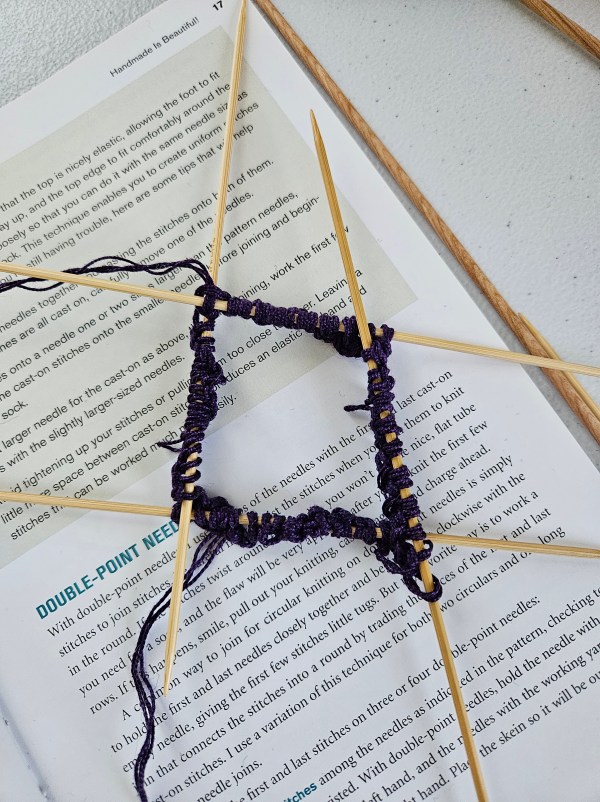
Today I completed the most stressful cast on of my knitting life, casting on a sock. This was with three strands of lace weight yarn and four double pointed needles, size US 1. Why double pointed needles? Why not! It got me out of my comfort zone and pushed me to be a focused, careful knitter with dexterity and cultivated patience for myself, the materials, and the technique.

Once the first round was joined, I felt the tension coursing through my body settle, like a war had been won in needles and yarn.

How will my first sock turn out? Who knows, but I’m optimistic. I have a sock knitting book, a step-by-step pattern, and properly gauged materials. I’d like to have cute socks to wear, the ruffly kind so here goes nothing! 😃

Create a website or blog at WordPress.com

Up ↑