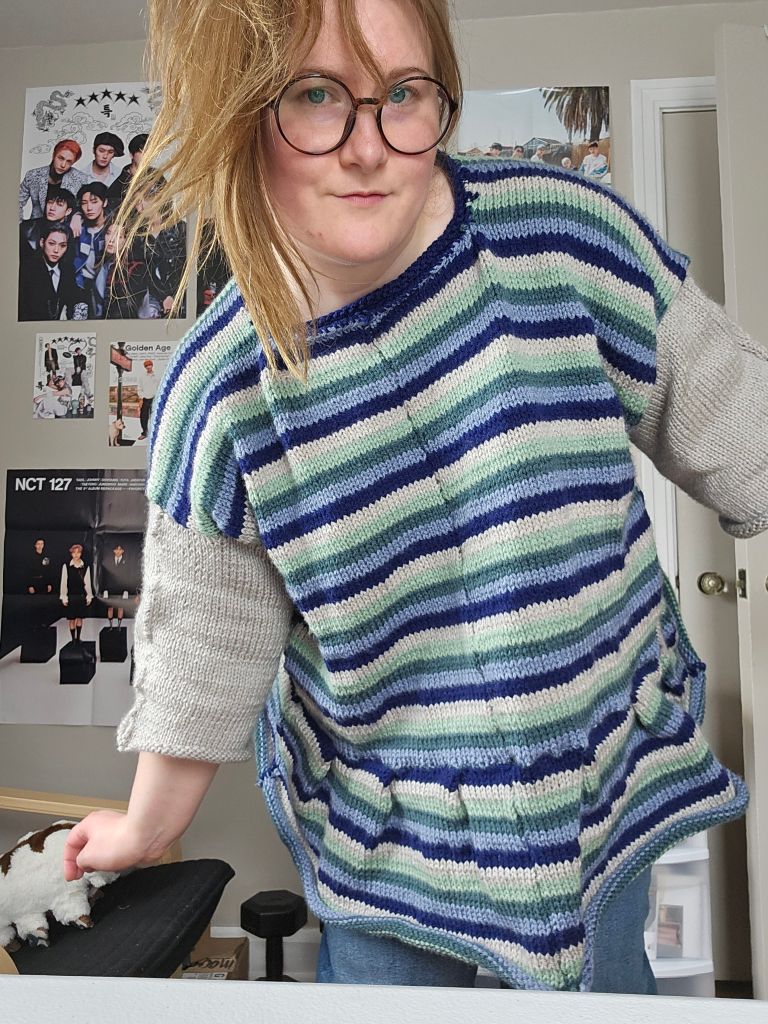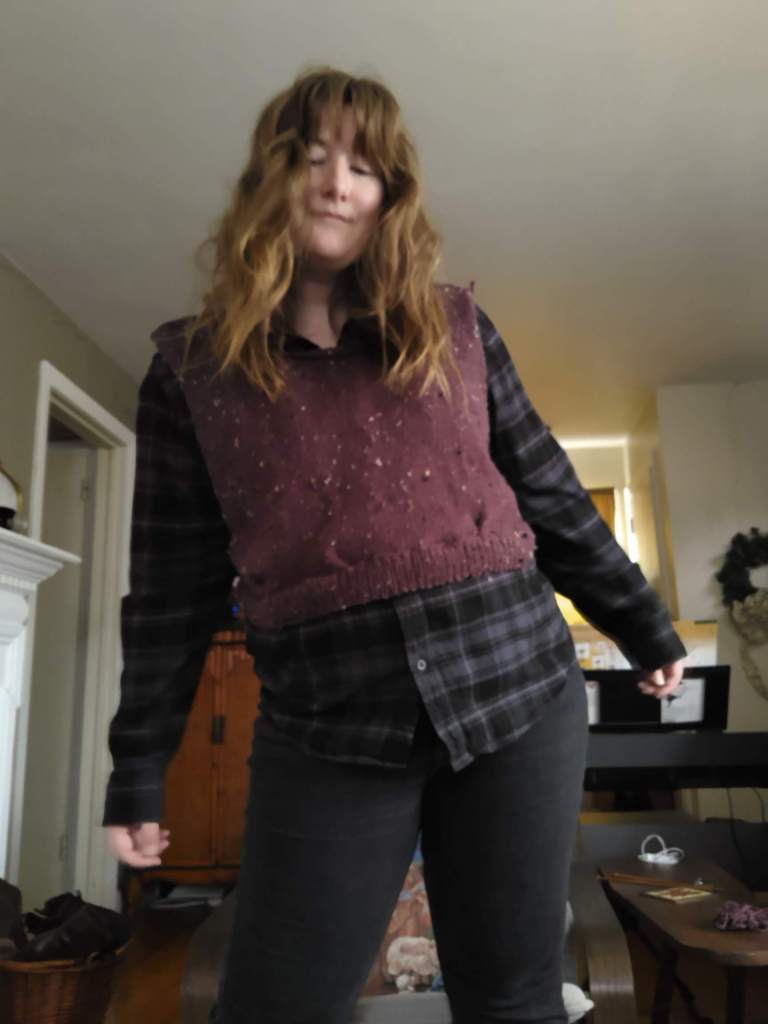
I Accidentally Felted My Magic of Scrap Cardigan

In the summer of 2024, I returned to an old fiber friend, wool, and introduced a new natural fiber – alpaca. When I began knitting in the early 2010s, I bounced between wool and acrylic fibers, not really looking at fiber content and instead looking at the pretty colors and my stitches so I didn’t drop one. Oh, how times have changed! When you love something you begin to obsess, dig, and it becomes a fiber woven into your identity. That’s where I found myself as a knitter for 10 years. I am constantly thinking about fiber content when planning a new project because it’s more than just the make that matters; it is how the garment is worn and washed for many years to come.

Wool

I think we have deep scent memories just like how wool fiber remembers the shape it is blocked into with water and pins. The scent of wool is woven deep into my memories of traveling to Ireland as a child in 2001. It is the fiber my Grandma wore most of the year. She was always cold, even in summer. Wool has always seemed a bit scratchy to me. It triggers my neurodivergent aversion to certain sensations. It was not a fiber I would choose to wear a whole sweater out of, although small accessories I could handle. Coats were fine too, until they weren’t.

After my grandparents passed away, within 6 months of each other I suddenly had things they used to own. Clothing being one of those things, a lot of those clothing items contained wool. I couldn’t stand the fiber being near me. I’d get a head, a migraine really. I’d feel stuffed up and allergic, at least I thought. From 2020-2024 I avoided the fiber. Begging my mom not to knit me anything in wool. I rounded up the wool items and put them in quarantine in a box in my house, the “allergy” being such a wave of anguish to my body. Looking back on it, I can see it was an expression of grief and stress. That smell of wool, it felt like a ghost lingering in the shadows of my mind not a normal fiber. Grief makes things so weird!

Acrylic

Under this belief of a wool allergy, I pivoted solely to cotton, bamboo, linen, and acrylic. If you are looking for a cheap and cheerful fiber acrylic is your yarn. It’s everywhere in the big box stores and that’s exactly what I did. I experimented with Red Heart, Big Twist, and Caron. They come in value packs and the worsted weight is an excellent fiber weight to use when learning how to create complicated garments such as wearables like sweaters that involve sleeves, shoulder shaping, and necklines. I’ve made a lot of mistakes along the way, it’s part of the learning process, yet using these affordable and easy-to-source yarn options took the trepidation out of the creating process.

Acrylic is seen as the “low-brow” yarn for a lot of the knitting community. It’s looked down upon for not being a natural fiber. Take organic and insert natural fiber and it is the same sort of elitism. But honestly, aside from how it’s made, acrylic being a polyester fiber, I don’t get the hate. It’s washable. These garments I was able to block in the dryer. As a knitter who was new to blocking this process taught me how and why blocking matters without the high stakes of felting, shrinking, or destroying my hard work during the wool sweater blocking process. It’s an approachable fiber for beginners.

Fiber Curiosity

Acrylic was my bread and butter, but after a while, we all crave some variety. For winter sweaters the other fibers – cotton, linen, and bamboo aren’t going to cut it. This is where some field trips came in! I’ve mentioned Keystone Safari before on the blog, it’s a wildlife preserve and education center in my region and they have sheep, alpacas, yaks, camels, and llamas. All of which I feed and pet without any allergies! This is where I began to question my “allergy” to wool. How could I spend time around these fibers, in their natural state where there would be more allergens like hay and not have a reaction (when I’m actually allergic to hay and grass)? It didn’t add up.

So in 2024, I began to run experiments. In the yarn shops, I’d pick up wool and alpaca-specific skeins and feel them in search of the truth! At my mom’s house, I’d ask her to see her skeins of wool and I’d do the same, even sticking them in my face, demanding they show me an allergic reaction. Nothing happened. Nothing. Could it be, that was I ready to find my true knitting form? A natural fiber artist, possibly a spinner, with a vast knowledge of wool, alpaca, mohair, and more? Yes, it was time.

Magic of Scrap Yarn Cardigan

So how does felting come into play in this story? It doesn’t sound like a story of woe, but it is. I was quite inexperienced with wool and how one cares for wool, that lack of experience came back to bite me with this lovely cardigan. I made this cardigan from wool extra skeins from my mom. Some of those skeins I put right up into my face to see if the wool would make me allergic. But this cardigan was not just a project of wool, it was a project made of extra wool skeins, wool-acrylic blend skeins, and acrylic skeins. Those fibers require different strategies to care for them properly.

This was my first mistake. I mixed fibers willy-nilly without thinking about each one has unique advantages and disadvantages. Wool is naturally anti-bacterial and requires very little cleaning. You can spot clean and refresh in the air or the snow. But you can’t throw it in the washer, and if you wash you must be gentle to the fibers with delicate movements and gentle water temperature, or else it will felt. Acrylic on the other hand is very durable. You can wash it in the washing machine without worrying about the possibility of felting the fiber. Acrylic fibers do not felt. It does not have anti-bacterial properties though so you clean it. Can you see where this is going? I screwed up the washing portion of this project.

I washed it in the washing machine without thinking and the cardigan shrank. Next, I tried to stretch the cardigan as it dried, while it was wet. Not gently, although the washer had already set the stage for stressed wool fibers. The cardigan no longer fit my person. To remedy this I thought I would hand wash delicately and attempt to re-block the cardigan. This was the nail in the coffin. This fatal mistake transformed the project from a knit cardigan to a felted mess. It was too far gone, like a burnt cooking disaster. There was no coming back from this, the damage was done.

I began to panic. How would I continue using wool and alpaca? I was currently knitting wool socks, um how was I going to wash those? Was I screwed? I was convinced I could never hand wash again without feeling sick to my stomach. I had to find a new solution. Steam. Steam was the answer. I have an iron, an iron with steam. Could I use this instead of purchasing a garment steamer? The answer amazingly was that simple! I steam my wool and alpaca projects now and the steam helps them bloom, they almost block from the steam along. It’s incredible. Just a little steam and the fibers refresh, safely! It’s transformed how I care for my knitwear. Sometimes these creative misfires lead us to places we may not have tried without the failure as a catalyst to try something new. I feel equipped to work with natural fibers, confident that if I spend months on a project I can care for said item for years to come. Have you tried streaming your wool garments before?

Magic of Scrap Yarn Cardigan

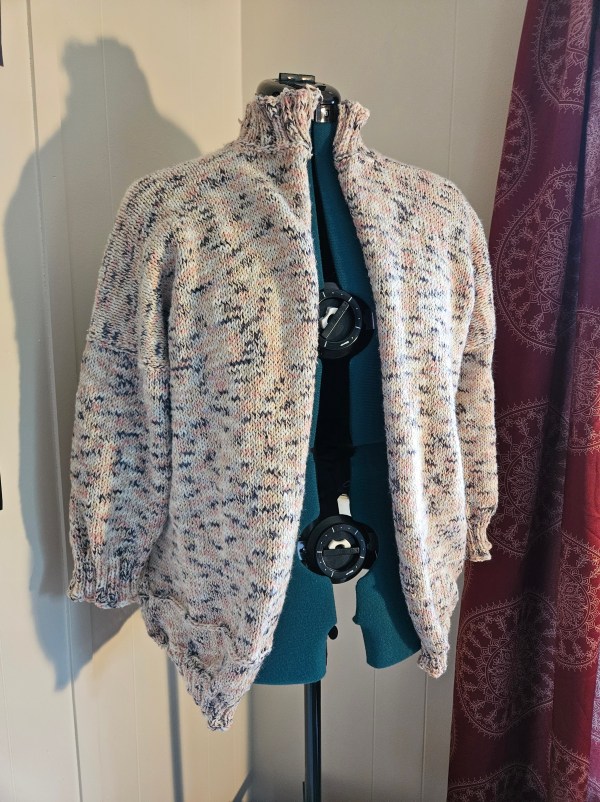
I was gifted a set of skeins. This yarn lot was made from peruvian wool, bulky weight in shades of slate gray, purple, and navy. It was some yardage but not enough to know what to use it for. 500-600 yards always trip me up. It’s close enough to be a garment so my mind wanders down that path, but too much to be an accessory, unless its a really extra, truly special accessory. I used to knit big scarves like that. I think maybe I got burnt out? Or maybe the scarf as a project feels like I am staying stagnant, not trying hard enough to make? I’m uncertain why I see it from a view point of melancholy.

Around the same time I was also passed down other bulky weight yarn, a green and red acrylic, a bright blue of wool-acrylic blend, and an olive green much chunkier fiber of many balls of yarn. More than I knew what to with. They were all random, similar im weight, and sort of related in color story. Aside from the red, the red was too bold.

Have you ever seen those absolutely scrappy sweaters? Those ones, usually worn by someone in Copenhagen or another chic city where the handknit garment is exquisitely random? A varied and unplanned web of yarn scraps, carefully made into a uniform pullover or cardigan. I love them. I pin them to boards. I save the posts. They fill the void of completeness of most projects, whether fabric or yarn, because they gobble up the bits left over, like a quilt, to rid the maker of left over yarn without wasting it.

So I made one.

The Candle Light Cardigan

Fall knitting is here! I’ve been working on this cardigan, off and on, amid a myriad of projects since July. As the days have passed, and a slightly cooler air awakens, I am thrilled to say this piece is ready to wear! I used to struggle to finish sweater projects and I would wander along with my yarn, for three or four months, dilly-dallying on a section because I was bored. This led to a lot of plans and not a lot of garments. This is in the past though. 2024 has been the year of sweaters for me, this being my seventh finished sweater this year! And its only September so I’m excited to see what else I can do in the last quarter of the year.

Do you remember what episode of Gilmore Girls this audio clip is from?

This Comfy Cotton Blend yarn from Lion Brand is a 1 to 1 ratio of polyester and cotton and the tag labels this color blend as chai latte. As I knit it, I saw it more as a banana split blizzard color and now in the spooky cloudy light of fall, I see it as candle light with highlights and shadows. Hence the name, the Candle Light Cardigan. I opted for now to keep this as an open cardigan without a button placket. Not out of laziness, but out of my intention to wear it. This was a cardigan I made specifically for the changing seasons, as a piece I could layer over my summer dresses and tops to get a little more wear out of them on these days when it is both cool and warm as the day progresses. I have two more yarn cakes of this color way which I can use to add a button placket at a later time if I change my mind.

I received this yarn as a gift from my mom as she was de-stashing it. It has been a lovely weight to knit and I like how soft it is. My only notes for Lion Brand would be to work on the splitting. This yarn split often as I was knitting which caught on my needles and led to messy stitches. Either because my needle held on to the stitch below or the yarn split and left some of the stitch behind. It was frustrating at times but not impossible to work with. The fabric it made has a good breathability and warmth to it which I was looking for in a changing seasons layering piece. This is a self drafted pattern that I knit on US 7 straight needles.

Happy Fall everyone one! (And Happy Spring to the southern hemisphere!)

To Hood or Not To Hood, That Was the Question

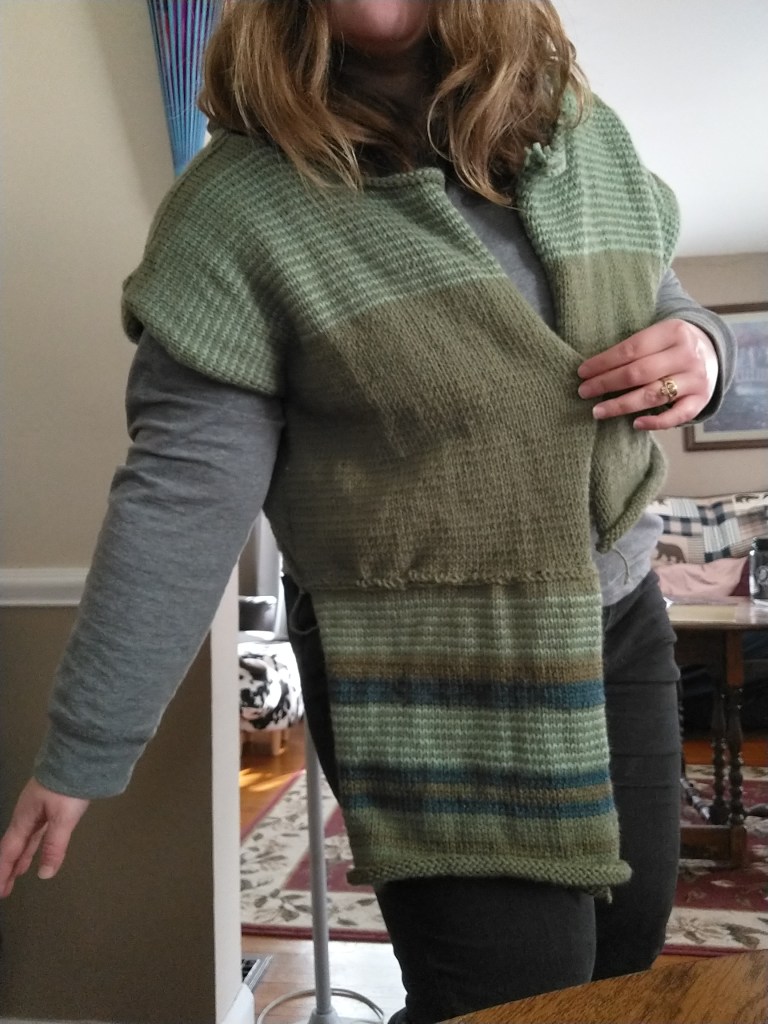
I’m currently working on a big knitwear design project. Probably the most ambitious project that I have taken on yet in my time designing knitwear and fabricating sweaters. It is a sweater coat with varying stripes that I have knit in sections over the past few months. I’m currently three months into this project, and per my working style, I’ve worked on smaller projects alongside this big project to keep me stimulated and my motivation high.

This was my progress at the end of September. I had the entire bodice done and sewn together at the shoulder seams, back seam, and under the arms until the point of the sleeve opening. Because I sew, this process of knitting makes more sense to my creative brain than the knitting in the round process. If this type of knitting drives you nuts, it’s only going to get worse so I warned you. 🙂

September Progress

October Progress

In October, I honestly futzed around with the hood and collar and that was about it. I knit one other body panel so two out of four were done and drafted collar and hood patterns, over and over again. I initially expected to make more progress in October and to have just the sleeves left going into November. That didn’t happen.

It was that dang collar and hood section, that kept me in this place of indecision and design frustration. I initially made a collar with a normal stitch, not a ribbed which looks a bit cleaner. I think I was concerned about the collar looking cohesive and was afraid that a solid collar in rib instead of a knit-purl stitch with a stripe would look less cohesive. It looked odd actually. The stripe was good, but the flat collar which began to roll on the end looked ineffectual for a collar. After I sewed it in I carefully cut the collar away which was discouraging from a progress perspective, until I realized the stitched of the collar remained (because I was afraid of snipping the wrong yarn and destroying the shoulders) and the neck opening had this lovely fit and structure now. The shoulders were slightly gathered up to the neck opening and the fit was fantastic now! It just needed a new collar.

I had an idea – what if instead of a collar I went straight to a hood. I had been watching a lot of Gilmore Girls throughout October, seasons four and five to be exact which spanned the years of 2003-2005, peak 2000s fashion. And you know what was popular during this time? The duster! I had an idea, what if the hood was just one piece of this puzzle, what if I made it longer, much longer, added a hood, a rib trim around all the edges with a button closure! A funky duster the likes of Sookie, the Olsen twins, Lindsay Lohan, and even Lorelai herself would have worn during this time.

I knew I wanted to keep the stripe theme going, something that looked labor-intensive and expensive, like a bohemian duster or sweater coat that would be featured in an Anthropologie campaign. I wanted the hood to carry on that stripe motif to make it feel integral to the garment, not an add-on.

Last October, I learned how to draft hood shapes for several outerwear pieces that I crafted for my loved ones as a part of my Potato Technology’s Autumn/Winter 2022 Collection so I am pretty comfortable with the shape and sizing scale for a hood on an outerwear garment. The thing I underestimated though was how tricky it would be to form the hood as I went, as you do with knitting, instead of cutting the hood shape out of fabric. This kicked my butt. I spent a weekend making one half of a hood out of yarn and it was so cursed. When I took it off the needles it didn’t look like the hoods I had created out of fabric and thread. It was lumpy, too short, and not going to work for what I needed.

Once again, I got my scissors out cut the bind off loose, and proceeded to wind the yarn back into a ball. That is when I decided I had to move on to a new section of the project, for my own sanity. Because I still didn’t know how the hood became misshapen in the fabrication process. None of it made sense. Going straight back into making a new hood when I didn’t know how to solve the problem would be a waste of time and resources. I only have one set of size 7 needles, there was no need to tie them up in another likely failed attempt.

I pivoted to the the length of the duster. To make the bottom have more structure I decided to knit this section in two pieces.

November’s Progress (11/16)

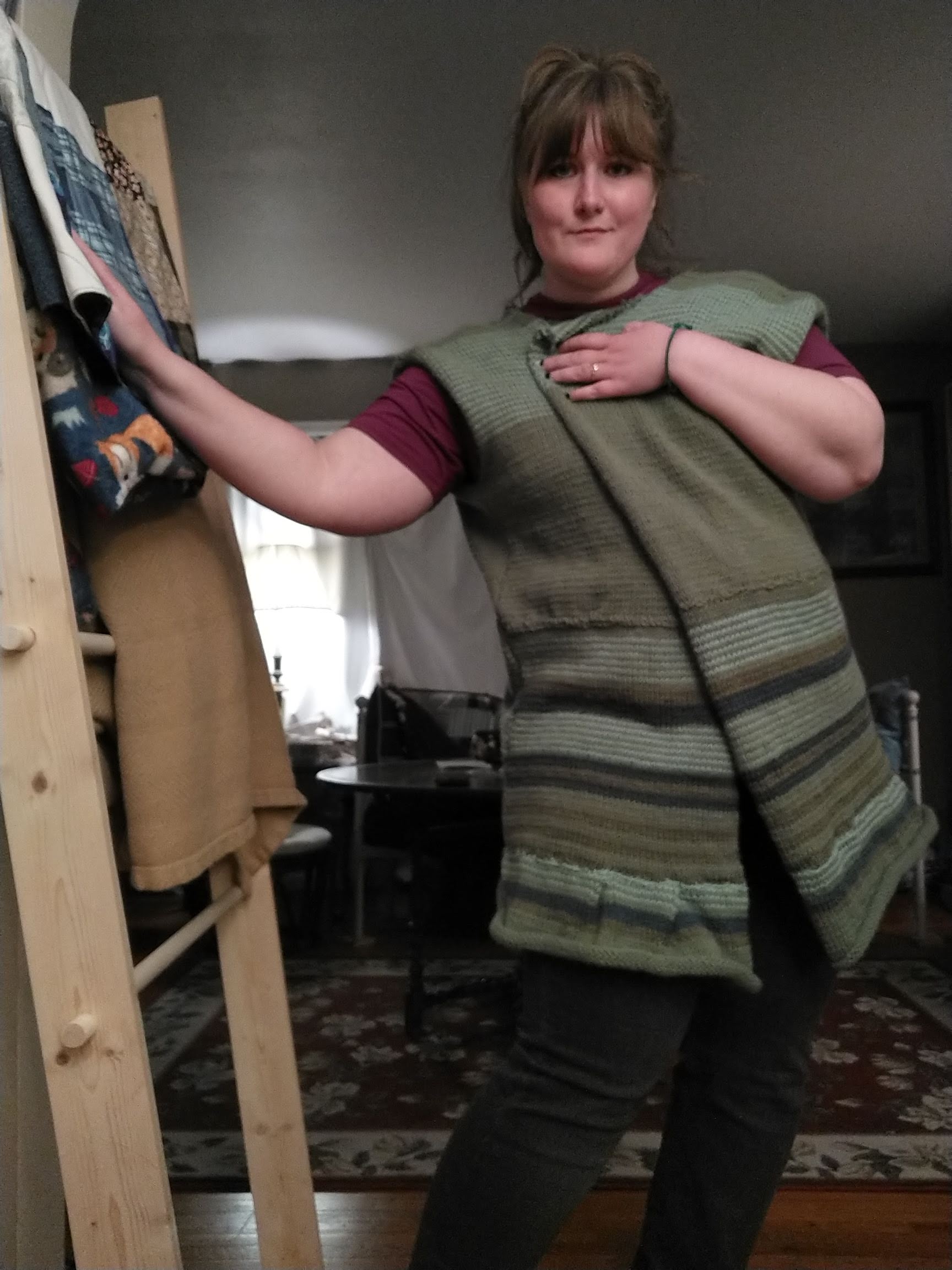
This was a good move. I made the first half 30 stitches wider than the previous body panels to create some drape around the hips and the results are cute. The sweater has this sophisticated little flare that accentuates the waist – I was not expecting that! 🙂

With this step in the right direction, I got to work and powered through the last two body panels and the second flare panel at the bottom. It was a lot of work but only took two weeks to complete with focus, stretching, and snacks.

I have a tendency to let the garment lead me. I like to see how the fabric or yarn responds to the vision I have in my head and adjust the design accordingly to the way the project is coming together. The flared panels at the bottom of the sweater inspired me to pivot again, to step back from the hood and long duster to a sweater coat cardigan that could be buttoned into a sweater dress if I would be inclined to wear it as such.

That’s where it stands now. I began drafting a sleeve and designing the color work I had planned for the stripes before I continued any further because I could change my mind and add more length. The hood is out through, it’s just not the vibe.

When will this project be done? I sure hope by the end of 2023, but we shall see.

Create a website or blog at WordPress.com

Up ↑