Do you ever get stuck in start mode when beginning a new thing?
Like you’re wandering through a maze of ideas. Maybe it’s the planning stage, too many ideas, not enough organization? It’s weird. I feel such a rush when I have multiple WIPs on my needles. The satisfaction of binding off stitches and slipping that garment onto my body makes every week of work worth it!
The void though, between new idea and casting on a new project, is a shape shifting process. The indecision sets in.
What yarn should I use?
Do I have a color palette
Stockinette or a new stitch?
Texture?
Colorwork?
Do I have an inspriation garment in mind?
Have I thought about how I want to garment to fit?
How much positive or negative ease should I plan for?
The next phase is choosing needles, selecting the amount of yardage, and gauge swatching the stitches to inches ratio to calculate the size of the garment.
It feels as important to start with the correct amount of stitches as it does to pour a concrete foundation evenly. I think this is why I get stuck in neutral instead of shifting into gear – when you get a creative idea sometimes the final design outcome is a little fuzzy.
So how do I get out of it and move forward with my design? I sketch, even simply shading the colors together in simple patterns helps me see if the image in my head will fit the realized garment. I also start working with the room to frog the yarn and begin again.
That is my favorite thing about fiber art, you can tear out and begin again without ruining your materials. Even though the first stitches feel like concrete the process is flexible.
Do you get stuck in planning? How do you move your mind forward? Thanks for spending time with me today. You are amazing and I hope you know that you are loved. Until next time. ❤
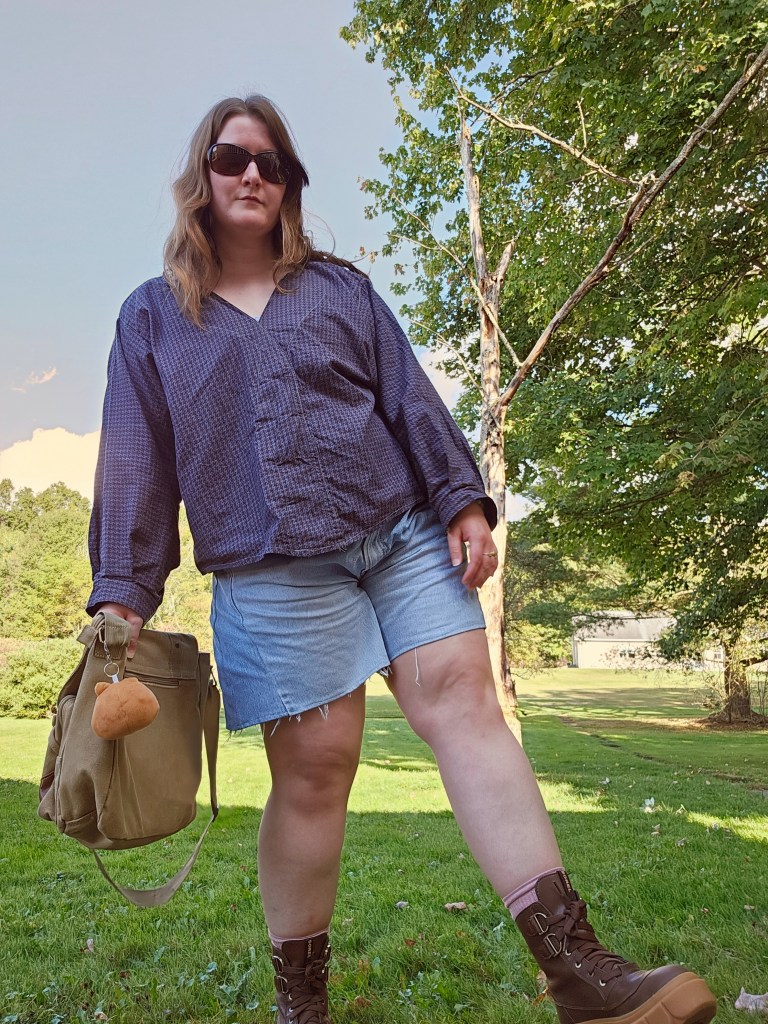
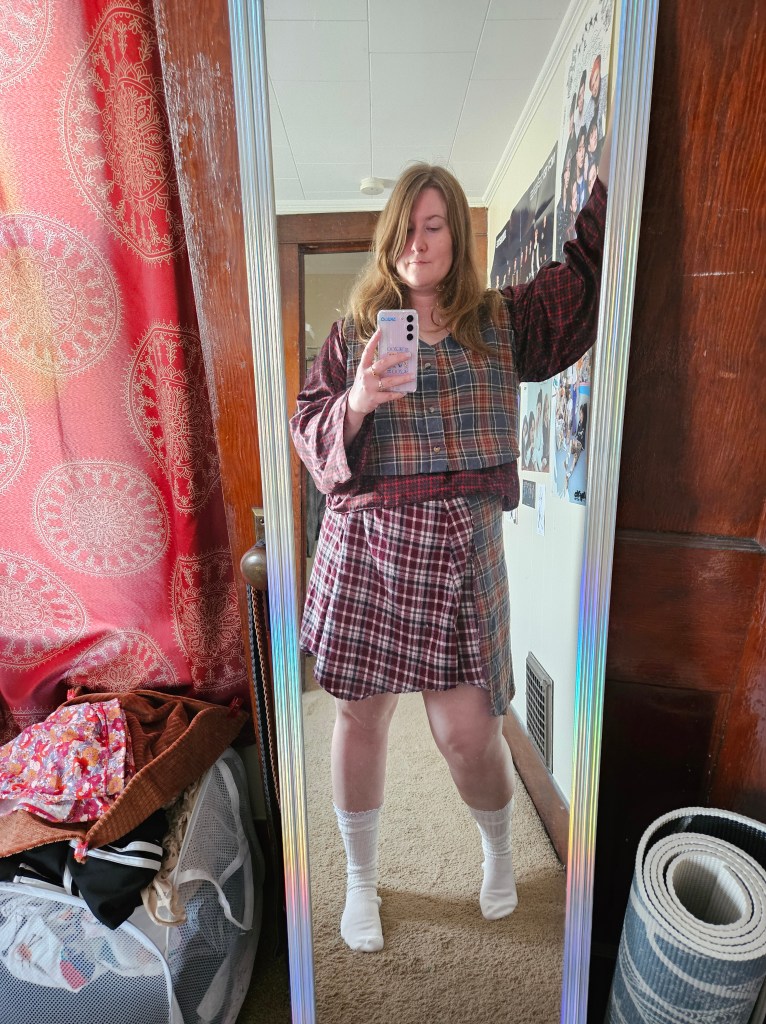
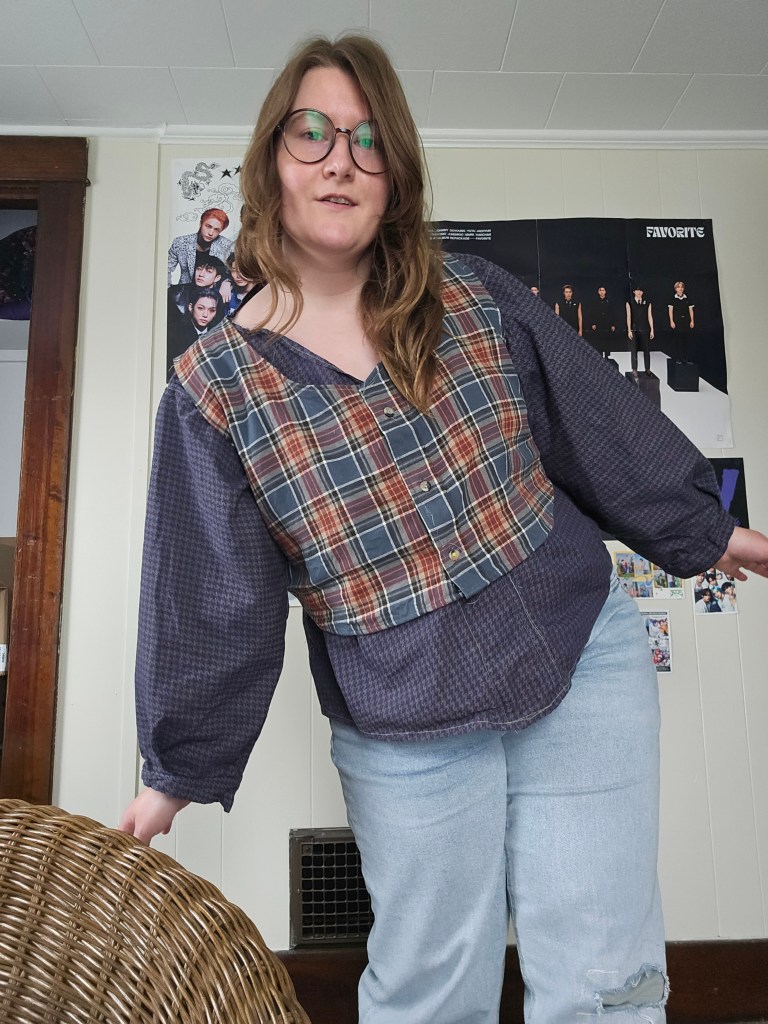
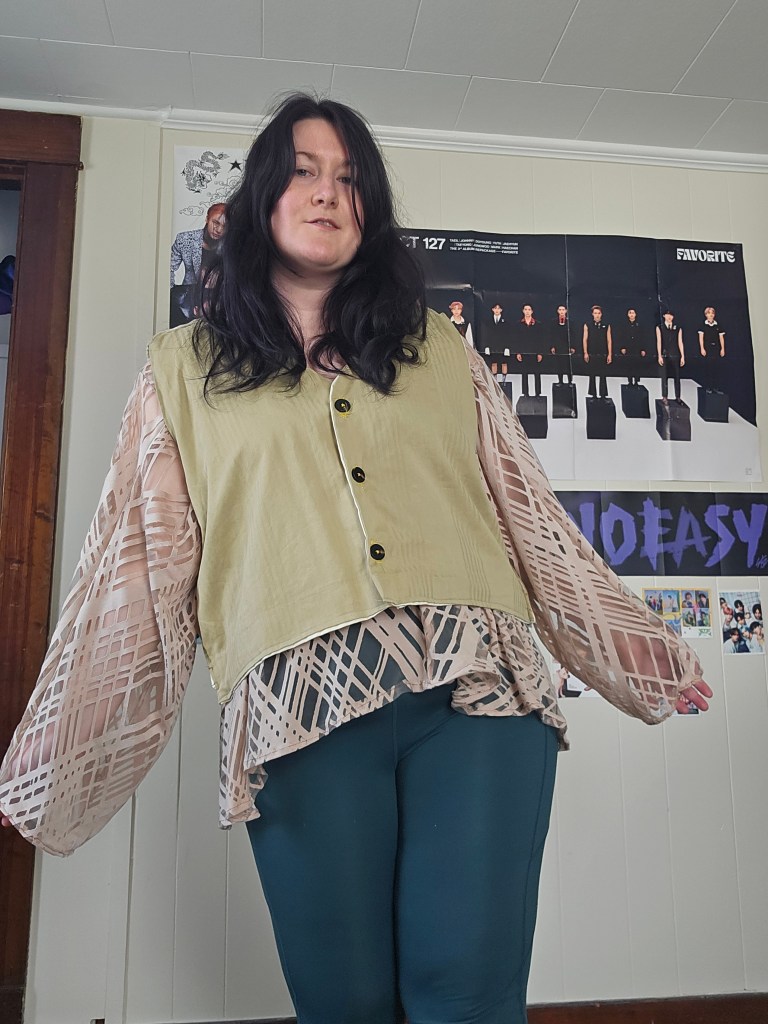
This collection was about upcycling, trying new techniques, and making things that expressed what I like wearing based on previous designs I have made, but with a twist. The items I designed were 75% sourced from existing materials. They were upcycled from items in my closet, hand-me-downs from my mom or grandparents. They were made from destashed yarn I acquired or fabric that had been in my stash for a long time. I focused more on creating with natural materials like wool, linen and as always, I love cotton.
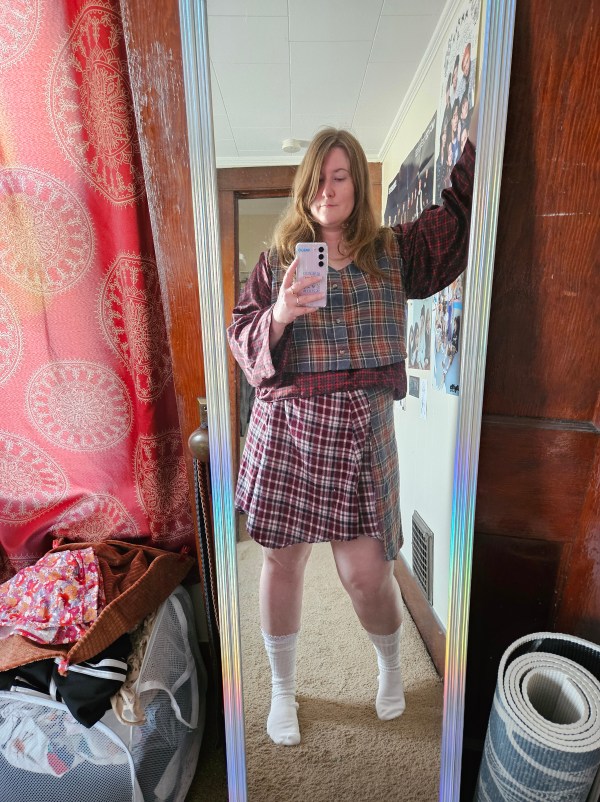
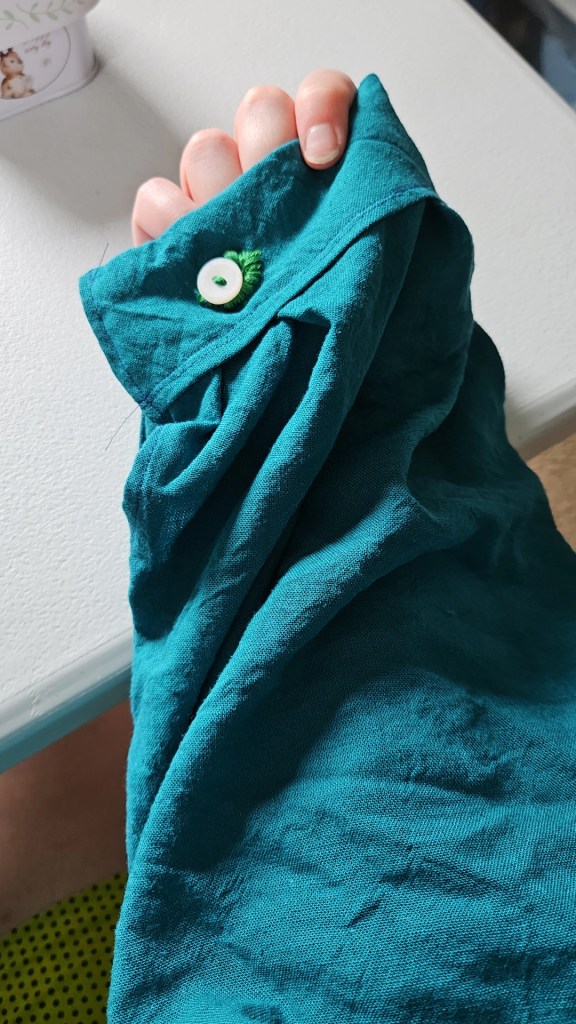
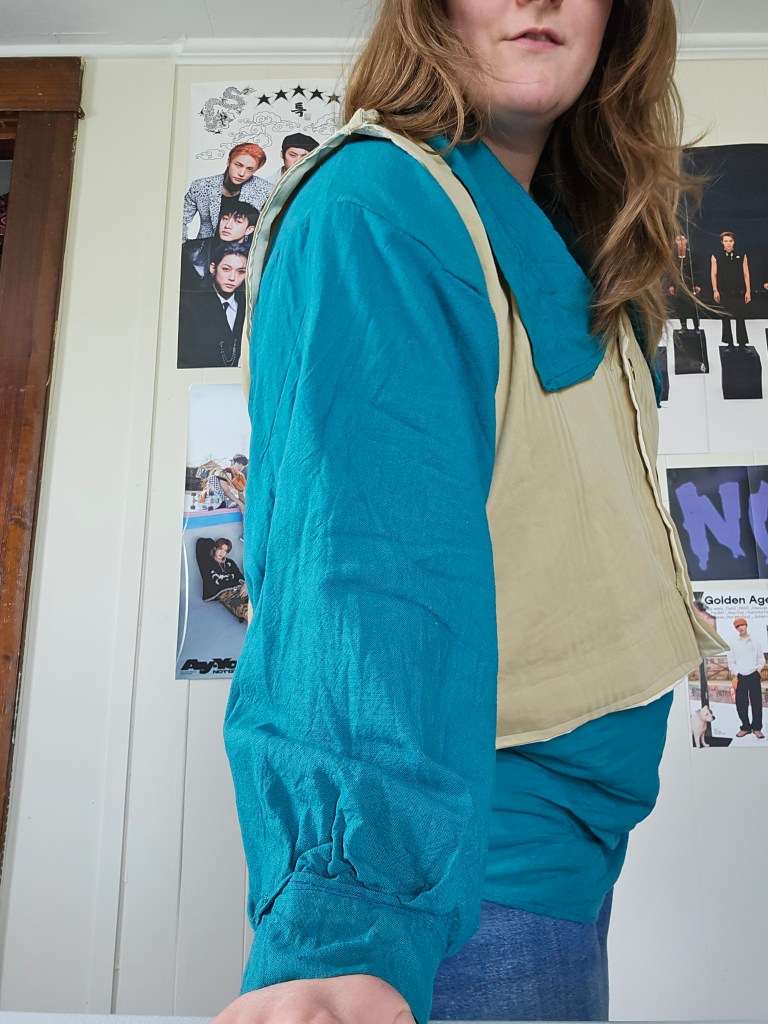
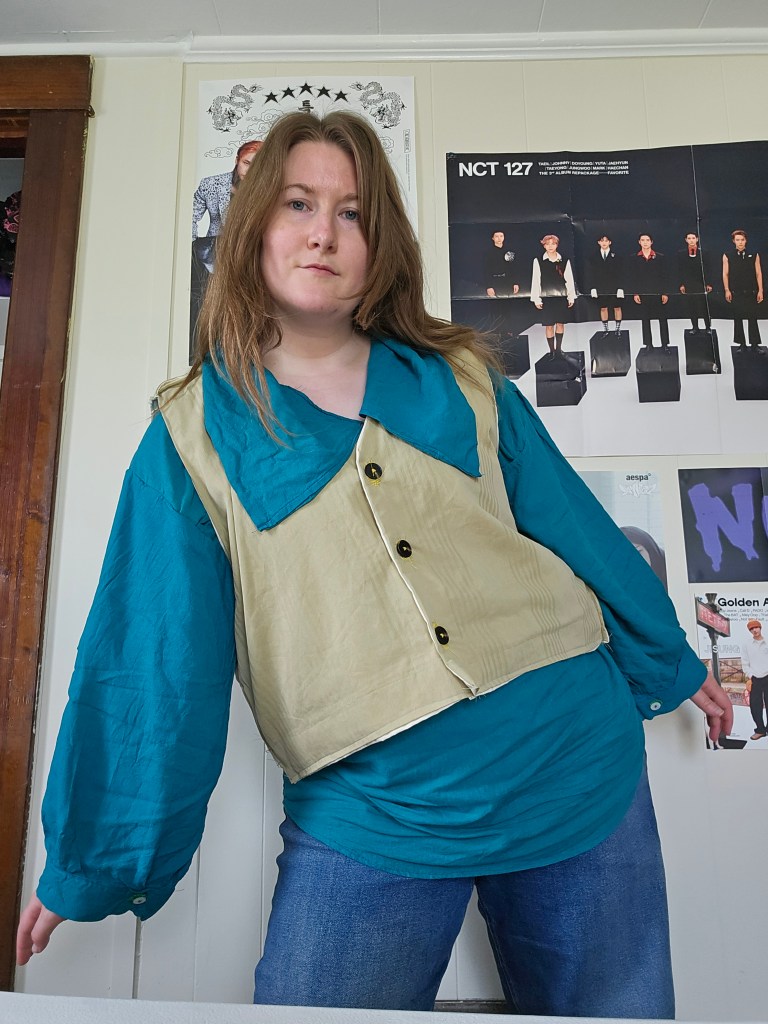
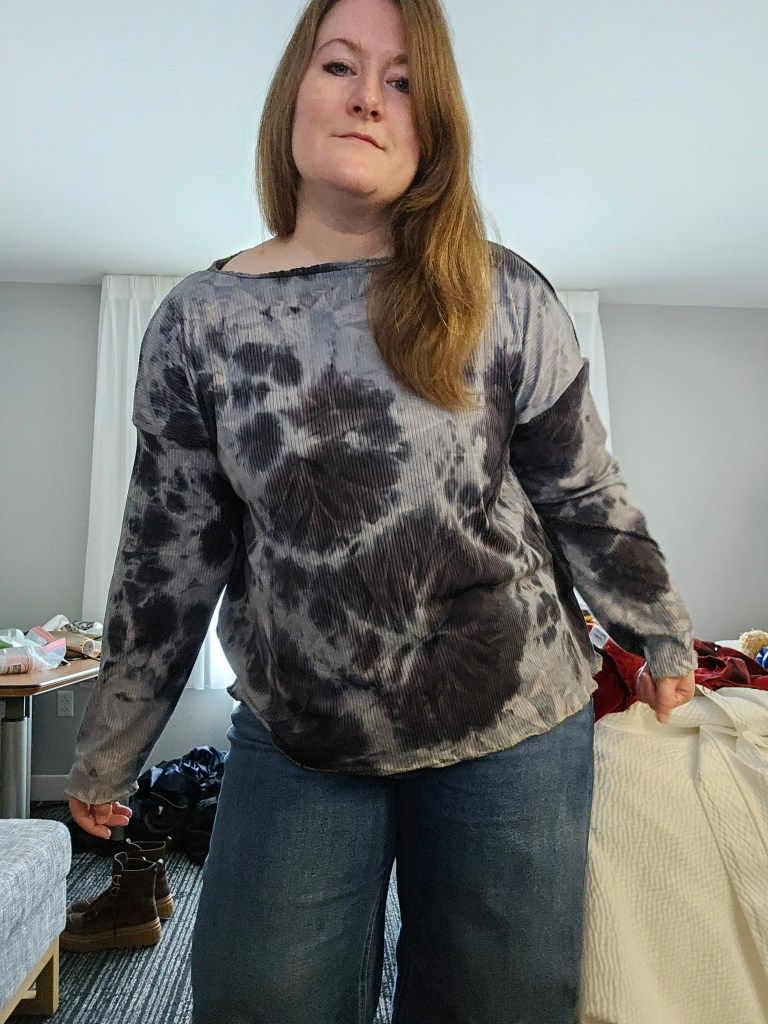
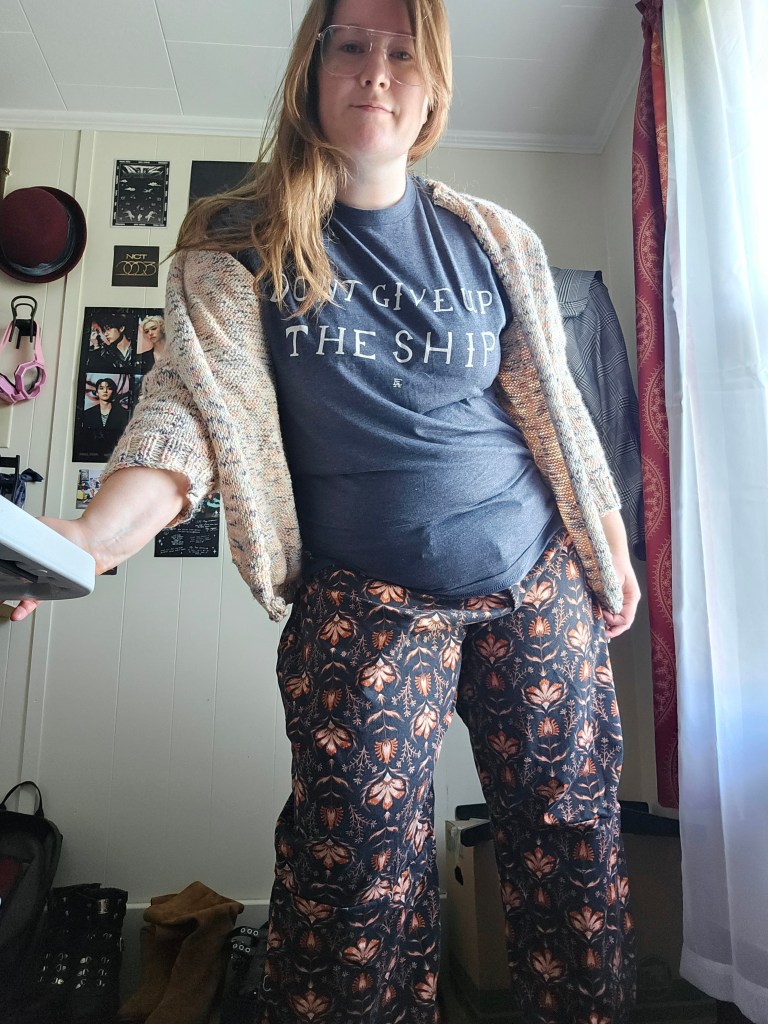
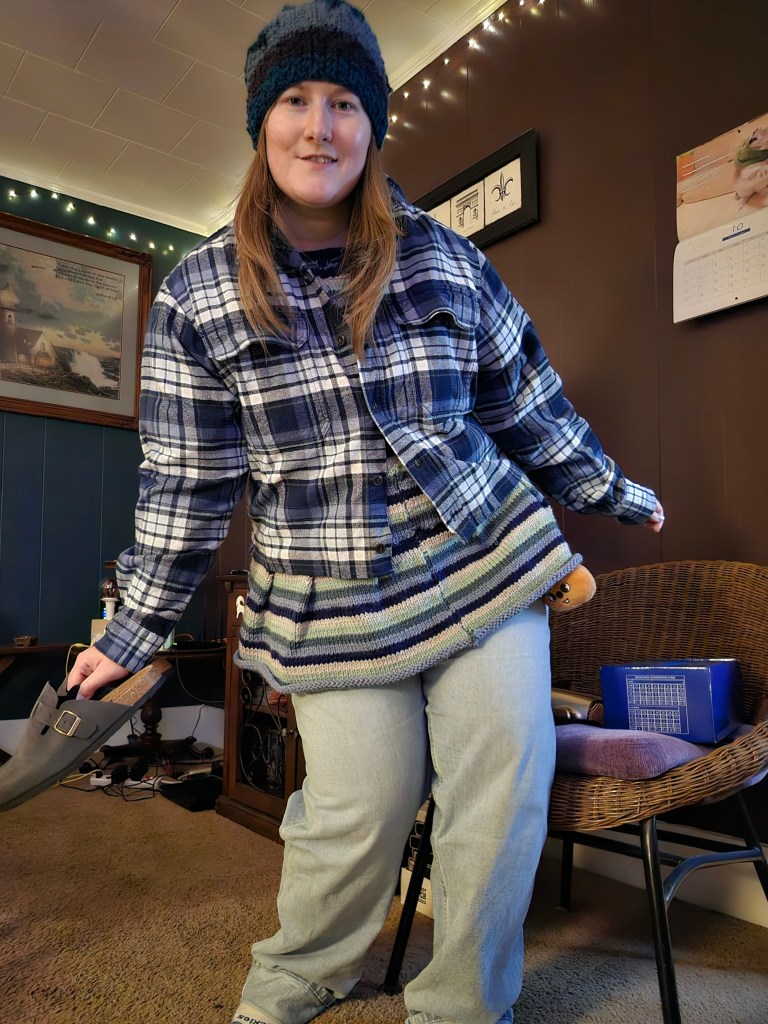
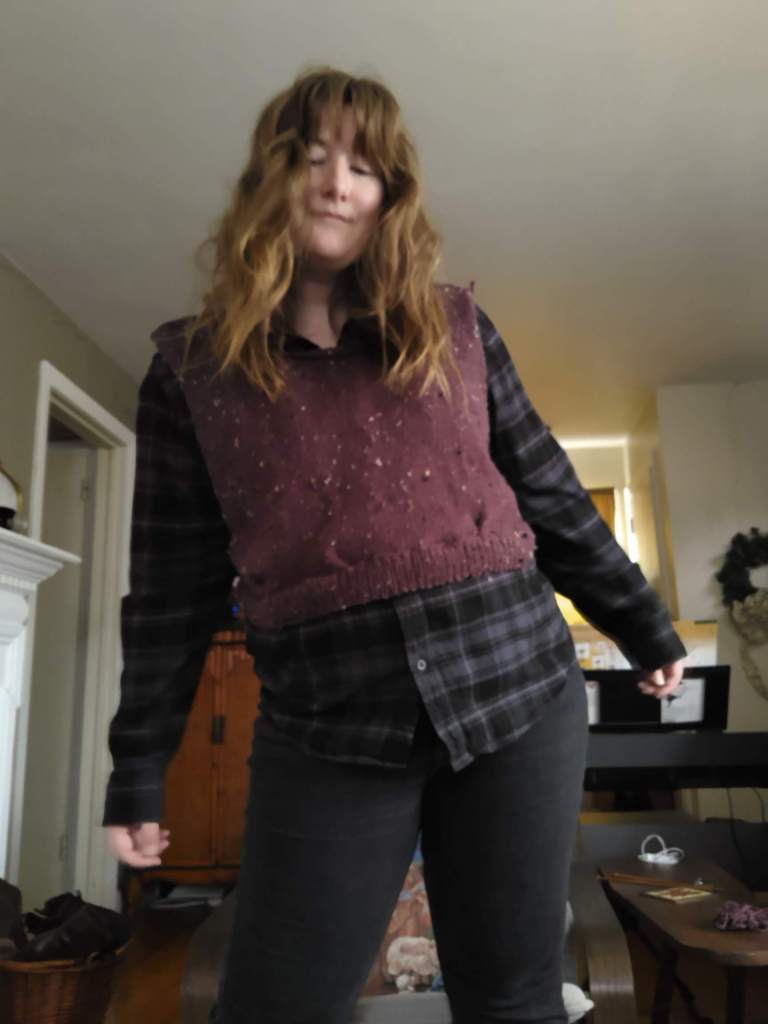
Vests were made from pillow cases and flannels. I re-worked a sweater from the existing sweater and leftover yarn. I dyed denim, deconstructed denim, and made some interesting new shorts and skirts. I combined leftover flannel from Christmas stockings to create a plaid and denim kilt. I used the cut-off sleeves of flannels from my vest projects to create a skirt from four flannel sleeves. I dove deeper into the world of trousers with two new patterns – a floral and railroad stripe. With each pair, I experimented with fastenings and pockets. I constructed my first “Mr. Darcy” shirt from teal linen using Bernadette Banner’s instructions for the body. I put my own spin on the collar, choosing a wider collar similar to a sailor collar that is popular in anime and J-fashion.
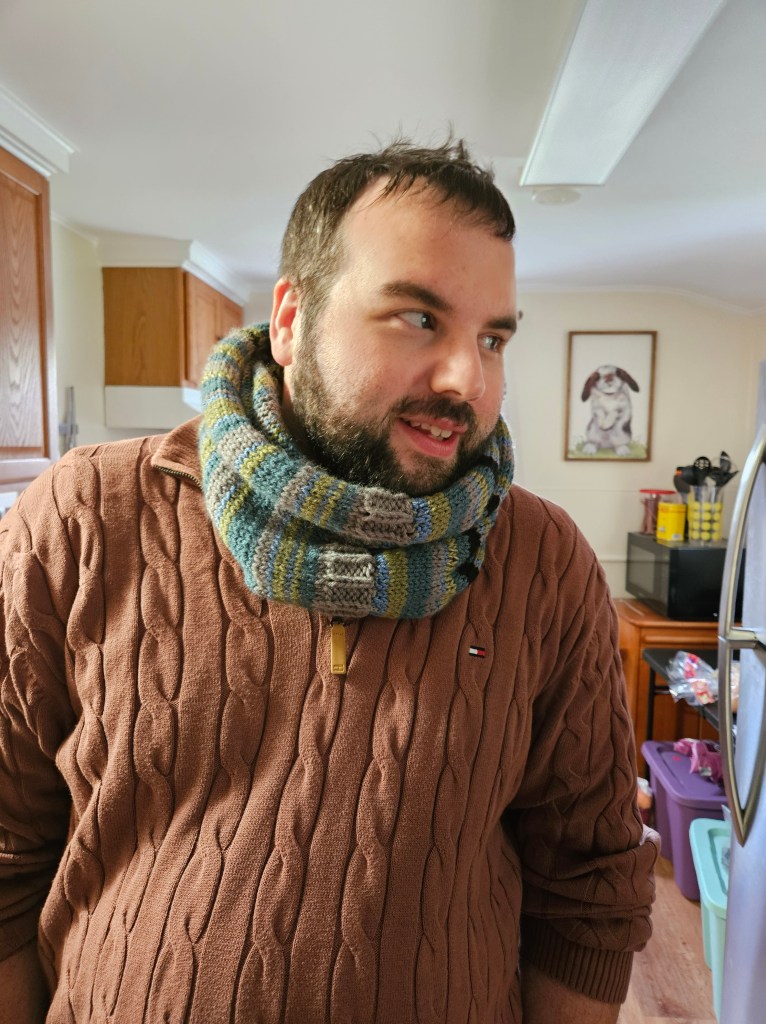
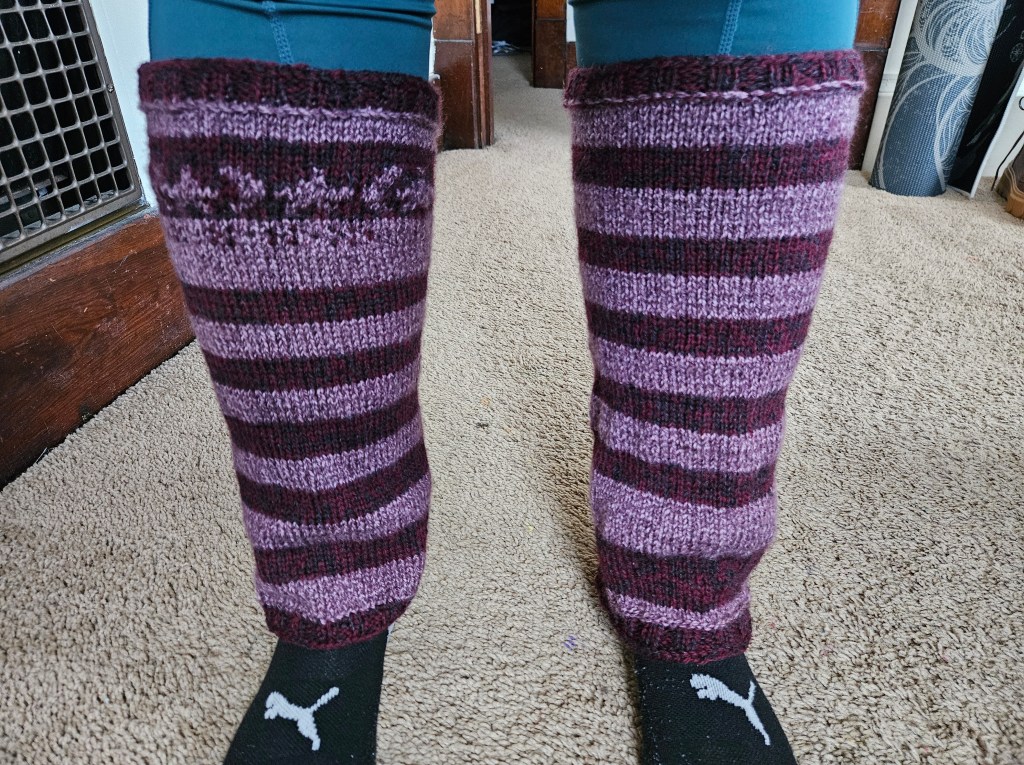
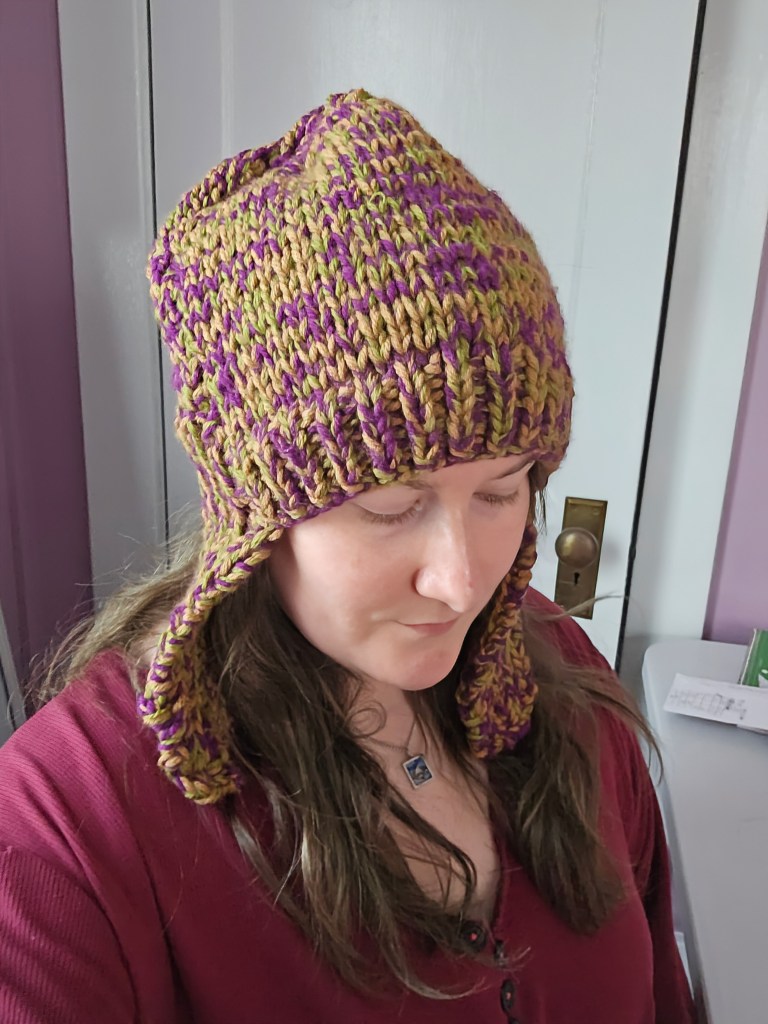
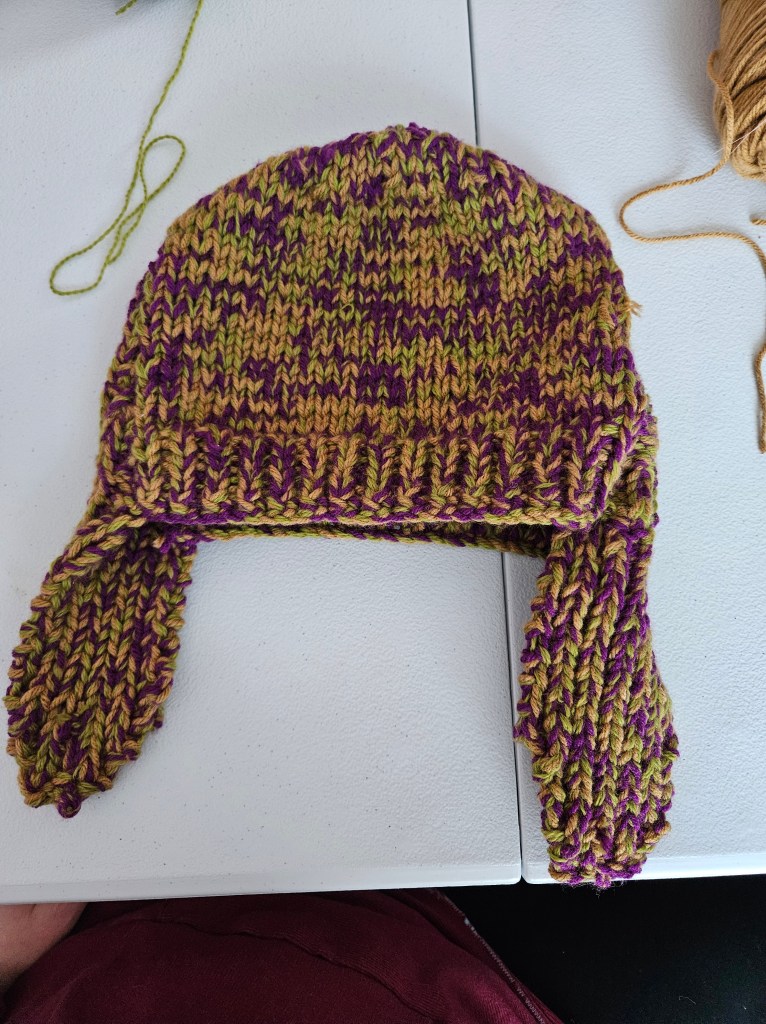
This was the first season I experimented with colorwork in knitting. I made a knit star motif hat from yarn that was leftover from my Magic of Scrap Yarn Cardigan. I made leg warmers, a squirrel motif mitten, and a melange of acrylic and wool to create this ear flap hat that reminds me of medieval European helmets. Although this season of creation was chaotic, I’m not sure if I even included all the projects I worked on, it was a time of great learning. It taught me that fashion design is more than taking raw material and cutting it into a new form.
Great design utilizes new and old. Fashion is about reusing, not wasting, and making things beautiful with careful craftsmanship. It does not mean it needs to be expensive, or need to be made by a great master couturier, it just needs to serve a purpose. We have lost sight of the purpose of fashion, but these projects of upcycling have reminded me that fashion is more than shopping, it is more than consumption, it is about the materials, the vision, the function.
In the summer of 2024, I returned to an old fiber friend, wool, and introduced a new natural fiber – alpaca. When I began knitting in the early 2010s, I bounced between wool and acrylic fibers, not really looking at fiber content and instead looking at the pretty colors and my stitches so I didn’t drop one. Oh, how times have changed! When you love something you begin to obsess, dig, and it becomes a fiber woven into your identity. That’s where I found myself as a knitter for 10 years. I am constantly thinking about fiber content when planning a new project because it’s more than just the make that matters; it is how the garment is worn and washed for many years to come.
Wool
I think we have deep scent memories just like how wool fiber remembers the shape it is blocked into with water and pins. The scent of wool is woven deep into my memories of traveling to Ireland as a child in 2001. It is the fiber my Grandma wore most of the year. She was always cold, even in summer. Wool has always seemed a bit scratchy to me. It triggers my neurodivergent aversion to certain sensations. It was not a fiber I would choose to wear a whole sweater out of, although small accessories I could handle. Coats were fine too, until they weren’t.
After my grandparents passed away, within 6 months of each other I suddenly had things they used to own. Clothing being one of those things, a lot of those clothing items contained wool. I couldn’t stand the fiber being near me. I’d get a head, a migraine really. I’d feel stuffed up and allergic, at least I thought. From 2020-2024 I avoided the fiber. Begging my mom not to knit me anything in wool. I rounded up the wool items and put them in quarantine in a box in my house, the “allergy” being such a wave of anguish to my body. Looking back on it, I can see it was an expression of grief and stress. That smell of wool, it felt like a ghost lingering in the shadows of my mind not a normal fiber. Grief makes things so weird!
Acrylic
Under this belief of a wool allergy, I pivoted solely to cotton, bamboo, linen, and acrylic. If you are looking for a cheap and cheerful fiber acrylic is your yarn. It’s everywhere in the big box stores and that’s exactly what I did. I experimented with Red Heart, Big Twist, and Caron. They come in value packs and the worsted weight is an excellent fiber weight to use when learning how to create complicated garments such as wearables like sweaters that involve sleeves, shoulder shaping, and necklines. I’ve made a lot of mistakes along the way, it’s part of the learning process, yet using these affordable and easy-to-source yarn options took the trepidation out of the creating process.
Acrylic is seen as the “low-brow” yarn for a lot of the knitting community. It’s looked down upon for not being a natural fiber. Take organic and insert natural fiber and it is the same sort of elitism. But honestly, aside from how it’s made, acrylic being a polyester fiber, I don’t get the hate. It’s washable. These garments I was able to block in the dryer. As a knitter who was new to blocking this process taught me how and why blocking matters without the high stakes of felting, shrinking, or destroying my hard work during the wool sweater blocking process. It’s an approachable fiber for beginners.
Fiber Curiosity
Acrylic was my bread and butter, but after a while, we all crave some variety. For winter sweaters the other fibers – cotton, linen, and bamboo aren’t going to cut it. This is where some field trips came in! I’ve mentioned Keystone Safari before on the blog, it’s a wildlife preserve and education center in my region and they have sheep, alpacas, yaks, camels, and llamas. All of which I feed and pet without any allergies! This is where I began to question my “allergy” to wool. How could I spend time around these fibers, in their natural state where there would be more allergens like hay and not have a reaction (when I’m actually allergic to hay and grass)? It didn’t add up.
So in 2024, I began to run experiments. In the yarn shops, I’d pick up wool and alpaca-specific skeins and feel them in search of the truth! At my mom’s house, I’d ask her to see her skeins of wool and I’d do the same, even sticking them in my face, demanding they show me an allergic reaction. Nothing happened. Nothing. Could it be, that was I ready to find my true knitting form? A natural fiber artist, possibly a spinner, with a vast knowledge of wool, alpaca, mohair, and more? Yes, it was time.
Magic of Scrap Yarn Cardigan
So how does felting come into play in this story? It doesn’t sound like a story of woe, but it is. I was quite inexperienced with wool and how one cares for wool, that lack of experience came back to bite me with this lovely cardigan. I made this cardigan from wool extra skeins from my mom. Some of those skeins I put right up into my face to see if the wool would make me allergic. But this cardigan was not just a project of wool, it was a project made of extra wool skeins, wool-acrylic blend skeins, and acrylic skeins. Those fibers require different strategies to care for them properly.
This was my first mistake. I mixed fibers willy-nilly without thinking about each one has unique advantages and disadvantages. Wool is naturally anti-bacterial and requires very little cleaning. You can spot clean and refresh in the air or the snow. But you can’t throw it in the washer, and if you wash you must be gentle to the fibers with delicate movements and gentle water temperature, or else it will felt. Acrylic on the other hand is very durable. You can wash it in the washing machine without worrying about the possibility of felting the fiber. Acrylic fibers do not felt. It does not have anti-bacterial properties though so you clean it. Can you see where this is going? I screwed up the washing portion of this project.
I washed it in the washing machine without thinking and the cardigan shrank. Next, I tried to stretch the cardigan as it dried, while it was wet. Not gently, although the washer had already set the stage for stressed wool fibers. The cardigan no longer fit my person. To remedy this I thought I would hand wash delicately and attempt to re-block the cardigan. This was the nail in the coffin. This fatal mistake transformed the project from a knit cardigan to a felted mess. It was too far gone, like a burnt cooking disaster. There was no coming back from this, the damage was done.
I began to panic. How would I continue using wool and alpaca? I was currently knitting wool socks, um how was I going to wash those? Was I screwed? I was convinced I could never hand wash again without feeling sick to my stomach. I had to find a new solution. Steam. Steam was the answer. I have an iron, an iron with steam. Could I use this instead of purchasing a garment steamer? The answer amazingly was that simple! I steam my wool and alpaca projects now and the steam helps them bloom, they almost block from the steam along. It’s incredible. Just a little steam and the fibers refresh, safely! It’s transformed how I care for my knitwear. Sometimes these creative misfires lead us to places we may not have tried without the failure as a catalyst to try something new. I feel equipped to work with natural fibers, confident that if I spend months on a project I can care for said item for years to come. Have you tried streaming your wool garments before?
I was gifted a set of skeins. This yarn lot was made from peruvian wool, bulky weight in shades of slate gray, purple, and navy. It was some yardage but not enough to know what to use it for. 500-600 yards always trip me up. It’s close enough to be a garment so my mind wanders down that path, but too much to be an accessory, unless its a really extra, truly special accessory. I used to knit big scarves like that. I think maybe I got burnt out? Or maybe the scarf as a project feels like I am staying stagnant, not trying hard enough to make? I’m uncertain why I see it from a view point of melancholy.
Around the same time I was also passed down other bulky weight yarn, a green and red acrylic, a bright blue of wool-acrylic blend, and an olive green much chunkier fiber of many balls of yarn. More than I knew what to with. They were all random, similar im weight, and sort of related in color story. Aside from the red, the red was too bold.
Have you ever seen those absolutely scrappy sweaters? Those ones, usually worn by someone in Copenhagen or another chic city where the handknit garment is exquisitely random? A varied and unplanned web of yarn scraps, carefully made into a uniform pullover or cardigan. I love them. I pin them to boards. I save the posts. They fill the void of completeness of most projects, whether fabric or yarn, because they gobble up the bits left over, like a quilt, to rid the maker of left over yarn without wasting it.
Several months ago, I started a new side quest in knitting – making socks. It’s a windy and treacherous climb, fraught with new equipment and an entirely new approach from a garment like a sweater. At the beginning it’s like casting on a mitten or a small hat, yet as time goes on you realize you are somewhere between a knitter and a sculptor, looking for the heel shape in your amphorous block of yarn. It is the most challenging garment I’ve made, culminating in going over the waterfall, at least that’s what turning the heel felt like at times.
What makes this ubiquitous garment so hard to learn? It’s a project of multi-tasking, like dribbling a basketball and moving at the same time. You are not only knitting a pattern – a sock, but you are also learning it on a new court – double pointed needles or with a magic loop configuration on circular knitting needles. There is also the third option, the one I leaned on when I was baffled by hitting gauge on my project and fed up with ripping out my progress over and over, knit flat tube socks that are sewn together to form the tubular shape.
My first two completed sets of socks were made this way, with straight needles to help me process all I was learning from these new techniques. It was the confidence boost I needed to keep going and finish the sock. I get overwhelmed in new projects when nothing is familiar but taking one part, flat knitting, and keeping that as the control part of the experiment let me knit and see how it should look and feel when the socks are completed. To better understand what I was working towards on double pointed needles or circular needles. Flat knitting also gave me the chance to try something I’ve never done before as a knitter, I cast on two socks at a time on my needles. It was incredibly satisfying to finish each sock at the same time!
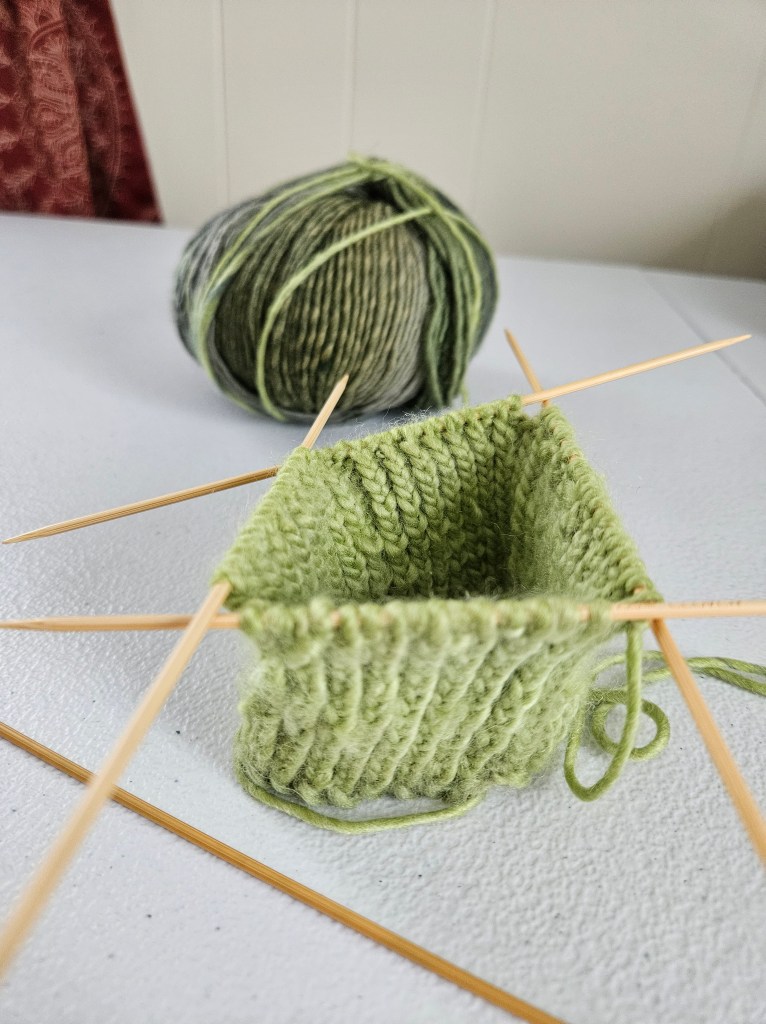
Attempt on DPNsFinshed tube socks pair knit at the same time on one set of straight needles
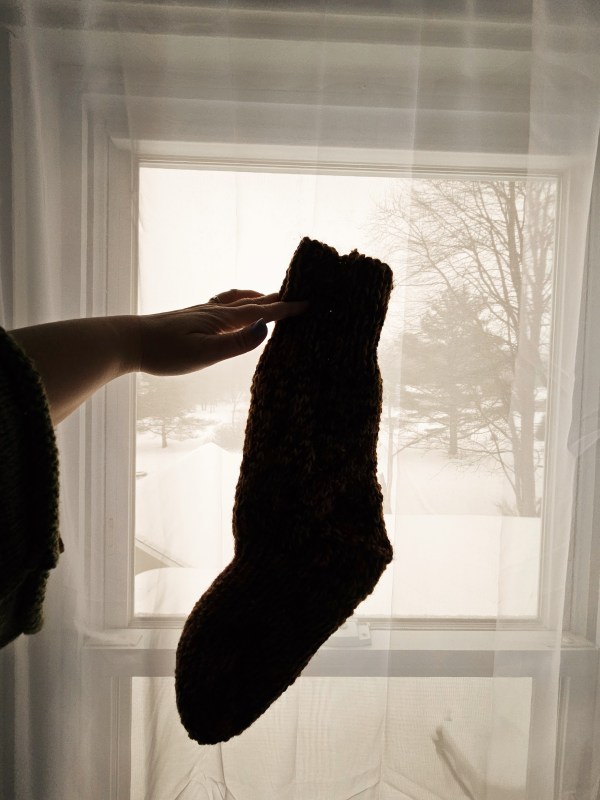
With this new found confidence I carried on and cast back onto the straight needles, making a brown pair of socks from recycled acrylic that wash and wear well. These green socks above are a blend that is mostly wool with a hint of acrylic in the yarn and they are hand wash or steam only for me. I wash them gently with either shampoo or conditioner in the sink, carefully to prevent felting. For my next project I wanted to explore fiber content, so I cast on a sock with three strands – two fingering weight wool and one acrylic. I chose this composition to test wear and washability, to make these a sock I could worry less about washing yet would insulate my foot, this was during a month long stretch of cold weather, dipping into the negatives fahrenheit so my mind was on cold weather. I decided to make these chunky socks into a sock I would use to insulate my L.L.Bean duck boots which are waterproof but are canvas, not insulated at all. They are a boot I want to wear for cold weather and snow, but they make my feet cold even with two pairs of socks.
As I got to the heel portion, I knit these socks cuff down, I made a last second decision and transfered my project to my round needles, joining the row into a round a stitches. With my heel turning reference book in hand I began turning that heel! It wasn’t as bad as I thought it would be! I don’t think I executed it perfectly, but I conquered a fear. Now, the tough part of the process is that my handwork for circular knitting is subpar. I hold my stitches too tight and the tension hurts my fingers the longer I knit on a project. The only way to improve this is to keep practicing, yet I don’t want to practice. The second sock is cast on but I have yet to make progress on project because I am dreading the circular process and those tight stitches that come from inexperience.
Is this sock the best fitting sock I’ve ever made? Yes! Is it better than store bought ones? A 1000% yes, and I’m a novice so they are going to get better with practice. It’s an art form we wear everyday without thought, but it is truly a sculpture of yarn. Next time you put on a sock, have a moment of appreciation for the geometry, the symmetry, and the sculpture adorning your foot.
At the beginning of January 2024, I made a post for fun predicting what I thought would become popular trends in 2024. Now that it’s December, how well did I do? I accurately guessed 6 out of 10 of the predictions I made! So what were these trends that I predicted and what did I get wrong? Let’s jump in!
Gameday Outfits
The NFL had a moment this year with the spotlight of Taylor Swift and Travis Kelce, and her gameday outfits became a source of public fascination. This created a wave of gameday outfit inspiration online, sparked by Blokecore in 2023. This carried on through WAG fashion and trickled into the mainstream. The Paris Olympics created fashion buzz, as did the movie Challengers. There was a rising fascination for F1 in the US. Not to mention the popularity of the team-branded baseball cap and Adidas soccer shorts paired with a button-down shirt. This one was a big deal and was unifying to be honest because who doesn’t like at least one of these sporting events? There is something for everyone.
Patches and Visible Mending
This definitely became a trend as DIY fashion and upcycling continue to grow in popularity online for sustainability and creative expression. Mending and learning to sew continues to rise in popularity as people choose to opt out of the fast fashion loop in search of clothing that will last all while standing out in a crowd. I think we can agree there was a hive mind within fashion since the Tik-Tok “core” aesthetics took off at the beginning of the decade and we are all looking for original ideas again.
Colorful Knit Accessories
Similarly, knitting along with crochet has continued to grow in popularity as hobbies and as a way to create DIY fashion by hand. It was so popular that chatGPT patterns and AI-created crochet and knit images cluttered the creative space. With Balletcore being popular, so were leg warmers and slouchy socks. Fingerless gloves, colorful hats, and brightly colored vests made 2024 what it was – a fiber artist paradise.
Exaggerated Tailoring
This was seen on the runway, with tailoring having a moment with trousers, vests, and blazers finding popularity once again. Dramatic shapes were popular on the runway. I also saw vests and dramatic trouser shapes in mainstream stores. I think this should always be in style so let’s keep in that way fashion trends. It’s a classic.
Resurgence of the Flip Flops
Yes, these were hailed the “It girl” shoe of the summer after Gisele Bundchen (yes I know I’m missing the umlauts) was seen wearing them. The specific flip-flop brand Havaianas, was the iconic style of 2024, but luxury brands tried to corner that market with $900+ flip-flops. I think it makes sense for these to come around again after how long the Birkenstock sandal has been the favorite choice, followed by Tevas, it’s the next logical evolution from clunky to delicate. Personally, all three of these drive my feet nuts but I’d probably choose the Teva for comfort or flip-flops for sheer chillness. Flip-flops were also worn by athletes at the Paris 2024 games.
Jersey Shore Nostalgia
Indeed Ed Hardy and Von Dutch did trend again this year! Mainly with teens and tweens, but this styling returned to the runway with Kim Petras’ Spring 2024 collection which featured Ed Hardy’s iconic designs. I’m excited for this era of fashion to return because I enjoyed the late 2000s-early 2010s fashion and the over-the-top spectacle of it. I’m certainly more for this than the mob wife styling of early 2024.
Parasols for Sun Relief
This one I thought, was a long shot but it made sense for it to become a trend because of how practical they are while protecting skin from UV damage. They are technically better for the planet than single-use sunscreen. I was not wrong. This market is projected to grow from 2024-2032 as the parasol or sun umbrella market is anticipated to grow globally. In 2024, there was significant growth as a trend for Japanese men. That’s a result! 🙂
What Did I Miss the Mark On?
ARMY-core was not a thing even though all BTS members were in the military this year, no trends emerged from this across the K-pop sphere. The only popular examples of camo I saw were from Chappell Roan’s ‘Midwest Princess’ camo hats from her tour and the Harris-Walz campaign hats which copied the same style.
Gilded Age Finery did not take off like I hoped. The only instances I found were Bad Bunny’s Met Gala look and Paris Fashion Week using late Victorian and Regency era opulence as inspiration for glamour.
Bonnets this was a flop except for two key shifts. One I hope I explain right because I am not familiar with the hair culture. According to a few articles I found black men styled bonnets as a protective hair style in 2024. Secondly, hats became popular again with rope hats and pillbox styles being the most talked about.
Cosmic Cowboy or Sailor Cowboy would have been accurate if I had dropped the qualifiers. Cowboy was the most iconic aesthetic of this year with cowboy styling, media, and country music being a key player in pop culture. Americana in general had a moment which is odd but hopefully a turning point for unification in my divided land.
What were your favorite style moments of 2024? And did you participate in any of these trends?
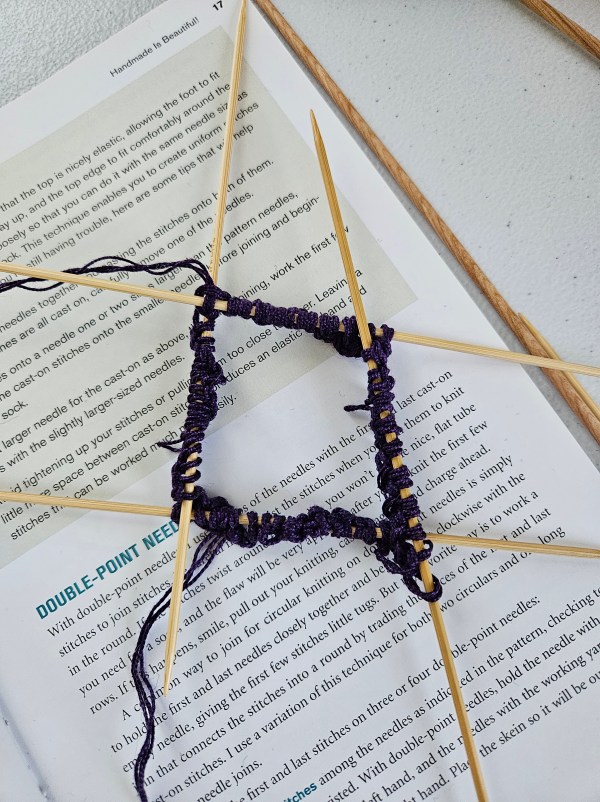
Today I completed the most stressful cast on of my knitting life, casting on a sock. This was with three strands of lace weight yarn and four double pointed needles, size US 1. Why double pointed needles? Why not! It got me out of my comfort zone and pushed me to be a focused, careful knitter with dexterity and cultivated patience for myself, the materials, and the technique.
Once the first round was joined, I felt the tension coursing through my body settle, like a war had been won in needles and yarn.
How will my first sock turn out? Who knows, but I’m optimistic. I have a sock knitting book, a step-by-step pattern, and properly gauged materials. I’d like to have cute socks to wear, the ruffly kind so here goes nothing! 😃
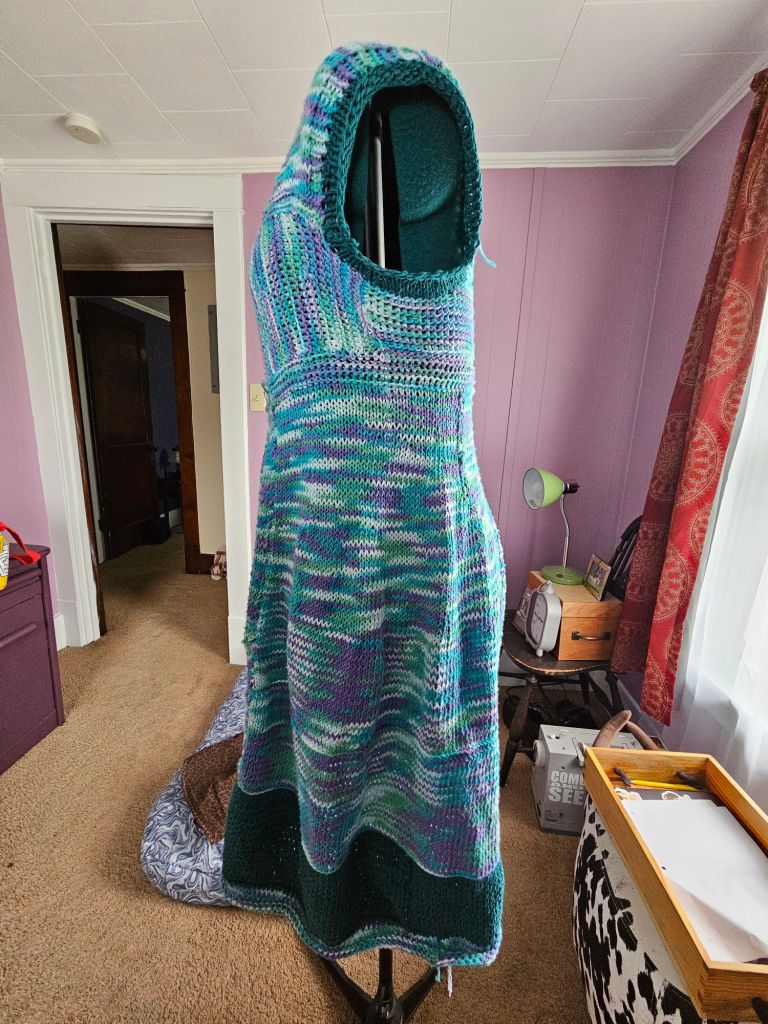
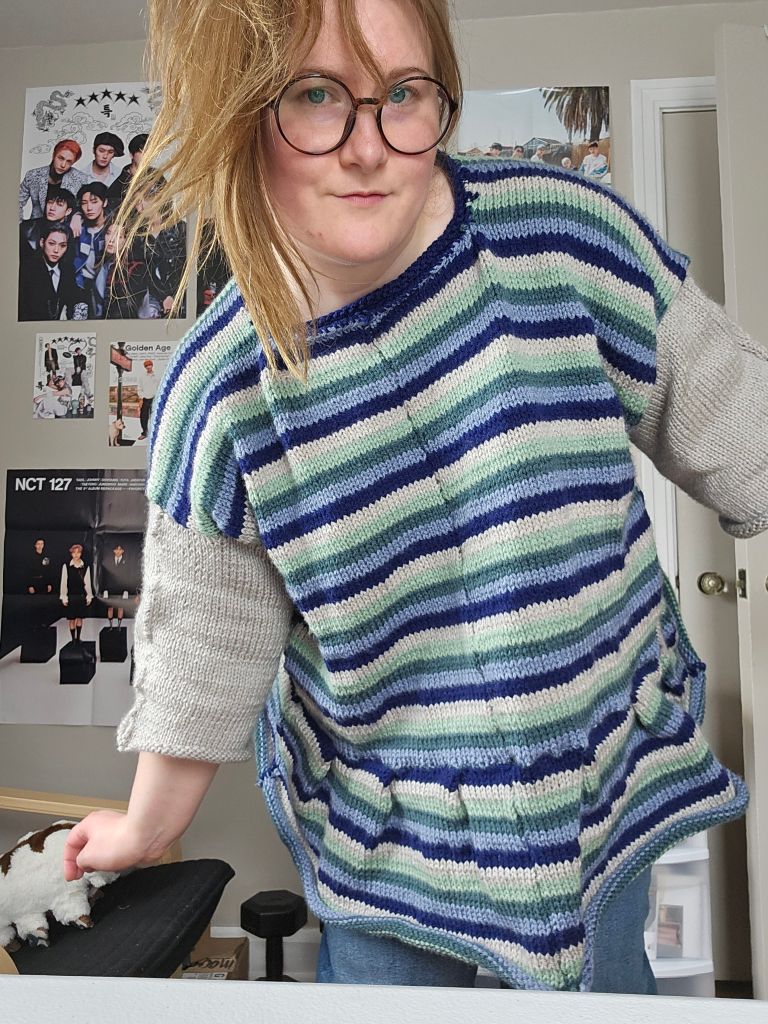
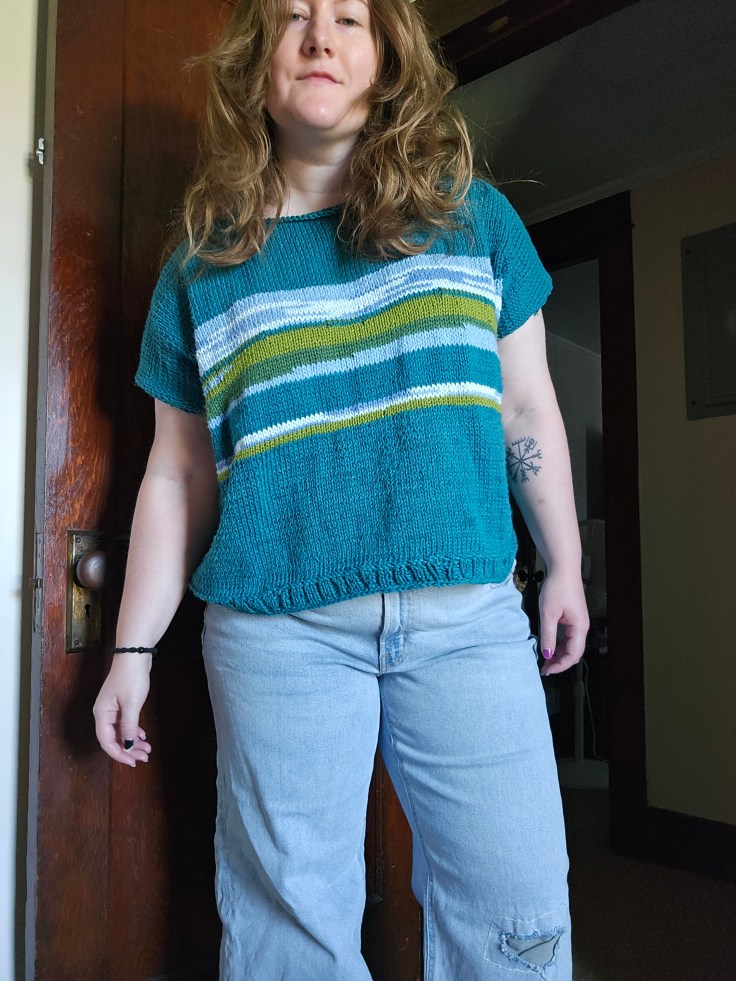
This year I’ve been looking for ways to use my stash as completely as possible and use up what I have to make new fibers and new projects. One way I accomplished this was through color palette knitting and through the stripe hype sweater. But another project idea I had this summer was to try minimal colorwork knitting by “painting” with yarn through a mix of new cotton yarn I purchased and yarn extras my mom passed onto me. This helped stretch the teal cotton yarn I bought, underestimating how much I needed to make a t-shirt. It was an opportunity to make a “graphic print” t-shirt out of yarn, something I didn’t have in my wardrobe, but sounded like a fun piece to wear.
These are the yarns I decided to use for the landscape painting section of the garment. Cotton yarn that was originally purchased by my mom to create handknit dishcloths in a color selection of blue, green, and pooling gray-to-white-to-blue, a lime green cotton-bamboo yarn, and the teal cotton I purchased. The pooling yarn was perfect for the clouds. Each side of the garment is unique because of this pooling yarn like a real sky. The plain blue was used for water, the dark green for a marshy grown-up bank, and the lime green for sunkissed meadows of grass. The teal was used for a distant tree line that was framed by the clouds.
I opted to make this oversized with a short sleeve opening, somewhere between a vest and a t-shirt because I haven’t decided how I want to wear this. As a t-shirt of course but do I want this to be a layering piece in the cooler months of the year? Or do I want to make detachable sleeves? That is something I am still milling over in my mind. I did split the back of the piece in a moment of indecision, where I thought it would be cute to make it a short-sleeved button cardigan. I may do this in the future. I opted to keep the t-shirt structure for simplicity and the ability to wear it more quickly. I was impatient to wear it.
I love projects that utilize things I already own and use techniques I haven’t tried before. Since this project I’ve begun to learn proper colorwork knitting, it’s been fun. Thank goodness for YouTube and knitting books to make the complicated things, like learning how to switch colors, feel approachable!
How have you been expressing your creativity this week? Do you like getting crafty? Are you a knitter and have you tried colorwork knitting before?
This is a weird knitting project for me because I usually can’t follow a pattern, at least it has been a few years since I tried to make anything with a pattern, and that was Butterick Retro ’44 #6374 and Butterick Retro ’44 #6485. They didn’t go super well.
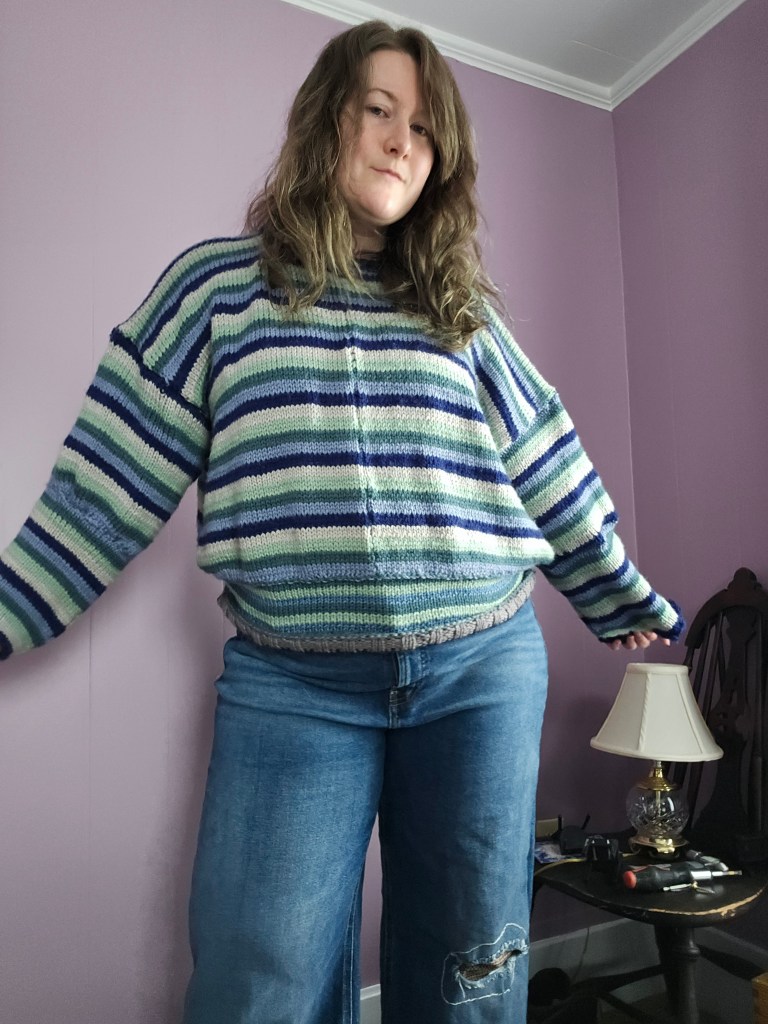
This is the only picture I saved from #6485 because it was so bad. It felt like a weird Star Wars dress. But I digress, with knitting, I would like to rectify my aversion to patterns to learn new skills and appreciate the creativity, celebrate even, the creativity and talent of my fellow knitwear designers. So I was inspired by Making Cassie’s Stripe Hype Sweater knitting project and through my move, I decided to use up leftover yarn in my stash to make a sweater someone else designed. It was one of the most rewarding knits I’ve made all year!
Who Designed the Stripe Hype Sweater?
The original Stripe Hype sweater and sweater pattern was designed by Veronika Lindberg and the pattern was published on Ravelry in 2023. Now I didn’t realize there was an actual Ravelry pattern, I just gave it a go off of other people’s versions of the Stripe Hype Sweater on Instagram and YouTube, like playing a song by ear. Whoops! Sorry, Veronika! But here is the link to her pattern.
My Take on the Stripe Hype Sweater
This is one of my favorite sweaters I’ve made because it challenged me to do things I wouldn’t gravitate towards like using white on a sweater. After all, I’m pale and I’m clumsy so stains. But dang it’s a fun background for the colors of this sweater. It taught me how to balance color, to mix colors with more abandon, and to bring balance and order to my pieces. This is also a make that grew my skills as it was the first project where I tried casting back onto sections – such as the ribbed collar and the sleeves.
It was a rewarding experience and reminded me that even though I like designing my own pieces there is always something new I can learn from using a pattern and although I can find it tedious, it puts limits on my creative energy to channel it into a direction I may not have gone if not for the guidance of the pattern. Always have a teachable spirit, my grandma would say, and yeah she’s definitely right about it when it comes to knitting!
Have you heard of the Stripe Hype Sweater? Would you wear or make something like this design? What colors would you choose? Until next time, thanks for being here, dear reader. I hope you have a lovely day!

























 One Rabbit Riot