

What’s the best brewery? It’s a question that I’m sure has thousands of answers. Location and access to beers, a person’s style preferences, and pricepoint can all lead to different answers. Plus, there’s the question of what it means to be the best brewery.
Is the best brewery the one that produces the best single beer or the one that produces the most high-quality beers? Because there is certainly a difference. I want to take a shot at answering this question.
I turned 21 during one of the peak craft beer time periods: the 2010s. I was in college from 2010 to 2014, when the number of craft breweries and the amount of craft beer drank exploded. Some numbers to back it up, all from the Brewers Association:
Number of barrels produced:
| 2010 | 2014 |
| Regional Breweries – 8,034,796 Microbreweries – 1,141,118 Brewpubs – 727,427 | Regional Breweries – 17,412,333 Microbreweries – 3,161,365 Brewpubs – 1,167,164 |
Number of breweries:
| 2010 | 2014 |
| 1,813 | 4,014 |
Number of craft breweries:
| 2010 | 2014 |
| Brewpubs – 1,057 Microbreweries – 620 Regional Breweries – 81 | Brewpubs – 1,717 Microbreweries – 2,116 Regional Breweries – 135 |
Some quick definitions to help with the above numbers:
These stats help convey the environment that existed when I started drinking beer. Whereas most college students typically drink low-cost domestics in kegs or cases, my friends and I usually went to a great local bar that had a massive list of craft beers. Granted, this decision was probably aided by the fact that our college was a dry campus, so buying cases or kegs of beer would have been pointless. And sure, I would still split a pitcher of Yuengling if we went to another bar, but my preference quickly became craft beers that were full of flavor and complexity.
Another aspect of the time period was the rise of India Pale Ales (IPAs). Although IPAs have been around for more than 150 years, they didn’t start to really take off in the United States until the latter half of the 20th century, and by the 2010s, American IPAs were everywhere. Essentially, every craft brewery was producing at least one IPA, with some of the most popular ones being Russian River’s Pliney the Elder, Sierra Nevada’s Pale Ale, and Dogfish Head’s 60-Minute and 90-Minute IPAs.
In fact, I was such a fan of Dogfish Head and its founder, Sam Calagione, that my first beer was a 60-Minute IPA. It’s a weird first beer to purchase, but I was so enamored with Dogfish’s approach to brewing that I wanted to participate in it. I loved it, and it kicked off my love of craft beer and trying as many different beers as possible.
The bar I first mentioned used to allow its patrons to keep beer lists, which I participated in. I think the list had 100 or so craft beers on it, and you would keep track of what beers you drank. I don’t remember if you got something for completing the list, but I do remember some of the beers on the list. Some notables included Magic Hat #9, Wells Banana Bread, Founders Breakfast Stout, and Dogfish Head’s Midas Touch. There were so many beers on that list that I still think about (RIP #9).
I have a pretty broad and eclectic beer taste as a result of trying all these beers. I love fruit beers like Ellicotville’s Blueberry Wheat, high-ABV IPAs like 90-Minute, dark imperial stouts like Sierra Nevada’s Narwhal, pumpkin beers, and Belgian and German imports. Like I said, it’s all over the place. These preferences will certainly influence my decisions as I attempt to find the best brewery.
Back to the question I reference at the beginning: what does it mean to be the best brewery? I’m going to take a page from Top Gear’s playbook when they attempted to find the carmaker that has produced the greatest number of excellent cars. So for me in this context, it means the brewery that has produced (and hopefully still produces) the greatest number of excellent beers. A brewery can produce the best beer in the world, but if the rest of the beers it brews are mediocre, I think it lowers the overall quality of the brewery. Similarly, a brewery can produce a single excellent beer and nothing else. To me, that still doesn’t compare to a brewery that produces a dozen elite beers even if no single one is the very best.
So, I am looking for a brewery that has a very high average instead of sharp peaks and valleys. Although I don’t know all of the breweries I’m going to consider, I can safely say that some of the ones I will consider include Dogfish Head, Ellicotville Brewing Company, Erie Brewing Company, New Belgium, Southern Tier, Troegs, and Sierra Nevada. My goal is to try as many beers from as many different breweries as I can, so this is certainly going to be a long-term project. I think as we buy beer at our local distributors, I’ll look for ones from the above breweries to ensure I get a solid understanding of their portfolios. If you have any breweries or brews that you think I have to try, please let me know in the comments. I will try my best to find it. One limitation I know I’ll run into is location and how far breweries ship their beers. For example, I’ve never tried Pliny the Elder because Russian River isn’t sold anywhere within 100 miles of our town. I also never tried it when I had a chance in the past. Beyond that, though, I’ll look for just about anything.
Every Spring and every Autumn, I would hear this phrase, from my mom, and my grandparents. It would follow with a flurry of activity. Sweaters unpacked from the “chifferobe” and piled onto the bed. Shorts and short sleeve shirts, carried from the drawers, to their cold weather slumber. Uno reverse, and the opposite dance began when the breezy warmth breathed life back through the open windows. As a kid, I enjoyed seeing all the clothes out of their drawers where I could look with curiosity at their clothes so different from my own. I didn’t understand the practicality, honesty, until this year, many, many years later.
Since we moved to Georgia almost a decade ago, we have been without proper dressers which sounds insane, I know. We’ve lived in some places with nice closets, that made storage simple. But we have lived in others where the closets were downright unusable. We’ve used moving totes, fabric dressers from Amazon, cube storage, and zipper totes for comforters. It’s an imperfect system, requiring a lot of digging through bins to find what you are looking for.
I think I have been so pre-occupied with simply organizing these bins, I didn’t think about moving my clothes around seasonally. That was until we bought our house and faced another closet that was challenging. I had hoped our house would have good storage, but that is something, I am learning, that you have to customize to your taste. This place has okay storage in the bedroom, but the problem remains that we need needed more storage like those proper dressers. Of course those are expensive and time consuming to make, the closet being bigger would have let us kick the can farther down the road, instead, God provided a really neat solution.
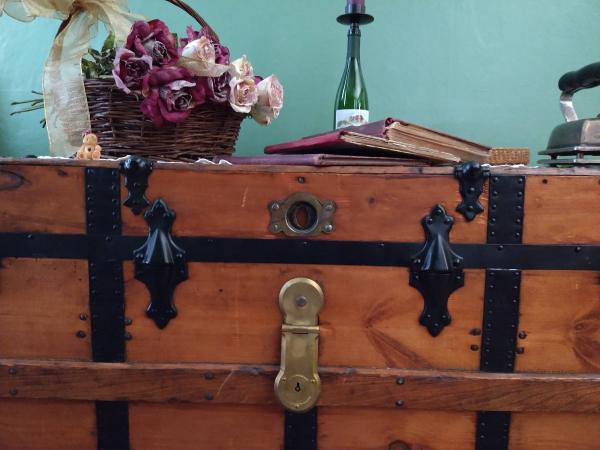
Our neighbors offered us a chest, a large cabinet really that can either be upright or laid down longways like a trunk. It’s an older piece, that with the dark stain patina, I think looks like a vampire coffin. This chest fits six of these large quilt storage totes! Which means I finally have my “chifferobe” storage piece. The chifferobe name makes me smile because this was not a wardrobe, this was a long trunk that sat at the foot of my grandparents bed, now it lives in my old bedroom at the foot of the bed I sleep in. My mom and grandparents also used trunks to do this. Steamer trunks to be specific, that my great, great grandparents used to immigrate from Ireland to America. Restored to the former glory and it such a convenient way to store clothing for the season.
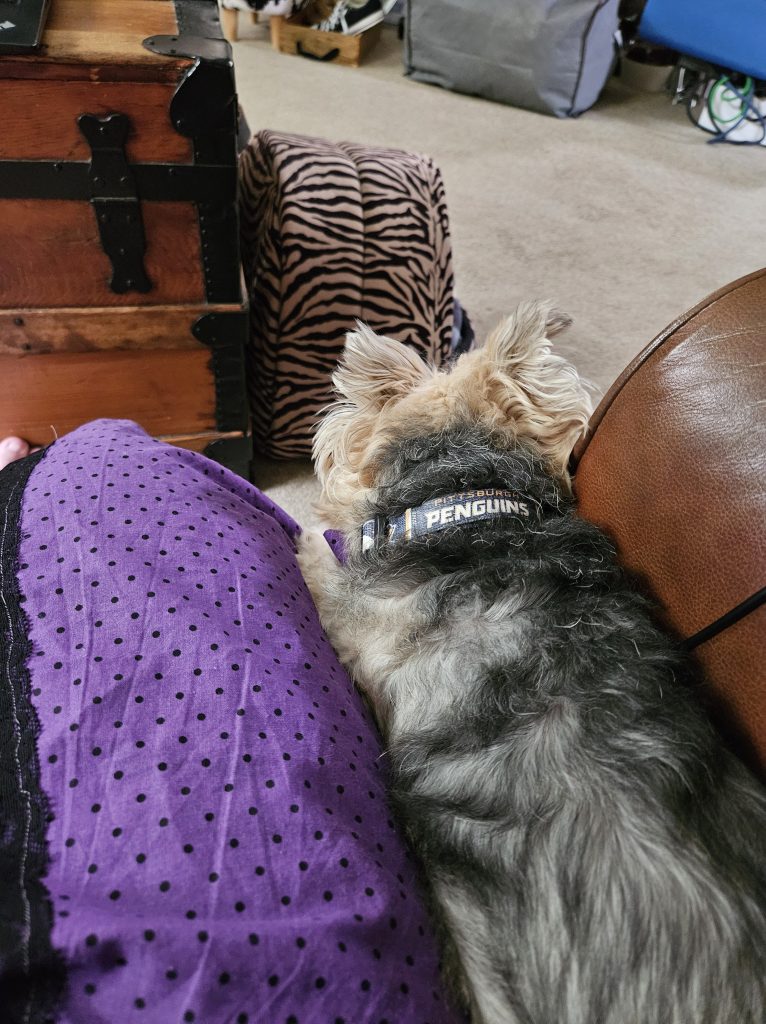
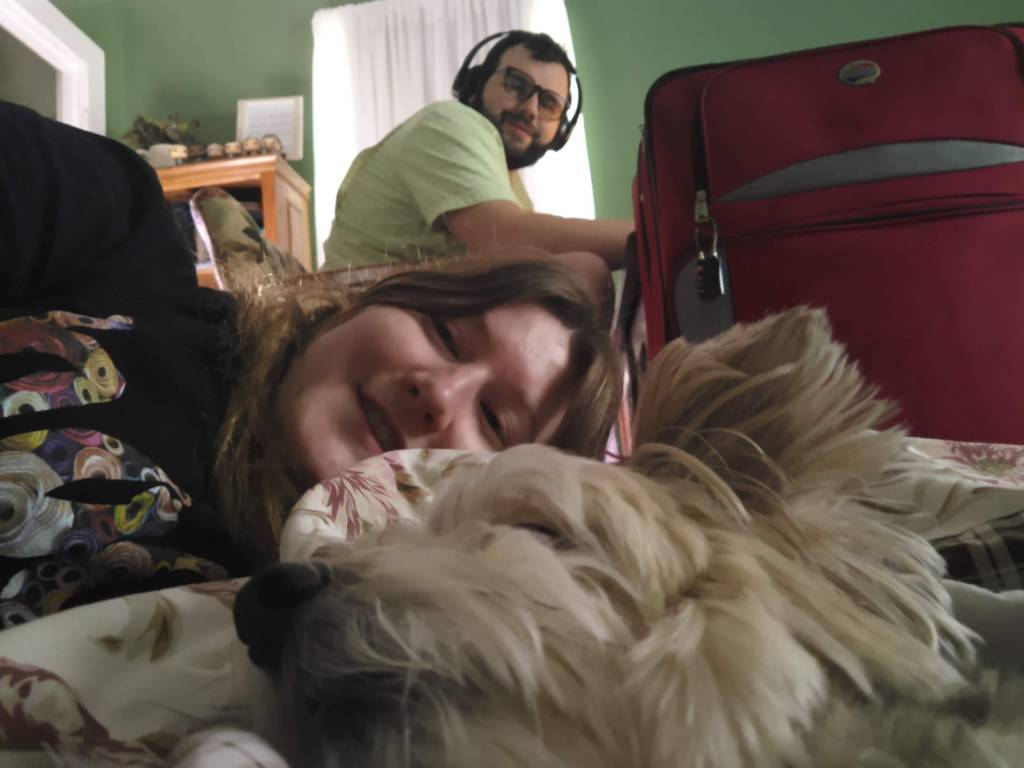
On the left and in the featured image are the steamer trunks, and to the right, blocked by a suitcase is the cedar chest at the foot of the bed, that Kyle is using as a desk.
Maybe you don’t need to declutter so often, as often as influencers do. Perhaps, you just need a organizing system that makes your closet smaller and manageable for the season you are in, either in a four season climate, or in a state of mind. Putting things into a longer term storage, sort of like moving items out of your backpack in Stardew Valley, into a chest, takes those items out of your daily mental load, without getting rid of them. It’s very clever. Do you store things seasonally? Would you give this a try?
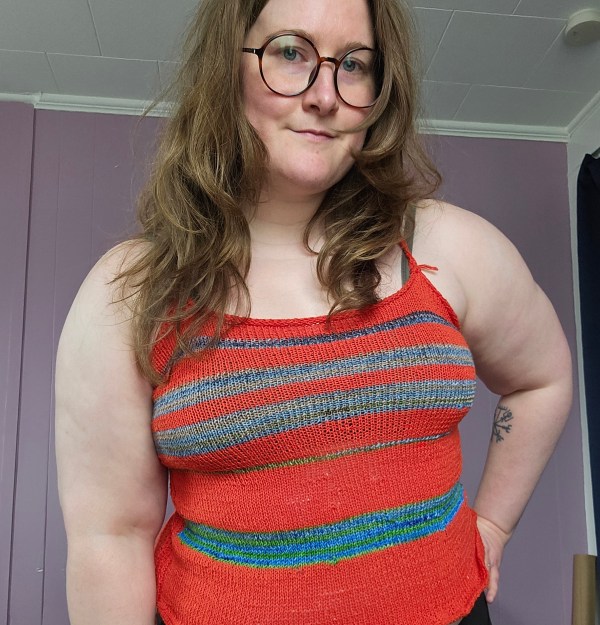
Happy October! I think this is the best time of the year. From August and beyond to December, it feels like a dance to the finish line. I’ve been busy, working to get my sewjo and knitjo back this year. One way I did that this spring and summer was to use new materials and techniques. This top I dubbed the Lizzie Halter Top, for my love of Lizzie McGuire, was an exploration of past muses.
The 2000s nostalgia is calling to me, as I have mentioned before, but there has been a pull for authenticity in these throwbacks. It’s becoming more than a trend for me, instead a way to explore style muses of the past, that felt like they passed me by as a kid, that with fiber arts. Making takes us out of that loop, if you like the thing, you can make it and then wear it. No fomo. No trends to chase. You’re free. This top is one of those throwback pieces for me.
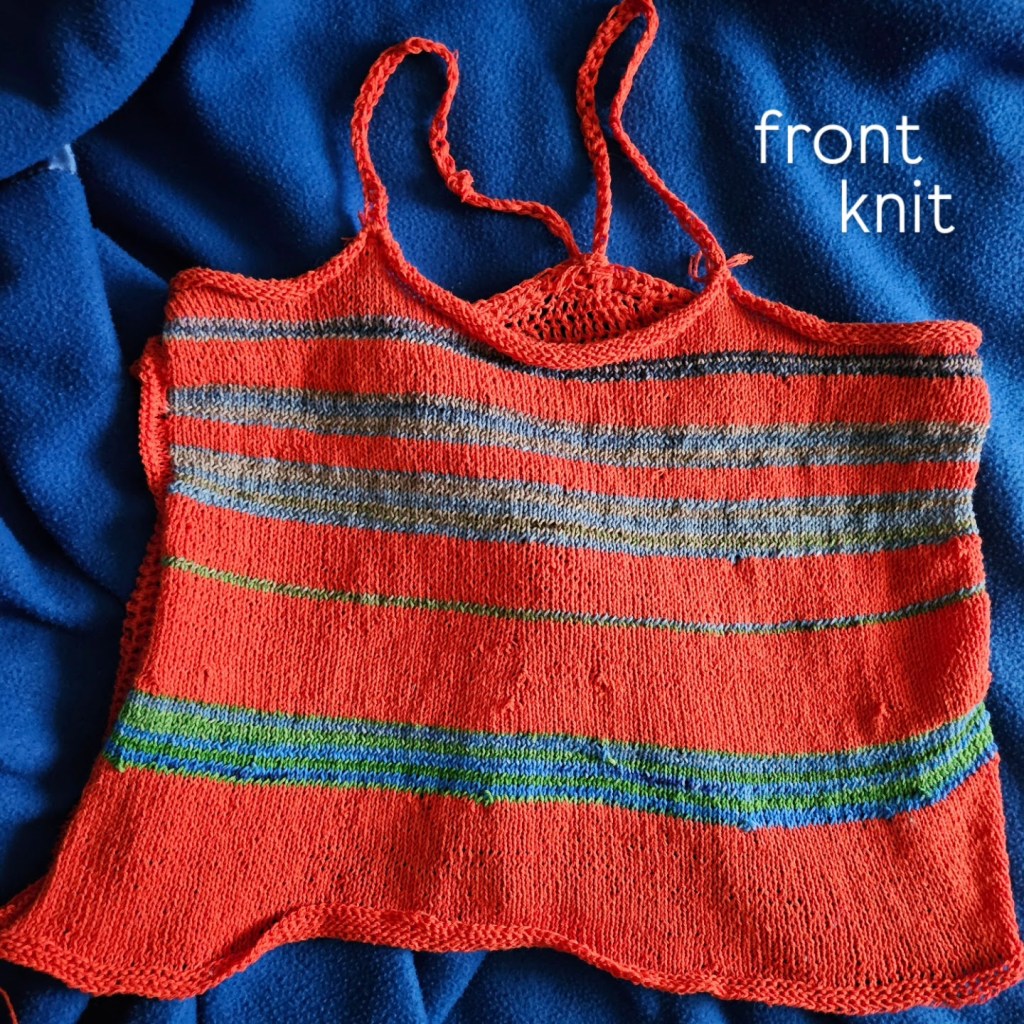
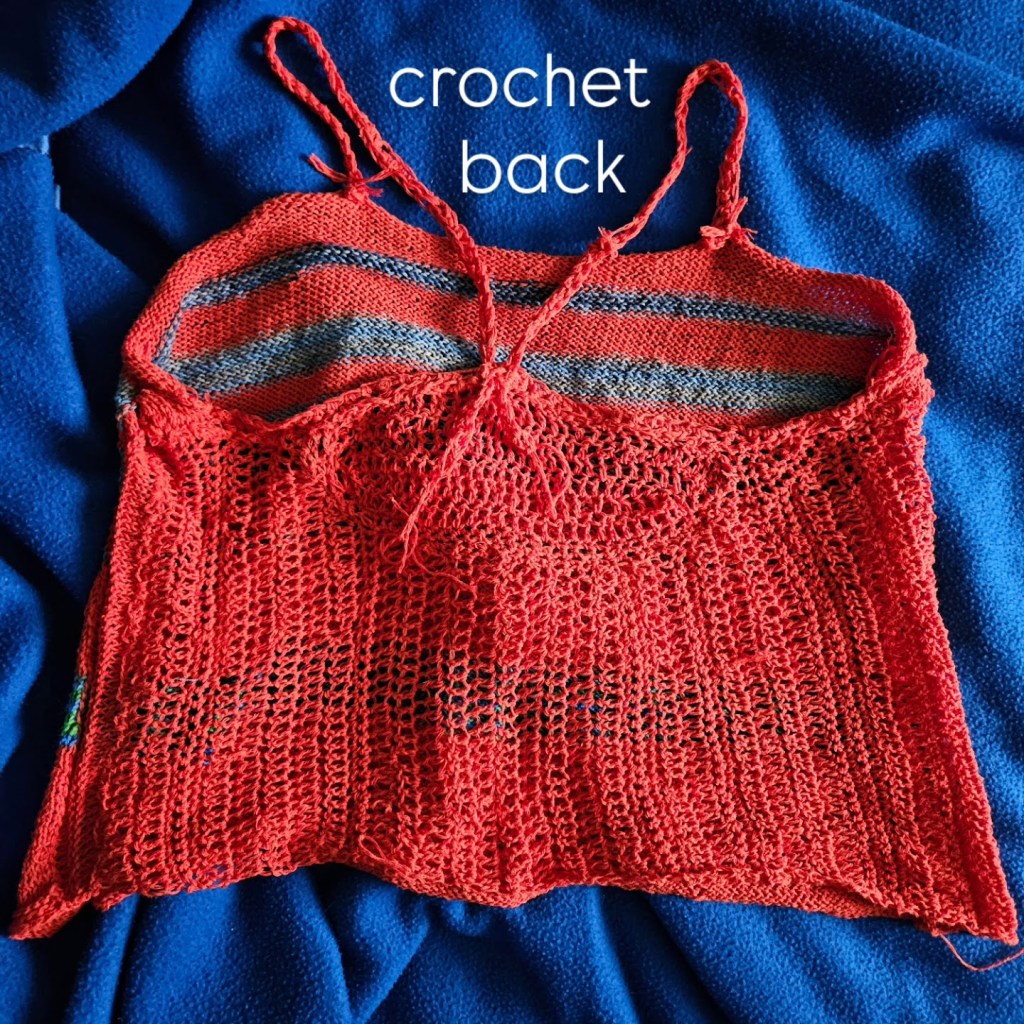
I knit the front panel using 3.5 mm (US 4) needles using two new materials for me. And the best part? They were both purchased at local to me yarn stores. I had never used Knitting for Olive before, although the brand is quite popular. I hope they stay this way moving forward because I loved working with their Pure Silk. This Pure Silk is in the color Blood Orange. I used one skein for this top, which equals 273 yards of fingering weight yarn for 12 USD, which I think is fantastic value for silk yarn. To pad out this top, I used leftover Uneek Sock Yarn from Urth Yarn, another fingering weight yarn that is a mix of super wash merino and nylon.
Although, I was excited to work with such a bright color, I don’t wear a lot of orange though, so as I sat with this yarn, I began to worry that I made too bold of a choice. But there is something about the self-striping Uneek in the contrasting cool tones that balanced all my concerns. When I pair this piece with a cool tone tank underneath, this effect grows stronger.
My second concern, although wool is recommended for its breath-ablity, was the wool in this project. Was it insane to include wool in a summer top? To counteract any breath-ability issues in the finished fabric, I chose to crochet the back panel and chain the halter straps. I was very comfortable this summer, even on hot days, wearing this piece. With wool! It’s wild to me but it works. The silk does the heavy lifting though. I like working with cotton, but silk may be my new favorite warm weather fiber.
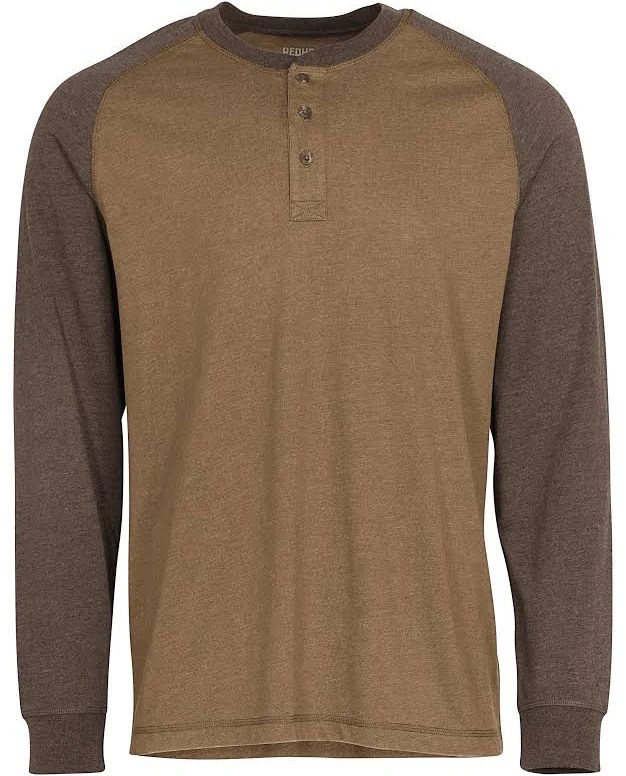
Over the summer, I went through my cool weather clothes and pulled pieces that I didn’t like to alter into garments I would wear more often. Two of these garments I chose to upcycle were a pair of men’s henley raglan long sleeve shirts from Bass Pro Shops. These were from a Black Friday sale last fall, to bring more henley style shirts and raglan baseball tees into my closet. They are great shirts. Soft and sturdy fabric, comfortable, but not the right fit for my body or style. Since this shirt was designed for masculine style, it was not as cute on as I hoped. The button placket is set higher on the chest, near the collar bone, instead of lower near the chest in feminine styles. The second issue was the shoulder, it had room for even broader shoulders than I have, accentuating my shoulders in all the wrong ways. Now, I could have re-homed these pieces but I’d like to keep the baseball tee shirts and enjoy wearing them. I bought them with the intention of keeping the a long time.
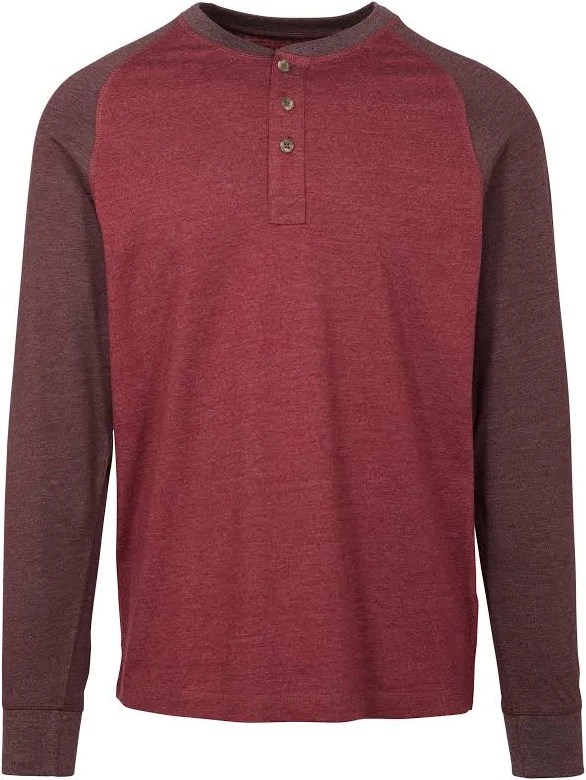
The neckline had to be fixed. That high collar was the biggest obstacle to styling the shirt for me, but how does one change a neckline from a from a crew neck button placket to a v-neck or scoop? I first removed the ribbed collar, and focused my efforts on the shape my open neckline would create. From previous alterations and pattern cutting, I knew that v-neck and scoop necklines can get you quick. The open shape can quickly shift from good to gaping, to sliding constantly off the shoulders. Once it is cut, you can’t go back – so you better have a plan.
I did have a plan this time. I would continue my cut in a key shape. I followed the line of the button placket, in a narrow scoop down until the end of the buttons. With those pieces removed it was time to taper and shape the final cuts. I matched each side for a tapered scoop, paying attention to the depth and at the bottom of the curve. Too low, and this shirt would be too revealing for casual wear. Too wide as we work our way up to the shoulder, and would slip off. I kept my line narrow, remembering to account for the rolled hem, that would eat up some width. I tried this on and was pleased with the scoop so I moved this project forward to hemming.
This is where my upcycling hit a snag. I still have a lot to learn when it comes to fitting garments, and my green tailoring skills showed when it came to finish the neckline. The neckline had excess at the bottom of the scoop, more gaping than I wanted, which left me with a fork in the road. Do I gather it? Do I add darts? Do I cut more? I decided to gather it at the bottom and live with it for a bit. I put it back in my closet and let it be until the cool weather returned.
Fast forward to this past weekend, and the first cool days of September. I wore the golden tan version with the gathered scoop, and it was not it. The shirt was close but no cigar, and I found myself tugging and adjusting this odd neckline. What I noticed as the day went on, is that the shoulder was fitting strange too. There was a bunching of fabric at the top of the neckline and back, not what I was looking for. Finally, last night I stood before my mirror and started adjusting. I tried the shirt on backwards, normal and off the shoulder. I folded the bottom hem to see if I needed to crop it. I thought about changing the neckline. Would a binding the neck opening in a collar solve the bunching? I took out the gathers and tried it on again, how do I make this sit flat?
The shoulders. I needed to take in the shoulders. I tried raising the neckline in the mirror by gathering some excess in the scoop, but then I pinched some fabric with my fingers at the shoulder and huzzah! We found our solution. (I also removed the cuffs to shorten the sleeve for a better fit for my arm length.)
My purpose in buying these shirts, was to bring a style back into my wardrobe that I used to own in college. My Gas Monkey Garage spark plug baseball tee and a v-neck baseball tee from Victoria’s Secret. I wore those pieces to death in the early 2010’s. By pinching away the excess at the shoulder line, the scoop rested flat and there was no bunching at the arm’s eye. It continues to amaze me how the most random parts of a garment change the entire fit.
Who knew a loose shoulder can make the neckline wonky? This novice tailor sure didn’t. I hope this little story of tailoring can help you if your stuck fitting a shirt. Or maybe this will inspire to take the plunge on a alteration in your closet.

In early August, I wrote a post about Magz and me going bowling for the first time in more than a decade. In it, I mentioned that a lot of bowling alleys have started transitioning to string pins instead of traditional pinsetters. The reasoning for this movement has to do with the complexity and costs of maintaining pinsetter machines, which have a lot of moving parts. String pins are very divisive among bowlers.
Since they’re technically approved for some competitions by the United States Bowling Congress (USBC), a lot of people are fine with them, while others are casual bowlers and don’t mind the break from traditional. However, the opposite opinion is that string pins destroy the sport of bowling and what makes it fun. The biggest issue is the reduction in pin action because the strings limit how far the pins can move. This has been proven to result in lower scores and fewer strikes. I’m vehemently opposed to string pin bowling; however, a few weeks ago, we accidentally went string pin bowling, and the more I think about it, the more awful it was.
So, how did this even happen if we were so committed to not going string pin bowling? Rewind back to the last time we went bowling with traditional pins. The old-school alley we go to was having some issues with its pinsetter on the lane we were on, and we had to pause three times for things to be reset. After the first two pauses, we resumed bowling; however, after the third one, we called it and left. We were already in the seventh frame of the third game, so we were fine with ending things early. That experience was disappointing, though, and left us unsure if we wanted to play at the same alley again until we were confident things were fixed. This was also the second time we encountered issues at this alley, as once before, all but two lanes were closed until parts arrived.
Fast-forward to early September on a day I was off work. We wanted to go bowling but didn’t want to risk having issues at our usual alley. Instead, we went to our local bowling alley, the one we first tried a few years ago but didn’t like the vibes. This time, we gave it a go because I saw that they do a Tuesday matinee special at only $2 per game. It seemed like it was worth the gamble…it was not. There was nothing on the website, and you couldn’t tell until you started bowling that they used string pins. It wasn’t until we got our shoes on and I threw my first ball that I realized things were off.
The actual strings holding up the pins were not the first indicator that we were string pin bowling. It was the lack of noise. This goes along with the reduction of pin action, but there was a noticeable noise level drop compared to traditional bowling. When you are traditionally bowling, physics allows the pins to go in all directions, and you hear the resulting crash of the ball and pins hitting each other. It’s an iconic sound that everyone can recognize. String bowling is muted and feels as though all your senses are dulled a bit.
The lack of pin action has a massive impact on results and your score. I’m by no means a great bowler and struggle with consistency, but I can average around 150 over a three-game set. It usually takes me a couple of frames to find my mechanics, but once I do, I can repeat things quite well. I immediately noticed how much more difficult it is to get a strike. When you’re traditionally bowling and in a groove, you can see the strikes happen before the ball hits the pins. You know when the ball is going to hit the pocket and has the right hook. Likewise, you are confident in converting a spare when you throw the ball correctly because you know how the pins should fall. String bowling changes all of that. Hitting the pocket with the right velocity doesn’t always result in a strike. Converting a five- or six-pin spare is much more difficult because you don’t know if the pins are going to crash the way you’re used to. My first two games were awful, and I know I didn’t break 100 points. I began figuring things out a bit in the third game, but I think I only finished with 120 points. I felt like I was questioning everything I was doing the entire time and never felt comfortable.
We went bowling on a Tuesday afternoon when school was back in session, so those bowling in the lanes nearest to us looked to be retirees. They had their own balls and shoes and clearly took it seriously. I don’t know where they were from, but they gave the impression that this was their first time bowling at this alley. And based on the conversations we could overhear, it may have been their first time string bowling. They were expressing the same sentiments that we were: struggling with the lack of pin action and a general disappointment in the strings. In general, they didn’t seem to be having fun.
I think part of the problem with string pin bowling is that it is rarely the only change that happens at bowling alleys. For example, this bowling alley didn’t have any of the vibes that normally come with bowling. I’m pretty certain that the lanes were synthetic, which probably isn’t a big deal on its own, but it contributed to a less-than-desirable environment. Research shows that synthetic lanes have less friction than wood lanes, so your ball doesn’t hook like you expect it to. Less active lanes and reduced pin action lead to an experience that is less fun.
This alley also had new computers and a new score tracker. It tracked a lot of data, such as the number of balls each of us had thrown, the number of strikes and spares, and more. However, one thing it didn’t track was the ball’s velocity, which would have been useful information. To me, if you’re going to show data, include all of it. Don’t leave off some of the most useful information. I did really like that you could raise and lower the bumpers from the computer instead of having to physically do it. The computers would also remember which bowler needed them so that each person could have an experience that matches their ability and skill level.
This bowling alley also had weird seating. Instead of being around a table or in a u-shape where people could see each other and talk, the seats were in diagonal rows so that you were never looking at the person beside you. But you also weren’t looking directly at the lane to see how others were doing. I’m sure a lot of bowlers would never notice this, but this seating arrangement takes away from the fellowship and conversation that takes place between throws. To me, bowling is as much a social engagement as it is a sport, and removing one aspect of it takes away some of its soul.
Finally, the atmosphere was way off. I hate cool-tone led lighting and believe it has no place in society outside of workshops and box stores. This bowling alley was all cool tones. The synthetic lanes looked like Nordic pine instead of varnished oak, the lights were bright white, and everything had a blue tint to it. It was entirely modern, and I did not enjoy it. It didn’t feel like a place where I could enjoyably spend a couple of hours, and I don’t see it ever becoming a “third” place for me. I loved that the alley had a pro shop and had a wall full of 300 games and 800 series, but none of that was enough to overcome the soullessness that it modern, string bowling.
In the weeks between then and now, we haven’t gone bowling. At first, I thought this alley could be a fallback option if we can’t go bowling at an alley with pinsetters. But the more I thought about it, the more I realized that I really hated the experience and think I’d rather drive 30 minutes to bowl in a more enjoyable setting than string bowl again. And if all the local alleys switch to string pins, I may make the decision to stop bowling altogether. It probably seems like a weird stand to take, and there’s nothing morally wrong with string bowling, but I don’t like that string bowling is another example of the soul getting sucked out of modern society in the name of efficiency and profit.
If you’re a fan of bowling, have you been string bowling yet? If so, what was your experience with it? Did you hate it? If not, I’d like to hear how you were able to overcome some of the issues I mentioned above.
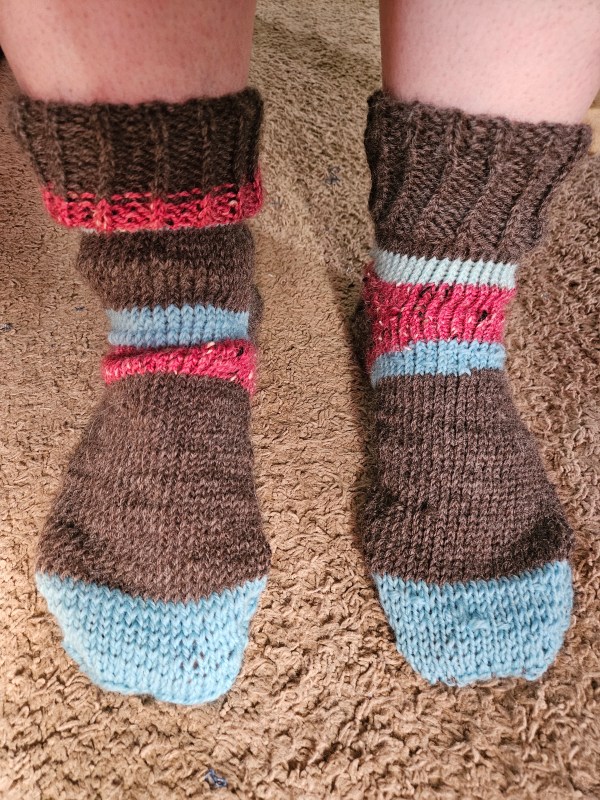
A special thanks to the pattern writing of Weichien Chan from Saskie & Co and Jamie Lomax from Pacific Knit Co, for explaining this process with such clarity, that I leveled up from a sock knitting dreamer to a sock knitter. Check out their patterns! I’m glad I did. 😃
How? And, why? Those were the questions burning at the back of mind as the sock process eluded me, again and again. For years, I couldn’t wrap my mind around the heel of the sock patterns I acquired. I tried a toe up approach. I tried to mess around with short rows. I even bought a sock pattern book from a used book store, for a bit of sock heritage. Heel flap, confused me. The mechanics of double pointed needles, challenged my hand eye coordination. Magic Loop tested my patience and exposed my tight tension, from my cluttered mind. But the Addi Sockenwunder 9″ cable in 3.5mm became the key to unlock knitting mechanics I was lacking.
If you’re familiar with this blog, you know my frustrations with knitting in the round. This came to a head in February, during the Melt the ICE hat knit along. I seriously messed up my tension, and initial attempt by twisting my work. My joined stitches became a helix, coiling around the cable. I frogged my work, and started again, this time waiting a few rows before joining. (I found this wisdom thanks to the advice of Reddit, I think? To the past comment thread that helped me, know that I am eternally grateful.) This time around, I was determined to keep my hands loose and my mind relaxed, and it worked. I did not feel the hand fatigue, I normally experience when knitting in the round. The short cable length of the Sockenwunder needles was the key, the stitches slid easily around in the exact space of a sock circumference. This is why Magic Loop and I, did not form a lasting relationship, the shifting of stitches was a hurdle I disliked. Same with DPNs, I don’t want to keep track of stitches on needles, I want to be in a flow state of stitching. That is the best part of knitting in the round, in my opinion, you just go and knit. It is incredibly relaxing, like crocheting a simple stitch across a project, you and the stitching implement become one with the yarn, looping and creating a fabric with a relaxed mind.
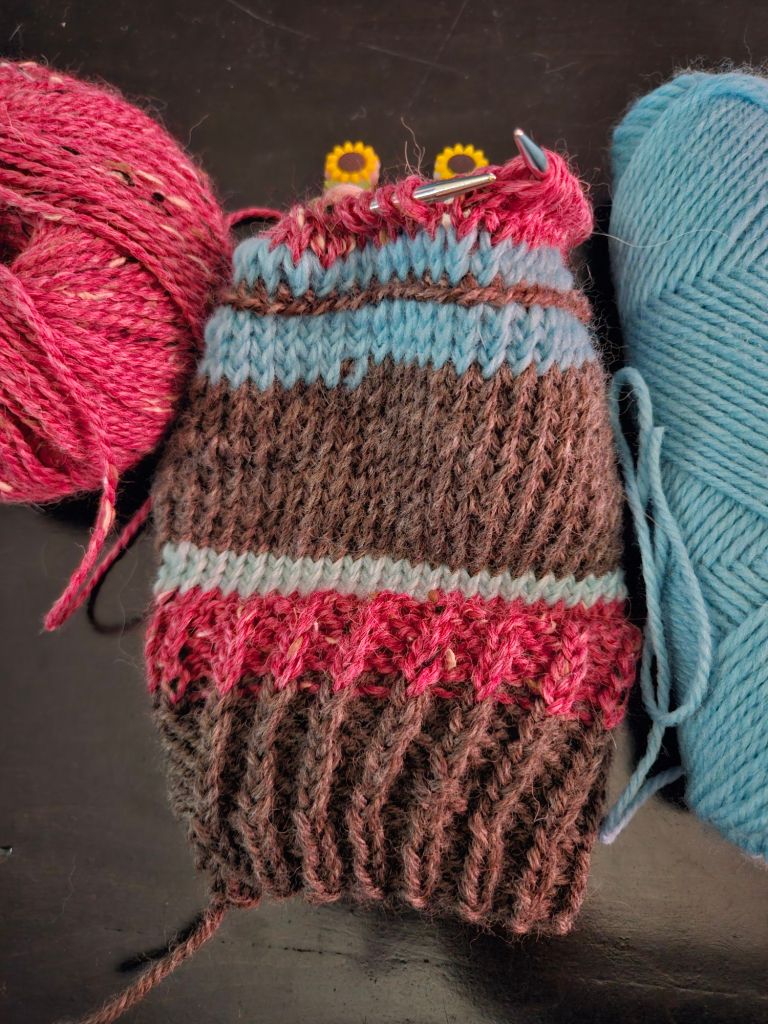
For this reason, the Sockenwunder socks came together quickly, despite the new techniques I was employing in this project. My first sock, I began at the end of the day on a Thursday, knit the body of the sock on Friday, and finished the toe and heel on Saturday. My second sock was began on Sunday, knit Monday, and wrapped up on Tuesday. Quick and easy, compared to a sweater! It’s what I want out of this knitting practice, something quick and relaxing, that is a pleasure to replicate over and over again. In the short term for my own feet for this coming winter, and in the long term for loved ones and beyond, hopefully charity knitting socks and possibly selling them at a market or online marketplace.
My sock pattern was loosely based on the patterns featured in the Arctic Knits book, which I will not go into detail for copyright reasons, but one thing I will talk about is my sizing mistake. I cast on an extra ten stitches from the Saskie & Co pattern, because of my usual tight tension knitting in the round. They fit a bit loose, and that’s okay. These first socks are a toile, for future socks, as I develop my preferences for socks. They are still usable, with a relaxed cabin socks fit for lounging around the house. I may layer other cotton socks underneath on cold days to pad the fit.
Another deviation from the sock patterns in the Arctic Knits book, was my choice to knit stripes, with scrap yarn from my Saskie Cardigan (another Saskie & Co project I will share soon). I didn’t know if these socks would turn out or be another failed attempt, so I used up my extras, in random stripes. This freed up my mind to concentrate on the mechanics of knitting the sock, and not the knitting charts. In the future, I plan to make the socks as written by Weichien Chan, they are stunning color work socks.
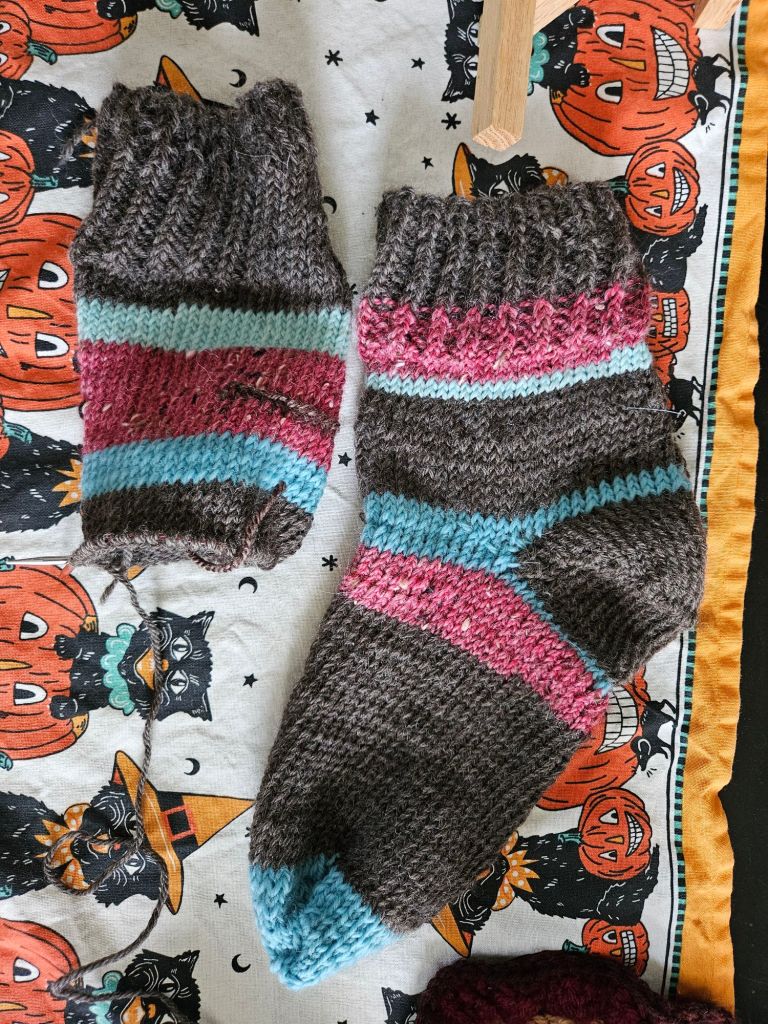
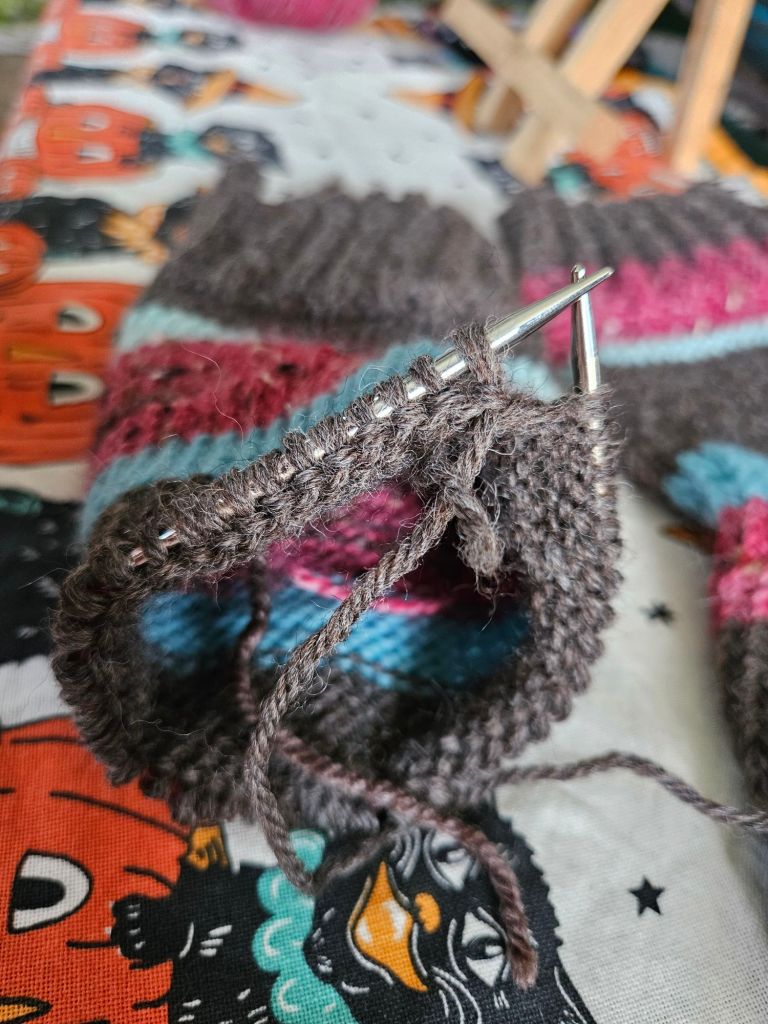
Now, what about that random raised row of brown yarn? That is the magic of the after thought sock! You make temporary arrangements for your heel and pick it up again after the sock body and toe are complete. This is where Pacific Knit Co’s tutorial had my back. Sometimes I need things rephrased, and many detailed pictures to make a new skill click. I’m a visual learner. Sometimes those patterns, although well written jumble in my mind. By using the combination of both pattern designers I successfully picked up the stitches above and below. I did this with a second set of circulars from Clover that were a bit longer, 16″ but the same gauge of 3.5 mm. The length difference was helpful during the knitting process, as the long needles hung down out of the way of my hands knitting on the Sockenwunder, and alleviated the stress of stitches falling off when unattended to.
Both Weichien and Jamie helped finally see the how and why of the heel shaping. With the heel flap techniques, I lost sight of the point. With the patterns that had me turn the heel while knitting the body, the complexity of this, overwhelmed me. But the after thought heel, eliminated both of these hiccups. I could see the sock body and the heel taking shape, it was intuitive. If you have experienced overwhelm by socks, I high recommend mixing up your tools and techniques. That is why we have so many to choose from, you must experiment to find the right fit like selecting a bowling ball.
Experimentation and repetition are my biggest takeaways from this multi-year sock saga. It’s not the finished project, as much as the process that defines the success. Knitting requires a patience and tenacity to frog and cast on again that has been hard for me, as a perfectionist with squirrel brain to stay the course with. Mistakes anger me. Frogging feels like a waste of time, but its not. Committing the skills to memory by practice is no different to volleyball practice drills or math homework. To be a skilled maker, you must put the time in, no short cuts. In this age of information and short cuts, it’s counter-cultural to slow down and fixate one skill until it is acquired, but it is the only way as humans we learn.

I think fall is the best season of the year. There’s something magical about the crispness in the air, the magical colors of the leaves changing, and the incredible flavors that come with it. Pumpkin is one of my favorite things to enjoy throughout fall, and I’ll eat it in pie, cookies, rolls, coffee drinks, and even soups, but one of my favorite ways to enjoy it is in beer.

Wikipedia says that the first mention of pumpkin beer being brewed in the United States was in 1771, but it wasn’t until the 1980s that it was commercially brewed when Buffalo Bill’s Brewery in California did so. Since then, pumpkin beer has skyrocketed in popularity, and Magz and I were in college during the 2010s when it felt like every independent brewery was releasing a pumpkin beer at a time when craft breweries were all the rage. Correct me if I’m wrong, but it felt like the popularity of pumpkin beers lessened toward the end of the 2010s and the start of the 2020s, but it appears to be back now. Go into any reputable distributor in early September when I’m writing this, and you can find more than a dozen different pumpkin beers to try. Here are the 10 best pumpkins beers for 2026 that I’ve drunk this year.
Ellicottville is located in the Southern Tier of New York about 30 miles east of Jamestown and directly north of Bradford, Pennsylvania. When you picture a beautiful fall day, the Southern Tier is the kind of place that comes to mind. Close to Ellicottville is the tiny hamlet (that’s what they’re called in NY) of Great Valley, where each fall the spectacle that is Pumpkinville comes alive and everything that is fall is celebrated. It’s this Pumpkinville attraction that the beer gets its name. Pumpkinville Latte is a smooth beer that builds upon its regular Pumpkinville beer by combining it with elements reminiscent of a pumpkin-spiced latte. I’m not sure how accurate this is, but it tastes like the regular Pumpkinville beer was mixed with a milk stout to give it a creamy mouth feel that is often associated with lactose being present. It’s certainly a unique beer, and I recommend it to anyone who likes quality beer, pumpkin, and lattes, but I don’t think it’s an improvement over the original Pumpkinville. It can also be a bit pricey at upwards of $12 for a four-pack of 16-ounce cans.
Prior to about two weeks ago, neither of us knew this beer existed. In the past, I haven’t been the biggest fan of Sam Adams beer apart from the Boston Beer Company’s partnership with Dogfish Head, so I wasn’t researching their fall beer offerings. We saw a six-pack of this in the grocery store; the description was intriguing and the price was right at less than $10, so we picked it up. I think it’s safe to say that it’s the most unique pumpkin beer I’ve ever had because it’s heavy on the nutmeg. Most spiced pumpkin beers are heavy on the cinnamon to replicate a pumpkin pie, but nutmeg gives it a different flavor profile. I really enjoyed it and think it’s worth trying or even buying a six-pack, but it isn’t a flavor I could have all the time.
Magz and I differ a bit on our opinions of Block House’s Pumpkin Ale. She likes it a bit more than I do, but I still think it’s a quality beer. It’s definitely on the sweeter end of things, but you get all the notes of pumpkin pie, which is clearly what Block House is trying to offer given the artwork. Even the beer’s phrase “spice & everything nice” indicates what you’re in for with this beer. I personally think it’s a bit too sweet, but the spice blend works really well. My biggest complaint with the beer is its price. At $21 for an 18-pack of cans or $11.99 for a six-pack of bottles, it’s not too expensive until you learn that Block House is the “craft” division of Pittsburgh Brewing Company, the same brewery that makes Iron City. That price point is on par with some higher-end imports, and I’m not convinced this belongs there. Regardless, it’s worth trying if you live near Pittsburgh.
I think this may have been the first pumpkin beer we had this year, as our local distributor had some leftover four-packs from last year. I think it was also our introduction to New Trail Brewing Company. This beer hits hard at 8.5%, plus it’s only sold in 16-ounce cans, so it’s not what you would call sessionable. Still, in spite of the fairly high ABV, it’s easy to drink and is smooth. In addition to the standard pumpkin flavors, Double Zombies also has maple syrup in it, adding an extra bit of sweetness and another flavor. Like other New Trail beers that are only available in four-packs, it’s a bit pricey. I’m not sure of the exact cost, but I would guess anywhere between $12 and $16 for the four-pack. But if you can find it in singles or have someone to split it with, it’s still worth trying.
Score: 6.5/10
This beer has some of the coolest artwork of any pumpkin beer, depicting the headless horseman from Washington Irving’s The Legend of Sleepy Hollow; however, this horseman does have a head, but it’s a pumpkin. I first saw the artwork when a distributor we like shared pictures of it on social media. I read about it and had to find it. Interestingly enough, our local distributor (the same place we bought Double Zombies) had a case of last year’s Pumpkinhead and sold it to us for $15. This is one of my favorite things about trying new beers. Sometimes, it’s the artwork or design that entices you, just like the cover of a book. Pumpkinhead lives up to its design with a flavorful beer that is light and refreshing. It actually tastes like beer, which isn’t always a given with pumpkin beers that are often full of spices. Pumpkinhead isn’t too sweet with a subtle pumpkin flavor, making it easy to drink, and at 4.5% ABV, it’s very sessionable. And even though we got our case really cheap, it’s still an affordable beer full price, at around $9 or $10 for a six-pack of bottles.
We became big fans of Smuttynose beers earlier in the summer when we found a discounted fall variety pack that was outdated. The pack had four great beers, including their Pumpkin Ale. It’s been a couple of months since I’ve had their Pumpkin Ale, but how smooth and easy to drink it is stood out. It’s a beer that reflects the earliest versions of pumpkin beer, so its flavor has more pumpkin than spice notes. It put Smuttynose on the map for us, and now we know that we’re likely to enjoy any of their beers. It’s also an affordable brewery to buy from, so it’s possible to find a six-pack of it for around $10.
Let me start by saying that Saranac makes some unbelievably good and affordable beers. Their Pumpkin Ale was our introduction to them, but we’ve since had the rest of their fall beers and their 12 Beers of Summer variety pack. It’s all delicious. Their pumpkin is darker in color than many of the others on this list, but it’s lighter in flavor, making it really easy to drink even at 5.3%. You get a nice pumpkin flavor with hints of the typical spices – cinnamon, allspice, ginger, and clove. It’s simply great and is comparable in quality and flavor to the three above it. For around $10 for a six-pack of bottles or $15 for their summer variety pack, you can’t go wrong.
Punkin Ale was one of the first pumpkin beers I tried in college, and it’s because I love all things Dogfish Head. It’s been brewed since 1994 before the brewery started, and the story behind it is great. Dogfish Head founder Sam Calagione brewed the first batch of Punkin Ale to enter it in the annual Punkin Chunkin contest in Delaware, putting it up against pumpkin baked goods and other homemade items. He won the contest, and it’s been brewed every year for a fall release since. Using all natural ingredients, you can taste authentic pumpkin, brown sugar, and pie spices. At 7%, it’s a bit heavy, but it drinks lighter than the ABV suggests. It’s a staple in our rotation of pumpkin beers. However, beware, because, like other Dogfish beers, it’s not cheap at nearly $14 for a six-pack of cans.
We looked for Johnny Rails for weeks before eventually finding it in our grocery store. I think Erie Brewing Company may release it later than other breweries release their pumpkin beers, and despite living just an hour away from Erie, we couldn’t find it at any of the distributors. We first had it years ago, but it had been since at least 2019 that we drank it, so the first sip this year felt like the first one. As a blonde ale, it’s really crisp and refreshing, and with an ABV of 6.5%, I think it’s the perfect balance of refreshing and heavy. It’s flavorful but not overpowering, establishing a great balance. It was worth waiting for, and I also think it’s worth the high price tag of $15 for a six-pack of bottles.
I referenced Ellicottville’s original Pumpkinville earlier, and here it is. I think it’s the best pumpkin beer I’ve ever had, and I don’t think it’s that much of a debate. At 6.5%, it’s right in the sweet spot of being heavy enough to notice the alcohol without being overpowering. You get plenty of pumpkin flavor, and the spice adds a nice touch to complete the tasting notes. It’s one of several reasons that Ellicottville has become my favorite brewery. Pumpkinville is also pretty affordable at $12 or $13 for a six-pack of 12-ounce cans. If you can find this in your area, you should give it a try. I don’t think you’ll be disappointed.
If you’re an experienced pumpkin beer drinker, you’ll likely notice that some popular ones are missing. I’ll address those here. I’ve had Southern Tier’s Pumking and Maple Warlock, but I think both are too heavy at 8.6%. I like pumpkin beer to be smooth and easy to drink, and anytime a beer gets above 8%, it gets into a range that I don’t find enjoyable. Both are also crazy expensive at nearly $4 a bottle. I also had a pumpkin cider from Penn Brewery that was a collaboration with a local orchard and didn’t enjoy it at all. I didn’t think the pumpkin flavor worked well with the cider and will avoid those moving forward.
There are also plenty of pumpkin beers that I want to try but have yet to find. I’d really like to try the pumpkin beers from Elysian, especially the Night Owl and Punkoccino, but I’ve yet to find them in singles to try. I’ve seen them in six-packs and variety packs, but at their price point, I’d really like to try one before committing to multiple of them. Good Gourd from Cigar City is another popular pumpkin beer that I have yet to see in stores.
Do you enjoy pumpkin beers? If so, what do you think of my list, and are there any that I need to try? I’m always interested in trying new beers and like to expand my horizons each fall.
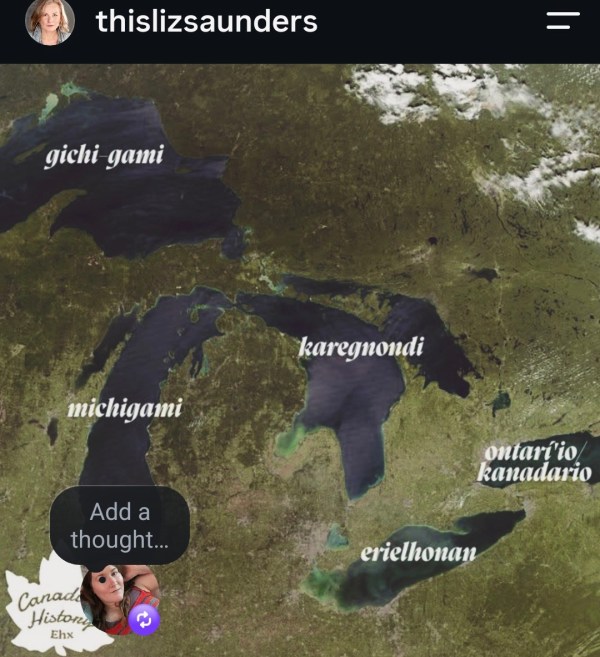
I feel like my brain is getting stuck in a quagmire of stupidity in 2026, like wet concrete under the feet of my thoughts when I am writing a blog post or crafting a conversation. It’s not because of using AI that is melting my brain, instead I feel like my brain is constantly having to jump through hoops to navigate the day’s new nonsense. I’ll explain.
Okay, so you’re having a quick search, ideally Duck Duck Go but habits die hard, so I Google only to be bombarded by AI overviews. Now comes the first hoop to jump through, remember to scroll down and ignore the overview to find a reliable source, scroll, scroll…then find a source to reference. Remember how a few years ago you could get Google search results, indexed and organized? Remember how simple that was? The mental effort required to find what you were looking for was streamlined, and now it is not, unless you want the “AI overview” which is nothing more than Google ripping information from the sources and digesting it for you, no matter how inaccurate they are. Creating more chaos, and more barriers to understanding. To be honest, maybe we were idiotic to leave the physical sources in the first place. Microfilm and archives are time consuming, but at least they are organized and unchanging.
For an example of how flawed this new overview format is, I present Dejeon Love. I recommend you look it up, because it is complex. For a reliable overview, I’d recommend Ashley Viola’s commentary on this. In short, Dejeon Love is a scammer, who was able to pad his online persona with so many videos claiming he was a San Francisco player, that it tricked the Google AI Overview. Why does this matter? When his victims searched for him, AI Overview confirmed the lie, and therefore it gave him credit. How disgusting is that? I personally think Google should be held accountable for assisting Love scam 1.3 million USD from 26 women, but of course they won’t be, because this is “the future”.
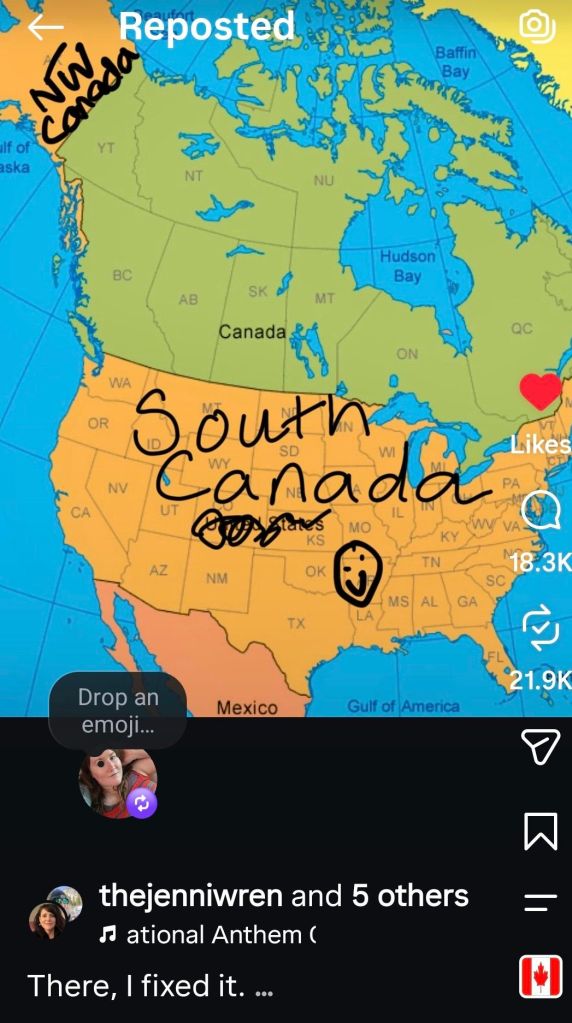
The other nonsense that is melting our brains day after day is the renaming game being facilitated by Google Maps, an 80 year toddler with a pen, and weak sauce government officials. First we had the Gulf of America in 2025, now we have the Lake of America, and now the state of New America, which I am sure Google Maps will bend over for that one. Aa long as the Kleptocracy of 2026 continues to line Google’s pockets, they will be whoring themselves out for it. I mean the scam worked for Elon, Meta, just give in for the money right? Who cares if it dilutes and corrupts your product, with legal and safety consequences. That seems to be of no concern, because they’ll just tell the machine to propagandize its safety. Case in point, the new Meta ads claiming its safety, while Meta in court over a lawsuit of the contrary.
My mind is so tired of critical thinking this much, over analyzing, factchecking things that used to be reliable, just to communicate the most basic things in 2026, because we have given into nonsense and the dissolution of standards. What are we doing to ourselves?! How will future generations view this time period? The regurgiation of everything era? The Golden Age of AI Slop? Honestly, I hope the state of New Mexico, which is the only governing body that can name itself, uses this as an opportunity to rename itself Nuevo Mexico, and educate our nation of its longer history in North America. The capital city of Santa Fe was founded in 1610, that is 166 years before America was created by the Declaration of Independence.
There are so many things, lofty things, we could be doing instead of debating the names of things that can’t be changed. Or how about how all the things we are having to debate because one person is doing things that he can’t do, with powers he doesn’t have? Or how about the time wasted everyday getting around the AI tools that have been integrated into our lives, slowing things down and stealing our resources? It is a quagmire, draining our focus and mental energy to avoid these idiotic improvements. I mean, after the Lake Ontario incident, how many of downloaded Map Quest? It’s not easy to use! I’m tired of this. Must we leave technology behind to escape this farce of progress? I hope not, for all the resources extracted to create this system that was helpful, that has been made more difficult to use, over and over again.
I’m just a girl, who hates change, especially when it is useless change. Do you agree?

It’s that time of the year when I come alive the most, and that means I prepare like its a new year, before the frozen embrace of winter sets us in place. I feel a flurry of energy to take stock of my yarn and fabric, go through my wardrobe to declutter, up cycle, and repair. I organize, I dream, I plan home improvement projects for those slow, hunker down days. I don’t feel this way at all in the Spring, I feel worn down by the winter icy, and dry air. I feel the weight of the garden, on my shoulders, and the desire to be outside again and sketch on the porch. The last thing I want to do is re-organize my house and clean. So is it the cadence of the four seasons that brings this rhythm of preparation to fall? Is is our fixation on the academic calendar? I’m not sure. It has been a time tested fixture of human culture. Forever, we have been preparing for winter, harvesting, hunting, and making.
So why, is it called Spring Cleaning? Surely Fall Cleaning would make more sense. I found that it is an ancient and modern phenomenon. The earliest mentions of a “spring cleaning tradition” are found in two west Asian cultures – Persian and ancient Israel. Iranian culture celebrates Persian New Year, Nowruz, on the first day of Spring. To recognize the new year, Iranians prepare by “shaking the house” a thorough clean, or “redd up” as my Western Pennsylvania culture would say. This makes a ton of sense to me. Honestly, I wish our modern New Year wasn’t in January, for my climate dictates the New Year kicks off during the coldest month! Not a time to do anything really other than waiting for the snow storms and negative Fahrenheit temps to pass. It makes for quite a boring holiday. The latter should have been obvious to me, growing up in the church, but I did not connect the two that Passover preparation could be the origin. During Passover, all things made with leavening or fermentation were removed to remember the Israelite flight from Egypt.
For a more modern origin, coal based heating systems would prompt a cleaning ritual in North America, to open up the windows and clear the soot. Honestly, quite a lame origin story, but important. I think a house down the road is burning coal in an burner, and I absolutely despise the stench of it. The smoke is thick and dark, permeating the air in the cold pockets of January’s bitter wind.
My fall cleaning, I’d say has a lot more in common with Nowruz than Passover or cleaning away soot. I love the description of shaking the house, it reminds me of how my Papa would describe my Grandma’s penchant for order, “She’s mean on clean.” As a child, I had no appreciation of her passion for cleaning, now as adult with my own spaces to keep tidy, a good straight up of the house brings me joy. I’ve been tackling the ever-present chaos of my craft room. It began with a sort through of my inventory, organizing it all into banker boxes and a new drawer set from Amazon to keep the fabric folded and yarn skeins arranged by fiber and weight. I can actually find what I need, when I need it, for the first time in my sewing and knitting life! Who knew a few boxes could be life changing? Organizing my stuff the way my mind processes it, well it has cut down on distractions. My easily distracted Neurodivergent brain used to find everything in my tornado of a closet, but the project I was looking for. It made everything take longer than normal, a simple search, an odyssey of investigation and forgetfulness. I couldn’t take it anymore.

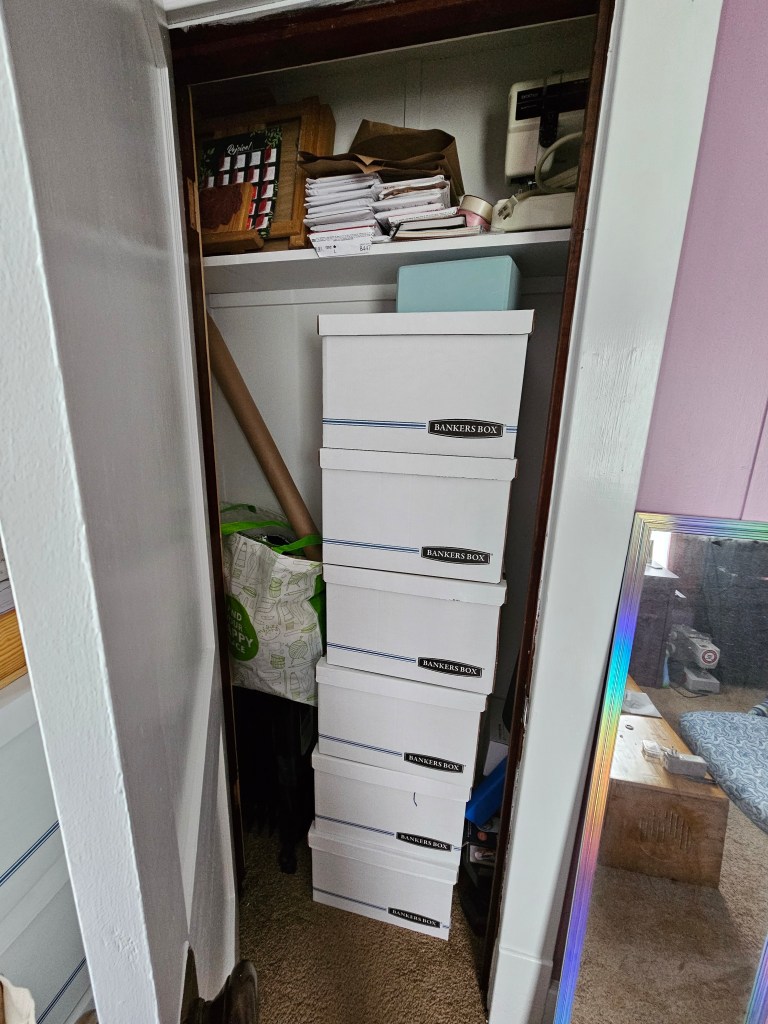
I rode this high into my closet, going through it all and organizing more, t-shirts by color family, mixing up my storage solutions from hangers, to zipper bins, to planning shelves to make there be a flow. Putting clothes away can turn into a series of doom piles, because the system was badly designed by me. I needed a way to keep the organization going, while I sorted and folded my clothes, yet again a bad plan led to me sorting through a random drawer for the third time that month, instead of putting the rest of the laundry away. It was a waste of time, leaving me frustrated once again at my squirrel brain. A flow to getting dressed, and a choreographed dance of freshly laundered clothes waltzing into their places once again. But why stop there? Less to organize would be ideal. Thus began a lovely fall purge of clothing into piles – donate, up cycle, repair, and trash/scraps. All the clothes, shoes too! I feel so empowered. I have struggled to part with anything since experiencing grief and trauma in the 2020’s, and it has been embarrassing. I will live with too much stuff, wanting to re-home it, yet being unable to part with it, in some guilt that I don’t understand. I think the burden of my mind is fading, with healthy clarity returning to my heart. I’m not saying goodbye, over and over again, I am being a good steward of things, and sometimes that means you have to let things go. Even my handmade items that may not serve me, but could make someone else happy.
With a clearer mind, I feel inspired to create. This comes ever fall, with a flurry of ideas for new sweaters, accessories, and clothing. This year is a special one as I have been making pants, from scratch and from up-cycled materials. I will be fine tuning my cold weather accessories too, with plans to make excellent hats, mittens, and socks. I’d also like to make a bag or two. My sweater plans are more focused this year. I understand how to make the thing now, so how can I make them better? I guess I shook the house of my creativity too, in this clean.
Do you feel motivated in fall to get things done? Are you a fall cleaner or a traditional spring cleaner?

