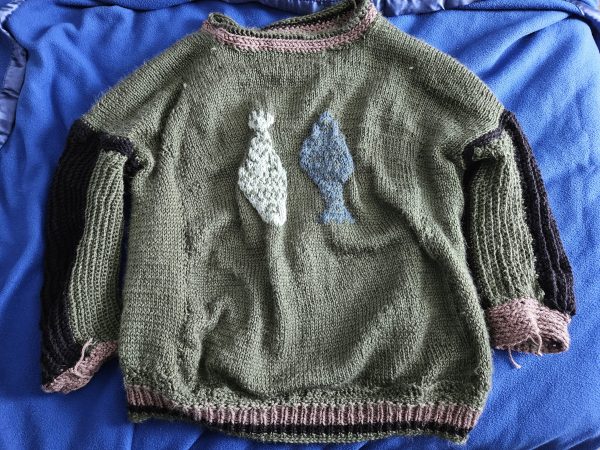
Catch of the Day Sweater

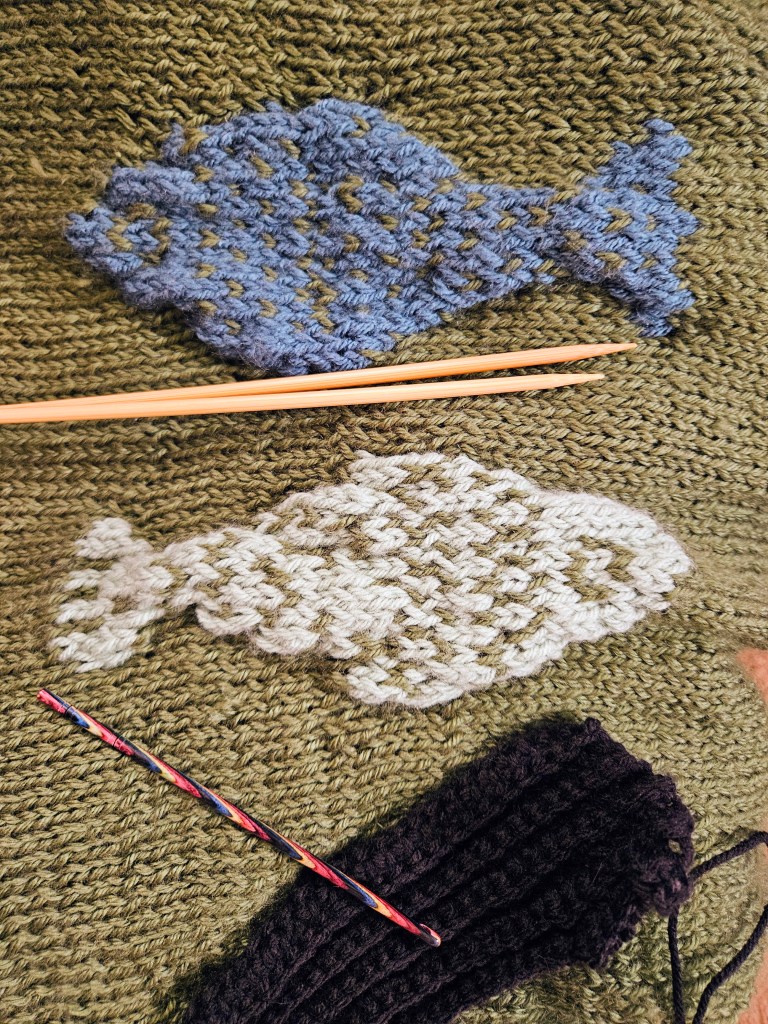
In 2025, sardines and other tinned fish became more than just food; they appeared on beaded bags, shirts, and prints. They also made their way to the fiber arts community, which inspired me to make a fish print sweater for Kyle, who enjoys fishing IRL and in video games. I just like the video game version.

The Design Concept

When planning a garment with a colorwork motif, I always consider scale, placement, and repetition. To do this, I use what I learned in art class many years ago – the seven fundamentals of art. So I consider line, shape, color, value, form, texture, and scale. In the catch-of-the-day sweater, it was important to make the fish wearable and to ensure good form and function. How do I make the fish on this sweater make sense? I decided to hang freshly caught fish on the sweater to help with the scale of the art. I placed them in the center, on the front, only to keep the perspective of this in focus. I thought placing more fish would become overwhelming to the eye and become unwearable.

Adding more fish would have required adjusting the scale and the color, meaning I would have simplified the sweater down to two yarn colors only, with sections of fair isle colorwork, which is a smaller, more concentrated technique. But I like the color contrast of using two colors, representing two types of fish with slightly different scale patterns. How big is too big? How do you represent a fish, with their scales and texture? For this, I went to Pinterest to find cross-stitch or knitting colorwork charts for inspiration. I believe I settled on a cross-stitch pattern because it had the detailed lines and scale I was looking for. I wanted the fish to look realistic, although it could be in an imagined world like Animal Crossing New Horizons or Stardew Valley. Whimsical? I think that is the best way to sum it up.
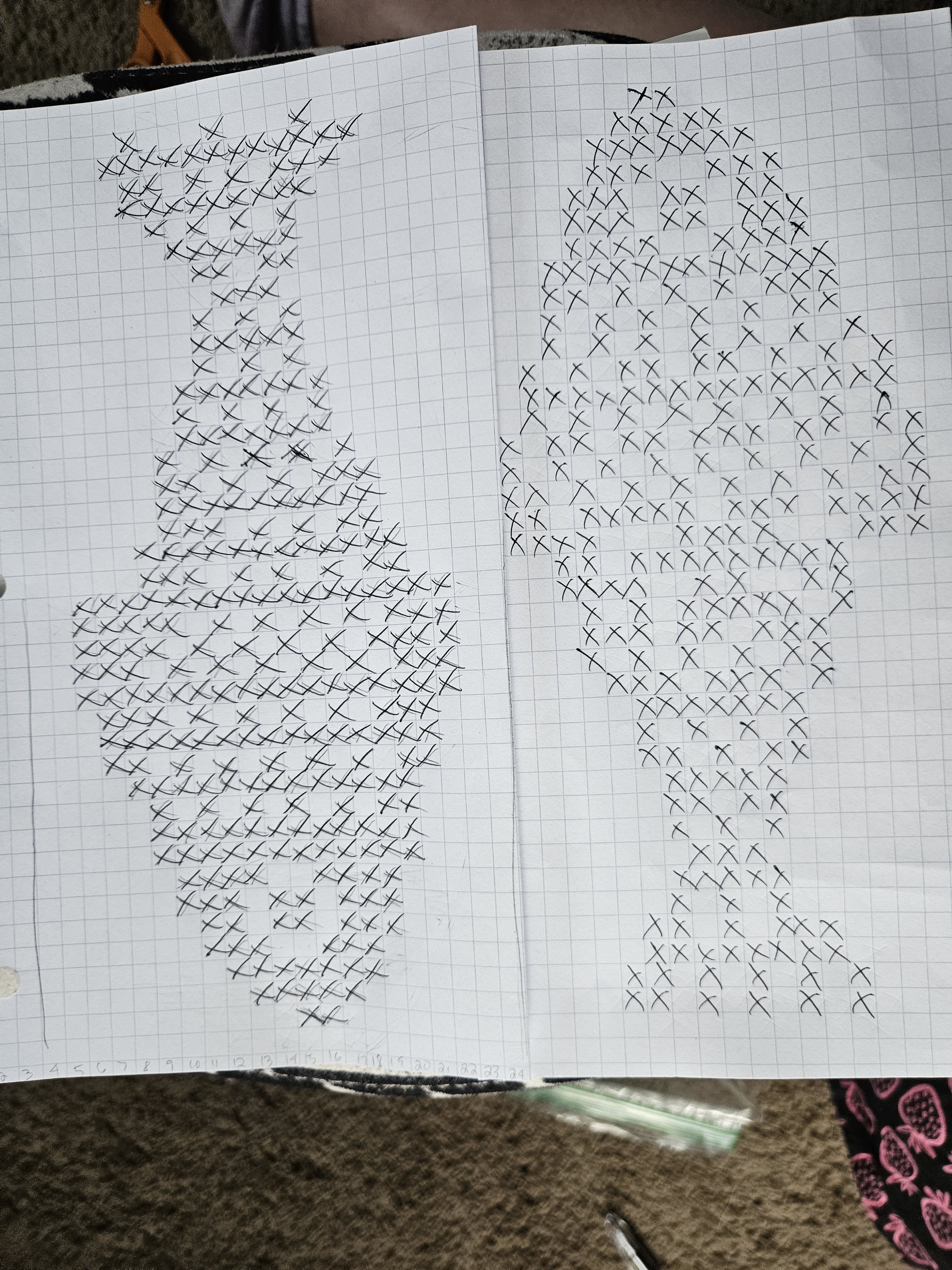
To make my pattern, I used the cross stitch reference and transferred it to graph paper by hand, tweaking some areas to make the inspiration my own. I did this in the same application for my Red Velvet Cosmic Knit Tank project. Next, I needed to determine the scale of the fish within the sweater pattern. It’s important to plan out how many stitches you need to complete the colorwork section across your rows and keep it centered. To do this, subtract the number of stitches in your colorwork pattern from the number of stitches in your row. Divide the sum by two and adjust to keep the stitches on either side equal, to keep the pattern centered. It is also important to note how tall the color work pattern is compared to the garment you are knitting, to allow enough room above and below that the graphic motif makes sense and doesn’t look misplaced on the garment. I think I literally held my pattern up to Kyle’s chest to figure it out.

Fiber Content

For this sweater, I went in a different yarn direction to try something new. I chose a wool and acrylic blend from Knit Picks called Mighty Stitch. It was underwhelming. The yarn, while soft, pills something fierce. It is also a slim worsted weight, which was exaggerated by the large needle size I used – US 10 or 6 mm. This created a breathable, airy sweater, but dang, did it throw off my pattern and design. Eventually, I had to face my fate – I was running out of yarn, and my panel was too narrow. Not exactly the outcome you want after spending a week on the front panel with the intricate fish design. I would rather start over than frog the color work, always.

I had some decisions to make. I originally purchased the Mighty Stitch on sale, but when I ran out of yarn, it was not on sale, and I wasn’t interested in doubling the price of this already too expensive project that was in the process of failing. So like Miss Frizzle recommends, I got ready to “Take chances, make mistakes, get messy!” I went to my closet of yarn and fabric and began to dig through the stash for something else I could introduce into the design. I found a warm-toned gray and neutral black yarn from Big Twist that was also worsted weight. Because the Mighty Stitch is a washable yarn, I felt comfortable combining the two yarns. I had already introduced acrylic yarn to the project through the mint and teal fish, using scrap Big Twist for those sections. Always check your fiber content, though, to avoid incompatible fibers that will make the project hard to care for over time.

Making a Change

The original design was changing from color palette to overall concept. This sweater would need to have color blocking sections now, to stretch the main green color. I decided to not only change up the design, but to change up my technique, opting for crochet on the sleeves to make the sleeves go faster. Knitting is a slow craft, and for some reason, knitted garments for Kyle have this curse of going horribly wrong and also knitting up slowly because of the hiccups. I wanted him to be able to wear this sweater for the bulk of the winter season of 2025-2026, and I was knitting this in August-October, so I took a shortcut. But in my defense, the texture of the sleeves, ironically, looks like fish scales to me. Especially with the gray and black colors!

The second change I made was adding width to the sides of the front panel to make the sweater a drop shoulder. I then knit the back panel wider from the start, and added a section of gray on the middle to upper back panel. It adds a nice contrast to the overall composition of the sweater, while making the sleeves feel cohesive.

Men vs Women Shoulder Shaping

The shoulders gave me such grief in this project! I’m used to making sweaters for myself and my female form. The bust makes the shoulders rest differently than I realized, and this came back to bite me. For a man’s sweater, the back needs to be longer. Especially the shoulder section on the back of the sweater is going to ride up the back, and be too long in the front. This happened, and I was bamboozled on how to fix it. Enter short row shaping and the principles of perspective and scale.

I learned that I needed to add short rows, meaning only working a section across a row to add length to a specific portion of the back panel, the back middle. To do this, you work back and forth on the section, evenually go back to working across the entire row. In addition, I made the back collar and back ribbing longer to compensate. These simple changes made the sweater appear the same length back and front, draping across the shoulders pleasantly, even if one side was technically longer. It doesn’t matter because of the role of perspective. Magic!

Final Thoughts

I learned a tremendous amount of knowledge from the Catch of the Day sweater, and I am grateful it all came together in the end to make a sweater that Kyle enjoys wearing. I have saved my patterns to attempt this again in the future with better yarn and proper dimensions to make the pattern fit well from the start, instead of scrambling to adjust at the end.
Our 2026 Gardening Seeds: Melons, Molokhia, and Peas

In a continuation of my series highlighting the garden seeds we ordered for our 2026 garden, I’m going to combine several vegetables into one post. This post will go over our melon, molokhia, and pea seeds. Below, I am including links to the previous installments of the series. Plus, here’s a post that showcases all of the seeds we ordered.

Links to Other Seeds:

Melons

Last year, I think we grew four types of melons: one watermelon, one cantaloupe, and two specialty melons. We had moderate success and were able to harvest one cantaloupe and multiple specialty melons. Given that we didn’t know what we were doing, I was pretty happy with the outcome. This year, we’re dialing it back by only growing three varieties of melons and no watermelons, which was the only type to not produce an edible fruit last year. The three varieties we bought were also bred to grow in northern climates, so we should be in a good position to succeed even if we have a cooler summer.

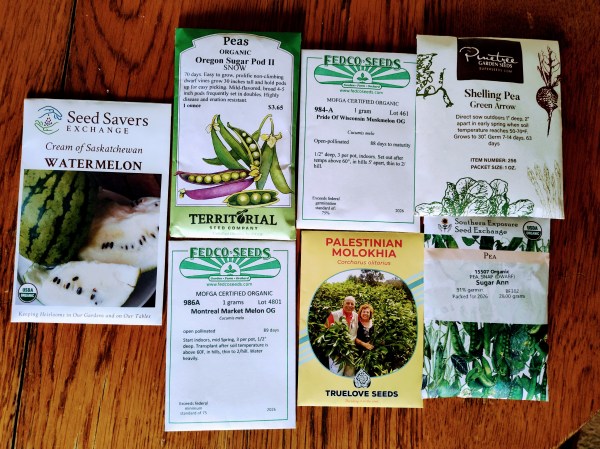
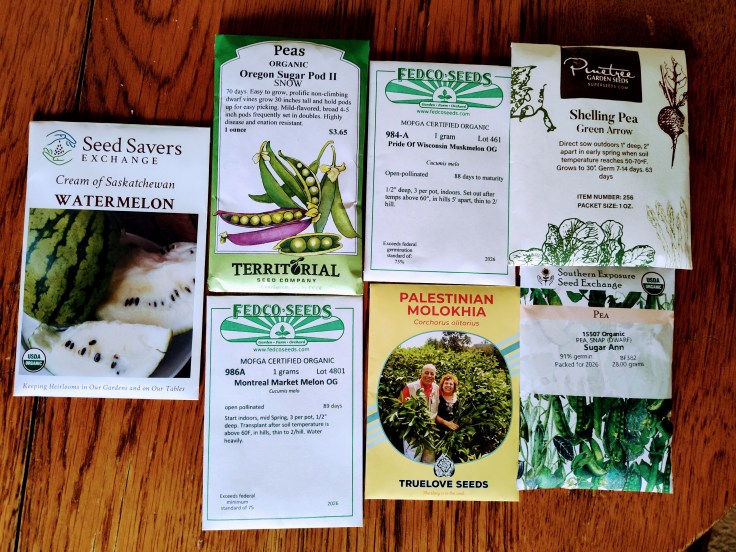
Melon Seeds, Molokhia Seeds, Pea Seeds
Our melon, molokhia, and pea seeds for 2026.

Cream of Saskatchewan

This white-fleshed watermelon has Saskatchewan in its name, but its origins are Russian. It grows very well in northern climates that have shorter growing seasons. Despite its white flesh, it is known for its sweetness and great flavor. It has a very thin rind and does not store well. This heirloom seed was bought from Seed Savers Exchange.

Montreal Market

This muskmelon has a fascinating story. The seed dates back to early French settlers of North America (to at least the 17th century), and Burpee commercialized it in 1881, but at one point it was thought to be extinct. Thankfully, a group of Montreal seed preservationists located a few seeds in 1996 and brought it back. A green-fleshed variety, Montreal Market has a sweet and spicy flavor that is unique. Grows very well in cool climates. Our seeds came from Fedco.

Pride of Wisconsin

Fedco, who we bought this seed from, describes the Pride of Wisconsin as the “best full-size open-pollinated muskmelon.” It was introduced by the St. Louis Seed Co. in 1923 and nearly went extinct during hybridization. The taste is supposed to be divine, and the flesh is edible down to the rind.

Palestinian Molokhia

I first learned about Molokhia in a podcast from True Love Seeds called Seeds and Their People. If you haven’t listened to that podcast yet, I recommend it. Magz came across molokhia when she was looking for flax seeds, buying both from True Love Seeds despite not knowing that I listened to their podcast. Molokhia is a green that is natively grown in the Middle East, North Africa, and East Africa that is rich in vitamins and minerals. It’s eaten like spinach and is also called Egyptian Spinach, while its fiber is used to make twine, rope, and rugs.

This variety comes from Palestinian refugees/immigrants living in the United States. Molokhia should be picked throughout the season for a perpetual harvest, and the leaves can be frozen or dried. Side note: I may not always love modern technology and the modern world, but the ability to learn about and purchase seeds that are vital to a culture halfway around the world is amazing. Buying and growing this seed is especially important, as the Palestinian culture, including its foodways, is being threatened. By learning about Palestinian culture and humanizing the Palestinian people, we are able to better understand them. The relationship between the Palestinian and Israeli people can be tough to understand, but one thing we should be able to agree on is that no one should have to worry about their culture being destroyed. As a Christian, I have no problem using the word “genocide” to describe what’s happening to the Palestinian people.

Peas

Peas get such a negative reputation, which is unfair. It’s probably because of people’s experience eating canned peas as children. While I also like those, fresh peas are amazing. Last year, we grew a couple of rows of snap peas and had some success, but we had issues with weeds and our corn shading the plants too much. This year, we’re growing all new varieties and picked one variety each of snap peas, snow peas, and shelling peas.

Green Arrow

Full transparency: This shelling pea variety’s name caught our attention and is the main reason we chose it. I’ve been watching the TV series Smallville over the past six months or so, and Oliver Queen (aka Green Arrow) is one of my favorite characters. As a seed, the Green Arrow pea is an heirloom that has been developed to have good disease resistance and high production. We got our seeds from Pinetree Gardens.

Oregon Sugar Pod II

The Oregon Sugar Pod II is a snow pea that has a contained growing habit with only 30-inch-tall vines that don’t climb. Like Green Arrow, this variety is highly disease resistant and very productive. Our seeds were bought from Territorial.

Sugar Ann

This variety is a snap pea that is known for its exceptional flavor and was named an All-American Winner in 1984. It grows in a bush habit with only 18-inch vines that don’t need to be trellised. Snap peas are my favorite, and I have a hard time not eating them fresh off the vine. Can be planted late in summer for fall harvesting. Our Sugar Ann seeds came from Southern Exposure.

Have you grown any of these varieties before, or have you grown molokhia in the past?

How I am Preparing to Leave Pinterest, if OpenAI Buys Them

I want to start off by pleading with Pinterest, please don’t work with OpenAI. (I know this is purely a rumor, but even so, I think using the internet to voice opinions is important.) I have been using your platform since 2012, and it is so useful! It has become less useful over time, with the “purely financial” decisions of peppering in a multitude of advertising pins and allowing AI-generated art to invade the platform. Even so, it is still a platform I use and love to escape into for inspiration.

Without Pinterest, creative writing projects like Udal Cuain, knitting colorwork projects, sewing projects, and home decor ideas would have been more difficult to source and may not have been on my radar – ever. I’ve even learned simplified versions of songs to play on the piano before I bought proper books, for free through Pinterest. Now what about fandoms? On really difficult days, my Stray Kids board is filled with memes, SKZ Code, captured moments from lives, silly edits, and STAY inside jokes that would not exist in one place to make me smile.

I don’t want to leave Pinterest at all, but there comes a time when we must make a stand for what is right – if you integrate with OpenAI, as rumors have thrown around, many other like-minded individuals, and I will leave because, as artists, we will not stand for the theft being carried out by generative AI of our work. Art is human. Generative AI is regurgitation. Art is for an audience of many; AI-generated art is for an audience of one. Human-made art has emotion; AI-generated art is the result of algorithmic decisions. AI-generated things are not new; they are not groundbreaking. They are human effort and human creativity scraped by these computers and served up as “new” all while consuming vast amounts of electricity and clean water, for nothing but perceived “innovation” that makes these tech bros wealthier. It gives nothing to humanity; it feeds the greed of the few. Alright, that’s enough of looking into the abyss for me.

How do I plan to make this change if Pinterest is bought by OpenAI?

  • Crafting Books
  • Used Books, Magazines, and Catalogs
  • Respectful Fan Accounts on Instagram
  • Physical Notebooks
  • Migrating to Milanote
  • Blogs and Research
  • Building a Creative 3rd Place Elsewhere
  • Creating Your Own Charts
  • Physical Moodboards
  • Acknowledging Frustration
  • Diving into History
  • Utilizing Libraries

Yes, we’ll be going back to analog inspirations, like going back to the 1990s and 2000s. I’ll be crafting even slower, researching longer, and spending more time digging to learn how to do new techniques like fillet crochet or how to paint using gouache paints, but that’s okay. At least it will be honest inspiration. In time, we will all come back together through a new creative community platform, and it will be a bit of a waste of time. So, Pinterest, put these rumors to bed, please, because when it comes to AI, we artists mean business, and you will be left behind.

Thanks for coming to my TED Talk ❤

Our 2026 Gardening Seeds: Cucumbers, Flax, and Leeks

In a continuation of my series highlighting the garden seeds we ordered for our 2026 garden, I’m going to combine several vegetables into one post. This post will go over our cucumber, flax, and leek seeds. And if you missed the previous installments, you can read about our bean seeds and corn seeds. Plus, here’s a post that showcases all of the seeds we ordered.

Links to Other Seeds:

Cucumbers

I love cucumbers, so much so that I dug into the history of them in this post. They’re one of my favorite vegetables to eat during the summer heat, and I crave the coolness they provide. Last year, we planted a lot of cucumber plants, and the vines went everywhere. They intersected with each other and other plants and were difficult to navigate through. We also had more cucumbers than we knew what to do with and lost some ripe ones that were buried underneath leaves. Because of that, we’re scaling back our cucumbers in this year’s garden. We still want variety that can be eaten fresh and pickled. Plus, there’s still a specialty cucumber that I couldn’t resist.

Cucumber Seeds, Garden Seeds, Leek Seeds, Flax Seeds
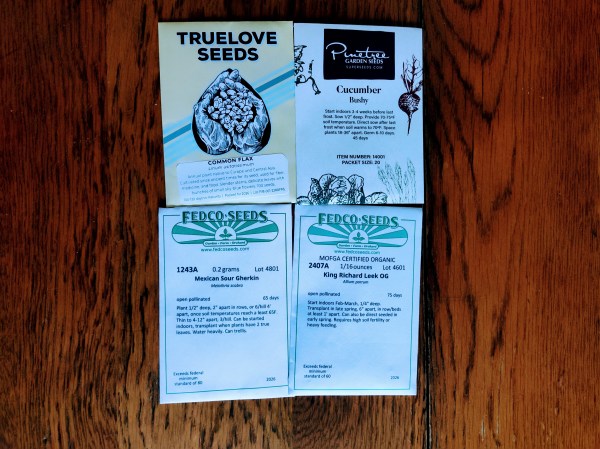
Our cucumber, flax, and leek seeds for the 2026 garden.

Bushy

This short-season cucumber is one of the earliest varieties you can find, maturing in 45 to 50 days. This variety has a bush-growing habit, as is evident by its name, and can even be grown in containers, which we are considering. The cucumbers are excellent for fresh eating and pickling. The Bushy cucumber originated in Moscow, Russia, where plants that thrive in short summers are essential. We haven’t grown this variety in the past. The seeds come from Pinetree Gardens.

Mexican Sour Gherkin

This is a variety I’ve been interested in for a couple of years. Also called Cucamelon or Mouse Melon, the Mexican Sour Gherkin is native to Central America and has been eaten there since before the Europeans arrived. This variety grows on vines, so it needs a trellis or fence and grows many 1-inch fruits that resemble tiny watermelons. Our seeds come from Fedco.

Flax

Historically, Pennsylvania grew a lot of flax, which was milled, spun, and used to create linen for clothing, bedding, and more. Its oil is what we call linseed oil. Over time, the commonwealth stopped growing flax on a large scale, and we no longer have mills for processing. Last year, Magz learned about the PA Flax Seed Project, which has a goal of reestablishing flax as a commodity crop in Pennsylvania. As a result, we became interested in being part of the movement to see flax grown in PA once again.

Common Flax

We were originally going to participate in the Square Yard Project, which is part of the PA Flax Project, but their website for signing up was down when we were ordering seeds. So, Magz found seeds from True Love Seeds, which is based in Pennsylvania. According to their seed description, common flax is mostly grown in Europe and Central Asia. Linseed can be used medicinally for its anti-inflammatory properties. The oil and seeds can be consumed and are rich in omega-3s. Plus, the fiber can be used to create textiles. We bought a single pack of it with the goal of learning how to grow it. It’s supposed to be very easy to grow.

Leeks

We have never grown leeks and, to my knowledge, have only cooked them once or twice. But with a flavor that’s described as being similar to a green onion but sweeter, we’re confident that we’ll like them. One of my gardening goals is to grow onions in the future, but they can be finicky and can take a lot of preparation, so leeks seemed like the next best thing.

King Richard

I knew that I wanted a leek variety with the shortest time to maturity that I could find in case we have another late spring or an early frost in the fall. The King Richard Leek fits that mold, only needing 75 days to mature. Our seeds come from Fedco.

Do you have a favorite cucumber variety to grow? If so, I’d love to hear about it and possibly grow it in the future. Also, have you ever grown flax or leeks? I look forward to hearing from you.

Create a website or blog at WordPress.com

Up ↑