What if the clothing we wear is more than just a garment, but connects us to the fibers of our being?
What if a pillowcase, from a loved one no longer here with you, could be more than just an item cluttering your closet? How could you repurpose it so the memories can walk with you in the new days ahead. All while the smell of their laundry detergent, and their home, so distinct to your senses, that being near it makes you feel comfort.
That is what this project is to me. More than an upcycle, or a thrifty hack, but a way to process feelings. Find a way forward. So the things left behind, that remind of what is missing, can do more than drown us in memory and stuff, but become a tangible way of healing.
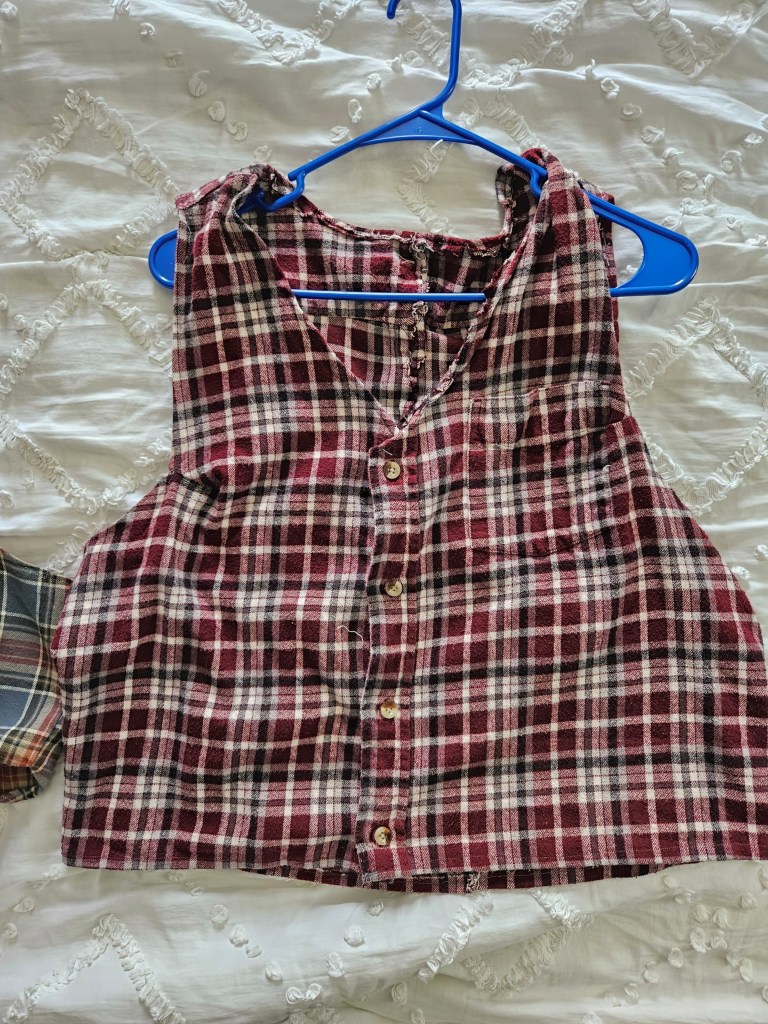
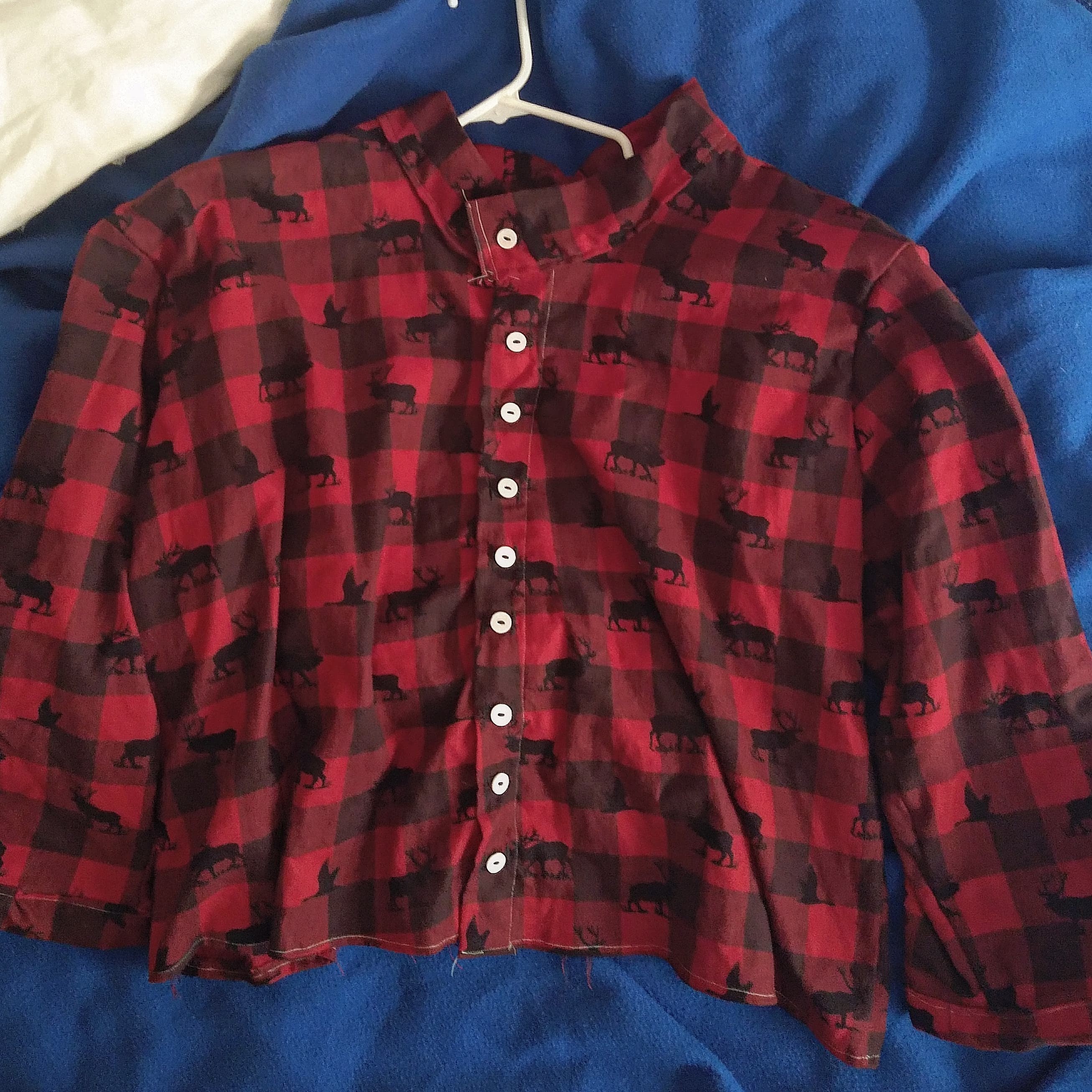
Last summer, I wanted to introduce vests into my wardrobe. I have made vests before for Kyle, but have not sewn a vest for myself before; I have knit them. Because this was a spontaneous idea, I needed to be budget-conscious and find a way to use what I had to make a vest. So I went to my closet and got creative! I had a few flannels in my closet that were hanging there, waiting for me to wear them, but I didn’t. That’s when I looked at the shirts closely – there was a button placket, shoulder yoke, and a sturdy fabric, with room to crop them. I saw the vest within the shirt, so I grabbed my scissors—and was a bit too zealous with the first one! Don’t be like me, have a plan. So how did I make this upcycle work? And what did I learn from my failed attempt?
Shoulder Seams, Yoke, and Waist Length
The crucial points of cutting, I would say, are being aware of the shoulder seams, accounting for the back yoke width, and properly measuring your waist length for a proper fit.
Shoulder seams on a flannel are boxy and loose. To achieve the set-in sleeve opening that accentuates and reveals the shirt underneath, you need to cut away the shoulder line – but not too much. Be mindful of how far into the shoulder you plan to cut, so that you are left with a proportional line.
The shoulder yoke is a technique used to tailor the shoulder line, while leaving the fabric below the shoulder loose. As a result, there will be more fabric on the back of the vest, which may affect the fit of the arm openings and possibly require a dart to remedy the loose fabric. If not, the back will gape open, looking awkward and like a mistake. A vest should hug the body, be tailored, or else the upcycle will look exactly like you cut up a flannel.
The length of the vest determines the style and balance of an outfit. One of my vests I cut too short, and this limits how I can wear it. I find it cuts me off in a regency high-waisted fashion that is fine when I wear it with a high-waisted skirt, but with pants or my linen Darcy shirt, it’s awkward. The other vest was cropped, in a careful fashion, ending at my hip and balancing my body line like a well-tailored garment. It’s far more versatile.
Cutting the neckline is crucial. For the front, a tapered cut to the button placket provides the classic look. Be careful not to cut too low for a historical silhouette. Also, remember not to cut the back the same as the front! I made this mistake and had to sew the cut portion back into my vest. This should be a crew neck line, straight across, with a slight dip in the middle for comfort.
Why a Flannel Shirt?
I chose flannel shirts as my medium to work with for three specific reasons. The first one I already mentioned – cost. We had just moved into our house and paid quarterly taxes. The vests were not a necessity, just a whim, so it made sense to me to take an existing item, I didn’t wear to create something I would wear. It’s funny how the sustainable option is sometimes the free option too. Secondly, flannel is a sturdy fabric, appropriate for the structure of the vest, that could be sewn without the addition of a lining, which I could add later if I wished, when I was more comfortable spending money on fabric. Thirdly, flannel is a classic pattern that reminded me of the woven woolen coating fabrics that vests have been sewn with for centuries, so it was a good match! I hope this inspires you to repurpose items you have to make something new! For the rest of the flannel, the pieces I cut away, like the sleeves, stay tuned to see what I did with those. It’s one of my favorite makes. 🙂
Like I said in my 2025 So Far Has Been a Creative Slump, I am sharing the projects I’ve hidden away in my closet and the photos buried in my gallery. It’s time to catch up on this blog on what I’ve been sewing, because it’s been a journey of new discoveries.
Go With the Flow
In 2022, Kyle gave me a unique birthday present. He curated a mystery box of fabric for me to do my own “Project Runway” challenge – one of those fabrics was this sheer wheat colored criss-cross fabric. It has lived in my stash ever since. It was a fabric that scared me but intrigued me. It’s a stretch mesh burnout pattern, and for over a year, I was baffled at how to sew it without destroying it.
Even so, after I sewed it into a garment, how would I apply it? Would it be a garment that would be sewn layered on top of an opaque fabric? What would that look like? Should I use a high contrast fabric or something similar in tone? It stumped me. I lived with it a bit more in my stash, and it came with me through the move and into the fall once more. In 2024, after two years, I had an idea – sheer layering. A garment I could wear under or over other pieces to add dimension and disguise the oatmeal color that I was concerned would wash me out.
My decision was to make a shirt. I thought making it a “basic” would provide the most opportunity to style it in my wardrobe. I sewed the delicate fabric with my machine very slowly. I relaxed the tension of the thread and progressed delicately, ready to hand-sew at any moment of panic. It was not terrifying; it was possible.
Structure of a Bodice – Armor
Many years ago, back in 2021 (four years ago, what?!) I crafted a structured dress, based on Lizzie Bennet’s dress, when Charlotte Lucas announces her marriage to Mr. Collins. It was a vest and a skirt, with buttons and a collar. It was ambitious but rubbish, yet a project I can’t stop thinking about how I could have made it better.
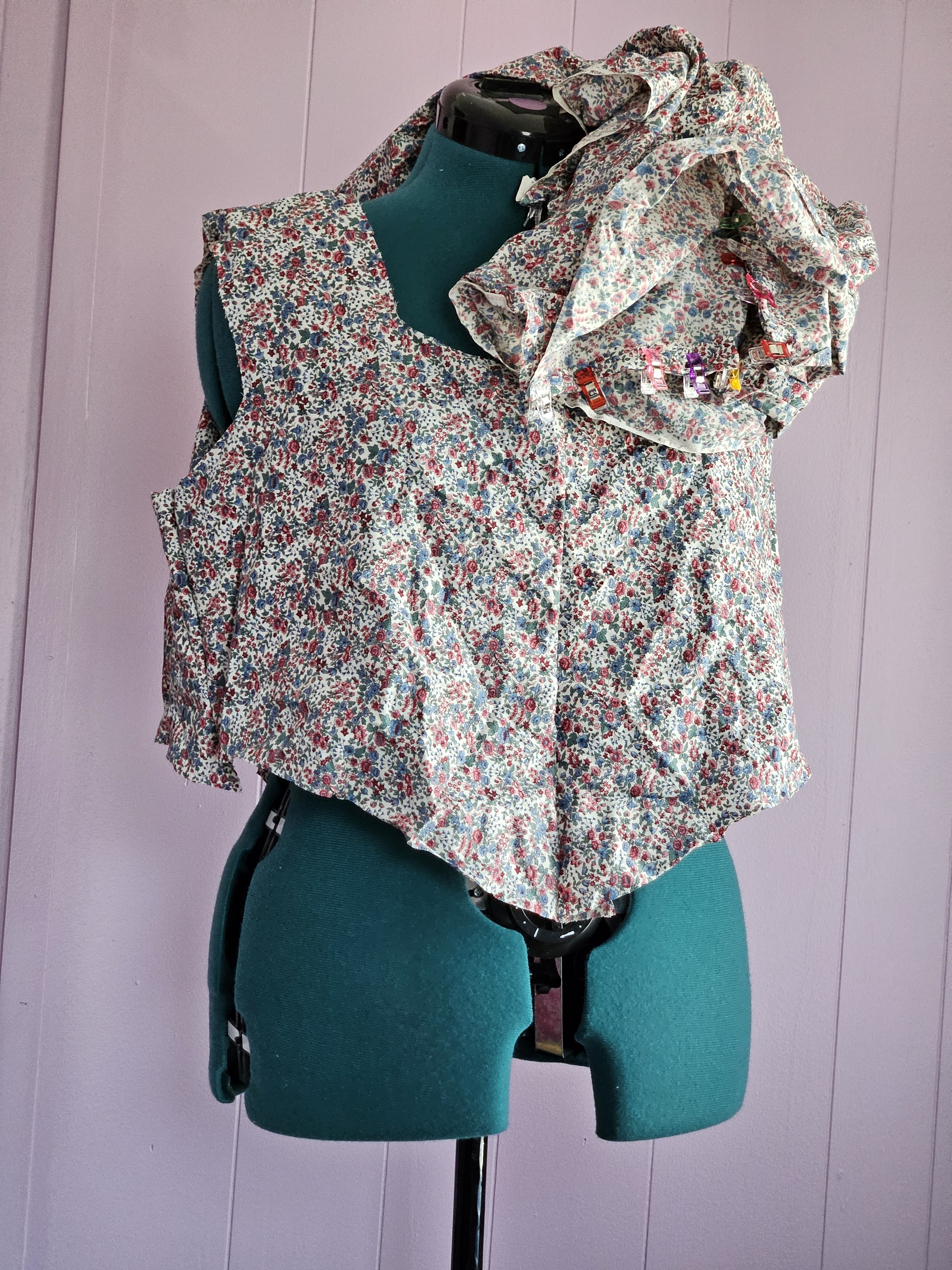
Enter this fabric and this bodice shape. It looks like an armor piece made of vintage ditzy flower fabric, lined with muslin. I wanted to reclaim what I learned in 2021, but try again in 2025, since the failure of my early projects made me shrink back to “easy” projects. I’ve made things that have challenged me a little bit, but not a true experiment. Constant growth is painful. Think of your body after consistent workouts, you’re going to hurt. It’s part of the process of getting stronger, and it feels at times like a negative experience. That feeling ground me down. I was tired of the learning experiences that felt more like loss and waste than an expression of crafting and artistry. It’s human, it’s passion, how can we not want the fruit of our labor to produce something good?
I made this dress slowly, over several weeks, while working on other projects, while being sick. It was a slow, steady, careful process to make a dress that would bring me joy from the creation and the wearing. The other thing I had to wrestle with, in this project, was shaking off the demons of my Lizzie Bennet dress. It was a dress I felt pretty in, but that I took a lot of crap for my appearance when I wore it out. It was structured, fitted, and flowy. The waist was not perfectly matched to the small of my waist, due to my lack of tailoring knowledge. This dress prompted a stranger to ask me when I was due, and then doubled down that I looked pregnant. I wasn’t pregnant, so to her, I looked fat. Thanks lady.
It was rude and such a breach of boundaries. Don’t ask random strangers if they are pregnant; wait for them to clearly tell you. It feels like a slap in the face for so many toxic culture reasons, the main one is the unwanted comment on your body with the double standard of “pregnancy being the most beautiful,” but don’t look pregnant, aka don’t be fat, because the zeitgeist is fat-phobic. I got rid of the dress and don’t have any photos saved of the dress; that’s how much this experience ruined the dress for me. I lacked the confidence to brush it off. I didn’t understand my body’s proportions and lines, therefore, I blamed my body and myself for the dress not working, instead of my tailoring skills being the problem.
2025 Style – Layering and Reclaiming
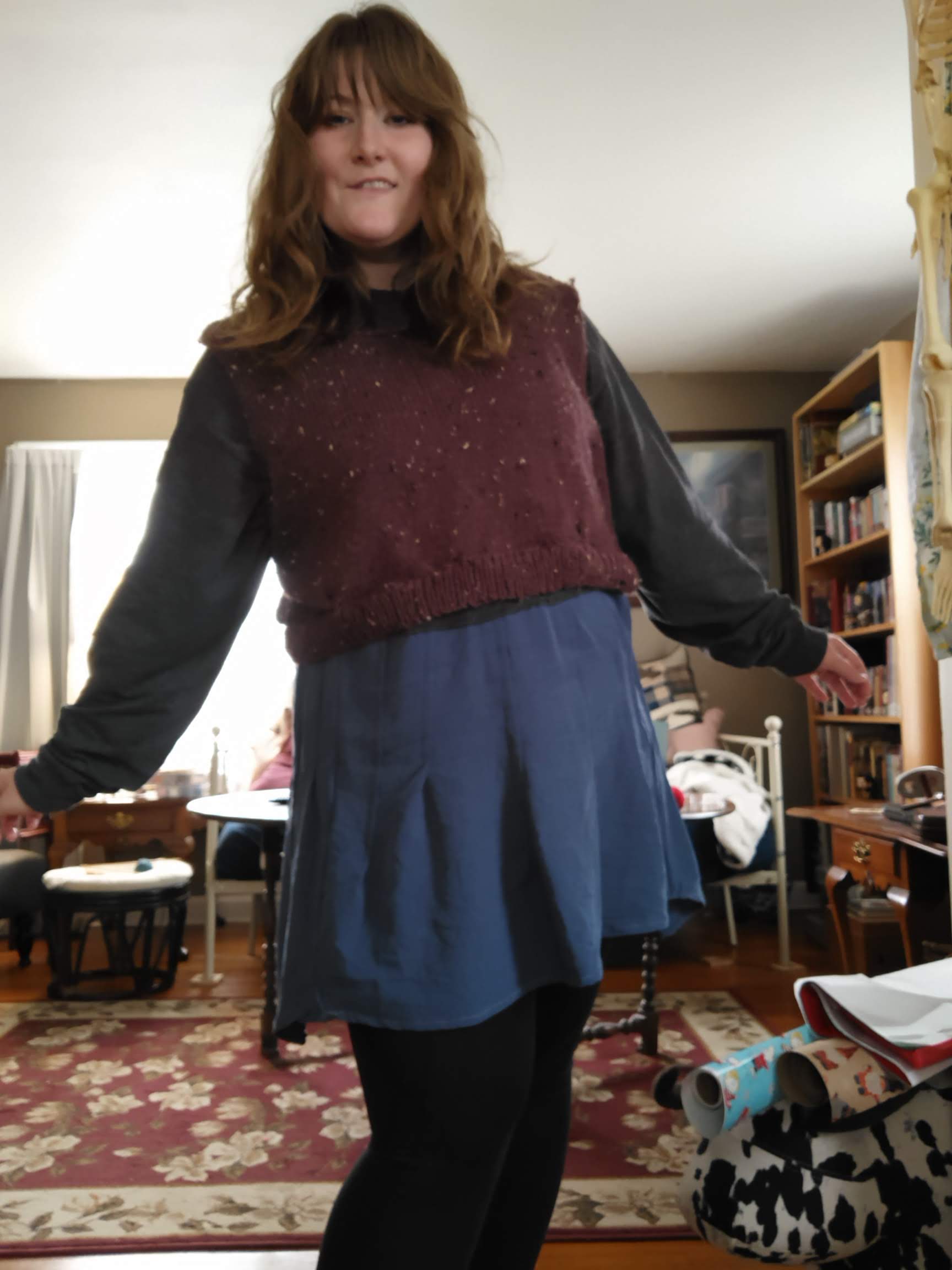
I chose to confront this feminine dress style once again. I knew it would clash with the natural lines of my body. I don’t have an hourglass body shape, which this fit and flare dress calls for. I’ve been scared to wear it, but I am challenging myself to try. I layered the sheer shirt I made in 2024 with this dress and a belt to create balance. It’s going to take time to get comfortable, for sure.
The dress not only has this flowy skirt, but it is fully lined, and the front gathering has been tracked down with stitches to reduce waist bulk. I also added eyelets and lacing at the back of the garment to define the waist, Lastly, I added a belt to my waist, which I don’t enjoy wearing, but the effect of pulling the eye to the waist should reduce unwanted comments, I hope. I like the contrast of these garments together. They have flow and structure. Together they create a complete thought, and in my opinion, look like designs with a point of view, which is what I am aiming for in my designs 2025.
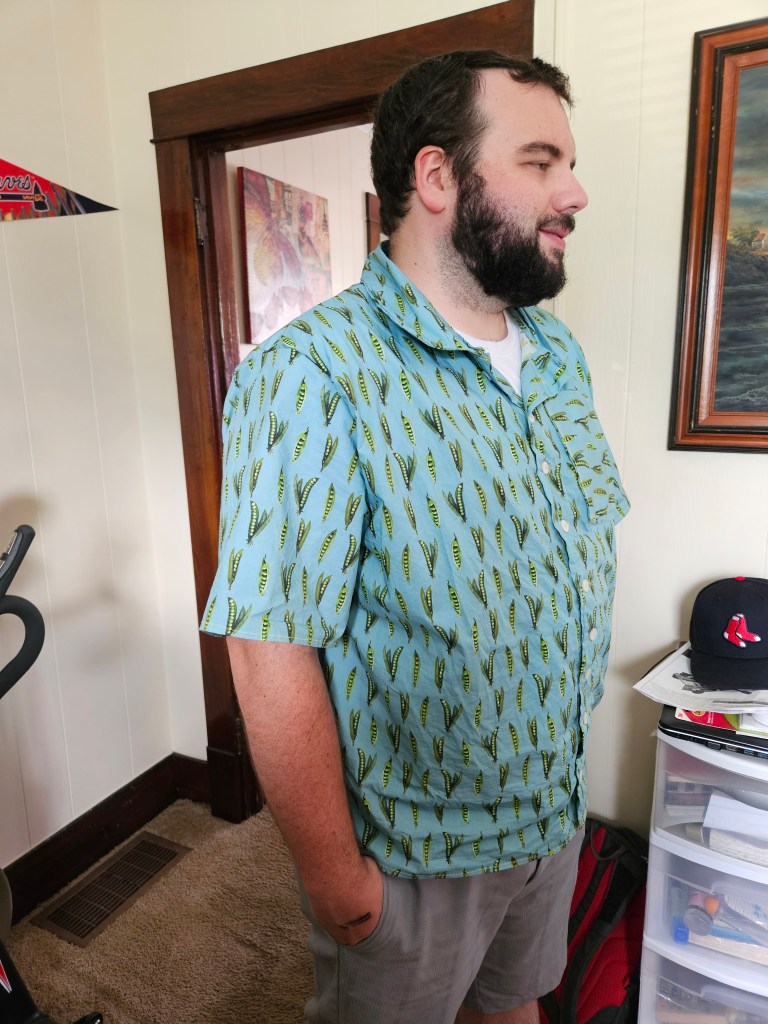
This was a special make for my husband Kyle who loves to find short-sleeve button-down shirts with fun and unusual patterns for the summer. This started early in our marriage at the thrift store where he found some nautical print button-downs. I slowly added to his collection finding a lobster print, a pina colada-themed shirt, and a shark one. Now that I sew, I approach this differently by browsing the fabric stores.
When I saw this print on Mood Fabrics’ website I knew exactly what it would be – a short sleeve button-down for Kyle. And it did not disappoint!
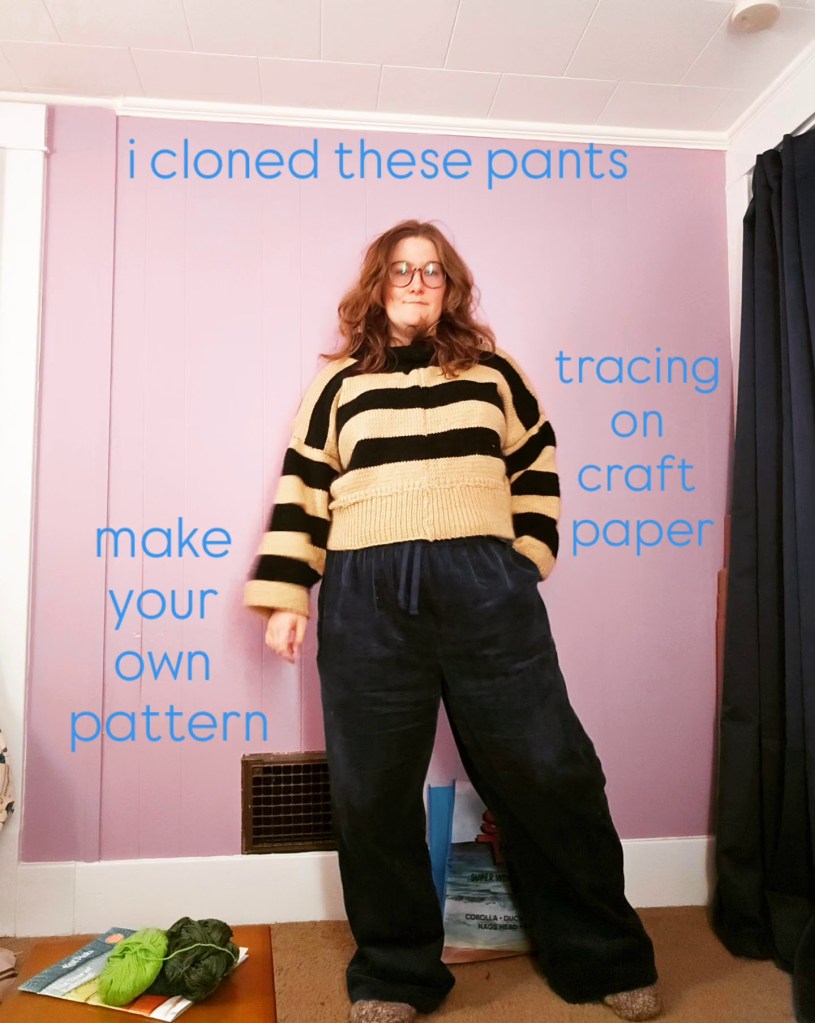
This year I’ve been transferring designs that I like onto my own paper patterns for a quick reference when planning projects and cutting out garments. It has also opened a new world of pattern hacking my own patterns! I’d heard of pattern hacking before but mainly in the context of pattern hacking pieces from the big four, either by altering the lines of the pattern piece or mashing up patterns from different garments to create something new. Trying it with my own patterns has been incredibly fulfilling and made designing a lot easier. I’m wasting less fabric and having a much easier time tailoring my garments, which means when I start designing to sell I’ll have this process down instead of being lost. It’s exciting!
One of the patterns I hacked into something new was the bodice pattern from this Henley top I made from a ribbed knit fabric from the Walmart remnant bin, it was a major score! This pattern has a scoop neck and a relaxed shoulder line that extends off the shoulder.
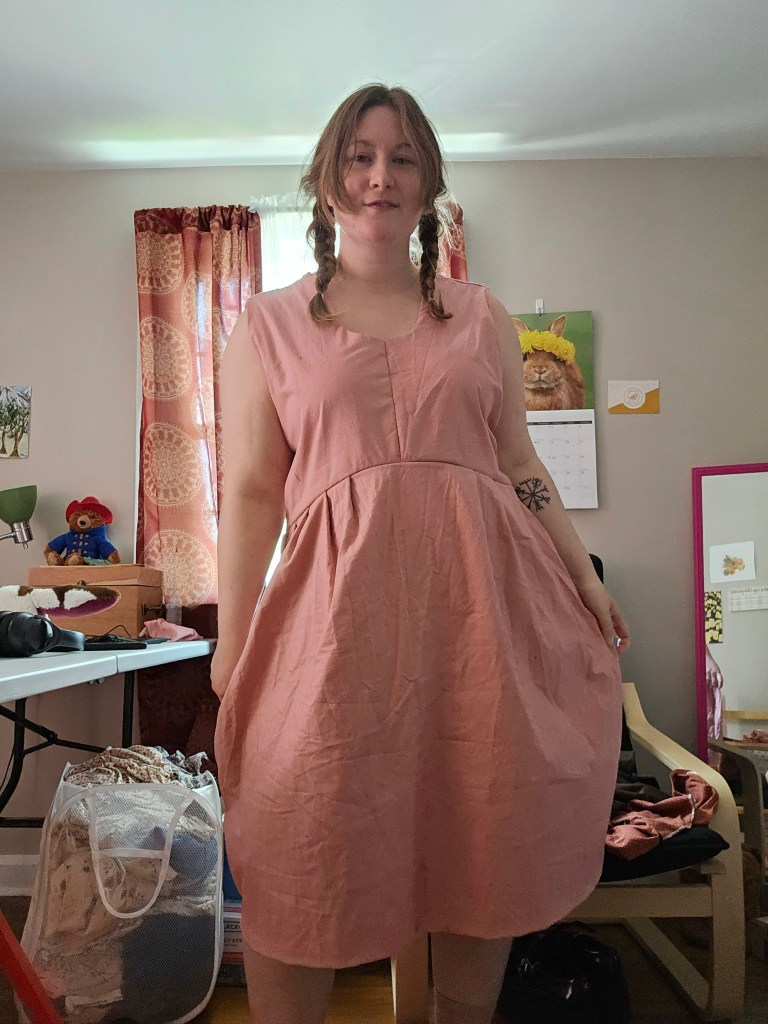
I used this pattern to make a pinafore-style dress from blush pink cotton with a micro polka-dot pattern in a vintage fabric from my Gram’s stash. She had 8 yards of it, and since it was translucent I decided to double layer the dress, the result has been one of the most well-finished garments I’ve made because of using the pattern and fully lining it. The first time I wore this dress out was actually to tour the house I ended up buying – good memories!
Because this was a pattern hack project, the original top may be a little tricky to see in the lines of the finished dress at first. The scoop is less deep and the relaxed shoulder I brought up an inch to make the sleeves a bit more graceful to wear on its own or with another garment underneath in the winter.
Another change was the v line in the back instead of being a crew neck, I also cut the back bodice pieces on an angle to create a better fit which worked well. I changed the line of the waist too by swooping the line upward in a half-moon shape which has been one of my favorite hacks so far. With the gathers on the skirt and minimal print, it draws the eye to style lines in the garment which is a different technique from how I normally design. It feels like a level-up of my skill set and I hope to keep exploring this style.
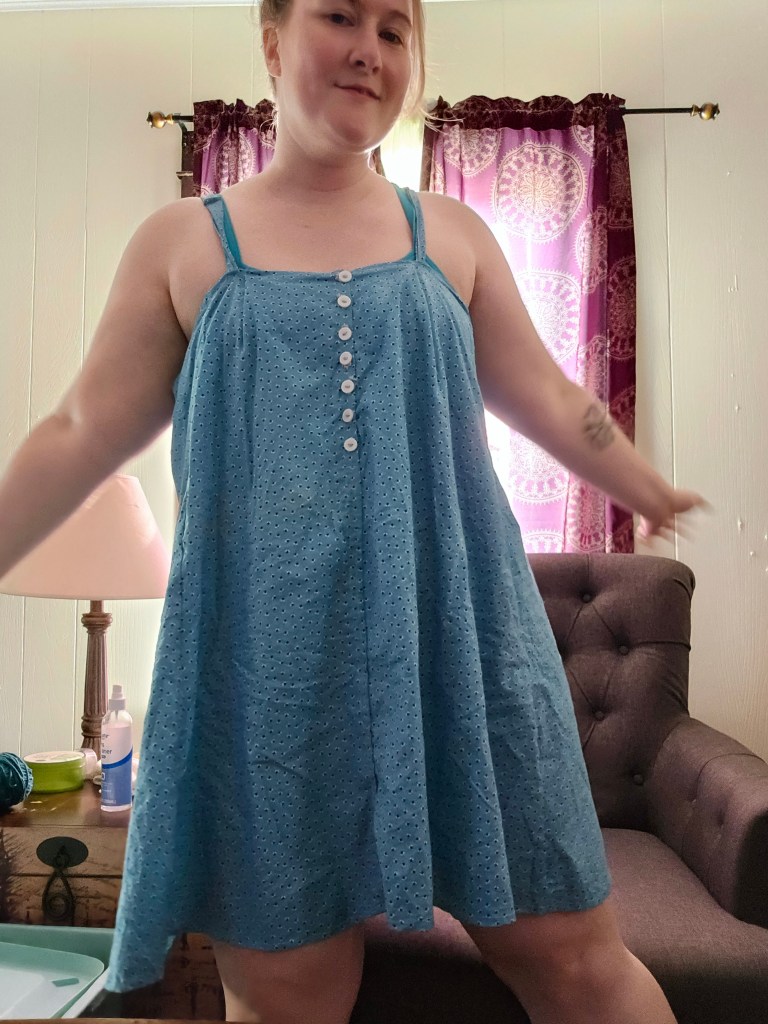
This collection is a combination of new items that I self-drafted and made this year and two dresses that I made in previous years that gave a refresh for a new garment. The ability to change up my wardrobe from existing items in my closet is one of my favorite aspects of sewing!
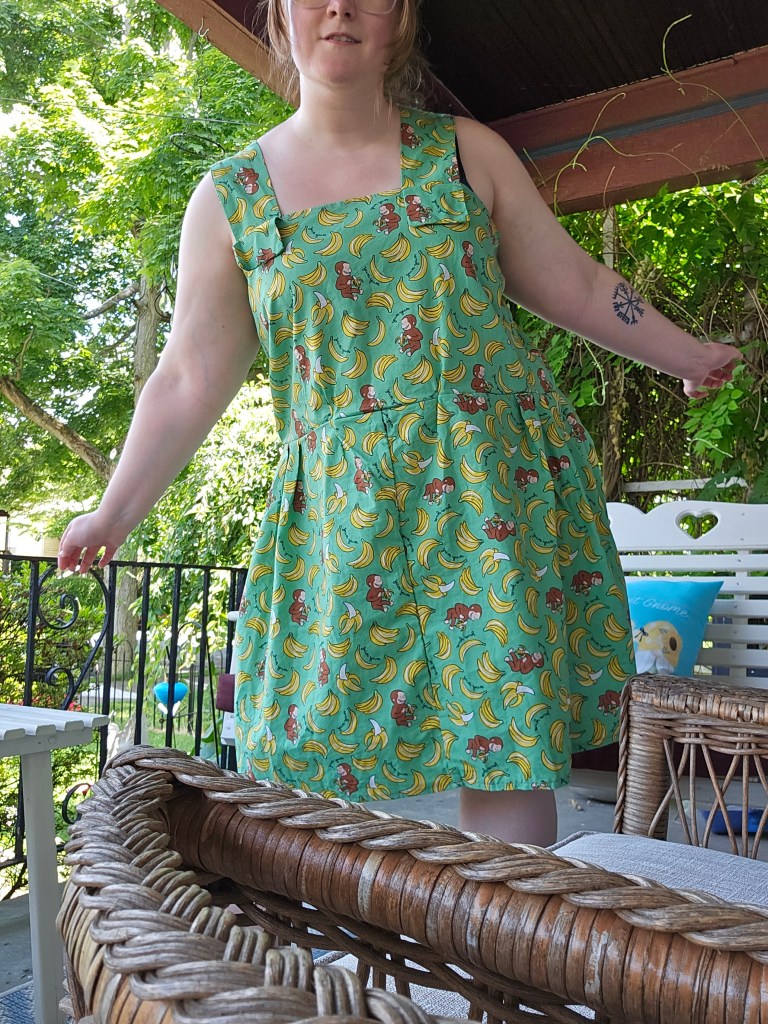
L to R: Bunny Swing Dress with Puff Sleeves, Heatwave Dress with Buttons, Plaid for Days Jumper Dress, Loyalty-Respect-Banana! Pinafore Dress, Blueberry Print T-shirt Dress, Potato Technology’s Strawberry Dress for 2024, Liz’s Shirtwaist Dress in Red Currant, A Classic Little Pink Dress in Polka Dot, Regina Phalange Dress with Lace Stripe
L to R Fabric: Joann Fabric Easter Collection (2024), Vintage Deadstock from my Gram’s Quilting Stash, Mood Fabrics and Hobby Lobby (2022), Joann Fabric Curious George Licensed (2024), Vintage Deadstock from my Gram’s Quilting Stash, Hobby Lobby and Joann Fabrics(2023), Mood Fabrics (2022), Vintage Deadstock from my Gram’s Quilting Stash, Joann Fabric Halloween Collection (2023)
An item that I added to my sewing tools in 2024 is brown craft paper and it has been a game changer! It’s not only transformed my creative process but has helped me create new garments that fit me better with less fabric waste. How cool is that?
Learning is Hardwork
As with every new skill, the first phase of creating is messy and full of flaws, this was my creative process. You have to start and in starting you are an imperfect sewist, fitting and pattern cutting are tricky and this really bothered me to accept. I like getting things right the first time. Learning to accept that this was going to be a journey, was frustrating at first. I have a vision in my head but I can’t always execute the vision at this stage. These things are part of the learning process, like using existing patterns to learn the techniques and accepting that things are going to fit poorly until I can learn to tailor them. Which is happening! With each garment I make, I can see a progression toward the goal, slow and steady but still moving forward.
But there has been a process I did not expect and that is making pieces with my silhouette and my body type in mind, not just my measurements. Things I want to make may not look fantastic on my proportions. That was a time of trial and error in my creative process that I wasn’t expecting because when you go to a store and try on clothing, the design decisions are already made and you only have to decide on which silhouette you would like to choose. But with fashion design, self-drafting patterns in particular, I realized what was going to make me happy was experimentation. Trying a little bit of everything and playing around with different styles to see what I liked and what looked good on my body.
Sometimes just an inch here, a lowered line there, a rise adjustment, or nipping in a shoulder can transform a project from a flop to a success. It’s subtle yet effective and a skill I see you are only capable of learning from experience, either from your own by the process of being self-taught or from the instruction of more skilled designers. It is sculptural, artistic, and honestly sometimes like architecture or construction. It may be fabric and tread but the same principles apply. The foundation is crucial, and the foundation of any garment is the fabric and how you cut it.
Enter the Craft Paper
How do you replicate a project that works? You need a template, a jig, or a blueprint. A pattern. I thought that understanding the dimensions alone would suffice when I am cutting, but there is nothing like having the template to keep my cutlines accurate for curves and hem allowance. It takes the guesswork out of this process which if you are cutting blind is like a chess match with the fabric and your memory of what you have made before. It’s too difficult so I needed to work smarter and make my own pattern pieces out of paper. There were two tops that I had designed that fit me quite well out of a stretch knit and before they were properly sewn together, I took the pins out and traced them onto my craft paper.
Two bodice types – one scoop neck, one v-neck, and one sleeve template. From this inexpensive paper I have found a cipher to make things with more finesse. A tried and true bodice and sleeve that can be used for tops or dresses. A foundation to build upon that has streamlined my making process. You don’t have to be an expert at your craft to make a template, I thought I had to reach mastery before I was worthy to do this, it is simply part of the making process to make things with excellence in mind.
Fix On
I’ve watched a few creators for too long without questioning why “good enough” was their motto. I in turn also fell back on this type of approach to my designs as I learned because learning is hard work. Striving to be better is not fun, it’s maintaining a critical eye and raising your standards for yourself. In this sewing journey of learning and making, instant gratification and impatience are my Achilles heel. I want to do things quickly because everything is done quickly now. I get stuck in that loop of making more, making faster, chasing after goals, and feeling left behind because I am still not selling my patterns or garments, still.
But “good enough” is fine for Youtubers who have an established brand and following, but that’s not going to get me anywhere near my goals of design. I have to continually “fix on” as Mingi says, to the goal ahead and stop paying attention to what others have done to achieve their success. They are already in that space and that is the path their life has taken, I have to find my own thing and continue to work hard.
I’m sharing this to encourage you dear reader to not settle and to challenge yourself to be your own person. I believe that God gave you unique talents and has a plan tailor-made for your life so fight the hive mind of our current world and do the strange thing – work hard, strive for excellence, and be uniquely you! I hope that wherever you are today you remember that you are special, you are loved, and that you have potential for excellence. No matter what has happened in your life and how gray the skies are above you, there is still hope for a future.
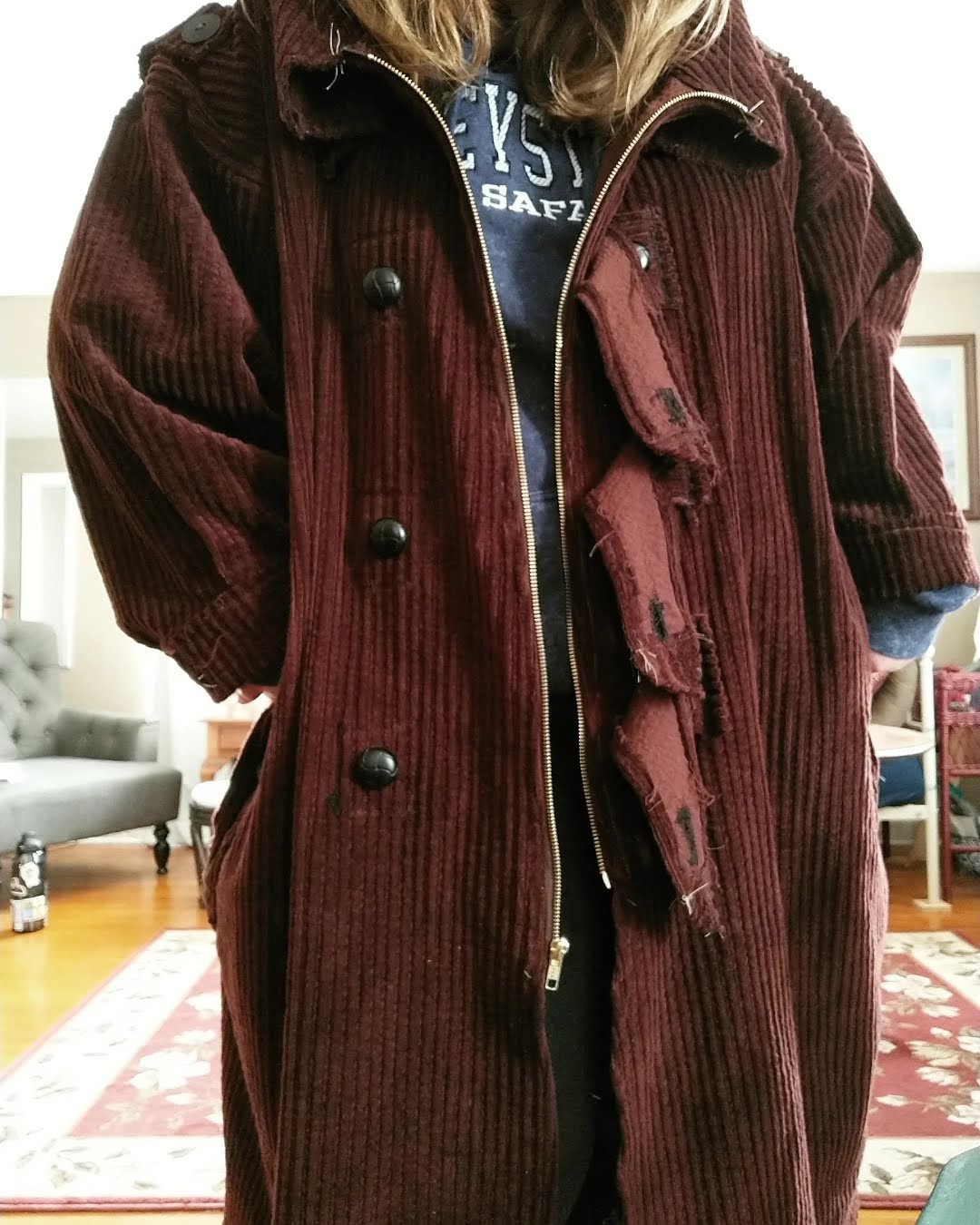
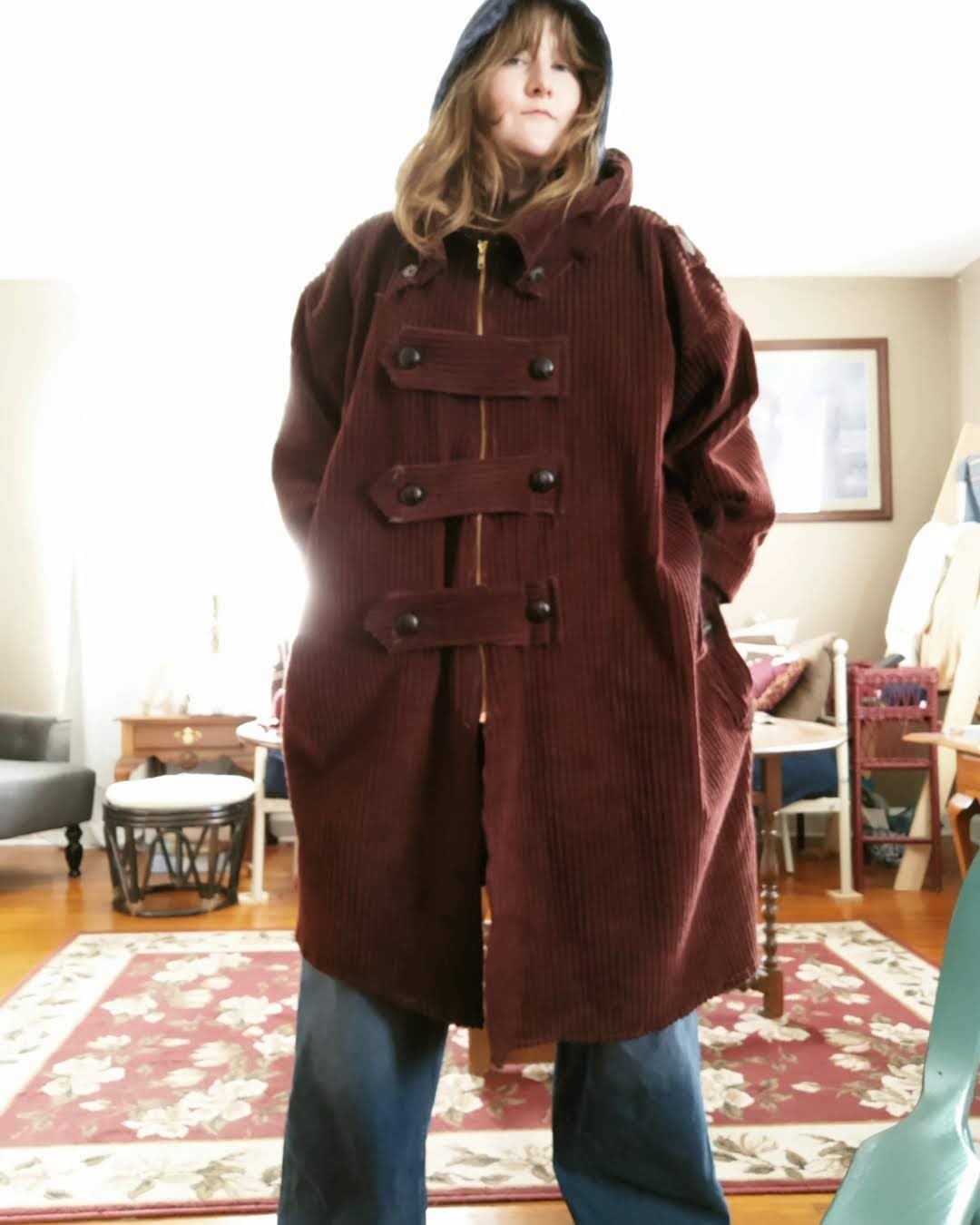
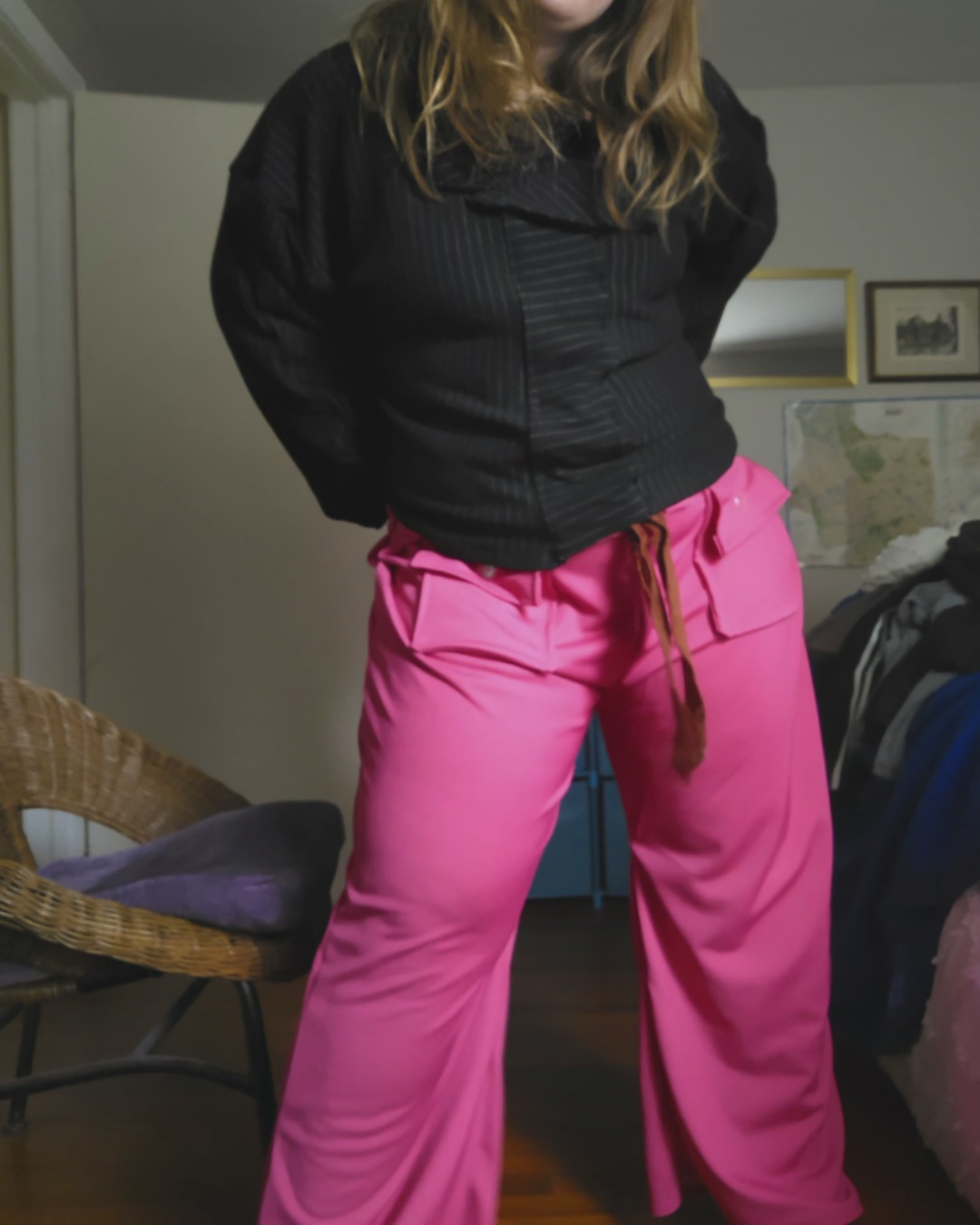
After a wear test this past weekend I realized my Jack Sparrow-inspired coat needed a few more touches to truly pop. Including accessories which will be coming soon. As for the coat, it was missing that polish, you know? So I took the belt and chopped it into five rectangles to make the button tabs and the pocket flaps. I also added more buttons! Two more styles, actually. I added leather-inspired buttons for the chest tabs and a tortoiseshell set to the lapels and the pockets. The pockets have closing buttons for security which was desperately needed because I was close to losing my phone on Saturday due to those gaping pockets. For only having the yardage from the belt to work with this turned out well. Is it a complete project? Time will tell. 🙂
Last night, I decided to be productive. I gathered my scissors and descended on my fabric stash. To the cuts of fabric, I’d left for the first hint of 30 degrees, to make a tweed coat and plaid trousers. Oh how excited I was to have a tweed fabric that was free from wool, and on clearance no less. What a thrill!
For months, I browsed Pinterest through the forest of street-style pins to the flowing river of coat inspiration. I studied the silhouette, the collar, and the button placement. Oh yes, I was going to do this right. I referenced pattern against pattern, for the right feel. The right lapel.
For moral support, I played a fellow chaos sewist in the background, Stephanie Canada, and laid my fabric on the floor. I determined my cut lines and set them to work, as Stephanie set to work on her #grimgrinninggarb I set my scissors to work carving out the back coat panel.
With a smile, I draped it against my frame to see that the arm holes were placed correctly. The opening for the neck, cut as a slim yoke, compared to the wandering necklines of my past attempts.
Next the sleeves were ready to take shape, a careful gusset planned for the armpit. “What mobility I will have,” I thought, “sweaters, hoodies, flannels – none will be too bulky for this!”
But then the summit appeared in the distance. The jacket front and collar! It was time for the big hurrah, the moment I studied and planned for. I smoothed the yardage to the floor with care to ensure the edges were plumb. With a careful swoop, the arm holes were placed. I steadied myself for the neck opening and lapel.
I stood, I pondered, I cut. A neckline sloping down, reaching outward towards the heart. A lapel. Large enough to fold over and sit regal down the coat. With satisfaction brimming, I carried on to the collar. Easy peasy right? After such a feat! I referenced my pattern one more time and cut it. I placed. I saw what I have wanted to see for years now. A coat with collar, notch, and lapel to follow.
Alright! This is going to work. This is my dream coat. A piece of outerwear ready for Friday Night Dinner. It was sharp. It was, just one. But two? Where’s the second piece?
With horror, I realized my mistake. I laid the second piece to see that I once again forgot to mirror the pattern. It was perfectly cut, backward. The lovely lapel was inside out. I had two lefts and no right.
And I had no more yardage left, on a clearance find remnant. Game over.
No tweed coat. No coat project at all. It was over. Fin.
Sewing humbles me every time. I know one of these days all my practice and failures are going to produce something made with care and wisdom. But dang, I feel so dumb!
If you are feeling discouraged today, remember, that we’re all in this together. 🫶 Hopefully we can all find a way to laugh through our mistakes and keep looking toward what the future holds. We got this! 😁