Flannel Upcycling – Skirt from Sleeves

When planning an upcycle, one thing that I consider with care is how to use the entire garment in the most innovative way possible. Maybe it’s all those episodes of Project Runway guiding me?

When I began my flannel upcycling project, and planned to transform them into vests, they needed a real purpose.

I began this project last year, as the summer was winding down, with fall whispering in the trees. Fall is an unmistakable inspiration for me. I love the color palette, traditional fabrics, and the academic style that returns to fashion every autumn season.

Sleeves Find New Life

Knowing how much yardage there is hidden in those sleeves, I had an idea – a plaid skirt with alternating colored plaid skirt panels connected by a waistband.

To do this, I cut the sleeves carefully from the shoulder seam to retain as much width and length as possible. This would become the bottom of the skirt. Next, I cut the cuffs from the sleeve; this tapered end was perfectly shaped for the waistline of the skirt for a flared effect.

For the waistband, I had yet to understand elastic, and was growing tired of waist ties, so I got a bit creative! I decided to use buttons, four of them to start, and created an adjustable button closure skirt, like the hook and eye of a bra band. The buttons were actually repurposed from the buttons of the shirt. For ease of getting dressed, I sewed the skirt on all the side seams, leaving a 2.5-3 inch opening to adjust the waistband, in a way that the fabric would cross over for security.

If you are looking for an easy and cute fall upcycle for the new season, I would highly recommend this project! You can even pair the vest and skirt together for a complete outfit!

Upcycling Pillowcases into a Vest and Skirt

What if the clothing we wear is more than just a garment, but connects us to the fibers of our being?

What if a pillowcase, from a loved one no longer here with you, could be more than just an item cluttering your closet? How could you repurpose it so the memories can walk with you in the new days ahead. All while the smell of their laundry detergent, and their home, so distinct to your senses, that being near it makes you feel comfort.

That is what this project is to me. More than an upcycle, or a thrifty hack, but a way to process feelings. Find a way forward. So the things left behind, that remind of what is missing, can do more than drown us in memory and stuff, but become a tangible way of healing.

Flannel Upcycling | Making A Vest

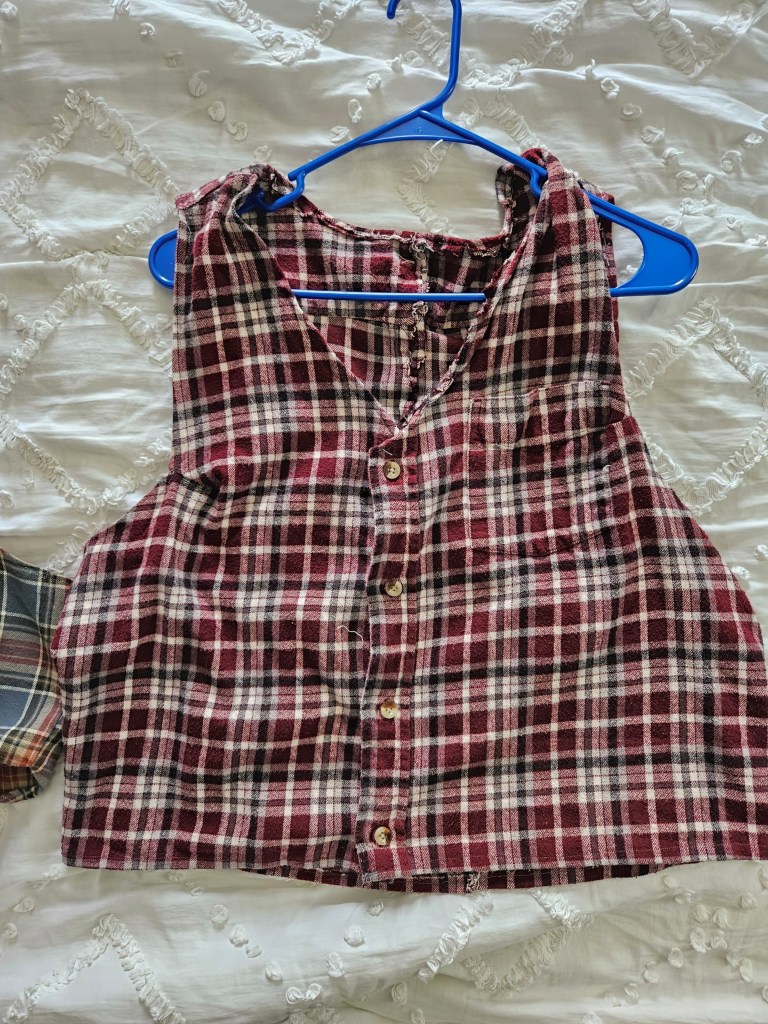
Last summer, I wanted to introduce vests into my wardrobe. I have made vests before for Kyle, but have not sewn a vest for myself before; I have knit them. Because this was a spontaneous idea, I needed to be budget-conscious and find a way to use what I had to make a vest. So I went to my closet and got creative! I had a few flannels in my closet that were hanging there, waiting for me to wear them, but I didn’t. That’s when I looked at the shirts closely – there was a button placket, shoulder yoke, and a sturdy fabric, with room to crop them. I saw the vest within the shirt, so I grabbed my scissors—and was a bit too zealous with the first one! Don’t be like me, have a plan. So how did I make this upcycle work? And what did I learn from my failed attempt?

Shoulder Seams, Yoke, and Waist Length

The crucial points of cutting, I would say, are being aware of the shoulder seams, accounting for the back yoke width, and properly measuring your waist length for a proper fit.

  • Shoulder seams on a flannel are boxy and loose. To achieve the set-in sleeve opening that accentuates and reveals the shirt underneath, you need to cut away the shoulder line – but not too much. Be mindful of how far into the shoulder you plan to cut, so that you are left with a proportional line.
  • The shoulder yoke is a technique used to tailor the shoulder line, while leaving the fabric below the shoulder loose. As a result, there will be more fabric on the back of the vest, which may affect the fit of the arm openings and possibly require a dart to remedy the loose fabric. If not, the back will gape open, looking awkward and like a mistake. A vest should hug the body, be tailored, or else the upcycle will look exactly like you cut up a flannel.
  • The length of the vest determines the style and balance of an outfit. One of my vests I cut too short, and this limits how I can wear it. I find it cuts me off in a regency high-waisted fashion that is fine when I wear it with a high-waisted skirt, but with pants or my linen Darcy shirt, it’s awkward. The other vest was cropped, in a careful fashion, ending at my hip and balancing my body line like a well-tailored garment. It’s far more versatile.
  • Cutting the neckline is crucial. For the front, a tapered cut to the button placket provides the classic look. Be careful not to cut too low for a historical silhouette. Also, remember not to cut the back the same as the front! I made this mistake and had to sew the cut portion back into my vest. This should be a crew neck line, straight across, with a slight dip in the middle for comfort.

Why a Flannel Shirt?

I chose flannel shirts as my medium to work with for three specific reasons. The first one I already mentioned – cost. We had just moved into our house and paid quarterly taxes. The vests were not a necessity, just a whim, so it made sense to me to take an existing item, I didn’t wear to create something I would wear. It’s funny how the sustainable option is sometimes the free option too. Secondly, flannel is a sturdy fabric, appropriate for the structure of the vest, that could be sewn without the addition of a lining, which I could add later if I wished, when I was more comfortable spending money on fabric. Thirdly, flannel is a classic pattern that reminded me of the woven woolen coating fabrics that vests have been sewn with for centuries, so it was a good match! I hope this inspires you to repurpose items you have to make something new! For the rest of the flannel, the pieces I cut away, like the sleeves, stay tuned to see what I did with those. It’s one of my favorite makes. 🙂

Designing Clothing That Fluctuates With You

This is inspired by a discussion from Maybe Bre, which made me reflect on something I hadn’t discussed before. As well as my own experience wearing clothing, as a garden-variety human who loves fashion but doesn’t always enjoy how our clothing is made.

By this, I mean the patterns and fastening of our modern times. The zipper is a wonderful thing, and so is the structured waistband. I love them in jeans because denim that isn’t compromised by stretch is a rugged and sturdy garment that isn’t a piece that conforms to you; your body is housed within the trousers. I feel the same way about a structured coat. In doing so, I buy these pieces oversized for comfort, which leaves me with a garment that most of the time doesn’t technically fit me. If I did buy it to fit me right now, there is no guarantee that over many decades it would continue to fit me – I’ve been burned before by this problem. Hence, all my “staple, investment pieces” from college no longer live in my closet because they are no longer my size. If I had planned ahead and bought them a bit oversized, they might still be with me, but they wouldn’t have “fit” me at the time.

My problem with clothing is becoming clear, isn’t it? I desire longevity and wearability from clothing, in a way that is not offered off the rack. I desire my clothes to grow and shrink with me, depending on how my body changes over time. This has been my design focus in the last few years as I have placed myself in the driver’s seat of my wardrobe through the process of sewing and knitting.

My idea is not innovative; it is historical. Clothing, because it was so expensive and hard to make, was more adaptable in the past. Fastenings such as tie waist, lacing, and buttons with multiple sizes of tightness were common because clothing was not as easy or cheap, and they were not seen as disposable or replaceable. Changing fashions came with garment reworks, ye olde upcycling as it were. This is what I desire: the ability to change the fit of my garment.

I recently figured out how to sew with elastic, which is a game-changer for shorts and gathered sleeve hems! Before this, though, I was making most of my bottomweight garments with tie waists or several options of buttons to let the garment adjust to the needs of the day, I’ve also sewed with intentional relaxed fit, initially due to a lack of tailoring skill but over time it has been to allow wiggle room in pieces I have spent days or weeks of my life crafting.

Being present in the making process has taught me to treat my clothing with more respect, even when it is time to discard the current version of it for something more useful. I’ve stopped donating as much, decluttering, and rebuying, to be honest, to be more intentional with the garment and its life cycle. I am the one who brought it to life, I can’t simply consume and discard it like it is nothing. I am deprogramming my brain from decades of fast fashion insanity.

I believe if clothing were made with this design philosophy, that clothing would fluctuate with you over time, I believe we would enjoy wearing our clothing more because instead of buying stretch fabric everything, we could still wear good natural fibers, maybe a bit bulkier than spandex and less figure hugging and lurex denim, but would be better for the humans and the planet. Style and substance, as they say on the Great British Baking Show!

A Simple Denim Upcycling Project for Beginners

What do we do when an item of clothing doesn’t fit? Rehoming is always a good idea, but here is another one – upcycling. What if you could transform that garment into another garment you will wear? Here’s an easy upcycle using one pair of jeans.

The Process

To begin, I cut off the legs of the denim above the knee. This was important. To hem the denim to the same length, including the excess fabric needed to fold over for a waistband, the leg section needed to be longer than what was cropped.

I carefully cut open the side seams, avoiding both the pocket and the rivets. The belt loops were set aside for later.

I then cut the leg pieces to the proper width, adjusting the fit with try ons, before sewing. The top of the section was hemmed for a waistband and the bottom hemmed with the rest of the short.

I sewed this very carefully with my machine. I did break a needle but, it happens just use caution and wear glasses to protect those eyeballs. Always know where your fingers are too when using a sewing machine.

Next I repaired the worn denim around the belt loops and attached the cut off belt loops to a new section and tada: you have a new pair of shorts for summer!

What About the Garment Workers? 2025 Edition

There are a lot of things about this new Trump term that are setting my jaw. The newest one, though, happens to be the tariffs zeroing in on Vietnam, and something we are losing sight of in this discussion—what is going to happen to garment workers?

Vietnam is one of many countries in the global south that are responsible for the garments and shoes we wear every day. In May 2024, they surpassed China as the largest textile and garment market share for U.S. imports. The nation employs around 2.5 million people within the 6000 garment and textile factories across Vietnam. This rapid growth of 37 billion USD worth of garments being made in Vietnam in 2024, from 26 billion USD in 2017, is due to the low wages of Vietnam compared to the higher wages of China and even higher wages in the United States. In the 1980s, before Clinton’s NAFTA in 1993, garments sold in American stores were made in the United States, but this changed during the Clinton era and has gotten worse in the 32 years since through the rise of fast fashion and the fashion industry’s reliance on cheap labor at the expense of the garment workers.

So, now we bring the so-called “Liberation Day” of tariffs, and since this is a space I like to keep safe, I’m going to move on because I have nothing nice to say. What I want to focus on is not making this job American again, the rising prices of garments, or anything political, and instead I’d like to zero in on what seeing the world with a Kingdom (God’s Kingdom that is) lens has taught me so far this year.

I’d say that my eyes being opened began last year with diving deeper into Fashion Roadman’s channel, which led me to watch two documentaries – The True Cost of Fast Fashion and Perfume’s Dark Secret in 2024. The other revelations that were exposed in 2024 such as the labor practices of Armani and Dior, were very telling for how are garments are made from luxury to fast fashion. It’s no secret that the fashion industry, including luxury brands, is not concerned with the moral cost of their decisions and is solely focused on getting money in their pockets for their shareholders. So, what is going to happen within the fashion industry as a result of these tariffs set on Vietnam, especially with no sign of negotiation from the Trump Administration? I think it’s going to be bad for everyone.

I think costs from the brands will be cut from the quality of the garments being made, to the materials, to the contracts with these factories. I think garment workers will probably see the biggest hit in their work environment and wages, as their economy is hurt. Or potentially the factories will no longer get these contracts to cut labor costs, meaning the production of garments will be further entrenched with slave labor in countries where workers are exploited. Then what will those women be left with? Garment Workers are primarily women, and they are skilled laborers who could be left without a way to provide income for their families.

It’s not okay for so many reasons.

That is why, as we look towards Easter, I am thinking about those who are oppressed in our world, because Jesus came to be a new Moses and lead us through the Exodus Way. Thank you, dear reader, if you stayed with me on this one. I wish this world weren’t such a downer right now, but just know, although we are from the United States, we are not pleased and empathize with how this is affecting you too. ❤

Magic of Scrap Yarn Cardigan

I was gifted a set of skeins. This yarn lot was made from peruvian wool, bulky weight in shades of slate gray, purple, and navy. It was some yardage but not enough to know what to use it for. 500-600 yards always trip me up. It’s close enough to be a garment so my mind wanders down that path, but too much to be an accessory, unless its a really extra, truly special accessory. I used to knit big scarves like that. I think maybe I got burnt out? Or maybe the scarf as a project feels like I am staying stagnant, not trying hard enough to make? I’m uncertain why I see it from a view point of melancholy.

Around the same time I was also passed down other bulky weight yarn, a green and red acrylic, a bright blue of wool-acrylic blend, and an olive green much chunkier fiber of many balls of yarn. More than I knew what to with. They were all random, similar im weight, and sort of related in color story. Aside from the red, the red was too bold.

Have you ever seen those absolutely scrappy sweaters? Those ones, usually worn by someone in Copenhagen or another chic city where the handknit garment is exquisitely random? A varied and unplanned web of yarn scraps, carefully made into a uniform pullover or cardigan. I love them. I pin them to boards. I save the posts. They fill the void of completeness of most projects, whether fabric or yarn, because they gobble up the bits left over, like a quilt, to rid the maker of left over yarn without wasting it.

So I made one.

Bunny Plush Keychain

Recently, I shared a Knit Star Plush Keychain Pattern, but that wasn’t the only keychain I’ve been working on. Behold, a knit bunny keychain made from repurposed fabric! This keychain was inspired by my Skzoo Quokka plush keychain which I have styled on my purse and belt loop. I was tempted to buy more as this trend has been all over my feed this year, but that’s unrealistic. So I thought, in Jeremy Clarkson fashion, how hard could it be?

This key chain was made by repurposing a pair of underwear, that was weirdly made without any stretch. They had no purpose but to be trashed, which I didn’t want to do because they were brand new and I liked the pattern and color story. So I wondered, could I translate this to a plushie and I could make this plushie into a keychain without buying any materials beyond the keychain hardware? The answer is yes!

I used a pen to draw pattern pieces onto the underwear by designating the fabric into four ear-pieces, two head-pieces, and a rectangle piece that would be used to connect the keychain hardware. The rest of the fabric was cut into small cut pieces that would be used as the stuffing. This worked like a dream!

I chose to sew this item by hand because of the small nature of the project. The pieces were too small and delicate to sew by machine with any semblance of control or care. It was a quick make and took one day to complete. I sewed 90% of the ears, turned them right side out, stuffed them, and then set the ears aside. Next, I repeated this process with the circle for the head and stuffed it. When I was certain that all the stuffing was divided between the three pieces adequately, I sewed closed the ears and head. Next, I attached the ears to the head. Finally, I sewed the rectangle and threaded it through the loop of the keychain before attaching it to the bunny plushie. I opted for an abstract look so I did not decorate the bunny plush with a face, therefore if it spins around it doesn’t matter what side is facing out.

Overall, this was a quick and thrifty project with the hardware coming in a pack of two for $2.99. I used the other clip on the knit star plush project. This type of plushie could be made with any scrap fabric you have and could be adapted into other animals. It would be an easy DIY gift too!

Create a website or blog at WordPress.com

Up ↑