
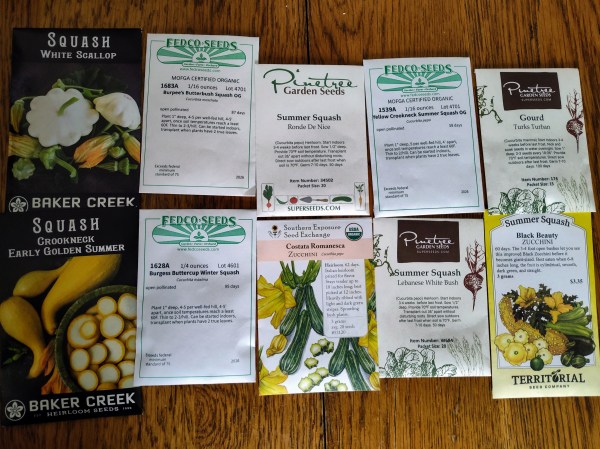
In a continuation of my series highlighting the garden seeds we ordered for our 2026 garden, I’m going to combine two vegetables into one post. This post will go over our pumpkin and squash seeds. Below, I am including links to the previous installments of the series. Plus, here’s a post that showcases all of the seeds we ordered.
Links to Other Seeds:
Pumpkins
Pumpkins are one of the most enjoyable crops to grow. We had a blast with them last year. It was delightful seeing the bright orange fruit jump out from the dark green backdrop. But equally enjoyable was the success we had. We harvested multiple midsize pumpkins last year that we used to bake pies for Thanksgiving. This year, we’re growing one variety that we grew last year as well as a new one. We also have some seeds from last year that we may try to replant. Our focus on picking pumpkin seeds is flavor over everything else. It’d be great to grow the biggest pumpkin possible, but if it isn’t flavorful and can’t be used for cooking and baking, we aren’t that interested.
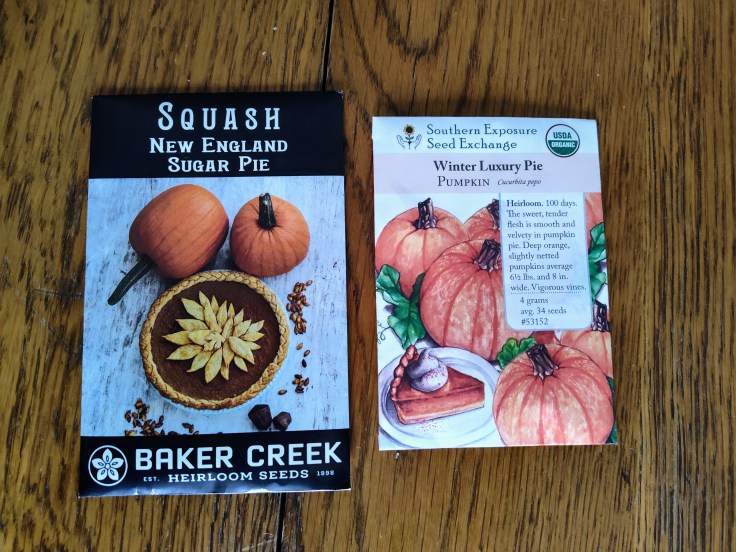
New England Sugar Pie
We grew this variety last year and loved it. The plants grew beautiful green vines with massive leaves and put on multiple volleyball-sized pumpkins. The pumpkins stored well, and we processed them into puree for our pies at Thanksgiving. It produced the best-tasting pumpkin pie any of us have ever had. We can’t recommend this pumpkin variety enough. Like last year, our seeds come from Baker Creek.
Winter Luxury
This heirloom variety dates back to 1893 and was improved in 1917. Grows medium-sized pumpkins that have the traditional orange skin. It’s described as being a great pumpkin for pies. This is our first year growing this variety, and we bought our seeds from Southern Exposure.
Squash
We love squash, both winter and summer. Last year, we grew zucchini and White Scallop for summer squash but didn’t do a deep dive into winter squash. We eventually started buying butternut squash (a winter variety) from the grocery store and fell in love with the flavor, so we’re growing it this year. We picked multiple zucchini, yellow squash, and winter squash varieties.
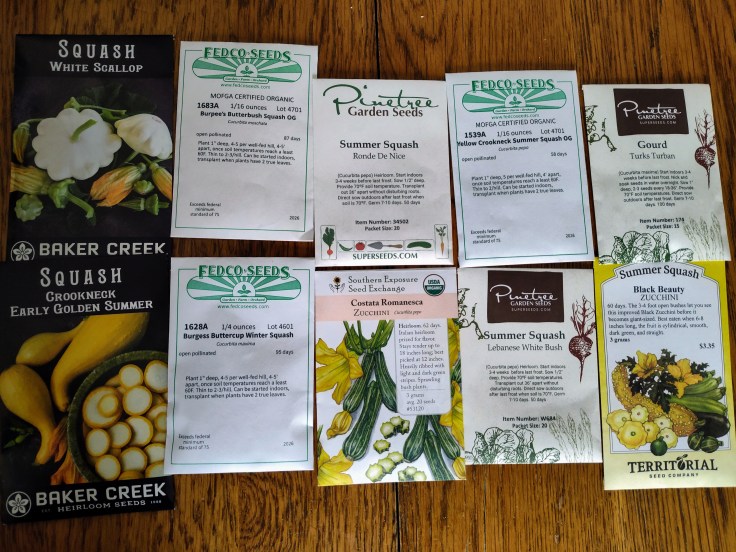
Black Beauty
One of the standard zucchini varieties, I think we grew Black Beauty last year. If so, it was extremely productive and flavorful. We got a late start planting the seeds, but in around two months, we were harvesting zucchini. I love that the plant stays contained yet open, which makes it easy to harvest. These seeds come from Territorial.
Burgress Buttercup
An heirloom that dates back to 1925, after the Quality and Essex Hybrid varieties were crossed, Burgress Buttercup first appeared in a seed catalog in 1931. The Buttercup is a winter squash with sweet orange flesh. It can be used in savory and sweet recipes. However, it does not store as long as other winter squash. Our seeds came from Fedco.
Burpee’s Butterbush
The Burpee’s Butterbush is a butternut squash similar to the popular Waltham variety but produces smaller 2-to-3-pound fruit. The flesh is sweet and moist but not watery. It matures in only 87 days, which is early for a winter squash. Although a determinate variety, its vines can still reach 10 feet long. It stores very well. We started eating butternut squash last year and fell in love with the flavor. We’re really excited to grow these seeds this year. Our seeds come from Fedco.
Costata Romanesca
An Italian heirloom zucchini, the Costata Romanesca is renowned for its flavor. Its plants are more vigorous than other zucchinis, and the fruit are best when picked at 12 inches, larger than most zucchini varieties. Still, the fruits remain tender even at 18 inches. We’re very excited to learn how the flavor differs from the typical zucchini we eat in the U.S. Our seeds come from Southern Exposure.
Crookneck Early Golden
This heirloom yellow squash variety is one of the standards for summer squash. It has been grown in North America since before Columbus arrived and has been one of the most popular varieties ever since. Matures early at 50 to 60 days and stays contained in a bush-growing habit. We’ve never grown yellow squash, but we love eating it and are excited to have a large supply of it this summer. Our seeds come from Baker Creek.
Lebanese White Bush
We stumbled upon this summer squash variety late in our seed searching process and are intrigued by it. It’s an heirloom that is similar to a zucchini, but the skin is light green and the flesh is white. The fruit appears to be pretty small, perhaps the size of a hand. It has a bush-growing habit and is supposed to be prolific. This is a new variety for us, and we’re excited to grow it. Our seeds came from Pinetree Gardens.
Ronde De Nice
This is another variety that we haven’t grown before and found it in the catalogs. It’s a French heirloom that dates back to the 1800s. It’s a summer squash, but it has the shape of an acorn squash, which is a winter variety. The plants are compact, vigorous, and produce lots of small, 4-inch fruit. These seeds come from Pinetree Gardens.
Turk’s Turban
The Turk’s Turban winter squash first caught my attention in our 2025 seed catalogs, but I didn’t highlight it and wasn’t confident enough to grow it. This year, it caught my attention again, and we’re giving it a go. It’s bright orange with green and white stripes on the top and sides. It is shaped like a butternut squash and categorized as an Aladdin-style squash or even a gourd, but I would describe its shape as being similar to a mushroom. It is stunning and can be used for decorations but is also edible and delicious. Our seeds came from Pinetree Gardens.
White Scallop
We grew this variety last year after never eating a patty pan squash before. It immediately became our favorite type of summer squash. The White Scallop is an old heirloom that was grown by Native Americans as far back as the 16th century. The plant produces many 5-to-6-inch round, flat fruits in compact bushes. They’re also delicious. We love slicing them and roasting them in the oven with a bit of oil, Season All, and pepper. My mouth is watering just thinking about them. The seeds come from Baker Creek again.
Yellow Crookneck
Similar to the crookneck variety described above, this variety has warts on its skin that come to mind when you think of crookneck squash. It’s an heirloom that was grown by Native Americans in the Northeast/New England region before Americans started growing it in the 19th century. We’ve never grown this type before. These seeds come from Fedco.
What are your favorite types of squash to grow? Have you ever grown a patty pan squash? If not, I recommend giving it a try. It’s a game-changer.
 One Rabbit Riot