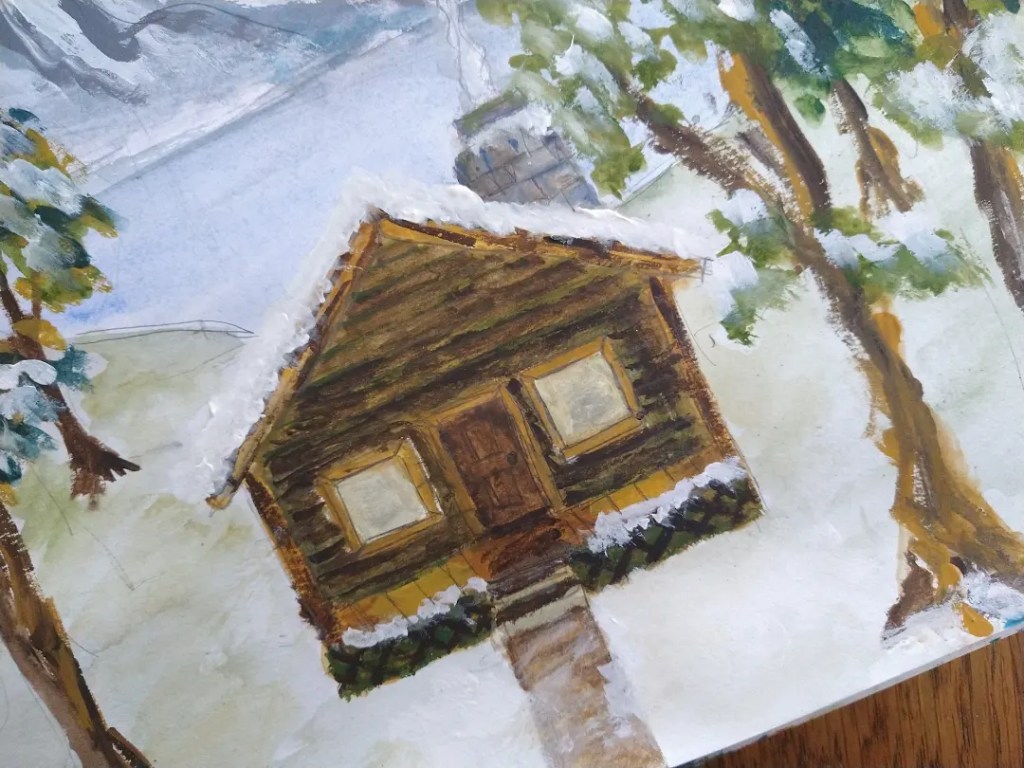
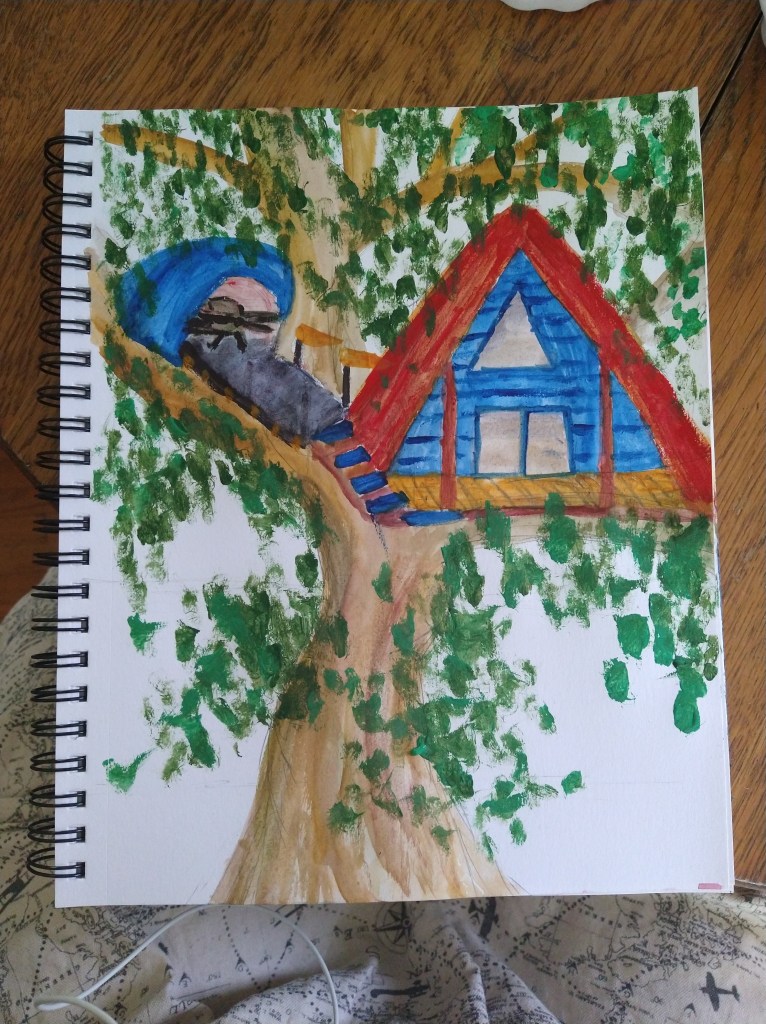
I am a visual person. When I begin drafting a setting or character it helps me to build a story around a tangible place. While I enjoy going to Pinterest for ideas, I like to sketch out original artwork to dive into a place of imagination. This week, I dove into my notebook of ideas and began painting places for potential settings for a story. Here are some of the places I came up with.
Udal Cuain was a story of many locations, each with a key purpose and strategic place on the map. When I began writing this novel I found the easiest way for me to develop the setting was to make a map of the places and ideas I had in mind. But where to start? As this was based on some historical structures and locations in Ireland, referencing the Irish map was a great place to begin!
Sketching the Map
The setting of Udal Cuain was set in western Ireland within the ancient kingdom of Connachtha during the Early Medieval period. Connachtha was one of the historic provinces within ancient Ireland – Ulster to the North, Connachtha to the West, Munster to the South, and Leinster to the East. So looking at four kingdoms, with Meath at the center, the spiritual center of the Druid Celtic faith, the story had a world to research and emulate from the evidence that survives of these kingdoms.
With a title like Udal Cuain, which means “tossed around by the sea” in Gaelic, I settled on Connachtha because it is on the rugged coast of the Wild Atlantic Way. It is also one of the kingdoms on the western side that my family is not connected with. I have family connections to the Munster region and Ulster region, and I wanted something unfamiliar and neutral for these fictional characters. It left the door open to interact with Ulster and Munster if I changed my mind.
County Galway’s geographical features stood out for its port and bay with small islands, perfect for a fictional island to exile my characters on. The Burren of rocky terrain to the south along with the Shannon River provided some interesting options for a secondary chieftain’s home base and the key feature – the Aran Islands at the mouth of the bay. With these three I planned my three smaller fictional kingdoms of warring chieftains:
Galway of the O’Connors
The O’Connors’ kingdom, which I placed at the location of Galway’s current city, was supposed to be a well-established chieftain dynasty, that had many enemies and allies. I wanted the kingdom to be both strong; and yet on the tipping point of losing it all because of the internal strife. I wanted their kingdom’s fortress and main structure to be stationed at the Galway city current location, with the idea that the O’Connors’ land would cover the coast around the bay to the Connemara Bog and down to the Burren at the south so that they had room to farm, hunt, and keep livestock. They would also have access to building materials, road networks to interior Ireland, and the mountains. There would be a connection to Ireland’s spirit within the people and leaders. They would also be connected to the land and there for the Tuatha De Danann, the mythology of Ancient Ireland.
I chose this location because it had a long history in Ireland, but had room to explore imagined locations. Galway doesn’t have historic anchor points for this period, like Newgrange or Glendalough. It allowed me to invent without clashing with the established places or treading on the stories of real people. It also has great geography. The bay provides natural resources like fishing, trade, boat building, etc. It would make sense to have a marketplace there and an imagined fortress. To the interior, there are forests, meadows, mountains, lakes, waterfalls, and rock for quarries.
Aran Islands of Murtagh
The Aran Islands to the far west of Galway Bay, an outpost of the Irish language during the centuries of oppression by the British, and a population decimated by the famine, I wanted to make these islands a key player in my story. They have many stories to tell, but in Udal Cuain, I wanted to bring them back to life as a powerful seat of trade. A necessity to the kingdom of Galway and the enemy to the North, the impending Vikings. I chose to make the Aran Islands kingdom a rival to the O’Connors, with an imagined trading kingdom built around the ancient fort of Dun Aonghasa. I also saw this as a choke point for the Galway kingdom of the O’Connors, they must keep tensions cool with Chieftain Murtagh in order to keep their own economy going and allow free use of the Ocean beyond. Yet as in relationships, this is easier said than done.
Limerick
Limerick on the Shannon River served as a connection to the Viking Age. This city was a settlement historically conquered by Vikings, in Udal Cuain it is a place of cross-cultural influences. There was a historic kingdom in the story, the Ui Neills, that one character is closely connected to. Yet with the changes that took place within Ireland during the Early Medieval period, the Ui Neills, are faced with Viking invasions. I chose to use this location as a place to see the impact, good and bad, of Viking settlements in Ireland. This played a key role in Ireland’s structure historically, with Dublin the capital city being established by Ivar the Boneless. In my fictional setting of Udal Cuain, I wanted this Limerick settlement to explore the Norse and Celtic cultures, while pondering the pain, the greed, the bloodshed.
Searbh
The Island of Searbh is completely made up, yet inspired by the small islands in Galway Bay. Searbh, being a fictional island in Galway Bay was a blank canvas to create my own hub of the story without needing to adhere to established geography or history. Searbh served as an exile and prison for the characters sent for their crimes against the O’Connors, used mainly by Chieftainness Tearlag to reinforce her agenda. The name Searbh in Gaelic means bitterness, that was what I wanted this island to encapsulate, a bitterness of landscape and mindset. The exiles have bitterness in their daily life as prisoners, but it also bleeds into their relationships and attitude toward survival on the island. I wanted to create a place that could be seen as hopeless, or potentially a powder keg of motivation.
These locations form a triangle around the Island of Searbh, furthering the message that the characters sent here are cornered by the adversaries, yet an unlikely alliance might be within reach if they can get off the island. From Searbh, you can see Galway, yet you cannot reach your home. It is psychological warfare. The Aran Islands are beyond sight, but the hope of finding an ally in Chieftain Murtagh lives on in the minds of exiles of their potential support and refuge against Tearlag. Searbh’s location and removal from the actual kingdom with its society and drama, makes Searbh a place of escape from reality. Here the exiles can both dwell and escape the reasons that brought them here.
There aren’t many resources on Searbh and so they are dependent on their captors to stay together, they also learn to adapt to a new life. The exiles learn new skills and have to get creative. Strangely enough, there are many relics on this island, like it has a life beyond what the exiles understand. I wanted there to be a mysterious undertone to the place and toe the line between reality and delusion and the psychological warfare gets in their minds.
If you were going to design a map for an upcoming novel how would you design it? Would you reference a real landscape or would you design purely from the depths of your imagination?






 One Rabbit Riot