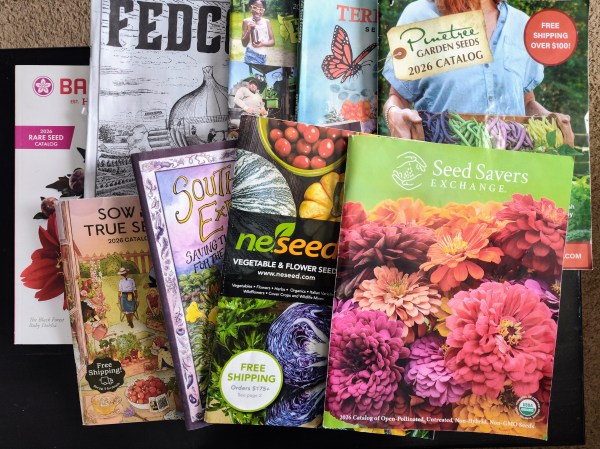
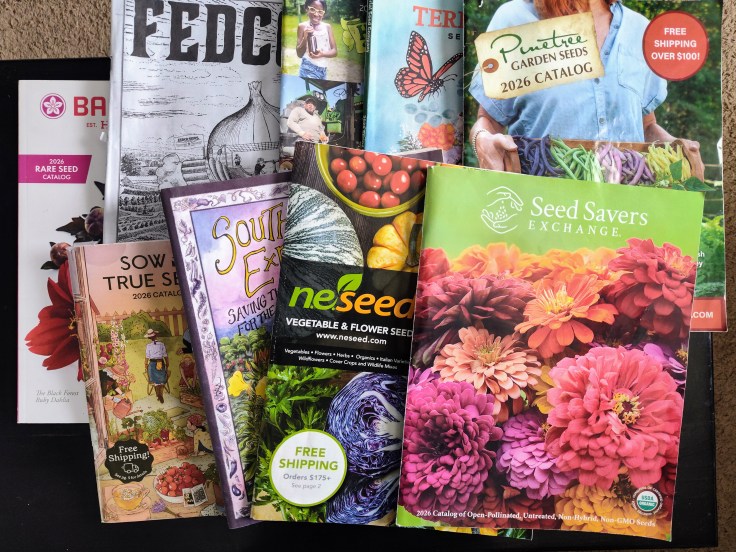
Over the past month, I have been reviewing the garden seed catalogs that we have requested for 2026. In total, I looked at and scored nine catalogs. If you missed them, links for each review are located below, and for a refresher, here is the criteria I used to score them:
Number of pages – 1 point per page over 100 pages; minus-1 point per page under 100 pages.
New varieties – 1/2 (.50) point for each new variety for 2026.
Total number of seeds – 1/4 (.25) point per seed.
Selection of “Specialty Seeds” – By “Specialty Seeds,” I mean any specially designated seeds that are separated from the other seeds. Examples are All-American Selections, Italian Gourmet, and Indigenous Royalties. – 1 point will be awarded for each specialty category.
Images – 1 point if there is an image for every seed; 1/2 (.50) point if fewer.
Non-Seed Offerings – 1 point for each category (fertilizers, seed-starting items, merchandise, weed control, pesticides, garden gear, etc.)
How Is it Organized/Ordered? – 1 point if its order is a positive; minus-1 point if it’s a negative.
Beauty – This is completely subjective, but it’s my way of determining if it’s aesthetically pleasing to look at. Does it include original artwork? Are the images crisp and clean? Is the text easy to read? A maximum of 10 points can be awarded.
What Sets it Apart or Makes it Unique? – This is another subjective category. What about a catalog makes it stand out from the others? A maximum of 10 points can be awarded.
2026 Seed Catalogs
Without further ado, here are the scores for the catalogs:
Do the Scores Match My Subjective Opinions of the Catalogs?
The short answer is no. When I was putting these reviews together, I looked at each catalog and wrote the review individually, so I didn’t pay attention to the scores and how they compared to each other. Solely based on my subjective views, my order would be:
Sow True
Southern Exposure
Pinetree Gardens
Fedco
Seed Savers Exchange
Baker Creek
High Mowing Organic Seeds
Territorial
NE Seed
The biggest surprise here is that the lowest-scoring catalog, Sow True, is actually my favorite. I love the design and shape of their catalog even though it’s on the smaller side. Territorial’s catalog, which scored high, was one of my least favorite catalogs, although the 5-8 catalogs on my subjective list are pretty close together.
I think the reason for this discrepancy is that my scoring system placed a lot of weight on the number of pages in each catalog, with one point being awarded for each page over 100. The reason for that was to award seed companies for offering thick catalogs that go above and beyond. I still think it was smart to award the catalogs for how many pages, but perhaps points should have been given on a tiered basis (1 point for 100-110 pages, 2 points for 111-120, 3 points for 121-130, etc.) Another scoring system would have been to award one point for every 5 pages above 100.
Another reason is that my scoring system intentionally awarded the objective traits, such as the number of seeds being offered, new seed varieties, and non-seed offerings. This naturally rewards the larger companies that can offer more seeds than the smaller companies. I wanted to reduce the likelihood that my personal thoughts and feelings could unfairly create imbalance in the scoring system. That was successful, but I think I went too far in the opposite direction, and some of the most beautiful catalogs didn’t rank highly. Ultimately, it doesn’t matter, because I can still follow up with my personal rankings, but I will adjust the scoring system for next year in an attempt to be more fair.
What Did I Learn?
I learned that I love catalogs from the companies that go beyond simply selling seeds. As a gardener, you can buy seeds almost anywhere in the spring. Go to any box store, home improvement store, or Agway, and you’ll find seeds. But not all seeds and seed companies are created the same. Some seed companies are businesses and operate with the goal of turning a profit. Others care more about educating gardeners and building a sustainable future than making money. You can perceive that difference in the companies’ catalogs. I prefer the catalogs that offer more than seeds. They’ll tell stories and teach lessons. I want to buy from companies that give back and support small farmers.
I know that I learned a lot by reviewing the seed catalogs. It forced me to slow down and really pay attention to what I was seeing and reading. Now, we begin the process of selecting the seed varieties that we want to buy, and I’ll be curious to know if we buy the bulk of our seeds from the highest-scoring catalogs (subjective or objective) or if they’ll be evenly divided. I’ll follow up with a post on what seeds we order. Thank you for reading.
Ahead of the 2025 gardening season, one of my first posts on the blog was titled “Where to Buy Garden Seeds.” There was a heavy emphasis on the seed catalogs we requested, what we liked about each one, and the ones we purchased seeds from. This year, I’m doing things a bit differently by dedicating a post to each seed catalog. In each post, I’ll review the catalog, go over the things I like and dislike about it, and score the catalog. Here’s how I’m scoring all the catalogs.
Scoring Criteria
I’m going to be looking at the following areas and applying them to each catalog we receive:
Number of pages – 1 point per page over 100 pages; minus-1 point per page under 100 pages.
New varieties – 1/2 (.50) point for each new variety for 2026.
Total number of seeds – 1/4 (.25) point per seed.
Selection of “Specialty Seeds” – By “Specialty Seeds,” I mean any specially designated seeds that are separated from the other seeds. Examples are All-American Selections, Italian Gourmet, and Indigenous Royalties. – 1 point will be awarded for each specialty category.
Images – 1 point if there is an image for every seed; 1/2 (.50) point if fewer.
Non-Seed Offerings – 1 point for each category (fertilizers, seed-starting items, merchandise, weed control, pesticides, garden gear, etc.)
How Is it Organized/Ordered? – 1 point if its order is a positive; minus-1 point if it’s a negative.
Beauty – This is completely subjective, but it’s my way of determining if it’s aesthetically pleasing to look at. Does it include original artwork? Are the images crisp and clean? Is the text easy to read? A maximum of 10 points can be awarded.
What Sets it Apart or Makes it Unique? – This is another subjective category. What about a catalog makes it stand out from the others? A maximum of 10 points can be awarded.
The catalog has 103 pages, and none of them have advertisements on them.
New Varieties – N/A – 0 Points
Neither the catalog nor the website indicate which seed varieties are new for 2026, so I had to give this category 0 points for not applicable and unavailable.
Total Number of Seeds – 146.5 Points
Sow True has 414 vegetable, 111 flower, and 61 herb seed varieties for a total of 586.
Specialty Seeds – 2 Points
Sow True features two types of specialty seeds – Slow Food’s Ark of Taste varieties and Small Farm Grown. Ark of Taste seed varieties are ones designated by the non-profit Slow Food to be vital to culture and should be preserved at all costs. Small Farm Grown varieties are ones grown on smaller-scale farms, which reflects Sow True’s commitment to support smaller farms when possible.
Images – .5 Points
Roughly half the seeds have images.
Non-Seed Offerings – 20 Points
The catalog and website sell non-seed items in 15 categories: hand tools, garden gloves, kids tools, soil amendments, soil testing, fertilizers, cover crops, seed starting, seed saving, growing supplies, pest management, indoor growing, gifts, merchandise, and books. They also have pages of the catalog dedicated to educating gardeners with a planting guide, a seed-starting guide, seed saving tips, a companion planting guide, and definitions of open-pollinated, heirloom, cold stratification, and scarification.
How Is it Ordered/Organized? – 1 Point
The catalog is divided into categories of vegetable seeds, bulbs & live plants, vegetable seeds, herb seeds, and flower seeds, and each category is ordered alphabetically. Each category also has a marker on the edge of the page for quick reference.
Beauty – 10 Points
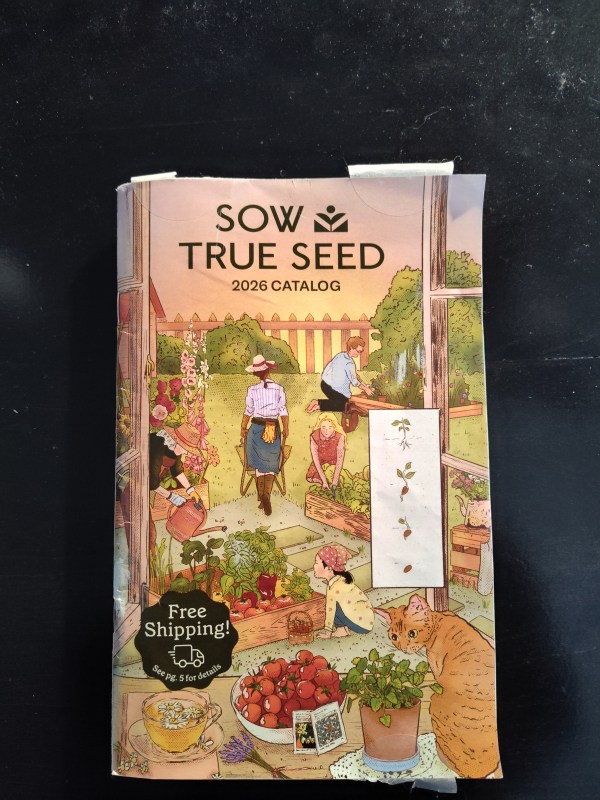
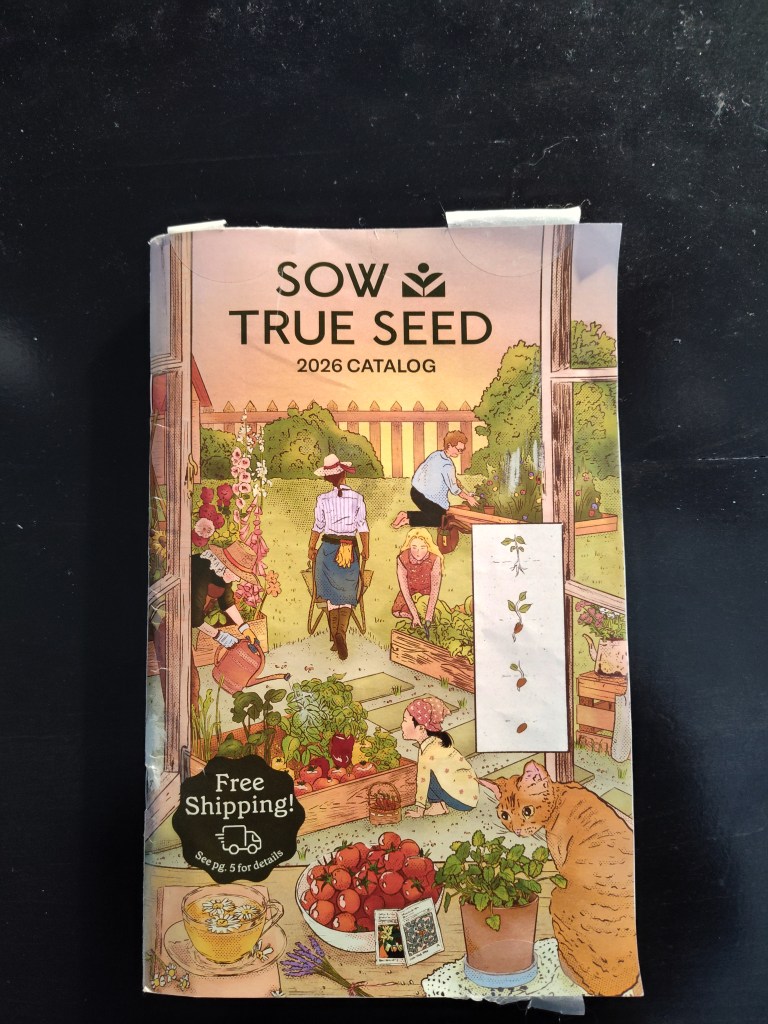
The catalog is easy-to-read, colorful, and features crisp imagery. One of my favorite parts of their catalog is the artwork that graces the cover and the featured seed packets.
What Sets it Apart or Makes it Unique? – 10 Points
I find Sow True Seeds’ catalog to be among the most unique that we receive. It’s shorter and narrower than others, being shaped similar to a book rather than a magazine. This compact shape makes it easy to carry and tuck in a pocket, as you would a journal. I also love the blend of artwork and photography, and the free guides make it more of an educational resource than a simple catalog.
Review
Like Pinetree Gardens, 2025 was the first year we received Sow True Seeds’ catalog or purchased seeds from them. They are an excellent seed company. They’re located in Asheville, North Carolina and operate as a co-op rather than a traditional business. That buy-in is reflected in the quality and care of everything they do. They go out of their way to support small farmers, to educate, and to create a community. It’s also reflected in their catalog. The seed descriptions are brief, clear, and informative. They provide all the necessary information with little extra. There are tables for each vegetable that provide the seed depth, spacing, germination time, days to maturity, and isolation distance. Combine that with the bonus guides, and it’s one of the best catalogs you can request.
Ahead of the 2025 gardening season, one of my first posts on the blog was titled “Where to Buy Garden Seeds.” There was a heavy emphasis on the seed catalogs we requested, what we liked about each one, and the ones we purchased seeds from. This year, I’m doing things a bit differently by dedicating a post to each seed catalog. In each post, I’ll review the catalog, go over the things I like and dislike about it, and score the catalog. The first installment will be Pinetree Gardens catalog, but before digging into the review, here’s how I’ll score all the catalogs.
Scoring Criteria
I’m going to be looking at the following areas and applying them to each catalog we receive:
Number of pages – 1 point per page over 100 pages; minus-1 point per page under 100 pages.
New varieties – 1/2 (.50) point for each new variety for 2026.
Total number of seeds – 1/4 (.25) point per seed.
Selection of “Specialty Seeds” – By “Specialty Seeds,” I mean any specially designated seeds that are separated from the other seeds. Examples are All-American Selections, Italian Gourmet, and Indigenous Royalties. – 1 point will be awarded for each specialty category.
Images – 1 point if there is an image for every seed; 1/2 (.50) point if fewer.
Non-Seed Offerings – 1 point for each category (fertilizers, seed-starting items, merchandise, weed control, pesticides, garden gear, etc.)
How Is it Organized/Ordered? – 1 point if its order is a positive; minus-1 point if it’s a negative.
Beauty – This is completely subjective, but it’s my way of determining if it’s aesthetically pleasing to look at. Does it include original artwork? Are the images crisp and clean? Is the text easy to read? A maximum of 10 points can be awarded.
What Sets it Apart or Makes it Unique? – This is another subjective category. What about a catalog makes it stand out from the others? A maximum of 10 points can be awarded.
The catalog has 129 pages, and none of the pages are advertisements.
New Varieties – 24.5 Points
Pinetree is offering 29 new varieties this year, including three new tomatoes, two new squashes, and two new melons.
Total Number of Seeds – 311.5 Points
There are 119 herbs, 434 flowers, and 693 vegetable seeds for a total of 1,246 seeds.
Specialty Seeds – 1 Point
Pinetree Gardens offers one specialty type of seed, which are their All-American Selections. These seeds are tested in independent trials.
Images – 1 Point
The catalog has one image for every item offered in the catalog.
Non-Seed Offerings – 24 Points
Pinetree Gardens really shines with its non-seed offerings. I believe they feature more equipment in their catalog than any other seed company. The categories I counted are seed starting, planting mediums, garden labels, watering aides, trellising, inoculant, fertilizers, thermometers, container growing, season extenders, weed control, insecticides, animal deterrents, pollinators, garden gear, household, kitchen gadgets, countertop sprouts, canning essentials, spices, teas, essential oils, and books.
How Is it Ordered/Organized? – 1 Point
The catalog is divided into three sections for its seeds – vegetables, herbs, and flowers. Each section’s seeds are then alphabetized. It makes finding a specific vegetable, flower, or herb very easy.
Beauty – 10 Points
Pinetree Gardens catalog is bright, easy-to-read, and clean. The text color always stands out from the page. The images are high-quality and do a great job of highlighting the product being sold.
What Sets it Apart or Makes it Unique? – 8 Points
There isn’t a lot that makes this catalog overly unique, but that isn’t a bad thing. It’s simply a very good catalog that provides everything you need as a gardener. One unique aspect is the brief growing guide for each vegetable. It includes the germination time and temperature, seed sowing requirements, harvesting information, and more. And if a vegetable is prone to specific diseases, there’s a key that indicates what each seed is resistant against.
Review
2025 was the first year we received Pinetree Gardens’ seed catalog and purchased from them. They have become one of our favorite companies to purchase from, and it started because of their catalog. The 2026 catalog continues what they did so successfully in 2025 (and likely in the preceding years). I love the variety of seeds they carry, their prices, and all the non-seed items they sell. Their keys and icons make it very easy to identify and find what you’re looking for. Finally, I’m a big fan of companies that make their own seed collections. They’re such a great way for gardeners who have difficulty making decisions or are just getting started to try a bunch of seeds at one time. Overall, I think Pinetree Gardens has the best catalog, but we’ll see if the scores reflect that.
As an aside, their employees and customer service are great. They had a very minor issue this year where catalogs were sent to the right address but with the wrong person’s name. They reached out to everyone to explain what happened, which is so kind.
A difficult decision when planning our garden for this year was which seed companies to purchase from. There are so many of them. Companies like Burpee, Ferry-Morse, Gurney’s, and Livingston have been around for over 100 years and have displays in Wal-Mart, Tractor Supply, Agway, and many other stores. They’re the companies that my dad and grandparents bought from and still do a very good job.
There are also many smaller companies that have popped up in the past 50 years that are focused on offering organic and non-GMO seeds. Some of the more well-known ones are Fedco, Territorial, and Baker Creek. These companies also usually focus on seed-saving and heirloom varieties. These companies tend to have a more local following but have grown in popularity thanks to YouTube gardening videos and blogs. With so many options, who do you choose?
Requesting Catalogs
When we gardened in the past, we ordered from Territorial, Fedco, and Baker Creek and bought Burpee, Livingston, and Ferry-Morse in person. We had successes and failures with all of them and don’t have an issue with any of the companies. Once we decided to grow a garden this year, we started casually talking about what we wanted to grow and what a garden could look like. Things didn’t get serious until November when I remembered that we needed to request catalogs. Maggie and I are both visual people who prefer the older system of looking at physical catalogs. I began by searching for companies that send free seed catalogs.
Side note: I’m never looking to take advantage of these companies. We won’t request catalogs from companies next year that we didn’t purchase seeds from this year. At the same time, though, we don’t want to pay for a catalog unless we’re certain to purchase from the company. I like when companies are willing to print and send their catalogs for free.
A Google search led me to a Farmer’s Almanac page that listed over 40 companies with free catalogs. Some of the listings were outdated, while other companies focused solely on flowers and trees. After filtering it down, we had a list of 10 companies:
Baker Creek
Fedco
High Mowing Seeds
NE Seed
Pinetree Gardens
Rohrer
Sow True Seeds
Territorial
Southern Exposure
Seed Savers Exchange
I requested a catalog from each and waited. If you’ve requested seed catalogs in the past, you’ll know that the time period between American Thanksgiving and New Year’s Day is amazing because that’s when the majority of catalogs arrive. The first to arrive this year was Fedco, which was in our mailbox in late November, and the last was Territorial, which arrived after New Year’s Day. It got to the point where we were receiving catalogs that I forgot I requested.
The Joy of Seed Catalogs
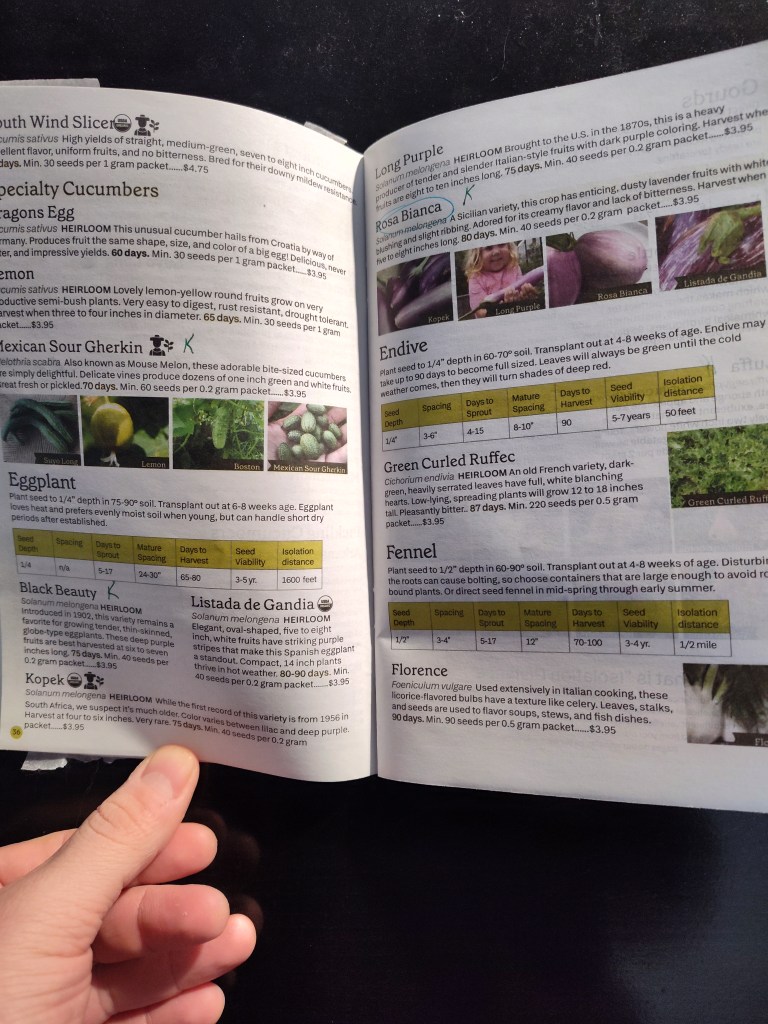
Flipping through seed catalogs is one of the most enjoyable experiences of gardening. Maggie and I love the joy of having something on the television for background noise (nothing too engaging), each grabbing a catalog and a pen, and marking off seeds we’re interested in. I recommend using a pen to initialize any seeds you’re interested in. It’s a great way to not forget the ones you see, which is easy to do when looking at multiple catalogs or browsing a website.
When looking at multiple seed catalogs, you’ll find a lot of the same varieties. Almost every company sells California Wonder Bell Peppers, Amish Paste Tomatoes, and Provider Bush Beans. Those are all common and productive seeds that have been around for decades. Companies sell them because they have high success rates and good disease/pest resistance. What you’ll learn is that different companies have different niches. For example, High Mowing Seeds, which is based in Vermont, sells only organic seeds. Meanwhile, Baker Creek only sells heirloom varieties. Also, the company’s location plays a part in its offerings. Fedco and Pinetree Gardens, both based in Maine, sell a lot of root crops and cool weather vegetables (lettuce, spinach, turnips, greens), while Sow True Seeds (North Carolina) and Southern Exposure (Virginia) sell a lot of okra, melons, and southern peas.
Then there is the catalog’s design. Seed catalogs are great because each is unique. Does the company focus on the growing information, such as germination time, thinning distance, sowing depth, etc. or does it tell a story with each seed? Does each seed have an image of the grown vegetable? Does the company include all seeds in its catalog or do you need to visit their website to see everything? Do they include educational information like seed starting charts, isolation distances, or plant disease information? Finally, do they sell gardening tools, starting equipment, and soil amendments?
Who Didn’t We Buy From?
There were only two catalogs from this year’s group that we were underwhelmed by. Territorial out of Oregon had most of the same offerings as the other companies but at a higher cost. The other was Rohrer from Pennsylvania, which wasn’t expensive but also didn’t wow us. Seed Savers Exchange has a beautiful catalog and their main goal is to save seeds from going extinct. However, we didn’t buy from them because they were a bit pricey and we could find the same varieties from other companies.
What Were Our Favorites?
We bought from all the other companies listed in the bulleted list above. I’ll go over what we liked about each company and their catalog.
Baker Creek
Baker Creek offers two catalogs: a free one that is 164 pages and a 532-page version that is $14.95. We got the free version and found that it had plenty of seeds. Plus, you can look at their entire offering on their website. Their catalog is beautiful. The pictures are crisp and vibrant, the descriptions are detailed, and they offer varieties that other companies don’t. Two minor improvements could be having more growing information, such as germination time, sowing depth, etc., and how they have the seeds organized.
Their catalog is alphabetized, which is great, but some of the seeds are categorized in ways that make it hard to find things. One example is melons vs. watermelons. Both have their own sections in the catalog, while other companies keep them together. We bought a lot of seeds from Baker Creek. Their prices are reasonable, shipping was free and fast, and they include a free seed packet for every 5 or so you buy. We bought 28 seeds and got 3 free packets.
Fedco
Fedco’s catalog is one of the most interesting because it’s black and white. It looks like a 19th-century Sears and Roebuck catalog and is 175 pages, which I love. There aren’t photographed images, but instead, they use beautiful illustrations to show the plants and vegetables. Some illustrations are straightforward, while others feature fantasy or humor elements, such as wings on a Speckled Swan gourd or a T-Rex biting the leaf off Dinosaur Kale. I’m always tempted to grab colored pencils and color the pictures. Plus, they provide pictures of the vegetables on their website.
Fedco provides a wonderful explanation of each seed. They include information on the seed’s history, a description of the vegetable’s physical attributes, growing tips, disease resistance, and the seed’s breeder/keeper. This is important because some give royalties back to Indigenous tribes or to black farmers if the seed originated in Africa or is a part of black foodways. Fedco’s catalog is organized well and offers a lot of seeds. Our favorites are their potatoes and corn.
High Mowing Organic Seeds
Prior to this year, I hadn’t heard of High Mowing Organic Seeds, and I wasn’t sure if we were going to purchase from them. We love organic farming, but organic seeds can be expensive, so I was unsure if it’d be possible. As mentioned above, High Mowing is a 100 percent organic seed company based in Vermont. When the catalog arrived, I was blown away. It was 117 pages and included images for every variety, which is almost unheard of. The majority of companies have images for most seeds, but you need to visit their site to see the rest. High Mowing, though, includes clear images for every seed. The best part is that they use a common background for each vegetable. For example, all the beets are photographed against the same background, which helps to see the similarities and differences between the varieties.
The information they provide is helpful and succinct. Each vegetable has an introduction that describes soil needs, disease/pests, and transplanting information. Each variety includes the growing time, if the seed is a hybrid or is open-pollinated, if it’s an heirloom variety, and a brief description of the visual and flavor profiles. They then include a chart with the cost and quantity of each variety. It makes comparison shopping easy.
NE Seed
NE Seed is another company I hadn’t heard of prior to reading the Farmer’s Almanac page. The company is based in Connecticut and mostly sells to commercial growers, so their quantities can be massive if you’re a home gardener. However, they do sell a lot of seed packets, and their prices are amazing. Still, I wasn’t sure if we would order from them because I didn’t think it’d make sense to only order 1 or 2 seed packets from a company if we had to pay for shipping.
Their catalog is nice and easy to navigate. It’s smaller at 87 pages, but they include images for most seeds. They also organize their seeds alphabetically by vegetable and further separate them by variety. For example, in their corn section, they have bicolor, yellow, white, open-pollinated, popcorn, and ornamental. They also have a large Italian Gourmet Collection that features Italian heirloom seeds. These seeds are a bit more expensive than their regular seeds, but most companies don’t offer those varieties.
Pinetree Gardens
Pinetree Gardens is another company I hadn’t heard of before this year. Like Fedco, they’re based in Maine. For some reason, we seem to really like Maine seed companies. Pinetree is a small company that’s been around since 1979. I get the impression that it’s a family-owned company that cares about its employees, customers, and products. The catalog is 130 pages and is everything you want: quality images of every seed, good organization, simple descriptions with enough information, and clear icons for pollinators, organic, sun requirements, etc. They also offer a lot of growing supplies, teas, and bulk herbs. We were impressed and bought a lot from them. The seeds took a bit to ship, which was fine given the company’s size. They communicated with us the entire time and included personal touches in their emails.
Sow True Seeds
Another seed company we were unfamiliar with (there’s a theme here) is Sow True Seeds based in Asheville, North Carolina. Sow True is an employee-owned company that has been around since 2009. They’re devoted to only selling non-GMO seeds, offering educational opportunities, and giving back to the communities that helped to save seeds throughout history. Located in the South, they offer seed varieties that are vital to Southern cuisine and culture, including collards, okra, southern peas, and beans. They also sell varieties with interesting histories, including the Queen Aliquippa tomato, which was named for a Native American leader of the Seneca tribe who spent much of her life in Western Pennsylvania. That sold us on the company.
Their catalog is beautiful. It is shaped more like a book than a typical catalog. It is 103 pages and has lovely artwork on the cover, similar to the artwork found on some of their seed packets. The catalog is perfectly organized – everything is alphabetized and each seed type has a chart with information about planting depth, germination time, and spacing. There are descriptions of each seed and they’re clear about the number of seeds you get in each packet, which isn’t always the case. There is even a section in the middle with a planting guide for all seed types, a companion planting chart, and a seed starting guide. The only negative I have for their catalog is that they don’t include images for all seeds.
Southern Exposure Seed Exchange
Finally, the last catalog we ordered from: Southern Exposure Seed Exchange (SESE). SESE is another wonderful seed company dedicated to preservation, education, and community improvement. They do a lot of work to help the hungry and partner with a program called Plant a Row to provide for those with food insecurities in their area. That is something important to Maggie and me. SESE’s catalog is 92 pages and has the classic newspaper page feel. Maybe I’m weird, but I like the texture of flat (unglossy) pages. Their catalog is full of seeds important to Southern foodways, and they include origin and breeder information.
Southern Exposure’s catalog is also visually stunning with lovely artwork on the cover that depicts faeries and elves (maybe gnomes) stacking stones for an exterior wall of a house. The faeries have butterfly wings on their backs, and there is a massive watermelon in front being cut with a two-person crosscut saw. It’s pretty enough that we may end up framing it. They also have lovely seed packets with colorful illustrations of the fruit on a simple white background.
We Could Never Only Choose 1 Company
Maggie and I knew that we were never only going to buy from one seed company. Going into this process, we were interested in multiple companies because we wanted to buy a wide variety of seeds that couldn’t all be purchased at one company. After looking through the catalogs, we fell in love with the companies’ missions, which we wanted to support. We are pleased with the companies we purchased from. We’re also confident that we’ll continue to purchase from them moving forward.
If you’re unsure about who to purchase seeds from, I recommend determining how many choices you want to have. If you only want to grow a few plants and have the most success you can, the seed displays in Tractor Supply or a feed store are great options. They typically carry the most popular varieties with a lengthy track record of success. However, if you want to look at as many varieties as possible or are interested in heirloom varieties, I recommend requesting a few of the catalogs in this post. You’ll be able to read about the varieties, compare them, and take notes all in one place.
Do you have a favorite seed company or any experience with the ones in this post? We’d love to hear from you. Happy growing.



 One Rabbit Riot