Part Two: Sewing Overalls Step by Step

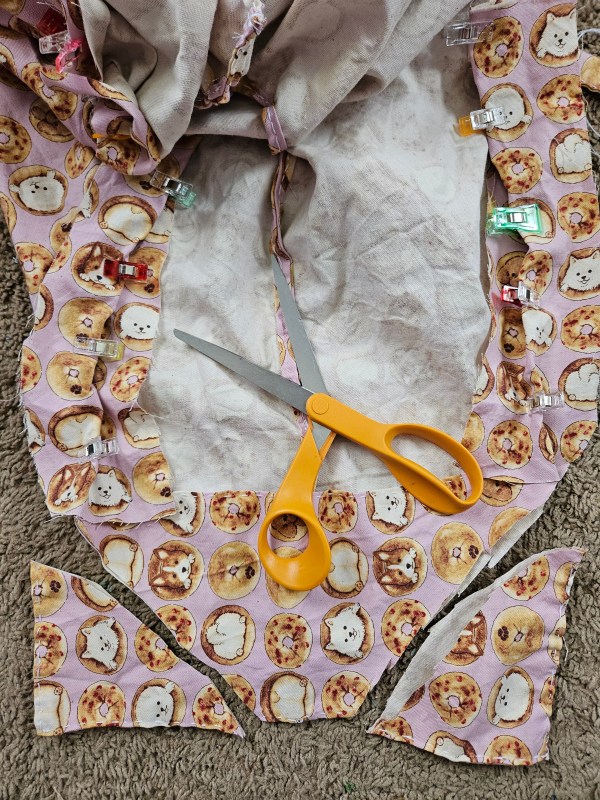
I’ve been looking at how to make a custom overalls pattern, based on drafting techniques, which I began with this post: Drafting Shortalls from Scratch. But how to construct them? Well, that’s what I plan to explore today! To do this, yesterday, I cut out another pair of overalls, this time for the fall-winter-spring season, to retrace my steps.

Step One

With your pieces cut out according to your measurements, you should have four leg pieces – two front and two back. The next two bib pieces should be cut out, with the back piece cut a bit differently to accommodate the straps. This is to anchor the straps at the middle of your shoulders to keep the overalls securely on your frame.

Step Two

I like to begin with the pants or shorts portion of an overall project, because they are foundational to the silhouette. I like to pin the leg pieces together to try on before sewing. Remember to leave several inches of the outer thigh seams pinned for the flies and buttons.

Once you know that the pieces will fit, with seam allowance accounted for, I begin sewing the leg pieces together, leaving out the crotch seam and the top part of the inseam, to attach the two pieces as one pair of pants. After these have been sewn together and I have tried them on, I will move on to the bib.

Step Three

For less bulk, I like to cut the seams of the crotch portion and leg seams that will join together, with pinking shears, to make my hems less thick. This lets the sewing machine, or your hand sewing needle, pass through the seam with ease, and is more comfortable to wear.

How do you join pants? Well, you leave the top of the inseam open so that those two inseams will line up together, making the two legs join at the top where the pelvis is. Remember this is a bifurcated garment, so you want your final shape to be two tubes, joined to make one tube at the top. I’ve messed this up several times; it’s okay even if you sew it wrong the first thousand times. That is what mockups and seam rippers are for!

Step Four

For the bib of these overalls pictured above, they were cut into short pieces, so I just had to join these pieces together. I added a facing to the inside of the bibs, which is just a piece of the fabric’s right side facing inside, so that the bibs are finished cleaner around the neckline.

I inserted the straps between the facing and the bib for a clean and secure stitch. The straps were finished with a loop on either side of the front bib to tie around, instead of the metal fastenings. I was inspired by Lucy and Yak Dungarees.

Step Five

The final touches are the bias tape, the side buttons, and the five pockets. I find the bias tape the most mundane thing; therefore, I choose to do that next, which is a 1-2″ ribbon of the fabric used to finish the raw edges still exposed on the sides.

Step Six

Next, I created the flies on either side by folding over the fabric to make the button placket and button hole placket. This was planned out when I cut out the overalls. After making the button holes and finishing them with either the machine or by hand, I mark out on the other side where the holes overlap to mark for buttons.

Step Seven

Finally, I sew the pockets. I chose a large, half-rounded bib pocket on the front, two smaller rectangle pockets on the backside, and medium side pockets sewn across the hip. Next? Enjoy your creation and feel a sense of accomplishment. You did something hard, and probably felt lost at times, but you persevered to learn a new skill. It’s not cringeworthy to try. So go for it! ❤
Can I Make Mid-Size Overalls from 1 Yard of Fabric?

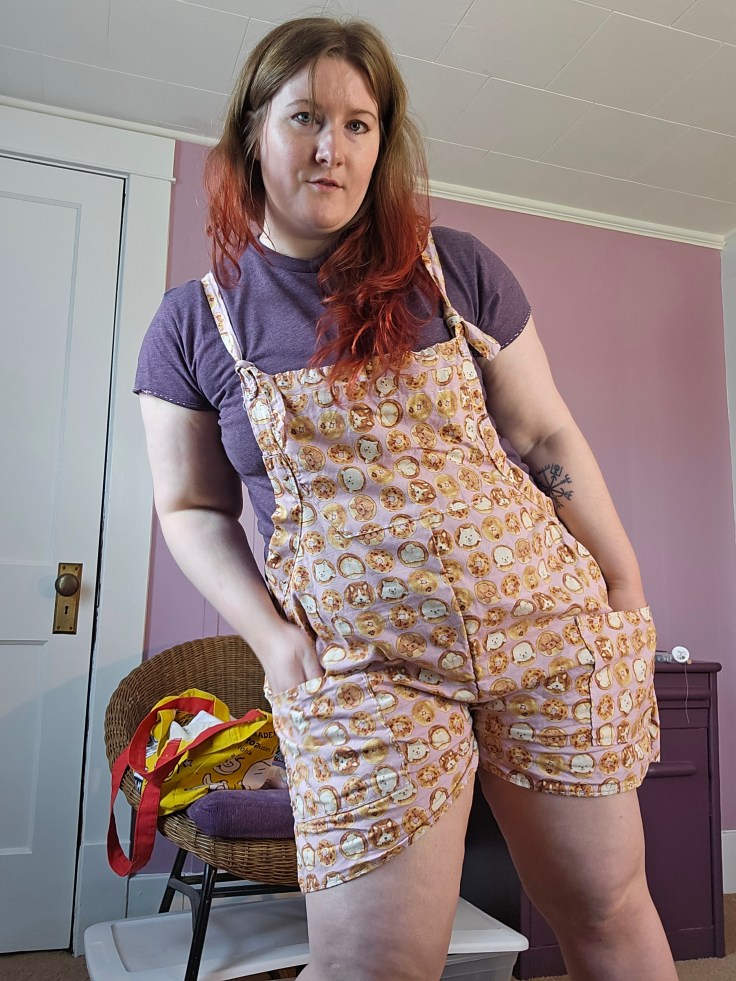
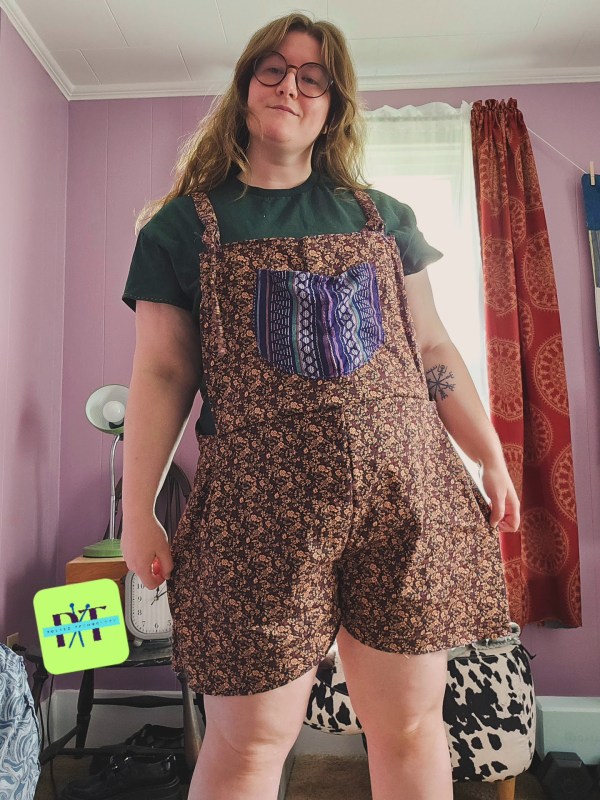
Do you ever think of something you’ve accomplished and wonder if you could do it even smaller? Well, I set a challenge for myself. A year ago, I wrote about creating a summer dress with a button-front from less than 1.5 yards of fabric. That post inspired this one, as this summer I was able to squeak out a pair of shortalls (overall shorts) from a yard of 59″ stretch twill from Mood Fabrics. This was not my first overall attempt, but I think my most ambitious because this yardage was for a pair of shorts with some abundant pockets, but I changed my mind after seeing a variety of overalls styled for spring and summer. I’ve owned this style before in denim. My favorite version I’ve purchased was a pair of vintage ’90s denim shortalls that were baggy and breathable for those swampy summer days. The more fitted versions I’ve found in stores in recent years are not my cup of tea, because for me, overalls are best when they are oversized.

When I cut these overalls out, I had just completed my draft of an overalls pattern from 2 yards of 44″ cotton twill from Kokka Fabrics, and I was itching to make more without fabric shopping, so I went for a dig in my fabric/yarn closet. It’s more of an antique clothing press, to be fair. This is where I found my gold – 1 yard of 59″ across cotton twill in a fun pattern, sturdy enough for a bottom weight garment with just enough fabric to cut the shorts, the bib, the straps. That was all I could muster for sure. I set aside the project and got to work on my Kokka Fabric project, which taught me so many things about sewing overalls that I had overlooked in past attempts.

Firstly, the back bib is not a rectangle. Secondly, a facing for the bib makes the project feel more professional. Thirdly, the buttons on the side need to be properly assembled with the fly for the right stability. Finishing the edges with twill tape made from the project’s fabric helped create a crisp look. Fourth, the overalls need pockets in order for the garment to sit well on the body. Lastly, I did not accomplish these with my 1-yard of fabric overalls. I took some shortcuts.

I ran out of fabric for the pockets, the fly, and the twill tape. To remedy this, I kept the shape to a romper style and less of a traditional overall. The bib is rectangular on both the front and back. The pockets were added from a previous project; I upcycled shorts into pockets. The side does not have any fastening, instead I sewed up the seam and let the boxy cut of the shorts and stretch of the fabric help me compensate for my lack of fabric.

So if this project is a pair of overalls that is not a traditional overall, but more of a romper, why am I writing about this?

Well, because the finished product is a wonderfully comfortable garment, practical for many things – gardening, sewing, cooking, knitting, farmers market, apple picking, cleaning, walking in the woods, going to the beach, etc – and I made it without being an expert. I made this garment through hand sewing, so you don’t even need a sewing machine if it’s out of your current budget. I purchased this fabric on sale for 10 USD/yard. I used less than a spool of thread, and repurposed the pockets from an item in my closet that I didn’t want to wear anymore. Have you seen the price of overalls? They are expensive, even the short version. A low-quality version will still set you back 30 USD.

I made these with 10 USD of fabric for a midsize frame, so this is accessible to all of us, not just the slim people. A lot of popular and cheap DIYs on the internet are made for very small bodies, which makes me nervous that if I try it, it will be expensive, but this wasn’t. Making these overalls was incredibly rewarding, too. These aren’t even the best pair I’ve made this summer, I’ll share the other ones soon! But these ones will have a special place in my heart because they are unique, comfortable, and made with my own hands. So if you have an idea of how you could make something by hand, make it happen! It’s a lot easier than you think, a great learning experience, and there are tons of resources here online to help you succeed!

Flannel Upcycling | Making A Vest

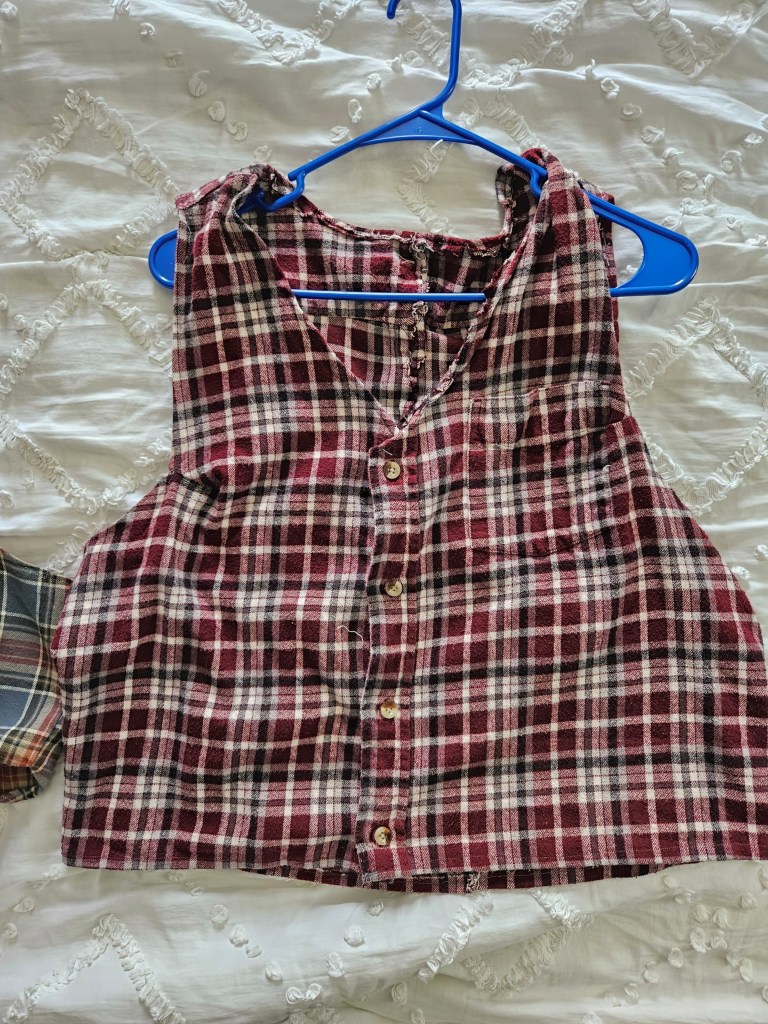
Last summer, I wanted to introduce vests into my wardrobe. I have made vests before for Kyle, but have not sewn a vest for myself before; I have knit them. Because this was a spontaneous idea, I needed to be budget-conscious and find a way to use what I had to make a vest. So I went to my closet and got creative! I had a few flannels in my closet that were hanging there, waiting for me to wear them, but I didn’t. That’s when I looked at the shirts closely – there was a button placket, shoulder yoke, and a sturdy fabric, with room to crop them. I saw the vest within the shirt, so I grabbed my scissors—and was a bit too zealous with the first one! Don’t be like me, have a plan. So how did I make this upcycle work? And what did I learn from my failed attempt?

Shoulder Seams, Yoke, and Waist Length

The crucial points of cutting, I would say, are being aware of the shoulder seams, accounting for the back yoke width, and properly measuring your waist length for a proper fit.

  • Shoulder seams on a flannel are boxy and loose. To achieve the set-in sleeve opening that accentuates and reveals the shirt underneath, you need to cut away the shoulder line – but not too much. Be mindful of how far into the shoulder you plan to cut, so that you are left with a proportional line.
  • The shoulder yoke is a technique used to tailor the shoulder line, while leaving the fabric below the shoulder loose. As a result, there will be more fabric on the back of the vest, which may affect the fit of the arm openings and possibly require a dart to remedy the loose fabric. If not, the back will gape open, looking awkward and like a mistake. A vest should hug the body, be tailored, or else the upcycle will look exactly like you cut up a flannel.
  • The length of the vest determines the style and balance of an outfit. One of my vests I cut too short, and this limits how I can wear it. I find it cuts me off in a regency high-waisted fashion that is fine when I wear it with a high-waisted skirt, but with pants or my linen Darcy shirt, it’s awkward. The other vest was cropped, in a careful fashion, ending at my hip and balancing my body line like a well-tailored garment. It’s far more versatile.
  • Cutting the neckline is crucial. For the front, a tapered cut to the button placket provides the classic look. Be careful not to cut too low for a historical silhouette. Also, remember not to cut the back the same as the front! I made this mistake and had to sew the cut portion back into my vest. This should be a crew neck line, straight across, with a slight dip in the middle for comfort.

Why a Flannel Shirt?

I chose flannel shirts as my medium to work with for three specific reasons. The first one I already mentioned – cost. We had just moved into our house and paid quarterly taxes. The vests were not a necessity, just a whim, so it made sense to me to take an existing item, I didn’t wear to create something I would wear. It’s funny how the sustainable option is sometimes the free option too. Secondly, flannel is a sturdy fabric, appropriate for the structure of the vest, that could be sewn without the addition of a lining, which I could add later if I wished, when I was more comfortable spending money on fabric. Thirdly, flannel is a classic pattern that reminded me of the woven woolen coating fabrics that vests have been sewn with for centuries, so it was a good match! I hope this inspires you to repurpose items you have to make something new! For the rest of the flannel, the pieces I cut away, like the sleeves, stay tuned to see what I did with those. It’s one of my favorite makes. 🙂

Designing Clothing That Fluctuates With You

This is inspired by a discussion from Maybe Bre, which made me reflect on something I hadn’t discussed before. As well as my own experience wearing clothing, as a garden-variety human who loves fashion but doesn’t always enjoy how our clothing is made.

By this, I mean the patterns and fastening of our modern times. The zipper is a wonderful thing, and so is the structured waistband. I love them in jeans because denim that isn’t compromised by stretch is a rugged and sturdy garment that isn’t a piece that conforms to you; your body is housed within the trousers. I feel the same way about a structured coat. In doing so, I buy these pieces oversized for comfort, which leaves me with a garment that most of the time doesn’t technically fit me. If I did buy it to fit me right now, there is no guarantee that over many decades it would continue to fit me – I’ve been burned before by this problem. Hence, all my “staple, investment pieces” from college no longer live in my closet because they are no longer my size. If I had planned ahead and bought them a bit oversized, they might still be with me, but they wouldn’t have “fit” me at the time.

My problem with clothing is becoming clear, isn’t it? I desire longevity and wearability from clothing, in a way that is not offered off the rack. I desire my clothes to grow and shrink with me, depending on how my body changes over time. This has been my design focus in the last few years as I have placed myself in the driver’s seat of my wardrobe through the process of sewing and knitting.

My idea is not innovative; it is historical. Clothing, because it was so expensive and hard to make, was more adaptable in the past. Fastenings such as tie waist, lacing, and buttons with multiple sizes of tightness were common because clothing was not as easy or cheap, and they were not seen as disposable or replaceable. Changing fashions came with garment reworks, ye olde upcycling as it were. This is what I desire: the ability to change the fit of my garment.

I recently figured out how to sew with elastic, which is a game-changer for shorts and gathered sleeve hems! Before this, though, I was making most of my bottomweight garments with tie waists or several options of buttons to let the garment adjust to the needs of the day, I’ve also sewed with intentional relaxed fit, initially due to a lack of tailoring skill but over time it has been to allow wiggle room in pieces I have spent days or weeks of my life crafting.

Being present in the making process has taught me to treat my clothing with more respect, even when it is time to discard the current version of it for something more useful. I’ve stopped donating as much, decluttering, and rebuying, to be honest, to be more intentional with the garment and its life cycle. I am the one who brought it to life, I can’t simply consume and discard it like it is nothing. I am deprogramming my brain from decades of fast fashion insanity.

I believe if clothing were made with this design philosophy, that clothing would fluctuate with you over time, I believe we would enjoy wearing our clothing more because instead of buying stretch fabric everything, we could still wear good natural fibers, maybe a bit bulkier than spandex and less figure hugging and lurex denim, but would be better for the humans and the planet. Style and substance, as they say on the Great British Baking Show!

Remaking My First Sewing Project Four Years Later

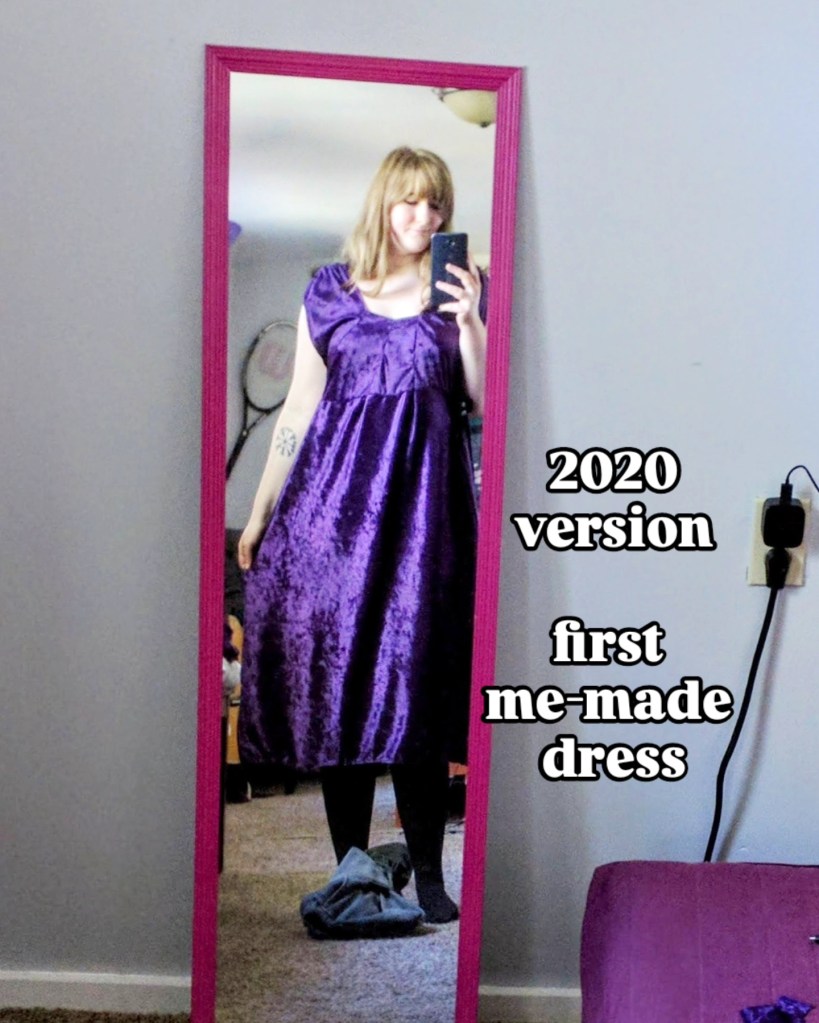
Last September, I felt this aching in my creative heart to make what I didn’t make well the first go around. A project that some would say was insane to attempt as a beginner because of the difficult nature of velvet and the frustration that is sewing with stretch fabric. The dress pictured below was my first wearable garment. I saw the same purple stretch fabric on sale for Halloween at my local Joann’s and my heart skipped a beat. It still exists – I could try again!

You see the first dress I made was constructed so poorly that I ended up cutting it down into a skirt because I was embarrassed to continue wearing it out. After all, the bodice was bunching up and gathered strangely in the back. I lacked the confidence to keep going and try to alter the dress for success. I see now that it would have been an easy make to take out the gathers and bunches of fabric for clean seams, but that kind of thought came with trial and error. I needed a bit more experience and patience to make it right, and at the time in 2020, my younger self was not willing to wait.

But what if I am living in the past? My mind thought, maybe I should let it be and let the dress be a learning experience. I put the purple velvet down and left it, it was not on sale, it would be a sizeable impulse purchase at 15.99 a yard for 4 yards. I can’t justify 60 USD for a passing whim, that would be a poor use of money. So I left the daydream and moved on. Still thinking about that fabric. Another few weeks passed, finding myself in my local Joann’s again. It was my favorite place to explore. I went to the shopping plaza over the weekend where Joann’s remains live boarded up with the lights still on. It was eerie. I found myself thinking about what was blocked off inside? Was the fabric slumbering in the bolts, waiting to be made into something new? Would the yarn ever find a home in a fiber artist’s hands? It felt like a mistake, a bad dream, but it was not. It is over and now it is just a memory.

Anyway, on the second trip to Joann’s during the Halloween sales, I found my purple beloved. The bolt was still full, now marked down to 7 USD a yard. But this time I couldn’t get the project out of my mind. I’m glad I did give in to the creative urge or this project would be left without an ending. At the time, I had no idea Joann’s was going to go under. I thought I had plenty of time to remake this when in reality the window was closing. As I worked on this dress in 2025, I followed Joann’s story with frustration and weight of expectation. This remake is the final try, for this fabric I will never find again.

I made a different dress from the original and that surprised me. I believed going into the remake project that I would duplicate the same dress but with better technique. Instead, it was a project of feel. This time, I had a dress form I could drape the garment on. I had fabric clips with securely held the the slippery fabric together while on the dress form or for a quick test of fit on my own form. This time I understood proportion and where this dress would fit into my wardrobe instead of making a dress that only went with my moto jacket. I reinforced the shoulders and was thoughtful about my stitching, to make the garment strong. I added darts to pull the dress in where it was fitting baggy instead of leaving it like a velvet sack.

It became something new and I am okay with that. None of us are the same as we were years ago, we grow and evolve with every passing year. Making a dress for now, with the spirit and the fabric of my first garment, but with a new neckline and a new fit I think is an inevitability of learning and growth. I had the patience this time to try on the dress, mark what was not fitting right, and go back to work until it was correct. That was not something I was willing to do when I started, because it was all so new and confusing, but with time and practice, those new concepts became a familiar old friend. Like this tan carpet. It wasn’t until I looked at the 2020 mirror photo and the 2025 mirror photo that I saw it. The carpet in the house we bought looks just like the carpet in our apartment in Meadville. How random is that?

I have one more section of the purple velvet left over that I plan to make something with, possibly a mini dress, a blouse, or maybe a jacket. I think knowing this fabric is a relic now, makes me feel unwilling to finish this scrap project, because once it is done. I’m going to feel like my time experimenting with fabric from my first craft store is done. A chapter of my sewing life is over, and I hate saying goodbye. I’m a sentimental person. When things end, I take it hard. I dwell on the loss and muse on it. It might be unhealthy. It certainly makes life harder as a person who wants to keep things alive that are gone, it’s why I think I was drawn to study history in college.

As I keep making things, some of these projects become an archive of crafting past. What are some things in your own life that have moved from the present to part of your past? Does it surprise you to consider these things as your history instead of your current story? Thank you, reader, for joining me again down this sewing memory lane. I hope you have a wonderful day!

Socks: An Update

Several months ago, I started a new side quest in knitting – making socks. It’s a windy and treacherous climb, fraught with new equipment and an entirely new approach from a garment like a sweater. At the beginning it’s like casting on a mitten or a small hat, yet as time goes on you realize you are somewhere between a knitter and a sculptor, looking for the heel shape in your amphorous block of yarn. It is the most challenging garment I’ve made, culminating in going over the waterfall, at least that’s what turning the heel felt like at times.

What makes this ubiquitous garment so hard to learn? It’s a project of multi-tasking, like dribbling a basketball and moving at the same time. You are not only knitting a pattern – a sock, but you are also learning it on a new court – double pointed needles or with a magic loop configuration on circular knitting needles. There is also the third option, the one I leaned on when I was baffled by hitting gauge on my project and fed up with ripping out my progress over and over, knit flat tube socks that are sewn together to form the tubular shape.

My first two completed sets of socks were made this way, with straight needles to help me process all I was learning from these new techniques. It was the confidence boost I needed to keep going and finish the sock. I get overwhelmed in new projects when nothing is familiar but taking one part, flat knitting, and keeping that as the control part of the experiment let me knit and see how it should look and feel when the socks are completed. To better understand what I was working towards on double pointed needles or circular needles. Flat knitting also gave me the chance to try something I’ve never done before as a knitter, I cast on two socks at a time on my needles. It was incredibly satisfying to finish each sock at the same time!

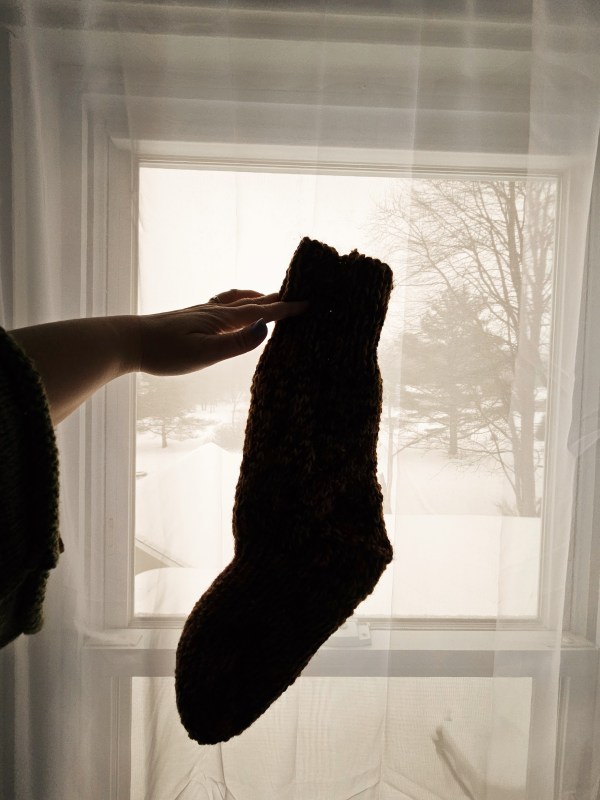
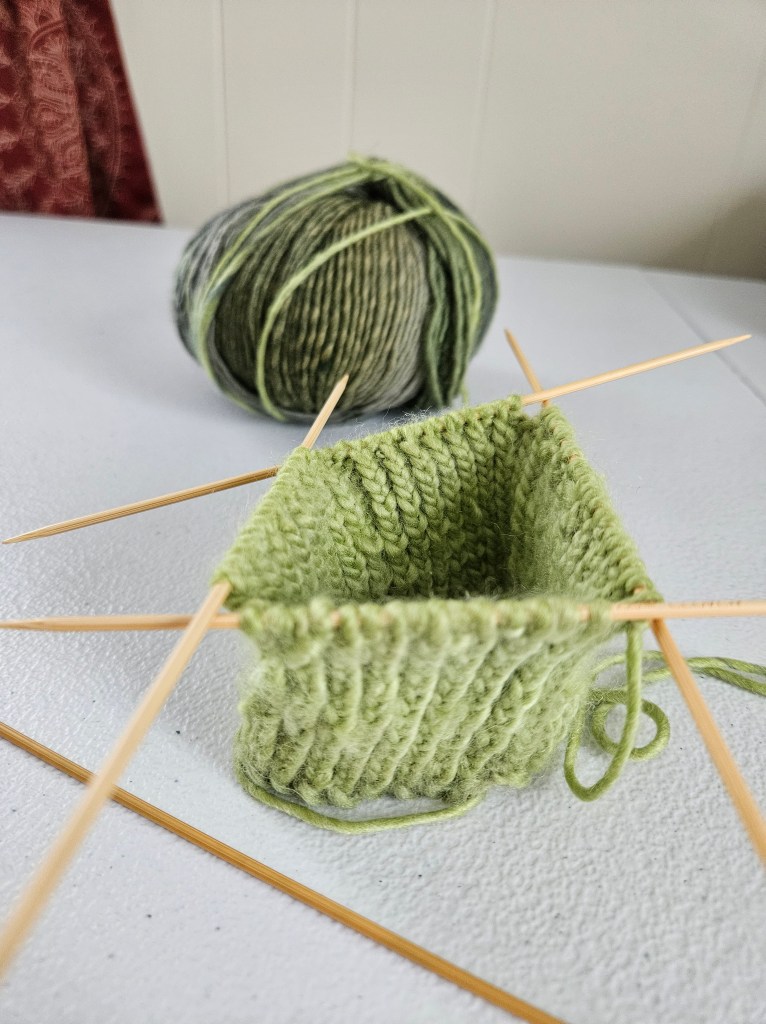
With this new found confidence I carried on and cast back onto the straight needles, making a brown pair of socks from recycled acrylic that wash and wear well. These green socks above are a blend that is mostly wool with a hint of acrylic in the yarn and they are hand wash or steam only for me. I wash them gently with either shampoo or conditioner in the sink, carefully to prevent felting. For my next project I wanted to explore fiber content, so I cast on a sock with three strands – two fingering weight wool and one acrylic. I chose this composition to test wear and washability, to make these a sock I could worry less about washing yet would insulate my foot, this was during a month long stretch of cold weather, dipping into the negatives fahrenheit so my mind was on cold weather. I decided to make these chunky socks into a sock I would use to insulate my L.L.Bean duck boots which are waterproof but are canvas, not insulated at all. They are a boot I want to wear for cold weather and snow, but they make my feet cold even with two pairs of socks.

As I got to the heel portion, I knit these socks cuff down, I made a last second decision and transfered my project to my round needles, joining the row into a round a stitches. With my heel turning reference book in hand I began turning that heel! It wasn’t as bad as I thought it would be! I don’t think I executed it perfectly, but I conquered a fear. Now, the tough part of the process is that my handwork for circular knitting is subpar. I hold my stitches too tight and the tension hurts my fingers the longer I knit on a project. The only way to improve this is to keep practicing, yet I don’t want to practice. The second sock is cast on but I have yet to make progress on project because I am dreading the circular process and those tight stitches that come from inexperience.

Is this sock the best fitting sock I’ve ever made? Yes! Is it better than store bought ones? A 1000% yes, and I’m a novice so they are going to get better with practice. It’s an art form we wear everyday without thought, but it is truly a sculpture of yarn. Next time you put on a sock, have a moment of appreciation for the geometry, the symmetry, and the sculpture adorning your foot.

Checker Board Pants: Making Pants From Your Favorite Jeans

In 2024, I was inspired to start making pants. I had attempted making pants before and they were successful but I struggled to make them feel like more than just a pair of lounge pants. Part of this was caused by not choosing a good bottom-weight fabric, and instead opting for a lightweight summer cotton that draped beautifully but didn’t give me that tailored look. I also tried an ill-fated scuba fabric in 2023 that crashed and burned because my thread tension was off. Enter this checkerboard denim print I purchased at Hobby Lobby. It was denim but lighter, not too heavy to be a problem for my sewing machine. But how would I find the right pattern?

I had a pants pattern in my stash for menswear trousers, that I considered using on this project. It’s a solid pattern and would make a straight-fit pair of jeans, maybe not the style I was going for though. I considered buying a new pattern, but then I fretted that the pattern would fit me weirdly or might not fit at all. The current style in 2024 still featured that tapered-in waist on pants that favor an hourglass figure, not my rectangle athletic build, so should I risk it? A big reason I chose to make pants in the first place was that I was sick of shopping and trying on pants that made me feel weird about my body. The men’s section was my go-to for their up-and-down pattern cutting, compared to the extreme tapering and high waist silhouette of women’s pants. Even low rise was stuck in mid-rise inseam, not the true low waist inseam I was accustomed to in the 2000s and early 2010s that helped me find good-fitting jeans because they favored my shape not the post-bbl world of fashion. I digress, my point is that buying a pattern someone else drafted felt like a risk because the fit is such a personalized thing.

My solution was to take a pair of pants in my wardrobe that I liked the fit of and to trace that pair of pants to gauge the shape. I did this with a pair of jeans that were high waist but had a nice loose fit through the hip and leg for the K-pop-inspired baggy jeans style I was interested in making with this 1990s Vans checker board print. This worked swimmingly! So much so that I traced the jeans onto a piece of brown craft paper for a quick pattern to reach for on future projects.

I chose to record this project, start to finish in video from instead of video to have a memory of how I did this to learn for myself and remember what I did but to also inspire others to try this. Pants are intimidating, especially from a paper or PDF pattern. The written instructions and diagrams have puzzled me in past projects but truly, pants are simple once you see how its done. I wanted to help others feel that freedom to create because at least in my American fashion market, fast fashion has destroyed the craftsmanship of pants and standardized sizing. I referenced this in a previous post, Shaping Up where I had to confront the dressing room terror of things not fitting and seeking to not be defined by my jeans size, when trends and pattern cutting shape shift sizes, but to take control of it on my end and get healthier in 2023.

This pants project was one of the most challenging and rewarding projects of 2024. I faced my fear of sewing denim, inserting pockets, and fastenings. I chose to not attempt a fly into I had more pants sewing experience, instead I planned to make what I knew I could achieve under my skill set. I opted for a side closer with a drawstring to have an adjustable fit since the denim had zero stretch. The denim containing no stretch was a feature I sought because I believed it would be easier to work with as it was my first project of this kind, and I wanted a crisp tailoring from the woven fabric. A key thing to note is that the jeans I used for my template also are non-stretch denim. For an accurate this is paramount or else the project will not work. Either you will cut your project too large or too small. It is also essential to leave a seam allowance on your pattern pieces. When self-drafting it is your responsibility to take charge of the seam allowances and plan ahead.

I messed this up with the crotch line and had to make a quick fix. My fix was a diamond gusset. Popular in women’s leggings, this diamond gusset shape piece allows for greater mobility while maintaining the strength of the seams.

The second challenge I faced was the problem of a narrow bolt and an all-over pattern. This fabric was quite narrow and because I was cautious with my seam allowance, I cut my pieces large. This meant that I was not cutting from the longest side, but the most wide. The pattern pieces were cut out missing length on the leg. My solution was to add on to the bottom and pattern match. It’s easier to match than people say, it just takes patience and intentional sewing. I’m pleased with how seamlessly I got my pieces to match up.

The pockets were a challenge. How do you place them? How do you insert them with strength so the pockets can be used without pulling the pants down or ripping? I chose to place them angled on the sides, aligned with my hips so that they would be practical and not create weird bunching at the front of the pants. No wonky crotch fit here!

Would you make your own pants? I hope I inspired you to get creative and go for it if you are sewing-inclined. Thanks, reader, for joining me once again on this quest to grow my fashion design skills. Have a wonderful day!

Experimenting with Stitching and Basics

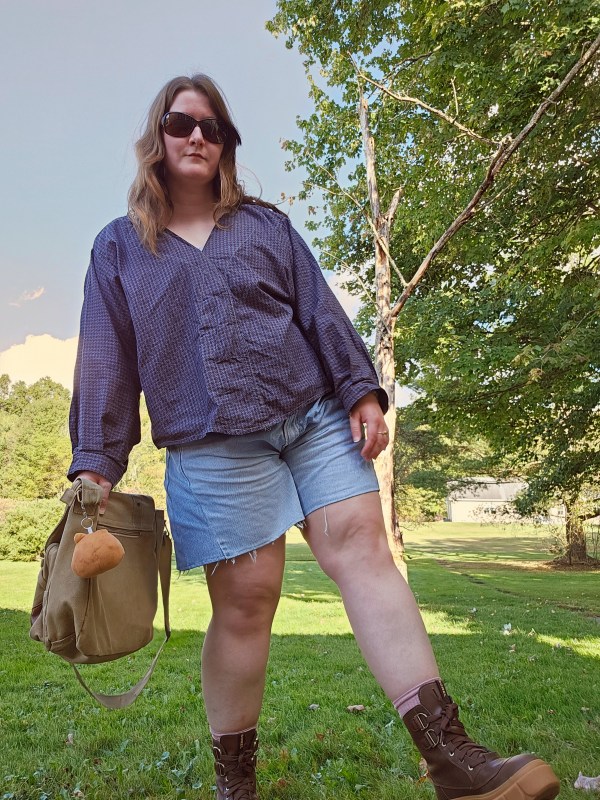
It’s that time of year when I am ready to wear long sleeves but the weather isn’t so convinced. This blouse is a project I made at the end of March 2024-early April 2024, that I completed and put into my closet to wear later. I was excited as soon as it began to cool off for the chance to style this piece! All summer long I’ve worn its sister piece, my denim houndstooth skirt that can also be worn as a dress that was absolutely lovely material to wear. It’s so breathable and has a bit more visual interest than the usual chambray, something I look for. This fabric is from Mood Fabrics, it looks like they no longer carry it which is a shame because I have two pieces from this cut of fabric, and I want to make more.

This piece is special to me because I did something a little different with the collar, I stitched in white the lines of a blazer lapel and lines of a jacket crossing over, for a bit of a formal feel. I originally wanted to make this fabric into a jacket but ran out of material, and I think it worked out for the best. I want to play with this stitching a bit more. It resembles a tailor’s chalk marking to me and I like that.

As the fall progresses and the temperatures continue to drop I’m looking forward to styling this piece with pants, vests, dresses, skirts, boots, scarves, etc. Styling this piece with new color combos excites me. I’ve only paired it with this brown and blue combo so far, which sparks my interest the most. I’d like to try this stitching application on trousers and dresses too with a solid fabric or maybe another pattern.

Do you like contrast stitching? Do you like clothing with a bit of whimsy like this faux blazer collar? Are you a fan of patterns? I like how different we all are and how tastes and preferences make this fashion thing, full of endless creativity. Thank you, dear reader, for stopping by. I hope we meet again soon. ❤

I Made the Stripe Hype Sweater

This is a weird knitting project for me because I usually can’t follow a pattern, at least it has been a few years since I tried to make anything with a pattern, and that was Butterick Retro ’44 #6374 and Butterick Retro ’44 #6485. They didn’t go super well.

This is the only picture I saved from #6485 because it was so bad. It felt like a weird Star Wars dress. But I digress, with knitting, I would like to rectify my aversion to patterns to learn new skills and appreciate the creativity, celebrate even, the creativity and talent of my fellow knitwear designers. So I was inspired by Making Cassie’s Stripe Hype Sweater knitting project and through my move, I decided to use up leftover yarn in my stash to make a sweater someone else designed. It was one of the most rewarding knits I’ve made all year!

Who Designed the Stripe Hype Sweater?

The original Stripe Hype sweater and sweater pattern was designed by Veronika Lindberg and the pattern was published on Ravelry in 2023. Now I didn’t realize there was an actual Ravelry pattern, I just gave it a go off of other people’s versions of the Stripe Hype Sweater on Instagram and YouTube, like playing a song by ear. Whoops! Sorry, Veronika! But here is the link to her pattern.

My Take on the Stripe Hype Sweater

This is one of my favorite sweaters I’ve made because it challenged me to do things I wouldn’t gravitate towards like using white on a sweater. After all, I’m pale and I’m clumsy so stains. But dang it’s a fun background for the colors of this sweater. It taught me how to balance color, to mix colors with more abandon, and to bring balance and order to my pieces. This is also a make that grew my skills as it was the first project where I tried casting back onto sections – such as the ribbed collar and the sleeves.

It was a rewarding experience and reminded me that even though I like designing my own pieces there is always something new I can learn from using a pattern and although I can find it tedious, it puts limits on my creative energy to channel it into a direction I may not have gone if not for the guidance of the pattern. Always have a teachable spirit, my grandma would say, and yeah she’s definitely right about it when it comes to knitting!

Have you heard of the Stripe Hype Sweater? Would you wear or make something like this design? What colors would you choose? Until next time, thanks for being here, dear reader. I hope you have a lovely day!

Less Than 1.5 Yards of Fabric to Sew With

In the spring and summer of this year, I was on a self-imposed low buy to sew through my stash in order to use up fabric that had been hanging out in my stash for a few years and have less to move to the new place.

One of those fabrics was this lovely vintage blue that evokes blueberries to me with the dainty floral print. I had made a previous garment with it and had less than 1.5 yards left in my stash. This was a fabric I brought with me to my mom’s while we waited for closing so I set another challenge in front of myself – make something that would use as much of the fabric as possible and make something that would teach me a new skill. It also needed to serve a real purpose in my wardrobe not just something that I “could” make. Something I liked.

I landed on this sundress design with a button front placket, embroidery floss buttonholes, and tapered panels to give the dress an easy flounce. I made the panels similar to skirt panels with a bell shape and gathered them to fit, hiding the gather with the straps. It was a fun little project that taught me how to utilize my stash.

Create a website or blog at WordPress.com

Up ↑