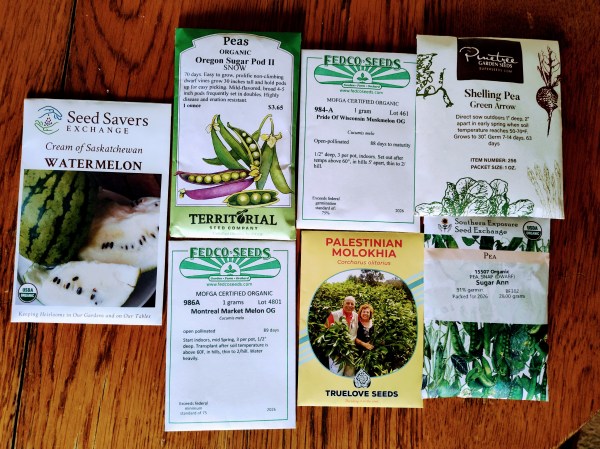
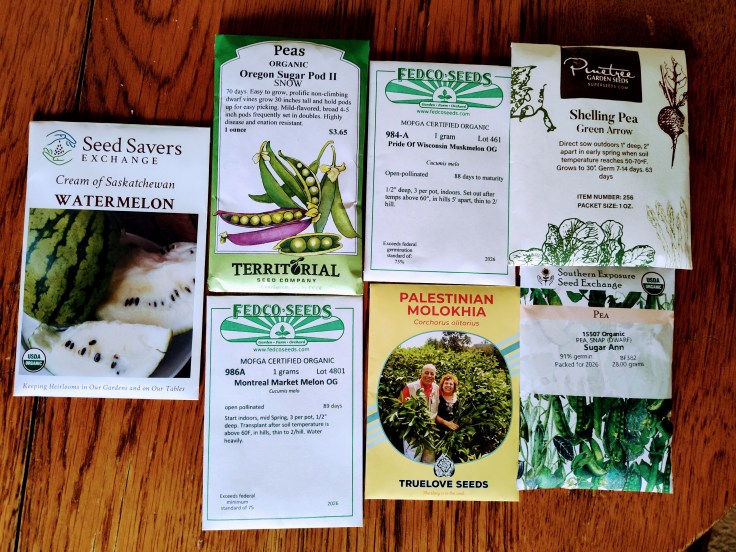
In a continuation of my series highlighting the garden seeds we ordered for our 2026 garden, I’m going to combine several vegetables into one post. This post will go over our melon, molokhia, and pea seeds. Below, I am including links to the previous installments of the series. Plus, here’s a post that showcases all of the seeds we ordered.
Links to Other Seeds:
Melons
Last year, I think we grew four types of melons: one watermelon, one cantaloupe, and two specialty melons. We had moderate success and were able to harvest one cantaloupe and multiple specialty melons. Given that we didn’t know what we were doing, I was pretty happy with the outcome. This year, we’re dialing it back by only growing three varieties of melons and no watermelons, which was the only type to not produce an edible fruit last year. The three varieties we bought were also bred to grow in northern climates, so we should be in a good position to succeed even if we have a cooler summer.
Cream of Saskatchewan
This white-fleshed watermelon has Saskatchewan in its name, but its origins are Russian. It grows very well in northern climates that have shorter growing seasons. Despite its white flesh, it is known for its sweetness and great flavor. It has a very thin rind and does not store well. This heirloom seed was bought from Seed Savers Exchange.
Montreal Market
This muskmelon has a fascinating story. The seed dates back to early French settlers of North America (to at least the 17th century), and Burpee commercialized it in 1881, but at one point it was thought to be extinct. Thankfully, a group of Montreal seed preservationists located a few seeds in 1996 and brought it back. A green-fleshed variety, Montreal Market has a sweet and spicy flavor that is unique. Grows very well in cool climates. Our seeds came from Fedco.
Pride of Wisconsin
Fedco, who we bought this seed from, describes the Pride of Wisconsin as the “best full-size open-pollinated muskmelon.” It was introduced by the St. Louis Seed Co. in 1923 and nearly went extinct during hybridization. The taste is supposed to be divine, and the flesh is edible down to the rind.
Palestinian Molokhia
I first learned about Molokhia in a podcast from True Love Seeds called Seeds and Their People. If you haven’t listened to that podcast yet, I recommend it. Magz came across molokhia when she was looking for flax seeds, buying both from True Love Seeds despite not knowing that I listened to their podcast. Molokhia is a green that is natively grown in the Middle East, North Africa, and East Africa that is rich in vitamins and minerals. It’s eaten like spinach and is also called Egyptian Spinach, while its fiber is used to make twine, rope, and rugs.
This variety comes from Palestinian refugees/immigrants living in the United States. Molokhia should be picked throughout the season for a perpetual harvest, and the leaves can be frozen or dried. Side note: I may not always love modern technology and the modern world, but the ability to learn about and purchase seeds that are vital to a culture halfway around the world is amazing. Buying and growing this seed is especially important, as the Palestinian culture, including its foodways, is being threatened. By learning about Palestinian culture and humanizing the Palestinian people, we are able to better understand them. The relationship between the Palestinian and Israeli people can be tough to understand, but one thing we should be able to agree on is that no one should have to worry about their culture being destroyed. As a Christian, I have no problem using the word “genocide” to describe what’s happening to the Palestinian people.
Peas
Peas get such a negative reputation, which is unfair. It’s probably because of people’s experience eating canned peas as children. While I also like those, fresh peas are amazing. Last year, we grew a couple of rows of snap peas and had some success, but we had issues with weeds and our corn shading the plants too much. This year, we’re growing all new varieties and picked one variety each of snap peas, snow peas, and shelling peas.
Green Arrow
Full transparency: This shelling pea variety’s name caught our attention and is the main reason we chose it. I’ve been watching the TV series Smallville over the past six months or so, and Oliver Queen (aka Green Arrow) is one of my favorite characters. As a seed, the Green Arrow pea is an heirloom that has been developed to have good disease resistance and high production. We got our seeds from Pinetree Gardens.
Oregon Sugar Pod II
The Oregon Sugar Pod II is a snow pea that has a contained growing habit with only 30-inch-tall vines that don’t climb. Like Green Arrow, this variety is highly disease resistant and very productive. Our seeds were bought from Territorial.
Sugar Ann
This variety is a snap pea that is known for its exceptional flavor and was named an All-American Winner in 1984. It grows in a bush habit with only 18-inch vines that don’t need to be trellised. Snap peas are my favorite, and I have a hard time not eating them fresh off the vine. Can be planted late in summer for fall harvesting. Our Sugar Ann seeds came from Southern Exposure.
Have you grown any of these varieties before, or have you grown molokhia in the past?
 One Rabbit Riot