This is a new term for me, but it is genius. Craftivism is activism through crafting. It is using your art and everyday things to show what you believe and to speak out against injustice. And to use an internet term, this has completely “changed my brain chemistry” to think of using my knitting to say what I believe, just like art.
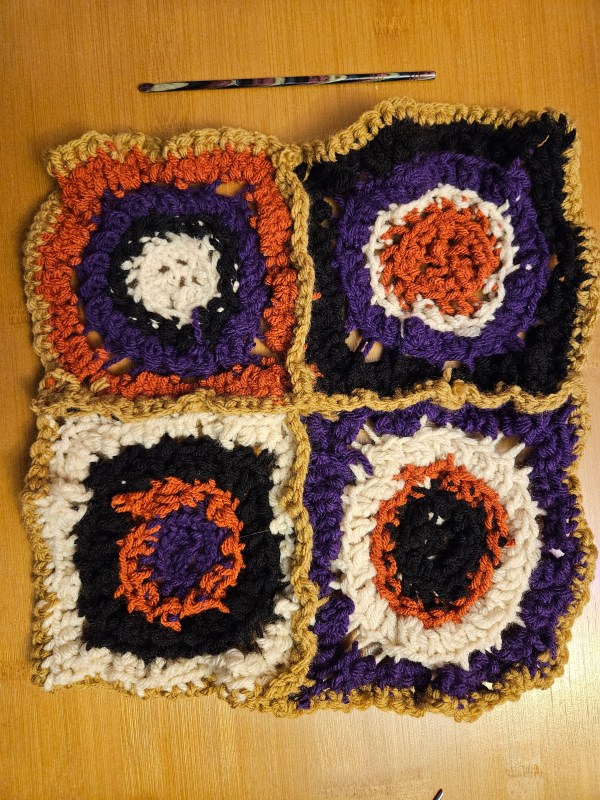
What made this a tangible thing for me to get started in community was the Welcome Blanket collection at my local yarn shop. Together, sections of knit and crochet squares would be collected and seamed into blankets, like receiving blankets, to welcome immigrants to the United States. With all the ICE-y conditions out there, it’s swimming against the current in a way that aligns with my beliefs and what we are called to do as Christians – love your neighbor and take care of immigrants. Not to worship power, money, and excuse racism like some so-called “Christians” in my country are doing. Seeing my crochet square stitched together with other like minded indivduals’ fiber art was powerful. It reminded me of how we are stronger together and how doing small things, as a community, makes a difference. I also enjoyed reflecting on my own immigrant heritage and sharing my story of how my family came to the US and why immigration is necessary.
As an American who is not Indigenous, every part of my family tree came from somewhere else. Some of my family came from Germany, I believe, in the early 1900s, since my great-grandmother, who was born in 1912 in the US, spoke German as her first language at home. Some of my family from Ireland left County Cork’s farmland during the potato famine to escape certain death from the genocide of starvation by Great Britain. Some of my family from County Armagh immigrated in the late 1800s to the US, went back to Ireland in the early 1900s, and came back again to the US during the Troubles. The rest of my family came from Canada in the 1960s. If we are not members of Indigenous nations, then we are all here because of immigration. To act like immigration is dangerous, un-American, and unwelcome is not American to me. We all came from somewhere else. Let’s love our neighbors and support them in this new chapter of their lives, which came about because of a very difficult decision.
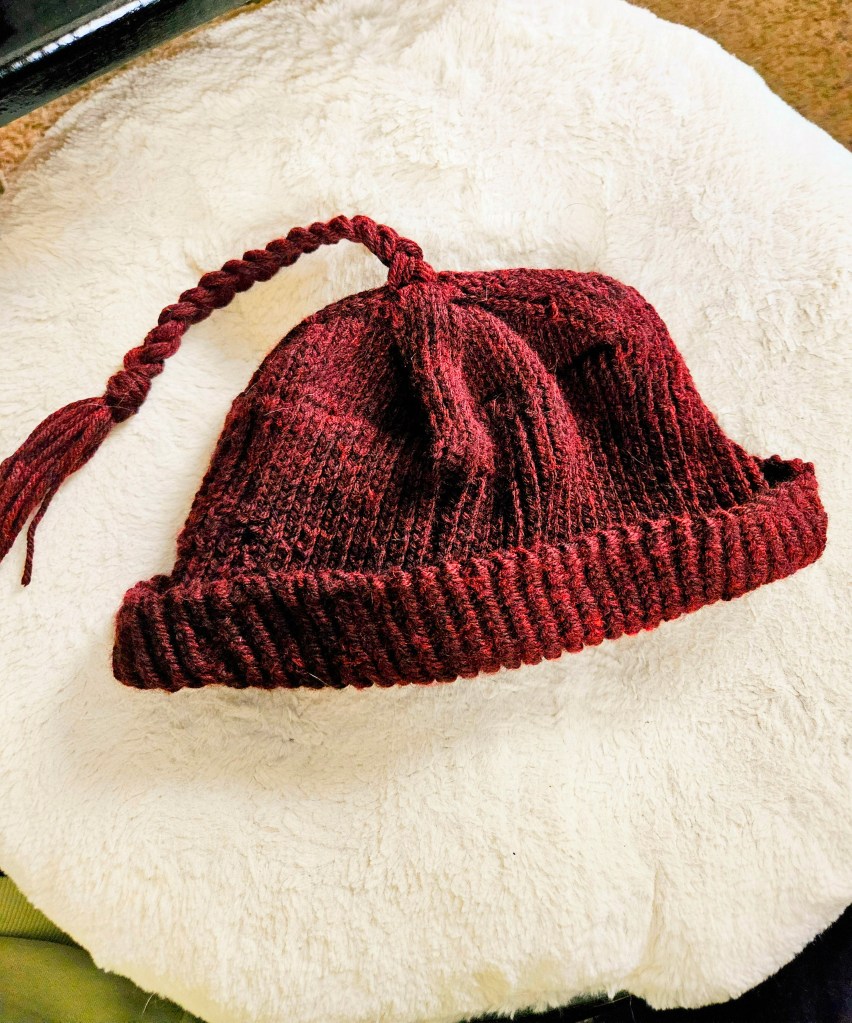
The second opportunity that brought Craftivism back on my radar was the Melt the Ice hat. This hat was used from protest by Norwegians in the 1940s during the Nazi occupation of Norway. Minnesotans, many of whom are descended from Norwegian immigrants, but now are a rich community of immigrants from all over the world, brought the hat pattern back to raise money for the Immigrant Rapid Response fund, which provides assistance for immediate needs – food, rent, etc. This fundraiser raised $650,000 with a $5 pattern during the Melt the Ice MAL in February 2026. If you are not aware of what has been going on in Minneapolis, there has been violence, there has been death, there has been kidnapping, and unlawful occupation of a city by federal forces in the name of corruption and power. Making the hat felt like there was a healthy place to channel my grief and anger over what is happening while bringing community together – Craftivism is powerful.
Have you ever heard of Craftivism? Would you participate in it?
I’m continuing my exploration of what is commonly grown in our state of Pennsylvania. Last week, I wrote about the state’s native plants and what we have growing on our property. This week, I’m looking at the commercial crops that are most prominent in the state and if they are native to North America or were brought here during European Expansion. I ultimately want to learn if the origins of Pennsylvania’s most commonly-grown crops align with where most of the state’s immigrants came from during the 17th, 18th, and 19th centuries.
Like Magz, I majored in history, and even though I don’t work in history, I still love it. I also approach a lot of things in life from a historian’s perspective and try to ask questions to dig deeper into topics. The gardening offseason seems like a great time to dive into these sorts of topics. Eventually, I want to look at all the vegetables we grew in the garden in 2025 and learn when they arrived in North America if they aren’t native to the continent.
What Does Pennsylvania Grow?
With this question, I’m not talking about what people grow in their personal gardens. I’m talking about the crops that are commercially grown and contribute to the state’s agricultural sector. Pennsylvania plays a prominent role in the agriculture of the United States, equating to just over $9 billion in 2024. That ranked 23rd in the country.
The majority of what’s grown in the state won’t surprise most people. There are a lot of cereal grains (wheat, oats, barley, and sorghum) as well as corn. These are largely grown on a commercial scale and are used to feed animals, as Pennsylvania is a large producer of dairy products. But there are also some surprising crops that you may not associate with the state and a lot of vegetables that are sold throughout the country and world.
Here are Pennsylvania’s most common crops, along with where they originated:
Crop
Native/Non-Native
Origin Location
Corn
Native
Wheat
Imported
Fertile Crescent
Oat
Imported
Fertile Crescent
Barley
Imported
Fertile Crescent
Sorghum
Imported
Sudan
Soybeans
Imported
East Asia
Tobacco
Native
Sunflower
Native
Potatoes
Imported
South America
Sweet Potatoes
Imported
South America
Apples
Imported
Central Asia
Pumpkins
Native
Peaches
Imported
China
Mushrooms
Native
Rye
Imported
Fertile Crescent
Blueberries
Native
Cherries
Imported
Fertile Crescent
Those crops aren’t in any particular order, but they do make up the bulk of what’s grown commercially in the state. It’s difficult to know exactly when immigration to the United States peaked, but most people think of the 19th and early 20th centuries as a key time period because that’s when large groups of Europeans arrived. They brought with them their cultures, foods, and seeds in an effort to keep a semblance of their home alive with them. It’s now why we grow so many different vegetables, both commercially and in home gardens.
Again, these aren’t in any order, but the countries are:
France
Netherlands
Sweden
Britain
Germany
Wales
Northern Ireland (aka Scots-Irish or Ulster Scots)
Ireland
If you compare the crops and where they originated with the countries that contributed the most immigrants, you won’t see any connections. On the surface, that is shocking and may lead to the question, “How did those plants/seeds get to the United States?” It requires taking the research to a deeper level, which taught me a few things.
Plants Arrived From Asia Via Europe
It was decades after European immigrants came to the United States that people from Asia, including the Middle East, immigrated in large quantities. And by that time period, the majority of what we grow commercially in Pennsylvania was already established. Instead, these plants were “obtained” by Europeans via colonization and trade and brought back to Europe where they were planted. In some cases, new varieties were established through adaptation that allowed these plants to thrive in different soil conditions and climates.
Ignorance of Where Our Food Comes From
It’s my belief that because of how history gets told in the West certain aspects are conveniently forgotten. In history, we were always taught that popular history is told by the winners/victors/privileged. You usually have to look to find firsthand accounts from the losers of a battle or war or from an underprivileged person. I think this holds true for the history of what we eat. In the United States, we were taught from a young age that Europeans brought their food, including plants and seeds, with them. But there was never a mention or discussion of whether those plants were native to Europe.
It took me until at least high school to realize that the Silk Road, British East India Trading Company, and Dutch East India Trading Company played key roles in transporting ingredients and plants across the globe. Sometimes, that happened through legitimate trade. Other times, it was less legitimate and more forceful. Either way, crops like cereal grains, cherries, soybeans, and peaches all came from the fertile crescent, Central Asia, and East Asia. Meanwhile, the Spanish brought potatoes and sweet potatoes back from Central and South America as a result of the inquisition. Learning this was a reminder to always go one level deeper when researching. I used to do that all the time when taking history classes, but it’s easy to get out of the habit if you aren’t being forced to.
Immigration Always Has & Always Will Play a Key Role in the American Identity
The United States is at a weird, and frankly, sad place in time. While immigrants have always been treated unfairly, including by other immigrant groups, we’re at a crossroads. Immigrants, including those legally in the country, are being rounded up and deported to places that aren’t their home. This is in spite of us being told that only those with criminal records would be subjected to arrest and deportation. Another lie. Forgotten is all the positive impact that immigrants have on communities and the economy, including how we grow our food. We’ve already seen the struggle to produce food at the same level as a result.
For some reason, there is a group of Americans who forgot how the country was started and the fact that immigrants and foreign-born people have always comprised a large part of our population. Unless a person is 100 percent Native American, everyone is in the United States because of immigration. Whether it was pre-Revolutionary War or the 20th century following the brutal genocides in Africa, Europe, and Asia, people have always been welcomed here with open arms. I’m concerned that we’re forgetting that.
American culture is weird. We want to say it’s a melting pot, but that’s not true. It’s better than a melting pot. A melting pot implies that people lose their personal identity and assimilate into each one common culture. What we’ve always had is an ability for people groups to maintain their uniqueness while pushing toward a common goal. Whether it was the millions of Europeans who came over during the 19th and early 20th centuries or the recent movement of those from the Middle East, Africa, and Southeast Asia, everyone has played a key role in shaping and honing what we know as American culture. The culture isn’t set in stone, but is instead one that is always changing and being refined. When we lose sight of that, we become isolationist, nationalistic, and the antithesis of what the nation was founded as.
Very little of what we consume or partake in as Americans is uniquely American. Sure, we’ve refined a lot of the seeds and plants to better serve our needs, but the majority didn’t originate here. And new foods and seeds coming to the country haven’t stopped. I listen to a podcast called Seeds and Their People, where the hosts talk to farmers and gardeners and discuss the origin stories of them as people and their seeds. Recently, they’ve had Palestinian refugees on their podcast who’ve been in the United States since the war in Gaza broke out in 2023. Regardless of where you fall on the Israel-Palestine debate, there are a lot of people whose lives have been completely altered by decisions that never considered their opinions. These farmers have been able to get seeds native to Palestine to plant in America. That may seem like a small thing, but those seeds represent their culture and help them feel at home. We should never lose sight of that.
This post really expanded from what I originally set out to write. I thought that I’d just look at where our state’s most common crops originated. It morphed into a deeper conversation of the importance of immigration to American culture and how we get our food.
It has been a while since I shared any Bible Study reflection posts on this blog, and I wanted to dive into why there has been such a drop-off in talking about the Bible.
It’s not because I have stopped reading the Bible or questioned my faith, nothing like that. Instead, it is because I am at a loss for how to write about what God is teaching me.
This year has been challenging; there is a lot of hurt going on around the world, and there has been a lot of chaos and hurt happening in my country. I have friends and family affected by DOGE. I am unhappy with the way ICE and immigration is being handled. I have been fearful of the tariffs, the executive orders, and the student loan discussions. I’ve been outraged, in tears, and had moments of feeling hopeless. But I know God is steadfast.
There has also been chaos within American Christianity. There is a distinct difference between a follower of Jesus, a far-right Christian, a far-left Christian, and the Gods, G*ns, and Trump crowd. I am disappointed in the divisions in the church politically and the lack of adherence to Jesus’ message. It’s not about political allegiance, it’s about doing what the Bible says – caring for the poor, not being proud, not creating division, and loving your neighbor as yourself.
I have been praying a lot and listening to all I can to learn and see the world with Kingdom eyes, not American eyes. I want to see those who need help in society and help them regardless of who they are. Knowing how to put these lessons into words has been tricky because I am still listening and don’t feel qualified to weigh in on anything going on. Especially as a white, Jesus following, female – I see a lot of hypocrisy, apathy, and exclusionary entitlement from this demographic, and I don’t want to be taking up space when other voices need room to speak.
The major thing I have learned this year from listening, studying, and my own prayer-filled conversations with God has been to love. When I ask God for direction or an answer on how to help, I feel the resounding answer – love. Love them, specifically. I also feel immense righteous anger at injustice. I can’t ignore it; my heart is broken. I have been asking to see things the way that God wants me to, and that means recognizing the evil being done in the name of “good,” and that is not aligned with the Bible at all. It’s a mess, but one that I believe we can fix if we remember to humble ourselves, to admit wrong, ask forgiveness, and change behavior on a cultural level.
A verse that I learned about in a discussion of the Exodus Way, I believe, or maybe it was the beginning of the City series, was this verse from Ezekiel about why Sodom in particular angered God.
Behold, this was the guilt of your sister Sodom: she and her daughters had pride, excess of food, and prosperous ease, but did not aid the poor and needy.
Ezekiel 16:49 ESV
That verse has eaten me up inside, as I see the rich getting richer and the poor being hurt more. How can any of our efforts be blessed if we are being selfish with the blessings we have?
I have also been reading Galatians. Paul’s writing just nails it every time. As humans, we are so cyclical in our bad behavior, but if we came together in unity and with the fruits of the spirit, dang, we could do some good. I am hopeful with each moment of protest that is carried out with words and without violence, that those moments will shine bright in the darkness.
Hopefully, I will feel more comfortable soon sharing more in-depth thoughts. It’s just a lot of chaos to sort through with God, to discern what is good in this mess of 2025. Clinging to Him above all, I guess, is the biggest takeaway.
Have you read or heard that passage of Ezekiel before? I was pretty stunned by that. I hope wherever you are, you know that you are loved. Until next time, thanks for spending time with me today, dear reader.



 One Rabbit Riot