How I Duplicated My Favorite Pair of Pants

Have you noticed I am not sewing as much as I used to? As Marie Kondo instructs, if it doesn’t bring you joy, let it go. That’s been my relationship with sewing, honestly, since 2024. Sewing and I had hit a rough patch in our relationship. No longer in the euphoric beginning, nor going deeper and bonding through the big sewing wins. We were burned out in the grind of sewing, striving to be better but lacking the proper knowledge to do so. Therefore, we’ve been on a break – off and on since 2025, and it’s been good.

It’s given me time to reflect on what I want to pursue, sewing, specializing, and what I feel like I should make because of the internet. It’s given me time to ponder what drives me to make my own clothes. When I began sewing, I was intrigued by historical styles, and then I drifted into more feminine items like dresses, blouses, and skirts. Shorts and pants were made and quickly cut up for scrap because they were such enigmas for my mind to understand. On this break, I’ve given myself room to figure out what I like to wear, which is key to sewing your own clothes. You can chase all the trendy patterns and styles, but if you don’t want to wear them, then you have a very expensive wardrobe of your own sweat equity that is useless to you. My desire was to break this cycle.

Going into 2023, I wasn’t sure what to make anymore or what I wanted to sew, but I felt this compulsion to keep going because I was so committed to this new hobby. A hobby I wanted to become my future career. It’s been in the midst of the slowdown that my artistic point of view has recalibrated. I like pants (trousers), overalls (dungarees), denim (dungarees), comfortable silhouettes like that of Lucy & Yak, and that is what I want to make.

This has only intensified since the Trad Wife trend co-opted the flouncy dresses, giving me the ick at the thought of associating with something I have always strived to avoid. Growing up in communities dominated by the Reformed Presbyterian church (a denomination I do not belong to and never shall) and Christian Nationalism spreading its snakey tendrils throughout the Christian bubble – I want nothing to do with the Trad Wife and all it represents.

That brings us to the present day, March 2026. After 2 years of sitting in my fabric stash, I finally started to cut the trouser fabric I bought to make my own pants in 2024. Too intimidated by my own past failure, I let it hide in my crafting closet, all of 2025, for fear of failing again. I did fail at pants in September 2025 with another fabric, so it was not unfounded fear. But what is the point of living in fear, especially for something so small? Would I learn that I am not very good at sewing? Sure, and who cares?! Is crafting a competition? No. It’s about making incremental steps towards success through practice.

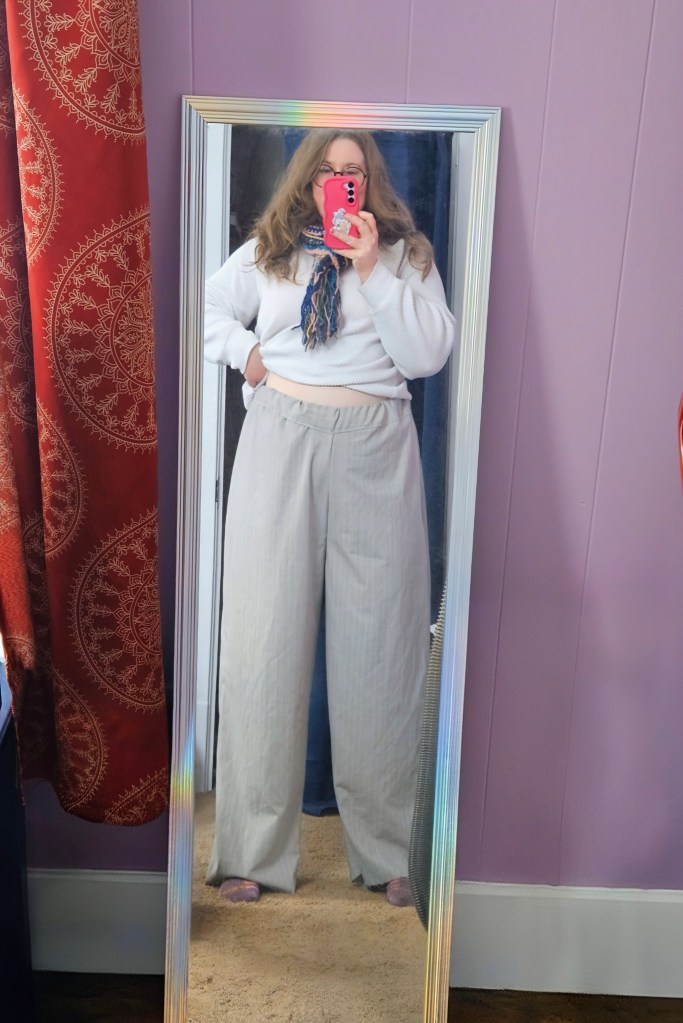
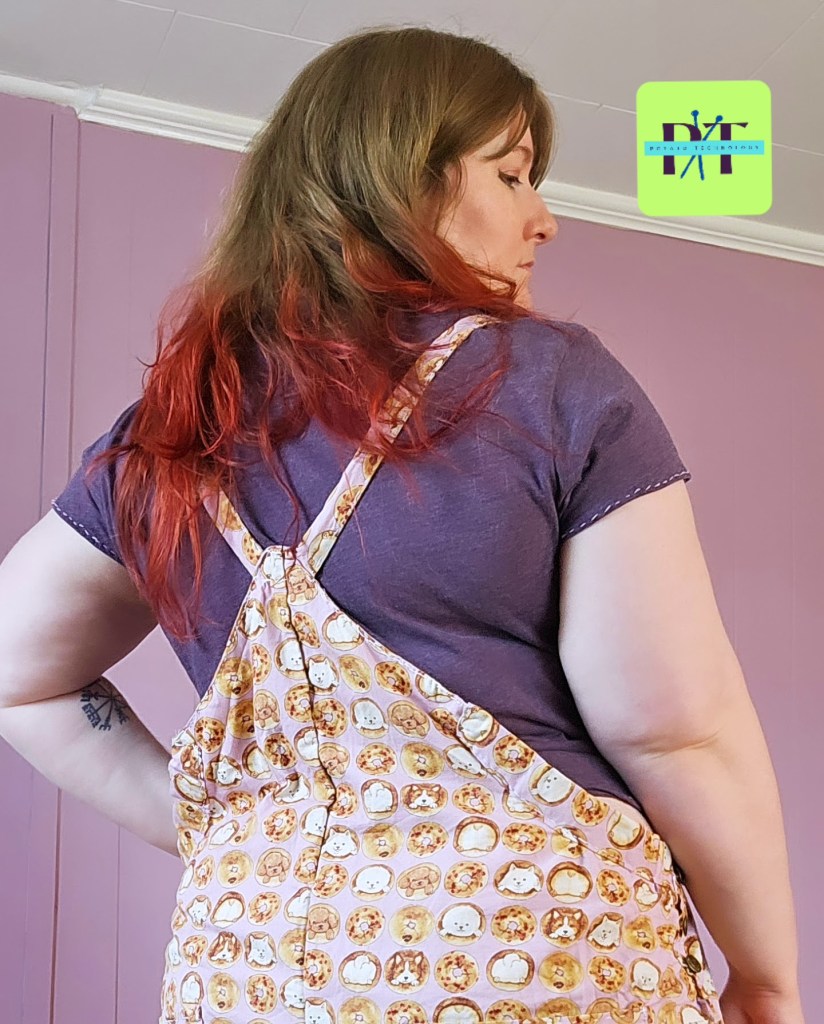
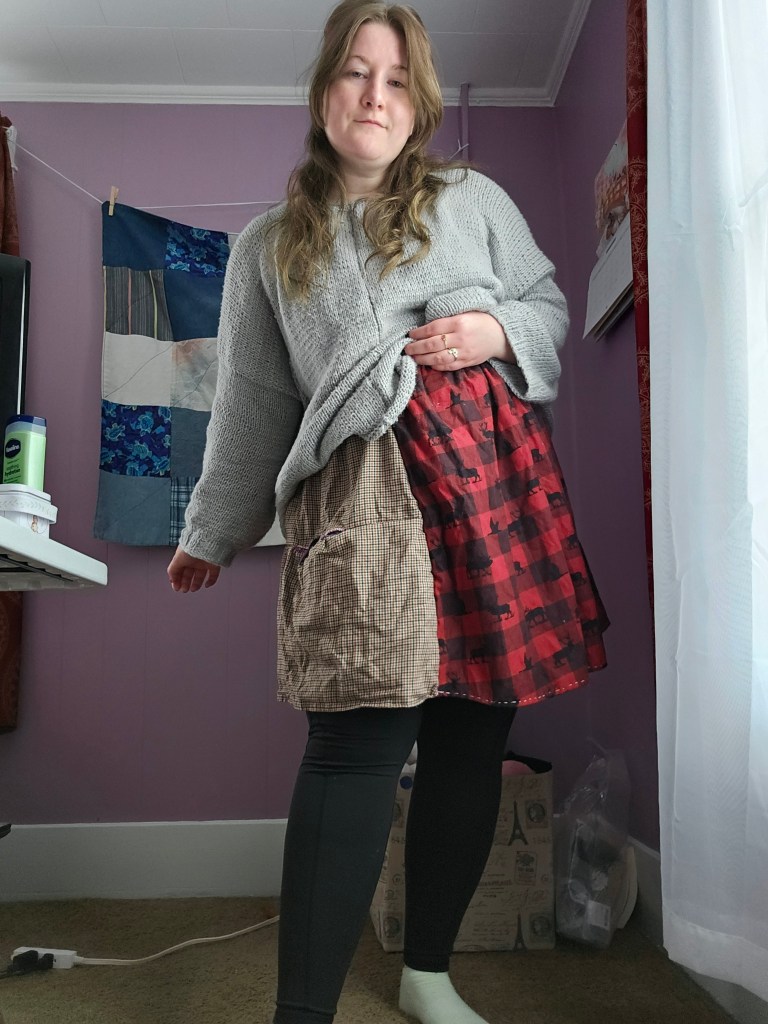
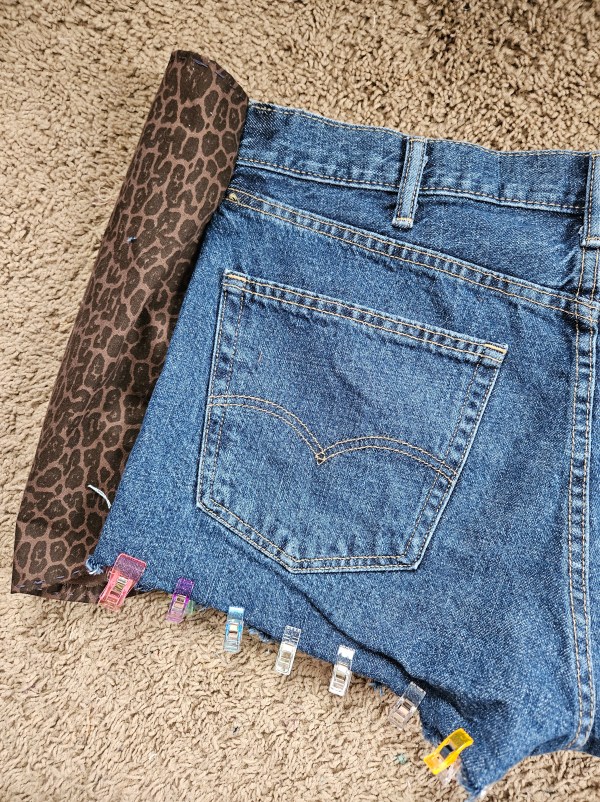
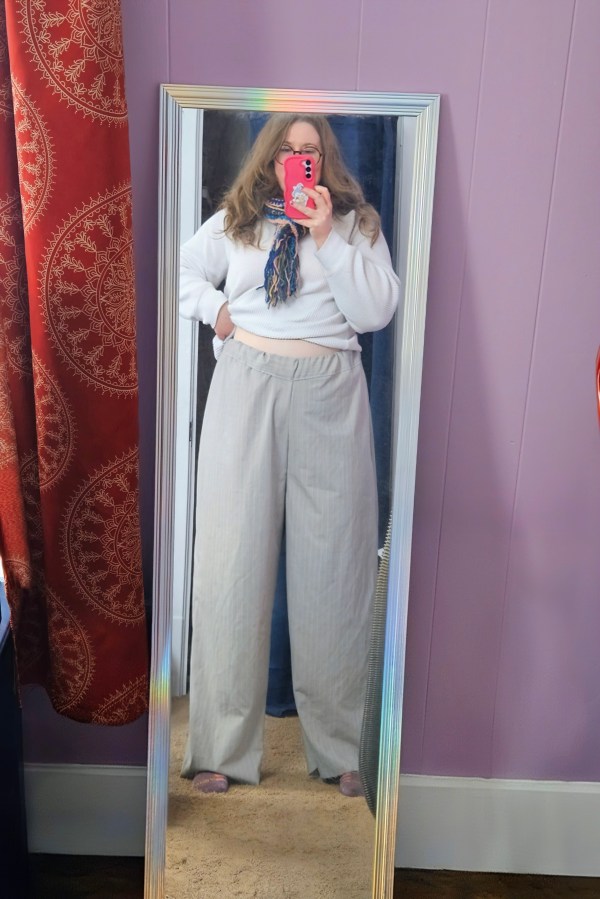
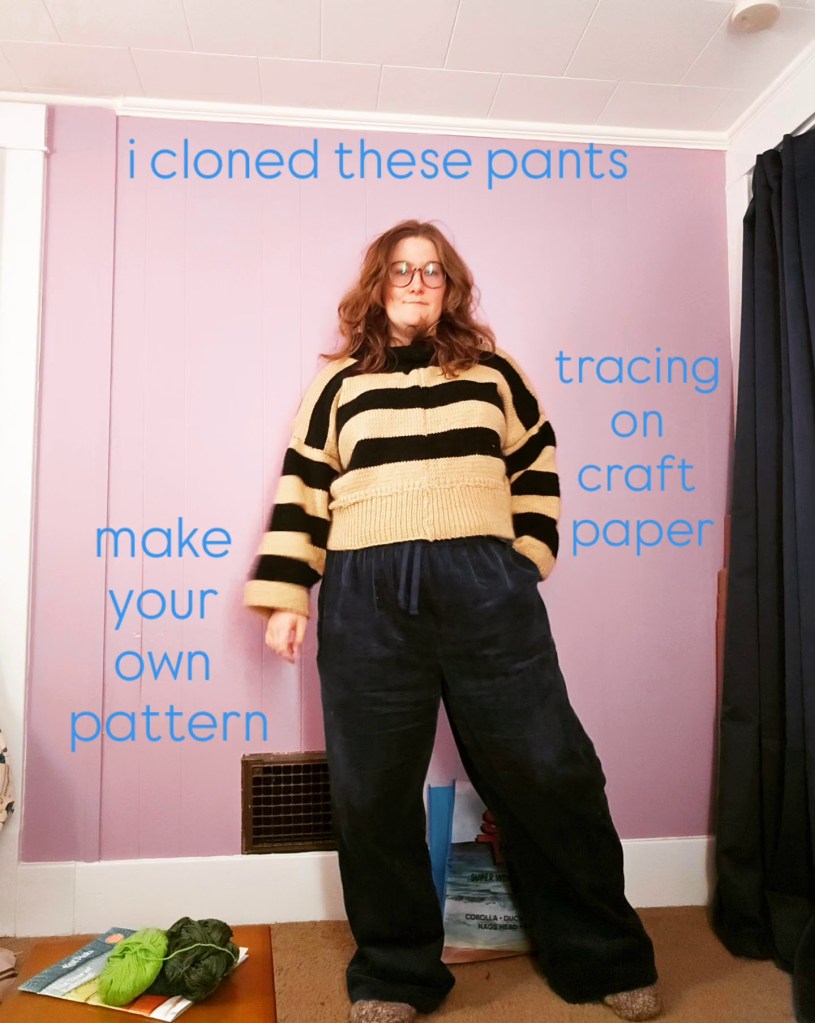
For my birthday, Kyle gave me two garments from Lucy & Yak, something I had dreamed of since 2019. A pair of denim dungarees and a pair of corduroy pants. And you know what I thought of looking at them folded? What a lovely thing to take a pattern from. Use brown craft paper or wrapping paper, and feel free. I traced methodically, marking the seam allowance, and back from the front pattern piece. I carefully laid out my pattern, mirroring the right and left pieces for the front and back. Then, over two weeks, I slowly sewed these pants together by hand with a fresh sewing needle, which makes all the difference. Don’t be cheap like I used to be; buy new needles regularly to save your hands. Sew with courage, because this might be the time it all clicks. What if you never let yourself succeed? That would be more terrible than failing again at doing the hard thing.

I wish you happy sewing and good-fitting pants that make you smile every time you wear them.
Catch of the Day Sweater

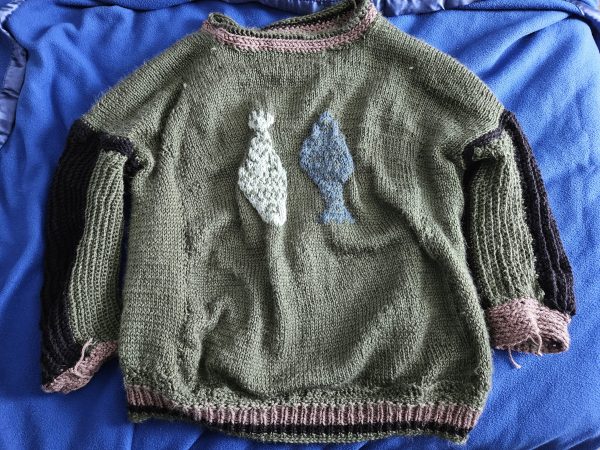
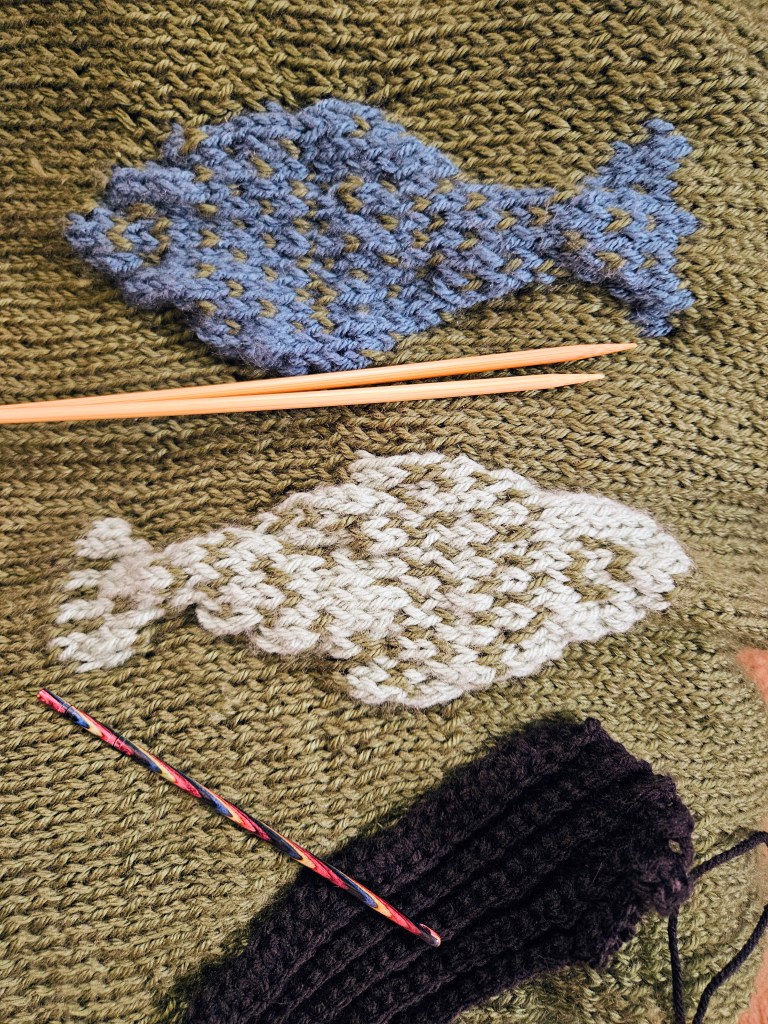
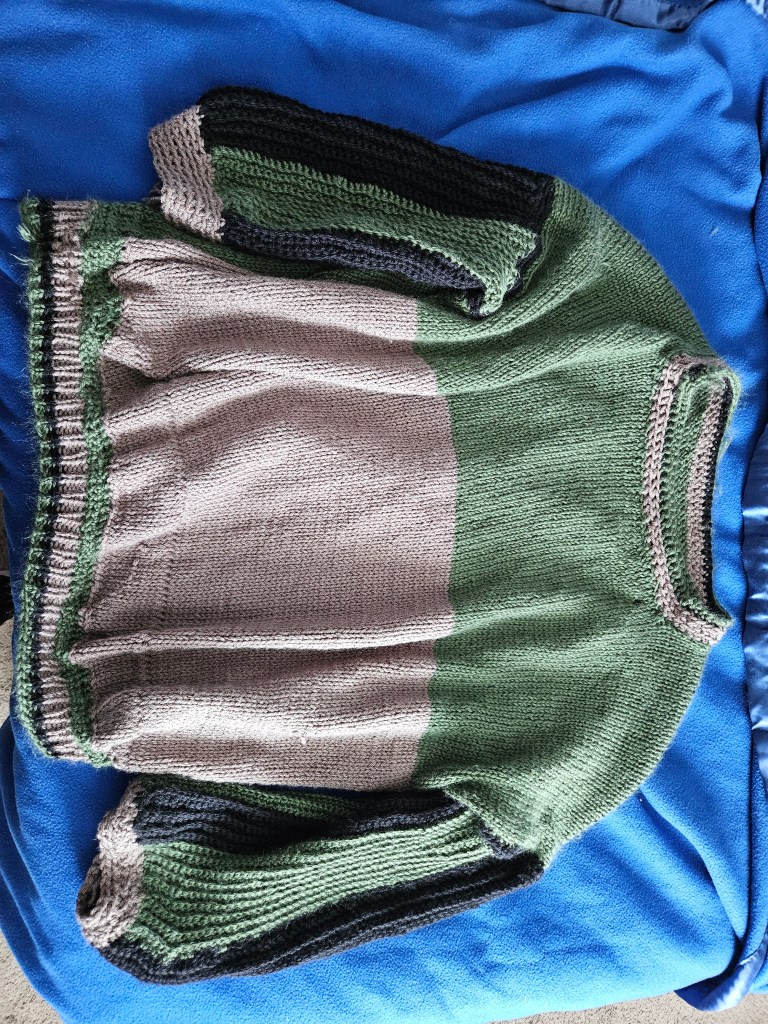
In 2025, sardines and other tinned fish became more than just food; they appeared on beaded bags, shirts, and prints. They also made their way to the fiber arts community, which inspired me to make a fish print sweater for Kyle, who enjoys fishing IRL and in video games. I just like the video game version.

The Design Concept

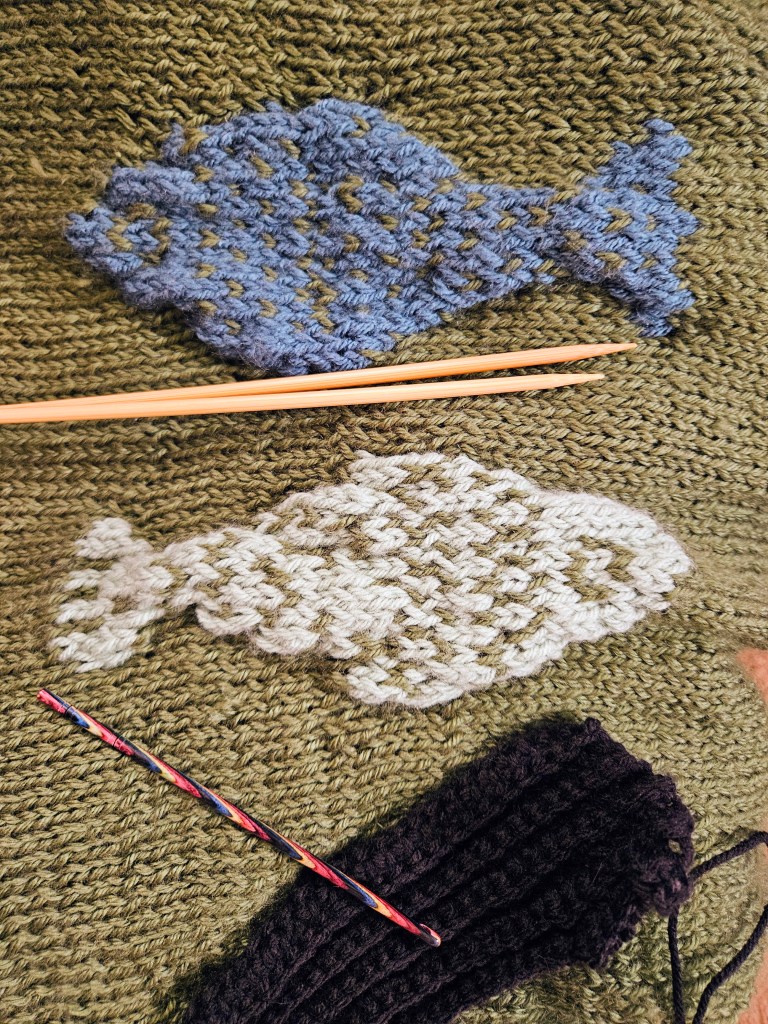
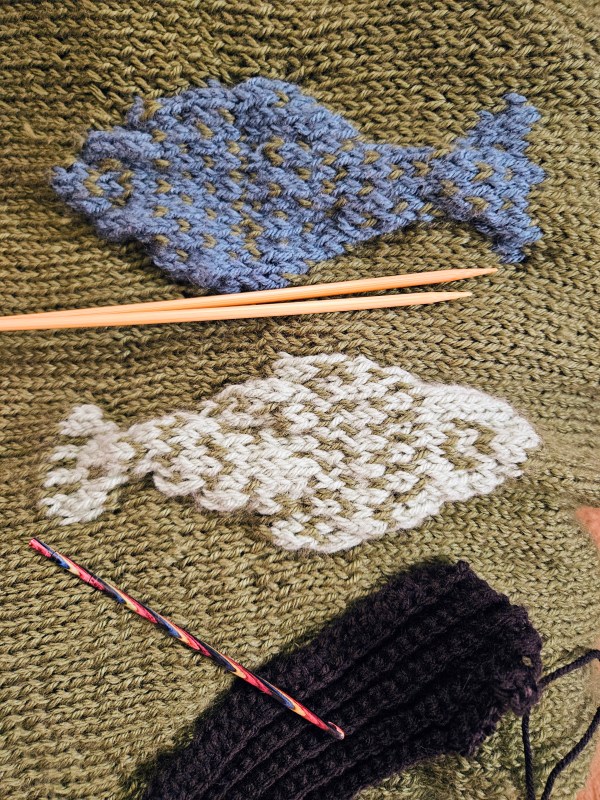
When planning a garment with a colorwork motif, I always consider scale, placement, and repetition. To do this, I use what I learned in art class many years ago – the seven fundamentals of art. So I consider line, shape, color, value, form, texture, and scale. In the catch-of-the-day sweater, it was important to make the fish wearable and to ensure good form and function. How do I make the fish on this sweater make sense? I decided to hang freshly caught fish on the sweater to help with the scale of the art. I placed them in the center, on the front, only to keep the perspective of this in focus. I thought placing more fish would become overwhelming to the eye and become unwearable.

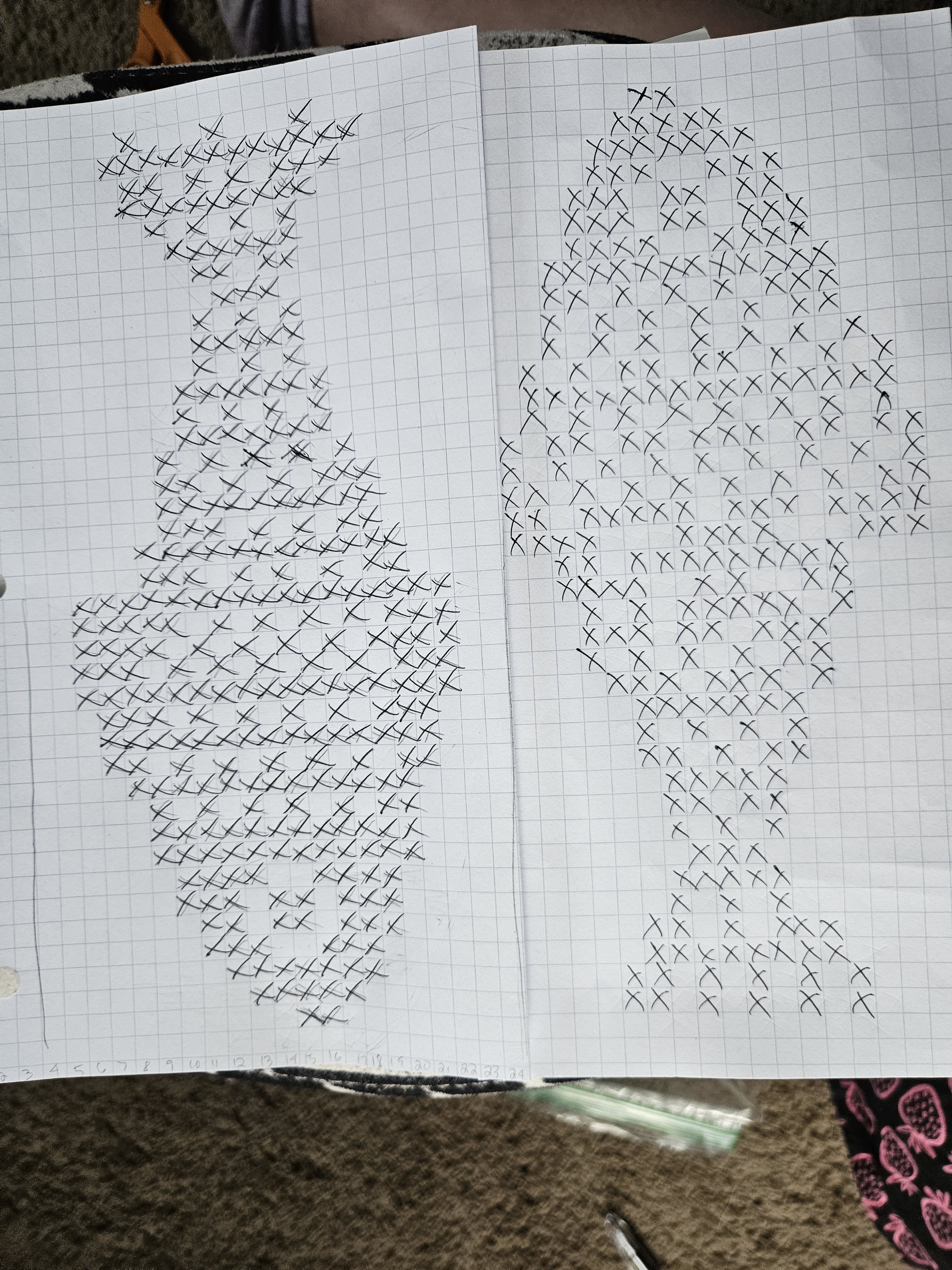
Adding more fish would have required adjusting the scale and the color, meaning I would have simplified the sweater down to two yarn colors only, with sections of fair isle colorwork, which is a smaller, more concentrated technique. But I like the color contrast of using two colors, representing two types of fish with slightly different scale patterns. How big is too big? How do you represent a fish, with their scales and texture? For this, I went to Pinterest to find cross-stitch or knitting colorwork charts for inspiration. I believe I settled on a cross-stitch pattern because it had the detailed lines and scale I was looking for. I wanted the fish to look realistic, although it could be in an imagined world like Animal Crossing New Horizons or Stardew Valley. Whimsical? I think that is the best way to sum it up.

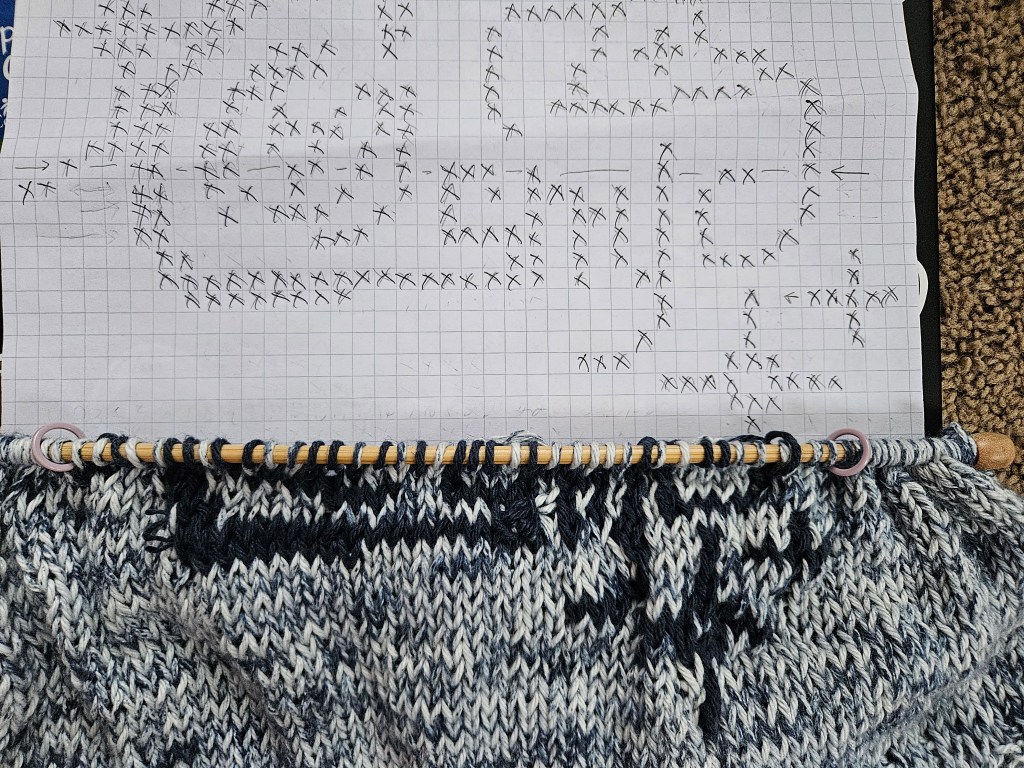
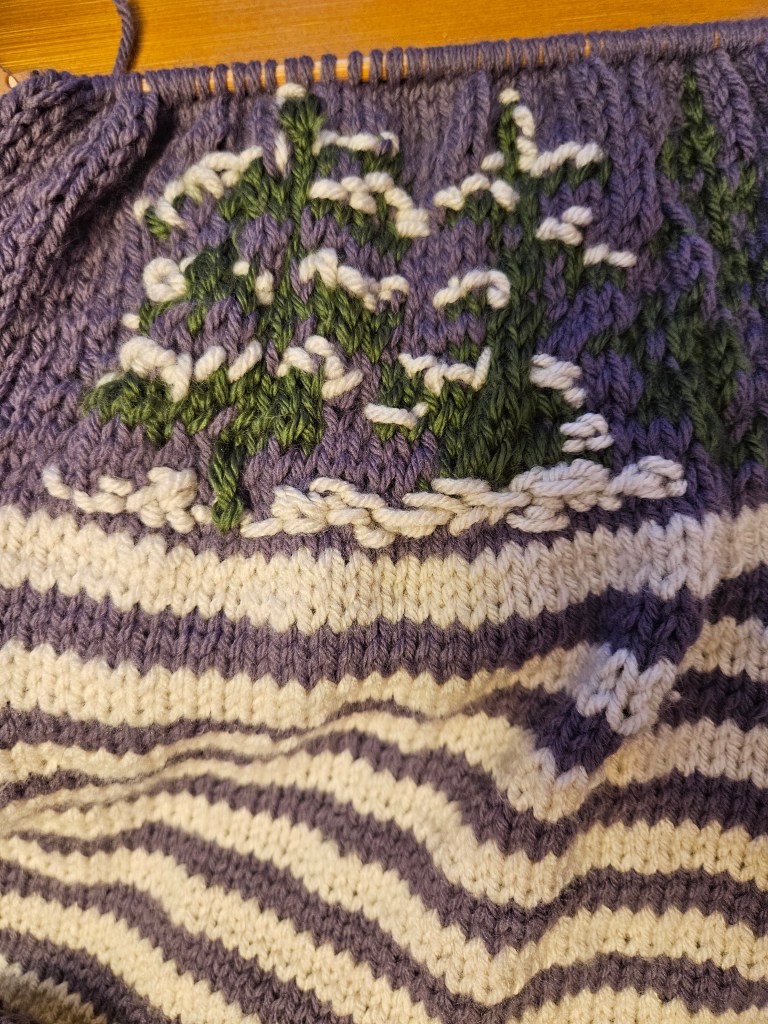
To make my pattern, I used the cross stitch reference and transferred it to graph paper by hand, tweaking some areas to make the inspiration my own. I did this in the same application for my Red Velvet Cosmic Knit Tank project. Next, I needed to determine the scale of the fish within the sweater pattern. It’s important to plan out how many stitches you need to complete the colorwork section across your rows and keep it centered. To do this, subtract the number of stitches in your colorwork pattern from the number of stitches in your row. Divide the sum by two and adjust to keep the stitches on either side equal, to keep the pattern centered. It is also important to note how tall the color work pattern is compared to the garment you are knitting, to allow enough room above and below that the graphic motif makes sense and doesn’t look misplaced on the garment. I think I literally held my pattern up to Kyle’s chest to figure it out.

Fiber Content

For this sweater, I went in a different yarn direction to try something new. I chose a wool and acrylic blend from Knit Picks called Mighty Stitch. It was underwhelming. The yarn, while soft, pills something fierce. It is also a slim worsted weight, which was exaggerated by the large needle size I used – US 10 or 6 mm. This created a breathable, airy sweater, but dang, did it throw off my pattern and design. Eventually, I had to face my fate – I was running out of yarn, and my panel was too narrow. Not exactly the outcome you want after spending a week on the front panel with the intricate fish design. I would rather start over than frog the color work, always.

I had some decisions to make. I originally purchased the Mighty Stitch on sale, but when I ran out of yarn, it was not on sale, and I wasn’t interested in doubling the price of this already too expensive project that was in the process of failing. So like Miss Frizzle recommends, I got ready to “Take chances, make mistakes, get messy!” I went to my closet of yarn and fabric and began to dig through the stash for something else I could introduce into the design. I found a warm-toned gray and neutral black yarn from Big Twist that was also worsted weight. Because the Mighty Stitch is a washable yarn, I felt comfortable combining the two yarns. I had already introduced acrylic yarn to the project through the mint and teal fish, using scrap Big Twist for those sections. Always check your fiber content, though, to avoid incompatible fibers that will make the project hard to care for over time.

Making a Change

The original design was changing from color palette to overall concept. This sweater would need to have color blocking sections now, to stretch the main green color. I decided to not only change up the design, but to change up my technique, opting for crochet on the sleeves to make the sleeves go faster. Knitting is a slow craft, and for some reason, knitted garments for Kyle have this curse of going horribly wrong and also knitting up slowly because of the hiccups. I wanted him to be able to wear this sweater for the bulk of the winter season of 2025-2026, and I was knitting this in August-October, so I took a shortcut. But in my defense, the texture of the sleeves, ironically, looks like fish scales to me. Especially with the gray and black colors!

The second change I made was adding width to the sides of the front panel to make the sweater a drop shoulder. I then knit the back panel wider from the start, and added a section of gray on the middle to upper back panel. It adds a nice contrast to the overall composition of the sweater, while making the sleeves feel cohesive.

Men vs Women Shoulder Shaping

The shoulders gave me such grief in this project! I’m used to making sweaters for myself and my female form. The bust makes the shoulders rest differently than I realized, and this came back to bite me. For a man’s sweater, the back needs to be longer. Especially the shoulder section on the back of the sweater is going to ride up the back, and be too long in the front. This happened, and I was bamboozled on how to fix it. Enter short row shaping and the principles of perspective and scale.

I learned that I needed to add short rows, meaning only working a section across a row to add length to a specific portion of the back panel, the back middle. To do this, you work back and forth on the section, evenually go back to working across the entire row. In addition, I made the back collar and back ribbing longer to compensate. These simple changes made the sweater appear the same length back and front, draping across the shoulders pleasantly, even if one side was technically longer. It doesn’t matter because of the role of perspective. Magic!

Final Thoughts

I learned a tremendous amount of knowledge from the Catch of the Day sweater, and I am grateful it all came together in the end to make a sweater that Kyle enjoys wearing. I have saved my patterns to attempt this again in the future with better yarn and proper dimensions to make the pattern fit well from the start, instead of scrambling to adjust at the end.

DIY K-Pop Band Tees Using Embroidery and Knitting

In 2025, one of my goals was to try my hand at crafting my own K-Pop Merch. Some bands are easy to find Merch for, and others, well, you are left to your own ingenuity. The bands I selected to try for this are NCT 127 and NMIXX, which I have tried and failed to find band tees for that I liked. For this project, I used two different techniques – embroidery and stranded colorwork knitting.

NCT 127 Embroidery

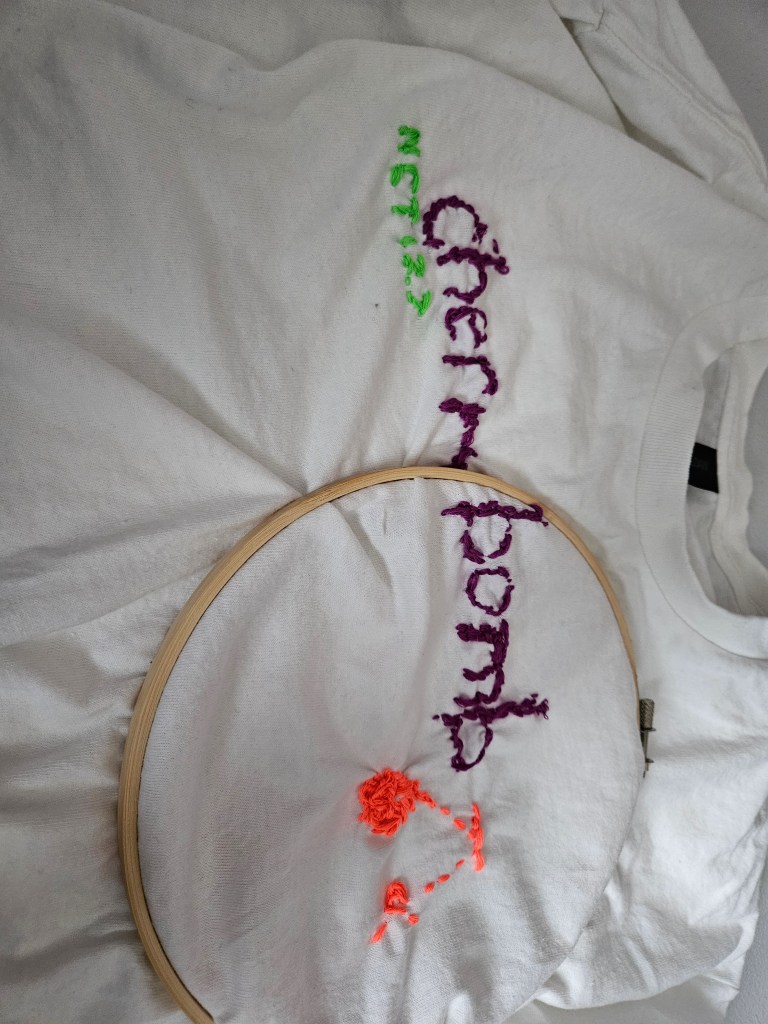
My first idea was to pick up a blank T-shirt from the craft section and get to work. The shirt I chose was a Gildan tee from Walmart, which I DO NOT recommend. This shirt is so freaking thin. Horrible quality compared to the blanks I have found at Michael’s, Dollar General, or even Hobby Lobby. But as I was dubious of my embroidery skills, I went ahead with the Walmart shirt as practice. That was the right call, because dang, embroidery is not as straightforward as it looks.

For this project, you will need: an embroidery hoop, embroidery floss bundles, a marker or pen to sketch your design on your shirt, and backing like embroidery interfacing or a fabric scrap that I used (because I forgot that the embroidery needed a backing).

For the design, I chose something simple. The song, the band, and a little imagery. I love their early album Cherrybomb (2017), but the song is almost 10 years old now, and it’s kinda hard to find any NCT Merch with it at this point. Seemed like the perfect option for a first try. I wasn’t expecting my stitches to be so tight; I felt like I was fighting myself across the whole piece. This was because I forgot about the backing for stability, and all this embroidery on this poor quality shirt, yeah, it wasn’t great. Afterwards, I added a backing to the embroidery with a scrap piece of another t-shirt.

Is it my best work? No. But is it a start for making better projects in the future? Yes! And I wear it anyway in the garden and as a sleep shirt.

Red Velvet Knitting

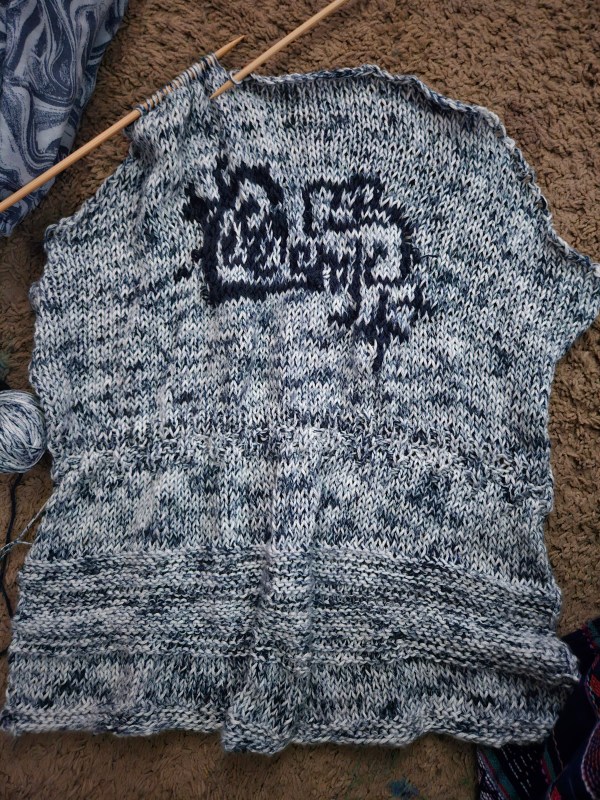
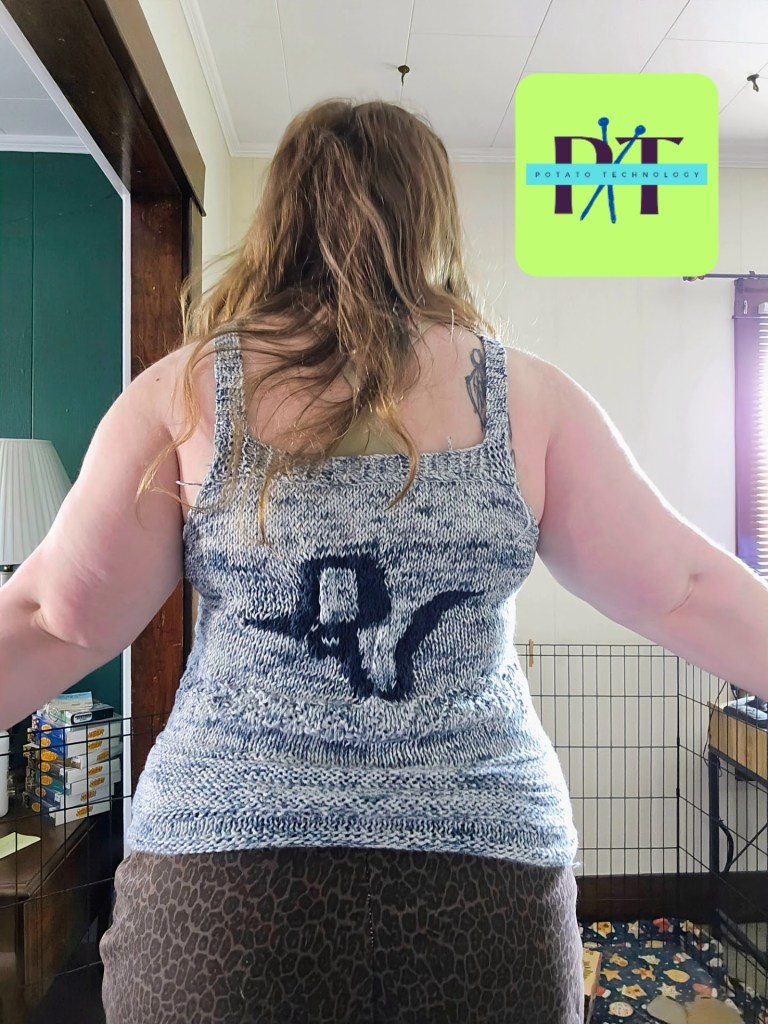
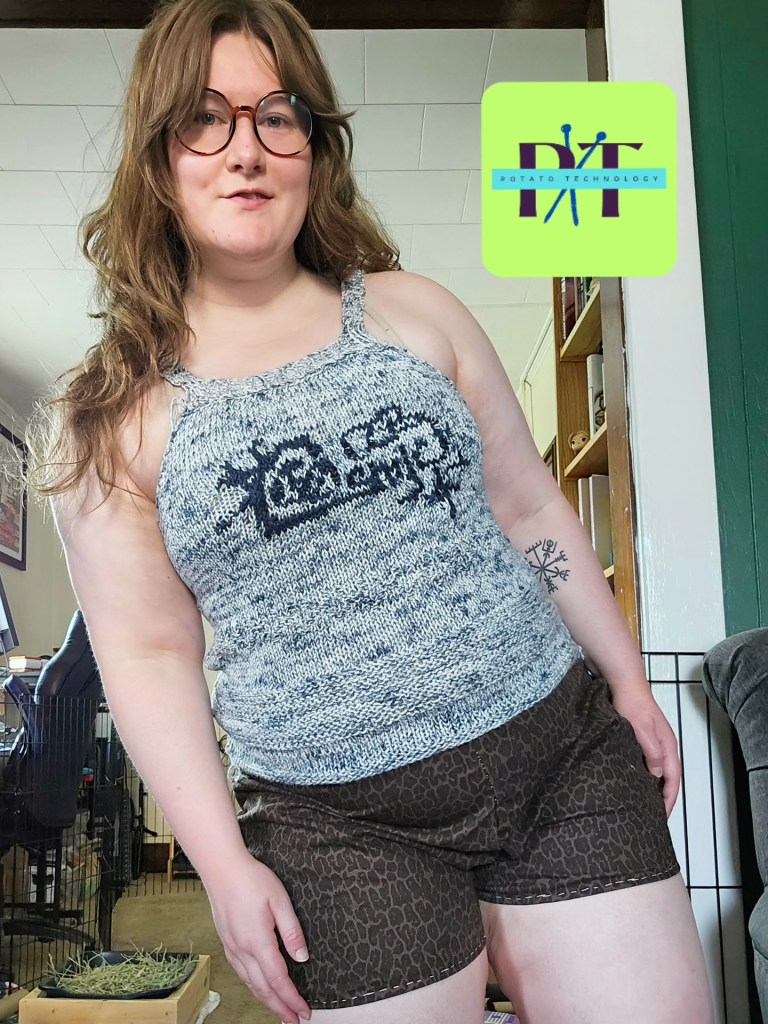
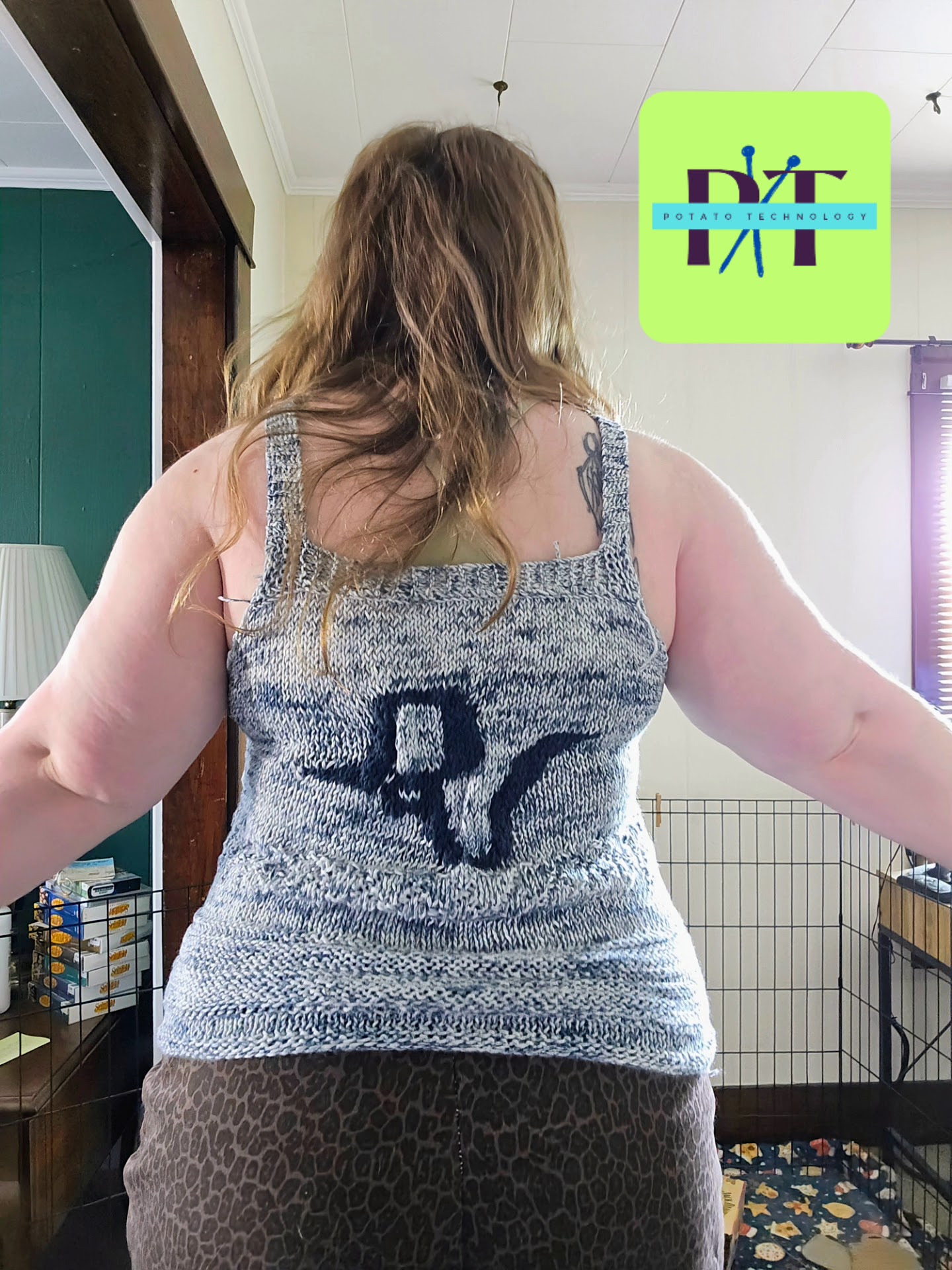
My desire for Red Velvet Merch was entirely motivated by the confusing announcement in April 2025 that members Yeri and Wendy did not renew their contracts with SM Entertainment, but Red Velvet was not disbanding. They have become one of my top girl groups after their release of Cosmic in 2024, so it seemed only appropriate to use the album Cosmic as my muse for a cotton knit tank with stranded colorwork. It’s a bit easier to find Red Velvet Merch on sites like Teepublic, from which I have bought a shirt. This project was more about expressing my love for this album, and I hope that Cosmic will not be their last release as a group.

You will need: a pencil, pen, graph paper, and stitch markers. (Along with your basic knitting supplies – needles, yarn, scissors, tapestry needle)

To start, I searched Pinterest for album artwork and a logo. I found a lot of options to use as a compass for the project, but decided the simplest option would be best. I opted for one color to keep the floats simple. To make my colorwork charts, I always use graph paper and a pencil to be able to adjust the marks that I transfer from the image. Once I am happy with my design, I trace over it in pen and use a pencil to cross out the lines of the pattern as I complete the project to mark my progress. To understand the dimensions of the image as I worked, I also marked the “canvas” with stitch markers. It is also important to note your garment construction and how that relates to your chart. I made this tank knitting bottom up, so I began working on my colorwork from the bottom of the chart.

I am thrilled with how this project turned out! As my first stranded colorwork project with this complex of a design, it was far easier than I thought to complete. You just have to plan out your image and be patient with your floats. Try not to hold too tightly and remember that blocking will help the tension relax.

Bat Ear Beanie

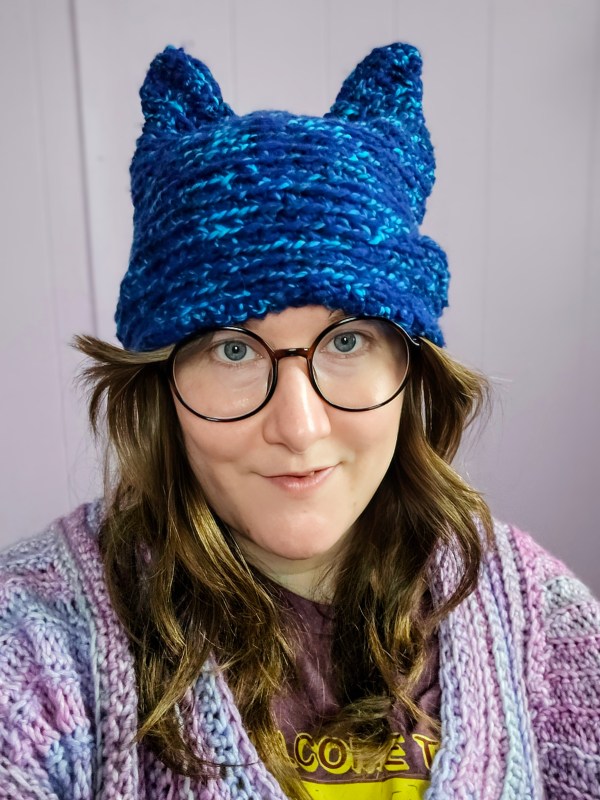
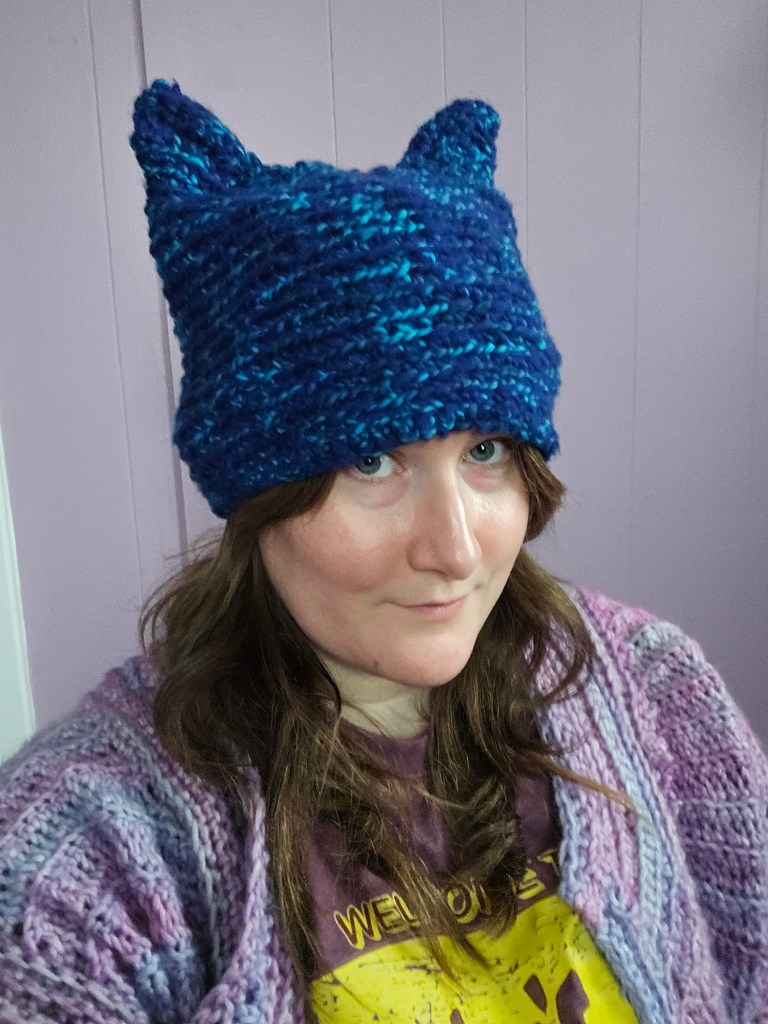
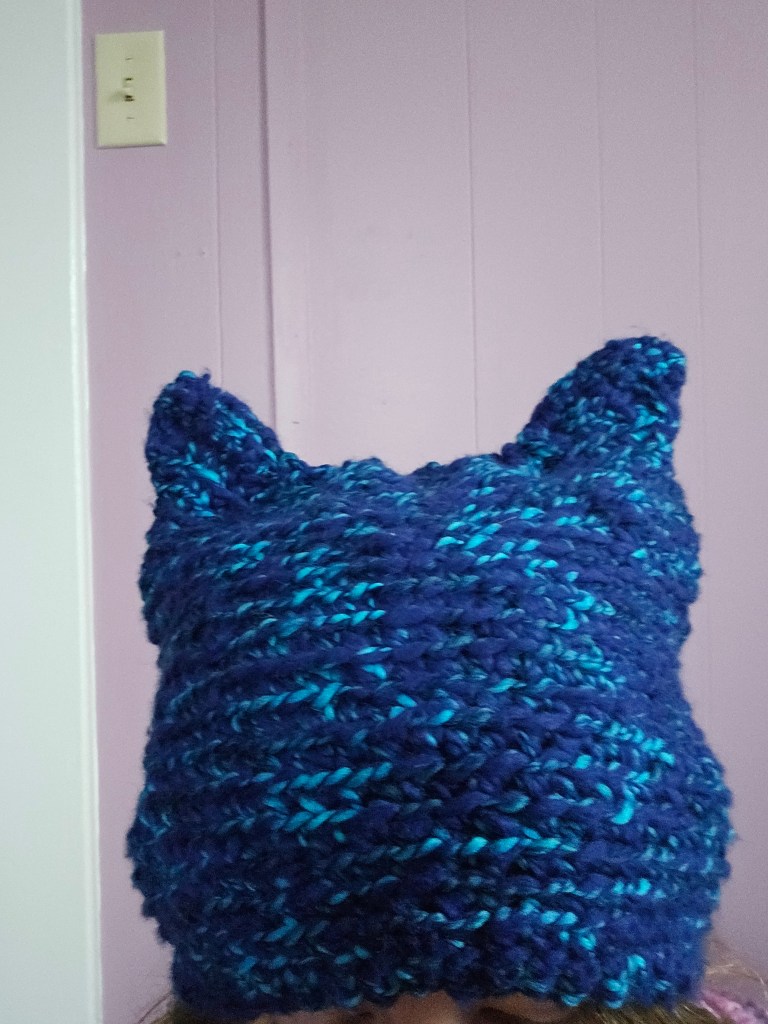
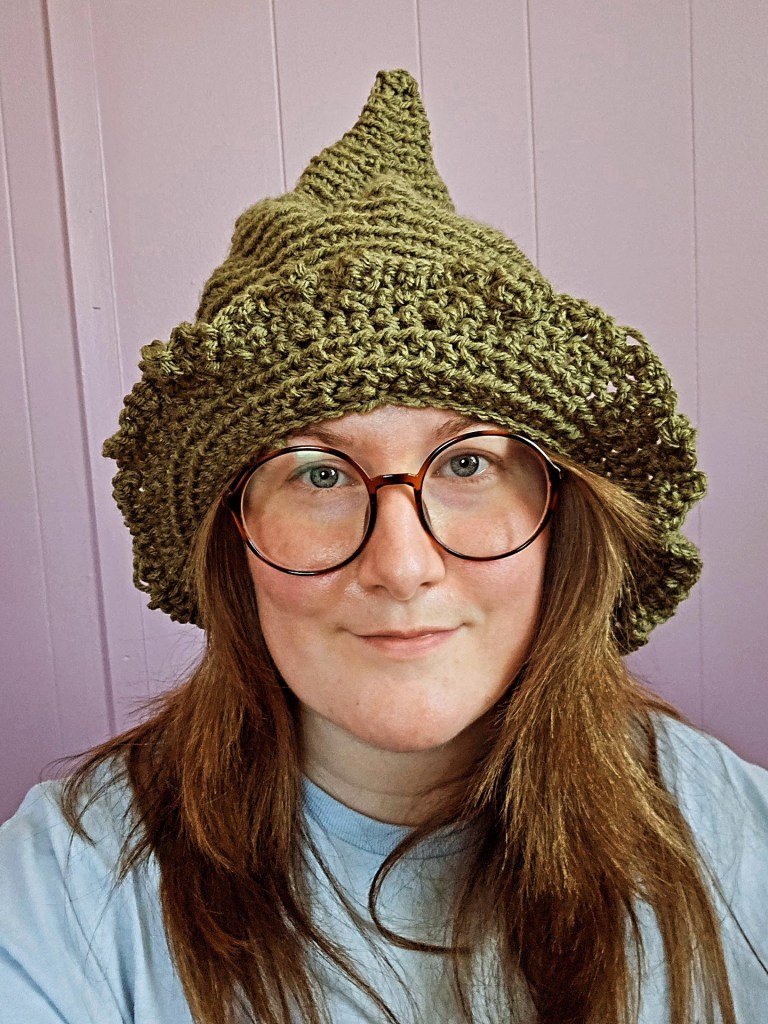
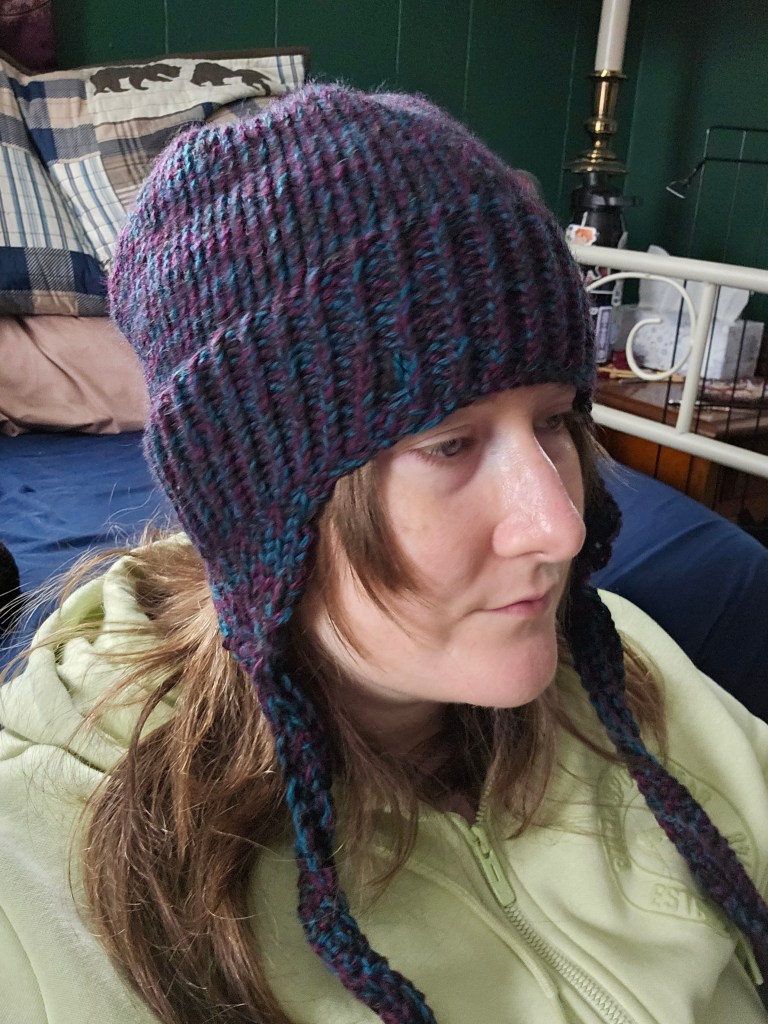
I’ve shared several animal ear projects on the blog before, the Cat Ear Beanie, and my Loverboy re-creation Bunny Hat, but now, without further ado, may I present the Bat Ear Beanie! This was made with less than 100 grams of local spun wool I found at my farmer’s market, held double with less than 100 grams of Knit Picks Snuggle Puff yarn in Neptune. I decided to crochet this hat instead of knitting, as I did with previous projects, to have a bit more freedom in the creation. Crochet reminds me of sculpture or papier-mache. You can always add onto the stitches in ways that the tension of knit stitches does not allow, and for that, the bat ear project seemed like a great place to practice my crochet technique once again.

The hat was crocheted in the round – so much easier than knitting in the round, in my opinion, with double crochet stitches, and was knit like a normal hat. I don’t have an exact pattern for it, but you can easily make it to your measurements. The yarn I used, one strand Snuggle Puff, a heavy worsted, and one strand local wool, a DK weight, resulted in an Aran/Bulky-weight yarn. Because of this, I used a 5.5 mm hook to create my stitches. I chained the number of stitches I needed based on my head measurement and double crocheted around and around until the hat was long enough to cover my ears and most of my head, then I began my decreases. I wanted a gradual curve shape for the crown of this hat. Go slow, and remember, you can always frog and try again if the shape is not what you want. After the hat was complete, I plotted my bat ears.

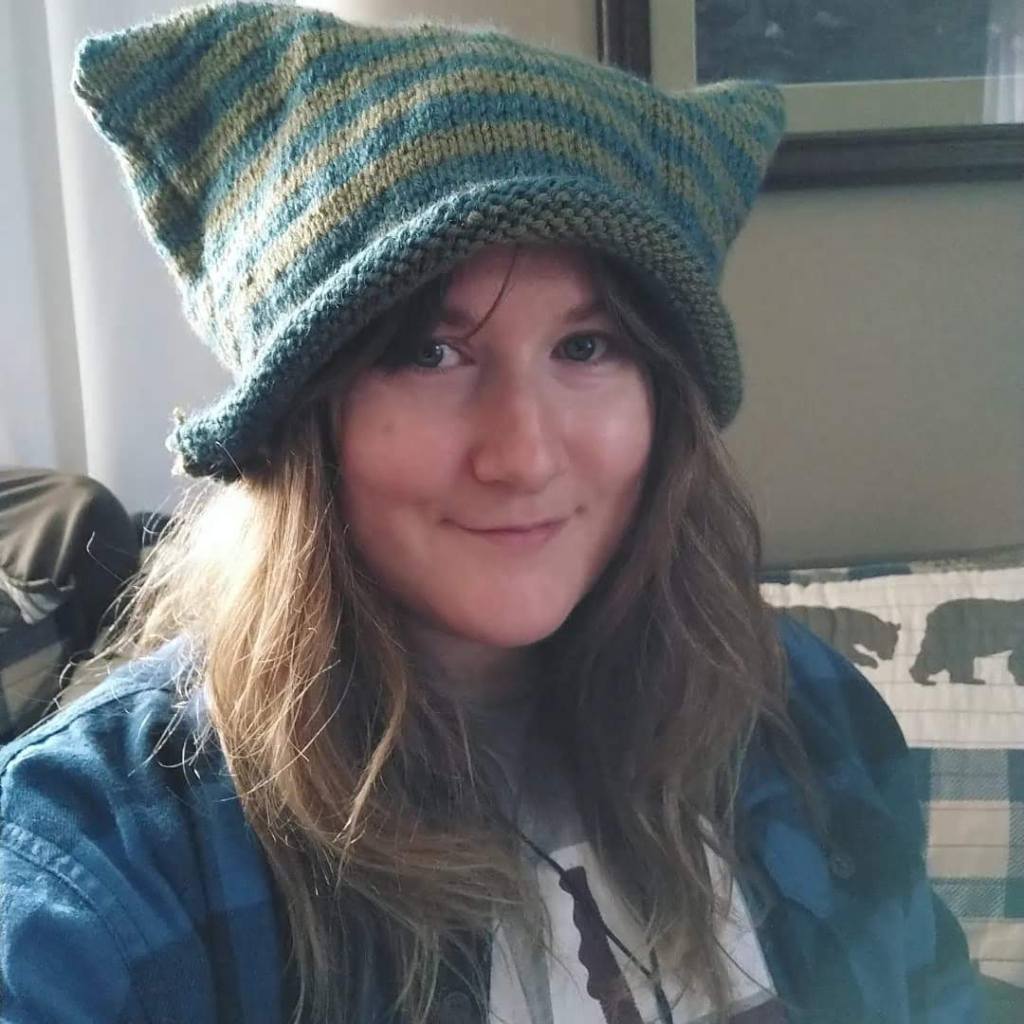
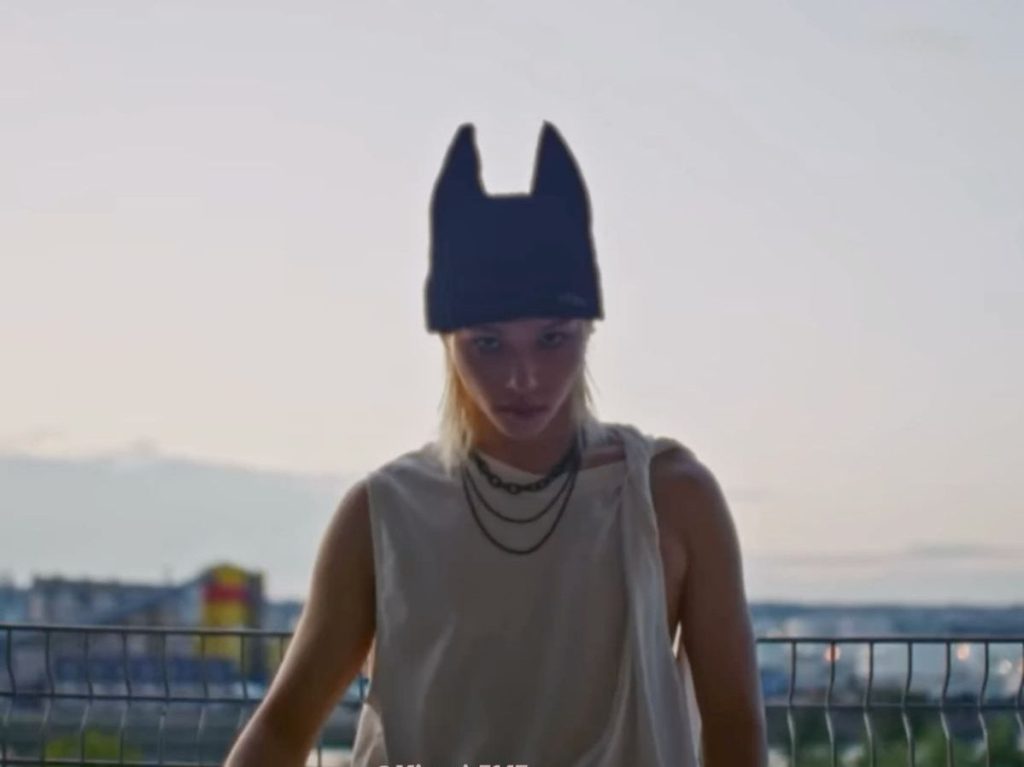
What makes an animal hat special to me is the scale and placement. What I learned with my cat ear beanie was that you can make the ears too wide and too big, leading to a sloppy effect. With the bunny hat, I learned you can put them too close together, not allowing the ears to drape properly. The effect can change the entire character of the piece, so place your ears with care and think about how you want to wear it on your head so that the animal cuteness is achieved. For this hat, I was inspired by the hat Felix from Stray Kids wears at the beginning of the Creed music video from 2025.

I began my bat ears by picking up stitches on the outside of the hat. I also crocheted these in a round, to give these good structure. By crocheting these in a round, to keep the tension even across the ears, so that they would stay upward like a bat. I used single crochet stitches and tapered the ears accordingly, simply weaving in the end to the inside of the hat, with a tapestry needle.

Why did I choose a bat? To raise awareness for bats. Did you know that bats are not a nuisance, but an essential part of the ecosystem? But due to misunderstanding the nocturnal animal, mainly I would say due to vampire lore, they are seen as dangerous. Yes, they can carry rabies like many wild animals, but this is not a reason for the animal to go extinct. Their habitats are under threat, and they deserve the space to thrive. They eat pests, contribute to the pollination process, and help spread seeds.

Unrelatabilty and 2025 Holiday Campaigns

I had plans originally to write about Ralph Lauren Christmas on its own, but then I saw two advertisements, one from local brand Steel City and another from Banana Republic, so bizarre that I knew I would be here. Hopefully not ranting too much, for the goal of this discussion for me is to think more deeply about the subtle oddities in my culture, I see weaving themselves in, like they are normal. Overconsumption, cultural appropriation, and the cosplay of wealth.

Banana Republic’s Holiday Edit

So what does fippery have to do with it? Fippery is another word for ostentatious; it’s showy. Frivility in dress or style. I also find the attitudes of these two brands, and I do want to write about exactly that. Banana Republic has always been in my mind, a bit ridiculous. But with every re-watch of Seinfeld, I see J. Peterman in Banana Republic’s threads, but their recent holiday commercial pushed me over the edge. They are that nonsense.

The holiday commercial is set in Ireland, County Cork, and I know I haven’t been to Ireland in 20 years, but dang, nothing about this commercial felt authentic. They play a cover of “Linger” from the Cranberries over the holiday scene in a pub, wandering around the town, finding a telephone booth with Irish Gaelic on the sign. They are all wearing vaguely Irish clothing, but really it looks like cast walked through a Premium Outlets on their way to Castletownshend, Cork. There are lovely Irish Christmas songs and many other songs by Irish bands that would have captured the spirit of the season better than a breakup song. No shade to the Cranberries, I love them. There were better Cranberries songs to pick. Personally, I would have looked at Dreams, Ode to My Family, and I Can’t Be With You to capture the nostalgia of the season with a non-traditional song.
Moving beyond the music, there was nothing really Irish about this ad. We barely see the town, we barely see the people, or the ancient beauty of Ireland. Think about movies such a Waking Ned Devine or Banshees of Inisherin – the landscape is a character, so is the music, and community. Ireland felt warm, not in temperature, but in the warmth of the people. The land feels like there is magic just under the surface, an imagination unbreakable, and a spirit that carries the culmination of all those who came before in an essence that makes you want to know more. The sweaters are intricate, made with the intention of preserving heritage crafts. Just take a look at Banana Republic’s holiday page compared to Blarney Woolen Mills, which is based in County Cork! The source material was right there. I guess what I am trying to say is obvious: Banana Republic’s collection is the fast fashion version of Irish style, don’t fall for it, no matter how they try to sell you on the “luxury” of it all. Now, what really bugged me about this ad was, in my opinion, the cultural appropriation of it all.

There is a fairisle sweater in this Irish collection, which is actually a Scottish heritage craft from the Shetlands. This sweater contains wool from Italy, being sold as an Irish-inspired sweater. You couldn’t even use Irish wool? Or include iconic Aran sweaters? Fisherman sweaters like the iconic one from When Harry Met Sally? The Donegal Wool sweater and sweater vest, straight up annoy me because these are again Italian wool. There is a wonderful mill in Donegal called McNutt that could have supplied true, authentic craftsmanship. We still have our clothing pieces from this store and Blarney Woolen Mills, 20 years later. I don’t like Ireland, which has been used for centuries, been the butt of the joke for centuries, being used again to peddle some lackluster clothes.

Gap, Inc. is a huge brand; they should have invested in sustainable Irish materials and supported the local Irish economy by using Irish craftspeople to create this collection. But just like J. Peterman, they come and see, then they steal other cultures’ designs to make a quick buck from subpar clothing. Look at the prices! The Banana Republic sweaters, made in Italy with Italian wool, versus the Blarney Woolen Mills sweaters made in Ireland from Irish wool, both made from merino wool, too. Local is better. Also, look at the craftsmanship of the Blarney sweaters; those cables are stunning and also affordable. Shame on you, Gap!

Steel City, What Are You Doing?

Actually, to quote the Big Fat Quiz Show, “You slag!” Steel City is a brand no one outside of the Pittsburgh area will know about, and that’s okay. Small businesses are great, and when this brand first started, they were cool. Their claim to fame was hyper-local graphic tees of beloved cultural things such as Turners Tea, the Stillers (aka the Steelers), Kennywood, Mr. Rogers, the Pens (Pittsburgh Penguins), and nostalgia. Over time, though they have expanded, which is great, creeping out to the suburbs of Cranberry and Ross Park Mall, and that is where things have taken a bizarre turn. In 2022, I went to their location in Cranberry Township and was appalled by how tissue-paper-thin the new items were. We had bought pierogi and Potato Patch shirts, which were of great quality, but the new stuff was off. The prices, quite higher than before, and I was no longer interested in their stuff.

But as targeted ads go, I keep seeing their stuff everywhere, and it has gone in some random places. There was a motorcycle and a desert aesthetic to their pieces now? Okay, odd. Neither of these things has anything to do with Pittsburgh. I guess the name is the only connection? Next, I got ads for quiet luxury workwear pieces, the local graphic tees, now behind a t-shirt club paywall. It felt soulless, and I was incredibly disappointed. I thought in the beginning maybe they were going to make the items in Pittsburgh, but they are made overseas. This morning, though, I got an ad that straight up felt out of touch.

Seriously? In this economy? With the amount of destruction the fashion industry creates on our planet? Honestly, Steel City, what the flipping heck are you doing? This brand is neither relatable nor cool anymore. Wasteful consumption is not in style, no matter what the internet says.

Ralph Lauren Christmas

Now, Ralph Lauren isn’t promoting this; this is just a TikTok trend, and I just wanted to drop my two cents. I’ve spent the last five years chasing the nostalgia of old Christmas, Christmas before everything hurt. Before people died. When I was a kid, things were simple. No matter how much you spend, decorate, chase – this aesthetic is not going to fix what is broken in your heart. I encourage you to seek out authenticity this Christmas. Volunteer time at shelters, donate supplies, check on neighbors. Call those friends or those family members you haven’t seen in so long and connect once again. The Home Alone house is stunning, but remember, what brings the true Christmas spirit is the relationships reconciled for the Old Man and Kevin on Christmas morning. People over things, always.

What If Game of Wool Celebrated Design and Craftsmanship?

If you missed it, I made a Game of Wool Bingo card for episodes 1-3, because in my opinion, this show should not be taken seriously. I’ve given up watching, interacting with recaps, etc. I’m not going to watch beyond episode 3, and that is because hate-watching is validation in the attention economy of 2025. That got me thinking, what do I wish Game of Wool was instead of what it is? Game of Wool, just like Project Runway, I have notes!

No Kits or Internet Dressing Projects

I don’t want any themed-making kits sold per episode. They have been doing this for the episodes I have watched, each week partnering with a big yarn company, honestly making kits that serve no purpose other than a cash grab. I also don’t want to watch weekly episodes with challenges that create useless items. Useless from a practical and technical standpoint.

  • Crochet and knit swimwear is dumb. You can’t wear it other than for a photo shoot, which places it in the “internet dressing” category. It’s for a photo. It’s not even practical for a music festival. But it does resemble a “Coachella” look.
  • A crochet deck chair had potential, but it was not used within the materials provided or the time frame.
  • A dog sweater with a required hat is not kind or practical for dogs. The sweater is comfortable, but the hat is not comfortable for the dog. Again, it is for a photo. Washability was not discussed either.
  • The mohair sweater was the only challenge that was the closest to being a useful challenge, for design teamwork and wearability, but they ruined it with the ridiculous time frame.
  • A couch cover is useless, because I have thought about constructing one for my own couch to stash bust, but it’s just not practical for anything other than a showpiece. Which is how they judged it, so a lot of wool was wasted to make a big, useless swath of fabric.
  • The fair isle vest misrepresented a heritage craft of the region they were filming in. Why not just film a historical film set in the Renaissance, and put the actresses in Victorian corsets without a chemise, tight-laced? Same level of idiocy to be flashy!

This Game of Wool presents everything that late-stage capitalism is in relation to crafting and hobbies, thanks to greed, social media, and the attention economy. The British farmers could use the income; how about sourcing locally? What about sustainability and slow fashion? Yeah, 12-hour challenges do not represent anything but hustle culture. Girl boss, slay!

How Would I Fix It?

  • Real experts, not these two ladies.
  • Either all amateurs or all expert contestants. Pick a lane. Either be the Bake-Off or be Project Runway and offer a CFDA mentorship kind of prize.
  • Bring in a real mentor to help in the wool barn.
  • Take them on field trips to see wool being processed, dyed, and spun. Same with flax for linen.
  • Tell the story of why textiles matter and why fair trade for the animals, farmers, and ethical standards matter.
  • Explain why local matters for the economy and the ecology of the region.
  • Teach the history of cottage industries.
  • Teach the history of how knitting has changed the world, such as the development of textile machinery and the creation of the binary code. Essentially, fill in the gap of what Sci Show failed to do.
  • Set real challenges that teach, showcase the skill of the fiber artists, and show innovation.
  • Do a challenge that involves unravelling sweaters for yarn and teach the world about this amazing, sustainable possibility.
  • Task the fiber artists to design patterns, and explore what goes into design and proper pattern writing, because it is a technical skill.
  • Make things that will be auctioned off for charity.
  • Bring in people as guest judges who will bring professional connections and opportunities for the fiber artists.
  • Set realistic deadlines, and slow down the pace of the show. Follow a timeline like Mind of a Chef that explores moments of cooking over an entire season.
  • Let the makers make, unencumbered by the pace of the internet. Take note from Bernadette Banner and other makers out there that celebrate true craftsmanship and sustainability in the heyday of microplastics.

I’m tired of this show discounting a skill that has been tossed aside as a Grandma hobby since the Industrial Revolution. In these weird and wacky times, slow fashion and an appreciation of craftsmanship are in short supply in the media. This show had such potential! But they are truly chasing the money over integrity.

It’s Okay to Admit You Don’t Like It

A place I didn’t expect to reach this year, was the mental head space of dislike for a dream I’ve had for most of my life. Now could it be burnout and I just need a break? Probably. But I also think it might a healthy thing to acknowledge something you thought you would love, may not actually bring you joy as you wished.

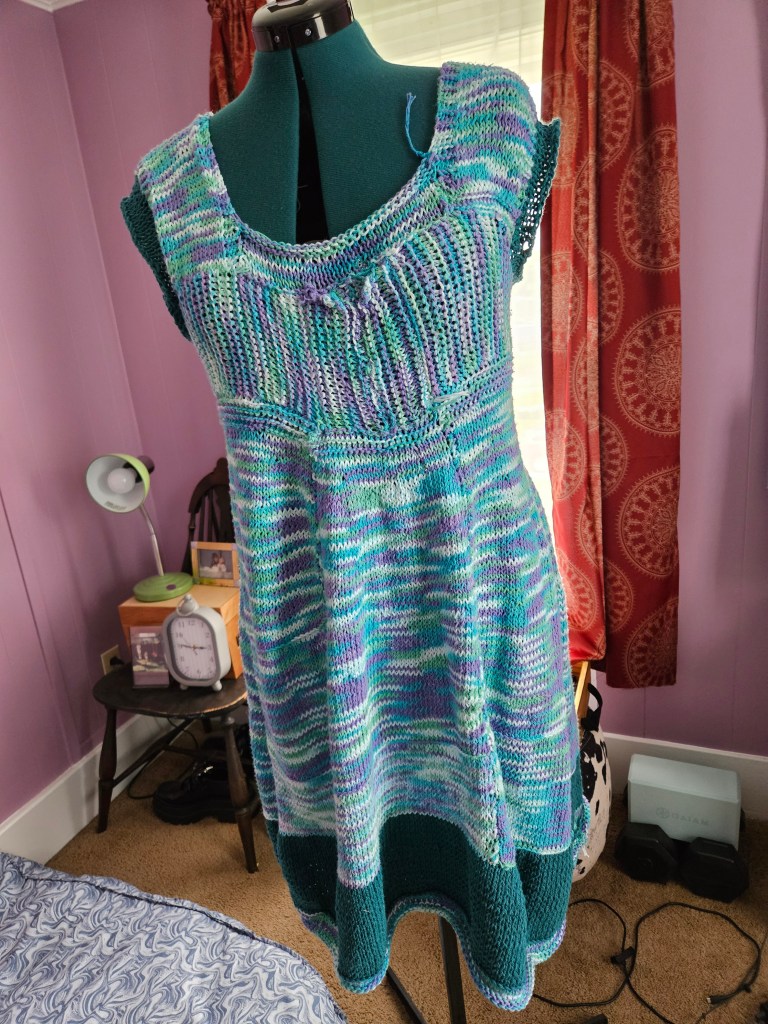
What am I talking about? Sewing. I don’t like sewing as much as I want to. It is tedious, extremely complicated, and requires a level of patience I lack. I’ve been a sewist for 5 years now. I devoted a large amount of my time over the past five years to the study of garment construction, and I realized that it is not my medium, yarn is, and its not a failure to admit I don’t like sewing as much as knitting and crochet.

I think I have known this for about a year, yet refused to verbalize my feeling because it felt like I failed the one thing I always wanted to do. But why is that a failure?

Just because it’s not my passion, doesn’t mean I am going to stop sewing. I think having this space to put less pressure on it to be “my thing” could make me enjoy it more!

Because then I am free to create, to fail, to be a slow learner, to take breaks from sewing when I am ready to cry. I don’t have to feel pressured to get my skills up to par for selling my work. I don’t have to feel pressure to design my own patterns or build a business on sewing. I can go back to basics of what has always been at my core – art. I am an artist, I don’t set out to be, but I know its there inside me too afraid to commit to the bit.

I love what sewing brings me. It’s a fantastic skill to have. I can design my own clothing made to measure and that is luxurious even if my sewing skills are mid.

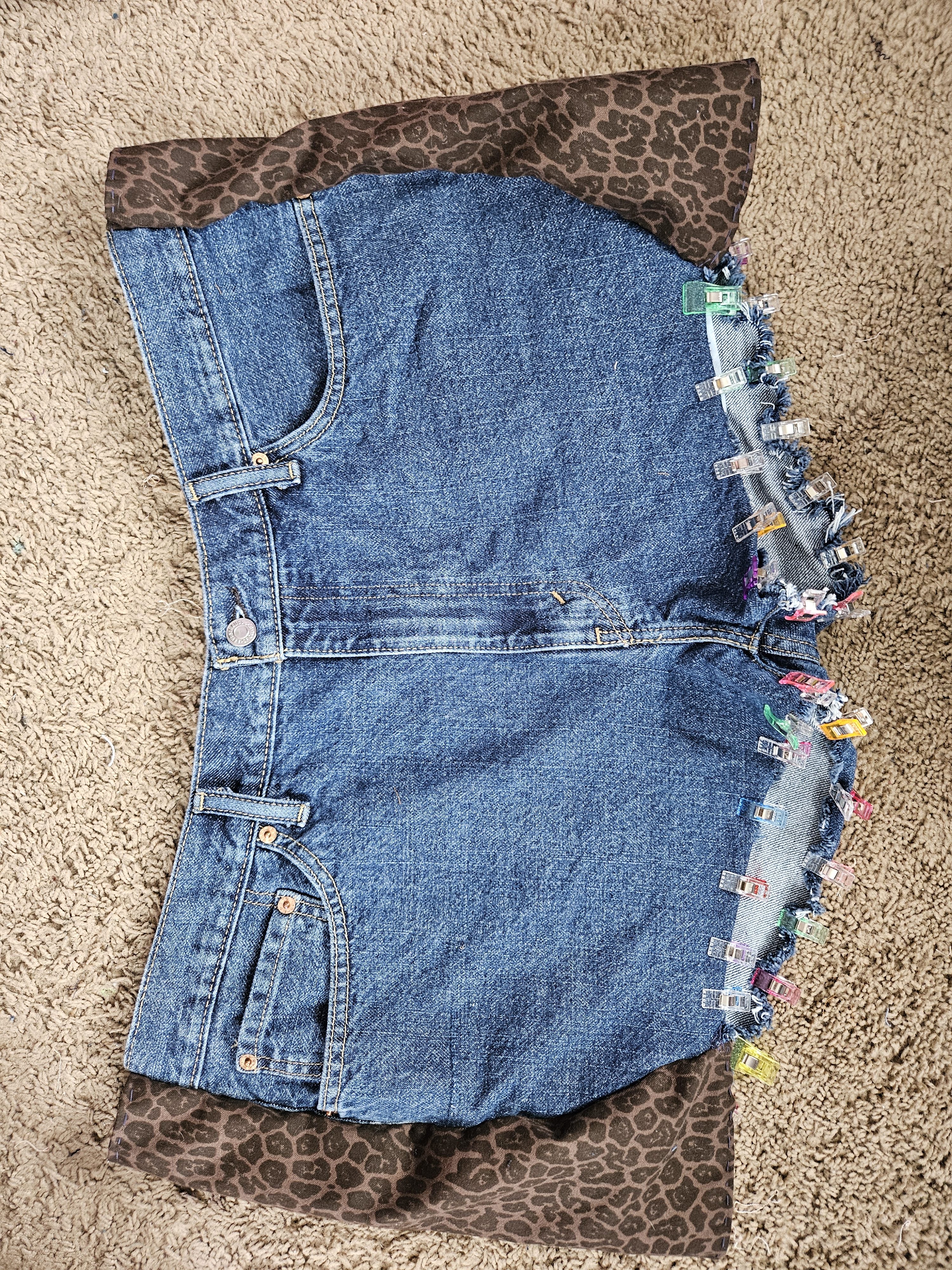
I can experiement with my style through upcycling. I love how I can recycle and repurpose fabric instead of donating. That is a important part of comsumption. We buy and buy but don’t think about the life cycle of the garment, but with needle and thread you can leave the buy and declutter cycle.

Sewing has taught me to be a wiser comsumer as well. I buy garments that I can’t sew. Complex garments. I also price compare fabric against pieces in store to figure out what is more cost effective to sew. Such as buying a 6.99/yard, one yard cut of cotton jersey to make one long sleeve basic tee. You can buy these from retailers for 35 USD compared to sewing one for 7 USD.

It’s not always cheaper, but sometimes it is and that is a huge win!

Finally, by allowing myself to feel these feelings, my hope is that I will be free to explore and create unencombered by goals of monetizing my hobby, instead that I enjoy the creative process again.

Have you ever tried sewing? Did you find it challenging?

Create a website or blog at WordPress.com

Up ↑