Every October, I feel more alive. I don’t mean to sound like a cringe, halloween obsessed person. I think, October fills me with life because it is the first wave of chilly air, and gray, rainy skies. Summer’s heat and bright sun, is great, but I feel burnt out from the stimulation by the end of August. It’s a time to reset and rest, in the spooky season and colorful leaves.
For another reason, I’ve realized this year, Halloween feels like a recharging time, because it is a holiday that is just about fun. There is no family meal, no presents, no longing or ache for those who have died. It is a holiday that does have a focus more on death but in this healthier other space.
It gives me room to breathe before Thanksgiving and Christmas, and the anniversary of my Grandma’s passing, to feel free from this heaviness. For a moment, things feel simple and joyful again.
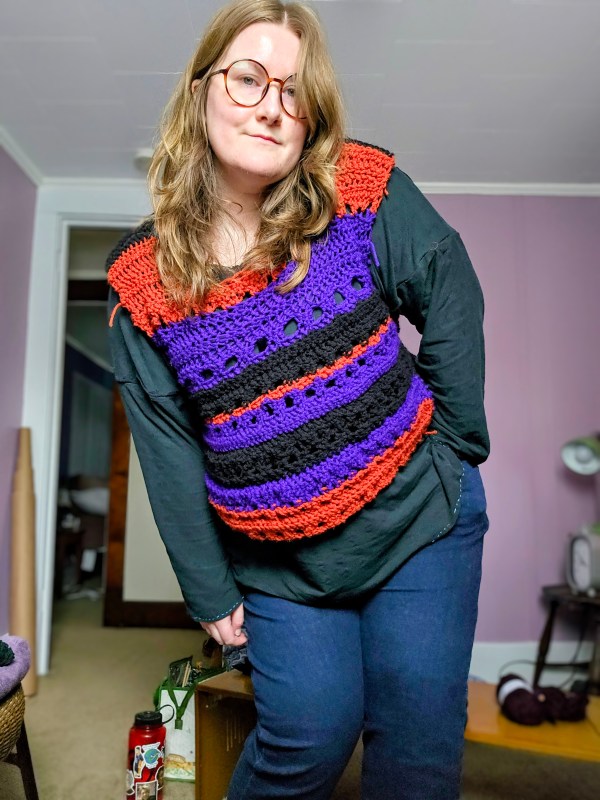
So to honor this time, I made my first Halloween themed garment with a self-drafted pattern using granny stitches, double crochet, and treble crochet to make this pullover vest breathable.
Purple, black, and orange are colors that work with my existing wardrobe so I believe this piece will fit in all year around…aside from the summer, for obvious reasons.
This is just one of many Halloween inspired creations, I am brewing up. I excited to see those come to life soon!
As a fellow neurodivergent person, or a neurotypical, do you look to October as a time to recharge? What’s your favorite “ber” month?
For those unfamiliar with him, Jeremy Clarkson is a well-known British TV presenter most famous for his work in the automotive journalist industry. His role as co-creator and host of the Top Gear reboot from 2002 to 2015 relaunched the show and made it a global hit. In 2015, he was fired from the show, and together with co-hosts Richard Hammond and James May, he launched The Grand Tour on Amazon Prime, which debuted in 2016. That series ran for six series before concluding in 2024.
In the background of his career as a TV presenter, Clarkson owned a 1,000-acre working farm in the Cotswolds that he purchased in 2008. Until 2019, he had a contract Farmer running the farm, but that changed when the farmer retired, which led to Clarkson taking over the farm and launching Clarkson’s Farm, also on Amazon Prime, in 2021. Four seasons of the show have aired thus far, with the most recent debuting in May 2025. A fifth series has been ordered, with filming likely done by this time in preparation for a May 2026 premiere.
Lessons Learned From Clarkson’s Farm
When Clarkson’s Farm premiered in June 2021, which covered the 2019-2020 farming season, Jeremy had zero farming experience. Previously, he lived in the farmhouse on the estate and allowed a farm manager to handle everything on the farm. He had to buy equipment, hire farmhands, and learn to operate everything. While it is a loosely-scripted TV series, it is non-fiction and filmed in a documentary style. Plus, because of Jeremy’s honesty, which he’s always been known for, you know you’re getting the truth. He isn’t trying to sugarcoat anything. Due to that, his ambitions, successes, and failures, of which there are plenty, teach you the viewer a lot as Jeremy learns.
Everything Is Farmable
In season 3, Jeremy has the idea of making money from the non-arable portions of his farm. This means turning to the areas that don’t have fields in them and aren’t used for animals. He begins harvesting the blackberries that naturally grow on the property and he buys piglets that can live in the woods on terrain that is too steep to plant in. It’s a reminder that you don’t need the perfectly groomed and idyllic land to grow things. Plants will grow in less-than-perfect soil, and some of the sweetest fruit grows naturally and in the harshest conditions, if you’re willing to go after it.
Farming Struggles
Season 1 starts a trend that has continued in every season: Farming is really hard, and there’s a lot that’s out of farmers’ hands. Weather plays a major role in their livelihood and can dictate a farm’s survival if there are consecutive years of poor weather. At different points, Jeremy has to do with record-breaking floods and historical droughts. Extended cool periods restrict plant growth, while lengthy warm periods scorch them.
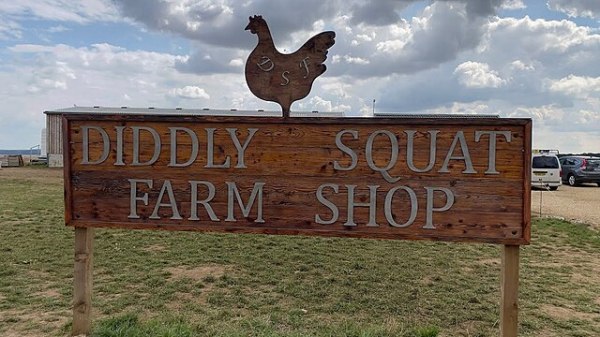
Diddly Squat Farm (aka Jeremy Clarkson’s farm) [kTb, CC BY 3.0 , via Wikimedia Commons]
Aside from weather, there are the emotions that come with becoming attached to animals that have to be butchered or die from natural causes. You always think about how the meat industry is a business, but if you have a heart, like many farmers do, it crushes them each time animals have to be delivered to the abattoir.
Additionally, equipment breaks and needs to be fixed or replaced, prices fluctuate due to global events (natural or political), and governments make decisions that affect your ability to purchase and sell products. It’s not an easy business, but most farmers stick with it because they’re passionate about it.
Gardening this year showed us just a hint of how difficult growing your own food can be. Some of our plants never grew because of the wet spring we had. Then, the summer brought extended periods of drought that stripped the soil of its moisture. It was hard to keep up with everything while also managing life. I can’t imagine how difficult it must be for farmers on a much larger scale.
Sacrificing Production for Long-Term Viability
In seasons 1 and 3, Jeremy makes two decisions that result in a short-term sacrifice with the goal of establishing long-term viability and success. Season 1 consisted of him planting native wildflowers in portions of his arable land to attract pollinators. He also let these areas go unmaintained to allow animals to establish habitats.
In season 3, he brought in well-known musician-turned-farmer Andy Cato who has established a business built on regenerative farming that replenishes soil nutrients while also producing a sellable crop. Much to the disbelief of Jeremy’s farm manager, Kaleb Cooper, Jeremy stuck with this plan, sacrificing that year’s profit potential in order to rebuild the soil that had been stripped of its nutrients following years of commercial farming practices.
Both decisions represented the importance of exchanging short-term opportunities for long-term potential. By dedicating a portion of his land to native growth and flowers, he willingly gave up the possibility of planting a grain that could be sold. It’s similar to season 3. While he still grew a sellable crop, it wasn’t as lucrative as selling a commonly-grown crop, such as rapeseed, wheat, or barley. However, the benefit of reestablishing nutrients in the soil was more important to Jeremy.
Learning New Skills Can Be Difficult
I believe Jeremy was 60 when Clarkson’s Farm debuted. He had spent the majority of his life behind the wheel of cars. He had no idea how to operate tractors, reverse trailers, raise and lower plows, or fill a spreader with seed. There was a major learning curve, especially for someone who has been very successful in his previous endeavors. Thankfully, he surrounded himself with people who do know what they are doing and taught him, albeit with a bit of sarcasm and attitude. He also humbled himself, which was a new path for someone who was famous for his smug face on Top Gear. Eventually, by the end of season 4, Jeremy actually had an idea of what he was doing. He could generally attach a trailer to a tractor by himself and knew what was happening on his farm.
It’s a reminder that regardless of how much experience you have in a field, it’s always difficult to learn a new skill or hobby. In our garden this year, I learned a lot even though I had gardened in the past. We planted vegetables we hadn’t grown before, experienced insects that we hadn’t encountered, and in-ground gardening brought with it new struggles not found with container gardening.
Impact of Clarkson’s Farm
Bringing Attention to the Farmer’s Struggle
With this show, Jeremy has used his massive platform to draw attention to how badly farmers struggle to make it. I think a lot of people believe that farmers have an idealistic agrarian lifestyle that consists of planting in the spring, harvesting in the fall, a bit of fertilizing in between, and being around animals. But that’s not the case. With so many aspects of their lives out of their hands, they are left at the mercy of the weather, economy, governments, and even global pandemics. One bad decision can lead to them losing their farm. They often can’t take risks because the potential to lose everything is too great. A disease can spread throughout their herd of animals and wipe out an entire year’s worth of income. Yes, there is insurance for these kinds of events, but they aren’t guaranteed to pay full value and can take a long time to pay out.
The Importance of Our Food System & How Fragile it Is
By watching Clarkson’s Farm, you realize how delicate our food system is. We have a great system of trade and infrastructure that allows countries to obtain raw materials grown on the other side of the world. But it’s also a system that can easily become imbalanced. One year of bad weather can result in a nation needing to import wheat for flour rather than growing it domestically. An idiot’s war in Ukraine can upset the world’s food security and lead to scarcity in developing nations.
Thus, it’s important to be able to grow stuff domestically when we can while also accepting that we live in a global society now where nations are dependent upon each other. As much as certain people like to complain about how much we import in the United States, we also export a lot of raw materials and goods. A drought in California or the temperature staying below freezing in Florida can upset the world’s agricultural market. It’s extra important to consider what we as individuals and families can grow. It also reflects the importance of having our own gardens when possible. And remember that when a natural disaster occurs or a weather pattern changes, it’s not the farmer’s fault that the prices fluctuate. Most of that is out of their control, and they certainly aren’t seeing an increase in their income.
Governments Set Farmers up to Fail
An unexpected part of the show is Jeremy, Kaleb, and Charlie Ireland’s encounters with the local and federal governments in the United Kingdom. Most of the show so far has featured Jeremy getting told “no” by the local council for everything plan he tries to implement. Restaurant? No. Farm shop? No. Pub? No. It’s like the council doesn’t want to generate revenue for the local community and district. On the federal level, they have to deal with the fallout of Brexit and the UK needing to develop domestic sources of food or pay more than they were before to import the food. The government promised subsidies to British farmers, but that money went away in 2024.
In the United States, the story is the same. The typical farmer has long struggled for survival. Dairy farmers barely make any money for their milk, and it leads to many converting to beef farming. They’re forced to plant corn for ethanol production rather than feed for their animals. Trump’s idiotic “leadership” has led to an increase in the cost of fertilizer and other farm chemicals because many of them are produced outside the U.S. Then, he doubled down on it by cutting or reducing most government aid programs.
Oh, and it gets better because of his decision to round up and deport immigrants who have been peacefully living in the U.S. for years. Those immigrants are often ones that farmers need as hands to operate their farms because Americans are usually too good for that kind of work. Those immigrants are the ones that we were told would be safe because they’re peaceful. It was just another lie that has resulted in Americans being victimized. Tariffs were supposed to result in other countries buying the vegetables we grow here, especially soybeans, but recent articles I’ve read have said that also hasn’t come to fruition. In fact, it’s worse than it was last year. Trump’s tariffs have led to retaliatory tariffs by China, resulting in them no longer buying our soybeans. Those farmers grew a crop that is no longer selling. At every turn, governments are making decisions that hurt their farmers. Leaders may say that they’re trying to help the farmers, but look at their actions. They speak much louder than words.
Clarkson’s Farm Has Been a Roaring Success
In the years since the show debuted, Jeremy has been honored numerous times by the British Farming Society. He has won awards for his work to bring attention to British farmers and the environment they find themselves in. It’s clear that he’s having an impact on the people who matter: the farmers themselves. He’s quick to point out that he is lucky to have other revenue streams, including the show itself, as well as the amount he earned from previous work. Most farmers have that opportunity or savings to fall back on. At the end of season 1, he gave the honest assessment that the farm couldn’t have continued without those other income sources.
A lot of people hate Jeremy Clarkson due to his brashness and how opinionated he is. But he has always been honest, even if you don’t like his delivery. That transparency is really refreshing in a society where things are masked and people make content just to generate clicks and views. Jeremy has become the voice of the farmer in the United Kingdom, and here in the United States, I think we should adopt him as ours as well. He speaks the truth and his dedication to finding innovative ways to farm is inspiration. I know that after watching the show, I wanted to do everything I could to be more agrarian. Gardening isn’t farming, but it’s at least related to it. They’re cousins. If you haven’t watched Clarkson’s Farm, I urge you to give it a go. It’s not a glamorous portrayal by any means, but it’s honest. And that’s what we need right now.
This is an interesting reflection for me, because granny squares, and crochet in general was my crafting white whale. Since their rise in popularity in the 2020s, the granny square technique, with its colorful bursts of color called to me.
They looked so different from the form and function of knitting. I found myself bamboozled by their craftsmanship, yet enamored by their novelty and variety. Which brings me to a shocking revelation – I don’t think I like them after all.
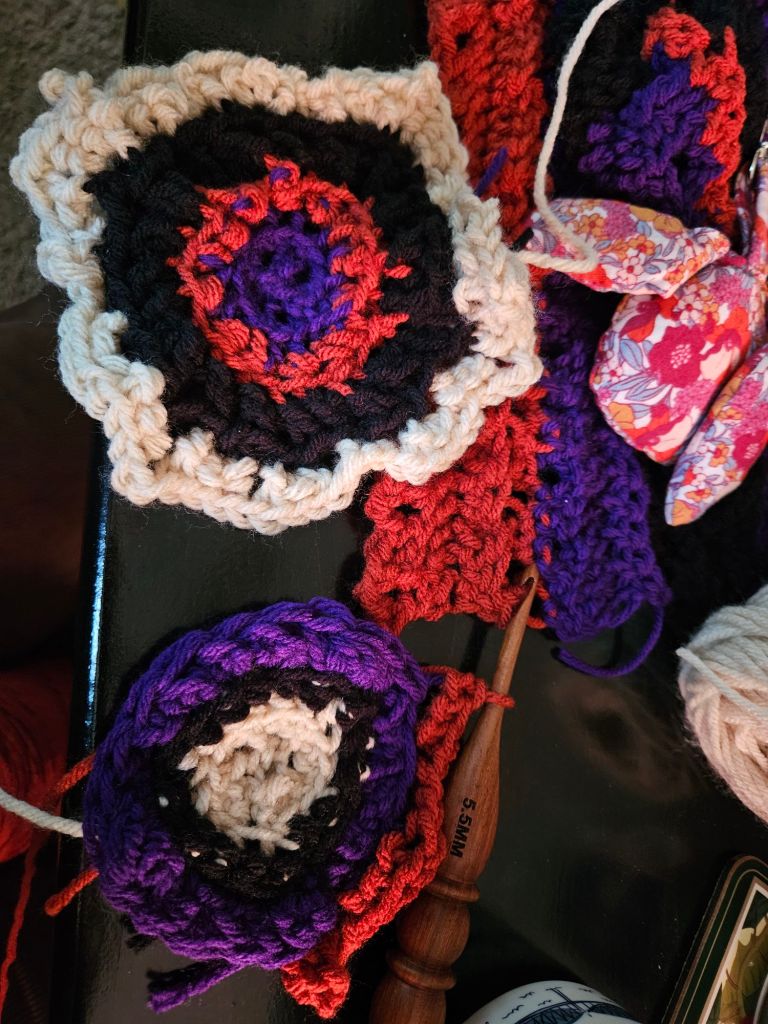
Yeah…I was not expecting this to be my reaction after crocheting four squares with a brand new colorburst square pattern for a halloween sweater I am working on.
The Importance of Design Point of View
So why, as soon as I made dedicated granny squares for a halloween project, did I not like them? I spent hours learning the colorburst granny square pattern. I struggled with the techniques of the cluster stitch, and the treble crochet corners, but didn’t give up. I expected to feel a sense of accomplishment and excitement, but instead I felt unsatisfied.
This surprised me. The squares and the design of the crochet cardigan with the squares added, didn’t feel like me. I didn’t like wearing them. It clashed with my own personal design point of view.
There was nothing wrong with the design, it just wasn’t me, and neither are the granny squares. And so, I think this is part of being an artist and the process. Learning the new skill is not a waste of time, even though it felt like I was wasting my week working on this design. If I want to be a designer and find my thing, I have to try things that won’t always feel like me, and adjust accordingly.
I’m currently watching the newest season of The Great British Bake Off, and it is bringing back wonderful memories from my childhood, thanks to one special contestant – Iain Ross. Iain is from Belfast, Northern Ireland, and his Irish charm reminds me of my trip to Ireland as a kid. He reminds me of the people I met, including my family members who live in County Antrim. He reminds me of my grandma, Florence, and my Gormley family tree. But I also remember the wonder of exploring this place called Ireland (and Northern Ireland) as an 8-year-old kid, who heard the legends of the places we saw, and found the stories truly magical.
Now, for political reasons, I wasn’t able to see Belfast due to some tensions around Orangemen’s Day. But there were lots of other cities and sites were got to see. There were stories of Dunluce Castle’s kitchen falling into the sea during a party. That was probably true. There are the ruins of tall towers, made to hide in safety from Viking raids, and also historical. But then there were the stories that lean into the fantastical, like the story of Finn MacCool and the Giant’s Causeway.
I had forgotten about the magical origin story of Giant’s Causeway until Iain turned the story into a pastry sculpture for the showstopper round. Finn MacCool, also known as Fionn ma Cumhaill in Gaelic, led a band of mythical warriors called the Fianna. Now, a giant Finn was in a rivalry with another giant in Scotland called Benandonner. To reach him, Finn created the causeway on the coast of County Antrim, which faces Scotland’s coast across the Irish Sea. When Finn saw how big Benandonner, standing in the distance across the sea, Finn decided this might not be a wise idea. Instead, Finn fled to his house, where he hatched a clever plan. He asked his wife Oonagh, to help him hide himself under a blanket, to disguise himself as a baby. Benandonner passed across the sea on the causeway, determined to settle the fight with Finn. He knocked on the door, but instead of Finn, he was greeted by Oonagh and a rather large sleeping baby, which Oonagh introduced as her son, Oisin. This terrified Benandonner. What could his father look like if this were the size of the baby? Benandonner fled back to Scotland, thwarted by the cleverness of Finn MacCool. In his haste, Benandonner ripped up the Causeway so that remnants only remain on the coast of Antrim, at the Giant’s Causeway site, and on the Scottish island of Staffa at the Fingal’s Cave site.
We know now that the hexagonal basalt rocks are evidence of volcanic eruptions that formed the Causeway in Ireland, but isn’t the creativity of my ancestors better? This story is one of my favorites. I may have been able to see through Santa Claus, but this filled me with the possibilities of a land where giants and magic roamed, and it filled me with a sense of wonder to exist in this place of extraordinary things. That’s what I began to explore in Udal Cuain and what continues to bring me back to Halloween every year – Samhain. The original celebration from Ireland.
Have you ever been to Giant’s Causeway? Did you know about the myth, and what do you think of it?
Growing up, one of my favorite video games was John Deere: American Farmer. Released in 2004 on PC, it allowed you to take ownership of a farm and operate it with the goal of expanding and making a profit. You were able to pick your location in the United States, buy your machinery and attachments (all John Deere, of course), and plan out your fields. You also could buy animals to raise. If I remember correctly, there were cows and pigs, but there may have been more. You were able to pick what crops to plant, but the biggest downside was not driving the machinery. Instead, you selected the field, the job (planting, fertilizing, harvesting, etc.), and which farmhand you wanted to perform the work. After that, you essentially “ran” it, and the non-playable character (NPC) did all the actual work.
I have very fond memories of playing that game, but I think I only played it for a year before moving (literally) and moving on to other video games. But I think playing that game was an important part of growing up. It greatly shaped the types of video games I enjoy in that I don’t like first-person shooter or online games. I would much rather play sports games or ones with long storylines. In fact, I’ve only owned one Call of Duty game in my life, and it was over 10 years ago. I’ve never played Battlefront, and the last military-style game I really enjoyed was Medal of Honor: Rising Sun, which came out in 2003. I enjoy games that have replayability and are even a bit repetitive, such as MLB the Show.
The other thing I learned from playing John Deere: American Farmer is that I enjoy games that are rooted in real life. Granted, I’ve never been a farmer (although I did work on a dairy farm when I was 15), but I have always enjoyed animals, planting, and growing things. The game also looked like everything around me, where there were countless fields and farms. It felt relatable, realistic, and achievable. There wasn’t any stress when playing the game. Instead, it was calm and relaxing. It’s what I would describe as a cozy game, although I’m unsure the term existed at the time.
Cozy Games
Cozy games are great if you enjoy playing video games as an escape and don’t want a lot of stress, fighting, and action when playing. Instead of intricate levels or storylines that require a lot of decisions and quick reactions, cozy games are often more open-ended and allow you to progress at your desired pace. I first started hearing this term in 2020 during COVID, and I think it’s obvious why. People were looking for an escape from reality, especially when they were stuck at home during lockdown, and a game like Animal Crossing: New Horizons was perfect for this. But, if you look back, earlier games fell into this category, including other installments in the Animal Crossing franchise, all The Sims versions, and many simulator games (Roller Coaster Tycoon, Zoo Tycoon, Sim City, Flight Simulator, etc.). By default, these games were able to be as complex or simple as you wanted.
I played most of these growing up, but I largely stopped in high school. However, in 2019, Sims 4 arrived on my radar after many YouTubers started making playthrough videos of it. We bought a copy for the PS4 and dedicated many hours to it, but it didn’t feel cozy. The game could still be played cozily, but most of the playthrough videos were dedicated to challenges (100 Baby Challenge, Rags to Riches, survival challenges, etc.), which made the game feel rushed and stressful. There were also plenty of ways to make the game dark and sinister, which goes against the cozy game ideal.
In 2021, we moved and bought the Animal Crossing edition Nintendo Switch that November. Magz had been introduced to the series in 2020 when New Horizons was released and was really interested in all the coziness that came with it. At the same time, I was looking for something equally cozy and remembered playing John Deere: American Farmer. I searched to see if there were updates in recent years (there weren’t) and looked for similar games in the same genre. That’s how I stumbled upon Farming Simulator, which met all the criteria I had: cozy, immersive, and could be played on the PS4. FS22 had just been released in November 2021, so I was able to get the previous version (FS19) at a great price when we bought the Switch. And it’s at this time, that I want to transition into a common theme of Animal Crossing and Farming Simulator: gardening/growing food. While not the sole focus for either game, both series dedicate a lot of time and attention to gardening or growing food, and gardening has become a popular theme in many games, especially in recent cozy games.
Gardening/Farming in Video Games
While farming in video games is really popular now, it’s far from a new thing. John Deere: American Farmer dates back to 2004, and the first Farming Simulator game was released in 2008. I even think about Farmville, which was played through Facebook and was released in 2009. While I played the game, I don’t remember a lot about it, but I do know it was massively popular.
Other video games with a farming element are Fields of Mistria, Roots of Pacha, and Wanderstop. I haven’t played any of these, but the reviews are great, and they’re very popular. Instead, I want to discuss three farming/gardening games that I have played and talk about what makes them great as well as areas of improvement. Lastly, I’m going to talk about how realistic each is.
Farming Simulator
I have only played one installment of this series: Farming Simulator 19. Giants, the game’s developer, tends to release a new one every two years; however, they’ve gone three years between the last three installments. I have watched people play both FS22 and FS25, so even though I haven’t played them, I feel pretty familiar with the series and its recent releases. Farming Simulator is a pretty great representation of farming. I know that I titled this post “Gardening in Video Games” and that it’s gone in a farming direction, but I think any game where you can grow crops on a small scale qualifies.
Best Qualities
Mods: Even though you only start with a few maps and a select number of tractors, combines, machinery, etc., the game’s mod library/community provides nearly endless possibilities. If there’s a tractor being used on a farm somewhere in the world, there’s a good chance it’ll make its way into the game. The best example for this was being able to buy Jeremy Clarkson’s Lamborghini tractor from Clarkson’s Farm. It’s not one of the most popular tractors used by farmers, but because he used it, it was modded into the game. The maps are another great example. In FS19, you start with one European and one North American map. Both are pretty good, but you quickly become bored with only two options. In the mod library, you can find maps from many European countries and US states. While not necessarily designed to perfectly replicate a specific town, it’s fun playing on a map that closely resembles where you live or a place you enjoy.
Complete Freedom: Farming Simulator gives you the freedom to do pretty much whatever you want. You can create fields where they previously didn’t exist, establish thick forests for logging, and become a dairy or sheep farmer if you want to raise animals. You don’t have to play a set storyline and can stick with a map for as long as you want. Because there are no goals or requirements, you have the freedom to determine what is success.
Driving Machinery: The coolest part of Farming Simulator is the ability to drive tractors, combines, excavators, and other pieces of machinery that most people will never have the chance to operate. When cultivating a field or spreading fertilizer, you have to manually raise and lower the cultivator and engage/disengage the muck spreader to not cause problems. It makes you feel like you’re really controlling the equipment.
Seasons: By default, Farming Simulator doesn’t have seasons; however, since FS19, there has been a mod to add them. You can adjust the season length from one day per month to eight days. Seasons give the game an extra touch of reality since crops have to be planted in the spring and harvested before winter, like real life.
Worst Qualities
“Helpers”:Farming Simulator has NPCs that you can hire to help do work in the fields. Setting it up is pretty easy; however, they rarely do the work as effectively as you expect. The helpers will get lost in the fields, are easily impeded by non-existent obstacles, and don’t complete the task before saying they’re done. They’re meant to be beneficial, but they only get in the way and distract you.
Repetition: It doesn’t take long for the game to become a bit repetitive. You do the same tasks (plow, cultivate, plant, fertilize, and harvest) on repeat. This is made better with the Seasons mod, but it still feels repetitive. There are animals that can be raised, but taking care of them requires the same repeated tasks.
Lack of Improvements: A big issue that Farming Simulator has had is that there are few improvements between the games. FS22 added some pretty interesting productions to the game, but that was about it. There are many crops that players would like to see in the game, but they remain absent.
Terrain Problems: This could also fall into the Lack of Improvements section, but Giants has forever struggled to make the terrain look real, especially when it’s being dug for crops or modified to level the ground. Tire marks from the equipment also never look real.
How Realistic Is It?
Fairly realistic in that you get to use equipment modeled after real-life examples and they all operate a bit different. With Seasons enabled, you have to operate within the growing parameters and can only grow what works in each season and climate. The things that are unrealistic include how quickly/slowly your vehicles consume fuel, the lack of damage, the monetary structure, and how animals are handled. I also wish that you could do some of the smaller jobs that happen on farms in the game. Things like leading the animals out of the barn and into the fields or feeding the calves would be really fun.
In general, my experience with Farming Simulator has been good, even though I haven’t played it in at couple of years. The repetition led me to become burnt out on it. I also grew frustrated with the controls on the console version, as they are finicky. That leads me to another improvement that could be made: make the console-playing experience better. That said, I do recommend playing it.
Score: 6/10
Animal Crossing: New Horizons
New Horizons is the first game in the Animal Crossing series that either of us have played, and I know that farming wasn’t part of previous games or this one when it was originally released. But I am glad they added it, because it brings something extra to the game. Farming isn’t too serious in ACNH. You get seeds or starts depending on the vegetable, dig a hole, and plant it. You water it every day, and after three days, the vegetables will be full grown and ripe. You harvest them, and the plant continues to produce indefinitely. It’s very simple, but it’s incredibly calming to see your character whip his or her watering can around. It takes an already cozy style of game and somehow makes it cozier. The only stressful part is when your watering can breaks in the middle of watering.
Best Qualities
Variety: For a game that isn’t solely a farming game, ACNH has a surprising amount of vegetables that you can grow. These are tomatoes, carrots, potatoes, wheat, sugarcane, and three colors of pumpkins. I was surprised the first time I learned that there are so many different vegetables that can be grown. And the best part is that they all can be used in different crafting recipes, some are used in cooking, while others are used to make furniture or decorations.
Simplicity: Because farming only plays a small role in ACNH, it’s not a complex process, which is great. It’s a series that’s designed to be played by people of all ages. You simply plant, water them every day it doesn’t rain, and harvest. That’s it. There are no fertilizers to worry about, and all vegetables grow in all seasons.
Graphics: I was blown away by the graphics of ACNH when I first saw Magz play it. I didn’t really have any expectations (high or low) for the game’s visuals, so I was shocked that it was so stunning. It’s not 3D, but everything has depth. My favorite thing is how the trees, weeds, and plants will sway when it’s windy or how you can see the plants glisten after you water them.
Worst Qualities
Would love to see more vegetables: I mentioned how happy I was with the variety of vegetables, but would love for there to be even more varieties. I’d love to be able to grow corn, beets, broccoli, and cabbage. It’d be a lot of fun to see how these vegetables would be modeled as well as the crafting recipes that would come with them.
How Realistic Is It?
It’s not at all. Plants don’t reach full maturity from seed in three days. Pumpkins, wheat, and carrots don’t continue to grow once you harvest them. You also can’t grow tomatoes, a plant that doesn’t tolerate cold weather, in winter. But that’s not the point of ACNH. It’s meant to be a lighthearted, fun, and enjoyable game. And I love it for that. I think it’s brought me the most happiness of any game I’ve ever played. You can play it for 10 minutes or two hours. If you’re down or in a bad mood, it’ll lift you up. It’s pure joy.
Score: 10/10
Stardew Valley
I came to Stardew Valley nearly 10 years after it was released in 2016. Magz bought it in (I think) 2023 and took a bit to really get into it. She eventually fell in love with the game and would have difficulty putting the Switch down when she played, and I had no idea what was happening. I didn’t understand what the mine levels were, how difficult fishing was, or who Haley is and why she’s so mean at the beginning of the game. After watching videos of people playing it, I downloaded the game in Dec. 2024 and spent a lot of hours playing it around Christmas. I quickly realized why everyone loves it. It’s immersive, entertaining, creative, can be quite difficult at times, and gives you a ton of freedom. What ConcernedApe continues to do with the game is amazing, and all the updates are free.
Farming plays a large role in the game, although you can farm as little or as much as you want. You have a farming skill that is developed as you harvest crops and interact with your animals. You can go through the entire game and beat the main storyline by not farming, but it’s definitely a better experience when you farm.
It isn’t difficult to farm in Stardew Valley, but it does require a lot of planning and thought. You manually hoe the plot you want to plant in. You buy your seeds at the town’s general store or use ones that you find throughout the world or are gifted. You can also purchase or craft fertilizers to improve the quality of your crop. Once a seed is planted, it needs to be watered every day to achieve the highest quality. Then, once the vegetable is mature, you harvest it and either wait for new vegetables to grow or plant something new.
Best Qualities
Freedom: By far, the best thing about Stardew Valley is the freedom you have. While there is a main storyline that you should play to reach 100% completion and to experience everything the game offers, it isn’t required. You can choose to focus on farming, mining, fishing, or foraging. I’ve reached 100% on Red Dead Redepemption 2, which is supposed to take well over 100 hours to complete, and Stardew Valley blows it away.
Variety: There are roughly 50 crops you can plant in Stardew Valley, ranging from items commonly found in real life (corn, beets, etc.) to some that I’d consider fantasy (powdermelon and ancient fruit). Each type has a season (or two) in which it can be grown as well as the number of days it requires to reach maturity. You can also grow giant versions of some varieties, and each will have quality levels (regular, silver, gold, and iridium). Vegetables are used in crafting recipes, can be given as gifts, and need to be used in pursuit of beating the main storyline. Oh, and this doesn’t even include the variety of fish you can catch or gems you can find when mining.
Tools don’t break or wear out: In ACNH, tools eventually fail, forcing you to craft or purchase a replacement. And while I know each tool lasts a set number of uses, it feels as though they always fail at the most inopportune time. In Stardew Valley, that doesn’t happen. You are given the following tools to start: axe, pickaxe, watering can, and hoe. These can all be upgraded, which allows you to do more and use less energy in the process.
ConcernedApe’s dedication: The game’s developer, Eric Barone (aka ConcernedApe), has poured his heart and soul into the game. He released the game independently after working on it for more than four years and continues to release updates that improve the game all these years later. He listens to the game’s fans when working on updates, and you can tell that he genuinely cares about the game, unlike a lot of developers.
Worst Qualities
Not always relaxing:Stardew Valley is a wonderful game, but it isn’t relaxing at all times the way ACNH is. The mines, and especially the skull cavern and Ginger Island volcano, can be very stressful and difficult. Time can also make the game not relaxing. Time is always advancing unless you’re in your storage or are crafting. A full day takes 14 minutes of real-life time without pauses, and you have to be in bed by 2:00 a.m. or you will pass out, which can lead to you losing items in your backpack. You also have to monitor your energy level, because if is depleted, you’ll pass out. All of this means you have to plan out your day to ensure you get everything accomplished while not taking too much time or using too much energy. It can be a lot.
Can cause eye strain: This may be a personal issue, but Stardew Valley strains my eye worse than any other game. I think it has to do with the default contrast levels of the graphics as well as the pixelated graphics. It means I can only play the game for a couple of hours at a time without stopping, which isn’t a bad thing, but it is more tiring than other games.
How Realistic Is It?
Stardew Valley doesn’t use a real-world clock, but a year in the game is divided into four 28-day seasons. Each season has four weeks of seven days. The seasons are like real life (spring, summer, fall, winter), and in all but winter, there are season-specific vegetables/fruit that can be grown. Those are all quite realistic for a game that has monsters and has fantasy elements. I also love that your energy gets consumed as you perform tasks or engage in combat. Finally, I like that you have to use hand tools. It’s so much more engaging and fun than using large pieces of machinery.
Score: 9/10
Do you have a favorite video game, farming or other genre? If so, I’d love to hear about it. Have you played one of the games discussed in this post?
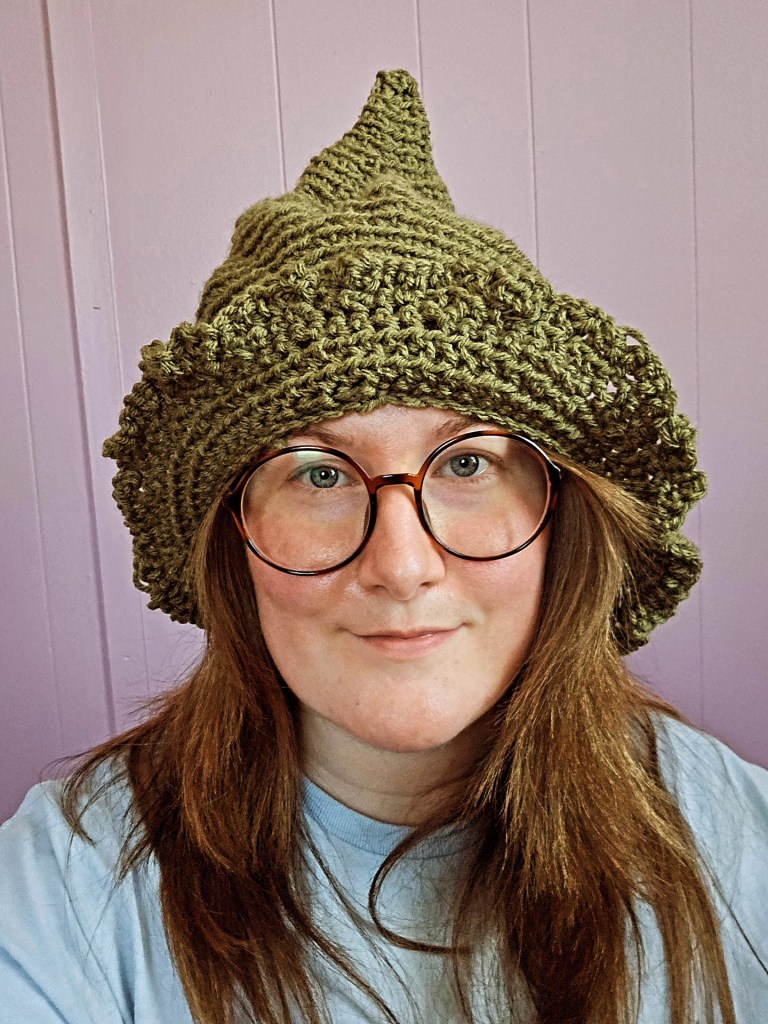
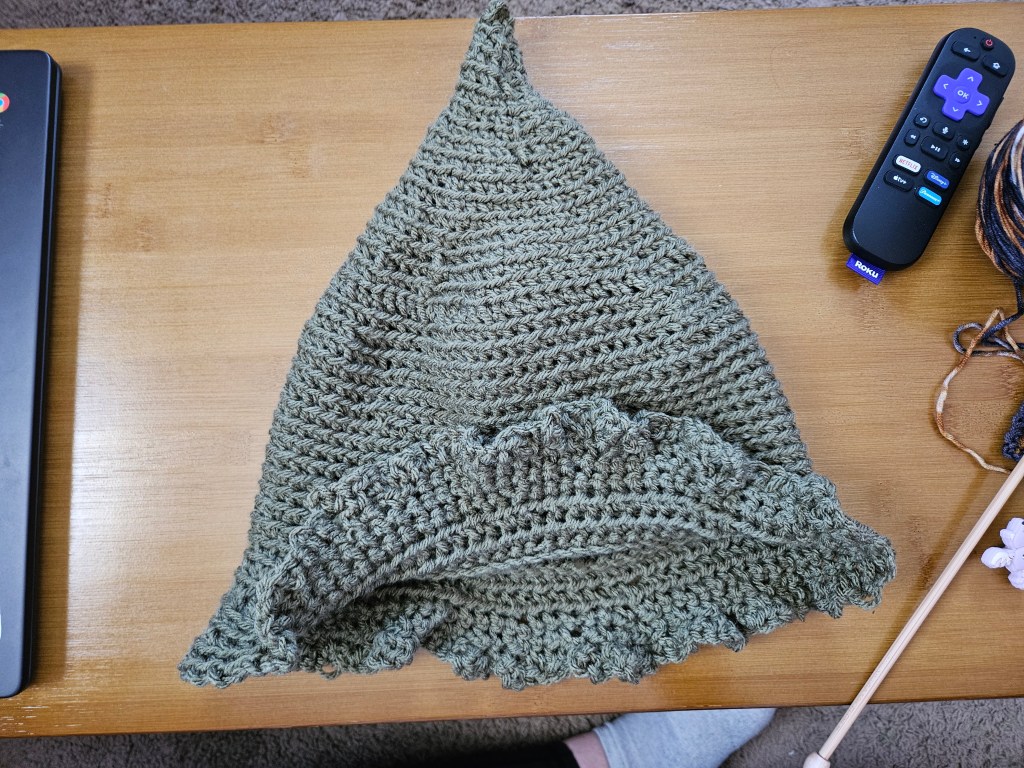
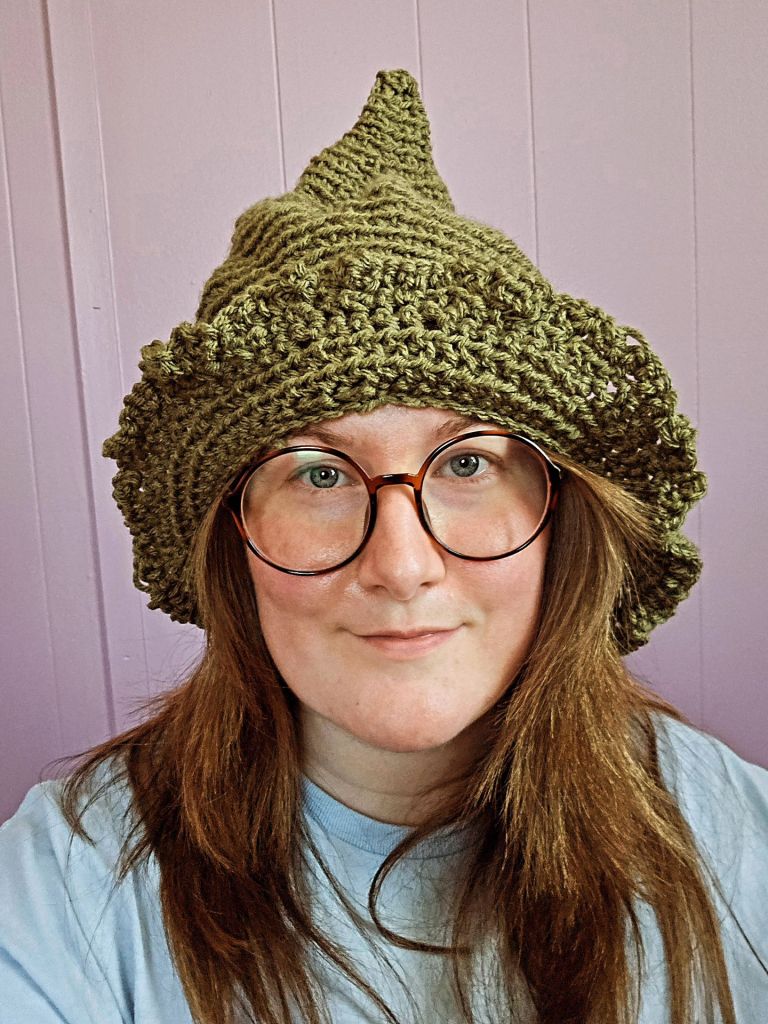
Have you ever wanted to look like you emerged from a cozy video game? Maybe you’d like to wear a hat that reminds you of spooky season? Behold my new crochet adventure, not my first hat, but the second stitched together for this autumnal season.
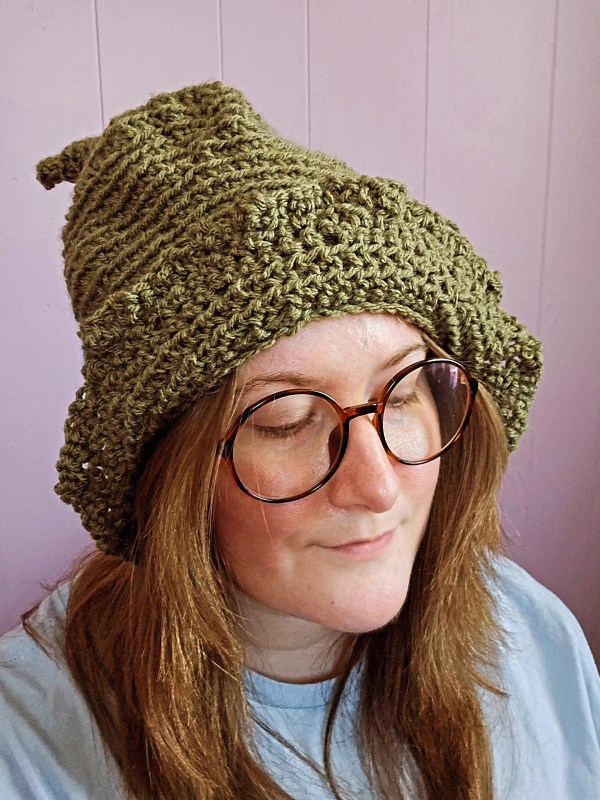
This hat is inspired by the pointed witch hats, either sewn or made from yarn, that make an appearance in October, either in patterns that I see advertised or inspiration sources online. I didn’t want to make anything too witchy. I am not aiming to be a witch; I am looking for something fantastical. My hat is more of an allusion to the pointed, wide-brimmed headwear, while also aiming to be something a bit historical, rural, maybe hobbity in form.
The inspiration image I used for this project is a hat from Animal Crossing: New Horizons – the frugal hat. It is a subtle nod to a scarecrow, while it could belong in the wizarding world. I chose to crochet this project for the ability to sculpt the hat in a way that is freeform. I love how crochet lets you create without managing all the stitches on a needle; instead, I was able to switch from the hat portion to the bill with ease. I crocheted onto the side of the hat and used varying stitches of single crochet, double crochet, and granny stitch to add the frilly volume to the bottom.
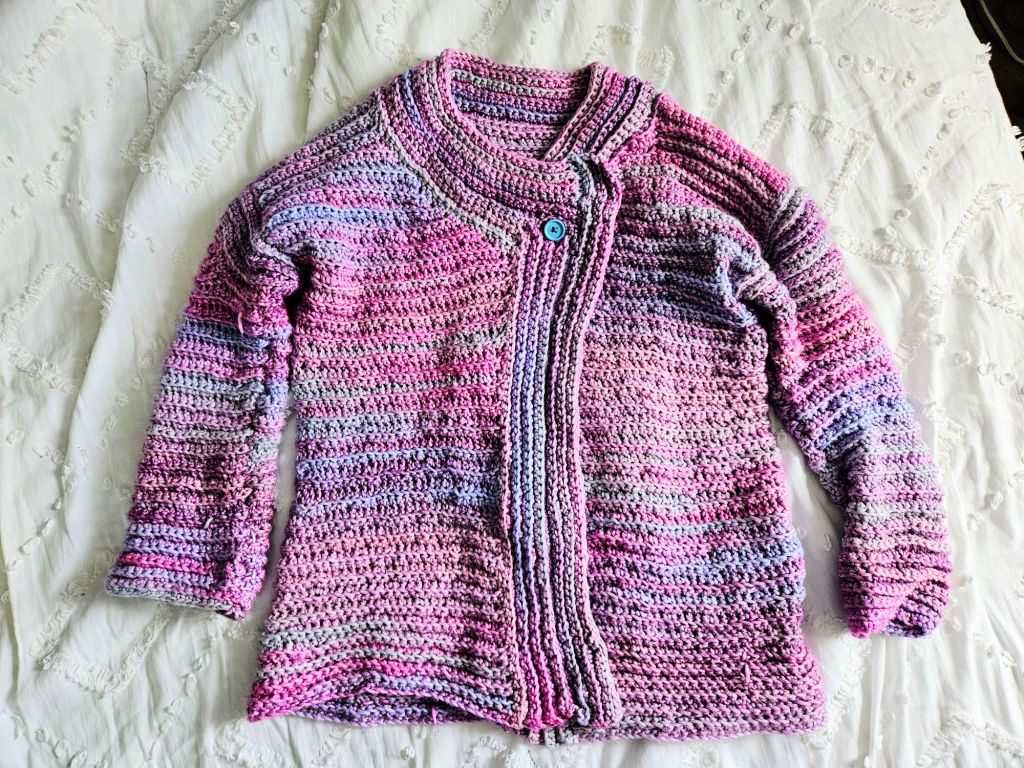
Another reason I chose to crochet, over knitting this hat, was to provide the hat with more structure than knit stitches. Crochet stitches have more body to them. This was a scrap project, using leftover yarn from my first sweater dress, now a cardigan, made in 2023. Which was also scrap yarn, from a previous scrap yarn project – my cat ear beanie from 2024. As time passes, and I make more things, I love seeing how projects are connected through materials over time, because scrap yarn is kind of magical. It’s always worth it, in my opinion, to hold on to the extras for these random projects that call for just a little bit of yarn.
Finally, this hat project was inspired by one other seasonal topic, the state of my country. It just never stops right now….ahhhh!!!
Am I living in the 1950s? No, but dang was this what McCarthyism was like? I’m sick of the FBI telling Black Americans not to mourn Assata Shakur. Charlie Kirk is being touted as a martyr by MAGA and the primarily white church, tainting the message of the gospel with that Nationalist sham of a funeral, complete with Hitler-esque photos by the orange man. It’s getting ICY in a lot of places nationwide. So, I made a witch hat, because the Salem Witch Trials of 1692 and 1693 were not about witchcraft.
Instead, they were about religious extremism, sumptuary laws, xenophobia, and social tension. It was profitable to report your neighbor as a witch. You could gain financial and political power by reporting people who did nothing wrong. So I made a witch hat, because I am done with the injustices being played off as not that serious, and I am tired of our own political witch hunts. I feel helpless and angry all the time because of the Idiocracy. So I made a hat to try to do something creative with my feelings.
This forest creature hat, named by my sibling, was designed by me and created using worsted-weight acrylic yarn with a 5.5 mm crochet hook.
I have been a bit lax with my writing lately, but I’m feeling inspired. The chill returns to the sunny blue sky, orange steeps upon the leaves, and the need to stay warm welcomes me back with open arms. I love fall. I love sweaters, flannel, corduroy, and denim. Getting dressed when the weather is crisp.
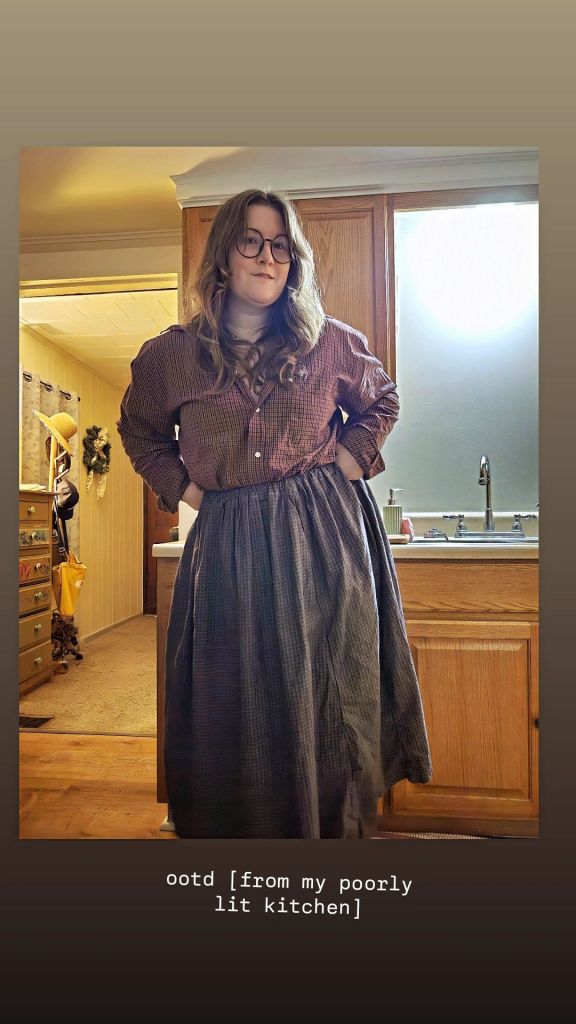
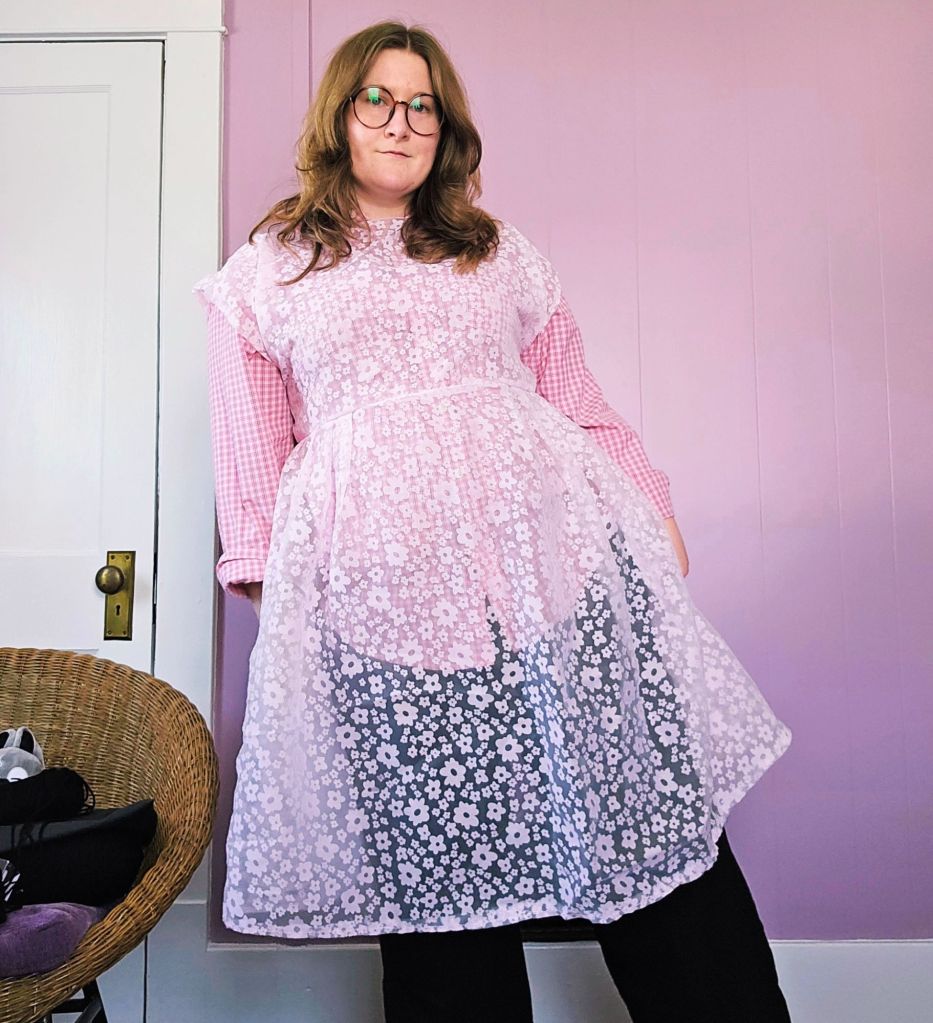
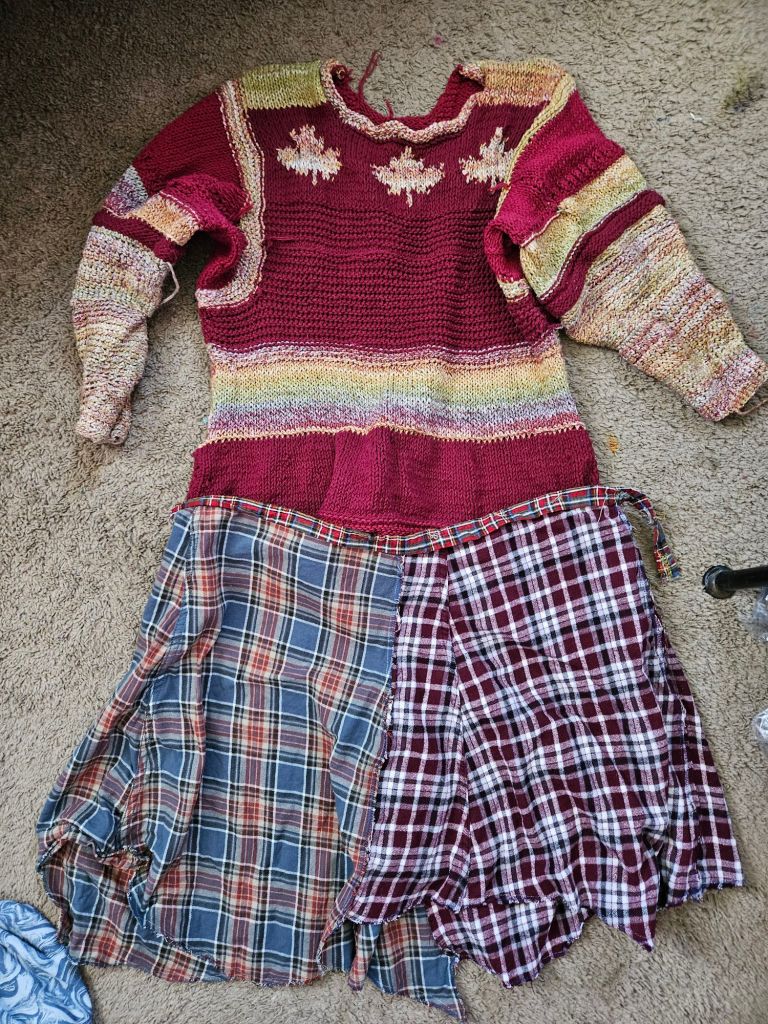
These are my favorite outfits, I’ve worn recently, using pieces I have sewn, thrifted, or upcycled. The only piece I bought new is the overalls, because I failed to make my own.
I’ve been getting into whimsy-goth style, like Practical Magic. I’ve been layering with sheer, with knit, and with textures. I’ve been drawn to brighter colors for the darker months. I’m trying to find the joy, before the year ends, and find a better way to end this challenging 2025.
So now that I have sat with my thoughts for months, finding my way out of the woods with my crafts, I am going to get chatty again!
I think what is bringing me the most excitement right now is kpop. Karma has been a wonderland. Chaeyoung of Twice’s solo release was Black Keys perfection. Nmixx new Blue Valentine era is thrilling, Red Velvet-esque, and the most exciting sryling I have seen from a girl group other than Twice in 2025. Taeyong is coming back from the military in December and I am beyond ready for punchy NCT to be back. It’s been 18 months of change and sadness since he left, we need the NEO king back. I’m also impatiently waiting for fellow NCT’s Yuta to release his full album at the end of October.
In other things, Mia is doing well and we are so bonded. It’s everything I hoped for! I’m excited for Saskie & Co’s second book to be released – Saskie Knits. I’d like to get my hands on both of her books. The Great British Bakeoff is back, and that has made for a lovely few weeks. I’m learning new crochet stitches, such as the waffle stitch and granny stitch. I can identify single crochet, half-double crochet, double crochet, and treble crochet stitches. I have also mastered using my yarn swift and ball winder!
I am faltering on my language learning, with a steep decline in practice sessions since June. But I have begun to hear the difference between Korean and Japanese. Even being able to identify a YouTube AI mishap where a kpop song had English subtitles with kanji appearing instead of hangul. By reading the Japanese, I concluded they did not match. I can also tell the difference in speech patterns between Korean and Japanese, identifying key grammar structures. So, I guess, if nothing else happens this year with my language learning, it is marinating up there and I am retaining it.
There have been some really trying personal things going on behind the scenes, that although I probably share too much on here, I can’t discuss. But I can say I have never felt more like I have been drowning than this year. As we head into fall though, I think the source of the stress is healing and I am grateful to be moving towards peace.
My last bit of good news is that I got a rebounder! Also known as a miniature trampoline for cardio. It is a blast. I can’t wait to get healthier and hold less tension in my body.
Something I struggle with is not falling into the trap of comparison. Whether it’s people I know or people I’ll never meet, I find it easy to compare myself to them if there are any similarities. And I think social media is a major factor in creating an environment where we compare ourselves to others. Now, comparing yourself to others isn’t always a bad thing. It can help us set goals for ourselves when done in a healthy manner. However, too often, when it comes to social media, it’s rarely healthy. Social media platforms, such as Instagram, are designed to only tell part of the story. We either don’t get to see the entire story and all the work that goes into achieving something, or the achievement itself is misleading. Either way, it’s not good.
Unfortunately, two of my favorite hobbies, gardening and woodworking, tend to be full of comparison and even being bad about yourself. With woodworking, you can get caught up in the size of a person’s shop, the quality (and price) of the tools they have, and the type of wood they can work with. I don’t remember my dad or grandfather ever working with quarter-sawn white oak, but that’s the bulk of what you see YouTube, HGTV, and Instagram woodworkers use. Most people can’t afford that quality of lumber. When it comes to tools, I don’t know many people who can afford to outfit their shop with Festool, whose most basic sander will set you back $300, but that’s what you see a lot on TV and the Internet. It’s easy to tell yourself that you don’t need those tools, but when a project doesn’t turn out as well as the media personality’s does, you can quickly point to your cheaper tools as the culprit. The reality, though, is that the tools don’t maker the woodworker; the person does. We don’t see how many failed attempts went into a project before the successful final product. We also don’t know all the years a person put into the profession or hobby before working up to the expensive tools and materials.
Gardening is the same: If you want the best results from the start, you’ll want to pay to have all new soil brought in to amend what currently exists or buy the best materials to create an above-ground garden. You’ll also want to have the strongest and tallest fence to prevent animals from gaining access to your plants. And don’t forget to have an automatic watering setup that measures soil moisture and waters the plants as necessary. And when you look at Pinterest or read a gardening magazine, you’ll find the most beautiful gardens that are absent of weeds. If you’re like me, your first thought will be “Why doesn’t mine look like that?” Rationally, I know it’s because that garden that probably existed for years and has been the result of small improvements on an annual basis. But still, we don’t know that, and the standalone image is unlikely to tell that story.
Focus on the Successes
I don’t know where you’re at with your garden or other hobbies, but please know that you are doing very well and should be proud of everything you’ve accomplished. If it was your first year gardening and all you harvested was a single tomato, celebrate it. Feeding, watering, and caring for a tomato plant long enough to reach maturity isn’t easy. If you’re a mature gardener who’s struggled with carrots and finally got to eat one out of your garden, be thrilled. You put in a lot of work for that one carrot, and that shouldn’t be taken lightly. In your mind, it may not be as impressive as Instagram handle 123’s harvest, but who cares? They aren’t you, and you aren’t them. Both are okay. We don’t know the background that’s allowed them to achieve their success. They could be veteran gardeners with years of experience. They could also be commercial gardeners with a personal page. Or, they may not be gardeners at all and are simply posing with someone else’s harvest and garden. I never want that to be the case, but the sad reality is that it does happen.
Be Comfortable With Small Improvements
After you begin to appreciate the successes you have each year, I think it’s okay to start focusing on improvements that can be made moving forward. It can be an achievable goal, such as trying a new vegetable or seed variety that you’re curious about. It could also be finding ways to improve your soil drainage or become more efficient at watering. Perhaps you can work toward buying a new piece of equipment each spring that will lead to more success.
We’ve been working to put all these into practice. We had pretty good success with our plants this year, but one of our goals for next year is to have more melons and pumpkins reach maturity. I also want to find a way to make watering more seamless and efficient. The majority of our watering was done with cans, and it would be nice to have a setup that used soaker hoses attached to a single hookup. Finally, we want to improve our fence system. Ours worked pretty well for the first year and was never meant to be a long-term solution. But we also know that we likely won’t be able to upgrade all of it for next year, especially if we do want a forever solution that doesn’t need to be upgraded again in five years. That means upgrading it a little at a time. Maybe, we’ll upgrade one or two beds at a time so that in a few years, the entire garden will have a fence that is deer-proof and structurally sound.
Reaching that decision and mindset hasn’t been easy. I’ve mentioned before that I’m an impatient person by nature and struggle to take things slowly. My default is to find a remedy for the failed fence immediately, but that isn’t feasible. To upgrade all the fence for next year would be a substantial investment or would mean buying another short-term stopgap that would result in failure again. Instead, I’ve focused on what will be the best long-term investment and use the fewest resources while not spreading ourselves too thin. That means upgrading the fence little by little until it’s all improved. It will also mean that we’ll have some breaches in the fence until it’s all upgraded, but that’s okay. We’ll navigate that just like we did this year.
Find Joy Where You’re At
To wrap it up, I want to circle back to being happy where you’re at. It’s important to find joy in our current situation. Sure, it’d be great to have all the best tools at the start of something, but there’s little gratification in that. Working with what you can afford at a given time will help you appreciate the higher quality items when you can upgrade in the future. You can also be amazed at how much ingenuity you have when you are working with “starter” tools.
For example, I began woodworking with a used compact Craftsman table saw. It had a plastic basic that twisted when I ran a board through it. It was a bit scary, but I was able to build a serving tray with it that Magz still uses. I’ve since upgraded to a larger, more powerful Rigid saw that is capable of doing a lot more work, but I wouldn’t have appreciated how nice it is had I not used the Craftsman saw. Eventually, I want to upgrade to a cabinet table saw that can do even more, and I know that I’ll appreciate that one because I’ve worked with my current one for at least three years.
Squeezing everything you can out of what you have is an important mindset to have even though it’s in sharp contrast to the current mindset of many people. It’s fun to be countercultural in that way. It’s also why we aren’t rushing to spend a bunch of money in our garden when what we have serves us well and instead can slowly upgrade things.
In August, Project Runway returned under a new network and reshuffled the format, hosts, and challenges to make a show I think was actually okay. Compared to where the show was left on Bravo in 2023, I think bringing back Heidi Klum was a good choice compared to the choice of Karlie Kloss, whom I didn’t see as an appropriate casting choice for a role that requires personality and colorfulness. It was boring. So were the new judges. The only new casting decision I was excited about at the time was Christian Siriano, my ult bias from the original show. So what was the good and the not-so-good, in my opinion, of season 21? And how has the show changed, for the better, yet in some ways, become less about fashion? These are my thoughts on my beloved Project Runway in 2025.
The Evolution of Project Runway
The original show premiered on Bravo in 2004 with host Heidi Klum, mentor Tim Gunn, and judges Nina Garcia and Michael Kors. It was filmed in NYC, at Parsons The New School for Design, where Tim was on staff, and the competition culminated in three finalists showing their work at NYFW Bryant Park. This format remained for the first five seasons, season four featuring Christian Siriano, who won his season.
After season 5, the show switched networks to Lifetime, where it remained until season 17. This change for season 6 also changed the location, with the show being filmed in Los Angeles at the FIDM campus until the finale, which was held at NYFW. Season 7 returned to Parsons and NYC, where the show stayed the course until season 11, when Zac Posen replaced Michael Kors. Zac Posen, Nina Garcia, Tim Gunn, and Heidi Klum remained through season 16.
Because of Harvey Swinestein being a producer of the show, and #Metoo movement addressing his depravity, Project Runway changed hands and returned to Bravo for season 17, sans the original cast. Karlie Kloss was the new Heidi, Christian Siriano the new Tim, and the judges were swapped for Elaine Welteroth and Brandon Maxwell.
The show remained this way through season 20, until the show changed again, switching to Freeform as its network, returning Heidi Klum to the host position, retaining Christian Siriano as mentor, and returning Nina Garcia to judge, with a new addition of Law Roach as the second judge. It’s a lot of change.
The Three Fashion Musketeers
When Project Runway moved back to Bravo in 2019, it was not the only fashion competition show in the American market; Netflix launched Next in Fashion for two seasons. Finally, Tim Gunn and Heidi Klum launched their own show on Amazon Prime, called Making the Cut, which was the equivalent of the original trio of Top Gear UK launching The Grand Tour on Amazon.
In my memory, from watching these three shows, Project Runway felt like a shell, undercut by Making the Cut, but losing the carefree fun of what Next in Fashion captured with hosts Alexa Chung and Tan France. All this change made me question what was the purpose of these shows anymore? With the rise of fast fashion and social media, it seemed like a relic. I could watch fashion design content on YouTube with varying points of view, to decide for myself what I thought was good fashion. Why would I care about the judges or the magazines anymore?
Project Runway in 2025
So now, six years later, what did the new Project Runway feel like? To be honest, it doesn’t have its own identity anymore, in my opinion. This could easily be RuPaul’s Drag Race with the amount of drama they packed into these episodes. The original format of challenge, runway, judging, and elimination was gone. Now you find out who goes home next week, which was unnecessary for me. I am tuning in each week, don’t make me have to, I want to, so just tell me who goes home so that the point of the show doesn’t seem like it’s an MTV reality show. It was hard to remember what challenge they were judging from last week. In some ways, I didn’t care; I just wanted the new challenge to be presented.
The contestants fought a lot, with Jesus and Veejay being a near constant. It was too much, and that leads me into one of my biggest gripes with the new season of the show. The editing was off. When Veejay was announced as the season 21 winner, I was confused. The final two eliminations before the finale were also edited strangely, because each time it seemed as though they were not going to keep Veejay, the judges’ critiques reflected this, and so it created this uncomfortable tension for the final three episodes, where it seemed like they were keeping Veejay in the competition so that she would become the first trans winner because of all the fighting.
That frustrated me because Veejay was doing good work, but then why make it seem like she was at the bottom, if the judges saw her work in high regard? It was really awkward. So was the out-of-control arguing between Veejay and the Estrada brothers, which I think the producers wrongfully kept in for a toxic series of episodes that is problematic, and I thought was manipulative. I wish for everyone’s sake that they would have paused the competition in a Tim Gunn fashion to unify the contestants again, because I liked this group of people. I can see where Jesus was coming from, and I can understand how bullying from the past can bring up past hurt, like Veejay expressed.
This is where the show shifted for me into a trash television show, such as Teen Mom, The Challenge, Real Housewives, or Keeping up with the Kardashians. Finally, the omission of NYFW for a quick 6-piece collection immediately after filming the bulk of the show felt lame. Every collection for me was a letdown, and this was the production’s fault once again. 8 out of 9 challenges were one-day challenges, so every other day, they were creating a brand new garment; it’s a recipe for burnout and mediocrity. The final runway show was like a fart instead of a spectacle of creativity, and it was underwhelming.
I hope they get a bigger budget for season 22 because the show has captured its thing again, but the finale and shift to the focus on drama over scenes from the workroom was a poor choice in my opinion. When I think of good reality competitions that have carried on throughout the decades, Survivor and Great British Baking Show are great examples that I may dive into in a part two.
Have you ever watched Project Runway? Did you think it was about planes? That’s what I first thought when I heard about the show in the mid-2000s.
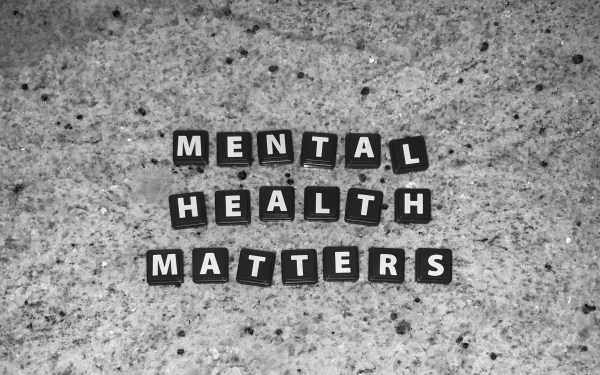
I’ve written a few times about how peaceful gardening and being in the garden can be. Escaping from technology, surrounding yourself with nature, and being fully present with your plants has nothing but a positive effect on your life. But that doesn’t mean it is a perfect prescription for everything in life, and this summer, I found myself battling mental health problems that the garden alone couldn’t solve.
This post will be a bit different from what I typically write here, but I think it’s important to share. As a guy, there’s often a stigma surrounding mental health and attempting to get help (or at least that’s the case in the United States). This is a little bit about recognizing that I needed help and how it’s going so far.
Owning a House & Having a Garden Were What I Always Wanted
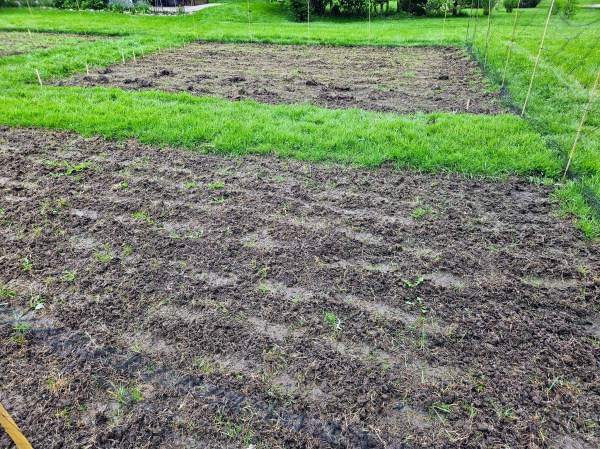
Buying our own house and having a yard big enough for a large in-ground garden were two goals I’ve had for a few years. When we were in the house we previously rented, I always said that it was going to be the last place we rented. I knew that only so much of that was in our control, but I was hopeful. The opportunity presented itself after three years, which was earlier than we would have liked, but with much prayer, help, and perseverance, we stuck with it. After signing all the paperwork and moving in, there was great excitement, but I still didn’t feel as happy as I probably should have. When last winter arrived, I was very happy and excited to be planning our first garden. I was also happy early in spring to be digging new garden beds, which I wrote about in great depth. But something still wasn’t right.
Feeling Off
Even in the midst of all the excitement that comes with gardening, I found myself being frustrated, irritable, and angry at the drop of a hat. Even in situations where I should have been happy, such as planting seeds, I was getting overly upset at little things. For example, if I put too many seeds in one area, I would beat myself up. That alone isn’t the worst thing; however, it affected my mood and how I interacted with those around me, including Magz. I would be short in how I communicated with her and have an edge to my voice.
I also began putting unnecessary pressure on things. I constantly focused on what was going wrong with the garden or what work needed to be done next instead of enjoying our successes or taking breaks. Weeds needed to be pulled and fertilizer needed to be added regardless of the temperature or UV index. This led to me being outside in the afternoon on hot, sunny days when the temperature was above 90 degrees. That work didn’t need to be done at that exact moment, but I felt like it had to. Worse yet, was that I passively applied that same standard to Magz. She asked me if I needed help or would be disappointed if she didn’t help (even though I know that she doesn’t do as well as I do in hot weather). I would tell her no, but when I came back inside, I would either act like I just did the hardest work anyone has ever done or would hold a grudge over it.
The last things I noticed were regularly being tired even after getting a good night’s sleep, no longer being interested in hobbies or activities I like, being moody, struggling to make decisions, and feeling as though I couldn’t hold conversations. In general, I felt depressed and down. Magz regularly asked me what was wrong, but I couldn’t pinpoint anything and just said that I felt off. Eventually, this led to us fighting pretty regularly and me not feeling confident in my ability to get out of the fight. I just felt paralyzed in my own mind and body. Finally, in July, I realized that I needed help. Mentally, I was at rock bottom, but I didn’t know what to do. I wasn’t interested in doing in-person therapy because I struggle to open up to people in person right away. Through our insurance, I found numerous services that provide virtual therapy, and the best part was that I could apply filters to find someone I was comfortable with.
Finding a Therapist, First Sessions & Progress
I wanted a therapist who is a Christian and a man. I didn’t feel comfortable talking to a woman in that situation, and I wanted a Christian counselor because I felt that it would be important to have a similar faith background. Within an hour, I found someone I was interested in, scheduled an appointment, and filled out the initial consultation. In a week or so, I had my first session, which was quite awkward.
Prior to this, I had never sought help from a therapist, although I should have. My parents’ divorce, multiple traumatic incidents, and some general emotional events that I never dealt with were all examples of times that I should have spoken to someone. Because of that, I had no idea of what to expect. I originally thought that I’d be “healed” in five or so sessions and didn’t want to drag this thing out. Boy, was I wrong. The first session was a basic “get to know” Kyle meeting where we went over my expectations and goals, and I began to tell him about my background and why I was there. Besides the goals and expectations, that’s actually how my first few sessions went, and I’ve only recently started to move beyond the intake portion of therapy, but I’m seeing real progress.
My therapist has given me the tools needed to process and react to situations and events that trigger me. I didn’t know it, but my ability to handle triggering situations in a healthy manner was basically stripped down to zero. I would overreact to everything and be unaware of how my body and mind were reacting to situations in the moment. Not recognizing this, I would respond to lies that I was telling myself, and situations would blow up. These new tools helped me slow everything down, recognize the emotions and bodily reactions I was experiencing in a given moment, and process them so that I could have a healthy reaction that was rooted in reality instead of falsehood.
What I’ve Learned
I’ve learned so many things from therapy. One is that it’s okay to admit that you need help. That’s a cliché, but it’s true. Not being okay is okay, but you don’t want to stay there. The second thing is that it’s really easy to fall into bad patterns of mental health. I never intended to develop poor reactions to events. It was a slow process that happened over time. The third thing is that developing healthy patterns takes a lot of work. You have to rewire how your mind responds to situations. You’ll have setbacks, which can be disheartening, but it’s important to stick with it. And the last thing is that it’s all worth it. It’s a time and financial commitment, and it’s also going to hurt if you allow yourself to be transparent with your therapist, but being healthy again is completely worth it.
And one more thing. Let’s call it an honorable mention. And this is for my fellow Christians who are having mental health struggles: Don’t let anyone tell you that your struggles are the result of not praying enough or that you don’t have enough faith. God is able to do anything and can solve a person’s struggles without any effort from us. But sometimes, it’s important that we put in the work, meet with a professional, and be able to process what’s causing our struggles.
Don’t Be Afraid to Get Help & Learning to Love Life Again
I started this post by talking about the stigma surrounding men and their mental health. Society is a much safer space for guys to have serious conversations about their mental health, but the sigma is still present. There are plenty of men (and women) who think guys are weak for seeking help with their mental health. If you’re struggling with mental health and would like to speak to someone but are concerned about how someone would view you, you owe it to yourself to get yourself help. Oftentimes, people aren’t as abrasive as we think they’ll be. But if you have a friend who would make fun of you or speak negatively of you wanting to get yourself help, you deserve better friends.
Now, let’s get this back to the garden. I struggled to find joy in the garden in spring and early summer. That began to change after talking to my therapist. It wasn’t instantaneous, but in August, I began to feel like myself again. I began to let the little things that went wrong in the garden go. We could only do so much to prevent the deer and other critters from getting into the garden, and it was wonderful to walk the garden and see the progress of our pumpkins. I also began to find joy in my favorite hobbies. I started the coffee table project and finished it in a (personal) record amount of time. Things are really beginning to look up, and I feel optimistic for the first time in a long time. I hope that if you are struggling with your mental health that you find someone you feel safe with and help yourself. You owe it to yourself. Your life is invaluable, and you deserve to live it to its fullest.

















 One Rabbit Riot