My Struggle with Patience in the Garden

Gardening is not fast-paced. It’s quite the opposite. It takes many months to go from seed to harvest. Most of the time, you will see little day-to-day progress. Instead, progress is seen across the weeks and months. A plant may not show growth from one day to the next, but from one month to the next, it can grow twice its size, start blossoming, or ripen. Unfortunately, I am not a patient person. Actually, I doubt that many of us are patient. It’s probably the result of living in modern society.

Technology allows us to be perpetually connected with people on the other side of the world, to get instantaneous results when we have a question that needs to be answered, and have items delivered to our house a day after ordering. Those are all great, but if there’s anything that doesn’t meet our expectation of speed, it’s easy to become impatient and frustrated. Someone isn’t going as fast as you think they should when driving? We tailgate and pass as soon as we can. A cashier takes longer than we want in a store? We either bolt to the next register when possible or are short in conversation when it’s our turn. Things that used to be treated with patience are no longer.

Gardening
Garden Beds

I think that’s why gardening maintains a vital place in our fast-paced society. You really can’t rush gardening. If you try to speed up the process, it won’t work. Roots won’t have the necessary time to establish, plants will wither if it’s still cold in the spring, and the fruit won’t mature if it’s harvested too quickly. So, what am I struggling with in our garden?

Seed Starting & Germination

My struggle with patience in this year’s garden started immediately. I wrote about my process of tracking the start dates for all the seeds we bought. I generally wrote down the earliest date for each seed, counting back the weeks from what is typically our last frost date. I didn’t take into account the possibility of not being able to transplant the starts into the ground because of excess moisture or low temperatures. I also didn’t consider the ramifications of seeds taking off and needing to figure out a plan until we can transplant them outside.

You can probably see where this is going. As soon as that start date arrived, I (generally) was ready to start the seeds. In my head, if I were late by a day or two, that plant was certainly going to fail. My focus was very much on the immediate and not on the long-term. Then, if a seed hadn’t germinated at the beginning of its germination window, I assumed it had failed. In reality, seeds can take the entirety of the germination window (and sometimes even beyond) and still be okay.

Tilling

Oh, the process of tilling. I will likely be writing a standalone post on the repeated tilling we’ve done. We started digging the beds in March, which was plenty of time, and got the first four established quickly. What we didn’t account for was grass regrowing before we could plant. Beds that we thought were in good shape have been overtaken by grass that hadn’t been killed. We’ve had an incredibly rainy spring, which has resulted in an out-of-control yard that didn’t give our garden beds a break. We’ve had to mow the beds on the lowest setting before re-tilling them, which was a bit frustrating. A positive is that we’ve learned the best way to use the cultivator to kill as much of the grass as possible when tilling. This has resulted in healthier soil that looks ready to be planted in.

At the time of this writing, though, we still need to finish the first bed, do another pass on a second, mow down the grass and re-till beds 3 and 4, and establish 3 or 4 others. That’s where the need for patience comes in. It’s tough being patient with this process because we’ve already put in a lot of work and needing to redo that work is a bit frustrating. There’s a lot of the “trust the process” going on here. Yes, it’s been a lot of work, and there’s still more to be done, but each time we till a bed, we make more progress. More grass is killed, and the bed becomes more suitable for planting.

Weather

I think weather may seem like a bit of a copout here because almost every outdoor project requires patience with the weather. Very rarely does the weather cooperate with our plans, and this is absolutely the case in Western PA. If you want it to be sunny, it’ll rain. Looking for rain? It’ll be blazing out. This year’s garden has been one long battle with the weather and it not doing what we need.

Mid-March was mild and allowed us to get an early start on tilling. That was followed by a lot of rain in late March and throughout most of April. That led to grass retaking the garden beds. Finally, in May, we’ve been getting the weather we need to address all the beds. My patience was certainly tested during this time period. When it was raining, all I could think about was how quickly the May 15th (average last frost) date was approaching. I also saw all the work that still needed to be done: beds re-tilled, new beds started, seeds sown, and starts transplanted.

The craziest part is that this impatience has now gone in the other direction. We are actually in a good place with some seeds sown and most of the beds taken care of. We’re also now on the right side of May 15th, where we aren’t late with our planting. I’m now finding myself so excited that I need to be patient and wait to plant the rest of our stuff. Would it be problematic to plant everything else now? Probably not. The nighttime lows aren’t problematic. But there also isn’t a reason to rush at this point. What a difference from a week ago.

Lessons to Learn

As I mentioned in the intro, it’s my belief that everyone struggles with patience. I think it’s part of the human condition and the result of the first sin. The Old Testament provides many examples of the Israelites’ battle with patience and trusting God. I think that same struggle has been passed down through the generations, and the struggle to be patient is perhaps harder than ever when we live in a world that is constantly pushing for better efficiency and quicker responses. There’s very little opportunity to sit, dwell, and ponder over things. I think about how philosophers, theologians, and inventors from centuries past would simply sit and think about their subject, working through problems. As Christians, we would say that it is the Holy Spirit leading us in these moments. We rarely give ourselves the freedom to sit and be still. I’m perhaps more guilty of that than anyone I know. I am always looking for the next thing to do or the next step in the process. In my mind, very rarely is that next step sitting and waiting.

I think that’s why gardening is both incredibly tough but also very rewarding. It’s tough because very little of it is in our hands. We can’t do much to speed up germination or plant growth. Sure, we can give them nutrients to aid in the process, but the plant still takes a certain amount of time to reach maturity. Attempting to expedite that process can actually cause more harm than good. The reward that comes in the end when you’ve picked the perfectly ripe fruit makes everything worth it, though. And while the growing process is taking place, if we can simply learn to find peace and comfort in the quiet and slow, I think we’ll learn to handle our fast-paced environment a bit better.

We’ll never be able to keep up with modern society, and I don’t think that should be the goal. If you’re a believer, you’ll know that our faith journey can be a slow one. Sometimes, it feels like two steps forward and one step back. There are even times when it feels like the opposite: one step forward and two steps back. But being patient on the journey and letting Jesus refine us as we draw closer to Him is incredibly important. Salvation is very quick, but sanctification is a slow grind at times. It’s like gardening: germination can happen in a few days, but the process of getting the plant to full maturity is slow.

I’ll leave you with this. John Muir is one of my favorite people in American history. He was a 19th-century writer and naturalist who helped establish multiple national parks, founded The Sierra Club, and his influence helped to establish the National Park System. He’s important to this conversation about gardening and patience because he lived during a time of rapid growth and industrialization. When he was born in 1838, there were 26 states. When he passed away in 1914, there were 48. During this period of population growth, he wrote about the importance of nature and getting away from society to find peace. One of my favorite Muir quotes is: “And into the forest I go, to lose my mind and find my soul.” It’s pretty easy to see what he was talking about. I think there’s something deep within us that makes us want to connect with nature. For Muir, it was escaping to the mountains. I love doing that too, but I think we can also find a similar reprieve from society in natural places closer to home, like our gardens. If we allow our gardens to become places of peace of tranquility, where we don’t take our phones, but instead be content with talking to our plants and watching them grow, I feel that we can let some of the stressors of modern society wash over us. If we do, all of a sudden, the impatience we feel with gardening may take a backseat to the calm the garden provides us.

Do you struggle with patience when it comes to gardening? If so, how do you combat it? Likewise, what does your garden mean to you? Is it simply something that provides food for you or is it a place or escape?

I Made Furniture From Fabric Scraps

Do you ever look at an item you want to buy and think, how hard can that be to make? Well, that’s exactly how we got here.

Floor Culture

I’ve been moving my sewing room around, I took down my sewing table and moved to the floor. Which I know sounds extreme, but seriously, sitting on the floor is underated. My back and hips don’t get tight and my posture is improving. In the West, I think we have been foolish to move away from sitting on the floor and should acknowledge how wise other cultures are to sit on the floor for health and posture.

I have a wicker chair that is good for sitting in when I want a break from the floor, but what I was missing was an in between piece of furniture that I could move depending on my needs. I settled on a floor cushion that could be used as a seat, a workspace, folded up in a cushion or rolled into the corner for yoga to add more stretch breaks to my life.

Quick Fix

But here’s the catch, I decided I needed this piece of furniture on a whim and that’s what I am trying to remove from my purchasing decisions – less impulse purchases. I want to become less of a consumer and use what I have, so I thought could I make what I want? Similar cushions for sale online were 100-400 USD and with the tarriffs looming, I was feeling a bit nervous to buy something.

But then I remembered my Mom made a pouf, she knit the cover. I’d watched Morgan Donner make things from her scrap and fashion a mattress from braided fabric. I had also begun saving my fabric scraps and sorting them into bags that were taking over my crafting closet. I just had to settle on the cover fabric and design.

Design and Materials

A large rectangle seemed like the ticket with corners I could sew crisply and easily stuff at the end. There was this one extra wide cut of fabric I bought from Joann’s last summer which caught my eye. It’s a fabric I bought because I enjoyed the design but didn’t want to wear it. It looks a bit like denim and had a lovely swirl pattern that I thought, would compliment the lavender paint of the room. With the fabric sorted, it was time to tackle the pattern and stuffing!

I measured the fabric into two large rectangles and four slimmer sections to form the sides. These I sewed inside out to leave only one end open to stuff. I sewed this by hand over the course of a day, I’d say in total the sewing portion of this project was the easiest part. What lay ahead next was tricky, blister inducing  and stressful.

Stuffing and Scraps

I had bags upon bags of scrap fabric in varying sized pieces ready to be repurposed into stuffing, but the thing with fabric cabbage is that it’s not uniform. Which means there will be a lot of cuts to make. This I foolishly chose to do with my old fabric scissors, instead of using my rotary cutter and mat. I wish I had. The repetitive cutting motion wore a blister on my thumb and aggrevated an old injury on my finger joint.

My hands were tired, weak, and wrecked by the end of day one. Worse the cushion was 1/3 full. Not what I was expecting! How could it take that much stuffing?! With my bags of fabric scraps depleted, I moved on to new sources of cushion comfort. Such as yarn that I was given secondhand, which I had no creative plan for. This yarn was a super bulky, acrylic yarn, about 300 yards left, and perfectly fluffy for stuffing. I cut this into pieces and carried on auditing my stash.

I repurposed some old clotbes into stuffing, a blanket Mia’s little bunny chompers had chewed into swiss cheese, and more leftover yarn floating around my sewing room. Yet, I still lacked the floof I was after so I broke down and browsed the interweb. I knew polyfill was an option, but it’s also polyester and the point of this was to repurpose and use up things, not go to Walmart for polyfill, which happened to stretch very little. When I made a bolster pillow for our couch out of an old sheet, I went through 5+ bags of it. Whuch made me wonder, are there alternatives to polyfill on the market? There are! I found a small business, selling cotton filling that shipped. This got me to comfortable fluff, I still need a bit more but I’m going to revisit it later.

Voila! A piece of furniture made (mostly) from what I had in my house that used up some trash in the process. I am pleased. 😁

Phone Calls in the Smartphone Era

As a Zillennial, on the cusp of both Gen Z and Millennials, my generation(s) have been stereotyped by the older folks as being afraid of phone calls, preferring a text to a voice on the other end of the line. And for a while, I’d say, yeah, I fell into this place of preferring a text as a teenager or chatting online, in my moody, insecure teenagedom, but then the phone call became this novelty of a thing. Calling someone seemed so serious, I became apprehensive if my question or answer was “serious” enough to warrant a call.

I didn’t want to be a burden, which is such a strange upside-down world from childhood, when the phone was the only way to contact your friends. I remember in the days of late elementary school, email being another exciting tool to communicate, like letters, but now email has become an intrusive contact on my smartphone. And maybe, that’s because email felt like real mail, when you could only check it on your window of computer time on the shared family computer. There was a boundary between online and offline. My mind has been marinating on this since watching a Theresa Yea video called, Why the Internet Will Never Be Cool Again.

I’m currently stuck in an endless game of phone tag, which is quite common when I am talking regularly to one of my parents. With my dad, it was a long game of waiting for that perfect window of nothingness. His layover in a city he found boring, I’d keep him company as he complained about life. Entertaining him and supporting him in his time of boredom, because if he were home, he was on the go every single moment. If I needed him, he would usually call me back on a drive home with a small set window for his attention span or horrible service.

My mom, in a similar fashion, gets stuck in these loops going non-stop. Except she answers the phone in loud restaurants, in the car, or at events, just to tell me that she is not available. She will even talk to other people around her, making me wait, or will pass the phone to the people she is with, as if I want to say hi to them when I really just wanted to converse with her about something important.

There is nothing like being on the brink of a panic attack and having your mom pass you to an acquaintance to say hi instead of listening to your crisis. Especially when you called because you thought they were home and available, but really, your loved one is always on the go. Not emotionally available. I hate calling and being met with passive-aggressive pressure to stop talking and let her go, even though she chose to answer the phone and enter into conversation like she was available at first, only to break that illusion as soon as you answer “how you are doing”. Read the room, kid, but honestly, how can I? This is particularly confusing when my parents both let me know how they would prefer me to live closer so I would be more available, but would it matter?

The video call and the text have become two of the most intrusive manners of communication, because a text should be responded to promptly and a video call, in her mind is perfectly normal to answer in a public setting like a restaurant or car without letting me know before I speak, what I believe I am saying in private to a person who is available to talk, to be swiftly gotcha-ed by the fact that I am not alone, and my privacy is not respected. The video call is like a two-edged sword; it is nice to connect with friends and family over long distances, but it is also a tool that hinders connection. It drops in unannounced and forces conversations that should be private to be open to the room.

I crave the dedicated correspondence of my grandma’s era, when she moved to another town, which meant that calling her mom would be categorized as long distance, and so she and her mom wrote letters to each other every day. I haven’t had that kind of connection with my mom since she got remarried, and I miss that feeling of connection, of being heard. It’s something that carried through my Grandma and my Aunt Florence’s generation, my phone calls with them being so intentional and full of connection. It was a visit, a catch-up, and was treated with hard boundaries. The common thread here is the lack of a smartphone.

Phones were still seen as tools to converse, not mini-computers full of distractions. I find this intentionality coming back to conversations I have with my friends; there are boundaries and moments set aside to converse without distractions. We have planned phone calls or dedicated pauses to set aside other tasks to write longer messages, like letters, through messaging apps. It has improved our communication and respect for each other’s time, in a way that I wish I could have with my parents. I just want to connect and not be connected. I want to converse and not call. I want to correspond and not text.

It is all a pipe dream, because this is never going to happen, they are just too enamoured with technology and the endless possibilities of their boomer generation, and the financial leg up that their generation has to be on the go and do things nearly constantly. We live in two different worlds, and that makes me sad.

Weekly Garden Update #9 – Finally Getting Seeds in the Ground

In this week’s garden update, the weather and schedule finally cooperated, and we were able to get our third and fourth garden beds completely tilled. We were also able to put seeds in the ground. If you’ve been following our journey, you’ll know that our weather this spring has been brutal. After a long and harsh winter, spring started out cold. It then rained a lot and only recently began to dry out and be warm enough at night for sowing to be a possibility. Some of our seeds, such as mustard greens, were supposed to have been in the ground in early April, so we’re more than a month behind. However, on Saturday and Sunday, we were able to (mostly) get caught up.

Gardening
Garden Beds

We planted (and by we, I mean both of us on Saturday, but it was all Magz on Sunday) onions, carrots, beets, greens, and some flowers. Something I don’t think either of us expected was the difficulty of planning where everything should go in the garden. You have companion planting to think about to ensure that beneficial plants are placed near each other. We also want to succession plant some veggies like greens, beets, and carrots to ensure a harvest all season. That means not planting too much to start but instead reserving enough space to plant more in the coming weeks.

We also want to plant flowers in our garden beds to help control pests while simultaneously attracting pollinators. The plan is to have these flowers intermittently planted with our vegetables to create a garden that is both productive and beautiful.

Not all of our seeds are planted, nor have our seedlings been transplanted. We’re planning to wrap that all up over the next week. May 15th is typically the last frost date in our area, so the plan is to sow the rest of the seeds and transplant our starts in the days around that date.

What Else Has Been Going On?

In addition to directly sowing some seeds, we were quite busy this past week. We began the process of hardening off our transplants by taking them outside and exposing them to fresh air and sunshine. That will make the process of transplanting our starts much easier, as they’ll be less likely to experience root shock.

Gardening
Seed Starts

We also bought and received the fence that I wrote about in last week’s update. We ended up buying it from Amazon because, once again, none of the stores in our town had it in stock. We could have ordered it and had it shipped, but it would have taken nearly a week to get here. We’ll now need to figure out the style of post or stake we’ll use to attach the fence to the ground. Oh, and between everything else going on, the grass has been growing out of control, and keeping up with the mowing has been a struggle. I love our battery-powered mower, but it definitely has its drawbacks when the grass is really long.

Structure and Flow: Sewing in Two Minds

Like I said in my 2025 So Far Has Been a Creative Slump, I am sharing the projects I’ve hidden away in my closet and the photos buried in my gallery. It’s time to catch up on this blog on what I’ve been sewing, because it’s been a journey of new discoveries.

Go With the Flow

In 2022, Kyle gave me a unique birthday present. He curated a mystery box of fabric for me to do my own “Project Runway” challenge – one of those fabrics was this sheer wheat colored criss-cross fabric. It has lived in my stash ever since. It was a fabric that scared me but intrigued me. It’s a stretch mesh burnout pattern, and for over a year, I was baffled at how to sew it without destroying it.

Even so, after I sewed it into a garment, how would I apply it? Would it be a garment that would be sewn layered on top of an opaque fabric? What would that look like? Should I use a high contrast fabric or something similar in tone? It stumped me. I lived with it a bit more in my stash, and it came with me through the move and into the fall once more. In 2024, after two years, I had an idea – sheer layering. A garment I could wear under or over other pieces to add dimension and disguise the oatmeal color that I was concerned would wash me out.

My decision was to make a shirt. I thought making it a “basic” would provide the most opportunity to style it in my wardrobe. I sewed the delicate fabric with my machine very slowly. I relaxed the tension of the thread and progressed delicately, ready to hand-sew at any moment of panic. It was not terrifying; it was possible.

Structure of a Bodice – Armor

Many years ago, back in 2021 (four years ago, what?!) I crafted a structured dress, based on Lizzie Bennet’s dress, when Charlotte Lucas announces her marriage to Mr. Collins. It was a vest and a skirt, with buttons and a collar. It was ambitious but rubbish, yet a project I can’t stop thinking about how I could have made it better.

Enter this fabric and this bodice shape. It looks like an armor piece made of vintage ditzy flower fabric, lined with muslin. I wanted to reclaim what I learned in 2021, but try again in 2025, since the failure of my early projects made me shrink back to “easy” projects. I’ve made things that have challenged me a little bit, but not a true experiment. Constant growth is painful. Think of your body after consistent workouts, you’re going to hurt. It’s part of the process of getting stronger, and it feels at times like a negative experience. That feeling ground me down. I was tired of the learning experiences that felt more like loss and waste than an expression of crafting and artistry. It’s human, it’s passion, how can we not want the fruit of our labor to produce something good?

I made this dress slowly, over several weeks, while working on other projects, while being sick. It was a slow, steady, careful process to make a dress that would bring me joy from the creation and the wearing. The other thing I had to wrestle with, in this project, was shaking off the demons of my Lizzie Bennet dress. It was a dress I felt pretty in, but that I took a lot of crap for my appearance when I wore it out. It was structured, fitted, and flowy. The waist was not perfectly matched to the small of my waist, due to my lack of tailoring knowledge. This dress prompted a stranger to ask me when I was due, and then doubled down that I looked pregnant. I wasn’t pregnant, so to her, I looked fat. Thanks lady.

It was rude and such a breach of boundaries. Don’t ask random strangers if they are pregnant; wait for them to clearly tell you. It feels like a slap in the face for so many toxic culture reasons, the main one is the unwanted comment on your body with the double standard of “pregnancy being the most beautiful,” but don’t look pregnant, aka don’t be fat, because the zeitgeist is fat-phobic. I got rid of the dress and don’t have any photos saved of the dress; that’s how much this experience ruined the dress for me. I lacked the confidence to brush it off. I didn’t understand my body’s proportions and lines, therefore, I blamed my body and myself for the dress not working, instead of my tailoring skills being the problem.

2025 Style – Layering and Reclaiming

I chose to confront this feminine dress style once again. I knew it would clash with the natural lines of my body. I don’t have an hourglass body shape, which this fit and flare dress calls for. I’ve been scared to wear it, but I am challenging myself to try. I layered the sheer shirt I made in 2024 with this dress and a belt to create balance. It’s going to take time to get comfortable, for sure.

The dress not only has this flowy skirt, but it is fully lined, and the front gathering has been tracked down with stitches to reduce waist bulk. I also added eyelets and lacing at the back of the garment to define the waist, Lastly, I added a belt to my waist, which I don’t enjoy wearing, but the effect of pulling the eye to the waist should reduce unwanted comments, I hope. I like the contrast of these garments together. They have flow and structure. Together they create a complete thought, and in my opinion, look like designs with a point of view, which is what I am aiming for in my designs 2025.

My 2025 So Far Has Been A Creative Slump

I can’t believe it’s May already, I’ve been so busy with our garden project and a follow up project of screening in our back porch, distracted by Joann’s closure and the evil running rampant in our world that I have been on a slow creative trajectory, and its really catching up to me!

Upcycling, Alterations, Mending

As of late, the bulk of my sewing projects have been preservation, updates, or reworking the garment into something new. In mid-winter, I decided to tailor every t-shirt in my closet. This meant I would be hemming every shirt to end above my hip and bringing the end of the sleeve upward, to end higher on my arm, which is more flattering to my vertical line. I’ve had to repair a few garments and mend some older pieces. I’ve also been taking some of my clothes in and tearing them apart to be upcycled into new projects I can’t wait to share. That I thought I already shared. This leads me to the next point: I have a backlog of projects I held back last fall.

The Head Games of Content

I still battle imposter syndrome, and in doing so, last year, feared that I would run out of ideas. So I slowed down my posting to keep these good ideas and projects in the tank for a rainy day, and instead of this giving me the freedom to create and write without pressure this gave my type-B nature and out to avoid writing, because I had the ideas, and so I sat on them and now it is almost a year later, without these projects having their time to shine. Grinding it out on Instagram last year definitely took my focus from me, and then these constant recession fears have kept me in a place of fear, which has stifled my desire to create, in case I can’t buy more materials in the future. I worry too much. Writing for two years, on this site, led me to a sophomoric slump heading into 2025. I lost the urgency to keep going and backslid into complacency and a lack of creativity. I have also transitioned into a slower creative process in hopes of gaining that spark again!

Hand Sewing 2: Electric Boogaloo

When I began sewing in 2020, I did so through sewing by hand through the tutorials of Bernadette Banner. I did this for two years and then acquired my Heavy Duty Singer, which I switched to using exclusively from the end of 2022 through the beginning of 2025. But this year, I am having some struggles with my sewing machine. I love the speed at which you can make things, but I fear that this boost in speed has dampened my craftsmanship.

When I was sewing by hand, I had the time to consider the project and to ponder where the design was going to lead me. With my sewing machine, I have fallen into a bad habit of making without pausing to ponder. I also started designing simpler, easier-to-sew garments for efficiency instead of art. But speaking of efficiency, I don’t think sewing machines are as efficient as we make them out to be. Mine is quite finicky. It eats fabric and thread. I go through the thread considerably quicker using my Singer than I do by hand. I have to rip seams and sew again, many times, because the machine messed up a stitch or skipped stitches altogether, and I’m tired of it. So my machine and I are taking some time apart.

Slow and Steady, A Life of WIPs

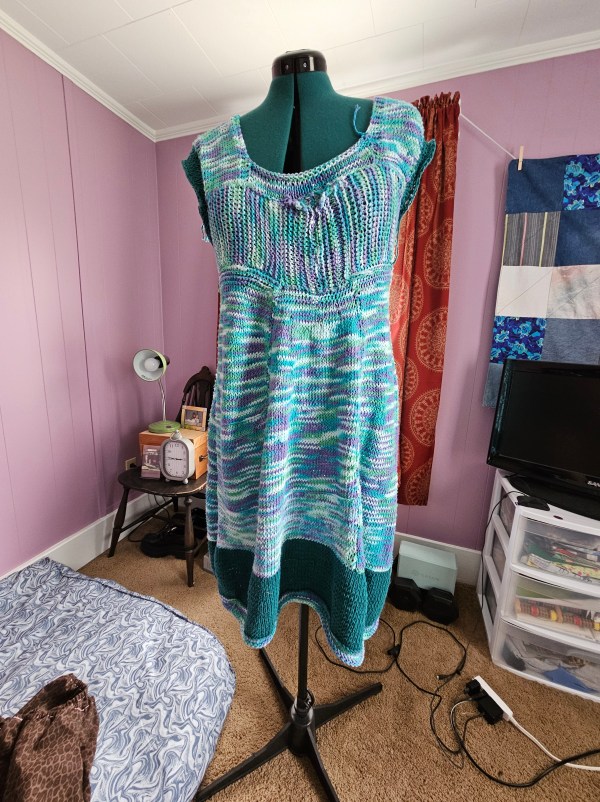
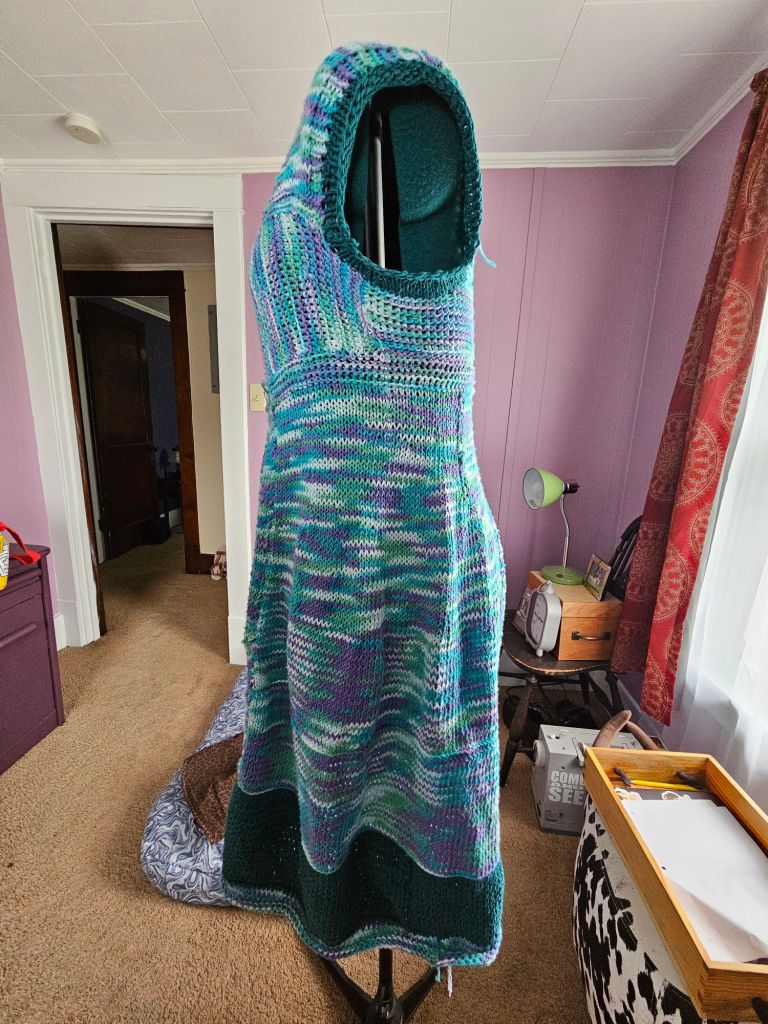
And so, here I am months later with a few finished garments, many WIPs, and a better life balance. Including a refreshed creative well. The time spent working outside with Kyle crafting our screened porch, tilling garden beds, painting, upcycling furniture, studying Japanese, drawing, reading, exercising, etc, has been a wonderful way to remember why I love creating. I find knitting to be my happy place. For a week, I barely knitted, and my mind was filled with far more rage without the needles weaving yarn into cloth. I’ve come to a place in my sewing journey where I want to learn and be ambitious again. I’ve filled my closet with good handmade pieces, but I want to create exceptional, one-of-a-kind things.

I have learned that knitting is my favorite mode of creation, and sewing is the freedom to make what I don’t want to buy or can’t find offered. The process is just as important as the final product, as trite as that is, creation and crafting are where we thrive, not consuming. I find moments of calm in working with my hands and feel satisfaction in stepping away to old creative haunts, like painting or gardening. I think the slump was an important part of growing. I hope that you find creative refreshment and know that you are loved. Stay safe out there, these are dangerous times, and know that I care about you all very much.

Weekly Garden Update #8 – Choosing a Fence

While we’re waiting for the ground to dry out so that we can direct sow some seeds and dig the rest of our garden beds, we realized that we need to figure out how we’re going to keep critters out of our veggies. Where we live, the most problematic animals are deer and rabbits. We definitely have squirrels and birds, but we aren’t going to keep them out.

We’ve always known that we’re going to need a fence, but reaching the point where we need to pick out the one we want to use snuck up on us. Ideally, we would have a limitless budget to pick a fence option that works and is pleasing to the eye. However, that isn’t the case, and choosing an option that is cost-effective is a top priority. I’m going to use this week’s update to discuss what fence option we’re going to use and how we reached that decision.

Short-Term, Not Long-Term

Because we don’t have a limitless budget to build or purchase our dream fence this year, we recognize that the fence we get this year isn’t the one we’ll have forever. There’s a good chance we’ll begin upgrading our fence as soon as next year. But that doesn’t mean we want to buy something that is completely disposable or junk. We don’t need a permanent solution at this time, though. We also want the fence to be minimal and not an eyesore, which removes some of the more expensive and permanent options.

What We Considered

Let’s start by discussing the fence styles we knew wouldn’t be possibilities given our budget and desires for an aesthetically pleasing fence.

  • Wood fencing – picket fencing is beautiful and iconic, but it’s also expensive ($60 for an 8-foot section of 6-foot-tall panel), regardless of whether or not you’re buying the panels or just the materials to build everything yourself. Also, because we need a fence that’s high enough to keep deer out, a picket fence gives off a vibe that you don’t want your neighbors to see what you’re doing. Rather unfriendly.
  • Vinyl fencing – see above, only more expensive ($109 for an 8-foot section of 6-foot-tall panel).
  • Metal fencing – not only is it very expensive ($152 for a 6-foot section of a 6-foot-tall panel), but it also wouldn’t successfully keep the critters out. Deer may not be able to jump it, but rabbits can hop through the spaces.
  • Chain link fencing – this fencing is very expensive ($139 for a 50-foot roll of 6-foot-tall fence), and it also doesn’t create the vibe we’re looking for. It looks like playground fencing and is anything but minimally intrusive. Our neighbors use this type of fencing for their garden beds, and it doesn’t look natural or happy. It also doesn’t work well because rabbits have learned to dig under it.
Fence
Photo by Simon Maage on Unsplash

Now for the types of fencing we did consider:

  • Rolled metal fencing – this can be either the chicken wire style with hexagonal openings or the welded type with square openings, but I’m including both in this. It’s pretty affordable (a 150-foot roll of 5-foot fencing can be purchased for $61), relatively easy to install, and successful at keeping the critters out. It can also be used for plants to climb. As a bonus, it looks pretty good.
  • Rolled plastic fencing – this can be called multiple things, including poultry fencing. It has 3/4-inch openings, is pretty durable, and easy to install. It’s decently affordable ($33 for a 25-foot roll of 4-foot-tall fence). It’s also green, so it blends in with the surrounding nature and doesn’t look out of place.
  • Construction barrier – this is exactly what it sounds like. It’s the plastic fencing that goes up around construction sites to prevent people from trespassing. It’s often found in orange, but you can find it in green. It’s pretty similar to snow fencing. It’s decently affordable ($45 for a 100-foot roll of 4-foot-tall fence) and very durable, but is an eyesore. The orange was a non-starter, but even the green looks out of place.
  • Deer fencing – this is also called extruded mesh rolled fencing. It is largely used to prevent deer from getting to orchard trees. It’s not overly durable, but there are many examples of people successfully using it to protect their gardens. It is extremely affordable ($23 for a 100-foot roll of 7-foot-tall fence).

What Did We Choose?

In the end, we’re choosing the deer fencing. It provides us with the ideal blend of price, size of roll, and attractiveness. We’re going to need somewhere between 600 and 700 feet of fencing. The deer fencing is less than $200 in total, while some of the others are well over $300. Because we needed to buy so much stuff to get our garden started this season and we screened in our back porch this year, we wanted to keep costs down where possible.

This deer fencing will not last forever, but we’re okay with that. If it breaks down or gets torn, we can replace it. We are also confident that if we take our time with installing it, it can last longer than expected. We can also repurpose the fencing in the future by using it as netting to protect plants from birds. Since it’s so easy to set up and tear down, this type of fencing will also allow us to replace it with long-term solutions a little at a time. Similarly, at the end of the season, we’ll be able to take the fence down and store it. We’ll let you know how installing it went and what we think of it throughout the growing season. Happy gardening.

Beginning My Study of Van Gogh

The other day, I ran across Van Gogh’s work again and I went down a rabbit hole of researching his work and soaking it in. I saw his and other artists I admire at the Musee d’Orsay in 2010, and although no pictures were allowed those memories have carried with me. So it got me thinking, would modern life be more beautiful to us again if we saw the world through the eyes of these artists of this movement? 

That’s what I plan to explore this year. This drawing above, captures the view from my sewing room. With modern infrastructure and other touches erased by the magic eraser tool to keep the analog and the natural.

#71 – Caramel

Luscious, warm, a decadent note that makes a dessert sing in perfect harmony. I used to crave this in candy bars, a Twix, or perhaps a scoop of Bruster’s Chocolate Turtle ice cream.

The Great British Bake Off opened my eyes to Banoffee Pie and the simple luxury of making a caramel without instructions. The process is a beautiful as the finished product. A melting sugar and butter, finished with cream.

The Caramel Macchiato taught me what coffee can do beyond ice cream sundaes and candy confections. It can be comforting, a delight to grab between classes, or an awful first job.

But how does one enjoy something they can not eat? I’ve been stumped on how to recreate this treat since my dairy-free lifestyle began, until I picked up a pint of dairy-free Phish Food from Ben & Jerry’s. It had the marshmallow fluff (which I discovered I could eat again this past winter) and ribbons of soft caramel. Caramel that tasted like the real thing.

I began to search for knowledge on blogs and Reddit until I found a recipe so simple I had to give it a try.

  • 1 can of coconut milk
  • 3/4 cup brown sugar
  • 1/4 tsp kosher salt

It was so simple. Melt the ingredients together on medium-low, then boil and reduce for 20 minutes. Let cool in a glass jar and store in the fridge. I made it last night and it was marvelous!

I found Vanilla Bean Oat Milk ice cream at the store for a sundae, and bam, I was a kid again, making an ice cream sundae with my grandparents on a summer evening.

What is a flavor that takes you home? Is there a food you haven’t had in a while that will comfort you in these trying times? Make it, your inner child will thank you.

Weekly Garden Update #7 – Making Mistakes, Patience & Construction

Out of busyness, I skipped last week’s garden update. Rather than mail it in with a very light garden update, I ended up taking a week off and coming back this week with a full update. I apologize for skipping last week’s post. We worked on screening in our back porch last week, and it was time-consuming and tiring. In this week’s update, I learned that I’ve made a mistake when it comes to starting seeds, started a bunch of new seeds, and continued learning the importance of patience with gardening.

Seed Starting Mistake

Each day, I check our seed starting trays to see if the plants need water or can be transplanted to a larger growing cell. Two weeks ago, I noticed that a few were a bit laggy and didn’t look as healthy as they did at the start. Since starting the seeds, I had kept the trays on the heat mats and under the lids. I also turned on the grow lights once germination happened. I did a quick Google search and was reminded that the heat mats should be switched off and the lids removed as soon as germination happens. I immediately unplugged the heat mats and removed the lids, but it was too late for some of the starts, and I needed to restart some of them.

When this happened, I was down on myself. I really hate making mistakes when it comes to gardening, especially when starting seeds. Maggie reminded me to be nicer to myself, which is something I always need to be told. It’s incredibly comforting to know that mistakes are okay. I have to remind myself that it has been three years since we gardened, so it’s natural to forget some of the details. And I suppose that if mistakes are going to be made, it’s best for them to happen at this stage rather than when they’ve been transplanted and are a lot further in their development.

Transplanting, Restarting, and Starting

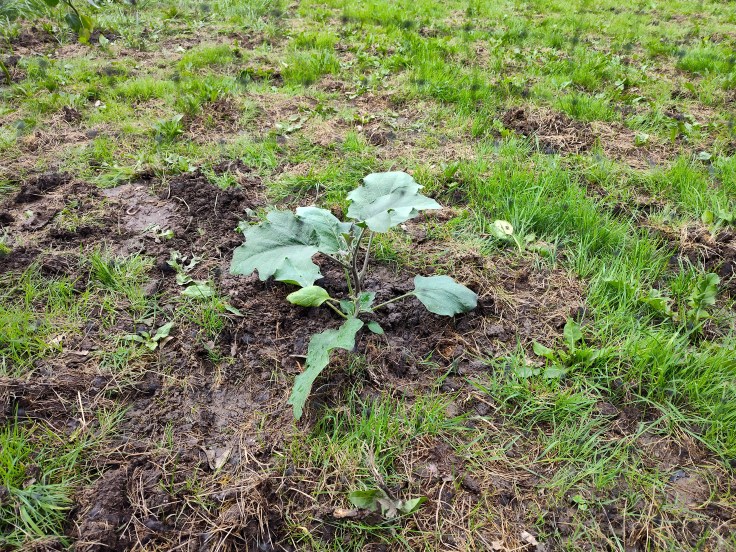
After learning that I needed to restart some of the seeds, I kept looking for opportunities last week in between the porch project to transplant starts, start new seeds, and restart some of the ones that failed. Sadly, it took until Friday, when the weather wasn’t great and we needed a day to rest, to find that time. That afternoon, I transplanted a bunch of tomato, pepper, and cantaloupe starts. I even transplanted a dahlia start that had outgrown its small starting cell. We didn’t buy any larger planting pots for this year’s garden after finding 10 or so of the peat pots from our previous garden. Beyond those, we’ve been reusing plastic containers that would otherwise be recycled.

Then, on Saturday morning, I took the time to restart the seeds that had failed and start some new ones that I hadn’t been able to get to. The ones that needed to be restarted were some tomatoes, peppers, cantaloupes, and dahlias. We also had to restart all of the eggplants, tomatillos, ground cherries, broccoli, and onions. The new seeds we started were our cucumbers, winter squash, pumpkins, and melons. We were originally going to start our beans at the same time; however, I read that they don’t need to be started indoors since they grow so fast. Instead, we’ll wait to direct sow them in the garden. With the newly remembered knowledge about heat mats, domes, the importance of air circulation for starts, and watering needs, we wait.

Gardening Requires Patience

I am not a patient person. I struggle to give things time and want to rush them. This is the case for gardening. At this time, we have a few plants that could be transplanted into the ground outside and other seeds that can be directly sown into the garden. However, the weather has been uncooperative, with cold temperatures at night that keep the soil temp low and consecutive rainy days, which isn’t ideal when seeds are trying to germinate or young plants are trying to establish roots. The rain has also prevented us from tilling the last two garden beds. I know that we’ll be able to get all of this done, but not rushing the process is difficult for me.

Up Next

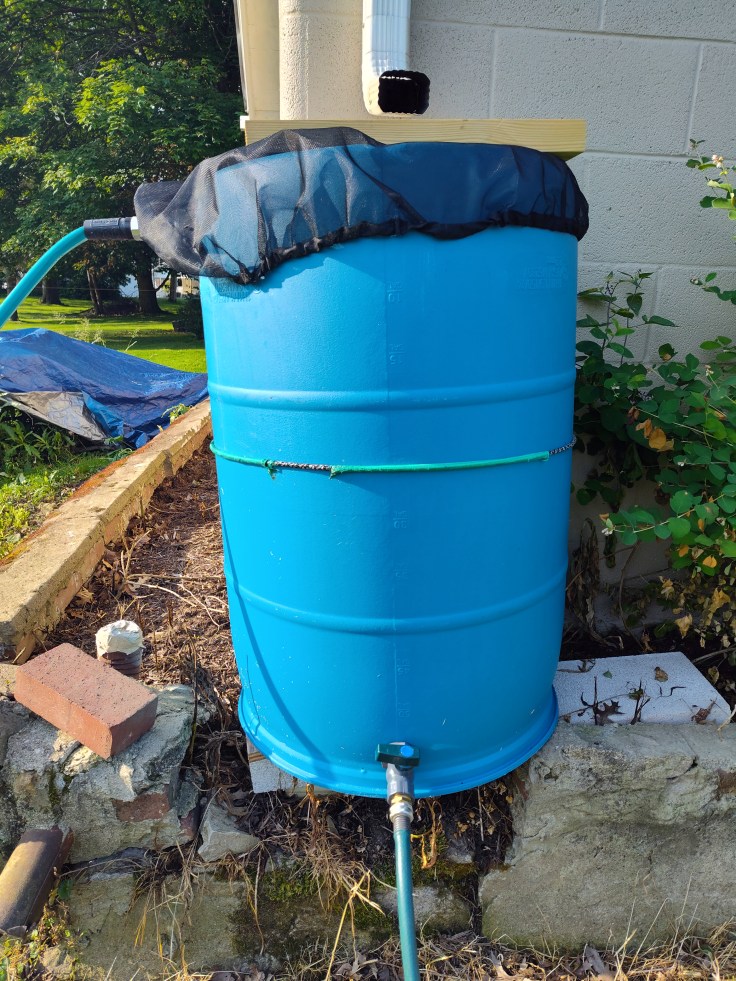
This week, we wait for the recently-planted seeds to germinate and to see how the starts do after being transplanted. The healthy ones have done very well in the first few days, while the ones that weren’t looking great in the original cells still don’t look too good. We also need to mow our grass for the first time this year, which will include mowing down the areas for the new beds and handling some of the grass that has regrown in the existing beds. Finally, we have plans to finish our screened-in porch when we can get to it and to work in the garden. We had success with setting up our rain barrel and have noticed its impact on the ground around where the downspout originally deposited water. I’m hoping for a pretty eventful week in the garden. Happy gardening to you.

Create a website or blog at WordPress.com

Up ↑