This is a follow-up to my recent post, ‘Will I Wear a Knit T-shirt?’, where I examined the fibers and wearability of a knit t-shirt and discussed whether this summer knit project could be a suitable option. Since then, I finished and got to wear a new piece of knitwear – my first knit tank top. I wore it in July, in full humidity with highs in the upper 80s to low 90s Fahrenheit. My experience surprised me – I said before that my knit t-shirts are wonderfully comfortable, but have a temperature and humidity limit for me, but the tank top surprised me!
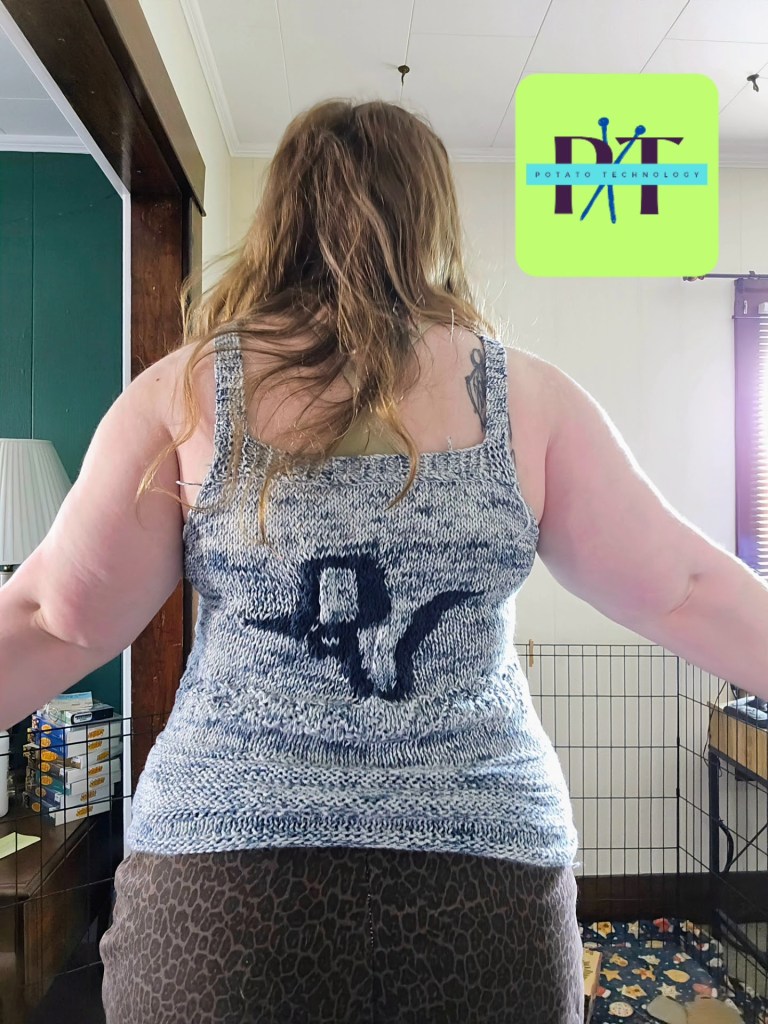
I think it was the high pima cotton content in the Knit Picks Comfy – a 75% Pima Cotton and 25% Acrylic mixture that uplifted the breathability for me. I was melting in the hot sun, but the air flow and temperature regulation were spectacular! This tank had delicate straps but did not have a lacy stitch or open weave. It was constructed with regular knit and purl stitches, with sections that had double layers of yarn due to two sections of colorwork graphics on the front and back.
With Pima Cotton, Silk, Bamboo, or Linen as the primary fiber, or a blend of these natural fibers, I believe knit tanks are just as breathable as woven fabric, and for sure more breathable than moisture-wicking tech fabrics, which are polyester. No, I wouldn’t work out in this top, but there is something to say for a garment that is comfy and breathable for those long summer days. It was a simple stitch-up up only calling for two hanks of 100-gram worsted-weight yarn, about 240 yards, with the addition of 1/3 or 40 yards of the accent yarn, another cotton-acrylic worsted-weight blend from Loops and Threads. You can make a tank like this for 30 USD or less, and this is a size large. So if you have a small amount of yarn, you can do a lot with it!
Do you think a knit tank would be an item you would wear?
In this week’s update, we have a lot of tomatoes ripening, but do we know the variety of each? It’s questionable. Our corn is starting to develop ears and silk. Along the same lines, we’re harvesting some beans, and there are a lot of blossoms on the other varieties. Finally, I’ll go over some general notes from the week, including pictures, and highlight this week’s Seed of the Week. Let’s dive in.
So Many Tomatoes
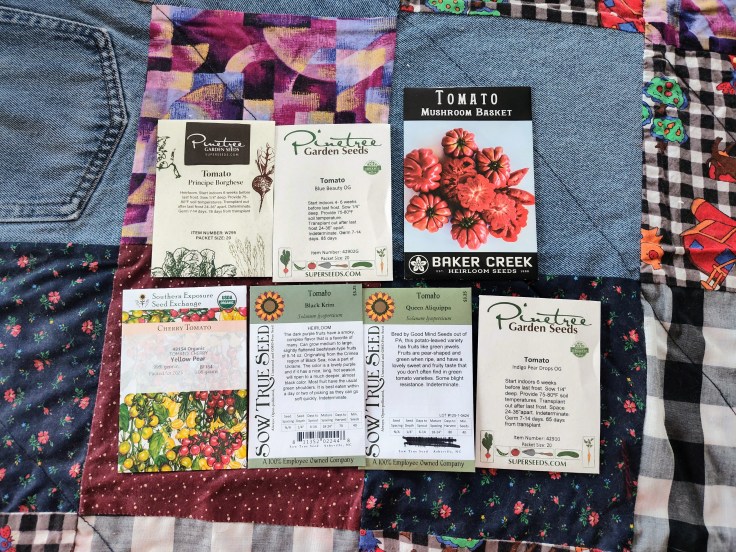
We have more than a dozen tomato plants, and the majority of them have fruit that is starting to ripen. Our paste tomatoes, which I originally thought were pear tomatoes, continue to grow and are now more than three inches long. Our actual pear tomatoes also have lots of fruit, and we harvested the first one on Saturday, immediately eating it. All of our pear and paste tomato plants have dozens of fruit on them. Then there are the Queen Aliquippa plants. These are the tallest tomato plants we have (more than three feet tall) and are growing lots of fruit. The problem we’re having is knowing when they’re ripe. Because they remain green when fully ripe, it’s not as obvious as red tomatoes. Thankfully, they develop a blushy red color on the bottom when they’re fully ripe, which will make it a bit easier to know when they’re ready.
That brings us to our Black Krim and Cherokee Purple tomatoes. These tomatoes look VERY similar to each other, growing to similar sizes when ripe and having similar colors and markings. Both are a deep red on the bottom with a dark blue/purple on the top. I think we bought two Cherokee Purple plants and four Black Krims, but it could be the other way around. The numbers could also be wrong. We kept the plant marker with the plants, but it’s currently buried under straw. If necessary, I’ll dig around to find it, but I’m hoping that we’ll be able to delineate between the two before that point.
Black Krim or Cherokee Purple Tomatoes
Corn Silk Developing
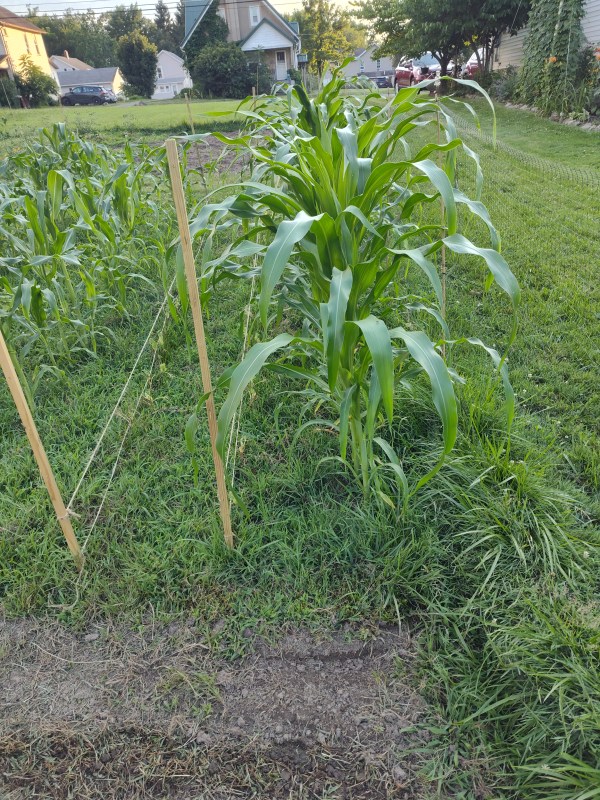
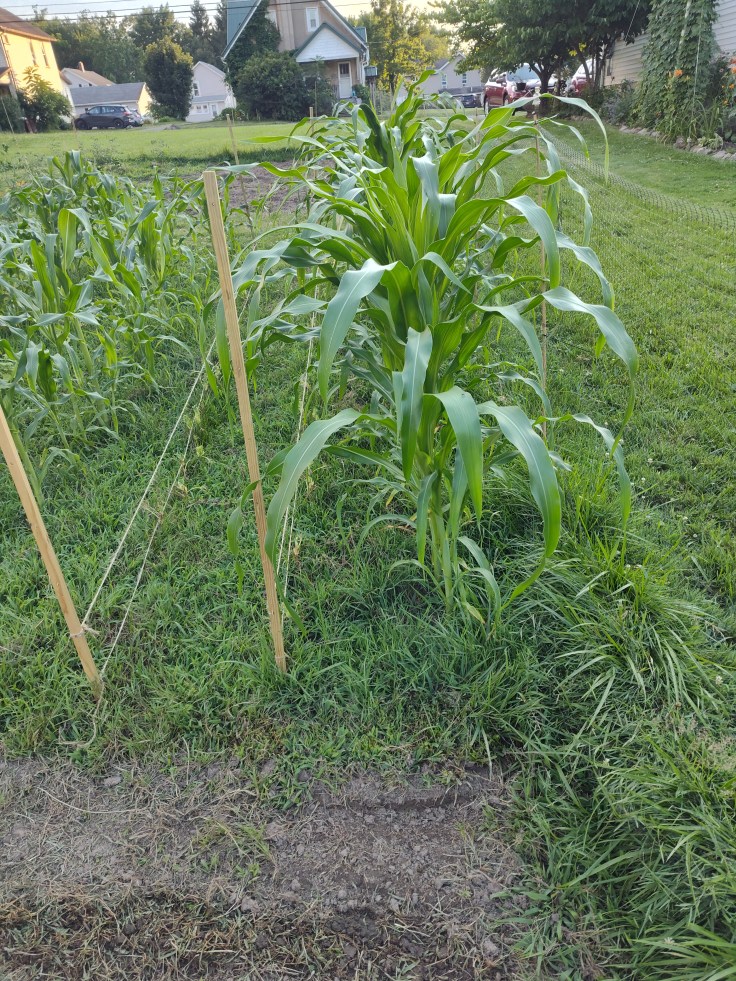
Over the past week, our Butter & Sugar and Black Mexican-Sweet Iroquois sweet corn plants have grown to a point where they’re in tassel, with roughly half the plants now developing ears with silk showing. I think they’re still weeks away from being ready to be harvested, but they’re well on their way. The other variety, Hopi Blue, continues to grow and is close to five feet tall now. The three rows of Black Mexican-Sweet Iroquois that I planted a couple of weeks ago have germinated with nearly a 100 percent success rate. I’ll likely thin these seedlings as needed this week.
Corn Silk
Beans Are Finally Starting to Produce
We haven’t had the greatest success with growing beans this year. The late spring and overabundance of rain stunted their growth, and to this point, they’re still only about 18 inches tall. In the past, we’ve had bean plants reach 30 inches tall. That being said, we are starting to see some bean pods on the plants. We’ve been pulling Provider bush beans for about a week now, but only a few pods per plant. Although the pods are pretty small, they’re delicious eaten right out of the garden. Our Jamapa plants are also putting on pods, with at least one being five inches in length. This bean is a shelling variety, though, so we’re going to let it dry on the plant as much as possible before harvesting. Finally, we have the Kebarika beans. These can be harvested as snap beans or as shelling beans. Our plants have been flowering for about a week now, so the bean pods will be following.
Notes From the Garden
Last week, I weeded and thinned our carrot and beet bed. You may remember that we’ve had a lot of issues growing both this year; however, I’m refusing to give up. My hope is that by clearing the area around the plants and thinning them to only one root every four inches, they’ll be able to develop and be harvestable.
We now have four spaghetti squashes on our plant. The first two are about seven inches in length, the third one is now four inches in length but still green, and the newest one is still a baby with the blossom only recently falling off.
The mystery plant beside our spaghetti squash has started to put on fruit. After flowering, the fruit starts yellow and turns green.
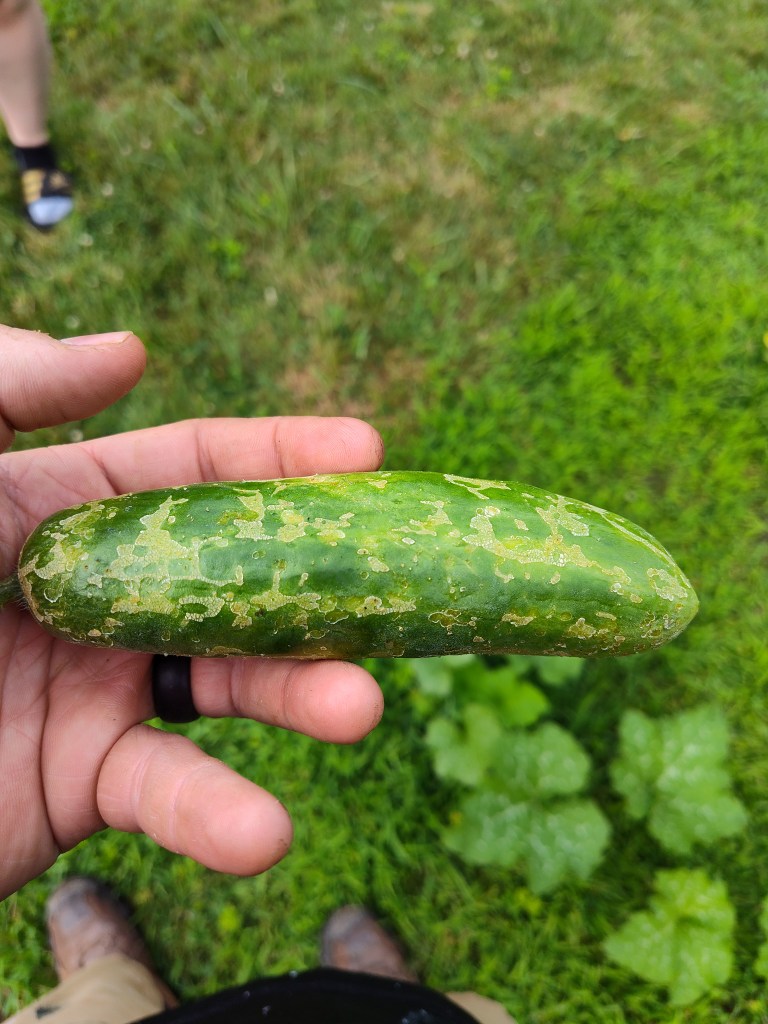
We are beginning to become inundated with cucumbers. Our Boston Pickling cucumbers are rapidly growing. We’ve already harvested three, and there are at least a half-dozen more on the vine that will be ready in the next couple of days. Our burpless variety has produced two more full-size fruit, but we’ve had a pest getting to them. There have been little scrapes all over the fruit, and it’s the only variety with these, which is confusing. We’ve added some straw beneath the vines and fruit to help with any dampness problems, and I sprayed some insect killer on the plant.
Our tomatillos are coming on furiously. I understand why people say that you can quickly become overwhelmed by how many you’ll have. We have three plants, and each of them has more than two dozen husks.
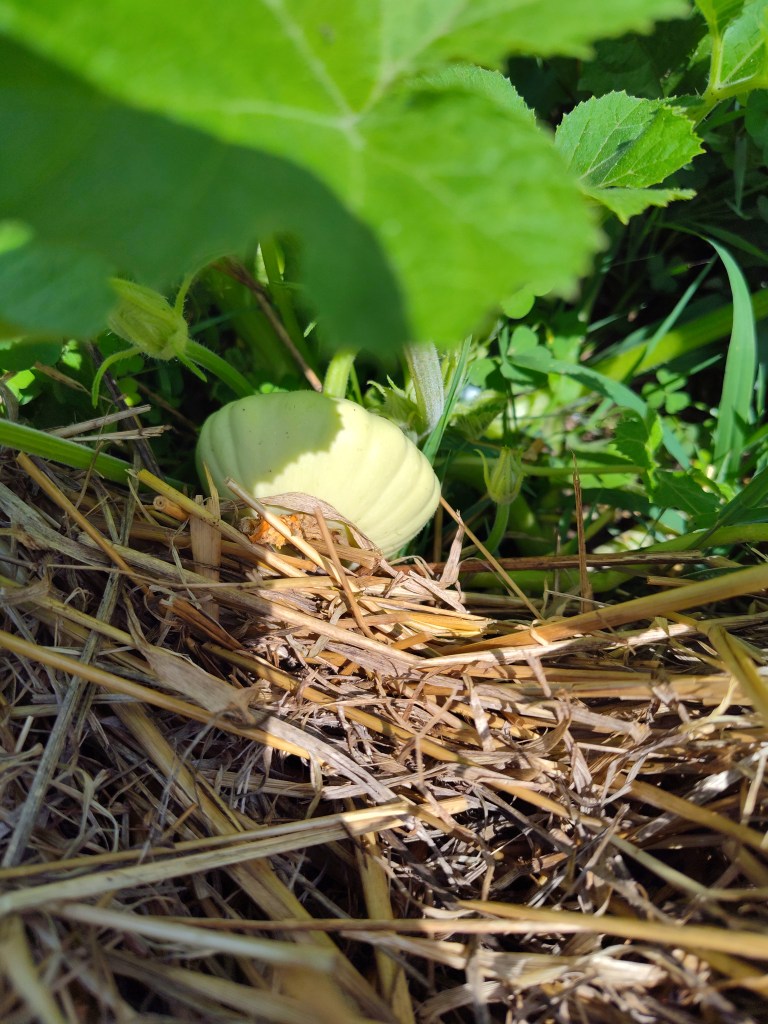
The first White Scallop patty pan squash that we saw is now about four inches in diameter and two inches tall. Everything I’ve read has said that these will grow to six inches in diameter and three inches tall when fully ripe. They should be ready within a week.
This week’s Seed of the Week is the White Scallop, mostly because it’s doing so well, and we’re close to harvesting our first one. The White Scallop is a patty pan summer squash that is rounder and flatter compared to a zucchini. It’s one of the oldest squash varieties and has been grown by Native Americans for hundreds of years. Baker Creek, which is where we bought the seeds, writes that these were first depicted by Europeans in 1591, so we have evidence of them being grown for at least 400 years. These are very easy to grow. The plants don’t vine out or sprawl, but instead grow vertically and stay compact. They’re supposed to be one of the best-tasting squashes. We’re very excited to eat these.
Up Next
We’ll harvest our first White Scallop squash this week. We’re also hoping to harvest more tomatoes, especially some of the larger varieties. We’ll also likely harvest more cucumbers and need to figure out how to preserve them. Happy gardening!
I recently joined a library again and it feels great. Going to the Meadville Public Library was a staple of our time as residents. Saying goodbye to those endless shelves, antique architecture, and Stars Hollow view of the gazebo from the sweeping windows was a precious gem I took for granted. When we moved to my current town, we checked out the new library and were underwhelmed from both the location – under the borough building – to the sparse and watered down collection. With current attack on public libraries by the big oaf and his minions, we decided to look around for a better option and we found it in a neighboring town.
With library card in hand, I downloaded an app my friend recommended – Libby. It’s a new to me digital book, digital magazine, and audiobook loaning platform that reminded me of audible but better, because its free. We briefly had an audible subscription to fill the void and it was a blast, except for the price. There was also a gatekeeping aspect to it, all these amazing audiobooks are here to change your life – now pay up. 🤨
Although with Libby, there are wait times, I deeply enjoyed my first listen. I chose ‘The Cousins’ by Karen M. McManus. I had started her book ‘One of Us is Lying’ back in 2021 and returned it before I could finish, but I liked her writing style. Since this title was checked out I went with her stand alone novel, for its mysterious yet Gossip Girl- esque plot.
The audio was smooth, with four different narrators that felt more like I was listening to a play than a book. It was atmospheric and enveloping. Listening to a book is my favorite way to craft. It keeps me engaged and off my phone.
What I have discovered since finishing ‘The Cousins’ is the magazine section which offers Marie Claire Korea, Vogue Japan, and several new Korean and Japanese fashion magazines I’ve never seen before. These are the editions I’ve seen my favorite bands featured in but have no way to interact with unless I wanted to pay $50 for an issue sold secondhand. All for free because of the library and the Libby app. I am delighted! 😄
Recycling is an important thing we should do. In the United States, only 21% of all the plastic gets recycled, and of that percentage, roughly 60% actually makes it through the entire process and is turned into something else. Of course, recycling is about more than just plastic, but plastic is the biggest problem. Plastic takes a minimum of 20 years to decompose, but some research suggests it can take up to 500 years for certain types to break down on their own. In the past, metal, glass, and paper/cardboard served the roles we now use plastics for, and all are easier to reuse, repurpose, and recycle. Take cardboard, for instance, which decomposes in two months. Plastic has its positives: it’s stronger, lighter, more flexible, and cheaper to produce than other items. Yet, we’ve become so dependent upon it that our landfills and oceans are full of it, and at this point, it may never go away.
Let me say that I’m not the greenest person you’ll ever meet. We have two gasoline-powered cars, and I don’t see the benefits of buying an electric vehicle, considering the damage that is done to mine the lithium needed for the batteries. The majority of our outdoor power tools are gas-powered, with the exception of our push mower, which is battery-powered and has plenty of problems. I like gas-powered things for their simplicity and how easy they are to work on. I also don’t believe that humans are the sole culprit behind climate change, nor do I think we can be the sole reason it is reversed and saved. I believe that the Earth’s climate has always been cyclical and that we’re currently in a warming trend.
That being said, it is my belief as a Christian that God created the Earth and gave humans the responsibility of stewarding it and all that’s on it, and we’ve failed in just about every aspect. We treat animals and the Earth’s natural resources with a level of disrespect that we would be offended if we were treated the same way. Most don’t think about or value the sacrifices made by the animals when we consume them, and few stop to consider how we need to put resources and nutrients back into the land to replenish what we’re taking from it. I despise fast fashion because of the toll it’s taking on the land and those who make the garments. I also can’t stand the gross willingness to exchange our natural resources for a quick buck. At the same time, I despise greenwashing and any attempt to profit off people’s convictions, especially if there’s nothing behind a company or person’s marketing.
That tangent may have been unnecessary, but I wanted to explain the position I am coming from. I want to be as respectful and loving toward the Earth as I can, but I don’t think that should come at the cost of humans, especially those in underdeveloped areas (have we learned nothing from colonialism?). I think we should put forth real efforts to recycle, but recognizing that it remains a flawed process and system, reusing items is equally, if not more, important. This is where I found myself as I began to think about how to recycle in the garden. To me, it’s only natural to seek out ways to reuse items when you already care enough about the land to reduce your dependency on commercial farming.
Here are some ways we’ve been able to recycle and reuse household items in the garden.
Yogurt Containers
I first learned about using yogurt containers in the garden after watching an MI Gardener video on YouTube. He recommended cutting the small single-serving containers into 1-2″ strips and using them as labels for starting seeds or in the garden. This is a great way to repurpose these containers since many gardeners buy the plastic/vinyl labels anyway. Any plastic container can be cut for this purpose as long as the marker you’re using to write the seed name stands out from the plastic. To me, the best part of using plastic containers this way is that they can potentially be used for multiple years, but if they can’t, you can still recycle them when you’re done using them.
I used yogurt containers in two other ways. One was for soaking bean seeds overnight and transporting them out to the garden for planting. The second way was to start seeds in them. This wasn’t as successful as the dedicated starting cells, but I’m planning to try it again next year. In theory, yogurt containers should work well since they hold more soil than the starting cells you can buy. My attempt at using them this year failed because I didn’t cut enough drainage holes in the bottom to help the excess water run out.
Gatorade (or Other Plastic) Bottles
We keep our seed starting setup in our basement, so I carry water to the plants rather than the plants to a water source. You may remember that I initially recommended using a cheap spray bottle for starting seeds, but I eventually switched to Gatorade bottles and watered the seeds from the bottom. You can use any bottle for this purpose, but Gatorade bottles are a nice size.
Woodworking Scraps
As a woodworker, I accumulate a lot of scraps. I struggle to throw away any pieces, even if it’s unlikely that I’ll ever be able to use them again. Thankfully, gardening gives me a way to use scraps that can’t be used in other woodworking projects. I’ve found that a lot of my cut-offs from squaring up pieces of lumber are the perfect size to stake up plants. I will use any unfinished wood, including pressure-treated, and tie the plant to it with a garden twist tie. Using these cut-offs saves money, since we aren’t buying anything new, and they should last multiple years.
I also used scraps to build the planter box and trellis system for our long beans. This project wasn’t technically recycling anything, but I decided to mostly use scraps instead of breaking down a full-size board.
Rabbit Droppings
Not everyone will be able to do this, because I’m not advocating for you searching through your yard for wild rabbit poop. However, if you’re lucky enough to have an adorable pet rabbit like we do, you can use their droppings as fertilizer. In fact, you can use most animals’ poop, but I would stay away from dog and cat feces. Rabbit poop is considered “cold” manure and doesn’t need to be composted or broken down before being applied to the garden. Basically, any animal that produces pelletized poop (goats and sheep are also in this category) can be directly applied. However, other animals, like chickens and horses, have “hot” manure and must be composted first. These animals can carry pathogens and diseases in their feces, and the poop can literally burn the plants if immediately applied. And dog or cat poop should never be used as fertilizer.
Rabbit poop, in particular, is a great fertilizer because it’s high in nitrogen, which is slowly released as the droppings decompose. When you figure that a domesticated rabbit produces up to 200 droppings each day, it can be a substantial fertilizer source, saving you a lot of money. Do yourself a favor: Adopt a rabbit, experience how wonderful they are as pets, and get the added benefits for your garden.
Milk & Juice Bottles
In the spring when the weather can be a bit volatile, it’s not uncommon to have frost advisories after your plants are in the ground, and they need to be protected. There are products sold to meet this need, including ground sheets, but my dad always kept his gallon-size milk bottles to keep his young plants insulated from the cold air. It’s easy to do. Cut either the top or bottom of the bottle off and place it over your plants. That’s it. This keeps warm air trapped inside, prevents the cold air from reaching the plant, and works as a greenhouse, which will help your plant to grow quickly. Milk bottles aren’t the only option, either. You can also save bottles that once held juice, vinegar, tea, etc. If the bottle was able to hold a consumable liquid, it’s probably okay to use in your garden. Just be sure to thoroughly clean it first.
Compost
This feels a little like cheating, but isn’t composting the ultimate act of recycling? You take food scraps that you didn’t eat and convert them into nutrients for your soil. These scraps can be the rinds of melons or strawberry tops. They can also be produce that has gone bad. Throw them in your composter, and they’ll eventually be converted into quality compost that can be mixed into your soil, which adds nutrients to help with your future gardens. If you don’t already compost, I recommend giving it a try. You can buy affordable composters or even build one yourself, and with a little bit of work and a lot of time, you can have a soil amendment that is nearly free.
Cardboard
Like plastic, we use a lot of cardboard in modern society. With all the online shopping and shipping that takes place, it’s common to have multiple cardboard boxes arrive at your house each week. Like I said in the intro, cardboard is great because it quickly decomposes, so no matter what you do with it, it isn’t going to cause long-term harm to the environment. Like most people, we always recycle our cardboard, but before doing that, we look for ways to reuse it. If we need to change the oil in the cars soon, we keep a few sheets on hand to put under the car when doing the oil change. We have also started keeping specific boxes and cardboard packaging to create Halloween and Christmas decorations. But cardboard can also be used in the garden. Because it breaks down so quickly, cardboard is a great form of mulch and compost. In the fall, after everything has been harvested and the plants have been pulled, you can lay sheets of cardboard on top of the soil and allow them to decompose. In the spring, this material will be organic matter that will improve soil quality.
Produce Containers
Eventually, if everything is successful in your garden, you’ll need containers to put your vegetables in after harvesting. We bought a couple of orchard baskets to use in the garden to make it easier to transport everything into the house, but those won’t work for storing vegetables. That’s where saving and repurposing produce containers come in. The plastic packages for cherry tomatoes, strawberries, and blueberries work perfectly for your smaller tomatoes. If you can find any of the cardboard/paper containers used at orchards, those are perfect for your larger tomatoes, peppers, potatoes, and tomatillos. Finding a way to repurpose what you have will save you a lot of money versus buying something specifically for this purpose.
Future Recycling Opportunity: Egg Cartons
I haven’t tried this yet, so it may be a massive failure, but I saw some of our leftover pressed paper seed starting cells yesterday and noticed how similar they are to egg cartons. I’m talking about the cardboard/pressed paper ones; not the foam ones. They’re about the same size as the cells we have, and with a drainage hole added, they would probably work to start seeds. I am going to give this a try next year to see how they do and will report back.
Recycling Where Possible
None of what I mentioned in this post is what most would traditionally call recycling. But it’s a literal understanding of it. It’s repurposing things that may otherwise end up in a landfill. And at the end of the day, the plastic from the yogurt may eventually wind up there anyway, but we’re giving this plastic a second life before it ends up in the recycling bin. I think it’s important to make attempts to improve the environment where possible, especially when we’re already dedicated to sustainable gardening through crop rotation and doing as little tilling as possible. I hope that you found this post helpful and may consider one of the things I mentioned.
This is inspired by a discussion from Maybe Bre, which made me reflect on something I hadn’t discussed before. As well as my own experience wearing clothing, as a garden-variety human who loves fashion but doesn’t always enjoy how our clothing is made.
By this, I mean the patterns and fastening of our modern times. The zipper is a wonderful thing, and so is the structured waistband. I love them in jeans because denim that isn’t compromised by stretch is a rugged and sturdy garment that isn’t a piece that conforms to you; your body is housed within the trousers. I feel the same way about a structured coat. In doing so, I buy these pieces oversized for comfort, which leaves me with a garment that most of the time doesn’t technically fit me. If I did buy it to fit me right now, there is no guarantee that over many decades it would continue to fit me – I’ve been burned before by this problem. Hence, all my “staple, investment pieces” from college no longer live in my closet because they are no longer my size. If I had planned ahead and bought them a bit oversized, they might still be with me, but they wouldn’t have “fit” me at the time.
My problem with clothing is becoming clear, isn’t it? I desire longevity and wearability from clothing, in a way that is not offered off the rack. I desire my clothes to grow and shrink with me, depending on how my body changes over time. This has been my design focus in the last few years as I have placed myself in the driver’s seat of my wardrobe through the process of sewing and knitting.
My idea is not innovative; it is historical. Clothing, because it was so expensive and hard to make, was more adaptable in the past. Fastenings such as tie waist, lacing, and buttons with multiple sizes of tightness were common because clothing was not as easy or cheap, and they were not seen as disposable or replaceable. Changing fashions came with garment reworks, ye olde upcycling as it were. This is what I desire: the ability to change the fit of my garment.
I recently figured out how to sew with elastic, which is a game-changer for shorts and gathered sleeve hems! Before this, though, I was making most of my bottomweight garments with tie waists or several options of buttons to let the garment adjust to the needs of the day, I’ve also sewed with intentional relaxed fit, initially due to a lack of tailoring skill but over time it has been to allow wiggle room in pieces I have spent days or weeks of my life crafting.
Being present in the making process has taught me to treat my clothing with more respect, even when it is time to discard the current version of it for something more useful. I’ve stopped donating as much, decluttering, and rebuying, to be honest, to be more intentional with the garment and its life cycle. I am the one who brought it to life, I can’t simply consume and discard it like it is nothing. I am deprogramming my brain from decades of fast fashion insanity.
I believe if clothing were made with this design philosophy, that clothing would fluctuate with you over time, I believe we would enjoy wearing our clothing more because instead of buying stretch fabric everything, we could still wear good natural fibers, maybe a bit bulkier than spandex and less figure hugging and lurex denim, but would be better for the humans and the planet. Style and substance, as they say on the Great British Baking Show!
In this week’s update, we harvested and began eating from our garden. I’ll tell you what vegetables they were and how we ate them. We also started more corn for a late harvest and planted the last melons we’re growing this year. I’ll provide a general update on everything we’re growing as well. Finally, this edition of the Seed of the Week takes us to the American Southwest, where a variety of corn has been grown for over 800 years. Let’s dive in.
First Harvest
This week saw us achieve a goal we set at the start of the garden: Harvest something from our garden and eat it the same day. That included three cucumbers and two eggplants. Two of the cucumbers were from plants gifted to us by our neighbor, but one was a Boston Pickling that I started from seed, making it the first fruit harvested from this year’s garden that I started from seed. We ate the cucumbers raw by slicing them and eating them on the side with dinner. For the eggplants, Magz sliced them into coin shapes and roasted them in oil and seasoning. They were delicious. We’ve found that doing as little as possible with high-quality, fresh vegetables is the best thing for them. We have a lot more cucumbers coming on, and there are more eggplants that are close to being harvestable, so we’ll be eating a lot more of them moving forward.
Starting More Corn
We had some open areas of our garden beds where potatoes weren’t growing, which we think is the result of poor drainage and too much rain early on. In the open rows, we wanted to grow more of something that we’ve had great success with: corn. We still had some Hopi Blue and Sweet Mexican/Black Iroquois seeds left, but because the Hopi Blue corn takes a lot longer to reach maturity, we planted the rest of the Sweet Mexican/Black Iroquois seeds. All three varieties (the above two and Butter & Sugar) have done exceptionally well, and a late planting of corn could lead to us having sweet corn in September.
At the same time, we planted all the remaining melons and squashes that we’re growing this year. In a few more open spots, we dedicated two of them to the White Scallop Winter Squash, three of them to Ali Baba Watermelons, and four to the Noir de Carmes cantaloupes.
A General Update (With Pictures!)
Our tomatoes continue to put on fruit, with the Cherokee Blue, Black Krim, and Queen Aliquppa growing close to full size. Now, we just wait for them to ripen.
Our Cal Wonder pepper plants have quite a few fruit on them, but they haven’t reached full size or started to ripen yet. Our plants also haven’t grown to full height, which is weird. I read that peppers are one of the slowest-growing plants and require hot temperatures and full sun, which we’ve had lots of this summer. I’m still holding out hope for them.
Our melons, squash, and pumpkins are all doing well. We have spaghetti squash that are close to softball size and many cucumbers that are growing. Most of the other plants are producing blossoms.
The tomatillos have been growing their husks for more than a week now, with one of them larger than a golf ball. There are many husks starting and even more flowers coming on at the same time.
We are finally starting to see some progress with our beans. The first batch of Provider beans has a few beans on the plants, which is major progress, even if the pods are small. Our Kebarika and Jamapa plants have started to produce flowers.
TomatilloBean blossom
Seed of the Week
Our Seed of the Week this time is the Hope Blue corn variety. It’s a very old type of corn that has been grown in Northern Arizona for over 800 years by the Hopi Native American tribe. This variety is a flint/flour type of corn and is milled down into cornmeal or flour. The Hopis use it to make a ceremonial type of bread called piki. But even though this variety is primarily used for flour, it can be eaten as sweet corn.
The kernels of Hopi Blue corn are dark blue, nearly black, and the stalks grow up to nine feet tall. We got our seeds from Fedco out of Maine, and on the listing, they quote one of their growers, who says that the corn is “crunchy, corny and wholesome.” We’ve had great success with our Hopi Blue seeds. They overcame torrential downpours within a week of being sown and have excelled. The stalks are currently taller than our fence (so about 4 1/2 feet) and are gorgeous. If you’re curious about growing different varieties of corn, give this one a try.
Up Next
This week, I’d love to see some of our tomatoes begin to ripen. Our cherry tomatoes are pretty much full size, so ripening is the next step. I also think we’ll harvest some of our beans. Beyond that, we’re enjoying how relaxing it is to watch our garden grow. Each day, something new happens or we can see measurable growth. For example, we had a cucumber grow multiple inches in one day. It’s unbelievable. I hope your garden is doing well. Happy gardening.
A couple of weeks ago, I wrote a post on the 5 hardest seeds to grow this year. If you haven’t read it yet, I recommend checking it out. In it, I went over the 5 seeds that I’ve had the most trouble with this year. It could have been the result of an error on my part, poor weather, or something else entirely, but for whatever reason, I couldn’t get them to grow.
Today, we’re going to look at the 5 seeds that I’ve had the best luck growing this year. I didn’t treat these seeds any differently from the ones listed in the previous post, yet they took off and are growing abundantly. With each seed, I’ll go over what has made them a success and why I think each was easy to grow. Let’s dive in.
5.) Queen Aliquippa Tomato
I’ve written about this seed so many times that people will get sick of it. We didn’t know this tomato variety existed until we saw it in this year’s Sow True Seeds catalog. They’ve been selling it for years, but this was the first year we requested their catalog. As a refresher, this tomato variety is named for Queen Aliquippa, a Seneca nation leader who lived in Pennsylvania during the 18th century. She is so well-known in Western Pennsylvania that a town, a school, and businesses are named in her honor. In fact, the town of Aliquippa is only 10 minutes from where Magz and I went to college.
These seeds could have been a bust, and I still would have been happy we bought them. Thankfully, that hasn’t been the case. Of the first batch of tomato seeds I started, only 3 are still alive, and 2 of them are Queen Aliquippas. I treated the Queen Aliquppas the same way as the other tomatoes; however, the others didn’t take off.
These plants have gone through a late Spring that resulted in them getting leggy at the start, multiple torrential downpours, and a week of excessive heat, but they remain our best-looking tomato plants. We have since transplanted a few more plants that I started later, and they are also looking good. The Queen Aliquippa tomato plant is unique among the others we’ve grown. It has potato leaves that aren’t serrated like a typical tomato plant. When ripe, the fruit will also mostly stay green with a bit of amber at the bottom. To this point, we’ve loved growing this variety, and assuming we like how they taste, we’ll continue to grow it in future years.
4.) Seminole Pumpkin
These pumpkins have done exceptionally well so far. We have plants that were started indoors and transplanted outside and ones that were direct sown. Regardless of how they were started, they’ve grown well. We don’t know how many of these plants we’re growing because I misplaced the labels when transplanting the ones I started from seeds, but we think there are 3 or 4 of them. The ones that were transplanted have vined out about 2 feet from the roots and are getting ready to produce flowers. The ones that were directly sown are smaller since they were started later, but all of the plants look healthy.
Even though these are called pumpkins and have pumpkin leaves, the fruit doesn’t look like a typical pumpkin. It’s buff-colored rather than bright orange and reaches about 6 inches in diameter. They can be stored for up to a year but can also be picked early as a summer squash. These have required little attention. Since transplanting or starting them, we’ve made sure they have been consistently watered, and I side-dressed the older plants with some bone meal. If you’re looking for a smaller and historical variety to grow (these were grown by the Seminole people of Florida) and you live in a hot and humid climate, you’ll love these.
3.) All Corn Varieties
Before we started gardening, a common remark I’d hear was that growing corn is hard or not worth having in the garden. I don’t remember any family members trying to grow it. Now, that could be because fresh sweet corn was plentiful and cheap where I grew up, so it may not have been worth the effort in people’s minds. Magz and I first tried growing it in containers in 2022 and had success with it. We had 3 stalks in each tote, and they produced small ears that were delicious.
This year, we bought 3 varieties: Hopi Blue, Black Iroquois/Mexican Sweet, and Butter & Sugar. The Hopi Blue is a flint corn for grinding into meal or flour, the Black Iroquois/Mexican Sweet is a dark-kernel sweet corn, and the Butter & Sugar is the common bi-color sweet corn. We planted a row of each on the same day in May after the threat of frost had passed. Immediately, we had a week of heavy rain that totaled more than 3 inches. I was nervous that the seeds had washed away because some of the soil had been relocated, exposing the seeds. We covered them over again, and within 2 weeks, nearly all of them germinated.
At this point, all 3 varieties are doing well. The Hopi Blue is more than 4 feet tall already and can grow up to 9 feet tall, while the others are about 3 feet tall and should only reach 5-6 feet tall. Yesterday, when I was checking out the plants, I noticed the tassel developing inside the leaves for the first time. Corn is an easy, low-maintenance vegetable to grow. Besides weeding and watering, the only thing I’ve done is give the plants consistent nitrogen. Corn is a heavy feeder, so it needs extra nutrients to reach full height and develop big, full ears. If you’ve been on the fence about growing corn, it’s worth a shot. It doesn’t require a lot of work, and seeing corn grow is a beautiful experience.
2.) All Cucumbers
Cucumbers are another vegetable we’ve had success growing in the past. In our container garden, we grew a pickling variety, and we were pulling multiple ripe cucumbers off it daily. This year, we bought 3 varieties to grow: Boston Pickling for pickles, Tendergreen, which can be harvested for pickles or left on for slicers, and Richmond Green Apple, an Australian heirloom. We were also gifted 2 starts of a burpless variety from our neighbor.
I started the 3 inside and transplanted 2 plants of each variety into the garden. At the time, they didn’t look good. Like other plants, they were leggy at the time, and the weather wasn’t friendly to growing cucumbers. However, within a couple of weeks, they took off and now have blossoms on them with small fruit growing. The starts we were gifted also weren’t healthy when we transplanted them, but they’ve taken off and have produced 2 fruits already. These have required little maintenance other than a side-dressing of fertilizer. We may need to trellis or stake them at some point, but up until now, they’ve grown nicely without any assistance.
Bonus: Most Melons, Squash & Pumpkins
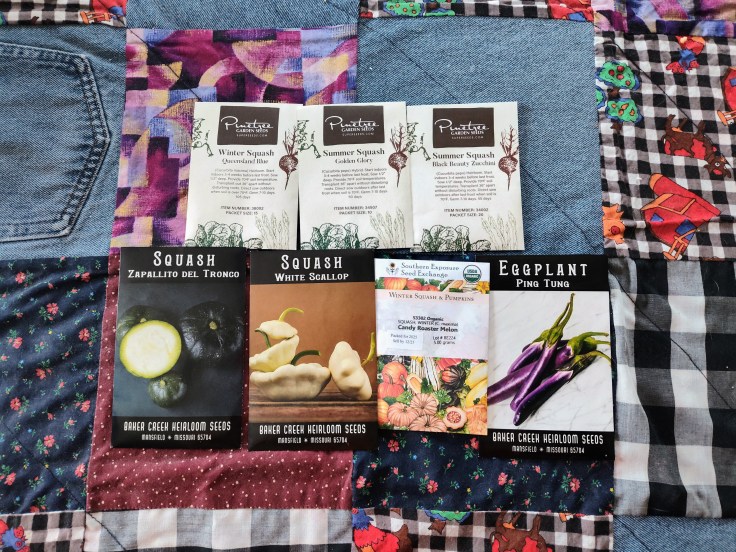
Because I didn’t want to have a listing for all melons, squash, and pumpkins, in addition to already having all corn and cucumbers, I wanted to add an honorable mention or bonus section. In this section are all melons, squash, and pumpkins. The Seminole pumpkin deserved its own listing, but most of the things I wrote about it apply to all of these. Quickly, these are all the melons, squash, and pumpkins that we are growing:
Ali Baba Watermelon
Noir de Carmes
Tigger Melon
Hokkaido Pumpkin
Black Beauty Zucchini
Candy Roaster Melon
Golden Glory Yellow Zucchini
Queensland Blue Winter Squash
Zapallito Del Tronco Zucchini
Ping Tung Eggplant
White Scallop
Kakai Winter Squash
Jarrradale Pumpkin
Dark Green Yuxi Jiang Bing Gua
New England Sugar Pie Pumpkin
Of the above seeds, the only ones that haven’t done well are the Black Beauty Zucchini, Golden Glory Yellow Zucchini, and the Ping Tung Eggplant. I don’t know why the zucchinis didn’t do well since they were planted at the same time as the Zapallito Del Tronco, but they didn’t. Only 1 Black Beauty and none of the Golden Glory seeds germinated. The eggplants were started indoors and never got to the point where they could be transplanted outdoors. The others have all done well.
I started a lot of the squash, melons, and pumpkins indoors. They immediately took off, but we couldn’t transplant them right away due to the weather. As soon as the weather broke, they were moved outdoors, but I had little faith in them doing well. All but 3 of the plants lived and are thriving. We also directly sowed a bunch of them later in early June, and they’ve done exceptionally well. All of the plants look healthy and are growing vigorously. What’s most interesting is how all the squash, all the melons, and all the pumpkins have similar leaf structures and growing behaviors, but have subtle differences between the varieties. For example, the Seminole pumpkins have silver lines on the leaves that the other pumpkin plants don’t.
We bought additional seeds (these are the ones in orange text) in late June to have a wider variety of pumpkins and squash. To put into context how quickly and easily these grow, I started them on Saturday evening. By Tuesday morning, the Hokkaido had germinated, and by Wednesday evening, the Dark Green Yuxi Jiang Bing Gua and Sugar Pie Pumpkin seeds had as well. Consistent moisture levels, full sun, and warm temperatures are the perfect recipe for these. If you find a variety you are curious about, give it a go. Odds are that it will do well.
1.) Provider Bush Bean
I love beans. In the United States, we’ve done a horrible job of educating people on how many bean varieties there are and all the ways we can use them in food. In most grocery stores, the only fresh beans you’ll find are green beans, and you may find some edamame or snap peas, which aren’t beans but are similar enough to include them here. I think that a lot of Americans picture canned beans when they think of beans. Whether these are green beans, black beans, pinto beans, or kidney beans, the average American doesn’t envision bags of dried beans or fresh varieties that are a color other than green. I’ve grown bush beans in the past, but this year, we found ourselves interested in growing other varieties.
American history is filled with people of the past growing bean varieties that were vitally important to their culture and heritage. Baker Creek sells a variety that was found in a New Mexico cave and dates back 1,500 years. In the South, Southern peas (also known as asparagus beans or Cowpeas) were preserved by slaves as a way to save their heritage. It’s the same in Latin America, South America, and Asia – beans (and all seeds) tell stories.
We attempted to grow 5 varieties this year: Kebarika, Jamapa, Red Bush, Provider, and Chinese Red Noodle. We’ve had moderate success with the Kebarika and Jamapa and nearly no success with the Red Bush beans. However, the Provider and Chinese Red Noodle beans have excelled. I planted the Chinese Red Noodle beans in a planter box I built, and they are currently climbing the trellis to a height of 7 feet.
I planted the Provider beans in our bed with the Kebarika and Jamapa, and they’ve done pretty well. They’re not real tall yet (about 18 inches), but are still growing and have started to flower. But when our Red Bush beans failed (only 1 successful plant among a full row of seeds), I planted more Provider beans in the same row around the lone Red Bush bean plant. So, it was the same growing conditions. Within 2 days, almost all the seeds germinated, and at the time of writing this, the plants are nearly the height of the Red Bush bean plant, which is more than 2 weeks older. As Magz pointed out, the name Provider is pretty on point. These plants provide.
So, there it is. These are the (more than) 5 plants that I’ve had the easiest time growing this year. All have a few things in common: they grow in spite of the weather, my mistakes, and questionable soil quality. They’ve all required little maintenance and make you believe in yourself as a gardener. Have you tried any of these varieties? If not, I recommend giving them a go. Do you have any favorite seeds to grow?
I asked myself this question last summer with genuine uncertainty. Knitting is such a cold-weather medium that a knit made to be breathable and light for warm weather seemed, well, a bit like an impractical fashion piece. I think this is an important question to ask of ourselves before we jump on a trend. Whether it is to buy a knit t-shirt or to handknit (which means you are dedicating weeks of work to a project), having the right expectation matters. Trying on a knit t-shirt beforehand helped me visualize what I was in for. Knitwear for all seasons is currently having a moment even in ready-to-wear, which makes this a great time to go try on a piece before committing to a big project.
Wearing my Grandma’s cotton knit t-shirts, although they were two sizes too small, helped me visualize knit as a process to make a fabric instead of a woolly winter garment. That’s what makes knitting and crochet extraordinary skills; they are versatile. The fiber maketh the project. The stitch maketh the airflow. Lacey, open weave? Fantastic for hot and humid days. Not so much for a pair of mittens.
To remedy this, I think fiber acquaintance is a fantastic way to learn whether a knit t-shirt is right for you. When I began knitting in 2012, I knew there was wool yarn and acrylic yarn. That was it. However, there is actually a rainbow of fiber waiting to be discovered, and the lineup sure has expanded in the last 13 years!
Cotton
Linen
Bamboo
Hemp
Pineapple
Lyocell
Rayon
Yak
Alpaca
Camel
Mohair
Cashmere
Silk
Did you know that wool has two unique properties? It helps you regulate temperature and is naturally antibacterial/antimicrobial; therefore, it inhibits bacterial growth naturally on the fiber and prevents odors, which is why it is such a great sock material! Although I wouldn’t recommend wool for summer tops, it is a remarkable fiber. There are two fibers, though, that are breathable and naturally don’t let bacteria and microbes hang around – it’s linen and silk! For fiber education and the chance to feel these materials, I recommend finding a friendly local yarn shop and talking to the experts.
Finally, I do have one possible hiccup with my current selection of hand-knit t-shirts. I can’t wear them in 85 degrees Fahrenheit weather and above with humidity, but I do believe a knit tank would fix this problem, and a lacey stitch technique in future projects will solve this. I don’t like sweating a lot in my handknits, and because I was learning with my first few tees, the knitted cotton fabric is a bit bulky. That’s my error. You know what is so cool about knitting, though? You can unravel the finished garments and try again, so I can rework these finished garments in the future. Anyway, I hope you will consider the knit t-shirt as a warm weather staple in your wardrobe, it’s a lovely way to use crochet and knitting all year round!
A few months ago, I wrote about my 2025 being a creative slump. Well, things have changed, and now I’d say I’ve found my pace. It’s a dash! I have more ideas than my hands can craft and it feels freeing, like all the crap from the past few months have lifted and the world makes sense, as long as it is crafted from needles.
New Materials
Maybe it’s the new yarns? I’ve been branching out to find new brands and new favorites. Loops and Threads cotton has provided an affordable fiber to try new techniques and play around. The Caron Big Cakes and Blossom Cakes are getting me excited for every stitch, and Knit Picks Pima Cotton has been a dream to work with.
With the news of Big Twist coming to Michael’s, I’m excited to have my tried and true affordable winter yarn to keep pushing my creative limits.
The most exciting new fiber, though, is a recent pickup from my local farmer’s market. A skein of yarn, from sheep in my neighboring county, that was processed and spun over the border in Ohio. It’s not quite the LYS I was wishing for, but it makes me hopeful for the future!
DIY Merch with Yarn
The North American leg of the 2025 Stray Kids Dominate Tour made me feel some big FOMO for the unique merch sold at the shows. From the SKZ Baseball jerseys to the Evil Skzoo tees, dang, I wanted to participate, until I heard the stories of long hot lines at the baseball stadiums and endless screechers, I came back to reality. But – it got me thinking, why can’t I make my own? So I’ve been designing, knitting, and feeling a buzz of happiness because these pieces are some of my best work to date. I can’t wait to share them!
Kokka Fabrics and Firecracker Fabrics
I’ve found new fabric sources and new go-to brands I love. In support of small businesses, I made a purchase from a local fabric store – Firecracker Fabrics, online, because honestly, it is far too difficult to go into Pittsburgh in road work season. Through this purchase, I fulfilled a goal – to try Kokka Fabrics. They are a textile design brand out of Japan, which is sold at my local shop, and it was a dream to work with! With the bad news of Joann’s and the uncertainty of tariffed materials, to be honest, I was thinking my sewing days would be cut short, but this is a fantastic resource. It was affordable, good quality, and unique – all the things I look for in fabrics but have struggled to find at Joann’s, which made me shop at Mood Fabrics. Now I have another option!
I also thrifted some fabric from my in-town thrift store, truly unique fabric that has pushed me forward to try making shorts again and overalls. For not sewing as quickly this year, the garments I have completed are more daring, and I think that is the new materials and new techniques, like elastic, that are pushing me to design more than just sew. I feel like I am back in my 2021 mindset, and I am ready to make clothes that express my design point of view. I lost that in 2023 and got burnt out in 2024, yet a six-month break got me back into it. Maybe that is one good thing that has come from the chaos – a break to reset.
New Inspiration
I’ve found inspiration from K-pop stages and historical sewing channels up to this point, but it was getting stale. Nothing was sparking that drive to create, until recently, when I found some new making channels. I like to watch other people make things, not to copy, but to learn by observing and then channel what I learn into my own inspirations, such as learning how to embroider, make eyelet openings for corset-ish vests, upcycling ideas, etc. A recent find has been Maybe Bre’s channel with her “Mama Mia Summer” video, inspiring me to make overalls. Mark Vogel’s channel has me itching to learn crochet after seeing his granny square vest, and finally Kali’s Threads/Handmade with Kaye – these sisters are innovative. I didn’t know I wanted to wear a crochet polo button shirt until I saw Kali’s finished garment; it’s beautiful!
Final Thoughts
Sometimes we need a break. Sometimes we need limitations to make us push forward in our goals. Sometimes a change of pace helps rediscover our passion. I’ve started gauge swatching, pattern writing, and looking for pieces I think I should make to enhance my wardrobe that are more fun, less functional. It’s weird how the creative process, when you hit a slump, can convince you of a lack of talent. When really, maybe your cup is empty? Or in my case, maybe you have lost your spark because you needed to raise your standard and make new, challenging projects to ignite your passion again. Until next time, thanks, reader, for spending time with me today. Happy creating to you! 🙂
In this week’s update, we went to a local farmer’s market and got to meet many people who are as invested in gardening as we are, we restarted a few of our garden beds, and we had a cute but unwanted visitor in one of our gardens. Finally, in the Seed of the Week section, virtually travel with me to the Middle East and learn about an Iraqi melon variety.
Farmer’s Market
Last week, we were looking forward to Saturday to visit the weekly farmer’s market in a nearby town. Our town has its own farmer’s market, but it takes place on Thursdays from 3 to 6 p.m., which makes it tough to attend. I work until 5 most days, so we wouldn’t get there until 5:15 at the earliest, and by that point, most of the items are gone. Early last week, our neighbor told us about the farmer’s market in the next town, and this market is held on Saturday mornings from 9 to 12, which is much friendlier to our schedule. We got up in time on Saturday and arrived by 9:45, and it was a great experience.
There were probably between 20 and 25 vendors, and they sold a lot of items, including produce, flowers, meat, baked goods, honey products, wooden kitchen utensils, and yarn. We came home with a bunch of red beets, green and yellow zucchini, 3 strawberry plants, a wooden flour scoop, and a skein of yarn. But it wasn’t just the items that got us excited. We were able to make connections with people in our area who have similar interests to ours and are motivated to grow their own food and be makers. Magz talked with a vendor who raises sheep and sends the wool away to a local mill to be spun into yarn. We also talked with the gardener who sold us the strawberry plants about the best way to grow them.
Lastly, the town’s library has a booth at the market each week, and we were able to become members. Up to this past Saturday, we haven’t had library cards since we moved to town in 2021. Our town’s library doesn’t have a great selection and is in the basement of the borough building, so it doesn’t feel like a library. Becoming members of our new library has us excited for the potential to get more involved in the community and find new books to read. I’m especially excited to check out their reference section for gardening books and to request such books from other libraries.
Restarting Garden Beds
For the past few weeks, we’ve been having some issues with grass growing out of control in a couple of our beds. It choked out the carrots and beets and also wasn’t allowing some of our greens to grow. Given that most of those plants were among the first things we planted, we weren’t confident that they’d grow to maturity at this point. So, we decided to get the mower and tiller out, and we mowed down everything that was growing and turned the soil over to start fresh. In those beds, we planted more winter squash/melons/pumpkins that we recently bought, more carrots and beets, and the strawberry plants we bought on Saturday. By restarting the beds, the plants will have a great chance to thrive, since the rows are spread out and everything is marked.
We’re also going to be turning over the soil where our potatoes were planted (they didn’t grow), where we pulled our ground cherry plant (also didn’t grow), and where a couple of our melons didn’t work. In their places, we’re going to plant a few more cantaloupes and watermelons, some late-season corn, and a final row of shelling beans. While it’s getting late in the season, there’s still time to get a late crop of seeds in the ground. July means hot temperatures for germination and plenty of sunlight to help the plants grow once they start.
A Potentially Unwanted Visitor
On Thursday evening, I was looking out the kitchen window at the backyard. It was close to 8 p.m., and I was about to get a shower. I saw two rabbits, which isn’t unusual. We have a populated woodland community on our property, and the rabbits are some of the most active members. They love our yard because we don’t cut our grass super short and have places that provide shade and protection. To this point, we haven’t had any issues with them getting into our beds or eating our plants. This day, however, one rabbit was outside the fence and one was inside.
The one that was inside the fence was getting dangerously close to one of the melon plants that Magz is passionate about and recently started. I quickly ran outside to get the rabbit out of the garden, which was an interesting experience. Thankfully, it left the way it entered, which revealed a hole in our fence that likely opened when we started the fence or was the result of the mower getting caught in it. I was able to put a new section of fence in and closed up the hole, and we haven’t had any more visitors, so fingers crossed that they stay outside the fence.
Seed of the Week
This edition of the Seed of the Week takes us to Iraq and the Ali Baba watermelon. We bought our seeds from Baker Creek, who originally got the seeds more than 2 decades ago from an Iraqi farmer who preserved them. Thankfully, that farmer and seed companies like Baker Creek have shared and preserved the seed, because it is now nearly impossible to get seeds from Iraq following decades of warfare.
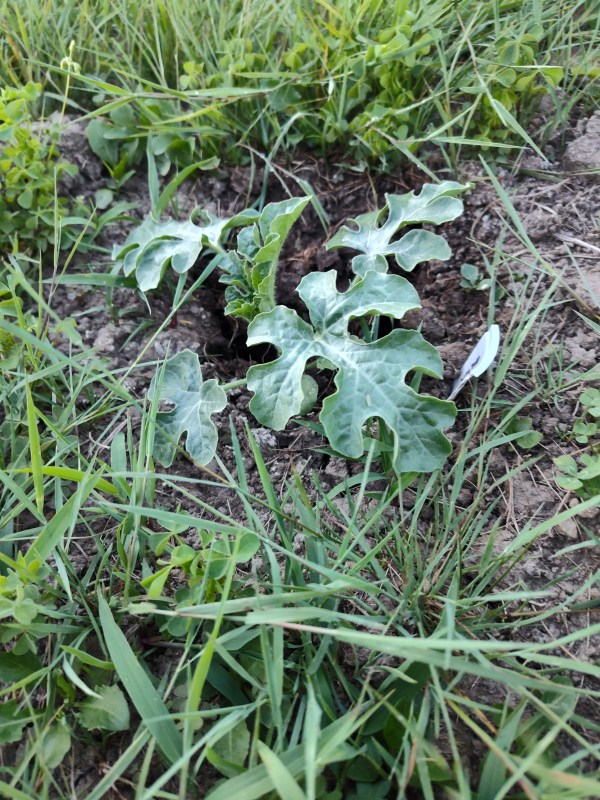
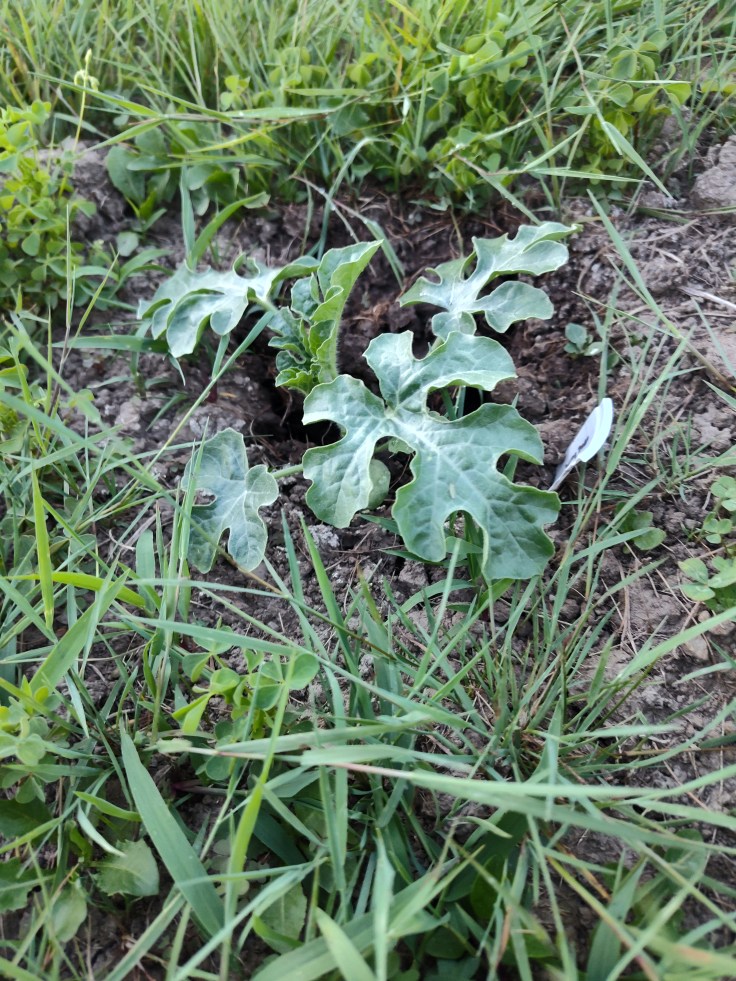
Ali Baba watermelon
We’ve never grown these before, but the Ali Baba watermelon plant produces an oblong fruit that grows to between 12 and 30 pounds and has a rind that is lighter in color compared to the watermelon we typically eat in the United States. We started these seeds in at least 3 spots, and they germinated successfully and quickly. All of our plants have produced their second set of leaves and will begin vining out next. As long as we keep them well watered, they should continue to grow and hopefully put on fruit. We’ll keep you updated on their progress.
Up Next
A small addition to the weekly update: we harvested our first cucumber last night. It was a burpless variety that our neighbor gave us and was about 5 inches long. It’s definitely a monumental occasion. Between now and next week’s update, we have plans to start a couple more rows of corn and beans in some spare space we have. We’re also going to start at least 1 more cantaloupe or watermelon plant. Hopefully, we’ll also get to harvest a few more items. Until next week, happy gardening!











 One Rabbit Riot