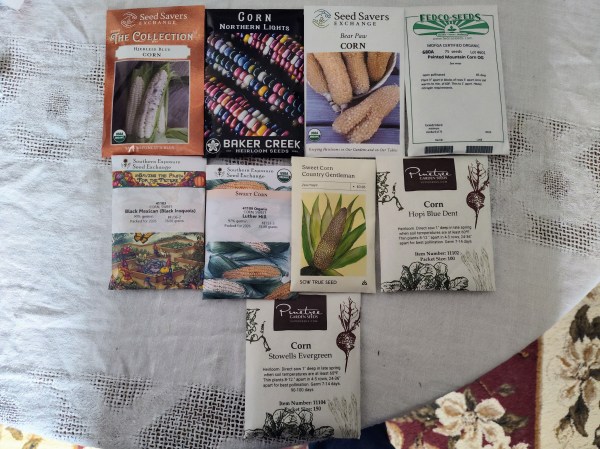
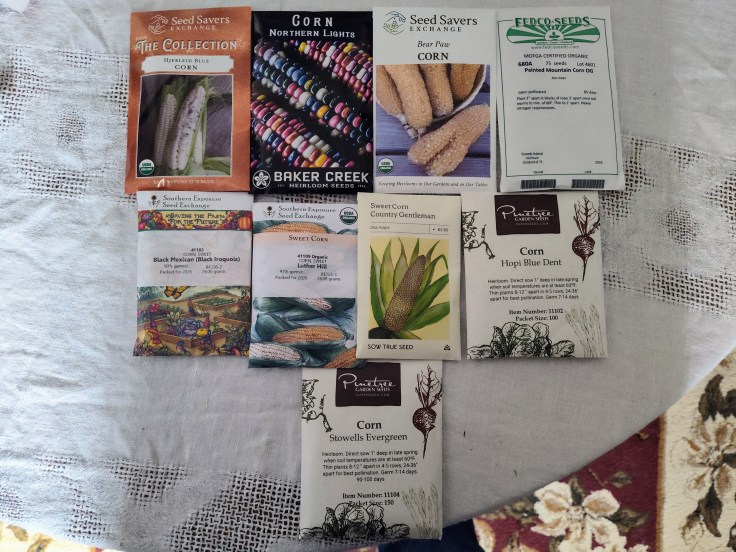
Earlier this week, I wrote about the bean seeds we ordered for our 2026 garden. Before that, I shared images of all the seed packets. In this post, I am going to go over the corn seeds we purchased.
We loved growing corn last year. We grew three varieties – Hopi Blue, Butter & Sugar, and Black Iroquois, Sweet Mexican – and had success with all of them. There were definitely some lessons we learned along the way, including not planting right before a heavy period of rain, not planting too close to the fence, and keeping more space between the seeds, but it was a positive experience overall.
Our corn seeds for 2026.
Because of that, we’re growing more varieties, including a popcorn variety and multiple flint corns that can be turned into cornmeal or flour. If there’s one common thread among the seeds, it’s that we want to grow heirloom varieties as much as possible. Modern sweet corn is great, but some hybrids were bred to prioritize sugar content over flavor, which we don’t like. Heirlooms help find the sweet spot of sweetness and traditional corn flavor. We’re really excited about the varieties we chose for this year’s garden.
Bear Paw
This is a variety we found late in the seed-picking process. It’s a popcorn variety, and according to the seed description, the “ears are often flattened and split at the silk end, giving them the appearance of a bear’s paw.” The Bear Paw was developed by Vermont’s Glenn Thompson, who released it in the 1930s. It was served at New England movie theaters and even featured at a World’s Fair. It matures in only 70-80 days and grows to about 4 to 5 feet tall. This is a new variety for us. It comes from Seed Savers Exchange.
Black Iroquois, Sweet Mexican
This is one of three corn varieties that we grew last year. We had success growing this variety and found it a joy to watch the kernels transition from white to nearly all bluish-black. The flavor was also amazing, and it wasn’t too sweet. It’s an heirloom variety that dates back to 1864 and likely originated in upstate New York. These seeds come from Southern Exposure.
Country Gentleman
Country Gentleman is an heirloom sweet corn variety that dates back to the 1890s. Its ears grow kernels in random patterns (called shoepeg) rather than neat rows and on stalks that can be taller than nine feet. While sweet, it’s less sweet than modern varieties. This will be the first year we grow this variety. Our seeds came from Sow True.
Hjerleid Blue
Even though the kernels of this variety turn blue when they mature, Hjerleid Blue is a sweet corn. The kernels start out white but transition into a dark blue, almost violet color. It is an heirloom that dates back to the 1940s when Ludwig Hjerleid developed it in Wisconsin. The plants will reach 4 to 6 feet tall and produce short, 4- to 6-inch ears. This is our first year growing this variety, and the seeds come from Seed Savers Exchange.
Hopi Blue
We grew this corn last year with great success until the point where the ears needed to dry out. As a flint/flour corn, Hopi Blue is meant to stay on the stalk until it’s dried out, much like dry beans should stay on their plants. Unfortunately, deer got to our ears before they dried out. Apart from that, the corn was great. The stalks reached more than 7 feet in height, and it was beautiful to see how different this variety looked compared to the sweet corn varieties we grew. This variety dates back more than 800 years, when the Hopi Tribe grew it in Northern Arizona. In fact, it’s still grown by them in the same region. Last year, we got the seeds from Fedco, but this year, they’re coming from Pinetree Gardens.
Luther Hill
Luther Hill is an heirloom sweet corn named for the horticulturalist who developed it in New Jersey in 1902. It’s popular in the Mid-Atlantic region for its ability to navigate a wide range of temperatures. Short, 5 1/2-foot stalks produce 2 ears per plant with shorter, white-kernel ears. It’s supposed to have a great flavor. This will be our first year growing this variety. The seeds come from Southern Exposure.
Northern Lights
Northern Lights is a gorgeous flint corn that produces ears with multicolor kernels in blue, red, yellow, and purple. It’s used as a grinding corn for flour. It’s our first year growing this variety, and the seeds come from Baker Creek.
Painted Mountain
Like Northern Lights, Painted Mountain is a flint corn developed for grinding into flour. This variety produces kernels of gold, orange, red, and purple and was developed to grow in some of the harshest conditions. This is a new variety for us, and the seeds come from Fedco.
Stowells Evergreen
Stowells Evergreen is an heirloom sweet corn that dates back to 1838 and is named after Nathaniel Stowell, who developed it. The stalks grow to 7 1/2 feet tall and produce 7- to 8-inch ears. We haven’t grown this in the past. Our seeds come from Pinetree Gardens.
Let me start by saying that I’ve not always been a fan of bugs, with one exception: the firefly. My dislike for them has never reached Blathers from Animal Crossing level, but I’ve always wanted them in their space, which is separate from mine. This has been the case despite my love for the outdoors. I spent countless hours hiking, mountain biking, fishing, hunting, and camping growing up, but bugs were one of my least favorite parts of it. Meanwhile, bugs have always loved me. They will bite me every chance they can, and in a group of people, I’ll be covered in bites when others have none. So, it’s safe to say that it’s been a one-sided relationship.
That has changed with our garden this year. Before our garden, I knew how important pollinators were to a garden’s success. I was also aware of the declining bee and butterfly populations. As a result, Magz and I were focused on planting flowers that would attract pollinators. But little did I know just how many pollinators there are. Nor did I know how beneficial non-pollinating bugs can be to our garden and the environment at large.
Research Changed My Mind
When we were planning our garden and researching seeds, we came across a lot of vegetable seeds that rely on pollinators to reach their peak. Many plants, such as tomatoes, peppers, and other members of the nightshade family, self-pollinate but need help from pollinators to reach their fullest potential. Meanwhile, squash, melons, cucumbers, and many fruit plants or trees can’t self-pollinate and need a helping hand. Humans can make this happen by removing the male flower and touching it to the female flower. However, it’s much easier to let our pollinator friends do the work for us. Letting pollinators, such as bees and butterflies, do this work is mutually beneficial. Our plants grow and produce ample fruit, while the pollinators get the food they need to survive.
For the longest time, the extent of my pollination knowledge ended with what I described above and the two types of insects: bees and butterflies. And, if I’m being honest, I was under the impression that the most important bee species was the honey bee. For years, the honey bee was the poster insect for environmental destruction and the collapse of native insect populations. This focus resulted in people buying local honey and establishing bee colonies to rebuild the population. However, I recently learned that the problem and the ways we can address it go much deeper.
Earlier this summer, I learned about Buzzkill, which was a podcast series produced by the Food & Environment Reporting Network (FERN) focused on the declining pollinator population. I learned so much, but what stood out the most was that the number of bees and beehives isn’t the problem. We have plenty of apiaries and beekeepers. The larger issue is a lack of food for the pollinators. Because we have destroyed a large portion of the natural habitat in the United States and many people choose not to grow native plants, we have reduced the amount of food for these insects and animals. Buzzkill also taught me that there are a lot more bee species than I ever realized, and honey bees aren’t necessarily the most important. After learning all of this and discussing it with Magz, it changed our approach to planting and gardening this year.
The Benefits of Bugs
Like most people, I was aware of pollinators and the benefits they bring, but that was largely the extent of my knowledge until I began doing more research and learned about all the ways that bugs help us. The World Wildlife Federation estimates that only 0.5% of all insects damage crops. That doesn’t mean that 99.5% of all insects are good, but it does mean that well over half of the insects are beneficial.
Tackling Problematic Insects
This was the benefit that surprised me the most. I didn’t know that some bugs help to manage the pest population. I ignorantly thought that the only way to handle these pests was with insecticides. As I typed that last sentence, I forgot that I had watched an episode of Ask This Old House, where Roger the landscaping expert traveled to Florida to help answer questions about pest control. Instead of recommending a potentially harmful spray, he brought in an entomology professor from the University of South Florida to educate the homeowner (and the audience) about beneficial insects and how they can destroy the population of invasive species. Now remembering that episode, the information I learned through my research makes a ton of sense.
Not having to solely rely on insecticide sprays or dust is a big deal. Our Creator has provided us with a natural remedy for problematic insects that can destroy our garden. When that’s the case, why would we want to only use chemicals? The majority of these insects are predators (ladybugs, lacewings, praying mantises) that kill and feed on individual pests, such as aphids. However, some of them are called parasitizers that lay eggs on other insects. The resulting larvae then feed on the insect. An example of this is the parasitic wasp.
Decomposition
Insects also operate as the garbage collectors and recyclers of our ecosystem. They eat and break down what we don’t want to touch or do anything with: animal matter, dead plants, food that we didn’t or can’t eat, etc. If you have a composter, you will have witnessed this. Anytime I open the lid to our composters when it’s warm, I see insects flying around or crawling on the rotting food and grass. As the insects consume these items, they produce nutrient-rich organic matter that improves your soil.
Soil Improvement
Soil improvement is slightly different from decomposition. This category applies to the insects (earthworms, ants, and termites) that tunnel through the soil. This aerates compacted soil, improving drainage and leading to better soil. So, the next time you’re digging in the garden and come across an earthworm, remember that it’s doing yeoman’s work to provide you with better soil.
Why it Matters & Applying the Knowledge
Why it matters is pretty obvious. Humanity has severely damaged the environment through selfish acts committed in the name of progress. The commercial farming industry has used chemicals that have killed all insects, including beneficial ones, stripped the ground of its nutrients, and run off into our water sources. We plant non-native or non-pollinating species of flowers that don’t provide food to pollinators, and international shipping has led to invasive species being transported throughout the world, so the native insects can no longer control the population. And to top it all off, we aren’t doing anything on a large scale to put nutrients back in the soil or restrict the importing of ornamental flowers that serve no purpose beyond looking pretty.
Focusing on beneficial bugs, growing plants that attract pollinators, and creating an environment where native, productive insects can thrive has many benefits. As mentioned above, predator and parisitizer insects reduce our dependency on chemicals to control the bad insects. Even organic insecticides can kill the beneficial bugs that we want to thrive. Relying on insects to do the job lets nature take its course.
Providing pollinators with a food source helps your plants to reach their full potential while also letting some of the most beautiful and productive insects (honeybees and butterflies) succeed. Furthermore, flowers that attract pollinators not only feed insects; They also serve as a food source for hummingbirds and bats. Both species eat a lot of insects, with brown bats capable of consuming up to 1,000 mosquitoes per hour, according to the U.S. Forest Service. Meanwhile, hummingbirds feed on aphids, weevils, and spiders, all of which can be detrimental to your garden. In fact, hummingbirds eat far more insects than the nectar they get from feeders or flowers.
Finally, we arrive at my last point. As gardeners, we should all be motivated to create native habitats on our property. That means growing native species, creating safe spaces for prey animals, and providing food and water sources for birds, insects, and herbivores. The benefits of doing this are innumerable, but include serving as the foundation of the entire food system, hosting native insects, and often having deeper root systems that address water runoff problems. Not to mention, there’s also the benefit of fitting into your area’s history and culture.
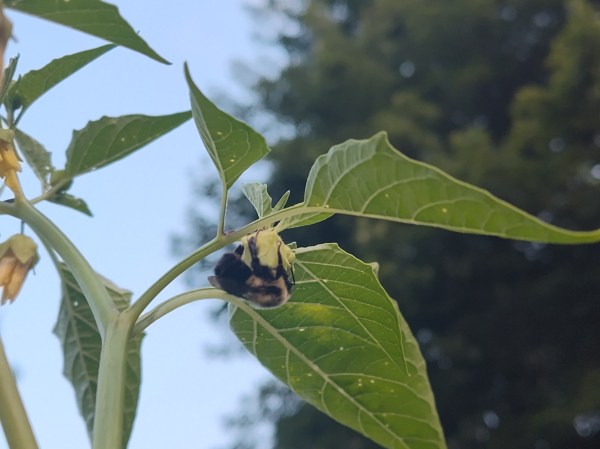
Magz and I applied this knowledge as soon as we started to plan our garden. We only bought flowers that attract pollinators, and when possible, we planted them close to our vegetables that need to be pollinated. We also started researching insects found in the garden to learn if they are beneficial or detrimental. Previously, I would have killed them without a second thought. I have also started to sincerely appreciate bees and not fear them when I’m in the garden. Of course, I still hate hornets, wasps, and yellow jackets, but being around bumblebees in the garden is a wonderful experience. I recently watched a bumblebee crawling over the flowers of a tomatillo plant as it collected pollen on its legs. It was such a peaceful environment to be in, and I recommend doing it unless you’re allergic to bee stings. Even then, though, you have to bother bumblebees to get them to sting.
Where We Want to Be
I’m at a place where I would say I’m borderline obsessed with pollinators, saving native habitats, and treating the earth with respect. Like I said, I’ve always loved being outside and have been committed to preserving nature. But my motivation has been intensified this year. The attempt to sell off protected lands pushed me over the edge and pissed me off. As an individual, I can’t change the nation’s direction on my own (although I did contact our representatives), but I can make a difference in my backyard.
Bee Pollinating Tomatillo Blossom
We’re going to dive deeper into native plants next year and continue our commitment to only growing flowers that attract pollinators. We are also going to continue converting our yard into gardens, both flower and vegetable. Ultimately, we’d love to have the bulk of our current yard be a wildflower meadow in the future. We’re also going to continue to provide animals with safe spaces with brush piles.
We recently learned that you can have your property certified by the National Wildlife Federation as an official Wildlife Habitat. The requirements aren’t outrageous and are pretty easy to meet. We’re going to pursue this in the coming years, and when combining it with our conscious gardening practices, we’re hoping to make a real difference. It may be difficult to fix commercial farming practices, but if we all focus on our own property, it will add up.
Future Preservation Content
I know that this post wasn’t as focused on our garden as my content typically is, but I think it’s important to think about. I also hope you enjoyed it, because I’m planning to write more posts in this area. I have plans to write about how we’ve blended flower and vegetable gardening, the frustration I have with lawn obsession, and more environmental content in general.
This post is inspired by current Wuthering Heights and Jane Austen adaptation discourse, in particular, the thoughtful discussion of the Regency Rumours podcast that sparked my musings. Which novels would I love to see adapted that have not been made into a movie or streaming show?
My list will be organized by author, since for some, there are multiple books I am featuring. I will try my hardest to tease the story without giving spoilers so that you can enjoy these stories on your own. Let’s jump in!
Elizabeth Lim
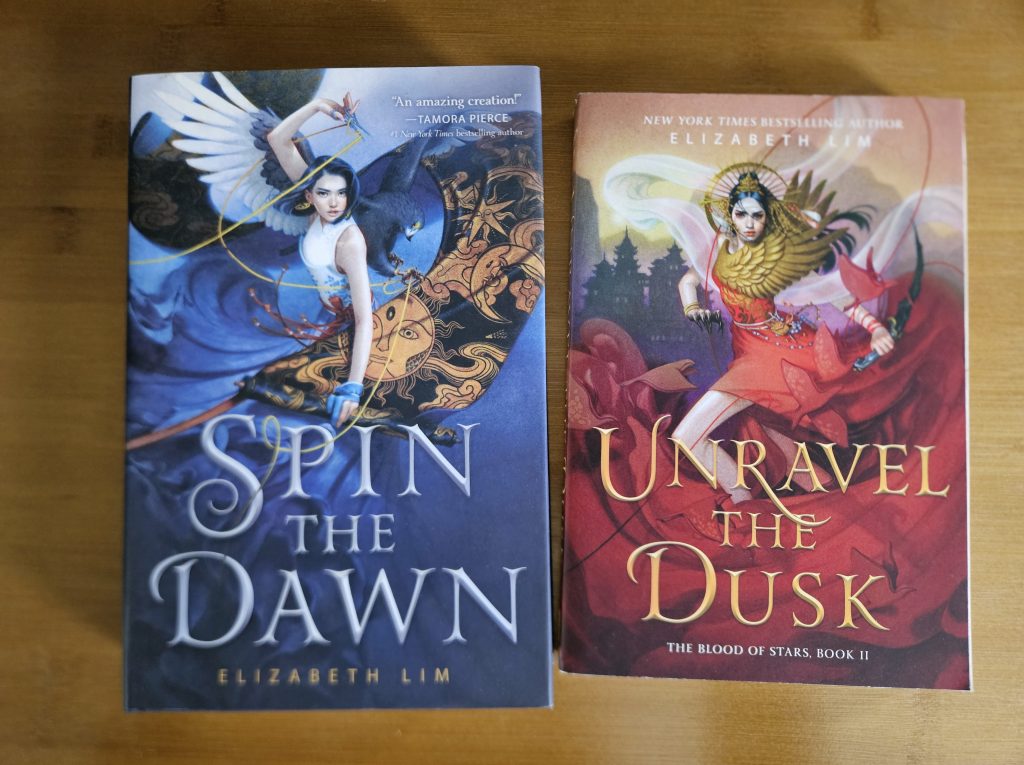
It started with Spin the Dawn, concluding with Unravel the Dusk. Now I find myself fully enveloped in another masterpiece of Chinese fairytale-inspired adventure fantasy – Six Crimson Cranes. The sequel, The Dragon’s Promise, and the prequel, Her Radiant Curse.
Why? These stories have imagination, action, twists, and flawed characters that experience growth. They live in both a fantastical world and also feel tangible to our everyday life.. Although magic is a driving force, the experiences of the plot feel incredibly human. Family, love, freedom, and facing down injustice, these are real-world issues placed in a far-off land.
I think these stories need grandeur, like C-dramas and the imagination of other magical favorites, like the school in Scotland with the magicians. Spin the Dawn features sewing, a dangerous competition, a perilous journey, a curse, a Kingdom in danger, and a main character facing crushing grief. Six Crimson Cranes features the confusion of adulthood, the consequences of our choices, looming corruption, and the fear of losing it all.
I think these two duologies – The Blood of the Stars duology (Spin the Dawn/Unravel the Dusk) and Six Crimson Cranes duology (Six Crimson Cranes/The Dragon’s Promise) would make excellent mini-series. Like the concise one or two-season format of K-Drama shows. With her Radiant Curse either being a separate show or a movie. I believe Elizabeth’s work will be beloved for generations to come for her imagination, unique settings, and plot pacing. Please, someone, adapt these stories and adapt them well.
Judy I. Lin
You know what really bugs me about the creative world? How can we can’t have nice things. That we compare and put down. I think it is idiotic for readers to compare Lin and Lim for their work of reimagining Chinese fairytales when Judy I. Lin created a magic system unlike anything I’ve encountered before – tea. But some people like to yuck my yum and say Lin is a lesser Lim, and to that I say, you’re missing out. A Magic Steeped in Poison and A Venom Dark and Sweet would translate well to film. Think Avatar: The Last Airbender and Murder on the Orient Express, but in a Chinese fairy tale. These books sing!
What if you needed to solve a murder, while sneaking into a national competition, with a skill you have to master overnight, and you have an undeniable connection with a person who may or may not be responsible for your demise? It’s just so dang good.
Susanna Kearsley
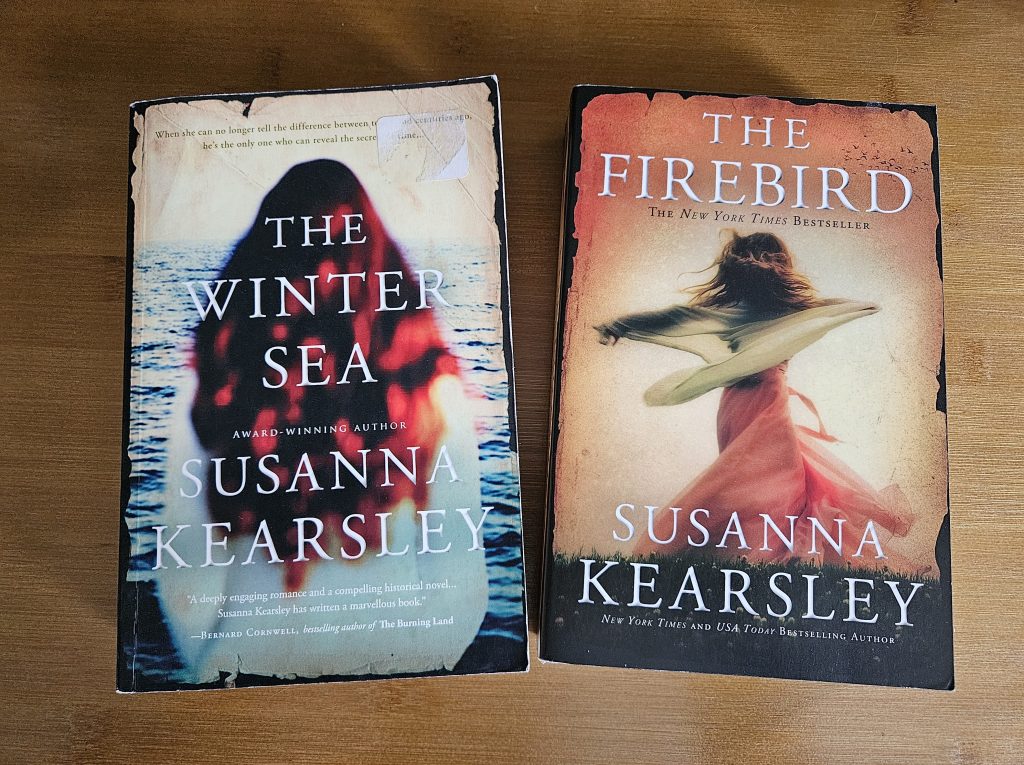
I have read most of Susanna Kearsley’s body of work. She is my favorite historical fiction author. Her romance-filled stories are closed-door, but charismatic, like a satisfying slow burn of a Jane Austen novel. The first book I encountered of her work was The Shadowy Horse, set near Hadrian’s Wall at an archaeology dig. This book feels a bit like Jurassic Park, Indiana Jones, and The Banshees of Inisherin. A movie would be great for a Halloween watch.
What about a cozy Cornwall mystery? Featuring a cozy rom-com protagonist, like a Kathleen Kelly who has a connection to the town and the house she rents that is stronger than she would ever imagine. The romance in this one gets me every time. Will they actually get together?! I’ve read this multiple times, and I am still on the edge of my seat. A movie of this would be lovely.
What about the Jacobean period, vaguely pirate in nature? What about romance, a castle, and the intrigue of spies? How about a two-book arc over several points of view, generations apart? Could history truly come to life from the relics of the past? I wish I could weave a story together with the same ease as Susanna can. This would be excellent as a mini-series with elaborate costumes.
With the rise of historical dramas in Hollywood and beyond, I think Susanna Kearsley’s stories should be shared in this way. Fans of Outlander would be intrigued, as well as Austenites, Bridgerton fans, and costume lovers.
Kayla Cagan
Were you an art kid? Did your parents ever discourage you from pursuing a career built on your artistic passions? Has your home life been disrupted by that one relative who is selfish and dysfunctional? Have you ever felt trapped in your hometown?
Piper Perish and its sequel, Art Boss, will pull on your heartstrings. The desire to pursue our dreams is a journey we can all empathize with. This coming-of-age story would make a great two-part movie set or a small mini-series. The art, the fashion, the settings! It could be fierce.
Annie Gray
Adapt a cookbook? With a historical interpreter. Yas queen. Mrs. Crocombe is that girl. She ran the kitchen at Audley End in the mid to late Victorian Era, a position also held by men. It was a great responsibility to prepare, plan, and manage the food systems on site and beyond in Audley End’s local produce. She had to keep up with trends and changing fancies, all while providing elegant meals for the family and their guests. In addition, cooking for the staff.
The restaurant world is a wonderful canvas to build a show upon. This would appeal to fans of Downton Abbey, The Mind of A Chef, The Bear, Great British Baking Show, and Chef’s Table.
Elizabeth Kostova
Alright, this last book is technically in progress. The rights have been sold, but nothing has moved forward for a movie or series. This could be a horror masterpiece.
This story pulls me in, to the point of drowning in the world that feels too real for comfort. It is Dracula, unlike the world has seen him before. It needs to be played out on screen.
What do we do when an item of clothing doesn’t fit? Rehoming is always a good idea, but here is another one – upcycling. What if you could transform that garment into another garment you will wear? Here’s an easy upcycle using one pair of jeans.
The Process
To begin, I cut off the legs of the denim above the knee. This was important. To hem the denim to the same length, including the excess fabric needed to fold over for a waistband, the leg section needed to be longer than what was cropped.
I carefully cut open the side seams, avoiding both the pocket and the rivets. The belt loops were set aside for later.
I then cut the leg pieces to the proper width, adjusting the fit with try ons, before sewing. The top of the section was hemmed for a waistband and the bottom hemmed with the rest of the short.
I sewed this very carefully with my machine. I did break a needle but, it happens just use caution and wear glasses to protect those eyeballs. Always know where your fingers are too when using a sewing machine.
Next I repaired the worn denim around the belt loops and attached the cut off belt loops to a new section and tada: you have a new pair of shorts for summer!
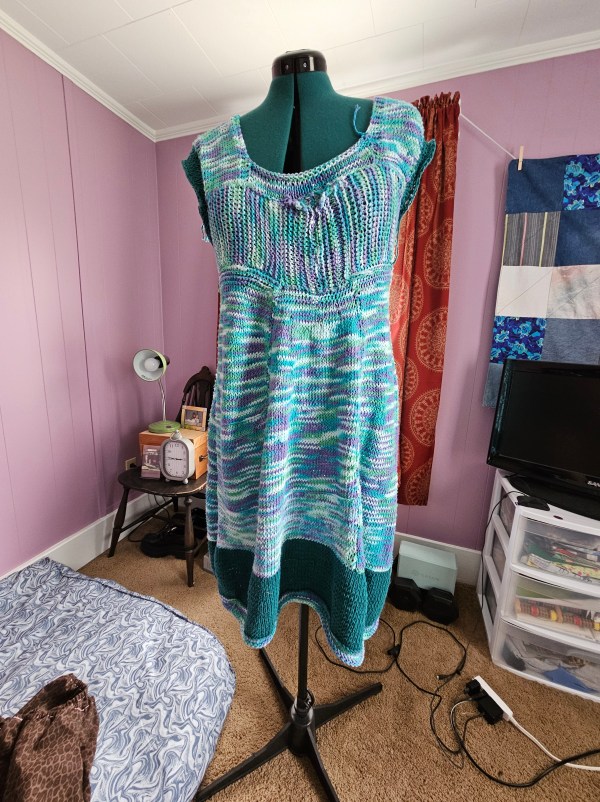
Knitting a dress, how hard can it be right? It was actually pretty managable garment as an intermediate knitter. I would not recommend unless you have made a sweater before but would definitely recommend knitting a dress if you want a soft and stretchy garment that hugs you!
Inspiration
I have made plenty of dresses over the past 5 years, but they have all been cut and sewn from fabric. Knitting kicks it up a notch, asking you to assemble the dress, but make the fabric to boot. I thought it would be silly to try until I discovered some lovely crochet designers on You Tube who make with imagination!
I was inspired by Mama Gwen of TL Yarn Crafts to give designing a knit dress a try. She makes such beautiful dresses all from self-drafted patterns in knit and crochet. Along with Dana from Blondie Knots. Her Coachella scrap two piece outfit helped me have the boost of confidence to try something new.
Materials
Last summer at Joann, before the shenanigans began, I purchased 14 Big Twist Cotton 50g skeins on a sale with the intention of knitting a top. Many months later, this yarn was sitting in my stash with my mind uncertain if the punchy color changing yarn was my cup of tea for a cotton knit top. But a dress? Yes, that could work. Did I have enough yarn though? I’d have to make it so because there was no more being sold.
Because of the circumstances, I decided this dress would be my goodbye to Big Twist.
Design
I knew from sewing, my design would need to be a dress that was either tubular or empire waist to suit my body shape. I decided to knit this on US 7 needles, straight needles. Sometimes I would shift to circular, but this was not knit in the round. With the combination of yarn minders, a measuring tape and patience this dress came together!
To start I knew I wanted the bodice to be the anchor I worked out from so I cast on stitches to work horizontally. From the bodice, I then added one strap to plan the width and placement of the top. I was uncertain how much yardage the skirt would consume, therefore I paused to determine sleeves later.
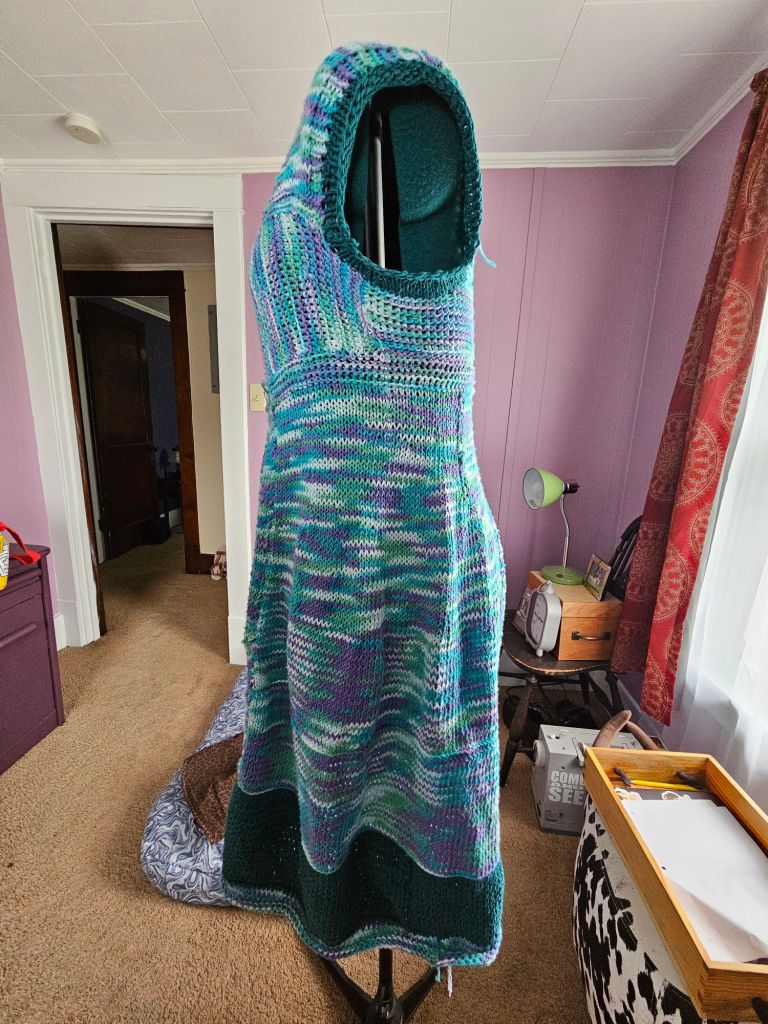
My plan for the skirt was to knit a section by casting on the bottom of the bodice, adding stitches to increase width until I finished a skein. Repeat and fill out the row by picking up stitches to join the sections vertically into a tube. I continued on, and on until weeks later I had a skirt but panicked that I was not going to achieve my desired length and second sleeve!
I decided to pull a teal yarn from my Landscape Painting with Yarn project. This hue pulled the cool tones into harmony in a pleasing way. I used two skeins of this teal color and then finished with the original Water Lily tonal yarn. I finished the second sleeve and tried on the piece with relative ease. There was one fit issue – plunging neckline. But it was a lovely, cozy knit from scratch dress!
The final touches to this project were addressing the neckline and the sleeves which were set too deep. I cast on to the neckline to fill in the gap and provided structure to the straps with several rows of decreases to give the dress a cap sleeve befitting my vision.
Final Thoughts
I am definitely making more dresses with knit! It’s far more pleasant than sewing if you want a comfy yet elegant style. You have both control of the drape and the fabric design. It’s your world, as Bob Ross would say.
This project was more than a goodbye to Big Twist, it was a new chapter for me. I began this journey 5 years ago to learn how to make and now I feel empowered by knowing I can make my own clothes, not just with fabric but with skeins of yarn and needles. It has been a wonderful journey of discovery!
If you want to knit a dress, I’d say go for it! If you’re a beginner, make one but not as your first project – you will be overwhelmed by the sheer amount of time this project took. It was weeks of work that as a beginner, would have scared me. In time I know you can do it though! ❤
Do you ever get stuck in start mode when beginning a new thing?
Like you’re wandering through a maze of ideas. Maybe it’s the planning stage, too many ideas, not enough organization? It’s weird. I feel such a rush when I have multiple WIPs on my needles. The satisfaction of binding off stitches and slipping that garment onto my body makes every week of work worth it!
The void though, between new idea and casting on a new project, is a shape shifting process. The indecision sets in.
What yarn should I use?
Do I have a color palette
Stockinette or a new stitch?
Texture?
Colorwork?
Do I have an inspriation garment in mind?
Have I thought about how I want to garment to fit?
How much positive or negative ease should I plan for?
The next phase is choosing needles, selecting the amount of yardage, and gauge swatching the stitches to inches ratio to calculate the size of the garment.
It feels as important to start with the correct amount of stitches as it does to pour a concrete foundation evenly. I think this is why I get stuck in neutral instead of shifting into gear – when you get a creative idea sometimes the final design outcome is a little fuzzy.
So how do I get out of it and move forward with my design? I sketch, even simply shading the colors together in simple patterns helps me see if the image in my head will fit the realized garment. I also start working with the room to frog the yarn and begin again.
That is my favorite thing about fiber art, you can tear out and begin again without ruining your materials. Even though the first stitches feel like concrete the process is flexible.
Do you get stuck in planning? How do you move your mind forward? Thanks for spending time with me today. You are amazing and I hope you know that you are loved. Until next time. ❤
I can’t believe it’s May already, I’ve been so busy with our garden project and a follow up project of screening in our back porch, distracted by Joann’s closure and the evil running rampant in our world that I have been on a slow creative trajectory, and its really catching up to me!
Upcycling, Alterations, Mending
As of late, the bulk of my sewing projects have been preservation, updates, or reworking the garment into something new. In mid-winter, I decided to tailor every t-shirt in my closet. This meant I would be hemming every shirt to end above my hip and bringing the end of the sleeve upward, to end higher on my arm, which is more flattering to my vertical line. I’ve had to repair a few garments and mend some older pieces. I’ve also been taking some of my clothes in and tearing them apart to be upcycled into new projects I can’t wait to share. That I thought I already shared. This leads me to the next point: I have a backlog of projects I held back last fall.
The Head Games of Content
I still battle imposter syndrome, and in doing so, last year, feared that I would run out of ideas. So I slowed down my posting to keep these good ideas and projects in the tank for a rainy day, and instead of this giving me the freedom to create and write without pressure this gave my type-B nature and out to avoid writing, because I had the ideas, and so I sat on them and now it is almost a year later, without these projects having their time to shine. Grinding it out on Instagram last year definitely took my focus from me, and then these constant recession fears have kept me in a place of fear, which has stifled my desire to create, in case I can’t buy more materials in the future. I worry too much. Writing for two years, on this site, led me to a sophomoric slump heading into 2025. I lost the urgency to keep going and backslid into complacency and a lack of creativity. I have also transitioned into a slower creative process in hopes of gaining that spark again!
Hand Sewing 2: Electric Boogaloo
When I began sewing in 2020, I did so through sewing by hand through the tutorials of Bernadette Banner. I did this for two years and then acquired my Heavy Duty Singer, which I switched to using exclusively from the end of 2022 through the beginning of 2025. But this year, I am having some struggles with my sewing machine. I love the speed at which you can make things, but I fear that this boost in speed has dampened my craftsmanship.
When I was sewing by hand, I had the time to consider the project and to ponder where the design was going to lead me. With my sewing machine, I have fallen into a bad habit of making without pausing to ponder. I also started designing simpler, easier-to-sew garments for efficiency instead of art. But speaking of efficiency, I don’t think sewing machines are as efficient as we make them out to be. Mine is quite finicky. It eats fabric and thread. I go through the thread considerably quicker using my Singer than I do by hand. I have to rip seams and sew again, many times, because the machine messed up a stitch or skipped stitches altogether, and I’m tired of it. So my machine and I are taking some time apart.
Slow and Steady, A Life of WIPs
And so, here I am months later with a few finished garments, many WIPs, and a better life balance. Including a refreshed creative well. The time spent working outside with Kyle crafting our screened porch, tilling garden beds, painting, upcycling furniture, studying Japanese, drawing, reading, exercising, etc, has been a wonderful way to remember why I love creating. I find knitting to be my happy place. For a week, I barely knitted, and my mind was filled with far more rage without the needles weaving yarn into cloth. I’ve come to a place in my sewing journey where I want to learn and be ambitious again. I’ve filled my closet with good handmade pieces, but I want to create exceptional, one-of-a-kind things.
I have learned that knitting is my favorite mode of creation, and sewing is the freedom to make what I don’t want to buy or can’t find offered. The process is just as important as the final product, as trite as that is, creation and crafting are where we thrive, not consuming. I find moments of calm in working with my hands and feel satisfaction in stepping away to old creative haunts, like painting or gardening. I think the slump was an important part of growing. I hope that you find creative refreshment and know that you are loved. Stay safe out there, these are dangerous times, and know that I care about you all very much.
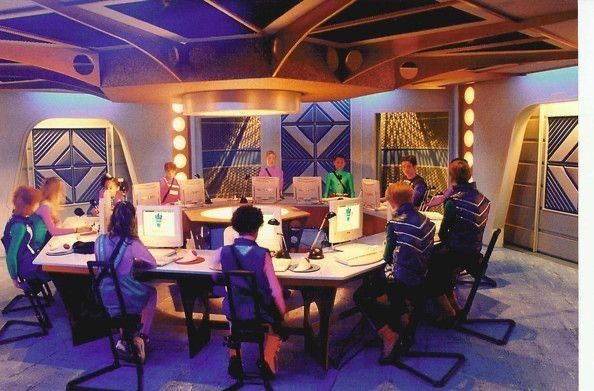
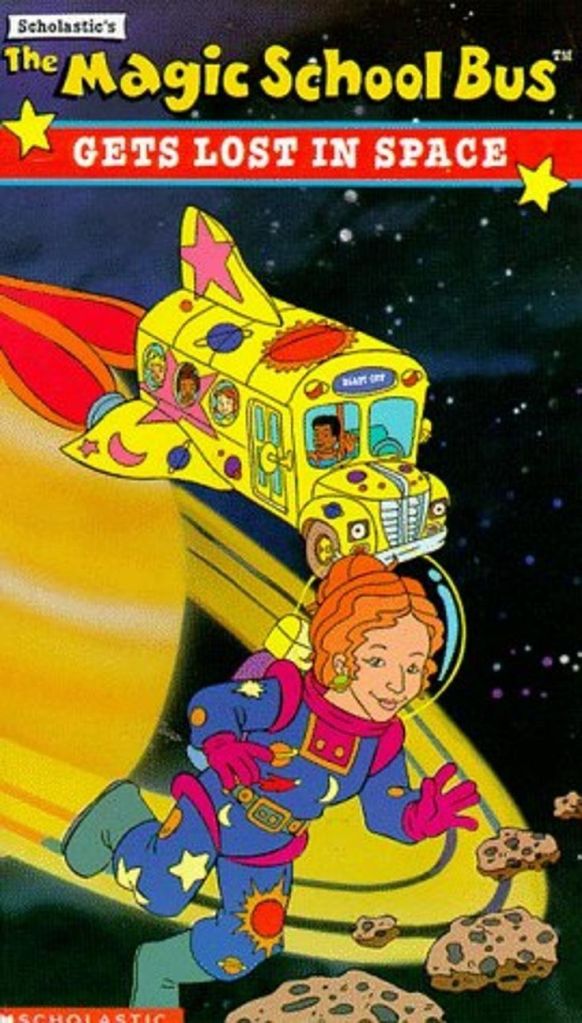
Okay, so technically the math of this doesn’t quite work, because Zenon: Girl of the 21st Century came out when I was six, but I believe the Magic School Bus Gets Lost in Space was released before this, so I’m counting it. My first dream life plan, before fashion design became my dream, was to become an astronaut and live in a space station like Zenon. Her space station was in orbit above the Earth, so easily accessible that they were a shuttle flight away. The space station was a cool futuristic community with hologram teachers, neon and metallic clothing, interesting interior design, a cafeteria with windows that displayed the glory of outer space, and a view of the Earth below. They had zap pads that were a precursor to our modern-day smartphones. Zenon was resourceful, dumpster diving and DIY-ing jewelry, clothing, and art. It was so inspiring!
This dream was quickly brought to reality in 2003 when I watched the Columbia space shuttle explode. Space was not the perfect playground I imagined as a kid; it was dangerous, not glamorous, and certainly not as simple as a plane ride upwards. The Magic School Bus originally sparked this interest in space. Ms. Frizzle’s adventure across the galaxy made it seem easy! The bus transformed into a space shuttle and quickly travelled from the Earth through the inner planets of Venus and Mercury, passing the sun and moving beyond to the Moon, Mars, Saturn, Jupiter, Neptune, Uranus, and don’t fight me, Pluto. I will not comply. Pluto should be a planet. They easily landed on planets with ready-to-go pressurized air packs for exploration. How fun would that be? All in one day of school, it was the length of a field trip, not a 100+ years of travel. Wild.
It was not the scary vacuum of Gravity nor the challenge of Apollo 13. It seemed like a safe and wonderful place to exist. But as the star burns up in an explosion, so does the dream of life as a Super Nova girl at Protazoa’s concert in space. Before Aespa’s Supernova, this song was my only y2k-inspired Supernova jam. I hope you enjoy it. Have you ever watched Zenon: Girl of the 21st Century?
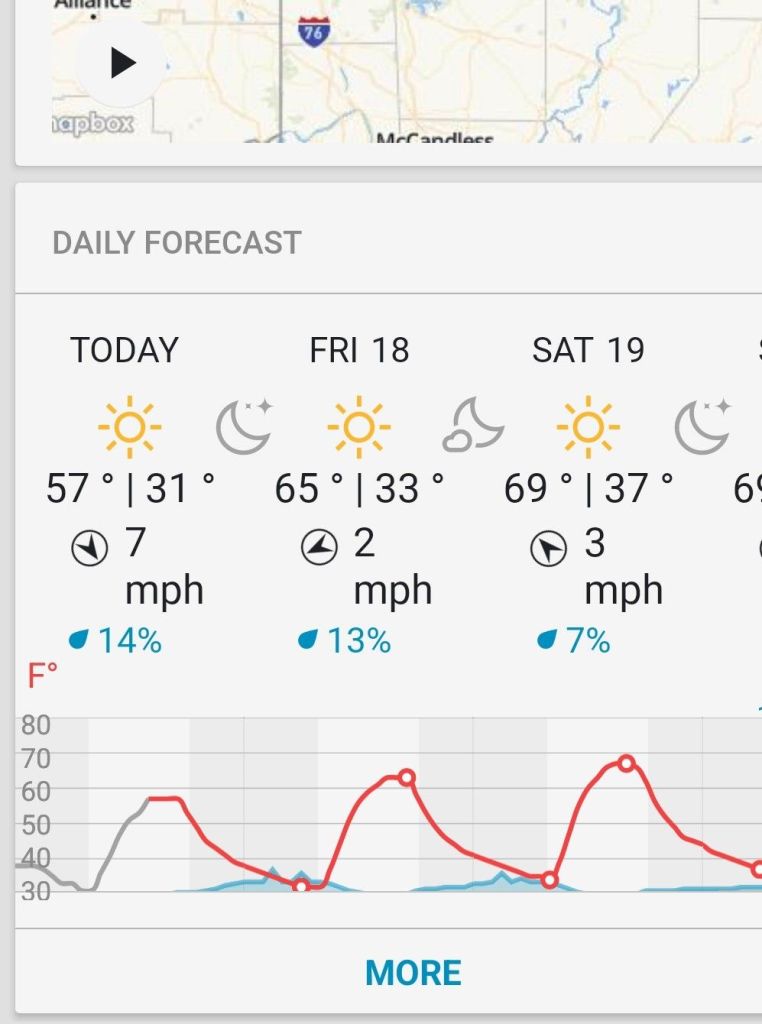
I find myself in an October slump which I discussed in a previous post. Last year I was much less productive with my writing goals in October than I wished, and its happening again! I’ve paused on sewing and have taken time to recharge, yet its still happening! I think I know why, the weather.
Since we were in Erie, my hometown has been having some pretty cool temps which has sent me into the knitting zone. I have been working on a cowl, some mittens, leg warmers, and reading up on how to make socks.
It’s been my trend for a while, I tend to focus on sewing fall/winter pieces in August and September to be prepared for the first cool days. Then in October when it drops and I get that first taste of cold hands or ears, I hurry to knit those cold-weather accessories. Like a light bulb goes off. It’s fun making things with the seasons too.
Stray Kids have been going insane with song releases so far this month too with two soundtrack releases for for the anime Tower of God and a third collaboration for Arcane on Netflix. Itzy and Ateez released new albums in October as well, plus Aespa’s upcoming release on the 21st, it’s been a distracting few weeks. Not to mention Mario Party Jamboree which I cannot wait to play tonight!
Currently, I’m dabbling in colorwork and its unlocking this whole world of possibilities for intricate storytelling across the canvas of wool.
I have a few knitting projects I excited to share that were the start of these colorwork projects. I just need to motivate myself to put down the needles and type.
Maybe I’ll do that now? Okay, I’ll meet you back here in a few. 🙂
Fast fashion is a problem for many reasons. The overconsumption. The exploitation of workers. The lack of quality in construction and fabric. Polluting water sources and landfills. Ruining thrift stores with Shein products. But one I hadn’t considered was how these fast fashion brands are watering down design to the point that they are misrepresenting fashion terms like corset, choosing the wrong fabrics for construction, and not even trying to pattern match. It’s becoming nonsensical!
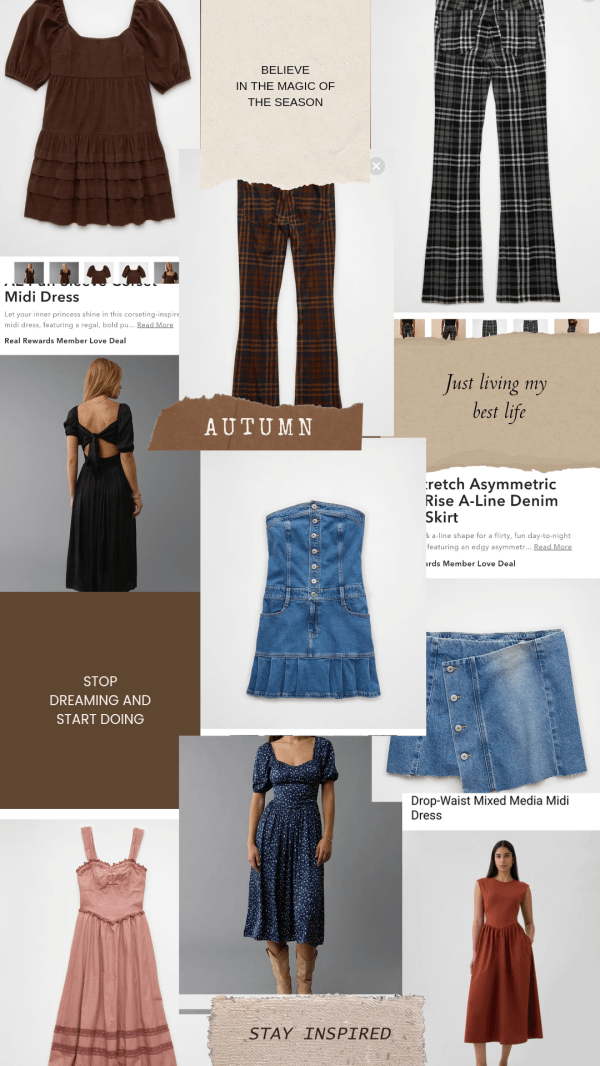
Fall fashion trends and fall sales are in full swing here in the US. I’m seeing ads everywhere, in between Instagram stories, in my email inbox, on YouTube, on television advertisements, etc. It’s bonkers! You would think that we had empty closets and had never owned cold-weather clothing before! Each season you need to completely restock your wardrobe! Buy, buy, buy!
So I caved and I started to look at these websites. Looked, not purchased. That is the key here because I found some wacky things masquerading as vintage and historical-inspired pieces of fashion. These fashion brands are two that are quite popular in my neck of the woods.
The Gap does Medieval Plate Armor
A brand I get a lot of ads from, which amuses me because I don’t like this brand, is the Gap. I probably see ads because I do buy occasionally from Old Navy and they are owned by the same company. If only the Gap knew how I feel about them, they would realize it is a lost cause. I think that the Gap cuts its patterns weirdly, is expensive for the quality, and is dry toast in terms of its aesthetic. So I wasn’t surprised to see a rather vanilla dress. What surprised me were the style lines of this dress and the fabric they chose.
This dress looks inspired by 16th-century plate armor, a breastplate specifically, but it is made out of what I would guess is a stretch jersey because there is no structure or fastenings in the photos. So a rigid garment, being made out of a stretch shapeless fabric, just isn’t right. There is something off about the shape of the bodice and how it hangs on the body. This is a missed opportunity. I think they could have added boning channels or made this out of a stiff woven fabric. Maybe a coordinating vest? Vests have come back in popularity. It’s a misrepresentation of the historical garment they were inspired by and as a dress historian, it bugs me. This dress is already an attempt at thinking outside the box, so why not do it properly and celebrate the design? 🙂
There is an exhibit at the Met, linked above showing a historical example of what I am talking about, featuring an exhibit of 16th-century armor with beautifully sculpted lines.
A Corset That is Not a Corset
This dress is not a corset. Maybe it is a Victoria’s Secret definition of a corset with the stretch smocking on the back, but this is not in form or function, what a corset is or was. The corset was a supportive undergarment, a foundation garment as they were called that shaped the body and supported the bust according to the specific standard of beauty at the time. The first iteration of the corset appeared in the 16th century, called a pair of bodies. This was followed by stays in the 17th and 18th centuries and the transition to the corset in the 19th century which held popularity until the 1920s when the corset began to fall out of fashion for other types of garments. This is a very quick overview and I probably oversimplified this so I would recommend checking out historical costuming YouTube for a better reference, also the V&A has an online exhibit featuring Victorian corsetry.
Because of the lack of familiarity, we have with the corset in our 21st-century mind, we tend to slap the word corset on any shape that looks like a formed bodice, which is what this is a bodice cut to accentuate the waist but will fall flat because it is not made with any structure to give the garment a shape. There is no lacing, cording, fake baleen, or steel to give this any shape beyond the body that will wear it. It is all smoke and mirrors. But that bugs me, because American Eagle, the maker of this dress, is a popular teenage and young adult brand that can shape the minds of the future by their experience with clothing!
So why not ride this wave of aesthetic TikTok dressing and go full-on corsetry? Tight lacing is not required, nor was it popular for most women historically, except for the Kim Kardashians of antiquity who did it for the spectacle, people of the past needed to move and breathe just like us so it could be a corseted bodice, and not be controversial! It’s just a thought. I do appreciate the trim on the skirt, it is very 1890s, and I like it.
This dress has the same problem, this is not a corset and this is barely a puff sleeve. This is bad marketing and bad fashion education. You could never corset an open-back dress and to puff a sleeve you need quite a lot of volume and possibly some Tarleton to help keep the sleeves voluminous. The Fashion Institute of Technology has an online exhibit featuring the Gigot sleeve, a beautifully puffed historical design.
When it comes to historical dress there are so many cool designs from the past, and with the amount of research that exists and abilities to connect through technology, there are endless ways to be inspired from the past but not screw it up. I think we should embrace the gift we have of historical dress knowledge and technology like sewing machines, the internet, etc to make something beautiful. These companies have so many resources at their disposal, that I wish they would try a bit harder to make good clothing. But alas, they are fast fashion, and this is one of the worst fast fashion blunders I have seen from these two brands, the Gap and American Eagle until I found this one pair of plaid pants, but that is another story!
Thank you, reader, for going on this adventure into historical dress with me. If you are as tired as I am of the current state of fashion, I encourage you to learn how to sew! It’s the best hack I’ve found.















 One Rabbit Riot