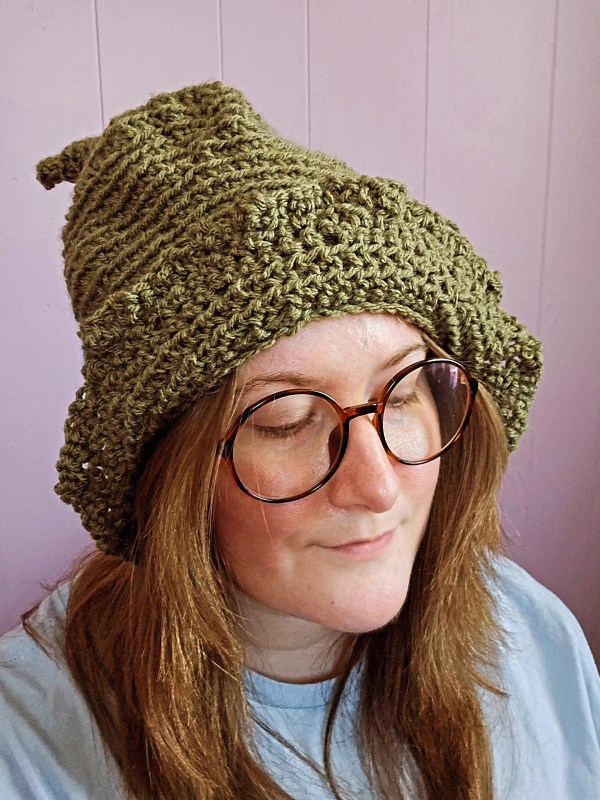
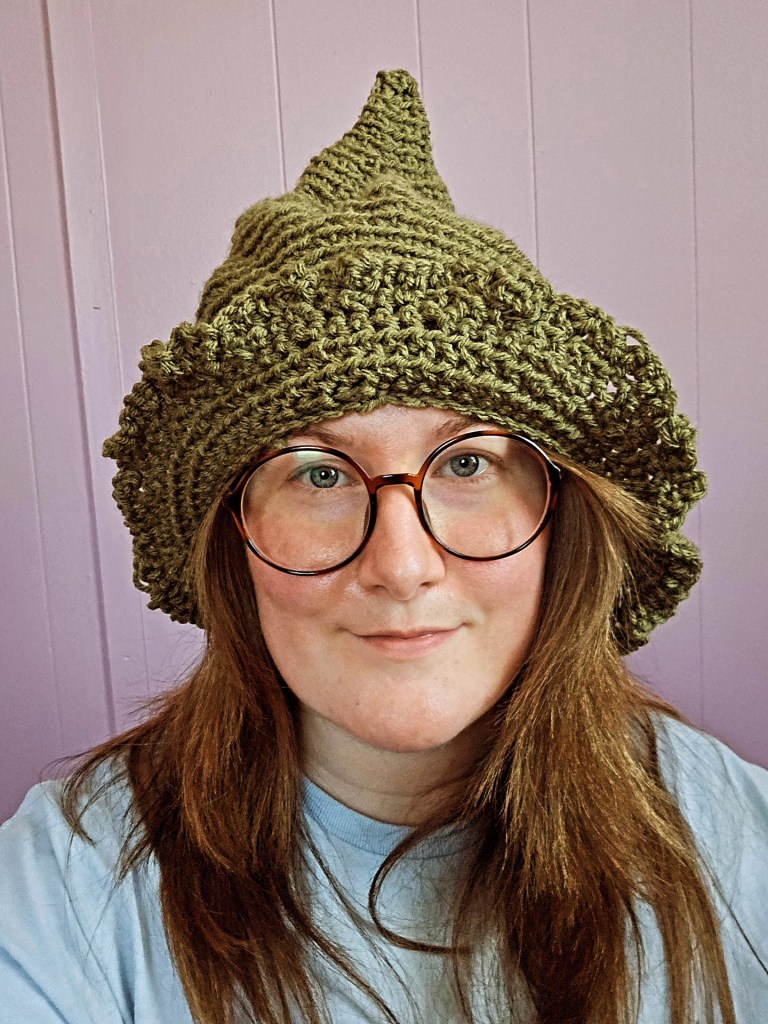
Have you ever wanted to look like you emerged from a cozy video game? Maybe you’d like to wear a hat that reminds you of spooky season? Behold my new crochet adventure, not my first hat, but the second stitched together for this autumnal season.
This hat is inspired by the pointed witch hats, either sewn or made from yarn, that make an appearance in October, either in patterns that I see advertised or inspiration sources online. I didn’t want to make anything too witchy. I am not aiming to be a witch; I am looking for something fantastical. My hat is more of an allusion to the pointed, wide-brimmed headwear, while also aiming to be something a bit historical, rural, maybe hobbity in form.
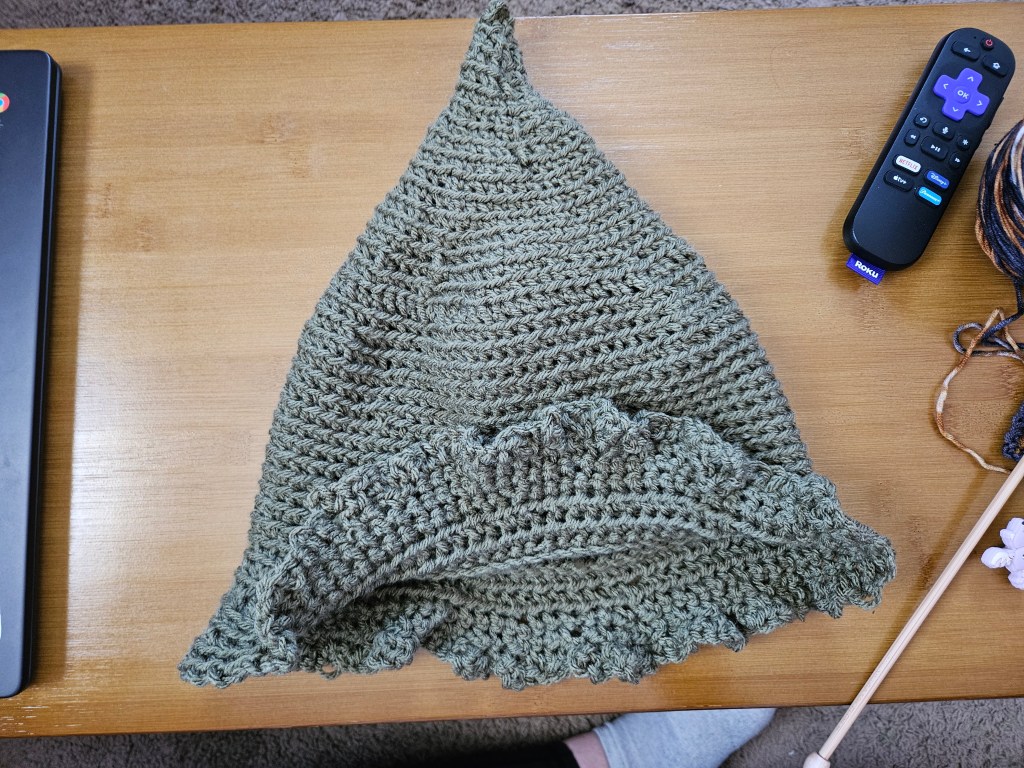
The inspiration image I used for this project is a hat from Animal Crossing: New Horizons – the frugal hat. It is a subtle nod to a scarecrow, while it could belong in the wizarding world. I chose to crochet this project for the ability to sculpt the hat in a way that is freeform. I love how crochet lets you create without managing all the stitches on a needle; instead, I was able to switch from the hat portion to the bill with ease. I crocheted onto the side of the hat and used varying stitches of single crochet, double crochet, and granny stitch to add the frilly volume to the bottom.
Another reason I chose to crochet, over knitting this hat, was to provide the hat with more structure than knit stitches. Crochet stitches have more body to them. This was a scrap project, using leftover yarn from my first sweater dress, now a cardigan, made in 2023. Which was also scrap yarn, from a previous scrap yarn project – my cat ear beanie from 2024. As time passes, and I make more things, I love seeing how projects are connected through materials over time, because scrap yarn is kind of magical. It’s always worth it, in my opinion, to hold on to the extras for these random projects that call for just a little bit of yarn.
Finally, this hat project was inspired by one other seasonal topic, the state of my country. It just never stops right now….ahhhh!!!
Am I living in the 1950s? No, but dang was this what McCarthyism was like? I’m sick of the FBI telling Black Americans not to mourn Assata Shakur. Charlie Kirk is being touted as a martyr by MAGA and the primarily white church, tainting the message of the gospel with that Nationalist sham of a funeral, complete with Hitler-esque photos by the orange man. It’s getting ICY in a lot of places nationwide. So, I made a witch hat, because the Salem Witch Trials of 1692 and 1693 were not about witchcraft.
Instead, they were about religious extremism, sumptuary laws, xenophobia, and social tension. It was profitable to report your neighbor as a witch. You could gain financial and political power by reporting people who did nothing wrong. So I made a witch hat, because I am done with the injustices being played off as not that serious, and I am tired of our own political witch hunts. I feel helpless and angry all the time because of the Idiocracy. So I made a hat to try to do something creative with my feelings.
This forest creature hat, named by my sibling, was designed by me and created using worsted-weight acrylic yarn with a 5.5 mm crochet hook.
In honor of National Sewing Month and the 160 years of their existence the big four – Simplicity, McCall’s, Butterick, and Vogue Patterns are taking a look back at their patterns. The Simplicity Creators group turned this little moment of fashion history into a challenge, Sew Your Decade. I first learned about this through a video from Stephanie Canada where she took a look at the patterns Simplicity was highlighting on their ‘Stitch in Time’ historical presentation of patterns and fashions made by these four companies over the years. A lot of them were reproduction patterns and had dubious choices, including some 1950s patterns in the 1960s. But that’s more of an editing problem.
Because I have a lot of other projects in progress but I love historical fashion, I thought I would take a look through the historical pattern wiki and choose a pattern from each decade of what I would want to make if I had the time to make a garment from each era. I’m using the vintage patterns wikia and historical sources instead of the patterns on Simplicity’s site because the originals are just more appropriate and imaginative than the ones selected on the timeline and the reproductions they sell currently.
1800s Era (1860s-1890s)
Butterick 9111; ca. 1897; Ladies’ and Girls’ French Bathing Costume. Pictured in September 1897 Butterick catalog.
I choose this bathing costume because it is such a unique relic from the past but also because we’ve seen some new designs for swimwear come out recently that reimagine the typical 20th century-21st century swim suit, that look less like bikinis and more like a crop top and a skirt.
1900-1910s Era
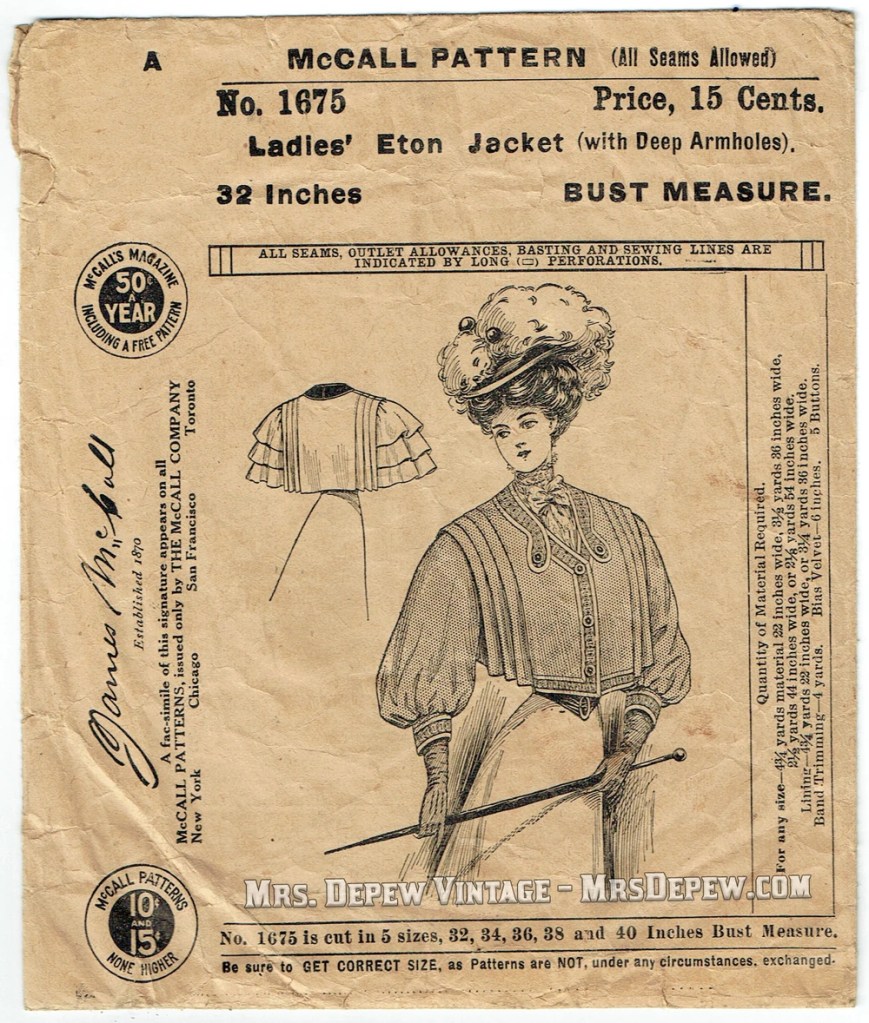
McCall 1675; ca. 1907; Ladies’ Eton Jacket (with deep armholes). Featured in McCall’s Magazine September 1907.
What a fabulous jacket! That’s why I would choose this Eton jacket from 1907 because not only would it create a great historical silhouette, I’d love to try styling it with other items from my modern wardrobe.
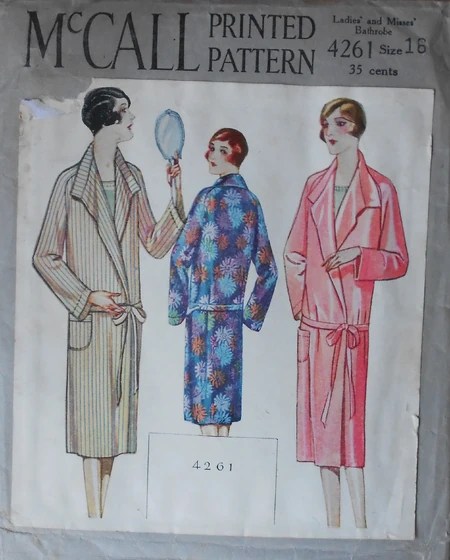
The flapper dress patterns you see in the store are so played out and inaccurate. My choice was influenced by the wonderfully boxy lines of this robe. It encapsulates the straight up and down silhouette of the time while looking like a piece that could be dressed up or down, for around the house or used for wearable garment in the right fabric.
1930s Era
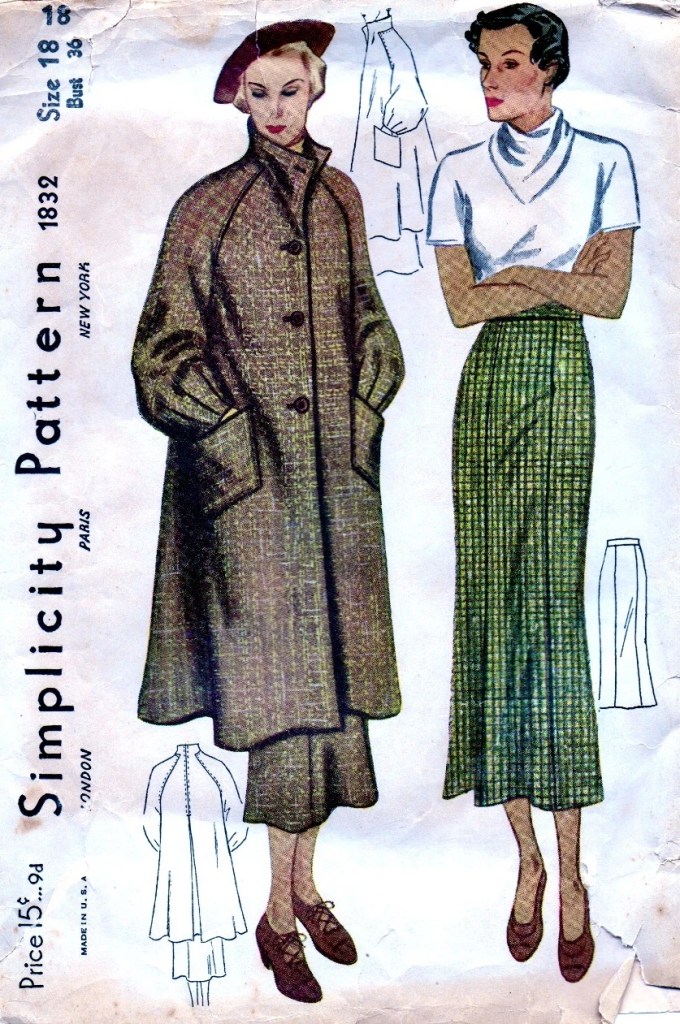
Simplicity 1832; ca. 1935; Ladies Swagger Coat and Six Gore Skirt. Coat has full raglan sleeve tucked at the wrist, patch pockets, stand-up collar and inverted back pleat.
Oh my goodness, this coat is fabulous. I may try to track this down in the future just to try my hand at it because I love these style lines. I love the raglan sleeves with the contrast of the narrow 1930s skirt. It’s so chic.
I like the academic style of view A and the elegant style lines of view B. I think I would get a lot of wear out of a dress in this style. The 1940s are one of my favorite eras for vintage fashion, I love the style lines of this time period and the 1920s-1930s.
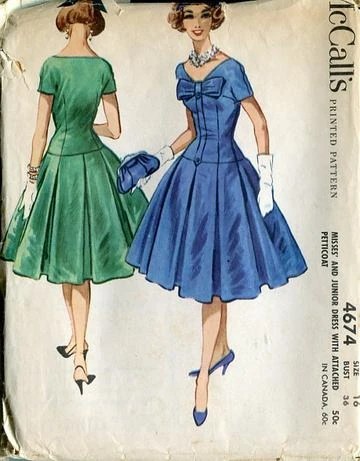
The 1950s is not my favorite era of fashion, mainly because this silhouette looks horrible on me and it’s really over done when people think of “vintage” so for inspiration I went to 1958, the year my grandparents got married to find something interesting. I like the bow on the front of this and flounce of the skirt. The shape reminds me a bit of a bridesmaids dress I tried on that my grandma wore for her friends’ wedding in the 1950s.
1960s Era
Vogue Paris Original 1434; ca. 1965; Pierre Cardin – Suit. Side-buttoned jacket with standing, bias ring collar and cuffs. Tie belt at front, welt pocket and three-quarter length sleeves. Slim skirt.
I chose this one, first because I had yet to choose a Vogue pattern and secondly, because this suit is sharp and screams 1960s glamour. I love the over sized buttons. The classic shape and the slightly mod-artsy feel of the over all look.
This is a unique pattern. I like how many styling options we get in the line drawings. It’s an interesting jumpsuit I could see made up in several types of fabric for casual or fancy styling. I should see the blazer made in a contrast fabric or the same. Jumpsuits were a staple of the 1960s and 1970s so I think this is a great option to represent the decade.
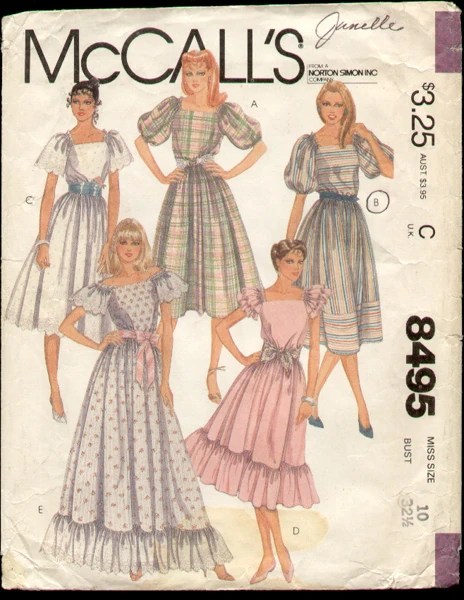
This pattern is so extra. I didn’t realize how much the cottagecore aesthetic pulled from this time period – wow! I thought the 1980s was just inspired by the 1940s, but there is a lot more there to see. I think this would be a great upcycling project with bedsheets.
I originally wanted to pull from 1993, but this pattern is too perfect for me. I honestly want to make all three of these. I have fabric that would work for view B. I wonder how difficult it would be to track down?
Closing Thoughts
A special thanks to Vintage Pattern Wikia for making it possible to browse vintage patterns and for keeping these moments of fashion history alive. Thanks also to Stephanie Canada for putting this on my radar and for sewists like her who are keeping vintage patterns accessible to us to sew with. This was a fun challenge posed by the Simplicity Creators group and Simplicity itself for putting this on all of our radar. Although I’m not going to sew anything from what I found because I seriously have to many projects to add another right now. It’s a great way to appreciate vintage paper patterns and the effect they have had fashion and clothing in the last 160 years. Sewing your own clothes is such a great way to make things that fit you, and have your own flair, they also combat the unhinged mayhem that is fast fashion. It’s a win win 🙂
I have a history with 1920s fashion, 1920s Ireland, and 20th-century football at Geneva College. My first successfully hand-knit sweater is a blend of all these flavor notes. As I consider how this piece came to be, it truly feels like the best possible way to write a love letter to the things that have become a piece of me, whether through ancestry or by my own seeking out, it is my beginning spark that pulled me into the world of designing knitwear.
I’ve been knitting for a decade now with degrees of success. I’ve kept to the small projects. Things like scarves, hats, mug warmers, a tea cozy, and tried my hand at mittens. There have been attempts at sweaters and even an oversized cardigan that turned out okay, but not what I had hoped. But then a movie was made that created exactly what I was looking for, they even made them by historical techniques and by hand. That movie is Martin McDonagh’s The Banshees of Inisherin.
The collar, the shoulders and silhouette of these pieces of knitwear look pulled out of a vintage collection of 1920s extant garments. Because they made these for the movie, it gave me hope that I could capture something historical from the weaving of my needles. This is what I came up with:
Originally, my plan for this sweater was to recreate a sweater I bought from H&M in 2011. I loved the striped boxy shape and easy to pair because of the neutral color story. I was knitting the body while I watched The Banshees of Inisherin for the first time and was taken aback by the knitwear of Padraig O’Sullibhean’s character. It was rugged, cozy, and yet practical in a beautiful celtic sea blue, almost teal hued wool yarn.
With only the body finalized and a sleeve on my needles, I realized I could pivot. I craved the chance to make something like the 1920’s football sweaters of Geneva’s yearbooks but I also wanted to capture the old style of sweater making from the early 20th century. Being from Irish descent, with my ancestors being from the O’Sullibhean clan out of Cork, it seemed like the stars aligned on this project. So I pivoted and widened the shoulders to look more inline with football attire. I added a longer ribbing to the bottom for a vintage feel and lastly I recreated the open collar of Padraig’s sweater.
The finished project perfectly marries the football feel with the connection to the past I desired, wrapped up in a sweater silhouette that I hope more people attempt. Historically inspired knitting was a blast. It also stands out which makes me happy. ☺️
After ten years, I finally did it! Knitting this, my first successful sweater, by my own drafted pattern was even sweeter. Thank you reader, for letting me share this project with you. It is one of my favorites.
What is an escape map you ask? Beginning in World War I, the Australians developed an escape map in July 1918 for Allied soldiers to escape from the German Holzminden prisoner-of-war camp. To do this, the creators needed a material that would be durable, unlike paper which could be destroyed by water, and so sections of the map were sewn into the clothing of prisoners who escaped through an Allied tunnel.
Moving forward into World War II, the British Royal Air Force, and the United States military used maps printed on a silky material called rayon. This is where the concept of silk escape maps comes from. If shot down in enemy territory the servicemen could use these maps to get back to safety or evade capture. Thousands of these maps were created during the war and during the post-war era these maps remained but for a different purpose. The destruction of the war was evident across Europe, during this period of rebuilding there was a lack of everything, including fabric and so these escape maps and parachutes were repurposed into clothing. For more examples of what these items looked like I highly recommend checking out this BBC article and this piece by Hannah Steinkopf-Frank for their wonderful images and research.
Just a Girl with Aviation in Her Blood and a Passion for Dress History
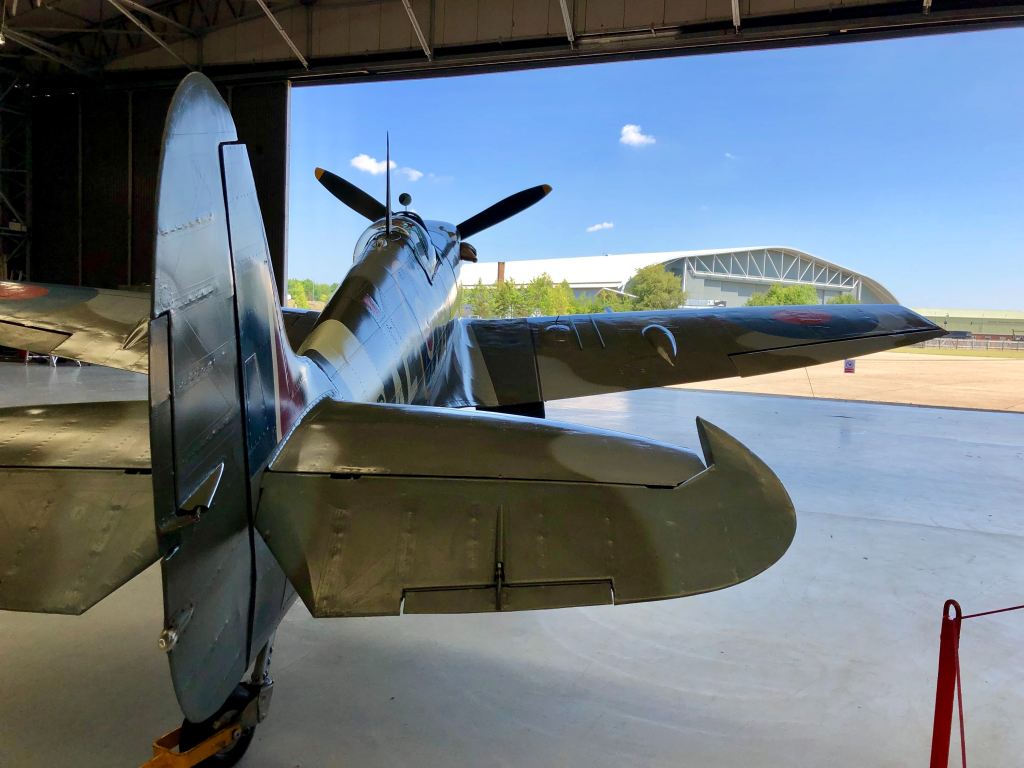
I’ve always been fascinated with unique garments from history and the story behind them. That is what makes dress history one of a kind because the garments were not just objects of history, people lived their lives in them. It tells us about what they looked like, what their life consisted of, their status, and their creative ability. The parachute and escape map garments truly speak to the resilience within the makers to find the normal and reclaim their humanness during one of the darkest times in human history. With that being said, what makes these dresses truly special to me is the connection to aviation. My dad is a pilot, aviation nerd, and history fan. From our conversations I have a well of random airplane knowledge I’m never going to apply to my life, but it truly fascinates me. It is his passion for it that I understand because I am so much like him. Although I have gone through bouts of hating aviation because it feels like the thing that comes between me and my dad having a close relationship, anything airplane related reminds me of him.
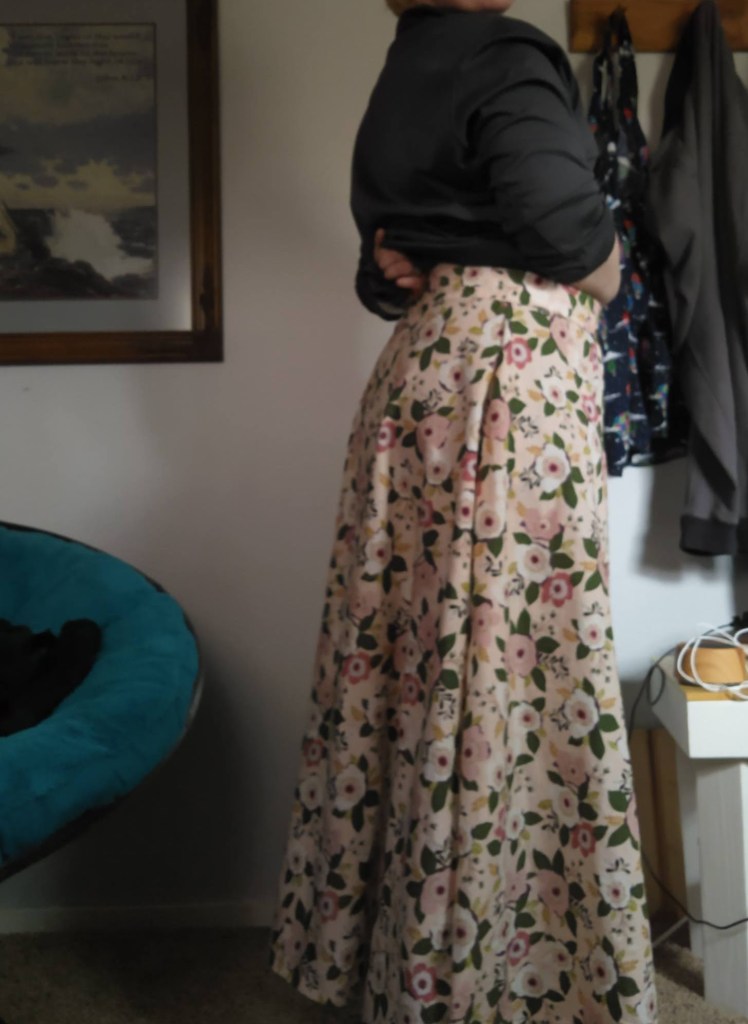
When I saw this fabric on sale at Hobby Lobby, I knew I had to get it. It is a canvas material, so a far stretch from the silken rayon of the WWII Escape maps, it is covered in what looks to be aviation charts crisis-crossing the world. It immediately made me think of the escape map garments and although the fabric cutter thought I has lost my mind when I said I was going to sew a garment out of it, I’m glad I didn’t listen. This dress is constructed from one of the comfiest and most flattering self-drafted patterns I have made. I wear it often and it makes me feel special because it is closely tied to my own story. Although I can’t share this dress with my dad I know he would be proud and that feels good.
Red Dead Redemption 2 was not a game I thought I would love or even appreciate. In fact, I’ve never played it myself, I’ve only watched my husband play, and seriously, I enjoy watching him play. The world created in the second game is so immersive and aesthetically pleasing that my dress historian heart sings when I see the detail and research the developers put into making Arthur Morgan and the cast of characters feel well-placed in a game of re-imagined history.
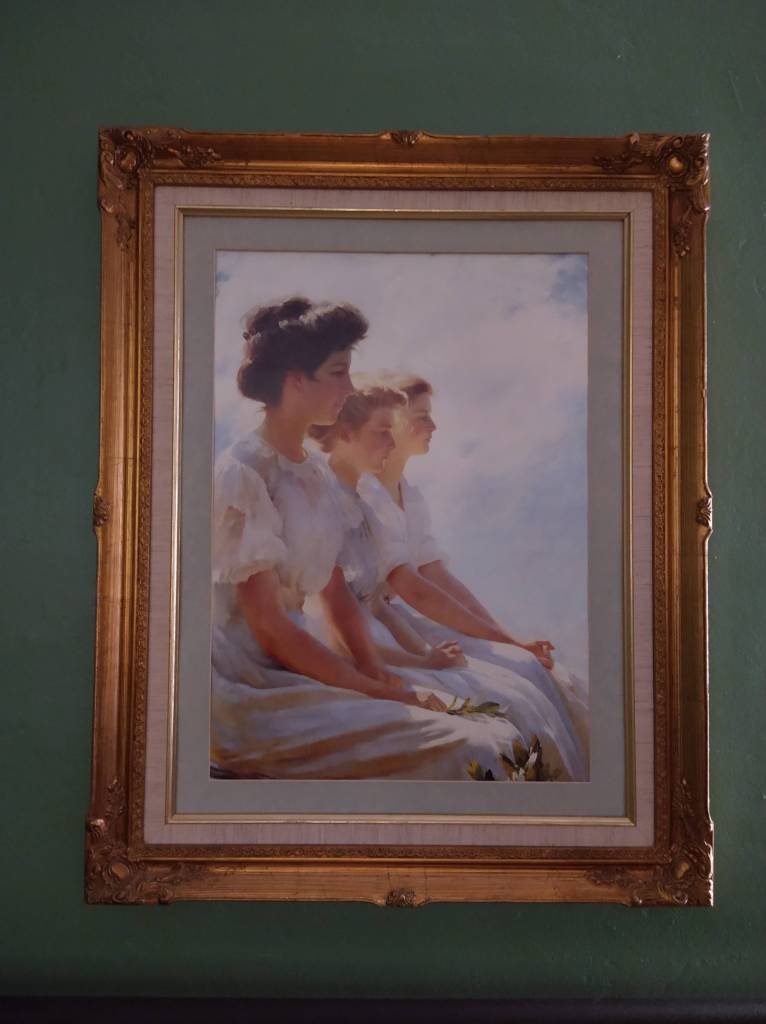
The 1890s have long been a favored period for me. From the popularity of the Gibson Girl look to the Anne of Green Gables movies, puff sleeves, bicycle jackets, and the pigeon breast silhouette with long walking skirts have long captured my imagination. Maybe it was the years of seeing these portraits of my 1890s ancestors above the mantel at my grandparents’ house. Or this Gibson Girl-inspired painting in my Grandma’s bedroom. It made an impact on my appreciation for this time period and design aesthetic.
There is such a quintessential Victorian-ness about it. But also this aura of possibility. The world was changing rapidly during this time through industrialization the Gilded Age brought splendor and wonder. The Arts and Crafts Movement was at its height which is why I think I am so drawn to this style. Arts and Crafts era houses are among my favorite styles of architecture, bringing forth the Craftsman style along with Frank Lloyd Wright’s prairie style. Maybe it was growing up in an old Victorian house too?
And so this game, Red Dead Redemption 2 with its 1899 time stamp and varied styles of architecture has brought me so much joy and comfort. Even the Bayou Nwa of Lemoyne is a delightful reminder of my time living in coastal Georgia. Especially the alligators, which seemed to lurk in every body of water. But those cypress trees still call, like the delightful menswear of Arthur Morgan’s wardrobe, and the wonderfully decorated towns of St. Denis, Strawberry, Rhodes, Valentine, Annesburg, and Blackwater. And so I find myself sewing Arthur Morgan-inspired pieces, for both myself and my husband. Who knows where inspiration will find you? I certainly didn’t think a Rockstar-developed video game would bring me such joy and fashion design inspiration. But it truly shows that inspiration is everywhere if you take the time to appreciate it.
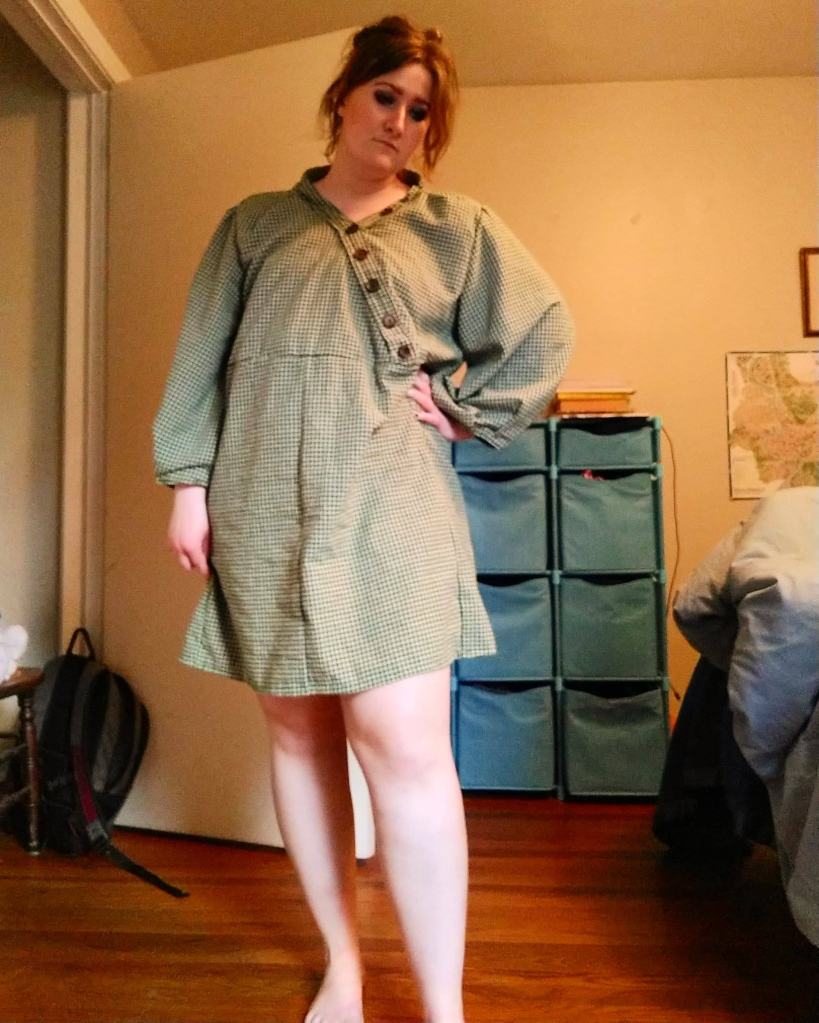
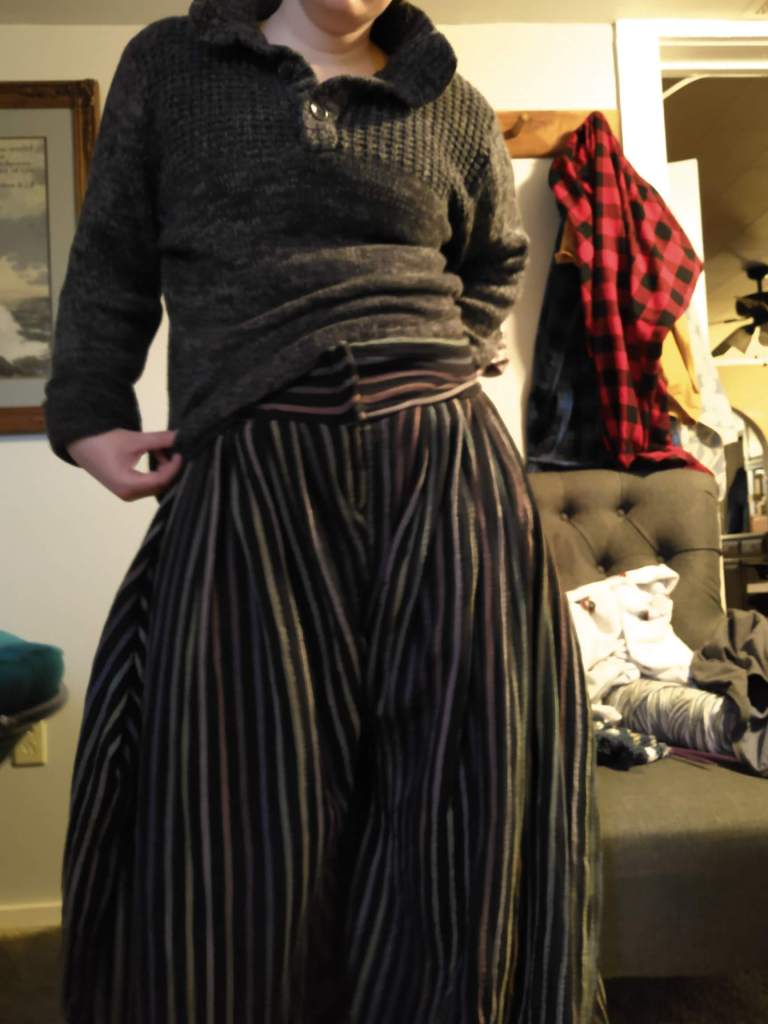
L to R: 1890s long underwear-inspired dress, Vest with high neck in the 1890s tailoring style, Exaggerated 1890s menswear stripe pants












 One Rabbit Riot