This is a follow-up to my recent post, ‘Will I Wear a Knit T-shirt?’, where I examined the fibers and wearability of a knit t-shirt and discussed whether this summer knit project could be a suitable option. Since then, I finished and got to wear a new piece of knitwear – my first knit tank top. I wore it in July, in full humidity with highs in the upper 80s to low 90s Fahrenheit. My experience surprised me – I said before that my knit t-shirts are wonderfully comfortable, but have a temperature and humidity limit for me, but the tank top surprised me!
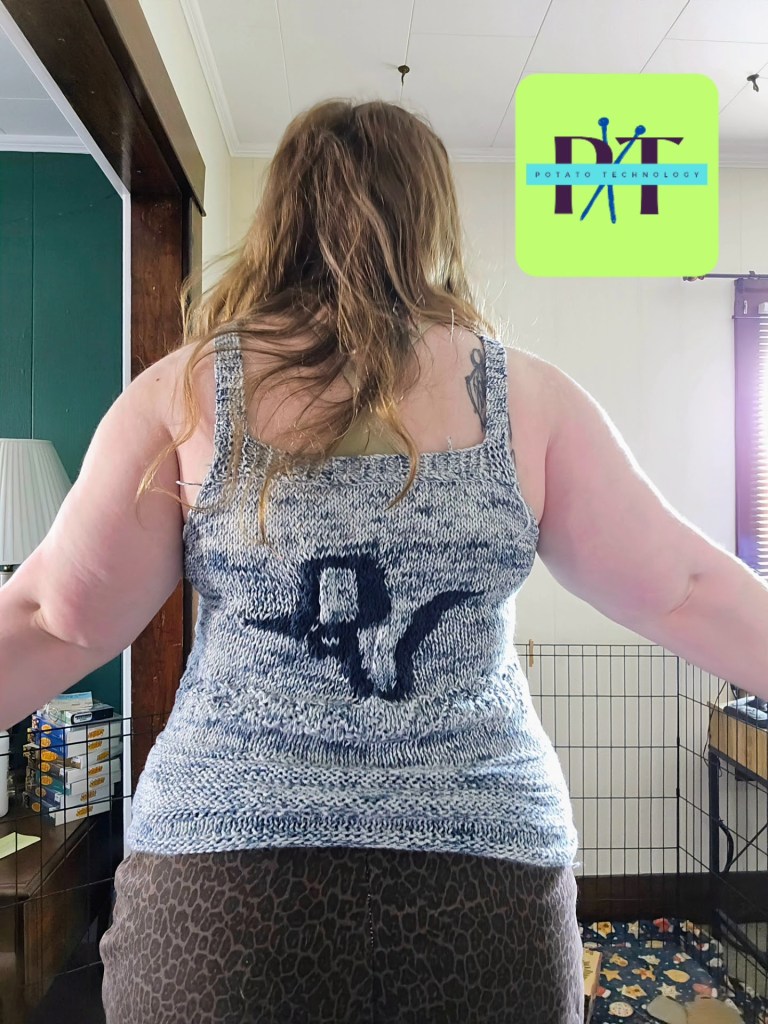
I think it was the high pima cotton content in the Knit Picks Comfy – a 75% Pima Cotton and 25% Acrylic mixture that uplifted the breathability for me. I was melting in the hot sun, but the air flow and temperature regulation were spectacular! This tank had delicate straps but did not have a lacy stitch or open weave. It was constructed with regular knit and purl stitches, with sections that had double layers of yarn due to two sections of colorwork graphics on the front and back.
With Pima Cotton, Silk, Bamboo, or Linen as the primary fiber, or a blend of these natural fibers, I believe knit tanks are just as breathable as woven fabric, and for sure more breathable than moisture-wicking tech fabrics, which are polyester. No, I wouldn’t work out in this top, but there is something to say for a garment that is comfy and breathable for those long summer days. It was a simple stitch-up up only calling for two hanks of 100-gram worsted-weight yarn, about 240 yards, with the addition of 1/3 or 40 yards of the accent yarn, another cotton-acrylic worsted-weight blend from Loops and Threads. You can make a tank like this for 30 USD or less, and this is a size large. So if you have a small amount of yarn, you can do a lot with it!
Do you think a knit tank would be an item you would wear?
I asked myself this question last summer with genuine uncertainty. Knitting is such a cold-weather medium that a knit made to be breathable and light for warm weather seemed, well, a bit like an impractical fashion piece. I think this is an important question to ask of ourselves before we jump on a trend. Whether it is to buy a knit t-shirt or to handknit (which means you are dedicating weeks of work to a project), having the right expectation matters. Trying on a knit t-shirt beforehand helped me visualize what I was in for. Knitwear for all seasons is currently having a moment even in ready-to-wear, which makes this a great time to go try on a piece before committing to a big project.
Wearing my Grandma’s cotton knit t-shirts, although they were two sizes too small, helped me visualize knit as a process to make a fabric instead of a woolly winter garment. That’s what makes knitting and crochet extraordinary skills; they are versatile. The fiber maketh the project. The stitch maketh the airflow. Lacey, open weave? Fantastic for hot and humid days. Not so much for a pair of mittens.
To remedy this, I think fiber acquaintance is a fantastic way to learn whether a knit t-shirt is right for you. When I began knitting in 2012, I knew there was wool yarn and acrylic yarn. That was it. However, there is actually a rainbow of fiber waiting to be discovered, and the lineup sure has expanded in the last 13 years!
Cotton
Linen
Bamboo
Hemp
Pineapple
Lyocell
Rayon
Yak
Alpaca
Camel
Mohair
Cashmere
Silk
Did you know that wool has two unique properties? It helps you regulate temperature and is naturally antibacterial/antimicrobial; therefore, it inhibits bacterial growth naturally on the fiber and prevents odors, which is why it is such a great sock material! Although I wouldn’t recommend wool for summer tops, it is a remarkable fiber. There are two fibers, though, that are breathable and naturally don’t let bacteria and microbes hang around – it’s linen and silk! For fiber education and the chance to feel these materials, I recommend finding a friendly local yarn shop and talking to the experts.
Finally, I do have one possible hiccup with my current selection of hand-knit t-shirts. I can’t wear them in 85 degrees Fahrenheit weather and above with humidity, but I do believe a knit tank would fix this problem, and a lacey stitch technique in future projects will solve this. I don’t like sweating a lot in my handknits, and because I was learning with my first few tees, the knitted cotton fabric is a bit bulky. That’s my error. You know what is so cool about knitting, though? You can unravel the finished garments and try again, so I can rework these finished garments in the future. Anyway, I hope you will consider the knit t-shirt as a warm weather staple in your wardrobe, it’s a lovely way to use crochet and knitting all year round!
Knitting a dress, how hard can it be right? It was actually pretty managable garment as an intermediate knitter. I would not recommend unless you have made a sweater before but would definitely recommend knitting a dress if you want a soft and stretchy garment that hugs you!
Inspiration
I have made plenty of dresses over the past 5 years, but they have all been cut and sewn from fabric. Knitting kicks it up a notch, asking you to assemble the dress, but make the fabric to boot. I thought it would be silly to try until I discovered some lovely crochet designers on You Tube who make with imagination!
I was inspired by Mama Gwen of TL Yarn Crafts to give designing a knit dress a try. She makes such beautiful dresses all from self-drafted patterns in knit and crochet. Along with Dana from Blondie Knots. Her Coachella scrap two piece outfit helped me have the boost of confidence to try something new.
Materials
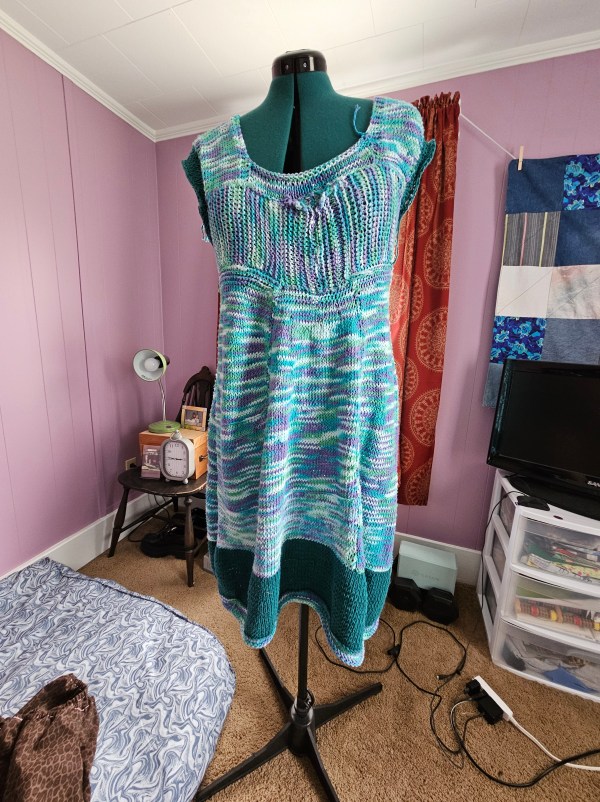
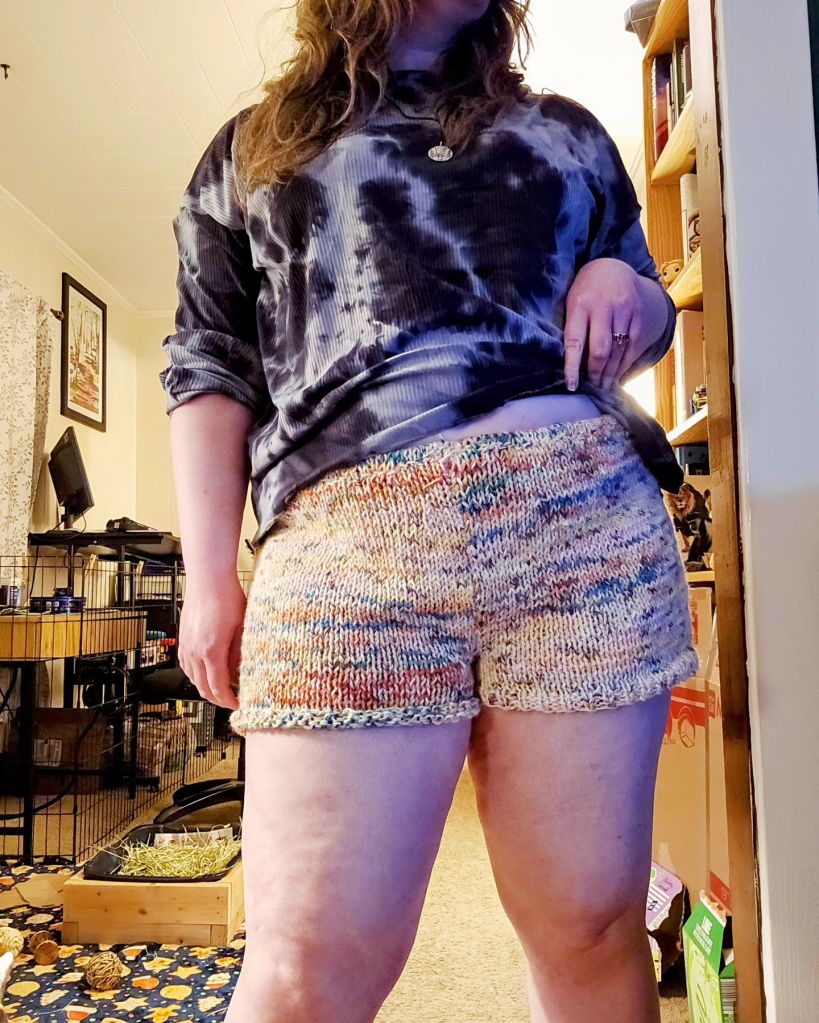
Last summer at Joann, before the shenanigans began, I purchased 14 Big Twist Cotton 50g skeins on a sale with the intention of knitting a top. Many months later, this yarn was sitting in my stash with my mind uncertain if the punchy color changing yarn was my cup of tea for a cotton knit top. But a dress? Yes, that could work. Did I have enough yarn though? I’d have to make it so because there was no more being sold.
Because of the circumstances, I decided this dress would be my goodbye to Big Twist.
Design
I knew from sewing, my design would need to be a dress that was either tubular or empire waist to suit my body shape. I decided to knit this on US 7 needles, straight needles. Sometimes I would shift to circular, but this was not knit in the round. With the combination of yarn minders, a measuring tape and patience this dress came together!
To start I knew I wanted the bodice to be the anchor I worked out from so I cast on stitches to work horizontally. From the bodice, I then added one strap to plan the width and placement of the top. I was uncertain how much yardage the skirt would consume, therefore I paused to determine sleeves later.
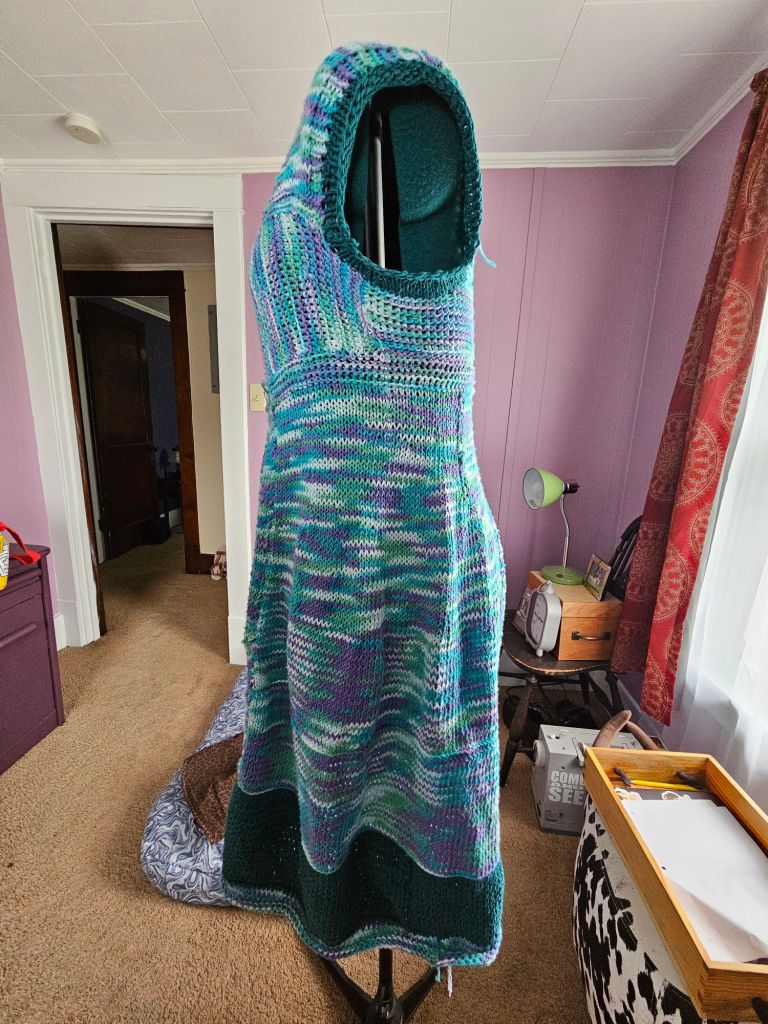
My plan for the skirt was to knit a section by casting on the bottom of the bodice, adding stitches to increase width until I finished a skein. Repeat and fill out the row by picking up stitches to join the sections vertically into a tube. I continued on, and on until weeks later I had a skirt but panicked that I was not going to achieve my desired length and second sleeve!
I decided to pull a teal yarn from my Landscape Painting with Yarn project. This hue pulled the cool tones into harmony in a pleasing way. I used two skeins of this teal color and then finished with the original Water Lily tonal yarn. I finished the second sleeve and tried on the piece with relative ease. There was one fit issue – plunging neckline. But it was a lovely, cozy knit from scratch dress!
The final touches to this project were addressing the neckline and the sleeves which were set too deep. I cast on to the neckline to fill in the gap and provided structure to the straps with several rows of decreases to give the dress a cap sleeve befitting my vision.
Final Thoughts
I am definitely making more dresses with knit! It’s far more pleasant than sewing if you want a comfy yet elegant style. You have both control of the drape and the fabric design. It’s your world, as Bob Ross would say.
This project was more than a goodbye to Big Twist, it was a new chapter for me. I began this journey 5 years ago to learn how to make and now I feel empowered by knowing I can make my own clothes, not just with fabric but with skeins of yarn and needles. It has been a wonderful journey of discovery!
If you want to knit a dress, I’d say go for it! If you’re a beginner, make one but not as your first project – you will be overwhelmed by the sheer amount of time this project took. It was weeks of work that as a beginner, would have scared me. In time I know you can do it though! ❤
Do you ever get stuck in start mode when beginning a new thing?
Like you’re wandering through a maze of ideas. Maybe it’s the planning stage, too many ideas, not enough organization? It’s weird. I feel such a rush when I have multiple WIPs on my needles. The satisfaction of binding off stitches and slipping that garment onto my body makes every week of work worth it!
The void though, between new idea and casting on a new project, is a shape shifting process. The indecision sets in.
What yarn should I use?
Do I have a color palette
Stockinette or a new stitch?
Texture?
Colorwork?
Do I have an inspriation garment in mind?
Have I thought about how I want to garment to fit?
How much positive or negative ease should I plan for?
The next phase is choosing needles, selecting the amount of yardage, and gauge swatching the stitches to inches ratio to calculate the size of the garment.
It feels as important to start with the correct amount of stitches as it does to pour a concrete foundation evenly. I think this is why I get stuck in neutral instead of shifting into gear – when you get a creative idea sometimes the final design outcome is a little fuzzy.
So how do I get out of it and move forward with my design? I sketch, even simply shading the colors together in simple patterns helps me see if the image in my head will fit the realized garment. I also start working with the room to frog the yarn and begin again.
That is my favorite thing about fiber art, you can tear out and begin again without ruining your materials. Even though the first stitches feel like concrete the process is flexible.
Do you get stuck in planning? How do you move your mind forward? Thanks for spending time with me today. You are amazing and I hope you know that you are loved. Until next time. ❤
Several months ago, I started a new side quest in knitting – making socks. It’s a windy and treacherous climb, fraught with new equipment and an entirely new approach from a garment like a sweater. At the beginning it’s like casting on a mitten or a small hat, yet as time goes on you realize you are somewhere between a knitter and a sculptor, looking for the heel shape in your amphorous block of yarn. It is the most challenging garment I’ve made, culminating in going over the waterfall, at least that’s what turning the heel felt like at times.
What makes this ubiquitous garment so hard to learn? It’s a project of multi-tasking, like dribbling a basketball and moving at the same time. You are not only knitting a pattern – a sock, but you are also learning it on a new court – double pointed needles or with a magic loop configuration on circular knitting needles. There is also the third option, the one I leaned on when I was baffled by hitting gauge on my project and fed up with ripping out my progress over and over, knit flat tube socks that are sewn together to form the tubular shape.
My first two completed sets of socks were made this way, with straight needles to help me process all I was learning from these new techniques. It was the confidence boost I needed to keep going and finish the sock. I get overwhelmed in new projects when nothing is familiar but taking one part, flat knitting, and keeping that as the control part of the experiment let me knit and see how it should look and feel when the socks are completed. To better understand what I was working towards on double pointed needles or circular needles. Flat knitting also gave me the chance to try something I’ve never done before as a knitter, I cast on two socks at a time on my needles. It was incredibly satisfying to finish each sock at the same time!
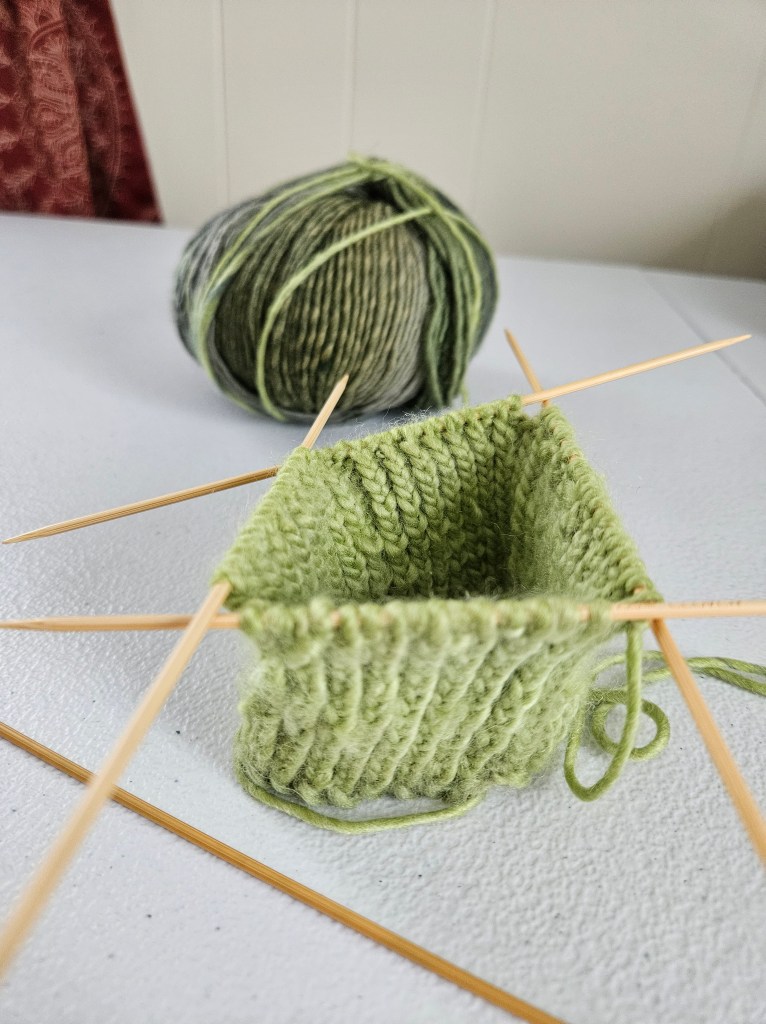
Attempt on DPNsFinshed tube socks pair knit at the same time on one set of straight needles
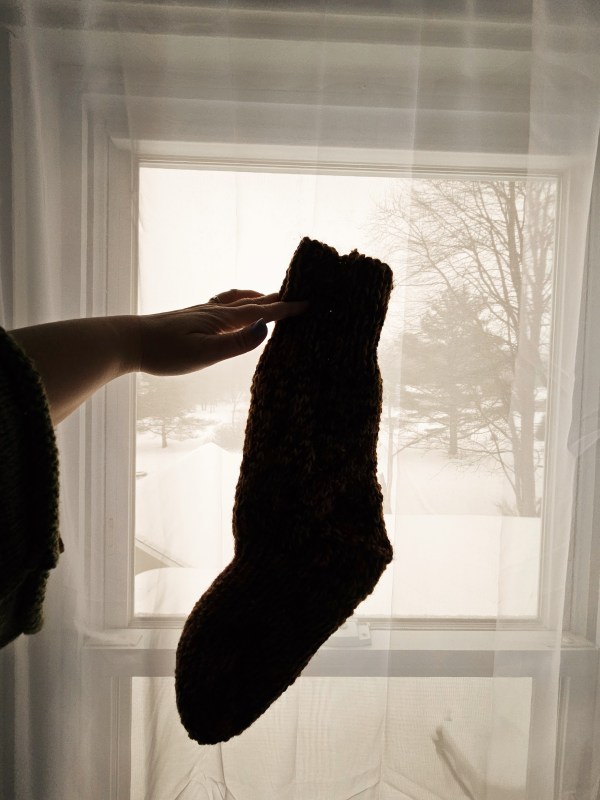
With this new found confidence I carried on and cast back onto the straight needles, making a brown pair of socks from recycled acrylic that wash and wear well. These green socks above are a blend that is mostly wool with a hint of acrylic in the yarn and they are hand wash or steam only for me. I wash them gently with either shampoo or conditioner in the sink, carefully to prevent felting. For my next project I wanted to explore fiber content, so I cast on a sock with three strands – two fingering weight wool and one acrylic. I chose this composition to test wear and washability, to make these a sock I could worry less about washing yet would insulate my foot, this was during a month long stretch of cold weather, dipping into the negatives fahrenheit so my mind was on cold weather. I decided to make these chunky socks into a sock I would use to insulate my L.L.Bean duck boots which are waterproof but are canvas, not insulated at all. They are a boot I want to wear for cold weather and snow, but they make my feet cold even with two pairs of socks.
As I got to the heel portion, I knit these socks cuff down, I made a last second decision and transfered my project to my round needles, joining the row into a round a stitches. With my heel turning reference book in hand I began turning that heel! It wasn’t as bad as I thought it would be! I don’t think I executed it perfectly, but I conquered a fear. Now, the tough part of the process is that my handwork for circular knitting is subpar. I hold my stitches too tight and the tension hurts my fingers the longer I knit on a project. The only way to improve this is to keep practicing, yet I don’t want to practice. The second sock is cast on but I have yet to make progress on project because I am dreading the circular process and those tight stitches that come from inexperience.
Is this sock the best fitting sock I’ve ever made? Yes! Is it better than store bought ones? A 1000% yes, and I’m a novice so they are going to get better with practice. It’s an art form we wear everyday without thought, but it is truly a sculpture of yarn. Next time you put on a sock, have a moment of appreciation for the geometry, the symmetry, and the sculpture adorning your foot.










 One Rabbit Riot