Catch of the Day Sweater

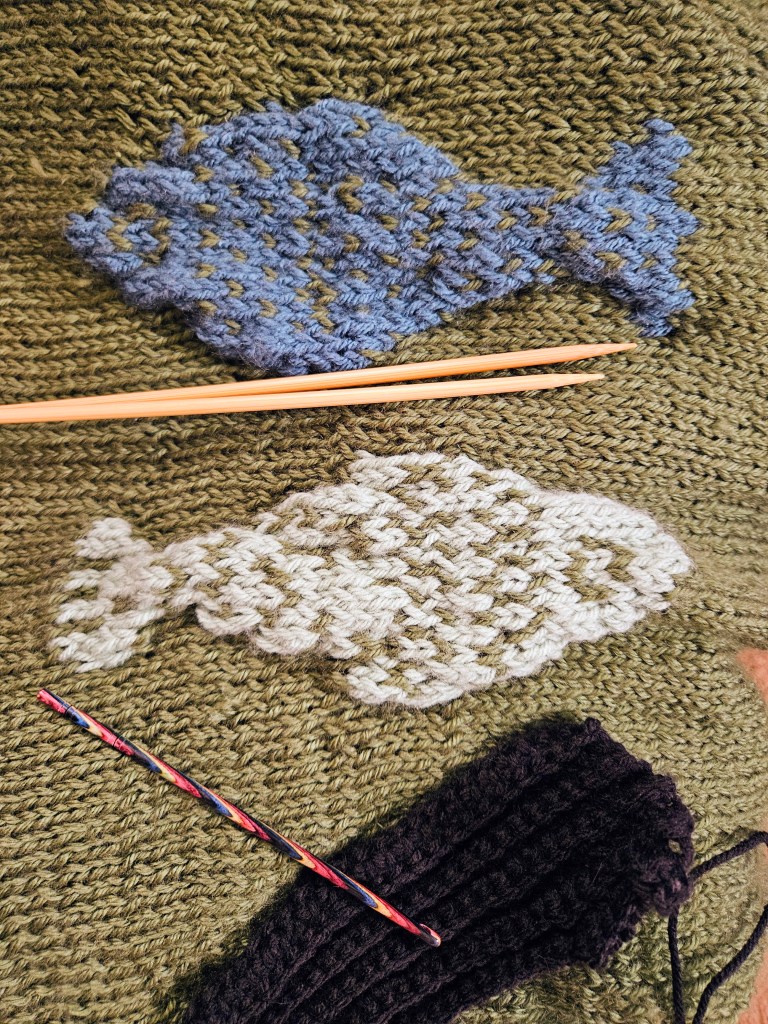
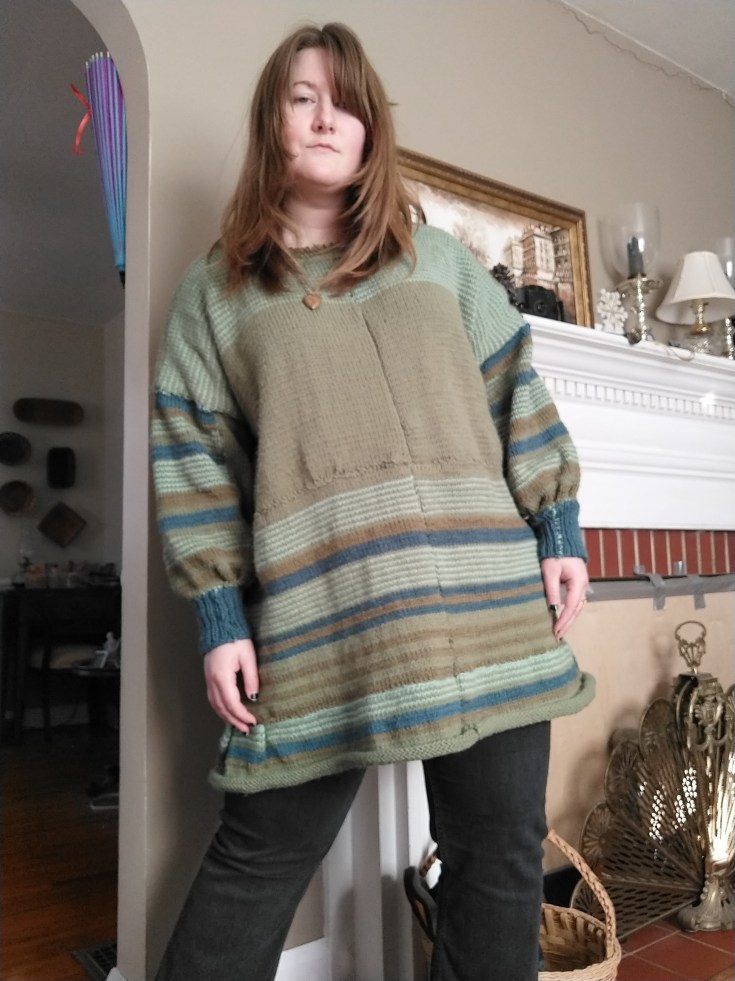
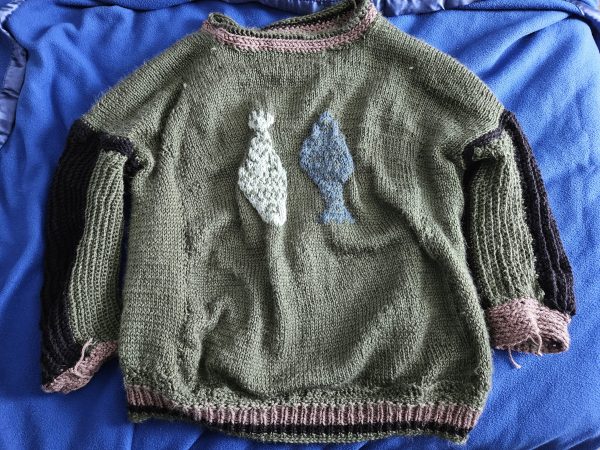
In 2025, sardines and other tinned fish became more than just food; they appeared on beaded bags, shirts, and prints. They also made their way to the fiber arts community, which inspired me to make a fish print sweater for Kyle, who enjoys fishing IRL and in video games. I just like the video game version.

The Design Concept

When planning a garment with a colorwork motif, I always consider scale, placement, and repetition. To do this, I use what I learned in art class many years ago – the seven fundamentals of art. So I consider line, shape, color, value, form, texture, and scale. In the catch-of-the-day sweater, it was important to make the fish wearable and to ensure good form and function. How do I make the fish on this sweater make sense? I decided to hang freshly caught fish on the sweater to help with the scale of the art. I placed them in the center, on the front, only to keep the perspective of this in focus. I thought placing more fish would become overwhelming to the eye and become unwearable.

Adding more fish would have required adjusting the scale and the color, meaning I would have simplified the sweater down to two yarn colors only, with sections of fair isle colorwork, which is a smaller, more concentrated technique. But I like the color contrast of using two colors, representing two types of fish with slightly different scale patterns. How big is too big? How do you represent a fish, with their scales and texture? For this, I went to Pinterest to find cross-stitch or knitting colorwork charts for inspiration. I believe I settled on a cross-stitch pattern because it had the detailed lines and scale I was looking for. I wanted the fish to look realistic, although it could be in an imagined world like Animal Crossing New Horizons or Stardew Valley. Whimsical? I think that is the best way to sum it up.
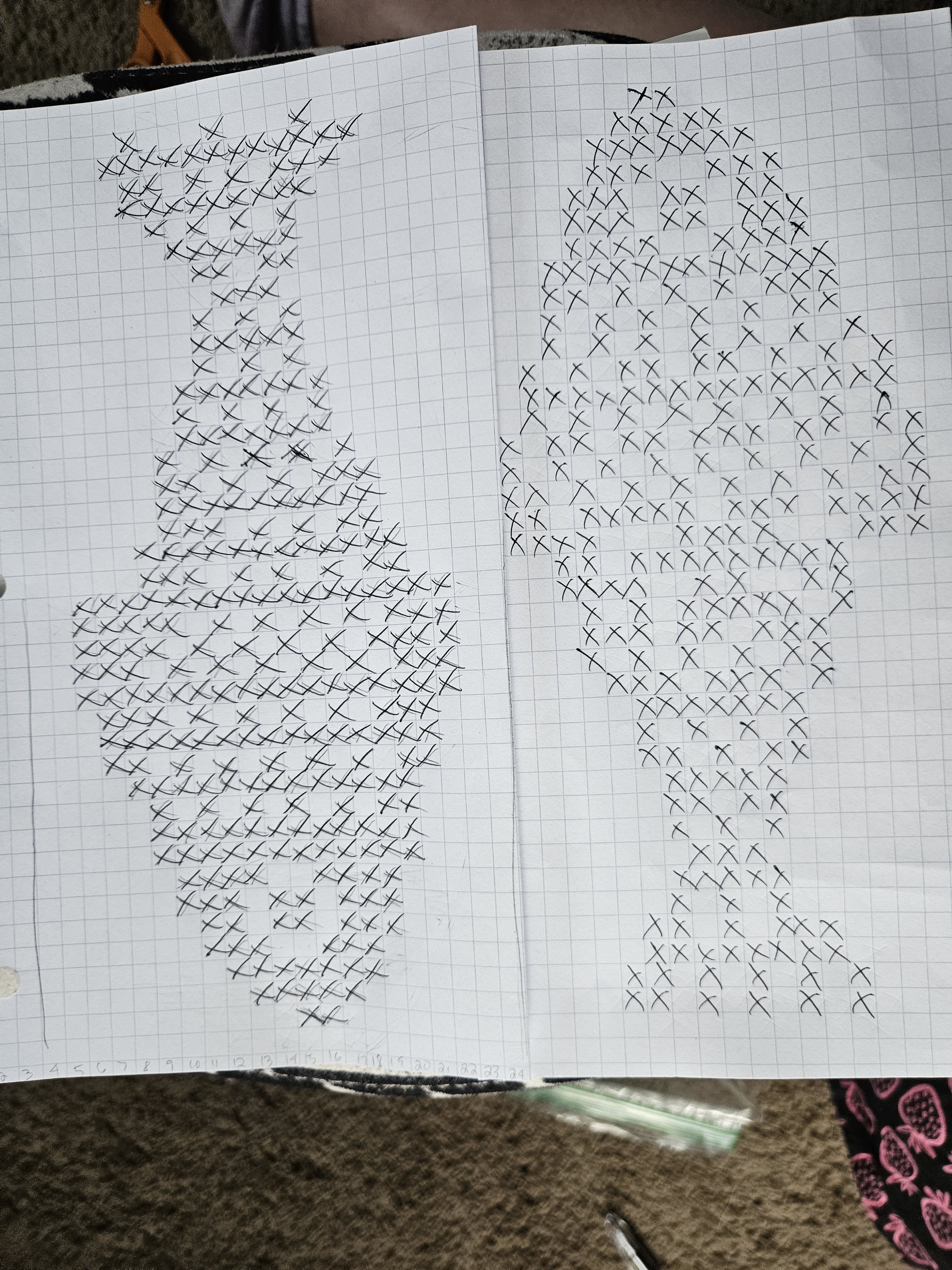
To make my pattern, I used the cross stitch reference and transferred it to graph paper by hand, tweaking some areas to make the inspiration my own. I did this in the same application for my Red Velvet Cosmic Knit Tank project. Next, I needed to determine the scale of the fish within the sweater pattern. It’s important to plan out how many stitches you need to complete the colorwork section across your rows and keep it centered. To do this, subtract the number of stitches in your colorwork pattern from the number of stitches in your row. Divide the sum by two and adjust to keep the stitches on either side equal, to keep the pattern centered. It is also important to note how tall the color work pattern is compared to the garment you are knitting, to allow enough room above and below that the graphic motif makes sense and doesn’t look misplaced on the garment. I think I literally held my pattern up to Kyle’s chest to figure it out.

Fiber Content

For this sweater, I went in a different yarn direction to try something new. I chose a wool and acrylic blend from Knit Picks called Mighty Stitch. It was underwhelming. The yarn, while soft, pills something fierce. It is also a slim worsted weight, which was exaggerated by the large needle size I used – US 10 or 6 mm. This created a breathable, airy sweater, but dang, did it throw off my pattern and design. Eventually, I had to face my fate – I was running out of yarn, and my panel was too narrow. Not exactly the outcome you want after spending a week on the front panel with the intricate fish design. I would rather start over than frog the color work, always.

I had some decisions to make. I originally purchased the Mighty Stitch on sale, but when I ran out of yarn, it was not on sale, and I wasn’t interested in doubling the price of this already too expensive project that was in the process of failing. So like Miss Frizzle recommends, I got ready to “Take chances, make mistakes, get messy!” I went to my closet of yarn and fabric and began to dig through the stash for something else I could introduce into the design. I found a warm-toned gray and neutral black yarn from Big Twist that was also worsted weight. Because the Mighty Stitch is a washable yarn, I felt comfortable combining the two yarns. I had already introduced acrylic yarn to the project through the mint and teal fish, using scrap Big Twist for those sections. Always check your fiber content, though, to avoid incompatible fibers that will make the project hard to care for over time.

Making a Change

The original design was changing from color palette to overall concept. This sweater would need to have color blocking sections now, to stretch the main green color. I decided to not only change up the design, but to change up my technique, opting for crochet on the sleeves to make the sleeves go faster. Knitting is a slow craft, and for some reason, knitted garments for Kyle have this curse of going horribly wrong and also knitting up slowly because of the hiccups. I wanted him to be able to wear this sweater for the bulk of the winter season of 2025-2026, and I was knitting this in August-October, so I took a shortcut. But in my defense, the texture of the sleeves, ironically, looks like fish scales to me. Especially with the gray and black colors!

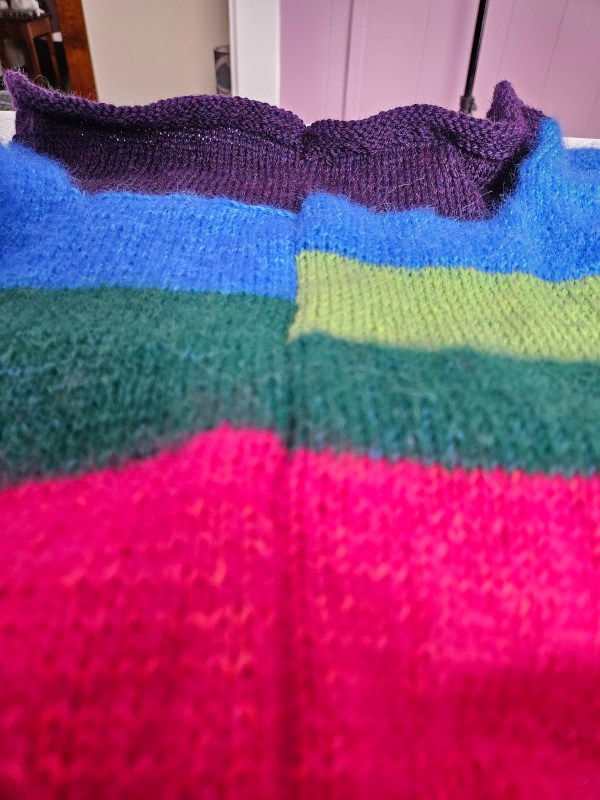
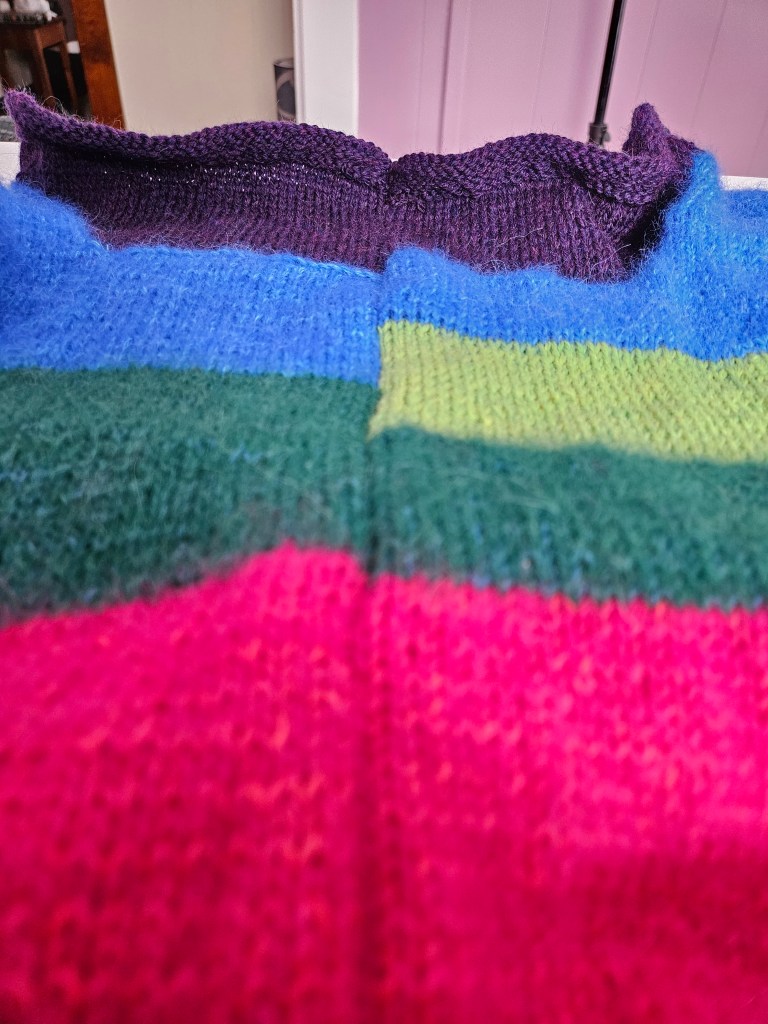
The second change I made was adding width to the sides of the front panel to make the sweater a drop shoulder. I then knit the back panel wider from the start, and added a section of gray on the middle to upper back panel. It adds a nice contrast to the overall composition of the sweater, while making the sleeves feel cohesive.

Men vs Women Shoulder Shaping

The shoulders gave me such grief in this project! I’m used to making sweaters for myself and my female form. The bust makes the shoulders rest differently than I realized, and this came back to bite me. For a man’s sweater, the back needs to be longer. Especially the shoulder section on the back of the sweater is going to ride up the back, and be too long in the front. This happened, and I was bamboozled on how to fix it. Enter short row shaping and the principles of perspective and scale.

I learned that I needed to add short rows, meaning only working a section across a row to add length to a specific portion of the back panel, the back middle. To do this, you work back and forth on the section, evenually go back to working across the entire row. In addition, I made the back collar and back ribbing longer to compensate. These simple changes made the sweater appear the same length back and front, draping across the shoulders pleasantly, even if one side was technically longer. It doesn’t matter because of the role of perspective. Magic!

Final Thoughts

I learned a tremendous amount of knowledge from the Catch of the Day sweater, and I am grateful it all came together in the end to make a sweater that Kyle enjoys wearing. I have saved my patterns to attempt this again in the future with better yarn and proper dimensions to make the pattern fit well from the start, instead of scrambling to adjust at the end.
The Search for Affordable Yarn – A Review

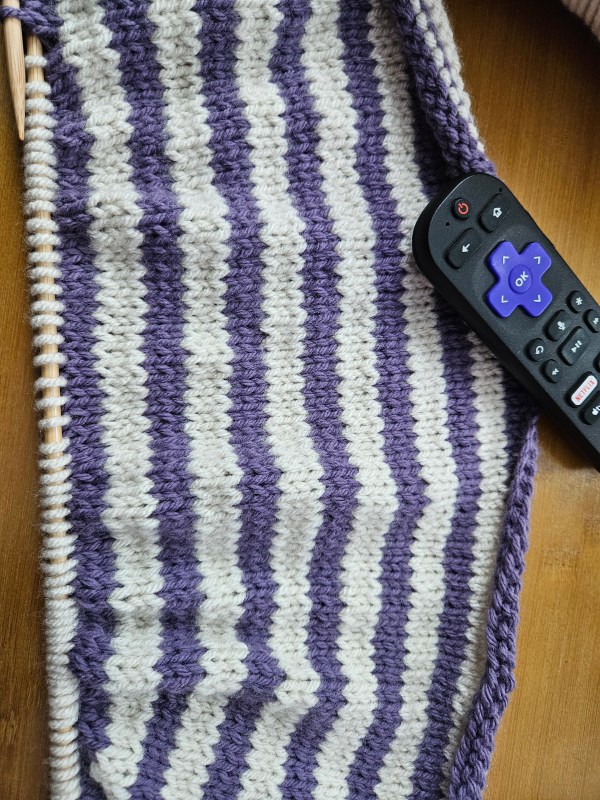
When my go-to yarn, Big Twist, was temporarily discontinued in 2025, I felt adrift in a sea of unfamiliar yarns with unfamiliar prices. Which raised an interesting question: what will be my new tried and yarn? I thought I would share this journey with short reviews of the yarn I explored in search of a new favorite.

Yarn Criteria:

What am I looking for in a yarn? Big Twist was my favorite for a few key reasons – affordability, quality, color range, and ease of accessibility. Big Twist had a large selection of colors in a worsted weight that did not split easily or snag in knotted tangles. The skeins contained 380 yards, selling for 4.49 USD, which made sweater projects affordable. It was easy to source in person. Now I am not looking for in-person yarn purchases like I used to. It’s just not possible at this time.

Wool of the Andes

Wool, worsted weight, has a large color range, and can also be purchased in a superwash variety. This yarn is a Knit Picks, made from Peruvian Highland Wool is sold for 4.99 USD per 110-yard skein. I like how sticky this yarn is. When it is stitched up, it stays in place and has great stitch definition. It’s not too itchy. I am sensitive to wool, and I find this yarn to be fine. I also used the superwash for a hat, so that could be where the extra scratchy feeling came from. I think this is a great yarn for budget wool, and for beginners, the best part is that it arrives in a skein, not a hank that you have to unwind. Yes, I would buy this again. I just purchased this for an upcoming rabbit-related project.

Mighty Stitch

Silky and soft. This yarn had great sheen for an 80% acrylic, 20% wool fiber. It was labeled as worsted, but I found it to be too thin compared to my other worsted yarns, which created some issues in my project. This Knit Picks yarn is 7.99 USD for 208 yards. When I purchased this yarn, it was on sale, but still more than I am used to paying for acrylic. Due to the thinness of the yarn, I failed to meet the gauge. I found myself using a lot more than I thought I would. The most disappointing thing was the way it slides out of knots, which was a problem for the colorwork and color blocking sections. The yarn also doesn’t respond well to my husband’s beard. I found this out because I knit him a sweater, and the top was falling apart where it caught on his beard. Would I buy again? No. I don’t trust it not to pull out of the weave, and I felt let down by the price for the experience.

Lion Brand Pound of Love

I found these oversized yarn skeins at Michael’s, and I was thrilled. Lion Brand is a fantastic budget yarn that I used before on a previous sweater project. At 1020 yards for 11.99 USD, this yarn has been a game-changer for experimentation. I can try new projects, have room to mess up, or be able to make gifts, blankets, etc, on a budget. It does not split. I can knit or crochet easily, and it meets the gauge. My only negative critiques are the color range and the composition of the fiber. I wish there were more colors; the range is small compared to Knit Picks or Big Twist. I also wish acrylic were not made from plastic. I wish this were wool, and was kinder to the environment. Yes, I will buy this again. It is the best budget acrylic yarn I have found that is easy to purchase and would be a great beginner yarn to learn with.

Loops and Threads Soft Classic

Before Big Twist fully came back in Fall 2025, I thought Loops and Threads may be Michael’s brand expression of Big Twist, after they acquired Joann’s IP and the yarn vendor contracts, so I gave it a shot, and I have some mixed feelings. The color range is large, which I like. Some of the shades are lovely, and some are a bit garish. Some of the yarn dyeing is odd. Some of the texture of the acrylic fiber is also odd. It can be a bit limp, almost too soft. I love the mushroom and curry color ways. The black yarn I purchased, however, smelled like a cheap pleather purse- a bit fishy and a bit like burnt hair. I still can’t get the smell out of the yarn with airing out, Febreeze, and laundering. Maybe it was the chemical dye? For this reason, I have some pause. But you can’t beat the 3.99 USD price and 354 yards per skein. Let the creativity reign! Yes, I will buy again.

Palette

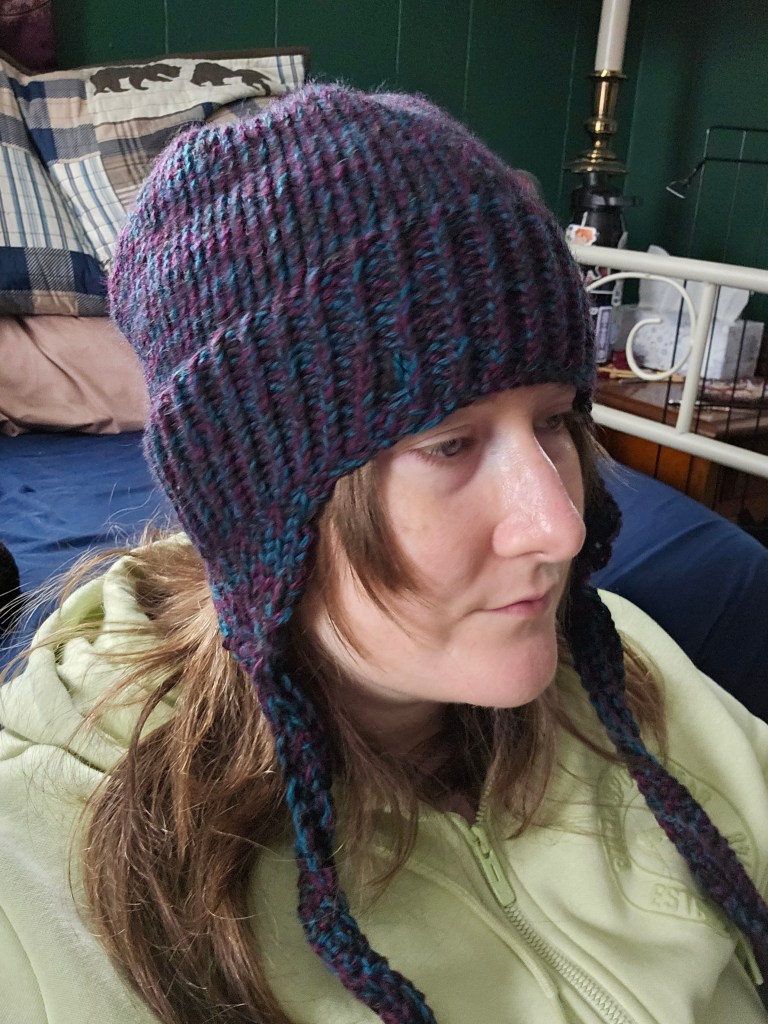
Palette Fingering Weight yarn from Knit Picks is a 100% Peruvian Highland wool yarn that has become my go-to winter accessory yarn. With its lightweight ply, I combine it with other yarns to create marled and warm hats, mittens, and socks. The hat to the left is three strands of Palette held together on US 7 needles. The hat to the right is made with two strands of worsted-weight acrylic (Big Twist) and one strand of Palette. It’s a non-superwash and has a lovely squish to the skeins. This yarn is already skeined up, no Hanks to unravel, and contains 231 yards for 5.49 USD per ball of yarn. I will rebuy. I actually panicked on New Year’s Eve, that I had drained my whole stash, to find they were at the bottom of a tote bag.

Caron Cakes

I have worked with two Caron Cake varieties in 2025 – Blossom Cakes and Big Cakes. The Blossom Cakes are a blend of 61% cotton and 31% acrylic fibers. They are variegated, worsted-weight cakes of 481 yards that sell for 14.99 USD per cake. They tend to do a BOGO sale at Michael’s, so I get them on sale, or else I would be less enthused about this item. The Big Cakes are also worsted-weight acrylic yarn, which is self-striping. I love the quality of the yarn, but the striping is a bit tricky. I am currently using them for blankets, but I did consider separating the sections of color to make something different. The Big Cakes contain 603 yards, which are sold for 14.99 USD. On a sale, you can make a blanket for a great price. For this reason, I will try the cakes again, with the proper project. They are complicated, and without a plan, they feel like a waste of money. With a good plan, they are a great resource.

Final Thoughts:

I found more options than I expected last year, and this led me to actually be happy that I had to find a new option for my tried-and-true yarn. Moving forward, I don’t have a sole favorite; instead, I feel like a nuanced palette of tastes is the better way to describe it. If you are a new knitter or curious about trying some of these yarns, I hope my thoughts helped. These are all my opinions, and all the yarn was purchased with my own money.

I Found A Local Yarn Store!

If you have been following my blog this year, you will know that I was feeling a bit frustrated, that I didn’t have a local yarn store to turn to after Joann closed – but that’s no longer the case! I found a local shop thanks to the Yarn Discovery Tour of North Eastern Ohio. How wonderful is that!

As a Western Pennsylvania resident, it was a little bit of a drive, but not too far to visit the lovely Three Sheep Gallery and Workshop of Boardman, Ohio. This yarn shop had so much for me and my mom to check out – spinning wheels, weaving looms, yarn brands galore, project kits, needles, hooks, etc. I picked up a sock kit with a superwash merino and nylon blend fingering weight yarn that is self-striping. I was excited to try this sock kit because it came with a free pattern from Urth Yarns. This sock pattern has been full of surprises, some good and some challenging. It is a toe-up sock pattern, based on traditional Turkish sock design.

I’ve never made a toe-up sock before, I’m excited to learn new techniques, but here is where I am struggling. I bought double-pointed needles, on recommendation for sock knitting, and they are wonderful needles, but dang, the combo of a new sock technique and new tools has been frustrating. I’m getting laddering on the sock every time I start over, and I feel a bit on the edge of tears because these needles were expensive – 21 USD! On top of the sock kit for 29 USD for 100 grams of yarn and a PDF pattern. I feel a lot of pressure, from my own mind, because I was not paying attention to the price and feel like I made a mistake, but I need to remember that new skills take time. With patience and practice, the skill will come in time.

The second project I purchased was a scarf kit with two yarn hanks of worsted weight wool and a pattern from Urth Yarns, that my mom also purchased so we will have matching scarves! I’m so excited. The biggest blessing of this day was the opportunity to share what I love with my mom, my Scott, and my Kyle. I am truly grateful for all that these guys did to make this a great day of bonding for my mom and I, and for the four of us. It’s been a heavy few weeks after losing our beloved Sully, and getting a day to explore a new yarn store, learn about weaving, and getting to meet the lovely owner of Three Sheep was a bright spot after days of gray.

Will I Wear A Knit Tank?

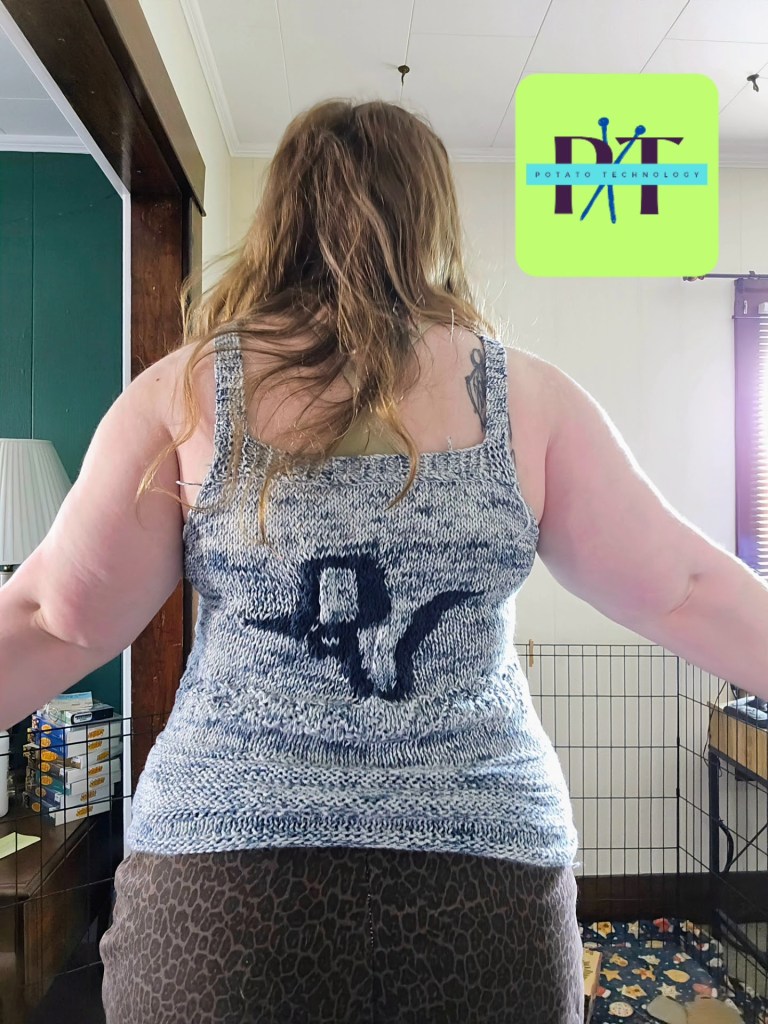
This is a follow-up to my recent post, ‘Will I Wear a Knit T-shirt?’, where I examined the fibers and wearability of a knit t-shirt and discussed whether this summer knit project could be a suitable option. Since then, I finished and got to wear a new piece of knitwear – my first knit tank top. I wore it in July, in full humidity with highs in the upper 80s to low 90s Fahrenheit. My experience surprised me – I said before that my knit t-shirts are wonderfully comfortable, but have a temperature and humidity limit for me, but the tank top surprised me!

I think it was the high pima cotton content in the Knit Picks Comfy – a 75% Pima Cotton and 25% Acrylic mixture that uplifted the breathability for me. I was melting in the hot sun, but the air flow and temperature regulation were spectacular! This tank had delicate straps but did not have a lacy stitch or open weave. It was constructed with regular knit and purl stitches, with sections that had double layers of yarn due to two sections of colorwork graphics on the front and back.

With Pima Cotton, Silk, Bamboo, or Linen as the primary fiber, or a blend of these natural fibers, I believe knit tanks are just as breathable as woven fabric, and for sure more breathable than moisture-wicking tech fabrics, which are polyester. No, I wouldn’t work out in this top, but there is something to say for a garment that is comfy and breathable for those long summer days. It was a simple stitch-up up only calling for two hanks of 100-gram worsted-weight yarn, about 240 yards, with the addition of 1/3 or 40 yards of the accent yarn, another cotton-acrylic worsted-weight blend from Loops and Threads. You can make a tank like this for 30 USD or less, and this is a size large. So if you have a small amount of yarn, you can do a lot with it!

Do you think a knit tank would be an item you would wear?

Will I Wear a Knit T-Shirt?

I asked myself this question last summer with genuine uncertainty. Knitting is such a cold-weather medium that a knit made to be breathable and light for warm weather seemed, well, a bit like an impractical fashion piece. I think this is an important question to ask of ourselves before we jump on a trend. Whether it is to buy a knit t-shirt or to handknit (which means you are dedicating weeks of work to a project), having the right expectation matters. Trying on a knit t-shirt beforehand helped me visualize what I was in for. Knitwear for all seasons is currently having a moment even in ready-to-wear, which makes this a great time to go try on a piece before committing to a big project.

Wearing my Grandma’s cotton knit t-shirts, although they were two sizes too small, helped me visualize knit as a process to make a fabric instead of a woolly winter garment. That’s what makes knitting and crochet extraordinary skills; they are versatile. The fiber maketh the project. The stitch maketh the airflow. Lacey, open weave? Fantastic for hot and humid days. Not so much for a pair of mittens. 

To remedy this, I think fiber acquaintance is a fantastic way to learn whether a knit t-shirt is right for you. When I began knitting in 2012, I knew there was wool yarn and acrylic yarn. That was it. However, there is actually a rainbow of fiber waiting to be discovered, and the lineup sure has expanded in the last 13 years!

Cotton

Linen

Bamboo

Hemp

Pineapple

Lyocell

Rayon

Yak

Alpaca

Camel

Mohair

Cashmere

Silk

Did you know that wool has two unique properties? It helps you regulate temperature and is naturally antibacterial/antimicrobial; therefore, it inhibits bacterial growth naturally on the fiber and prevents odors, which is why it is such a great sock material! Although I wouldn’t recommend wool for summer tops, it is a remarkable fiber. There are two fibers, though, that are breathable and naturally don’t let bacteria and microbes hang around – it’s linen and silk! For fiber education and the chance to feel these materials, I recommend finding a friendly local yarn shop and talking to the experts.

Finally, I do have one possible hiccup with my current selection of hand-knit t-shirts. I can’t wear them in 85 degrees Fahrenheit weather and above with humidity, but I do believe a knit tank would fix this problem, and a lacey stitch technique in future projects will solve this. I don’t like sweating a lot in my handknits, and because I was learning with my first few tees, the knitted cotton fabric is a bit bulky. That’s my error. You know what is so cool about knitting, though? You can unravel the finished garments and try again, so I can rework these finished garments in the future. Anyway, I hope you will consider the knit t-shirt as a warm weather staple in your wardrobe, it’s a lovely way to use crochet and knitting all year round!

Is A Yarn Made From Recycled Marine Plastics Any Good?

As I have dove deeper into the world of fiber crafts and created often, I’ve become more conscious of the fibers I choose. Mainly because when a project doesn’t work, I feel like a jerk for making that mistake in hard to break down acrylic. I would feel less of a fool if my mistakes were constructed in biodegradable natural fibers like wool, cotton, linen, or bamboo. Starting in 2024, I began to migrate back to natural fibers, which I mentioned before in my Summer Knitting Plans post from last year. I had been hesitant to use wool before that, supposed allergies that I debunked in 2024, which led me to explore the many fiber offerings of Knit Picks.

When I was looking at sock yarns in the fall, a particular fiber caught my eye – Oceana. The Oceana line has this vibrant kaleidoscope of colors that evokes the tropical hues of a coral reef. It’s stunning! When my stepdad gifted me a Knit Picks gift card for Christmas, I knew exactly what I would order – the Oceana! Not just for the colors, but the innovative fiber content.

L to R: Sea Lettuce, Spirulina, Tiger Fish, Swordfish, Axoloti

This yarn is composed of 54% Superfine Alpaca and 46% Polyester SEAQUAL, which is made from marine litter cleaned from the ocean, and that plastic is then recycled into polyester (acrylic) yarn that is blended with the Alpaca fiber to create the Oceana yarn. The halo seems to be the Alpaca, based on my experience working with this yarn, and the interior chain fluffy fiber strand seems to be a combo of the recycled polyester and Alpaca fiber. Now, fiber blends are not the best for decomposing, but I like the motives behind this yarn. Instead of using newly created polyester, which doesn’t break down easily and is cluttering our environment, they are taking the trash out of the ocean and repurposing it into something useful. How cool is that? Can more polyester-based products start with recycling the plastic litter before making more? We literally have endless resources of trash, thanks to Shein and our rampant overconsumption.

So how does this yarn knit up? Excellently! It has this plush texture with a fuzzy halo that to me looks like those mohair strands knitters use to plush up a sweater.

I’d say the only cons I have are the price and the yardage. I didn’t find this yarn went far, and had to play yarn chicken a few times. I secondly was only able to order five skeins with my gift card, the yarn was on sale might I add, with a 50 USD gift card. When I ran out of yarn, I chose to supplement with Knit Picks Palette yarn in fingering weight, held in double strands to match gauge. I do understand that part of the price is the process of SEAQUAL and the Alpaca fiber costs as well, but it was just a bit too much for me to purchase more at full price when I ran out, especially when I had existing yarn in my stash that could work.

I had planned to have this project done by the time I reviewed the yarn, but as it is now April, and I’ve shifted to summer and spring knitting it is unlikely this project is wrapping up soon. Here’s a look at the project at its current state. 🙂

I Accidentally Felted My Magic of Scrap Cardigan

In the summer of 2024, I returned to an old fiber friend, wool, and introduced a new natural fiber – alpaca. When I began knitting in the early 2010s, I bounced between wool and acrylic fibers, not really looking at fiber content and instead looking at the pretty colors and my stitches so I didn’t drop one. Oh, how times have changed! When you love something you begin to obsess, dig, and it becomes a fiber woven into your identity. That’s where I found myself as a knitter for 10 years. I am constantly thinking about fiber content when planning a new project because it’s more than just the make that matters; it is how the garment is worn and washed for many years to come.

Wool

I think we have deep scent memories just like how wool fiber remembers the shape it is blocked into with water and pins. The scent of wool is woven deep into my memories of traveling to Ireland as a child in 2001. It is the fiber my Grandma wore most of the year. She was always cold, even in summer. Wool has always seemed a bit scratchy to me. It triggers my neurodivergent aversion to certain sensations. It was not a fiber I would choose to wear a whole sweater out of, although small accessories I could handle. Coats were fine too, until they weren’t.

After my grandparents passed away, within 6 months of each other I suddenly had things they used to own. Clothing being one of those things, a lot of those clothing items contained wool. I couldn’t stand the fiber being near me. I’d get a head, a migraine really. I’d feel stuffed up and allergic, at least I thought. From 2020-2024 I avoided the fiber. Begging my mom not to knit me anything in wool. I rounded up the wool items and put them in quarantine in a box in my house, the “allergy” being such a wave of anguish to my body. Looking back on it, I can see it was an expression of grief and stress. That smell of wool, it felt like a ghost lingering in the shadows of my mind not a normal fiber. Grief makes things so weird!

Acrylic

Under this belief of a wool allergy, I pivoted solely to cotton, bamboo, linen, and acrylic. If you are looking for a cheap and cheerful fiber acrylic is your yarn. It’s everywhere in the big box stores and that’s exactly what I did. I experimented with Red Heart, Big Twist, and Caron. They come in value packs and the worsted weight is an excellent fiber weight to use when learning how to create complicated garments such as wearables like sweaters that involve sleeves, shoulder shaping, and necklines. I’ve made a lot of mistakes along the way, it’s part of the learning process, yet using these affordable and easy-to-source yarn options took the trepidation out of the creating process.

Acrylic is seen as the “low-brow” yarn for a lot of the knitting community. It’s looked down upon for not being a natural fiber. Take organic and insert natural fiber and it is the same sort of elitism. But honestly, aside from how it’s made, acrylic being a polyester fiber, I don’t get the hate. It’s washable. These garments I was able to block in the dryer. As a knitter who was new to blocking this process taught me how and why blocking matters without the high stakes of felting, shrinking, or destroying my hard work during the wool sweater blocking process. It’s an approachable fiber for beginners.

Fiber Curiosity

Acrylic was my bread and butter, but after a while, we all crave some variety. For winter sweaters the other fibers – cotton, linen, and bamboo aren’t going to cut it. This is where some field trips came in! I’ve mentioned Keystone Safari before on the blog, it’s a wildlife preserve and education center in my region and they have sheep, alpacas, yaks, camels, and llamas. All of which I feed and pet without any allergies! This is where I began to question my “allergy” to wool. How could I spend time around these fibers, in their natural state where there would be more allergens like hay and not have a reaction (when I’m actually allergic to hay and grass)? It didn’t add up.

So in 2024, I began to run experiments. In the yarn shops, I’d pick up wool and alpaca-specific skeins and feel them in search of the truth! At my mom’s house, I’d ask her to see her skeins of wool and I’d do the same, even sticking them in my face, demanding they show me an allergic reaction. Nothing happened. Nothing. Could it be, that was I ready to find my true knitting form? A natural fiber artist, possibly a spinner, with a vast knowledge of wool, alpaca, mohair, and more? Yes, it was time.

Magic of Scrap Yarn Cardigan

So how does felting come into play in this story? It doesn’t sound like a story of woe, but it is. I was quite inexperienced with wool and how one cares for wool, that lack of experience came back to bite me with this lovely cardigan. I made this cardigan from wool extra skeins from my mom. Some of those skeins I put right up into my face to see if the wool would make me allergic. But this cardigan was not just a project of wool, it was a project made of extra wool skeins, wool-acrylic blend skeins, and acrylic skeins. Those fibers require different strategies to care for them properly.

This was my first mistake. I mixed fibers willy-nilly without thinking about each one has unique advantages and disadvantages. Wool is naturally anti-bacterial and requires very little cleaning. You can spot clean and refresh in the air or the snow. But you can’t throw it in the washer, and if you wash you must be gentle to the fibers with delicate movements and gentle water temperature, or else it will felt. Acrylic on the other hand is very durable. You can wash it in the washing machine without worrying about the possibility of felting the fiber. Acrylic fibers do not felt. It does not have anti-bacterial properties though so you clean it. Can you see where this is going? I screwed up the washing portion of this project.

I washed it in the washing machine without thinking and the cardigan shrank. Next, I tried to stretch the cardigan as it dried, while it was wet. Not gently, although the washer had already set the stage for stressed wool fibers. The cardigan no longer fit my person. To remedy this I thought I would hand wash delicately and attempt to re-block the cardigan. This was the nail in the coffin. This fatal mistake transformed the project from a knit cardigan to a felted mess. It was too far gone, like a burnt cooking disaster. There was no coming back from this, the damage was done.

I began to panic. How would I continue using wool and alpaca? I was currently knitting wool socks, um how was I going to wash those? Was I screwed? I was convinced I could never hand wash again without feeling sick to my stomach. I had to find a new solution. Steam. Steam was the answer. I have an iron, an iron with steam. Could I use this instead of purchasing a garment steamer? The answer amazingly was that simple! I steam my wool and alpaca projects now and the steam helps them bloom, they almost block from the steam along. It’s incredible. Just a little steam and the fibers refresh, safely! It’s transformed how I care for my knitwear. Sometimes these creative misfires lead us to places we may not have tried without the failure as a catalyst to try something new. I feel equipped to work with natural fibers, confident that if I spend months on a project I can care for said item for years to come. Have you tried streaming your wool garments before?

#69 – Joann Fabrics, A Crafter’s Thoughts, LYS

We are in a clickbait world, with insane thumbnails and exaggerated headlines. Over time I’ve learned to stop clicking, stop believing, to wait and see if there is an ounce of truth to the “news” on the screen. That was my strategy for the ongoing Joann’s bankruptcy story. They filed for Chapter 11 bankruptcy in March 2024, which raised many red flags in my mind, but I wasn’t allowing myself to worry. Bankruptcy happens, it should be fine. I decided to wait and see with a cool and calm demeanor. In the meantime, I would craft and mind my business.

In the fall of 2024, a news headline caught my attention – Joann’s was closing a few stores nationwide, one of them being my local Joann Fabrics. What a weird coincidence! But only a few stores nationwide, my mind pondered, that must signify this is okay, right? They’ll close my small store and a few more, not a big deal. No need to be concerned. I have other Joann Fabric locations within driving distance, I’ll go to those!

As the news cycle went, I continued to see thumbnails of a concerning nature as we entered the new year, questions of Joann’s future, and whether they were closing their doors for good. What an odd way to get traffic, I thought. They filed almost a year ago and the consequence was a few stores that would shut down, are these creators making a mountain from a small pile of dirt? I ignored them and carried on my way, thinking of the projects I’d like to make and the yarns I’d plan to use from the ever-growing list of inspirations I have saved.

I love Joann’s Big Twist line along with their collaboration with Eddie Bauer. They have been my two most used yarns aside from Knit Picks in 2024. I use the Eddie Bauer for sock and accessory projects, while the Big Twist has been my go-to yarn for wearables like sweaters due to its soft not scratchy acrylic structure, which gets softer with wear and washing, it is such an affordable yarn that has helped me create in lean times.

I have the same affection for Joann’s fabric department! The amount of inspiration I have found from Joann’s clearance section has been a huge blessing to my sewing journey. It has provided an affordable way to try new fabrics and hone my fabric knowledge without the pressure of learning by sewing expensive fabric for these experimental projects. Some of my favorite makes have been possible because of the clearance section. I also adore their lightweight quilting cotton fabric for summer. It makes a great sundress and no, people don’t automatically see that it is quilting cotton like some sewists fear. The ribbons, the notions, buttons, zippers, thread, interfacing, patterns, embroidery thread, not to mention Halloween decor!

Over the weekend, my alarm bells rang out while watching a new TLYarnCrafts video, because Toni is not a clickbait creator. She and her mom, Gwen, went to their local Joann’s for one last trip just in case of closure. That’s when it sunk in, Joann Fabrics filed Chapter 11 bankruptcy again in January 2025, calling for its sale and possible liquidation by said buyer until Joann’s is gone. I began tracking the updates on Reddit this week and the news was grim with each passing day. My fellow sewists and yarn enthusiasts seem just as heartbroken and confused as I feel by this ominous development. I truly thought Joann Fabrics was turning the financial woes around by closing just a few stores, but I was wrong.

It’s a staple for me to shop there. My local yarn shop and local fabric shop where there isn’t a small local business to support in my area. Joann’s filled that void. It was my first fabric store experience and will always hold a special place in my heart for supplying access to items that gave me purpose through crafting when my life needed a new direction.

On Wednesday, the updates became utterly ridiculous. An official document from Joann Fabrics named 500 of their 800 locations across the United States marked for shutdown. Including all the ones in my area. After I sat with the news I began to feel despair, not for me, but for all the workers who were getting the rug pulled out from under them. I’ve been laid off in the past and it is such a bizarre feeling. You’re not losing your job for a better opportunity or because you screwed up, nothing about the reason which led to your layoff was connected to you. Yet it directly affects your life and it leaves you feeling empty, in my opinion.

There has been a lot of bad news here in the last two months – fires, plane crashes, Tulsi Gabbard being confirmed, etc. The air is ripe with change and I hope that every employee who is being affected by this can transition to their next step with as little stress as possible. You guys did nothing to deserve this, the leaders of your company are taking away a great resource for the crafting community due to their mismanagement, not yours. What a weird year this is and it’s only February.

So this is my little reflection on what Joann Fabrics has meant to me and I hope this is not the end. Even with the sale looming, I hope they will not get rid of the company entirely, it serves a good purpose that cannot be filled by Michaels or Hobby Lobby. This will be a new adventure for me to find other yarn and fabric stores, not local to me but a local small business for someone. Thankfully the internet does exist so who knows where this will find me.

What will never be the same though is the ability to go look at fabric and yarn in person in a store that had it all in the same place, only catering to creative endeavors at an affordable price. It was a third place to be around others who liked the same crafts as me. I’m going to miss the connection to others and the lovely fabric-cutting humans who more often than not had more sewing experience than I had years lived that helped me numerous times formulate my sewing plans. Even if I didn’t agree with them, they were usually right when I went rogue and used fabric not meant for that project. I’m going to miss that.

The Candle Light Cardigan

Fall knitting is here! I’ve been working on this cardigan, off and on, amid a myriad of projects since July. As the days have passed, and a slightly cooler air awakens, I am thrilled to say this piece is ready to wear! I used to struggle to finish sweater projects and I would wander along with my yarn, for three or four months, dilly-dallying on a section because I was bored. This led to a lot of plans and not a lot of garments. This is in the past though. 2024 has been the year of sweaters for me, this being my seventh finished sweater this year! And its only September so I’m excited to see what else I can do in the last quarter of the year.

Do you remember what episode of Gilmore Girls this audio clip is from?

This Comfy Cotton Blend yarn from Lion Brand is a 1 to 1 ratio of polyester and cotton and the tag labels this color blend as chai latte. As I knit it, I saw it more as a banana split blizzard color and now in the spooky cloudy light of fall, I see it as candle light with highlights and shadows. Hence the name, the Candle Light Cardigan. I opted for now to keep this as an open cardigan without a button placket. Not out of laziness, but out of my intention to wear it. This was a cardigan I made specifically for the changing seasons, as a piece I could layer over my summer dresses and tops to get a little more wear out of them on these days when it is both cool and warm as the day progresses. I have two more yarn cakes of this color way which I can use to add a button placket at a later time if I change my mind.
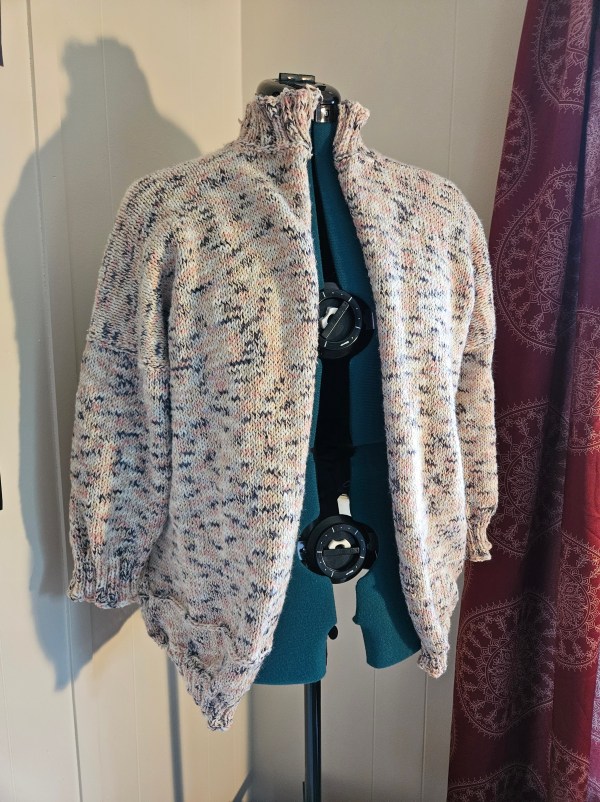
I received this yarn as a gift from my mom as she was de-stashing it. It has been a lovely weight to knit and I like how soft it is. My only notes for Lion Brand would be to work on the splitting. This yarn split often as I was knitting which caught on my needles and led to messy stitches. Either because my needle held on to the stitch below or the yarn split and left some of the stitch behind. It was frustrating at times but not impossible to work with. The fabric it made has a good breathability and warmth to it which I was looking for in a changing seasons layering piece. This is a self drafted pattern that I knit on US 7 straight needles.

Happy Fall everyone one! (And Happy Spring to the southern hemisphere!)

Create a website or blog at WordPress.com

Up ↑