

Tomatoes, Beets, Beans
Up from the ground, watch them grow
Decision Fatigue
The above poem was a bit of an homage to James May who ended each episode of his Amazon series Our Man in Japan with a Haiku. I’m not overly good at them but find them a joy to write. The point of that Haiku, and this post, is to discuss the difficult decision of choosing what seeds to buy and grow.
So Many Seeds!
In our previous gardening post, I covered the seed catalogs that we requested and reviewed the ones we ordered from – 7 of them. In total, we ordered 82 seed packets and got an additional 3 for free from Baker Creek. A rough estimate shows that the companies we ordered from are offering more than 5,800 seed varieties this year. So, we ordered less than 2 percent of the seeds we looked at. It’s a lot, and toward the end, all of the seeds sound the same.

Where to Start
The first thing Magz and I did when thinking about seeds was to figure out what types of vegetables we were interested in. We knew we wanted to grow tomatoes, cucumbers, sweet peppers, beets, potatoes, and carrots. We also have experience growing beans, corn, melons, peas, and pumpkins and wanted to give them another go. In the past, we grew all of these in containers and want the chance to grow them in a more traditional, in-ground garden.
There are also a lot of new seeds we’re going to try:
- This winter, we’ve remembered how much we enjoy eating broccoli and want to have it fresh throughout the summer.
- Aldi sells an avocado tomatillo green salsa that we’ve been buying for years and are going to try growing tomatillos.
- Similarly, ground cherries sound very tasty and, like tomatillos, are husk tomatoes.
- We love to cook Asian food and want to give different greens and cabbages a try. These include mustard greens, bok choy, and bunching onions.
- At the last minute, I noticed that Baker Creek sells Scotch Bonnet pepper seeds. Scotch Bonnet peppers are used in Caribbean jerk marinade and are tough to find in our local grocery stores. We’re going to grow those to give us an authentic flavor.
- Similar to Asian greens and cabbage, we’re going to give radishes and turnips a try. We have a great climate for these and both are healthy. Also, I think Animal Crossing (Stalk Market) and Stardew Valley may have influenced our decision.
- Finally, we get to squash. We have been eating a lot of green and yellow zucchini this winter, and both grow very well in our region (6A). We also like eggplant and are going to give a couple of winter squash varieties a go. These are similar to pumpkins but are technically squash.
Choosing What Varieties to Grow
Once you determine what vegetables you want to grow, you have to decide what varieties to grow. I’ll go over some of the decisions for each vegetable/plant as well as what seeds we purchased. I didn’t include radishes, turnips, Asian greens, or cabbages in this list because I’m not familiar enough with growing them to discuss the decisions you need to make when picking seeds.
Beans
Decisions to Make:
- Bush vs. Pole: This refers to how the bean plant grows. Bush plants have a bushy growing habit, staying compact and growing their beans in bunches. Pole beans, also known as runners, require trellising or another type of support that the plant’s vines will climb. Some varieties can climb 8-10 feet. Historically, Native Americans would grow their beans at the base of corn plants because the bean’s vines would climb the corn stalks.
- Snap vs. Shelling: Snap beans are typically eaten fresh or stored via canning, freezing, or pickling. Green beans are snap beans. Shelling beans are also called drying beans and are left on the vine for the pods to dry. Once dried, they are shelled, the beans are removed, and stored. Black beans, pinto beans, and navy beans are all of the drying variety. They need to be rehydrated before cooking and consuming.
- There is also edamame or soybeans. These grow similar to bush beans; however, you shouldn’t eat the shells.

What We Picked:
- Provider Green Beans – A variety that’s been around for five decades and is a staple in American gardens. We got ours from Pinetree Gardens.
- Red Swan Snap Bean – Another bush variety with a red pod and green beans inside. These came from Baker Creek but were bred by Robert Lobitz.
- Jamapa Dry Bean – A style of black bean used as a side dish with tacos or in Frijoles Negros. This seed is similar to the popular Black Turtle Beans but originates from Veracruz, Mexico. We got our seeds from Southern Exposure Seed Exchange.
- Kebarika Dry Bean – Another bush variety, this bean comes from Kenya. Produces a purple and white speckled bean. Can also be consumed fresh if picked in time. These also came from Southern Exposure.
- Chinese Red Noodle Long Bean – A Chinese heirloom that produces pods around 18 inches long. The plant has to be trellised as the vines can reach 8-10 feet. Bought from Baker Creek.
Beets
Decisions to Make:
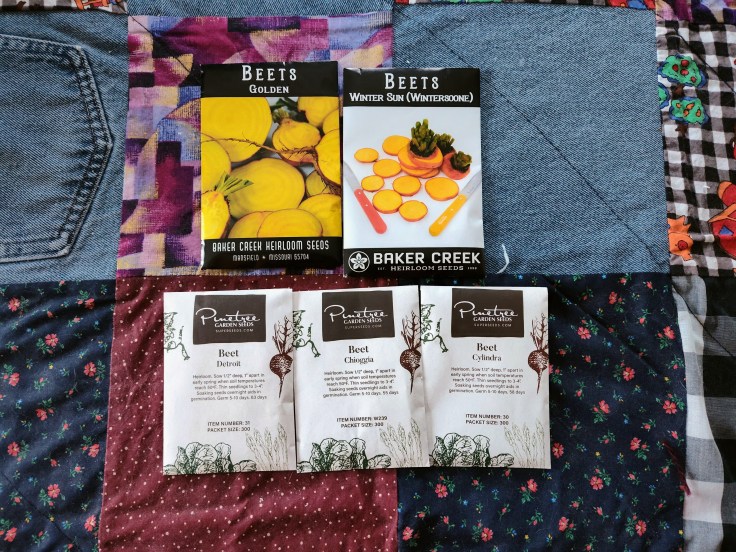
- Color: Red beets are the most common in the United States. They’re consumed fresh, cooked, and canned/pickled. Golden beets are typically more mild than red beets. White beets can either be albino versions of red beets or sugar beets, which are used to make beet sugar. Finally, there is a specialty beet called Chioggia, or candy striped. The root has alternating white and red stripes and is beautiful when sliced.
What We Picked:
- Chioggia – As mentioned above, this variety is also known as the candy-striped beet. It’s an Italian heirloom variety that dates back to the 1840s. We got our seeds from Pinetree Gardens.
- Cylindra – This variety has more of a carrot shape than the traditional globe shape of most beets. Their roots can reach 6-8 inches deep. A Danish heirloom that dates back to the late 19th century. Ours also came from Pinetree Gardens.
- Detroit Red – The Detroit Red is the most popular beet grown in the United States and is considered the standard for home gardeners. It can be eaten fresh, canned, and frozen. Once again, ours came from Pinetree Gardens.
- Golden – Similar to the Detroit Red but won’t stain your hands, clothing, counter, or cutting board. We bought ours from Baker Creek.
- Wintersonne – Also known as Winter Sun, this variety is a Swiss heirloom. It’s sweet and earthy but extra crunchy. This seed also came from Baker Creek.
Broccoli
Decisions to Make:
- Broccoli: I’m unsure if this deserves a more specific name, but by broccoli, I’m referring to the plant that produces green heads.
- Broccoli Raab: Spicier than regular broccoli and doesn’t form heads. Matures much quicker.

What We Picked:
- Calabrese – The Calabrese broccoli has a relatively compact plant and produces a 3-6 inch main head with multiple smaller side heads. It originates from Italy and arrived in America in the 1800s. Our seeds were purchased from Pinetree Gardens.
Carrots
Decisions to Make:
- Orange vs. Specialty Colors: We typically think of carrots as orange because that’s what’s in our grocery stores, and it’s what Bugs Bunny ate (side note: rabbits shouldn’t have a lot of carrots as they’re high in sugar). However, the first carrots were actually purple. If you’re looking for the traditional carrot, you can’t go wrong with orange, but if you’re interested in experimenting, growing purple, red, or yellow carrots can be a lot of fun. Non-orange carrots even have different nutritional benefits.
- Early vs. Main Season: Early season and main season correspond to how long it takes the carrot to reach maturity. Early-season carrots can take between 50 and 70 days to mature, grow fast, and tend to be shorter. These are great carrots for Northern gardens and in containers. Main-season carrots can take anywhere from 55 days all the way up to 100 days. These tend to have deep roots and store better. Grow some of both types and succession garden to have carrots all season.

What We Picked:
- Black Nebula – A deep purple main-season carrot that takes 70 days to mature. The roots grow to 6-8 inches in length and the color is so rich that it can be used as a dye. We bought ours from Pinetree Gardens.
- Bollin – An orange main-season carrot that takes 75 days to mature. Its roots also grow to 6-8 inches in length and have great storage properties. It matures about 20 days sooner than similar varieties. These seeds came from High Mowing Seeds.
- Dragon – A beautifully colorful carrot that is reddish-purple on the outside but orange inside. It takes 85 days to mature and grows 7-inch roots. These came from Pinetree Gardens.
- Little Finger – An early-season carrot that only grows to about 3 1/2 inches long and matures in 60 days. We’re planting it because it can be grown in succession and can be planted close together. These also came from Pinetree Gardens.
- Uzbek Golden – The Uzbek Golden carrot hails from Central Asia and is an important ingredient in making plov, one of the most famous dishes in the region. It’s golden in color and has a consistent shape that doesn’t taper like most carrots. Our seeds came from Baker Creek.
Corn
Decisions to Make:
- Sweet vs. Popcorn vs. Milling: Most home gardeners will grow sweet corn, but there are also popcorn and milling/flint varieties. Sweet corn is eaten fresh or preserved, popcorn is dried and popped, and milling corn is dried and ground for cornmeal or flour. There are also some ornamental varieties that are dried and used as decorations during the fall. Within the family of sweet corn, there are bi-color, yellow, and white kernels as well as different levels of sweetness. Traditional sweet corn is sweet but not overpowering, but we’ve since developed hybrid varieties that are super sweet.
- Stalk Height: This may seem like a weird category, but it is important depending on your garden’s location. Previously, we had some success with growing a shorter, 4-5 foot variety in containers. The roots took and the stalks grew, but they didn’t reach maximum height and the ears didn’t fill out as much as we would have liked. If you have a well-established garden with loose soil that is rich in nitrogen, you can grow corn with stalks greater than 7 feet tall. How much wind your garden receives also plays a role in how tall you want your stalks to be. If your area isn’t windy or you have a wind barrier such as sunflowers, a solid fence, or a building, you can have taller stalks than a garden with no protection.
- Kernel Color: Most sweet corn varieties fall into one of three categories: yellow, white, and bi-color (yellow & white); however, some heirloom varieties will have dark, blue/black kernels. Flint, popcorn, and ornamental varieties can be a wide range of colors, including blue, red, purple, orange, black, and brown. Heirloom varieties are incredibly colorful.

What We Picked:
- Hopi Blue – A flint/flour variety that is one of the oldest grown in North America. Early versions of it date back 800 years in Northern Arizona. The Hopis used it to make ceremonial bread. It has tall 9-foot stalks and grows 8-10 inch ears. We bought ours from Fedco, who pays Indigenous royalties on it.
- Black Iroquois, Mexican Sweet – This is the heirloom sweet variety referenced above in the kernel color section. The kernels are white for most of the growing process and turn black/blue late in the milk stage. It’s a shorter plant at 5 1/2 feet. The seed dates back to the 1860s in Upstate New York and likely originates from the Iroquois Black Puckers. Our seeds came from Southern Exposure.
- Butter and Sugar – A classic bi-color sweet corn, Butter and Sugar is one of the most popular seeds available. The stalks are 5-6 feet tall and the ears are 8 inches long. We bought ours from NE Seed.
Cucumbers
Decisions to Make:
- Bush vs. Vine: As discussed with beans, this has to do with the growing habit. Bush cucumber plants stay relatively contained and compact. They can grow a couple of feet tall and may need a stake for support but don’t sprawl. Vining cucumbers, on the other hand, do. Their vines can spread 7 feet out from the hill and take over entire sections of your garden. Bush plants tend to have smaller fruit than vining plants.
- Pickling vs. Slicing: This decision is pretty straightforward: Do you want your cucumbers to mostly be for fresh eating (slicing) or pickling. Pickling cukes tend to be crunchier than slicing cukes, but both types can be eaten fresh and pickled. To be safe, you should grow both and eat a lot of cucumbers.
- Specialty Cucumbers: These are cucumbers that either aren’t green in color, don’t have a traditional cucumber shape, or don’t taste like most cucumbers. I recommend growing these in addition to a pickling or slicing cucumber but not as a replacement.

What We Picked:
- Boston Pickling – An heirloom variety that dates back to the late 19th century. Grows on a vine and remains crunchy when pickled. Small enough to be pickled whole but can still be sliced into spears or chips. Ours came from Southern Exposure.
- Tendergreen – A slicing cucumber that is nearly a century old, Tendergreen grows on a vine. It can be harvested young for pickling or left to mature to be a slicer. It’s a burpless variety that doesn’t have the aftertaste of other cucumbers that some find off-putting. Our seeds came from NE Seed.
- Richmond Green Apple – A specialty that’s an heirloom from Australia. Harvested when it’s the size of a lemon and is green with white stripes like a watermelon. The texture is crispy like an apple. We’re very excited to grow this variety. Our seeds come from Baker Creek.
Melons
Decisions to Make:
- Picking a Type to Grow: There are a lot of fruits within the melon family, including cantaloupes, muskmelons, honeydew, watermelons, and varieties popular around the world that I’m uncertain how to categorize. As a side note, most of the fruit we call cantaloupes in the United States aren’t actually cantaloupes. They’re muskmelons. Muskmelon refers to the larger family of fruit, while cantaloupe refers to a single variety. Within each type of melon are a seemingly-endless number of seed varieties to pick from.
- Will it Grow Where You Live?: Most melons require hot temperatures and the right climate to fully mature. That’s why the majority of the watermelons we see in grocery stores are grown in Florida. The state’s climate and sandy soil make for a perfect environment. However, that doesn’t mean you can’t have success in other locations. Just take note of the temperature and soil requirements of a seed before purchasing. If you live in a Northern climate, you can also give the seeds a head start by starting them indoors.

What We Picked:
- Ali Baba Watermelon – This heirloom comes from the Middle East, with these seeds originally being sent from an Iraqi man over two decades ago. This seed produces fruit in the 12-30 pound range with a light green rind. They store exceptionally well and grow in a variety of conditions. Said to be one of the best-tasting watermelons. This seed came from Baker Creek.
- Noir des Carmes Cantaloupe – This is a true cantaloupe that dates back to before 1787 and was named for the Carmelite monks in France. Grows 2-3 pound fruits that transform greenish-black to orange and yellow when ripe. Bred to successfully grow in Northern climates. These seeds are organic and come from Southern Exposure.
- Tigger Melon – This melon doesn’t fit into a pre-existing category. It has a creamy white flesh with a fiery red and orange skin. Much smaller than other melons at only 1 pound but has high yields. It’s an Armenian heirloom that grows in mountainous valleys along the Tigris River. Our seeds were purchased from Baker Creek.
- Kajari Melon – Another melon that doesn’t really fit into a category, although it does have green flesh like honeydew. This Indian heirloom comes from the Punjab region and produces an abundance of 2-pound fruits that have orange and green-striped skin. These too come from Baker Creek.
Peas
Decisions to Make:
- Shell vs. Snow vs. Snap: Shelling peas should be removed from the shell prior to eating them. The shells aren’t toxic but fibrous and difficult to consume and digest. Snow peas are pods that are harvested while the peas are immature, so the pods remain flat. Snap peas have fully mature peas inside an edible pod.

What We Picked:
- Avalanche Snow Pea – These pods are 4-5 inches long on 3 to 3 1/2 foot plants. A very prolific variety that doesn’t require trellising. Our seeds come from High Mowing.
Peppers
Decisions to Make:
- Sweet vs. Hot: Do you like sweet or hot peppers? Sweet peppers are self-explanatory, but there are many levels of heat with hot peppers. At the low end are jalapenos that are used in salsas, eaten fresh, or stuffed, while at the upper end is Pepper X, the hottest pepper in the world. Personally, I like spicy food but want flavor, so I typically top out with habaneros or scotch bonnets. Keep in mind that peppers love hot weather, and the longer they can stay on the vine in hot weather, the sweeter or hotter they become.
- Shape of the Pepper: Sweet peppers tend to have the classic “bell” shape, but there are sweet peppers that have the shape of hot peppers.
- Color: Sweet bell peppers can come in a variety of colors with the most popular being green, yellow, orange, and red. There are also some exotic colors like purple, brown, and white. All bell peppers start green and mature into their final color the longer they’re on the vine. So, green bell peppers are more bitter than red ones. Even bell peppers that are bred to stay green when mature will eventually turn red if left on the plant for too long. Hot peppers also come in many colors. Jalapenos are green, wax peppers are yellow, and habaneros can be many colors.
What We Picked:
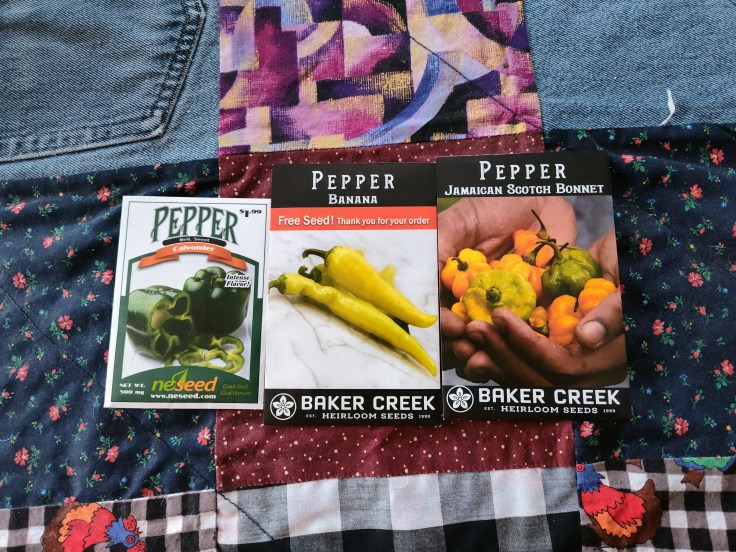
- California Wonder – A classic red bell pepper that has been bred to have strong disease resistance. Great when eaten fresh but also large enough to be stuffed. Our seeds were purchased from NE Seed.
- Jamaican Scotch Bonnet – Scotch bonnet peppers and seeds are not easy to find where we live. They’re a vital ingredient in Caribbean cooking, including Jamaican jerk marinade. While habaneros are often used as a substitute, they’re not authentic to the culture and cuisine. We found our seeds at Baker Creek and are from a Jamaican farmer.
- Banana – This seed was one of the free packets from Baker Creek. I love banana peppers, so we’ll definitely grow this seed. This variety of banana pepper is a sweet Hungarian wax with a pale green color that will develop into a red-orange if left on the plant. Despite its name, the Hungarian wax pepper originated in North America and was introduced to Central Europe in the 1500s.
Potatoes
Decisions to Make:
- Early vs. Mid vs. Late Season: This refers to how long it takes for the potatoes to grow and when they’ll be ready for harvesting. Early-season potatoes can take between 65 and 80 days, mid-season potatoes between 80 and 90, and late-season potatoes more than 90 days. Early potatoes are great for fresh eating, midseasons have some storage properties but are generally a quality all-around potato, and late potatoes do well in long-term storage and can last through winter.
- Color: Just like the potatoes you can buy in-store, you can buy seed potatoes for red-skin and yellow-skin potatoes. There are also purple-skinned potatoes, blue-skinned potatoes, and even potatoes with colorful flesh. Colorful potatoes are fun to grow, but the flavor isn’t different from white or yellow potatoes. They make for some interesting roasted potatoes or fries, but the color does leach out when placed in water.
What We Picked:
- Dark Red Noland – These are our early potatoes for this year’s garden. They are a red-skinned potato with white flesh and were bred to grow well in Northern climates. They were developed by the North Dakota Agricultural College in 1957. Our seed potatoes were purchased from High Mowing.
- Huckleberry Gold – A mid-season potato with a purple skin and yellow flesh, these potatoes are similar to Yukon Golds but are more resistant to tuber malfunctions and hollow heart. These seed potatoes were also bought from High Mowing.
- Red Pontiac – We bought these to be our late-season potatoes. They have a red skin and white flesh and have a history of producing large yields. They store very well and will keep long into winter. They were first introduced in 1945 and are named after Chief Pontiac, an Odawa tribe war chief from the 18th century. These seed potatoes were bought from Fedco and a portion of the money is given to a Wabanaki project in Maine via Indigenous royalties.
Squash
Decisions to Make:
- Summer vs. Winter: The most important decision to make when choosing squash seeds is summer vs. winter squash. Summer squash are green and yellow zucchini (yellow zucchini is often called yellow squash) and patty pans. I would also put eggplant in this category even though they aren’t technically squash. Winter squash varieties include acorn, butternut, buttercup, spaghetti, kabocha, and hubbard. Summer and winter refer to the time of the season when they’re harvested. Summer squash grow quickly (40-60 days) and are harvested before they’re fully mature, so their skin is still soft and edible. Winter squash, however, grow slower and fully ripen on the vine (80-100+ days). They develop a tough skin that is inedible but allows for the squash to store through winter in the right conditions. Pumpkins are also a type of winter squash.
- Use: Summer squash is used fresh and can be consumed raw. We typically use green and yellow zucchini Asian stir-fries or rice bowls, but a lot of people will marinade and grill them or batter and fry them. Zucchini bread is also very popular and eggplant is made into eggplant parmesan. Meanwhile, winter squashes typically have to be roasted to be soft enough to eat.
What We Picked:
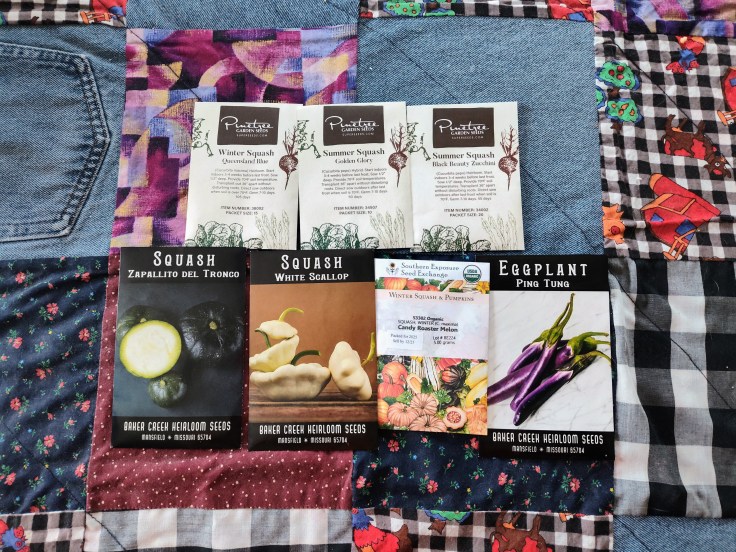
- Ping Tung Eggplant – These eggplants are from Taiwan and have a long, cylindrical shape rather than the bell shape of most eggplants. This variety is an heirloom that was first introduced to the U.S. in the mid-1900s. Our seeds came from Baker Creek.
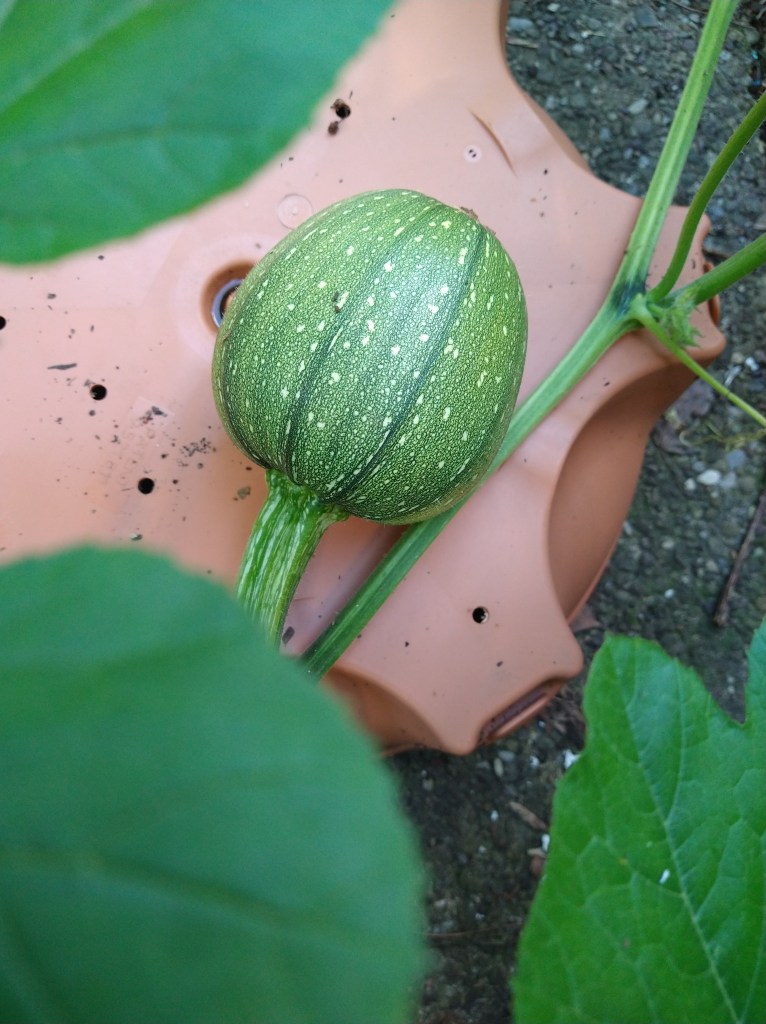
- Zapallito Del Tronco – A green squash that has the shape of a small pumpkin (roughly 2-4 inches in diameter), this squash is also referred to as an avocado squash due to its creamy texture. It’s an Argentinian heirloom. These seeds also came from Baker Creek.
- Candy Roaster Melon Winter Squash – Truly an American heirloom, this melon/squash was grown by the Cherokee people in Western North Carolina, and they shared the seeds with the Europeans who settled in the area. According to West Virginia University, there are 40 known varieties of this squash and 4 different shapes they can have. Our variety is pink and orange with some blue and green and has a pumpkin shape. The seed comes from Southern Exposure and is part of Slow Food USA’s Ark of Taste.
- Queensland Blue Winter Squash – A flattened round squash that can grow up to 20 pounds. A native of Australia that dates back to the 1880s, this seed arrived in the U.S. in the 1930s. The skin is a lovely blue color, but the flesh remains orange like a pumpkin. These seeds came from Pinetree Gardens.
- Golden Glory – A classic, straight variety of yellow zucchini. It grows fast at 50 days and produces lots of fruits 7-8 inches long. Our seeds came from Pinetree Gardens.
- Black Beauty Zucchini – Iconic zucchini shape and color with dark green skin and firm flesh. An heirloom variety that dates back to the 1920s, Black Beauty grows fast at 55 days with 5-6 inch fruits. Our seeds came from Pinetree Gardens.
- White Scallop – A scallop-shaped squash that grows fast at 50 days. A very old Native American heirloom with Europeans first depicting it as far back as the 1590s. An abundant crop that will produce a lot of fruit and has an excellent flavor profile. These seeds came from Baker Creek.
- Seminole Pumpkin – An heirloom pumpkin variety that dates back to the 1500s and was grown by the Seminole tribe in Florida. Grows extremely well in hot, humid conditions and will produce 6-8 inch fruits that can store up to 1 year at room temperature. Our seeds are organic and were purchased from Southern Exposure.
Tomatoes
Decisions to Make:
- What do you want to grow tomatoes for?: This question will determine what seeds you’ll want to grow. If you want to make sauce or tomato paste, you’ll want paste tomatoes. These tomatoes have fewer seeds and less water content than other tomatoes, producing a less watery sauce. If you want tomatoes for fresh eating, either as a snack or on salads, a cherry, grape, or pear tomato is your best option. These tomatoes are bite-sized and don’t need to be cut and grow abundantly. If you want a tomato that can be sliced for sandwiches, cut up for salads, or stuffed and grilled, you’ll want a larger, beefsteak tomato.
- Determinate vs. Indeterminate: Determinate tomato plants have been bred to only grow to a certain height and often produce all of their fruits at one time. Often, paste tomatoes are determinates because you want as much fruit at one time as possible for sauce purposes. These plants usually don’t require support and only a stake instead of a cage when they do. Indeterminates, however, can grow very tall and need a cage or other support system to hold them up. Which style you choose will often depend on how much room you have to grow them in. If you’re growing in containers, you’ll want determinate varieties, but if you have an in-ground garden, you can grow either type.
- Color: Do you like the traditional bright red tomato color do you want a rainbow of colors? Not many people are aware that they can buy yellow, orange, purple, blue, purple, and even green tomatoes. Growing a variety of colors can make for a beautiful garden.
What We Picked:
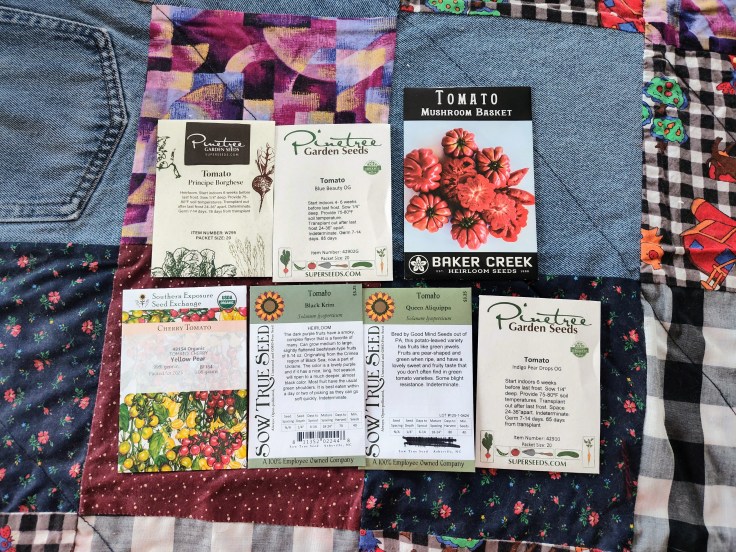
- Yellow Pear – An heirloom variety that dates back to before the 18th century. An indeterminate variety that produces a lot of fruit and is resistant to heat. Our seeds are organic and were purchased from Southern Exposure.
- Black Krim – An heirloom slicing tomato that originated in the Crimea region of Ukraine along the Black Sea. It’s an indeterminate variety that produces an abundance of dark purple, nearly black fruit that darken as they ripen. These seeds come from Sow True Seeds.
- Queen Aliquippa – Another heirloom variety, this time from Pennsylvania. It was named after Queen Aliquippa, a leader of the Seneca tribe in the 1700s. This variety stays green even when ripe. An indeterminate variety that produces pear-shaped fruits. These seeds were also purchased from Sow True Seeds.
- Indigo Pear Drop – A pear-shaped tomato with lots of orange fruit that ripen to have purple shoulders. An indeterminate variety from Pinetree Gardens.
- Principe Borghese – An Italian heirloom that can be used for pastes and sauces or left out for sun-dried tomatoes. This variety dates back to the early 20th century in Southern Italy. Our seeds come from Pinetree Gardens.
- Blue Beauty – A moderately-sized slicing tomato that ripens from red to dark purple. These were developed in the 1960s at Oregon State University. An indeterminate variety. These too came from Pinetree Gardens.
- Mushroom Basket – The only beefsteak-style tomato that we bought, the Mushroom Basket tomato originally came from Russia and was bred in the late 1800s. The Mushroom Basket has fewer seeds than most beefsteak tomatoes. Grows fast at 75 days. Indeterminate variety. These seeds came from Baker Creek.
Have you ever grown any of these seeds? If so, did you have success? We’d love to hear about the seeds you’re growing this year and what your favorites are.















 One Rabbit Riot