Conn’s Journal – Bringing a Dead Character to Life

Something I knew I wanted to capture in my novel Udal Cuain, was the deep world of lore that literary classics such as Lord of The Rings, the Hobbit, and Harry Potter present by creating books within books. Such as There and Back Again by Bilbo Baggins, Quidditch Through the Ages by Kennilworthy Whisp, or Fantastic Beasts and Where to Find Them by Newt Scamander. But it had to fit the world I had created in Udal Cuain with the type of literacy and availability of books, according to the time period.

I settled on a private journal that would make sense in the world of a Cheiftain living in Viking Age Ireland, that although Ancient Irish had a spoken language mostly, a brief written language of Ogham based on trees, they did have the influence of monasteries and with it written language and booking making availability. Especially if that Chieftain had studied with monks and was interested in cultures other than his own, a wanderlust and curious man, a recorder of history, both good and bad that could lead to secrets being recorded, that others did not want. A cause for his death? Perhaps! This was my jumping-off point for creating an active character in a story, where this character had already died.

In Media Res

Because I was a novel writing novice I wanted to be as slick and tricky as possible, at times writing myself into a corner by joining the story in media res, jumping into a story in the middle of the narrative without context. This left me with a problem, how do I tell the stories I need to tell without lengthy flashback scenes that may confuse the reader and muddy the plot?

Insert a lost journal. Found by a key character, with similarities to Conn. This character, who is one of the main characters, is named Kinvara. Kinvara is a misfit turned hero, through her pure spirit, she is chosen by the faeries to be their advocate and right the wrongs of her fellow clan. It is she who finds the journal after Conn’s death when she is in exile on Searbh for treason against the reigning Tearlag, widow of Conn. Kinvara desires to understand why her family and their allies were driven from home to this island, and why her parents would align themselves with Riordan and Saoirse, the ones accused of treason by Tearlag when they seem to be such bad people.

Kinvara like Conn, observes people, and so by choosing her as the character to find the journal, it is like we get to experience Conn in these situations and resolved a problem I did not anticipate – How do I make Conn a relatable character when he’s dead? How do I make the reader see his side? By making Kinvara a foil of Conn, her experience with the secrets she discovers inside Conn’s Journal allows the reader to understand who he was. How Kinvara reacts to the information both shows her value system and Conn’s and allows Kinvara to be a fly on the wall of events that apply to her but gives her the knowledge of such information that would not be available to her character otherwise.

It eliminated for me, the need to create an omniscient narrator. Something I wasn’t interested in.

Sowing Seeds of Story

Now came the task of integrating the two. How should this book, Conn’s Journal be presented in the story of Udal Cuain?

I pondered if it should be in reference only, or maybe a separate book? But that felt like I was putting a burden on the reader to seek this out when I didn’t know if anyone would care enough to do so. I don’t have a writing pedigree to fall back on, I’m an unknown writer that may not be engaging or worthy of devoting so much time to, so I thought about how to make the journal part of the chapters.

Integrating the pieces of Conn’s Journal into the chapters seemed like the most efficient option for the reader, if it exists in the story without requiring the reader to look up an additional source, I believed the reader would be more engaged, and more likely to read Conn’s Journal. This was a great strategy, I believe because this opened a new framework to chapters. If I wanted to reveal something from the past, instead of having the characters talk about it, I could paint a whole scene with action and foreshadowing, so that it was like the reader was reading Conn’s Journal like Kinvara and experiencing the story from her perspective, but also Conn’s perspective.

This plan provided a great opportunity to reveal more about the secretive O’Connors and fact-check what son Riordan, daughter-in-law Saoirse, and wife Tearlag were presenting to the characters in the story and telling the reader. It allowed me the chance to experiment with unreliable narrators, which was a lot of fun, and use the tool of dramatic irony.

Because of the seasonal framework, I discussed before in Ancient Irish Calendar, I had a concise way to show the reader when Conn’s Journal took place. His entries could be dated and set in a specific season or month that could be referenced before or later on, like a hyperlink. But, this could be more layered, Conn may have written about an event in his early life that was set in the calendar framework, and I could demonstrate when Conn did this writing later in life with an entry dated so that the reader could feel like Conn was a three-dimensional character. Just as in life, I wanted my characters to feel human and humans have memories triggered by events that are extremely personal in nature. We connect the dots in our own way, and I wanted Conn’s character to have the chance to tell his own story.

Thank you reader for allowing me to muse and reflect on this work with you. I truly miss the story within the story I created with Conn. What do you think about this writing technique? Would you apply it to your own work? Do you enjoy when authors employ in media res, dramatic irony, or books written by their characters? Should dead characters stay dead? It’s a lot to ponder.


Breakfast Table Wisdom

Q: Do you have a quote you live your life by or think of often?

A: PROVERBS 3:5-6

At the breakfast table, on my placemat next to a bowl of cereal and a glass of juice, Papa would leave half a banana. I’m not sure when this tradition started but each morning, he would split a banana with me. He was always willing to share anything he had with me, including wisdom.

By the time I wandered downstairs, sleepy-eyed and wishing it was still night, my chipper, morning-person Papa would be done with his breakfast and reading the paper. Waiting for me. Never waiting in impatience, waiting in such a warm and mentoring way. He wanted to know what was on my mind, was there a test at school that day to pray for or an event with friends that I was looking forward to? He took the job of raising me, as a substitute dad very seriously.

Around that breakfast table, Papa would prepare me for the day ahead not just with food but with cultivating a wise mindset. Before he ate breakfast, while I was still sleeping, he and Grandma would do their morning Bible study together. It was a ritual that as an adult my husband and I try to emulate. It was from this time with the Lord that I understand how Papa had so much wisdom to pour into me at those breakfast chats.

Lean Not, On Your Own Understanding

A verse that has become my favorite, a nugget of wisdom that I seek to live by, is Proverbs 3:5-6. It was a verse that came up often at those morning meals, so much so that I memorized the verses simply by hearing this piece of wisdom over and over throughout the years.

As a child, I absorbed it but did not understand it. As a teen I scoffed at it, in college I ignored it, and as a floundering young adult, I clung to it.

“Trust in the Lord with all your heart and lean not on your own understanding; in all your ways submit to Him and He will make your paths straight.” Proverbs 3:5-6 NIV

I thought it was just a bunch of rules, another way to feel like I had no agency in my life and so as a hubris-filled teen I didn’t want to submit my way to God’s way. “I am the master of my fate,  I am the captain of my soul.” William Earnest Henley writes in his poem, Invictus. As young people, I think we are so keen to believe the world stretches out before us. We are told that by media, secular books, and movies. I think we believe it because it makes us feel powerful and less overwhelmed by the future that awaits us. Because we don’t know the future, we can only guess what tomorrow will bring. We are not in control at all. And when the world knocks you down, and changes the path you chose to a path that fails you, being the master of your fate rings hollow.

The illusion of being in control makes you realize how small you really are. The individualistic culture of the United States sells you a false promise of control that living for yourself and pursuing what’s best for you above all will bring you ultimate happiness. It directly contradicts what Papa was teaching me with our morning chats, and pulled me into a path that was not straight, but twisty and shadowed. As a chronic overthinker, Proverbs 3:5-6 didn’t appear to me as the safer option because in its message it challenges you to drop your worries at the feet of the Lord and rely on Him to give you directions on where you should go.

As an overthinker, the process calms me down not the result, thinking and obsessing about what to do next keeps my mind busy, and so I misbelieve this is the way to peace. When indeed, as someone who now strives to live according to Proverbs 3:5-6, the cycle of overthinking is just a distraction. It is not peaceful or profitable.

Don’t Try to Figure Everything Out

What has made me feel strong in those weak moments has surprisingly enough been submitting to the Lord and not leaning on my own understanding; because I learned over a string of mistakes that my understanding is flawed. I’ve learned that I play a short game while God is playing the long one. He is playing chess while I’m playing checkers. I simply cannot perceive all He has in store for me. And unless I get out of God’s way and let Him lead me, I’m going to miss out on His will and His process, like being at peace in the middle of uncertainty.

My grandma, like me, was an overthinker, at times a bit of a control freak like myself. She struggled with submitting her concerns and desires to God, but when should tell me about her struggles she would bring up Proverbs 3:5-6 and I believe she was reminding me as much as she was reminding herself. Papa was a worrier, which I struggle with. I see now that He was probably passing this verse down to me because He could see my penchant to worry and wanted to give me a tool to thrive when worry washed over me.

At the time, I thought He was just putting a challenge in front of me, but now I see he was instilling godly wisdom around that breakfast table. I see now that as much as Proverbs 3:5-6 was for being brought up for me at those breakfast chats, it was a reminder for Grandma and Papa too. When the time came to learn how to keep living without Papa, Grandma and I clung to Proverbs 3:5-6. I even have a few voicemails from her reminding herself and myself not to try to figure everything out but to lean on the Lord for guidance.

Now that she is gone too, I have wondered who is going to remind me? When I am feeling stuck, wishing I could ask either Papa or Grandma for advice, I have worried about who will keep me directed on the right path in those key moments? Ironically enough, I am forgetting who said those words of Proverbs 3:5-6 in the first place. The Lord. And the Lord has reminded me when I am stuck. He replays His words of wisdom in my mind. Because He is such a comforting and loving God He reminds me in such a dear way. I hear Papa’s wisdom at the breakfast table, and Grandma’s reminders when it gets tough, the memories of their voices saying to rely on the Lord for He will make your paths straight.

This is why I live by this quote. What quote do you live by? Did a mentor instill in you, wisdom that you still rely on today? Have you had the chance to mentor and pass wisdom down to others?

Kindness in the Culture

I felt challenged by the Lord in 2023 to get to know the unknown parts of His word. The sections of the Bible make us say, “Is that a book of the Bible?” At least in North America, the minor prophets of the Old Testament, are a group that are skipped over for sermons. You don’t get fed from this book, instead, sermons seem to focus on the “seeker-friendly” sections of the Bible, the gospels, and some New Testament epistles for good measure.

I don’t mean to sound cynical but I went to a Christian school, and a Christian college, and have been in the church for most of my life – that’s a lot of opportunity to have learned about the entire Bible, but the whole book wasn’t taught. This frustrates me. I don’t feel properly prepared for a complete reading of the Bible, and I’m sure I’m not the only one who feels this way. Which posed a problem when I decided to read Obadiah, mainly what does this book mean? What does this story refer to? And who is Edom?!

Thankfully resources like the Bible Project exist! They have a terrific guide to the Book of Obadiah along with a video summary that provided historical context that helped me understand why this book matters. Here’s what God revealed to me through my reading and study of the book.

In short, Obadiah addresses a shameful part of human behavior, yet it is something we have all experienced – when a prideful person hurts someone who is struggling, because the proud person believes they are better than the struggling person, and therefore takes advantage of that person for their own gain. Exploiting your opponent’s weakness, in strategic terms. In a social and economic context, this would be corruption and discrimination being used to exploit a group of people who have been kept from opportunities. In a personal context, hurting your neighbor instead of helping them or reveling in the pain of others because you believe you are better than them. Obadiah applies to life!

The book of Obadiah says a lot in just twenty-one verses. It is full of family history and dysfunction! The people of Judah and the people of Edom share a common relative – Isaac, the son of Abraham and Sarah. For this story, you have to go all the way back to Genesis 25-27. Isaac and Rebekah had two sons, Jacob and Esau. There is major sibling rivalry, ending in bitterness, family dysfunction and Jacob being favored over Esau because Esau traded his birthright blessing for a bowl of soup. Esau’s anger towards Jacob does not end there. Jacob becomes the nation of Israel and Esau’s descendants become the nation of Edom, their bitterness for each other carries on through generations.

Hundreds of years later, the Israelites are conquered by Assyria and Babylon. Israel the Northern Kingdom is destroyed and taken into exile by Assyria, and Judah the Southern Kingdom is conquered by Babylon and taken into exile. When Babylon comes to conquer Judah, Edom in their resentment for Judah sees this as a time to celebrate the destruction of their brother and gets a few punches in for themselves.

While Judah is being rampaged and the people are being killed or carried off in chains, the people of Edom decided to get a little gloating in. They come to the land of Judah and do some pillaging of their own, they celebrate the destruction and even take advantage of Judah’s refugees, going so far as to kill them.

Not a pretty legacy for Edom, but before we judge, how often have we as humans celebrated someone else’s misfortunes? Especially in the age of social media, how easy is it to join the hater bandwagon? I mean it’s just a comment, right? It’s anonymous, it doesn’t mean anything, it’s not hurting anyone – or is it? What about in our day-to-day lives? I’ve been jealous, and guilty of finding joy in the struggle of others when I believe they have wronged me. It’s human nature and is so easy to do. Even easy to hide from others because if it is an internal thought, who is going to know? Obadiah reminds us that God does see it and He does know.

I thought about this today as I learned about the Tik-Tok “baseball mean girls” trend that involves photo bombing a person taking a selfie at a baseball game so that you are flipping them off in the background. It’s just plain rude and reminds me of what I read in Obadiah. I think we could make a huge difference in our culture with simple actions like pausing to think through our actions. Is flipping someone off in the background of a photo a kind thing to do? Obviously no. Is there a better way to handle yourself? Yes. But do we all make the right choices all the time, no we do not and we take jokes too far. We hurt people.

But do not gloat over the day of your brother
    in the day of his misfortune;
do not rejoice over the people of Judah
    in the day of their ruin;
do not boast
    in the day of distress.
Do not enter the gate of my people
    in the day of their calamity;
do not gloat over his disaster
    in the day of his calamity;
do not loot his wealth
    in the day of his calamity.
 Do not stand at the crossroads
    to cut off his fugitives;
do not hand over his survivors
    in the day of distress.

Obadiah 12-14 ESV

So, what do we do with that? I mean I feel guilty for the personal ways I have hurt people. Even worse I have held onto grudges. I am ashamed to see myself in the reflection of Edom. In verse 15, the tone changes from Obadiah referencing Edom to all nations, “For the day of the Lord is near upon all the nations. As you have done, it shall be done to you; your deeds shall return on your own head.” Yikes! That is scary to think about. I don’t want people to treat me the way I have treated them. I used to have a bad temper, and it hurt people. Feeling the return on that would be horrible. So, how do you move forward without fear or guilt?

What I have found the most peace in is asking God for forgiveness and changing my attitude, especially in the ways I handle grudges. Seek kindness. Be different than the aggression that you see in the world, and forgive others who fail at keeping their bad behavior in check. I am currently on a journey to learning how to forgive – it is not easy. All of it is God, I just have to ask for His help to show me. It can sometimes feel unnatural to our human minds to forgive, but it is freeing. Oh so freeing.

To unpack verse 15 a bit more, I found hope in reading this verse. I thought about all the evil in this world. The ways people are taken advantage of systematically. I thought about racism, human trafficking, colonialism, genocide, dictators, and censorship. In this world of AI and big brother surveillance, big tech companies seem like behemoths above the law. Yet it all comes crashing down when you read verse 15. God sees it. God knows what is happening in the shadows and His justice will hold it accountable in His time. Evil deeds will not slip through the cracks forever.

The more I read the backstory of Obadiah, the more I wondered what would happen if the whole Bible was being taught? I considered the ways in which the church has allowed itself to be corrupted by the culture and what would happen if the health and wealth gospel was laid to rest and the wisdom of these unknown books like Obadiah colored our understanding of Christianity instead of prosperity. It is something to think about.

If you made it this far, thank you for allowing me to share what God revealed to me through my study of Obadiah. I hope you have a lovely day. ❤

#20 – A Beethoven Milestone

When I moved to coastal Georgia, it was a big, unknown kind of step. New family, new culture, new job description, new kind of humidity I’d only heard of. It was disorienting at times, exhilarating at others. Yet it made me perceive what really made me feel at home. I realized it was a piano. No really, a piano.

Life of a Piano Teacher’s Kid

When I was very little my mom and I moved in with my grandparents, at the time my grandma was a full-time piano teacher. My grandma’s living room had not one but two pianos – an upright piano and a grand piano. Due to wear and tear, the two consolidated down to one new grand piano that filled the house with music from 6:00 am to 6:00 pm during the week. My breakfast routine included the broken melodies of piano lessons and a bowl of cereal. At the time, I would grow tired of the piano music, but as an adult, I look back on those days with fondness.

Something that I think is interesting, is that before I left for Georgia, my grandma gave me my old piano lesson books that she kept from my failed lessons in 2nd grade. I thought that was really sweet, and I think a bit of comfort from the Lord because I did not anticipate how hard homesickness was going to hit 6 weeks into my new life. I was all settled into a nice apartment and little community, a new church, and a new side of the family to hang out with, yet bam I was thrown into this wave of sadness.

I felt like part of me was missing. For some reason, those piano lessons came to my mind and, all I wanted was to hear the piano music again.

I would say before this point I appreciated classical music but it wasn’t a regular rotation within my Spotify profile, it then became my comfort music with Claire Hwangci’s Rachmaninoff Preludes album being one of my favorites. My grandma used to play Rachmaninoff, Chopin, Brahms, and Beethoven. Moonlight Sonata was one of her favorites. Since then I’ve been determined to learn piano, one day. The problem was the keyboard I had access to was pretty busted, with a whole octave not registering noise when I tried to play.

Grandma encouraged me to keep going even if my keyboard was not great, she was thrilled that I felt the call back to music lessons.

We eventually moved back to Pennsylvania, and as the ebb and flow of my time changed, I had a lot more time to practice in my new routine. The problem was I lacked discipline and was a lazy student. Instead of seeking to learn musical theory again, I went to my Pinterest and YouTube feed, to find quick learning techniques. Watered down piano guides and on Pinterest, I literally found pins that were just the notes in sequence. I learned a watered-down version of Hedwig’s Theme, The Phantom of the Opera Overture, and Jurassic Park. It was a good way to gain quick satisfaction, and it was a blast to hear the piano music again.

It filled my heart a bit fuller again when I felt empty.

The Yamaha P-45

Fast forward to 2023, I had let the broken keyboard go and was keeping my eye out for a used free piano on Craigslist, but truly my current rental is too small to accommodate such an instrument. But something really cool happened, Kyle found a music shop nearby and encouraged us to go. He was on the hunt for an electric guitar. The music shop was incredible. It smelled like all the piano shops I had gone to with my grandma as a kid. A flood of memories came back, warmth deep in my heart. With great surprise, they carried something that would make me feel reconnected with my past – a digital piano with weighted keys that felt the same as my grandma’s grand piano!

Since she passed away in December 2022, I’ve felt a bigger emptiness in my heart. A vast homesickness that can’t be solved until I move on from this world. But, when I put my hand on those keys, the expanse felt a bit smaller. Have you ever felt that way? It’s this pure bliss of memory that is like a big hug to your weary heart.

There is one elephant in the room, pianos even digital ones are quite expensive.

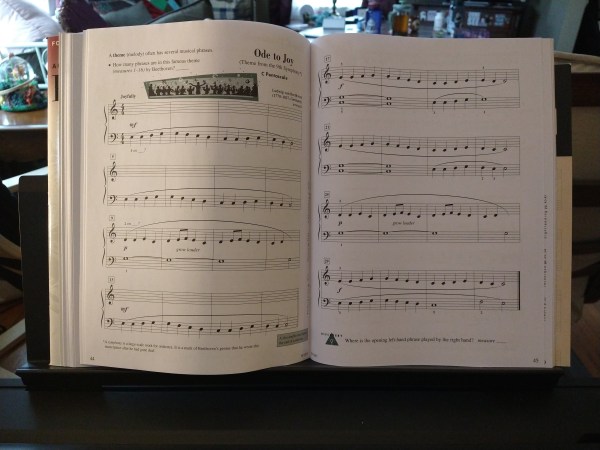
Like, it’s not an impulse purchase. But that is where another principal comes in – delayed gratification. Over several months and previous months of careful saving, we were able to purchase the digital piano and stand. Through the process of waiting, saving, and dreaming, I was primed and ready to dive in and be a committed student. This was not going to be a repeat of my previous tries, I even bought a piano theory book!

To my surprise, all those mornings of eating breakfast to the accompaniment of piano lessons, some of those lessons stuck.

The book is teaching me musical theory, treble and bass clef, and how to read music – the foundation. And the foundation is jogging my memory to all the little techniques my grandma used. How to navigate the guide notes, how to skip thirds, and to make sure to not play by ear but truly understand the technique of what I am doing, and have good form with my fingers. Although sometimes I get sad that she doesn’t get to know this part of me, through my memories, I feel as though I am still getting to do this with her.

Crescendo

Sunday I felt the peak of my piano success, a real milestone. I have been diligently playing through my lesson book, learning and repeating the instructional songs, even if I feel like I know them. I want to remember and have the skills not hubris. And so, to begin my lesson I went back a few pages, as I do. I played through the French Minuet sample, a bit of Mozart samples, onto Home on the Range, through a taste of bass clef practice. Moving to the understanding of C Pentascale, on to let’s play hands together up to a bigger octave. I am so engrossed in my lesson that I begin to play a familiar tune without stopping to see what it was. I moved on to this song, not thinking much of it because I’m learning here, really getting it and somehow I am playing hands together! With a rhythm and respect to the time signature, who are these hands? But my hands, are uncoordinated and frustrating! They don’t do this, right?

I feel the same thrill that came when I drove our standard transmission for the first time in top gear. It feels good.

Then I stopped to notice, hey, this is my first Beethoven piece.

A simplified version of Beethoven’s Symphony No. 9, Ode to Joy or the Hymn ‘Joyful, Joyful, We Adore Thee’ depending on your context. What a milestone! I wanted to learn how to play the piano, with theory and discipline, and learn not a popular tune but a classic. In that moment I understood why good things take time. It is a craft. It cannot be rushed.

I look forward to my next piano milestone!

Sewing the 1890s Aesthetic

Red Dead Redemption 2 was not a game I thought I would love or even appreciate. In fact, I’ve never played it myself, I’ve only watched my husband play, and seriously, I enjoy watching him play. The world created in the second game is so immersive and aesthetically pleasing that my dress historian heart sings when I see the detail and research the developers put into making Arthur Morgan and the cast of characters feel well-placed in a game of re-imagined history.

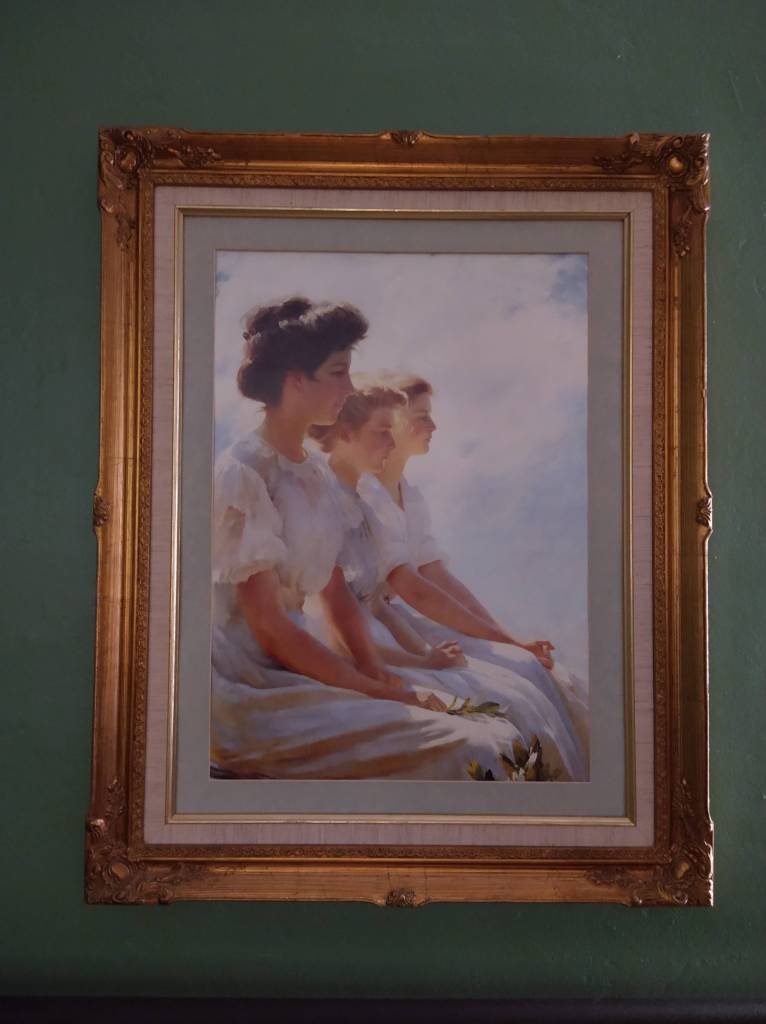
The 1890s have long been a favored period for me. From the popularity of the Gibson Girl look to the Anne of Green Gables movies, puff sleeves, bicycle jackets, and the pigeon breast silhouette with long walking skirts have long captured my imagination. Maybe it was the years of seeing these portraits of my 1890s ancestors above the mantel at my grandparents’ house. Or this Gibson Girl-inspired painting in my Grandma’s bedroom. It made an impact on my appreciation for this time period and design aesthetic.

There is such a quintessential Victorian-ness about it. But also this aura of possibility. The world was changing rapidly during this time through industrialization the Gilded Age brought splendor and wonder. The Arts and Crafts Movement was at its height which is why I think I am so drawn to this style. Arts and Crafts era houses are among my favorite styles of architecture, bringing forth the Craftsman style along with Frank Lloyd Wright’s prairie style. Maybe it was growing up in an old Victorian house too?

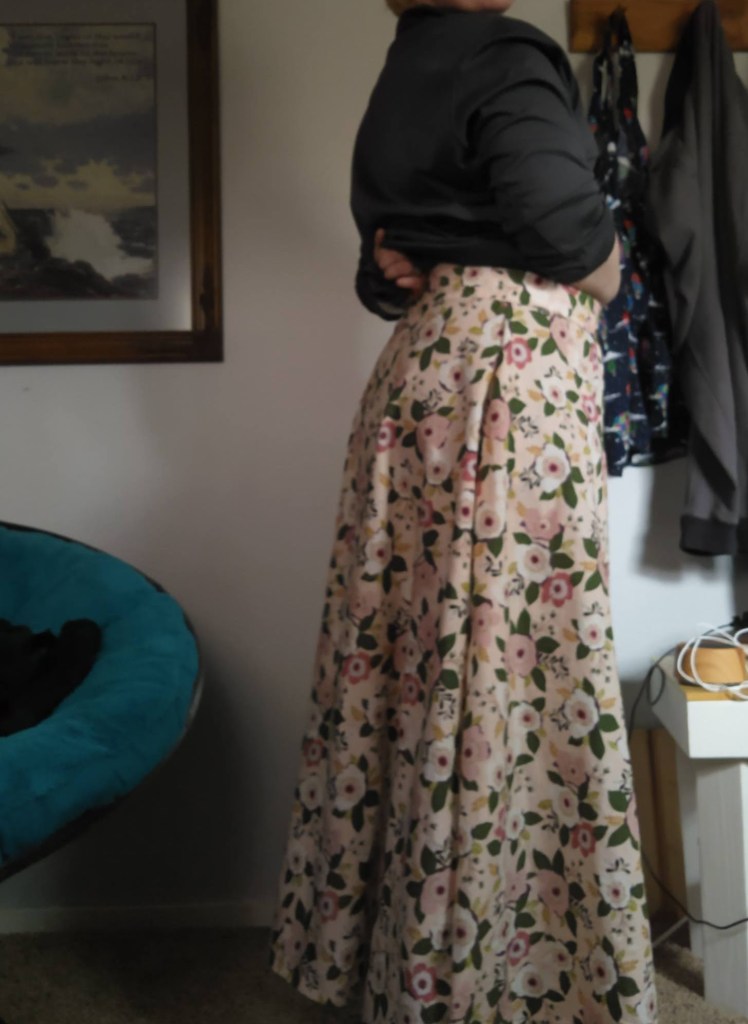
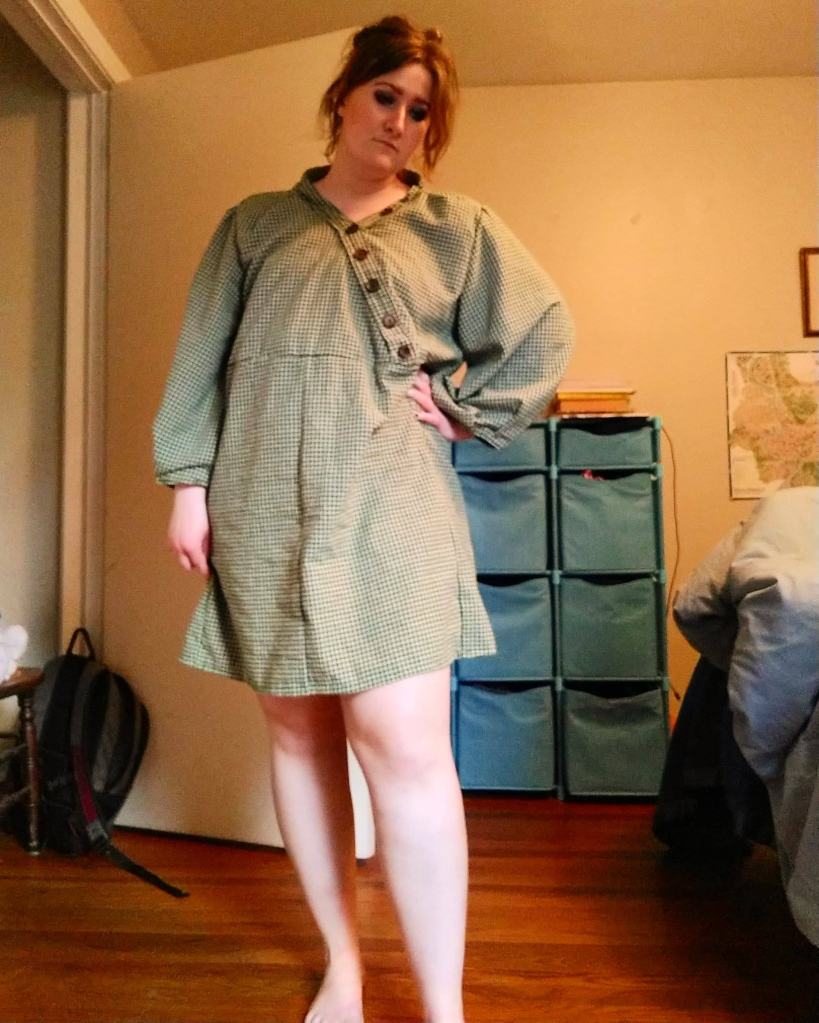
And so this game, Red Dead Redemption 2 with its 1899 time stamp and varied styles of architecture has brought me so much joy and comfort. Even the Bayou Nwa of Lemoyne is a delightful reminder of my time living in coastal Georgia. Especially the alligators, which seemed to lurk in every body of water. But those cypress trees still call, like the delightful menswear of Arthur Morgan’s wardrobe, and the wonderfully decorated towns of St. Denis, Strawberry, Rhodes, Valentine, Annesburg, and Blackwater. And so I find myself sewing Arthur Morgan-inspired pieces, for both myself and my husband. Who knows where inspiration will find you? I certainly didn’t think a Rockstar-developed video game would bring me such joy and fashion design inspiration. But it truly shows that inspiration is everywhere if you take the time to appreciate it.

L to R: 1890s long underwear-inspired dress, Vest with high neck in the 1890s tailoring style, Exaggerated 1890s menswear stripe pants

ATEEZ’s Don’t Stop M/V is a Masterpiece

My first comeback experience for the South Korean boy band ATEEZ was for their single Don’t Stop. I gave their music a try thanks to the recommendation of Katie from Steal the Spotlight. What was at the time a random song pick, has become a piece of fashion inspiration that I could watch on repeat and my journey to becoming a new member of Atiny.

Ateez debuted on October 24, 2018, with the song ‘Pirate King’ and incorporated the pirate aesthetic into their lightstick, insignias, and this video, ‘Don’t Stop’. I love the pirate aesthetic, with The Pirates of the Caribbean series being one of my favorites for costume design. In the music video ‘Don’t Stop’ the pirate aesthetic is mixed with an Ocean’s Eleven style heist framework making this a perfect match for me!

Pirates on a Quest for Redemption

The scene begins with a beaten and bruised Mingi being thrown from a car that later blows up. Cut to Hongjoong, seated at a grand piano in a pirate-esque coat with a compass insignia looking at a pirate ship model, with the implication of loss and frustration.

In the shadow of night, we meet Seonghwa, Jongho, Yeosang, and Yunho as they break into a pawn shop. This is no ordinary pawn shop but one containing a pirate-style sword and a skull. In pure Ocean’s Eleven style, they break into the vault of I assume the guys who took Mingi to retrieve the title for their pirate ship. I believe Yunho wears the jacket with a skeleton motif, evoking to me the skull and crossbones of a pirate flag but also the ghost pirates of ‘The Curse of the Black Pearl.’

Meanwhile, Wooyoung and San try to take the baddies in a rigged poker game for their spyglass.

Things begin to turn, from the ashes of the blown-up car, Mingi finds a compass that matches the patch on Hongjoong’s coat.

In a fit of despair, Hongjoong, aka the Captain, throws an oil lantern off the piano he stands on, next to the pirate ship, and it looks as though he is going down with the ship in a sea of fire. It’s a visually stunning image. Instead, he throws the small pirate ship into the flames that have consumed the piano. The ship shatters, sending an ember upwards into his eye. In spite of the destruction, within the flames and remains of the tiny ship, a skeleton key is seen at the feet of Hongjoong.

The video culminates with Mingi being picked up by Seonghwa, Jongho, Yeosang, and Yunho in an armored car with a pirate king hood ornament reminiscent of the siren on the bow of a pirate ship. San and Wooyoung, winners of the game go to claim their prize but not before the gang seizes the spyglass. At this moment the armored car erupts through the wall to save San and Wooyoung.

When we see Hoongjoong next, he takes his full form as the pirate king with an eye patch. He stumbles down an empty road, in the distance from where he came smoke billows upward. As darkness falls, the crew reunites with Hongjoong to reveal their bounty – the compass, the title to the ship, the looking glass, and a bag full of cash. The video ends with all eight members, changed to pirate-inspired garb, walking towards the camera, past the camera, in search of something bigger. In the distance we see beached on a desert dune, the stern of their pirate ship.

The Fashion is Rich in Details

There are a lot of looks I would like to recreate from this video. By far the standout piece for me is the yellow plaid pants with faux skirt worn by Mingi. They are like punk plaid pants mixed with a kilt in the best way possible. I hope to figure out the pattern someday so that I can sew my own version. Seriously, why is this not a style seen on the runway or the street? It’s such a versatile statement piece.

The lapels, length, and overall cut of Hongjoong’s pirate coat is such a classic outerwear silhouette but with the twist of the graphic print and edgy styling, it looks like a brand-new kind of coat. Because of how much work goes into the tailoring process of making an outerwear garment I love seeing how the right styling can make a piece even more wearable.

San’s sweater with the axe motif and color-blocked sleeves is one of the most unique sweaters I have seen. I hope as my knitting skills improve I can attempt to make a sweater using the techniques and make my own version of his look at the poker game.

Yunho’s skeleton-inspired letterman jacket would be such a great thrift flip. As a girl who grew up with the Pirates of the Caribbean franchise and the “rawr” aesthetic of ‘scene’ being quite popular in my teen years, I have an appreciation for skulls. I even have an Alexander McQueen skull scarf that I think would fit perfectly in the music video.

San and Wooyoung’s final looks of the video shine for me as the pirate core aesthetic has emerged in 2022/2023. It is such a clean and modern interpretation of the romanticized pirate style this aesthetic celebrates. San’s vest to me evokes those little details of the Spanish galleon. The vertical lacing looks like bones from a Jolly Roger flag. The criss-cross lacing evokes the stays and early corsetry of the pirate era and the rigging of the sails.

Wooyoung’s half vest looks like a piece of armor, reminiscent of a holster, but it also bridges the gap between East Asian pirates and Western pirates of the Atlantic. The lacing on his shoulder adds the subtle detail of the classic men’s shirt of the period worn by Western pirates. I also enjoy the contrast of the white shirt, like a sail, and the black of the half vest, like the black flag being raised for an attack.

All in all, I love the fantasy of this music video. Fashion and music can bring out the best in each other when there is a clear vision. The stylist for Ateez continually inspires me to push my own style further and excites me for the day when I can construct garments with the level of care that is seen on the band members.

Create a website or blog at WordPress.com

Up ↑